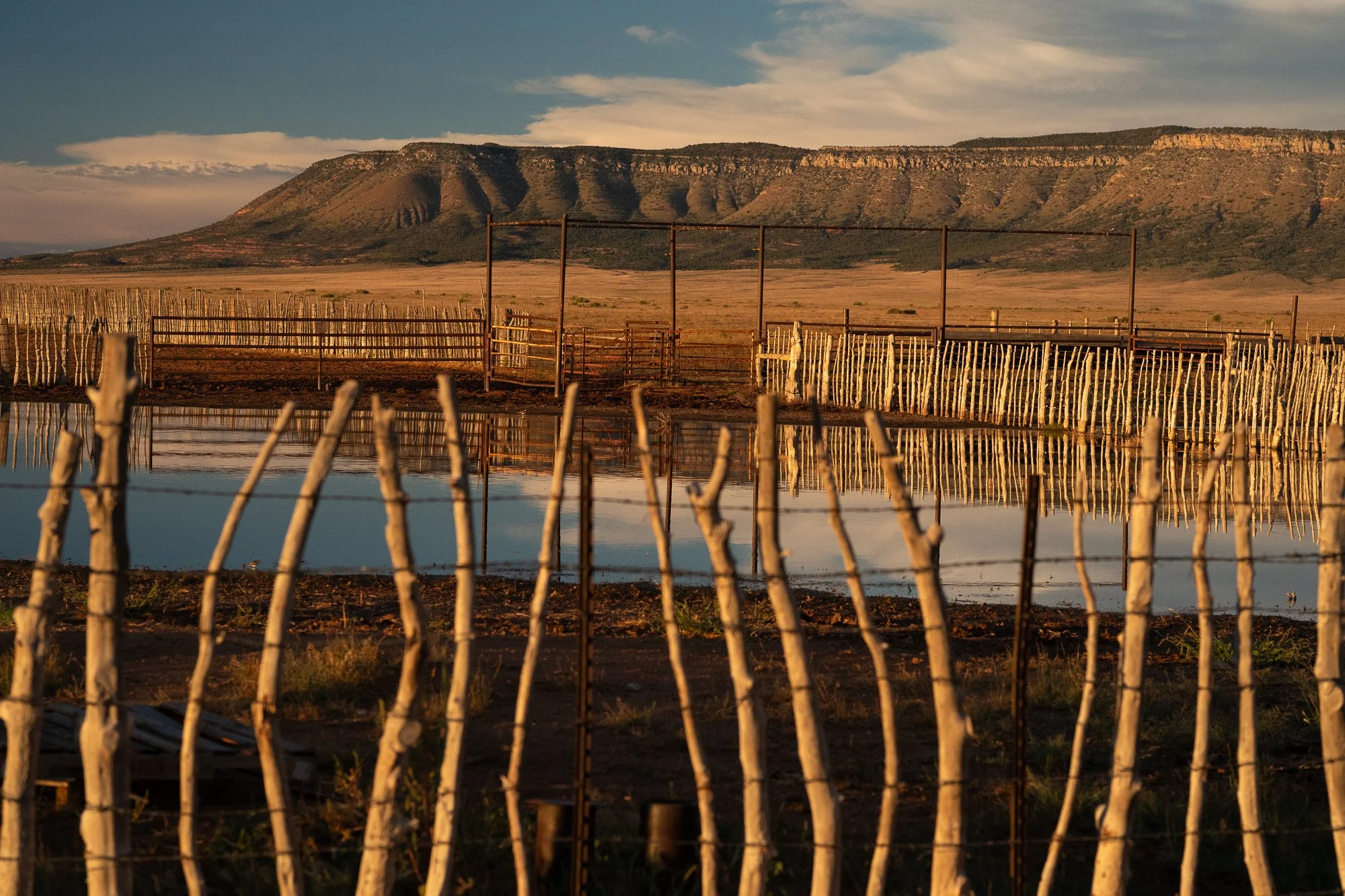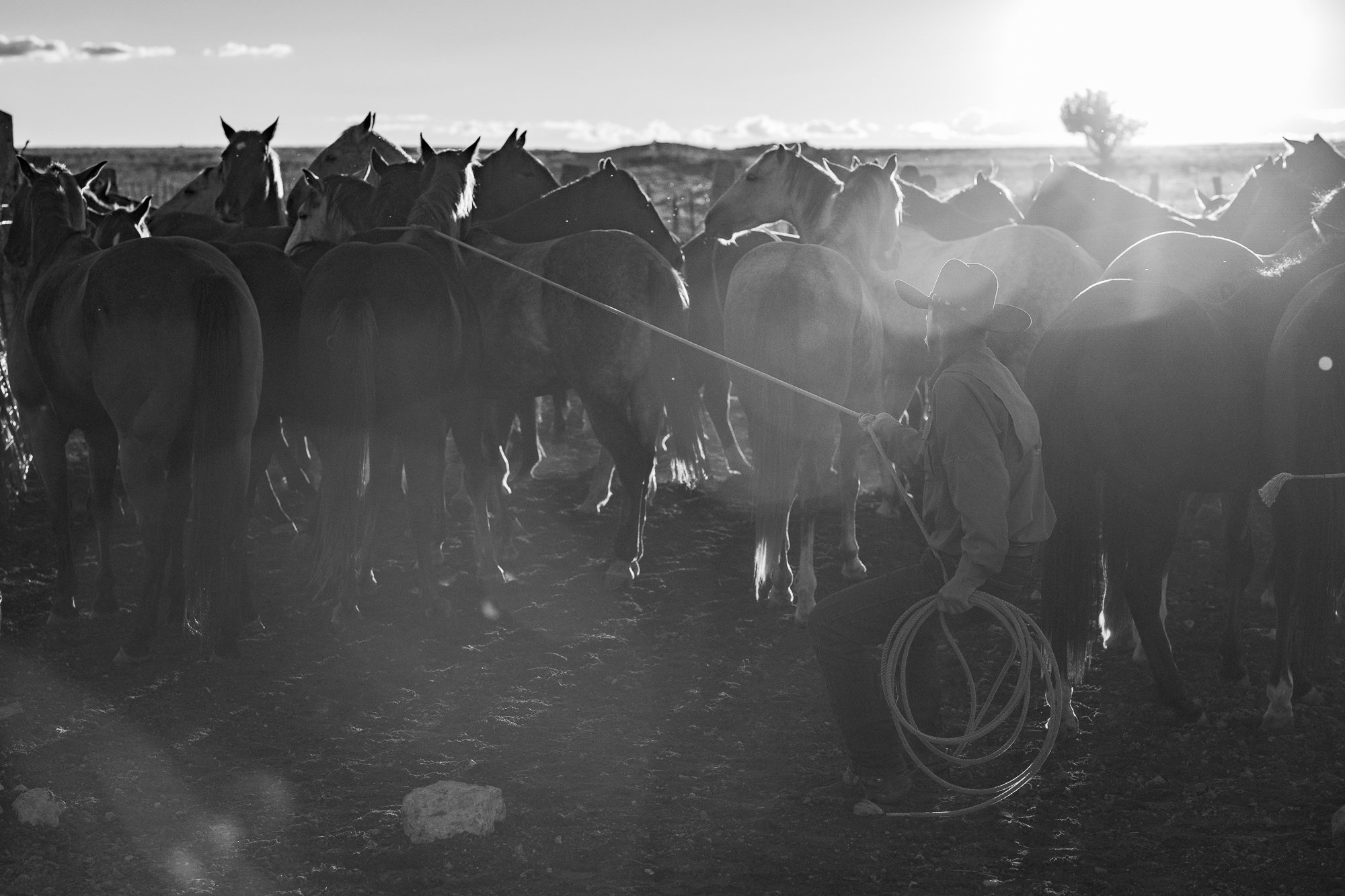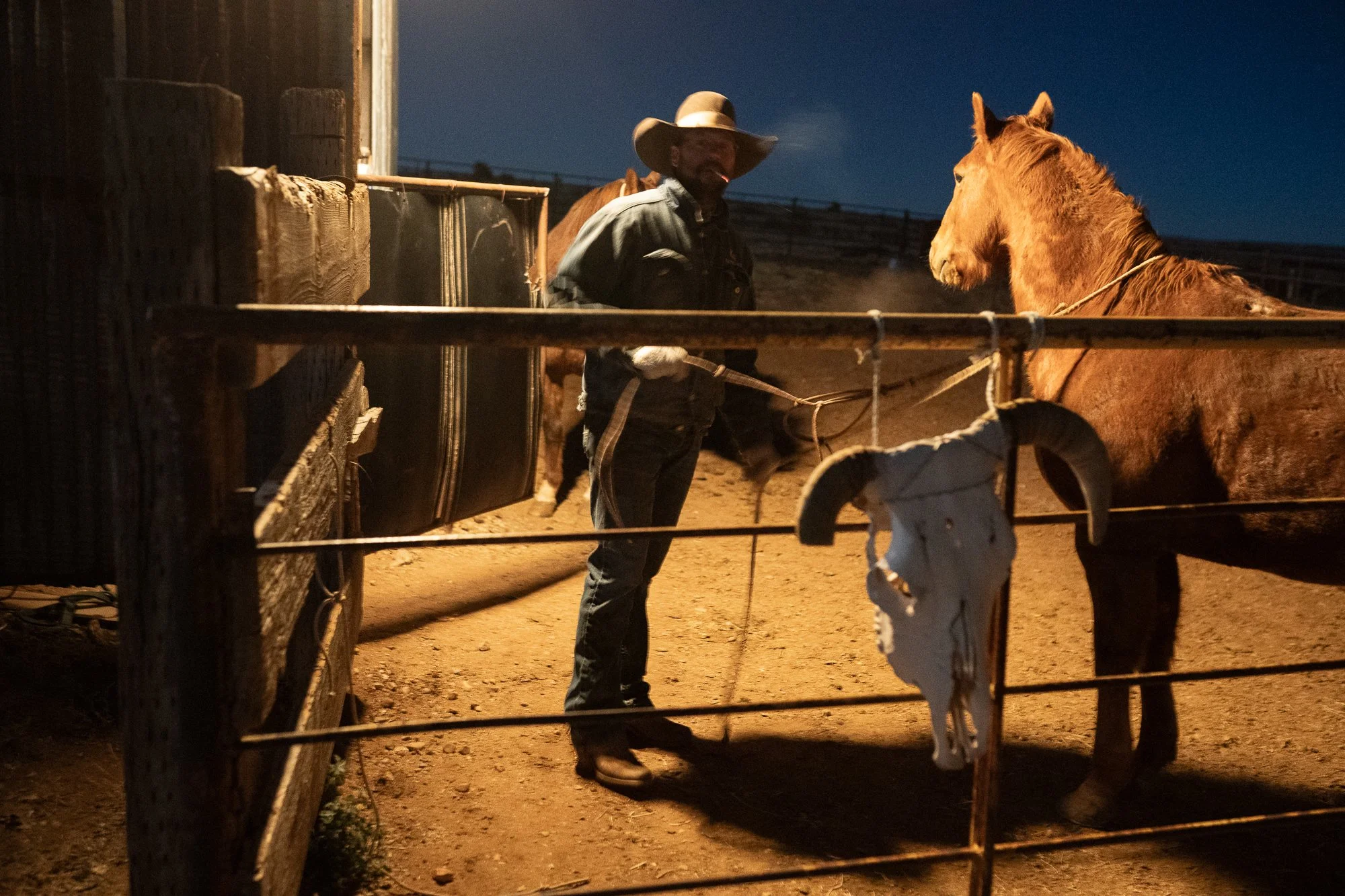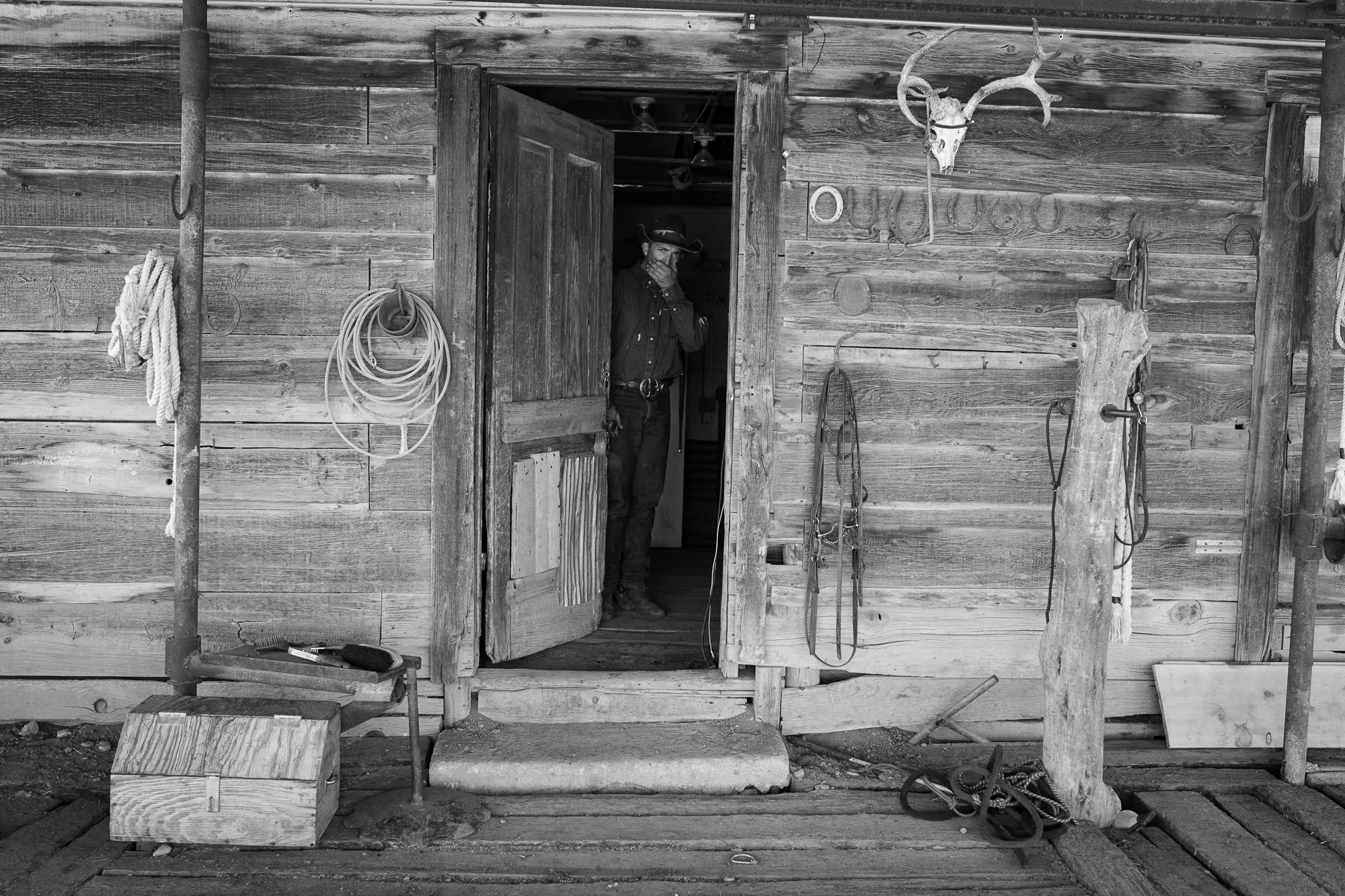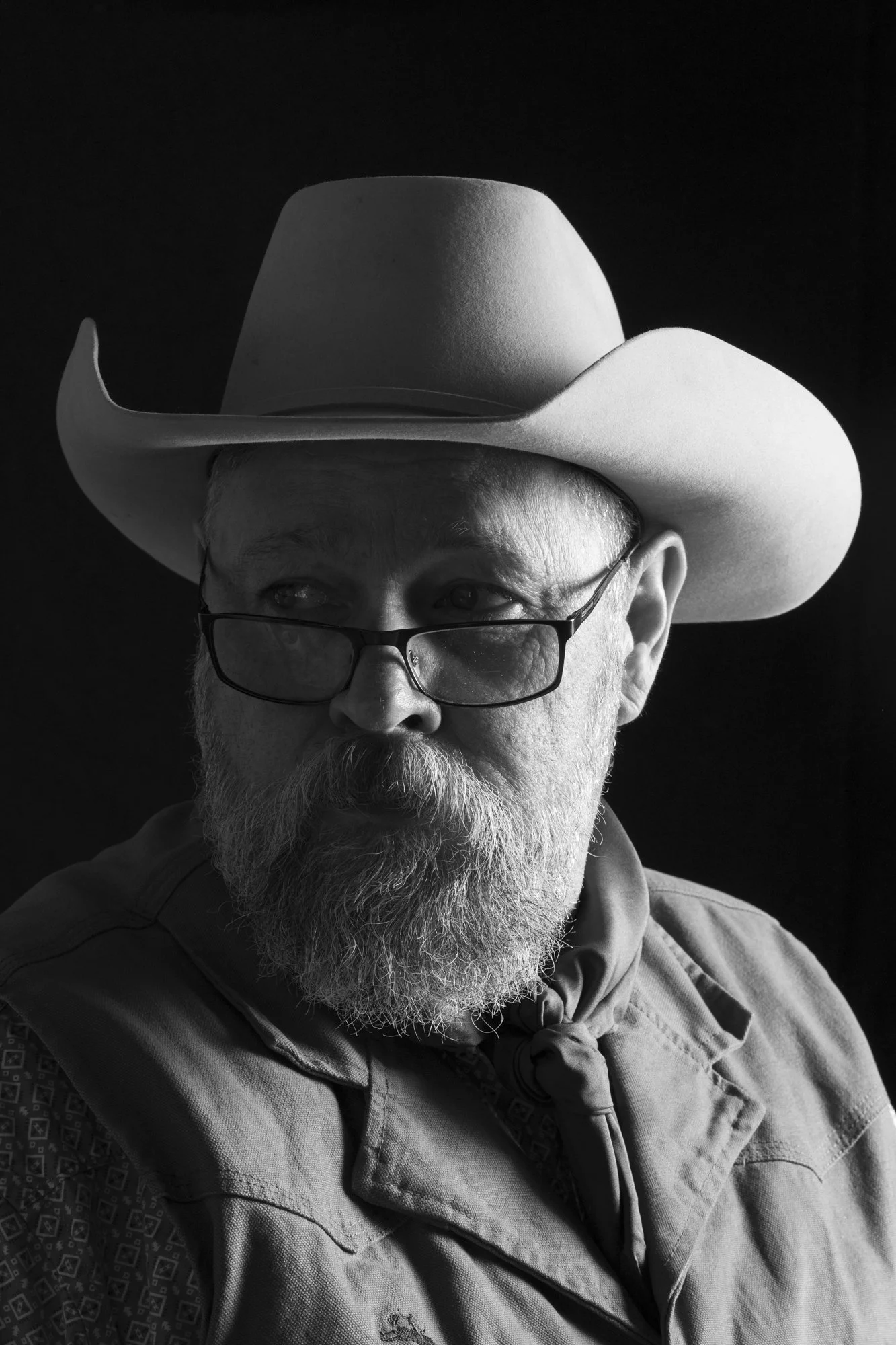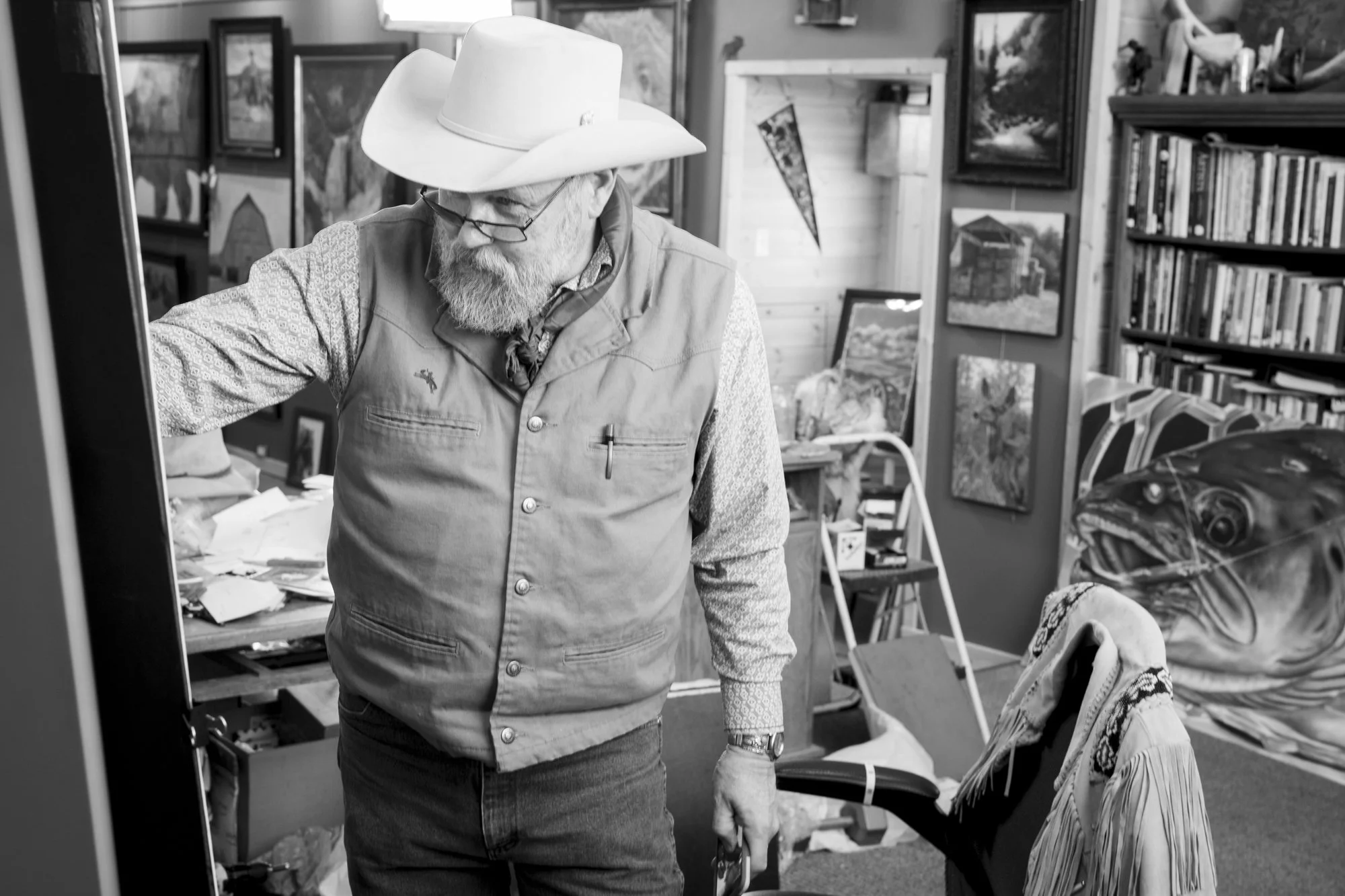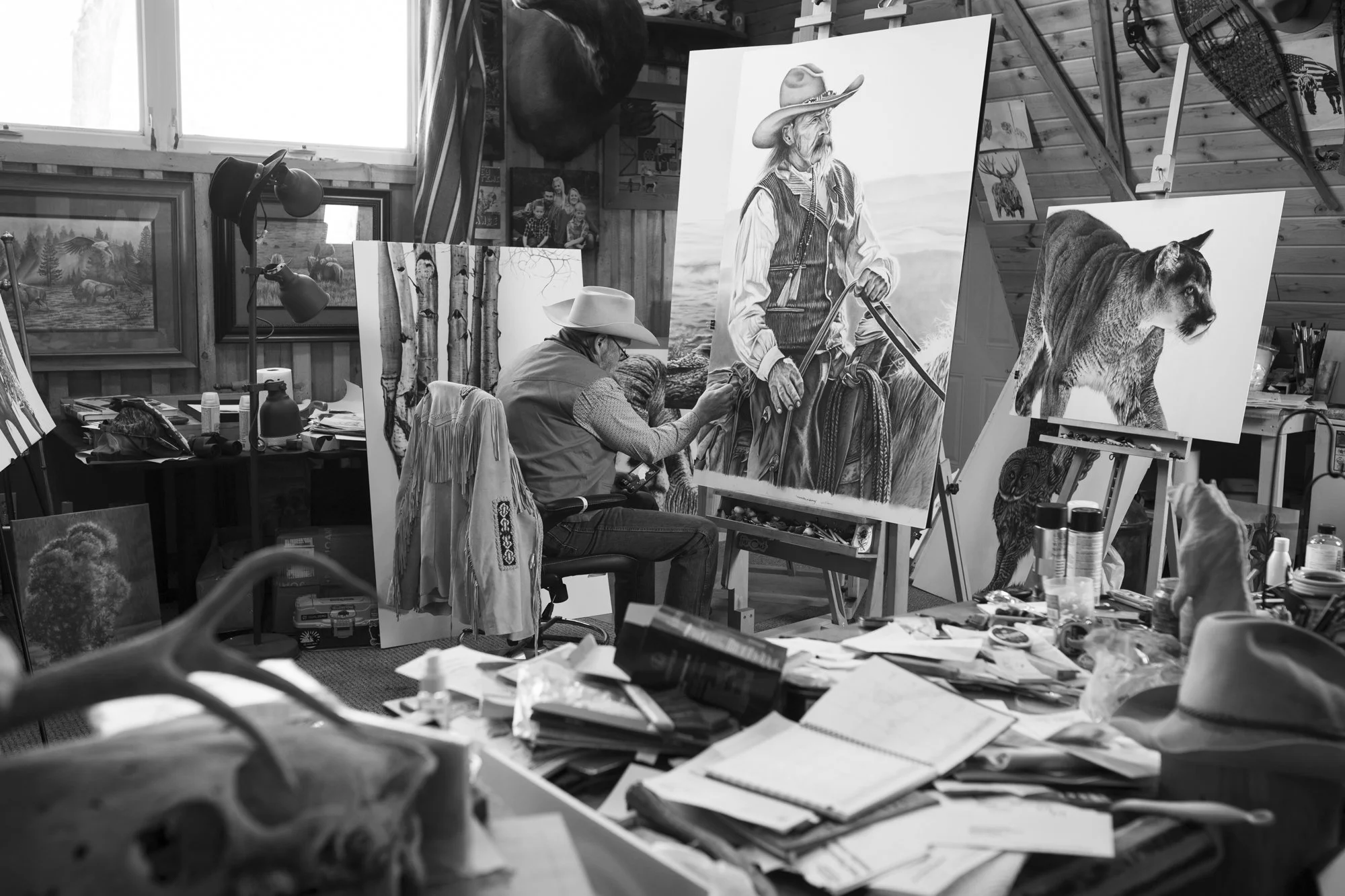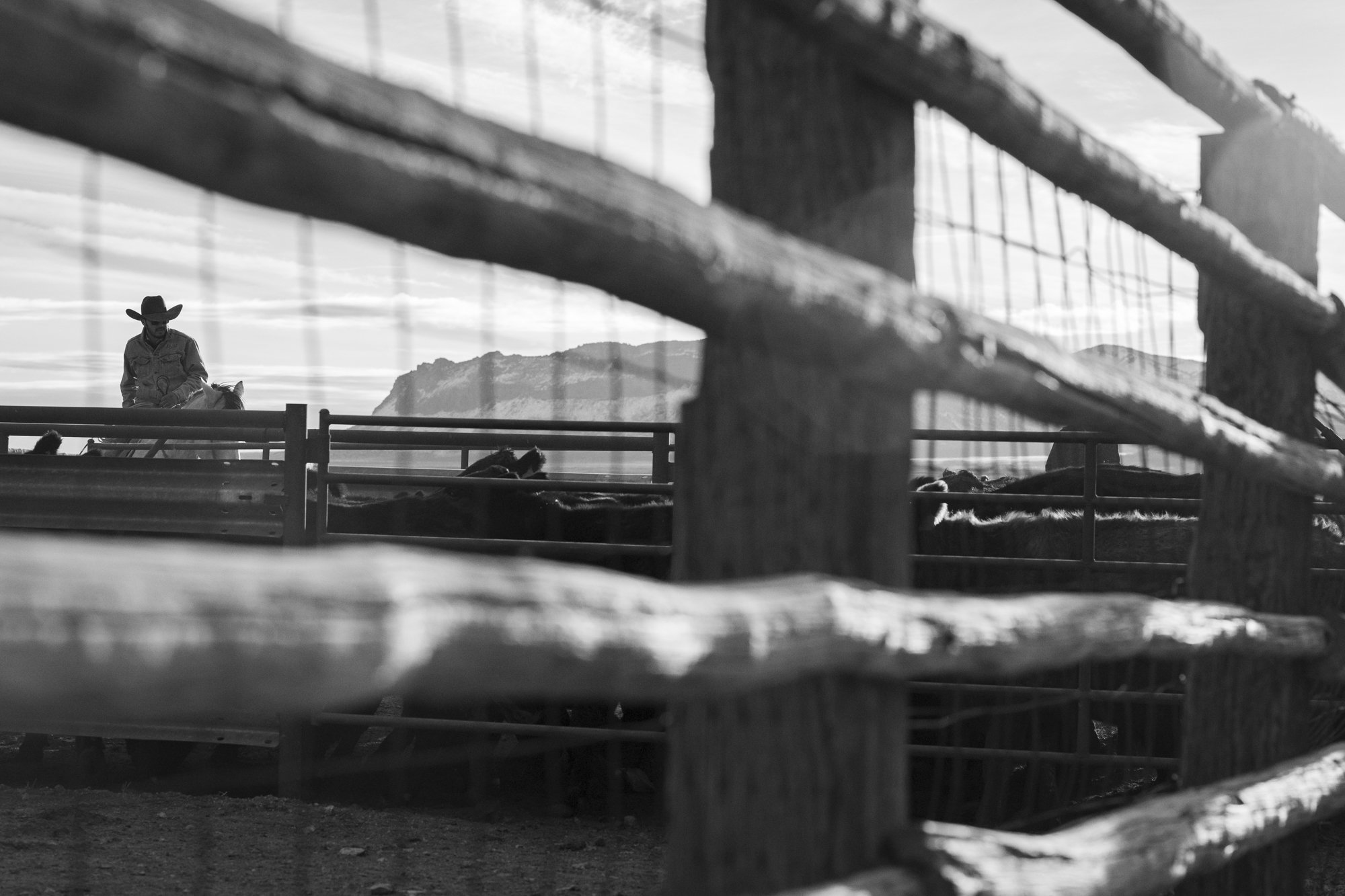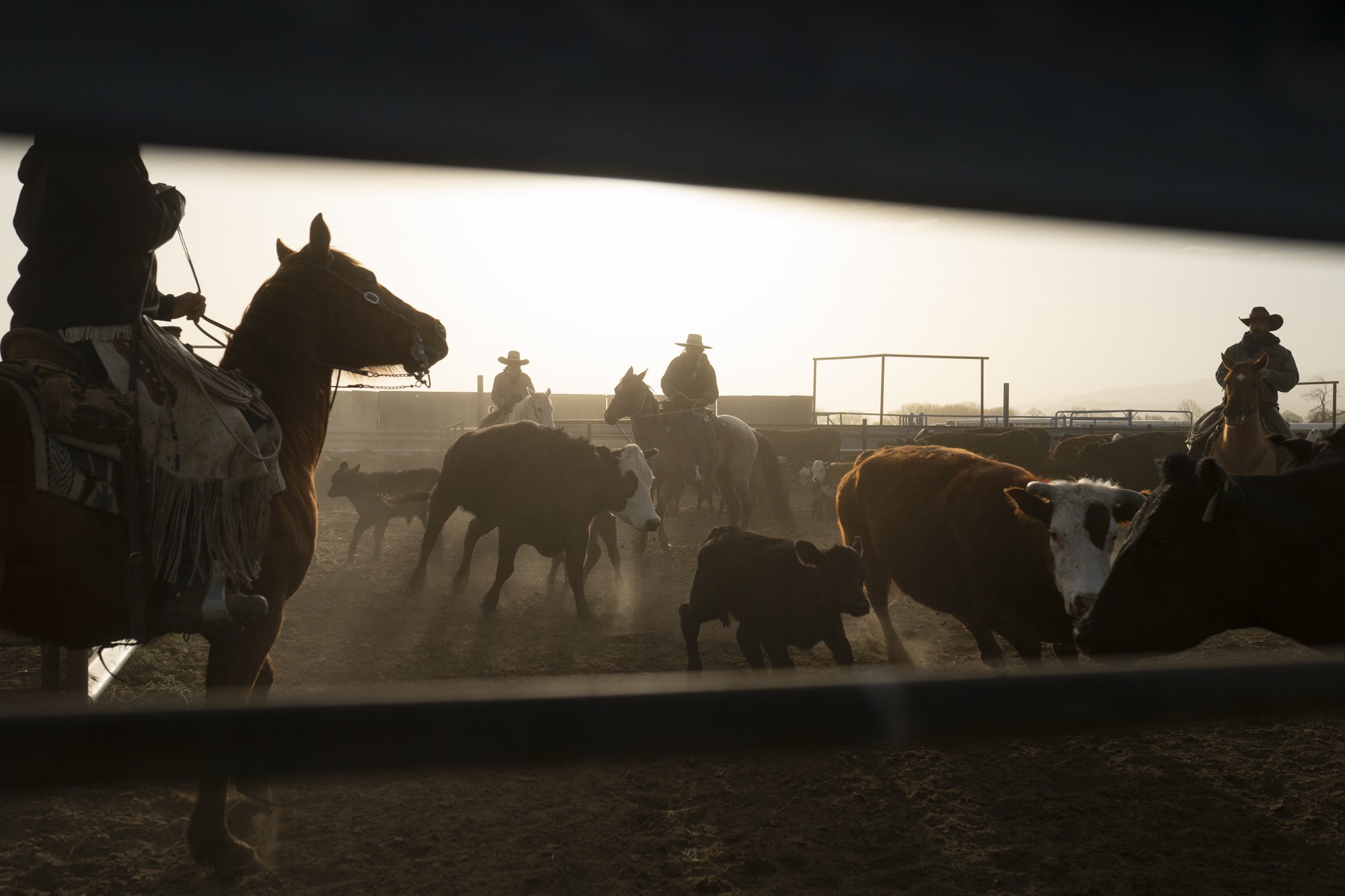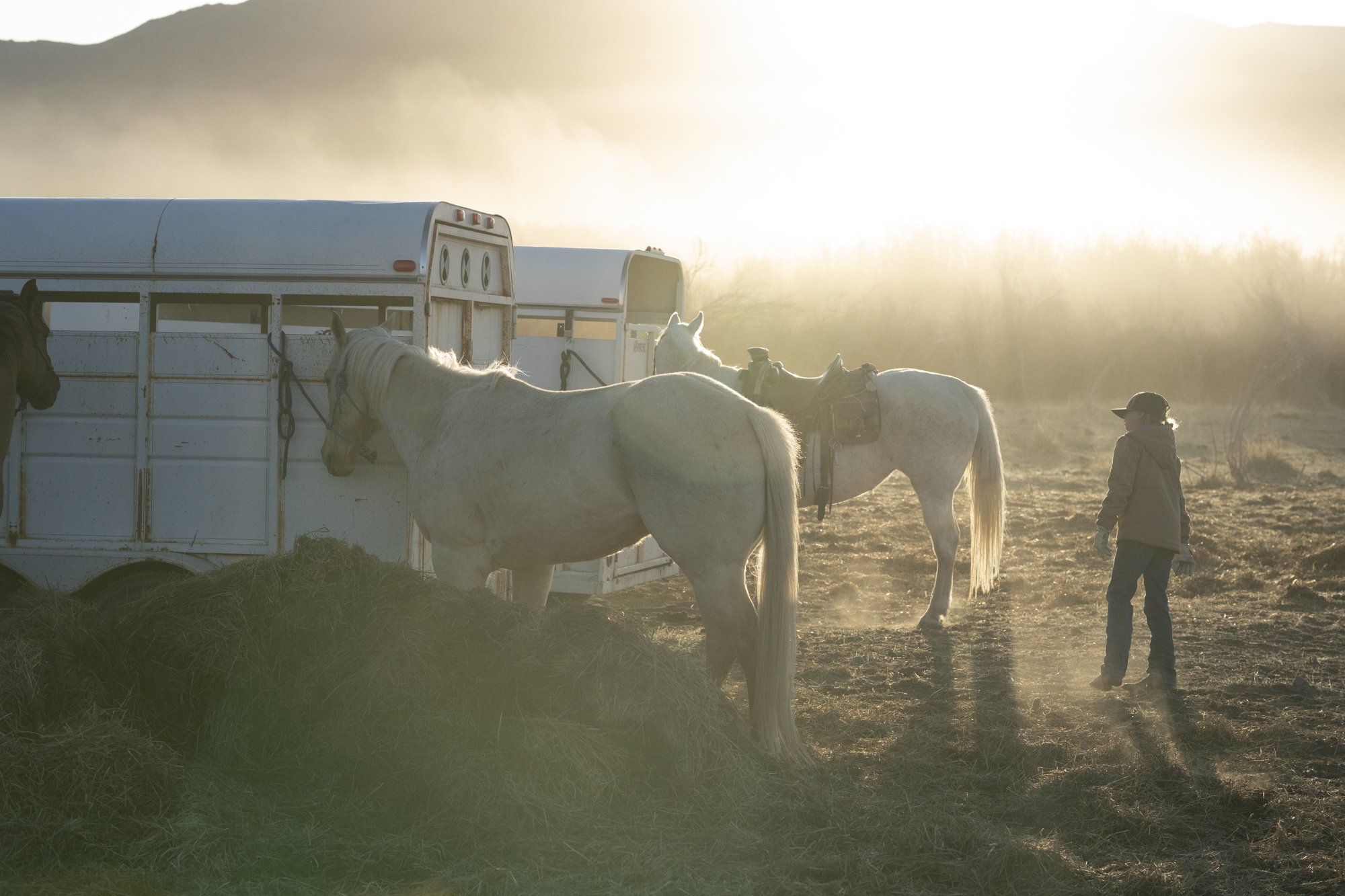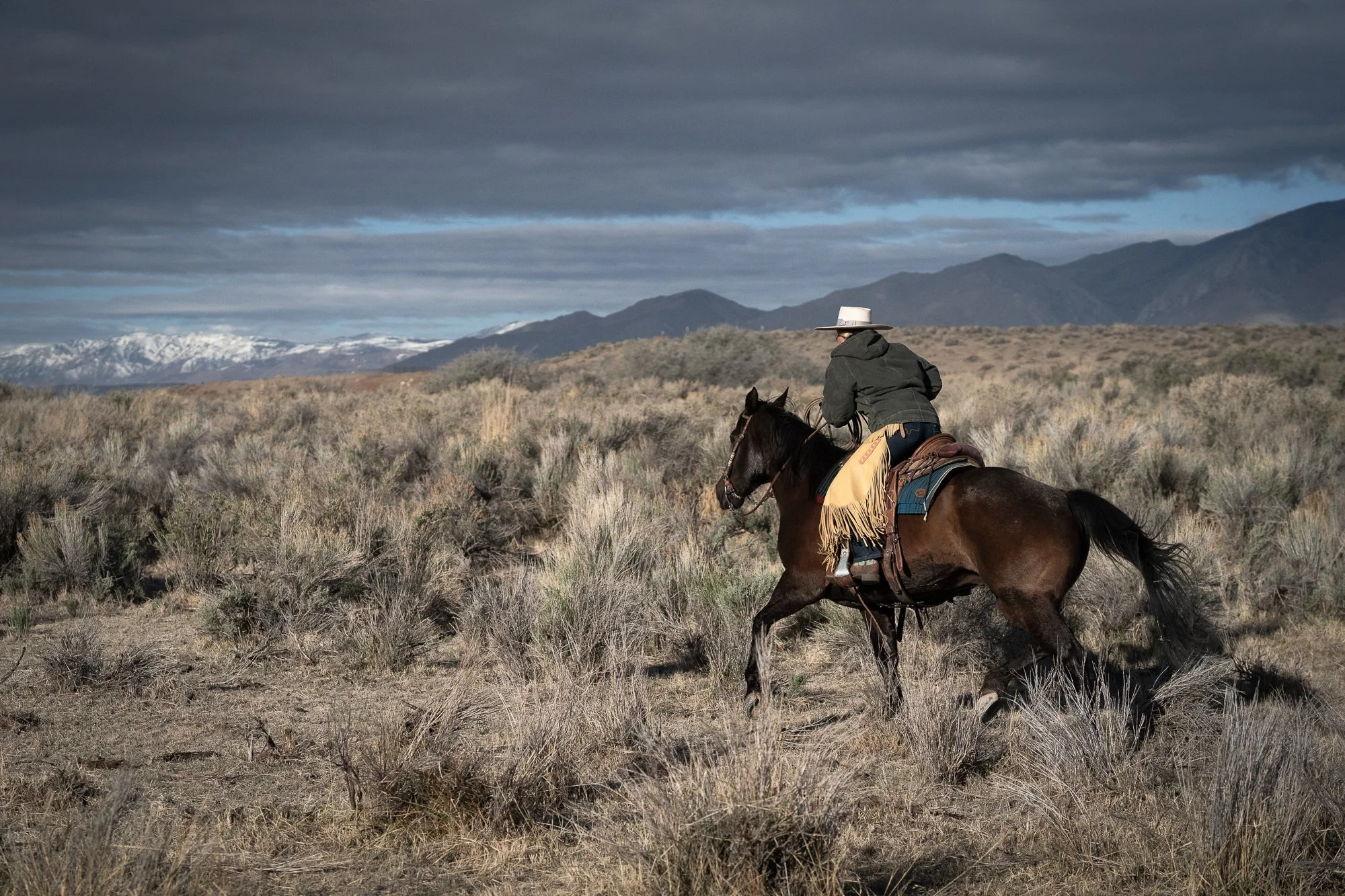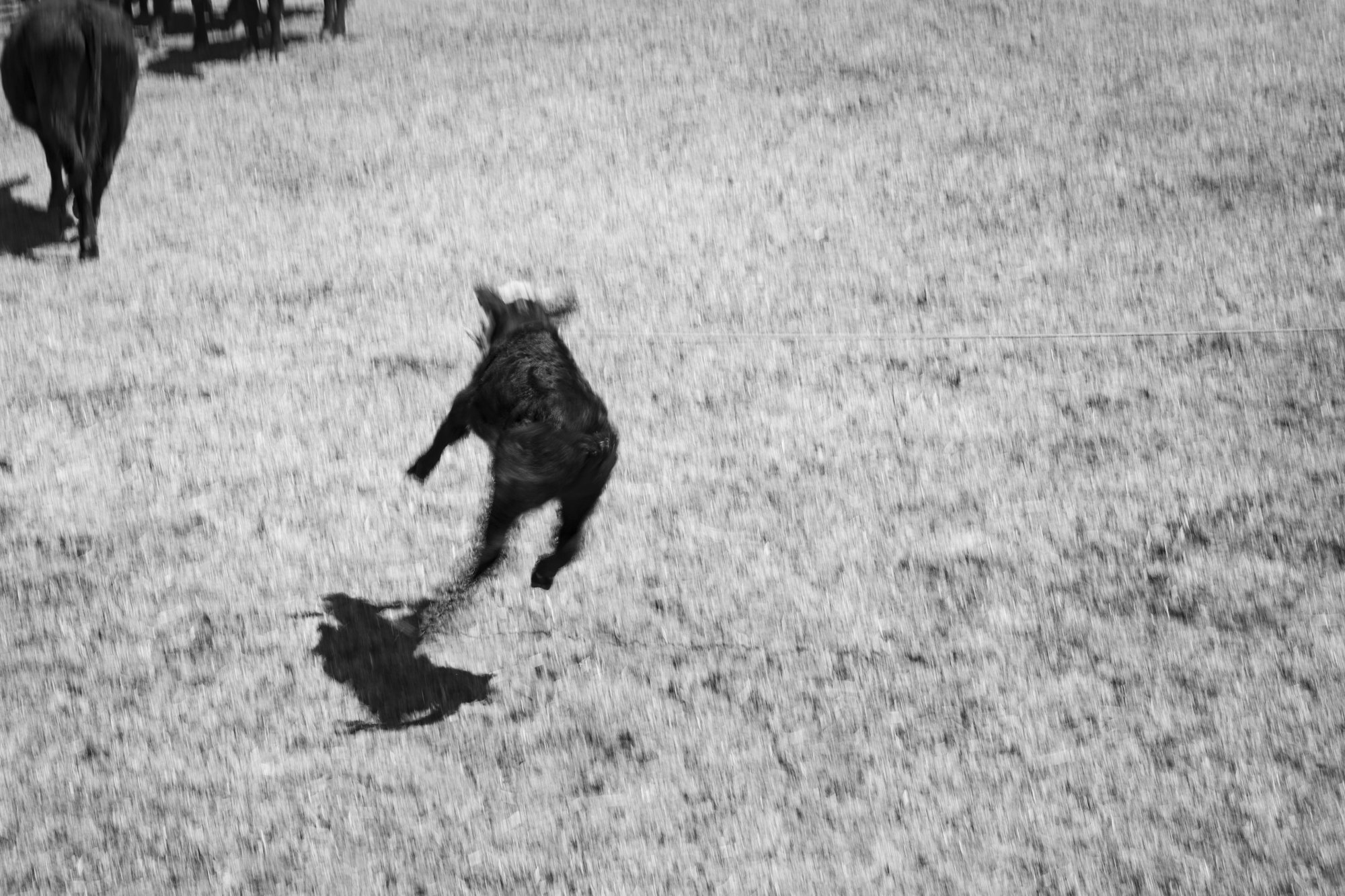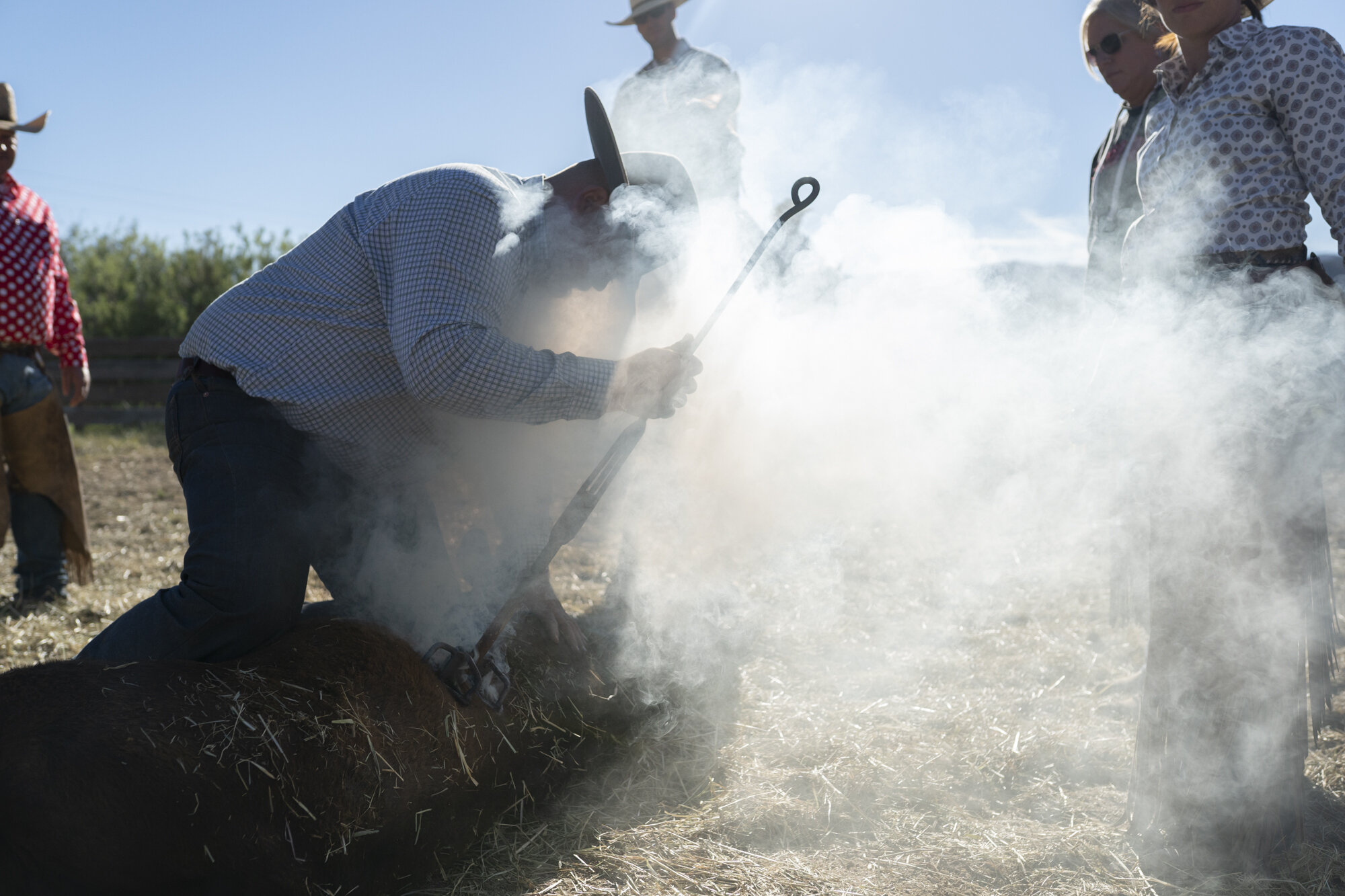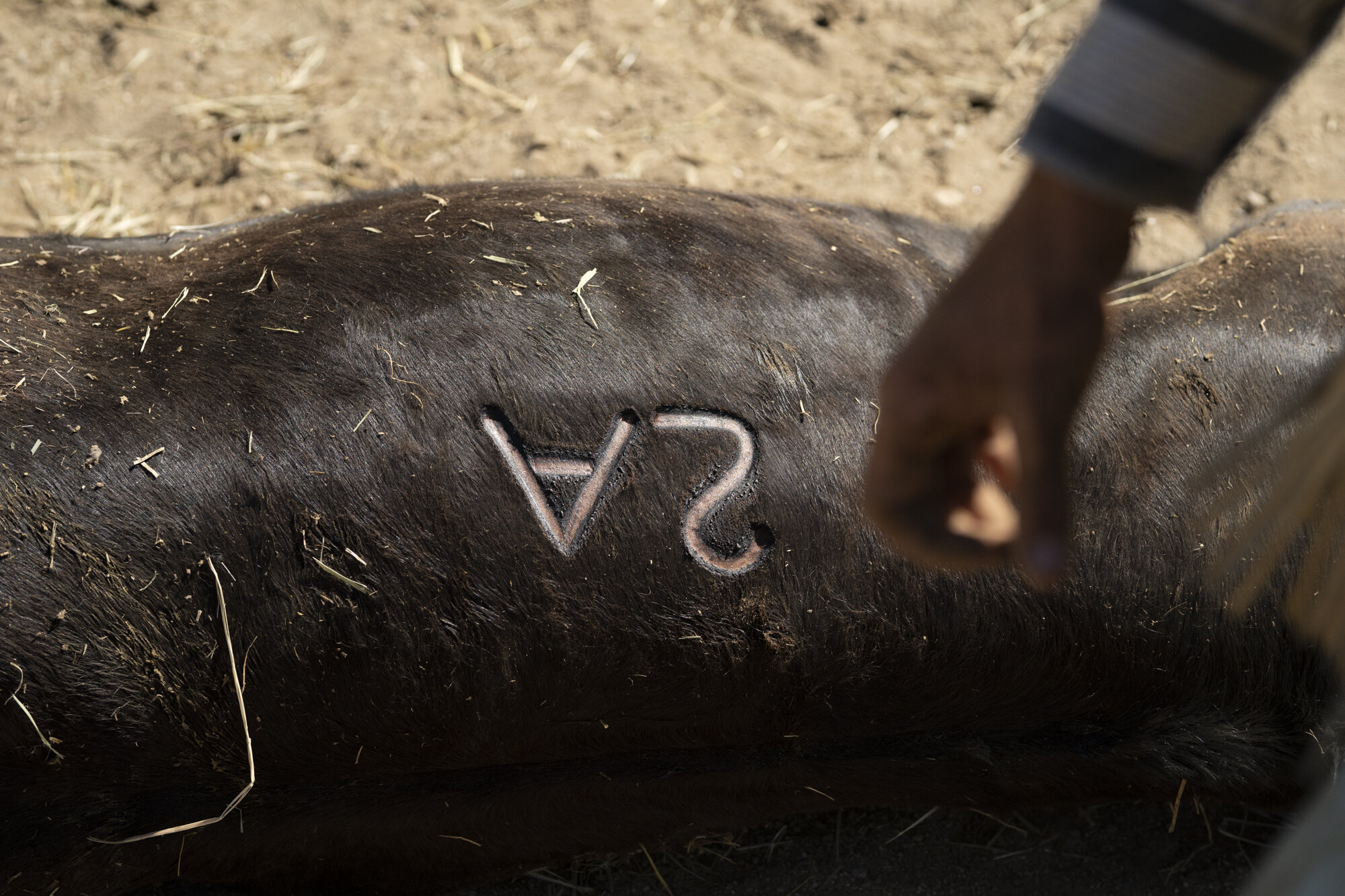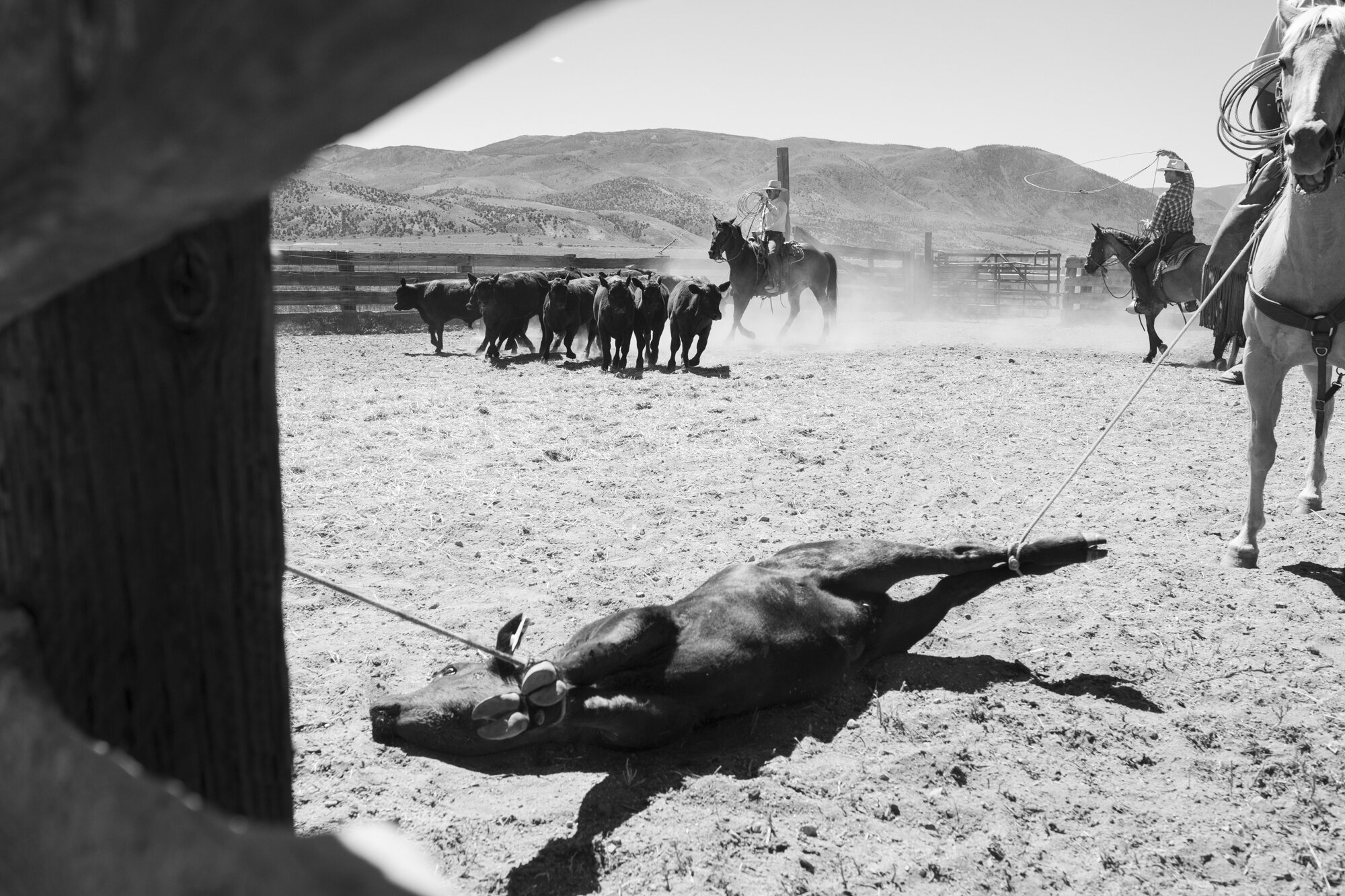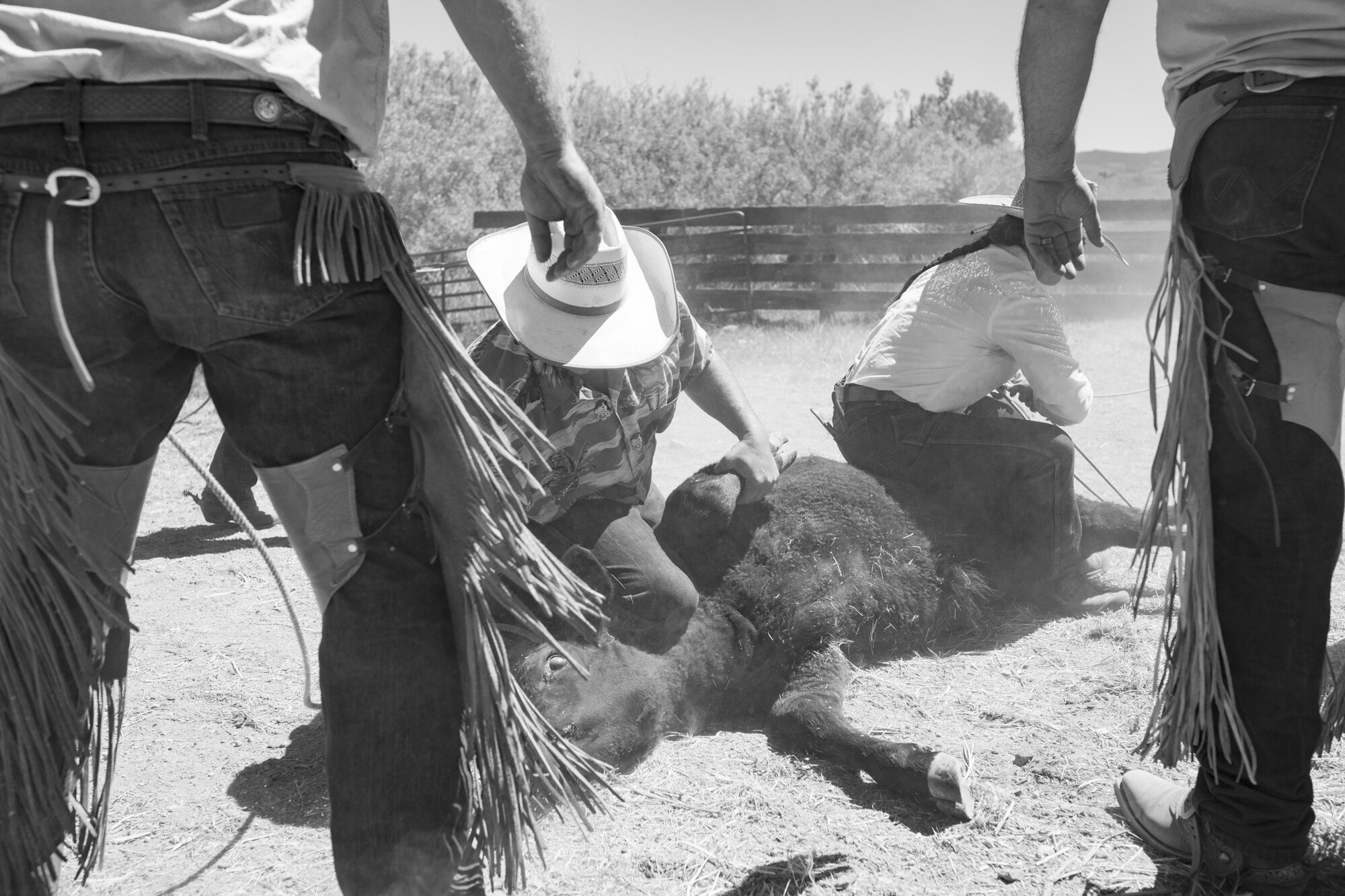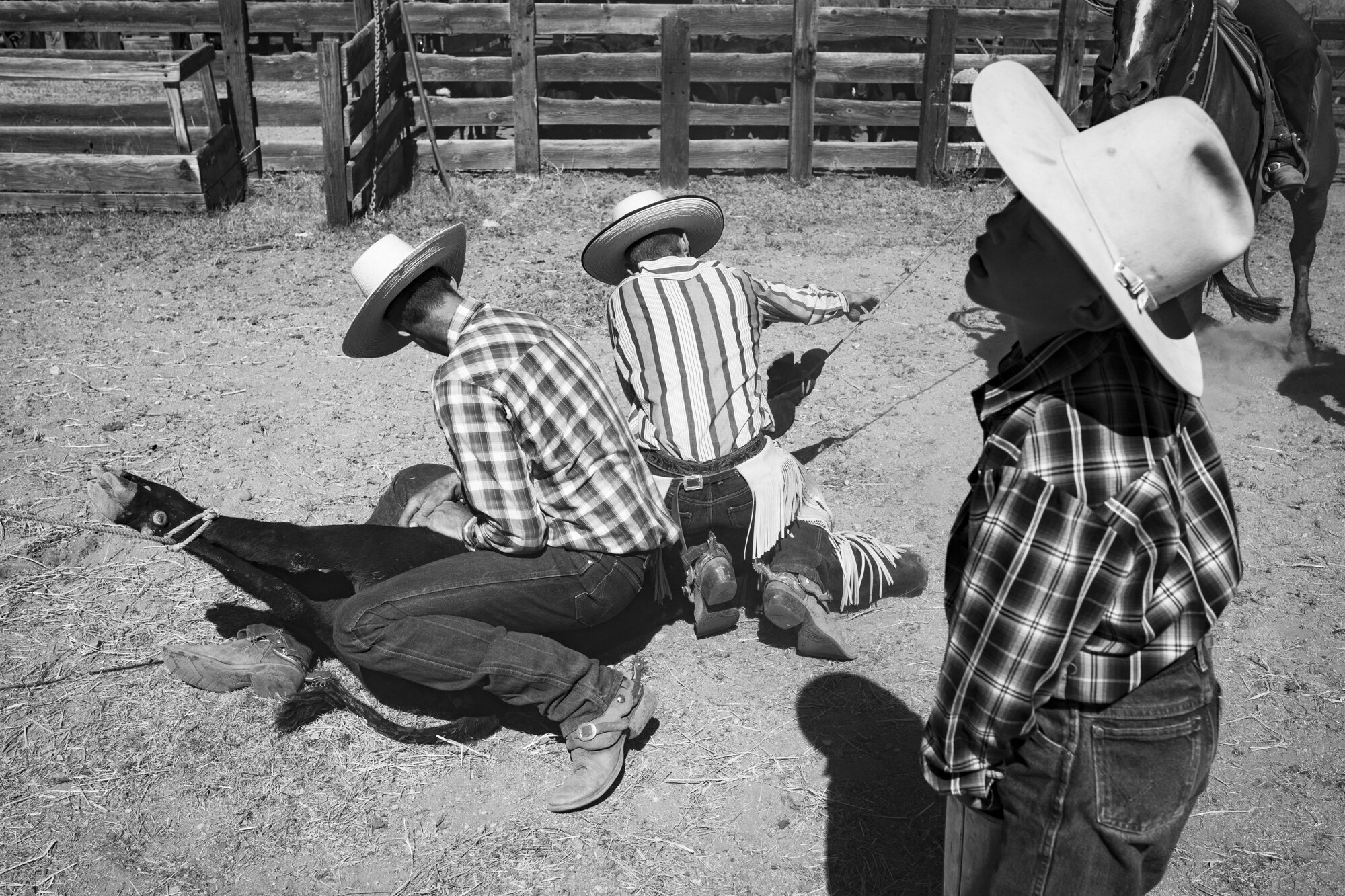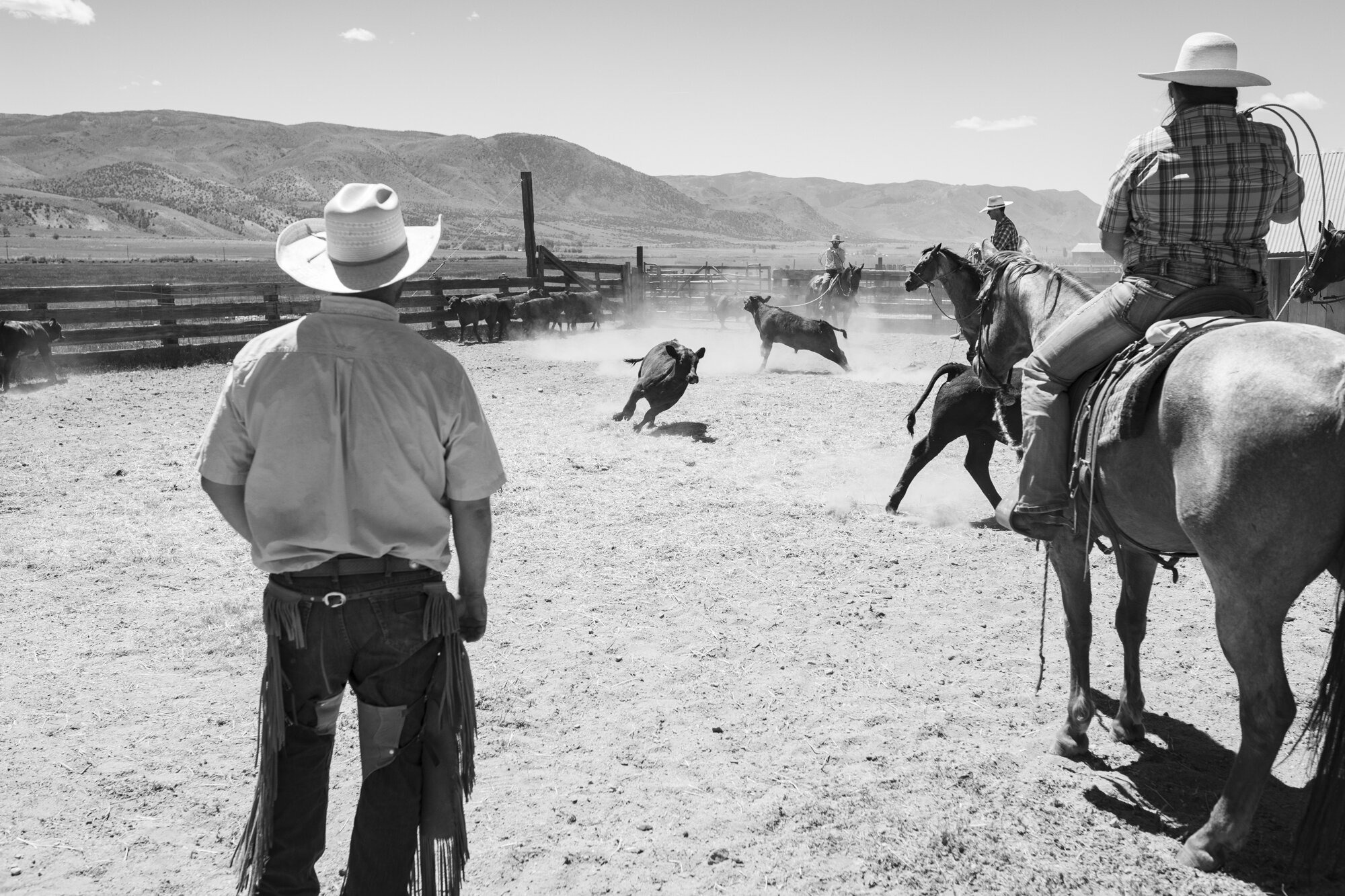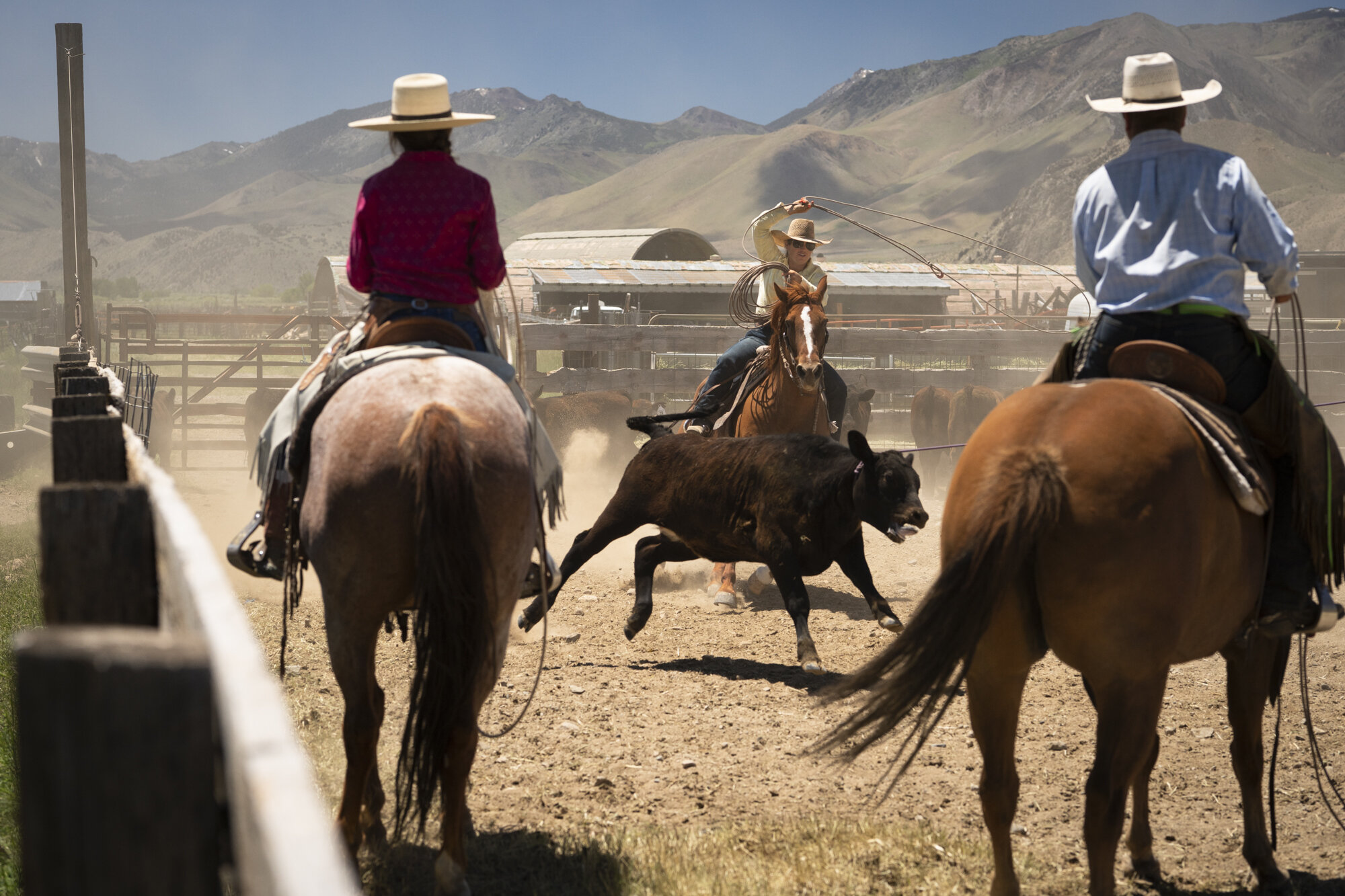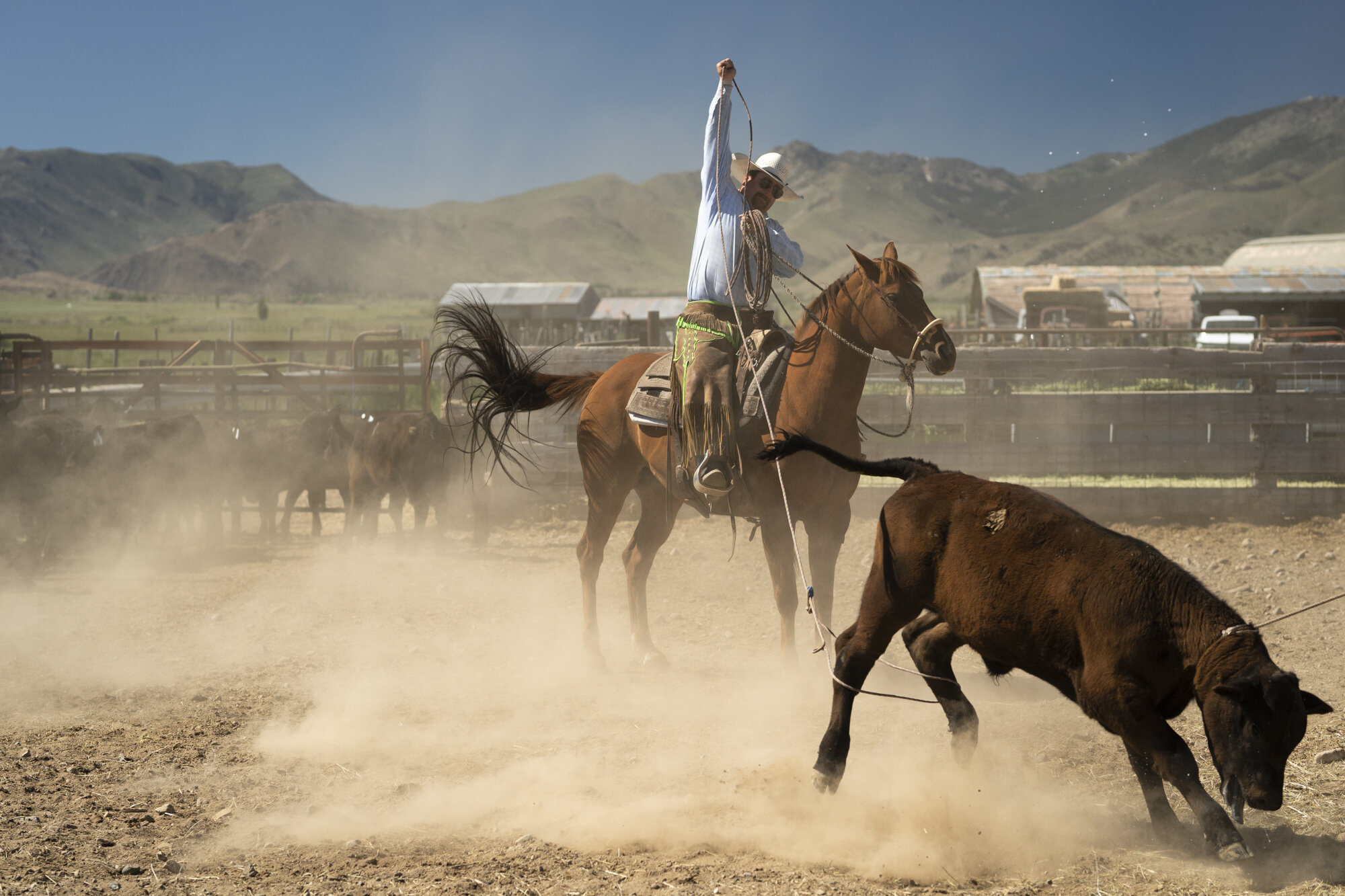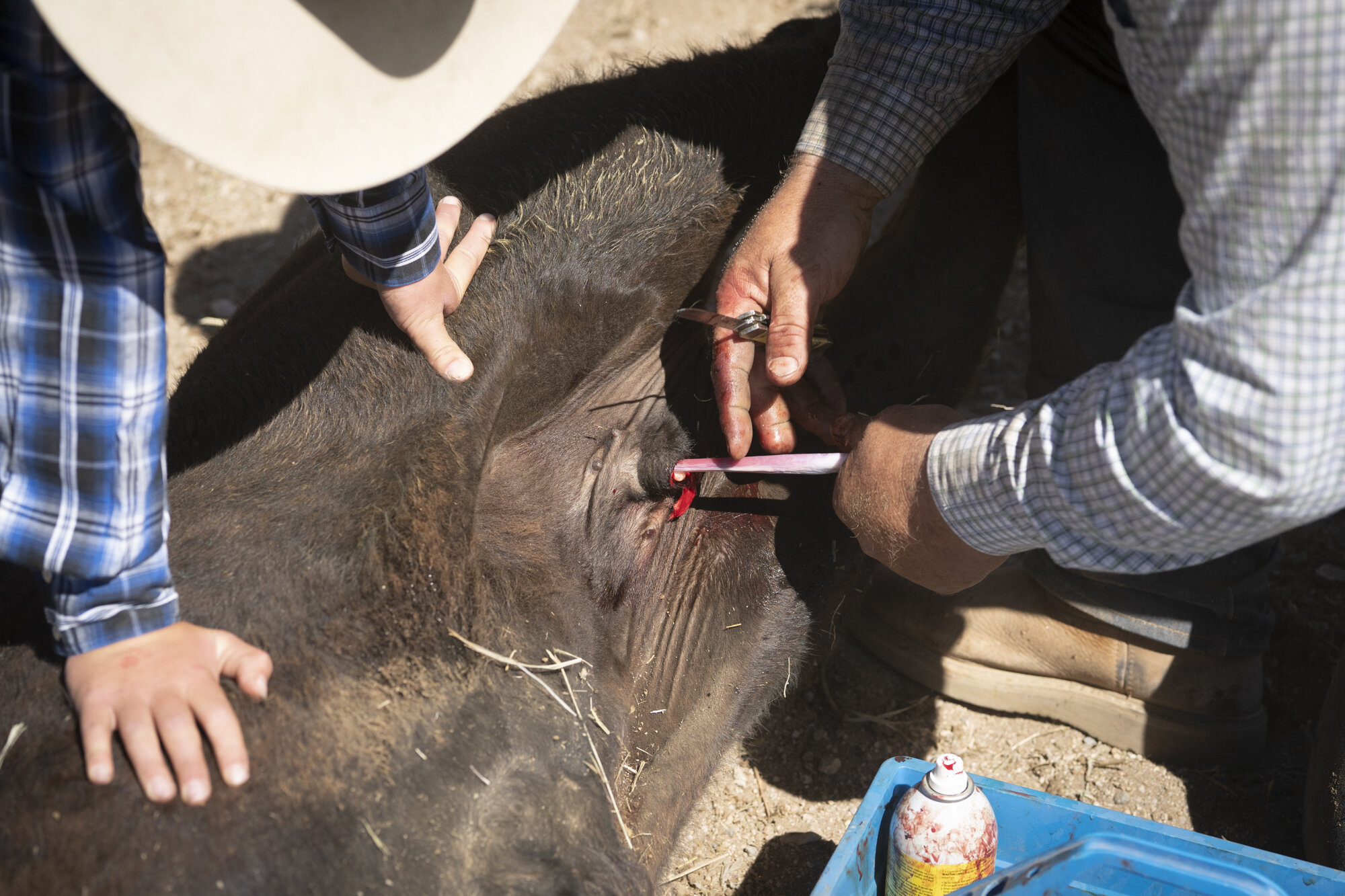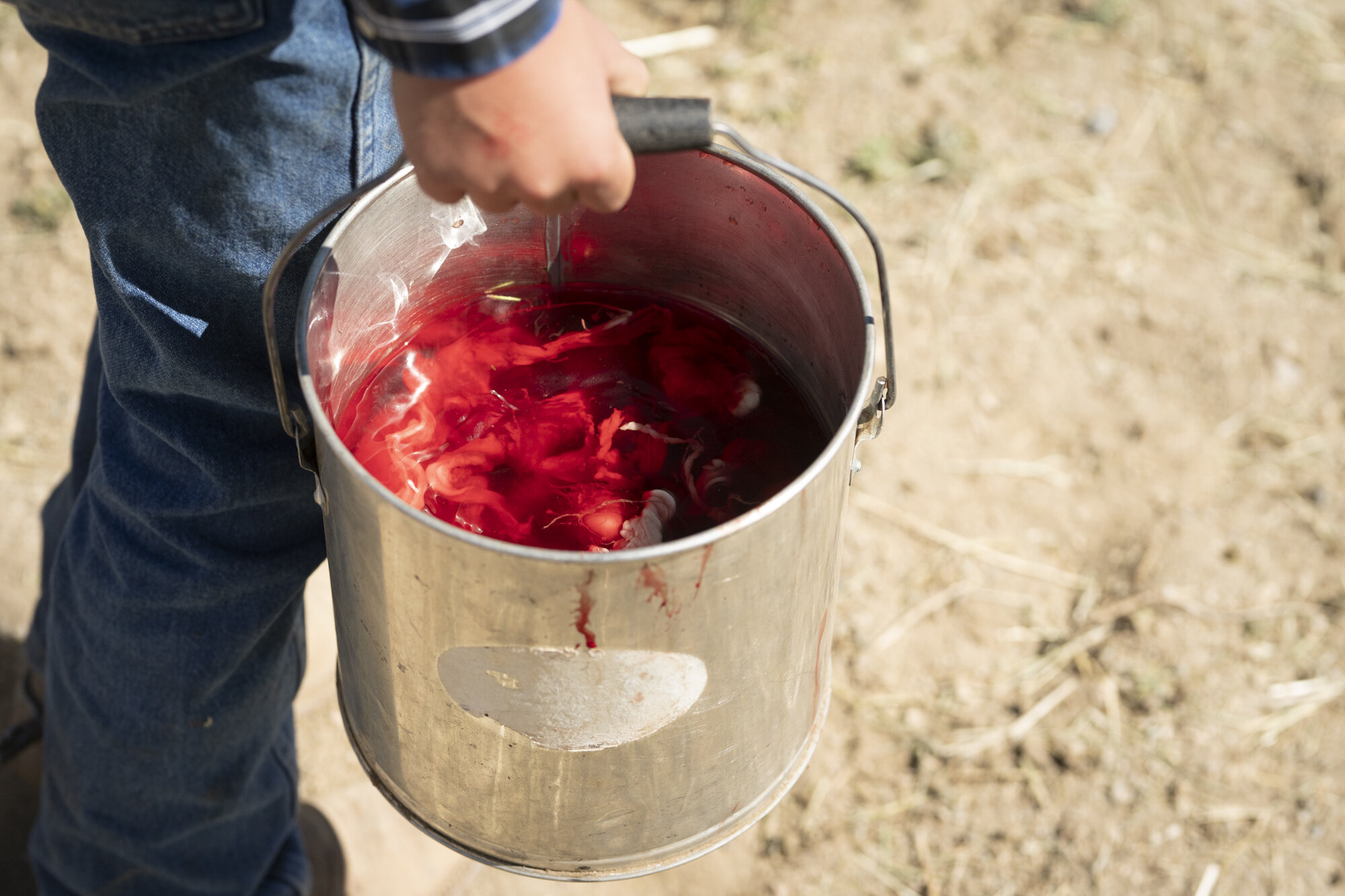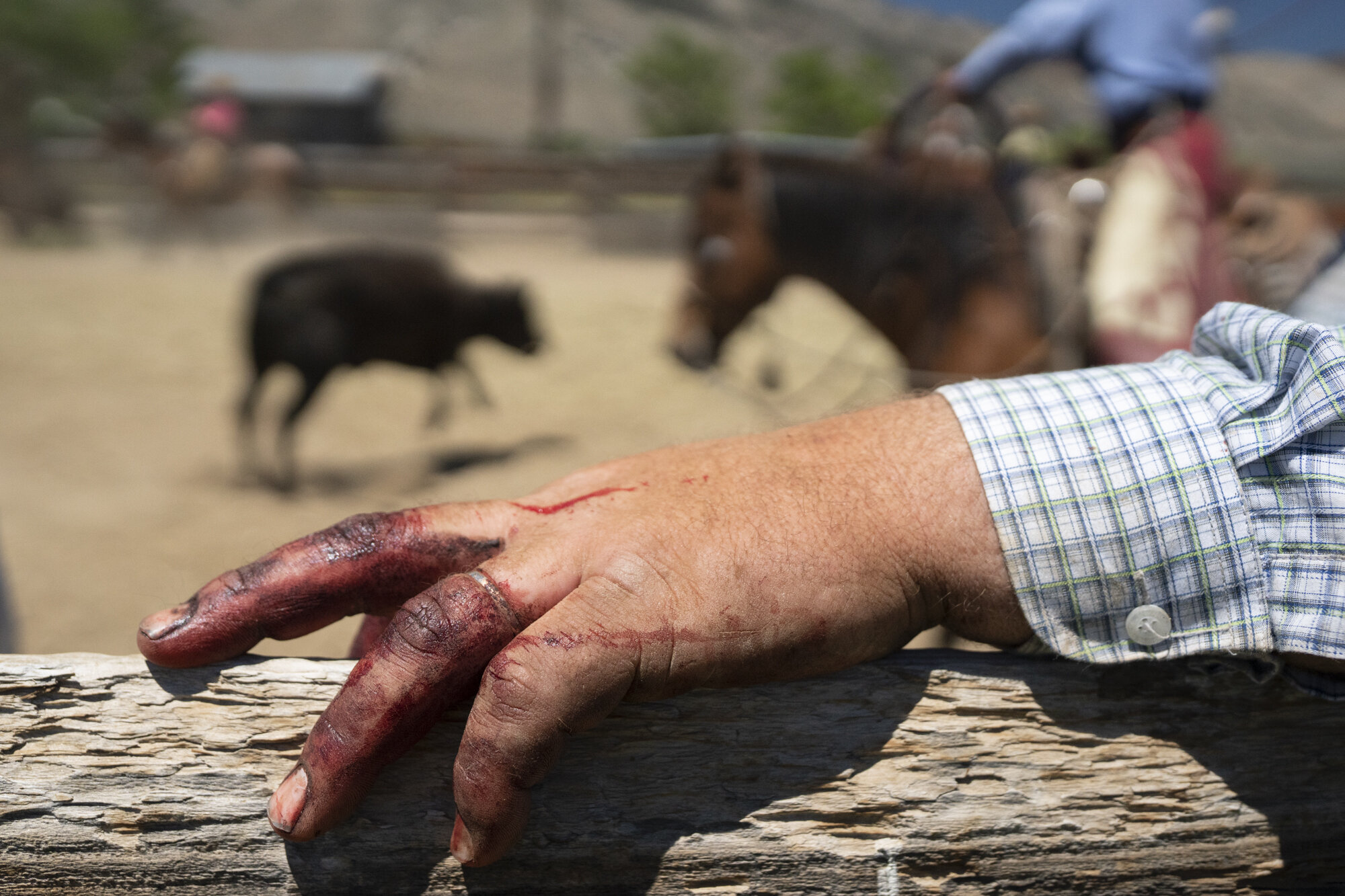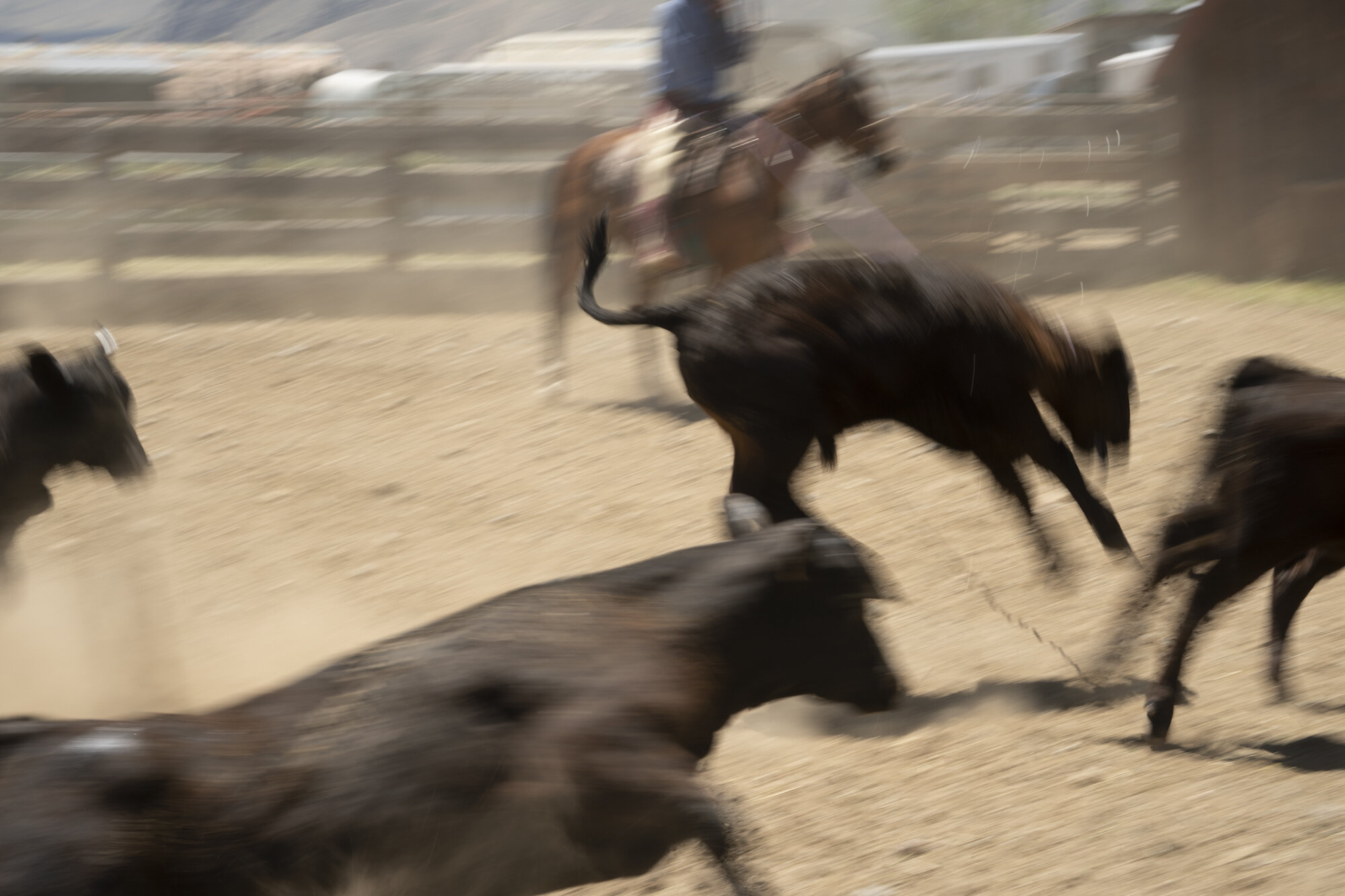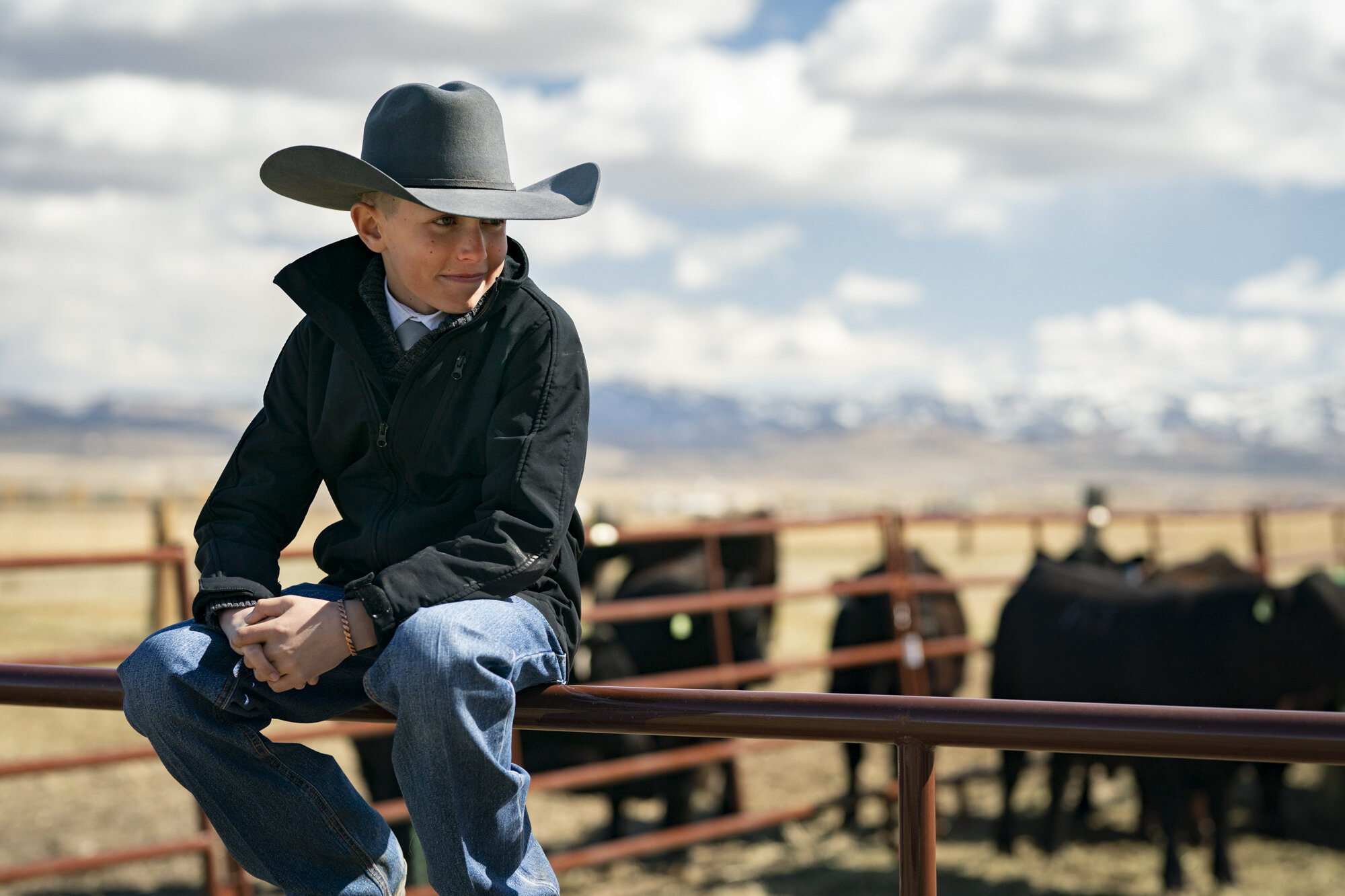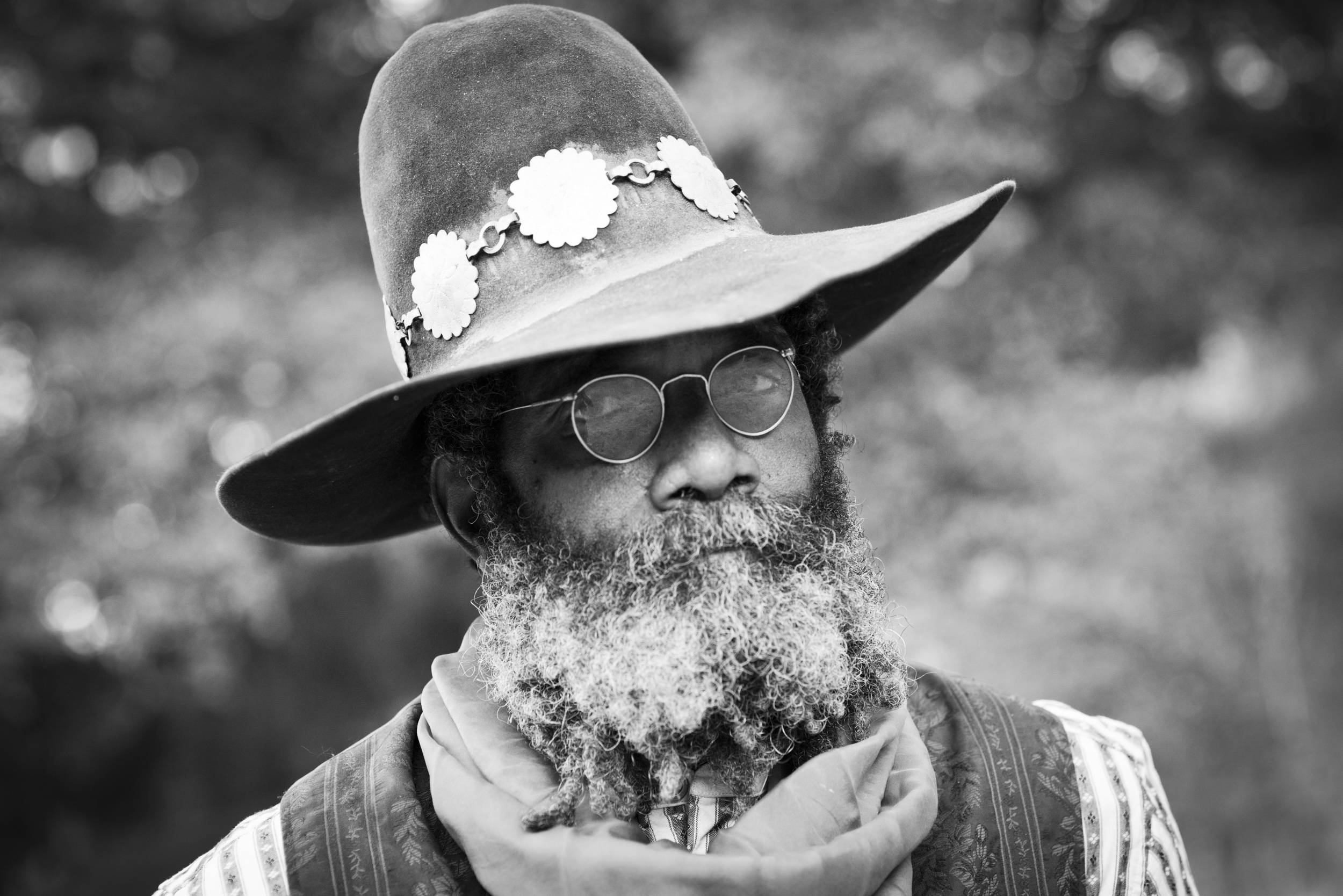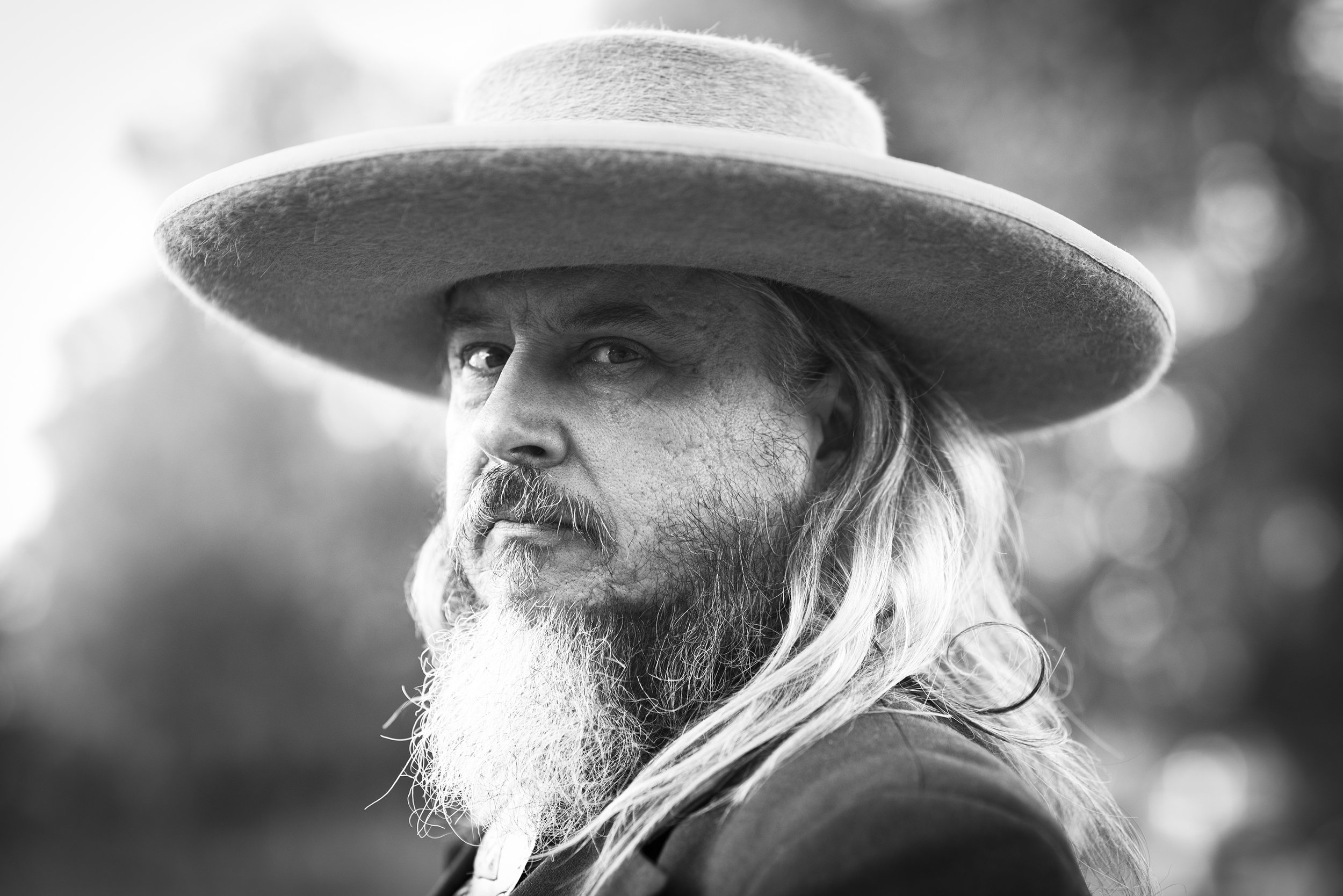
Cowboy Photographer

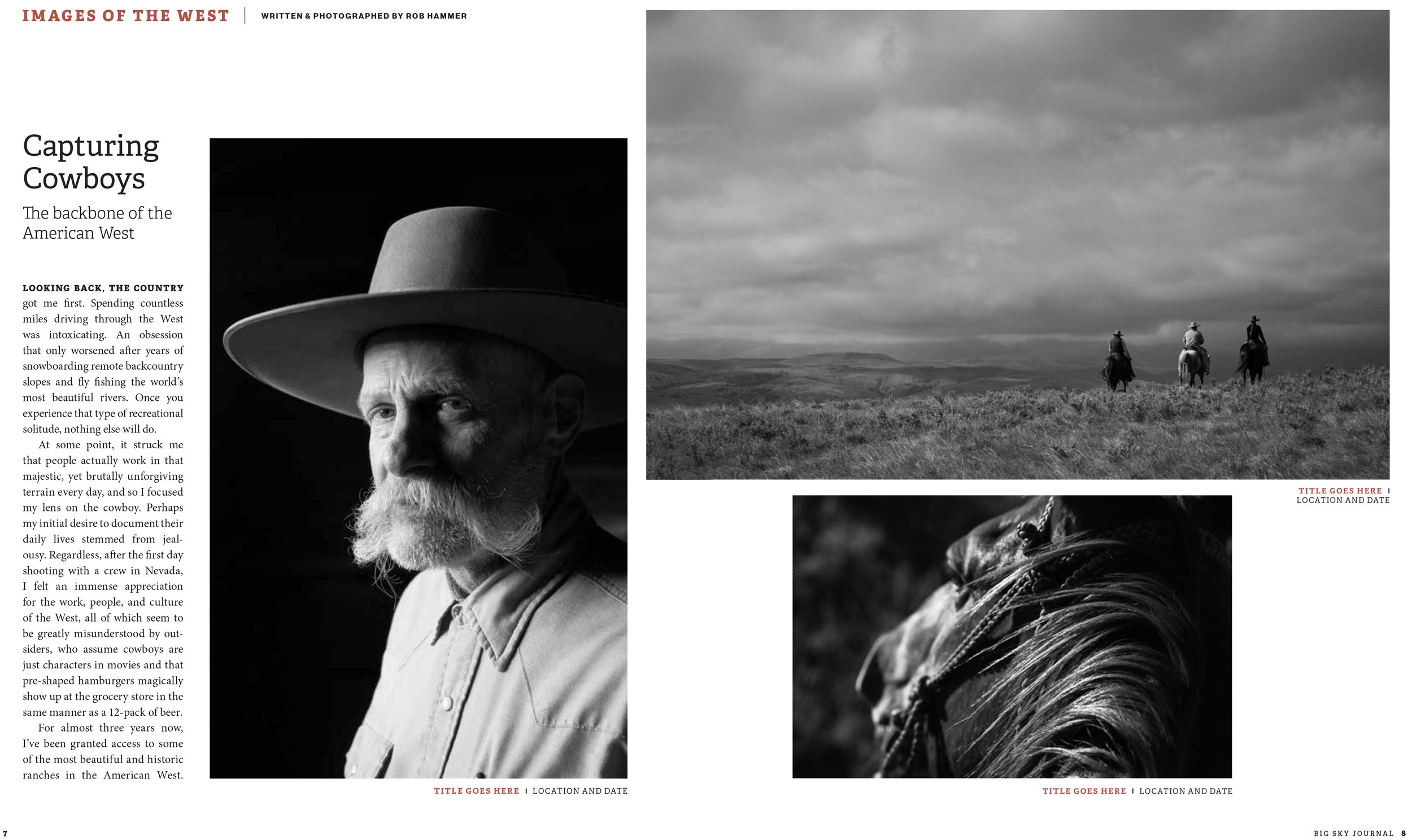
Western Horseman Magazine Names Rob Hammer Among the Best Western Photographers

Being recognized by Western Horseman Magazine is an honor that carries real weight in the world of Western culture. For over 85 years, Western Horseman has documented the lives, traditions, and work ethic of ranchers and cowboys across the American West. Their editorial standards are deeply rooted in authenticity, history, and respect for the people who make a living on horseback.

That’s why being named one of the best Western photographers by Western Horseman is especially meaningful to me.

A Dedication to Authentic Western Photography

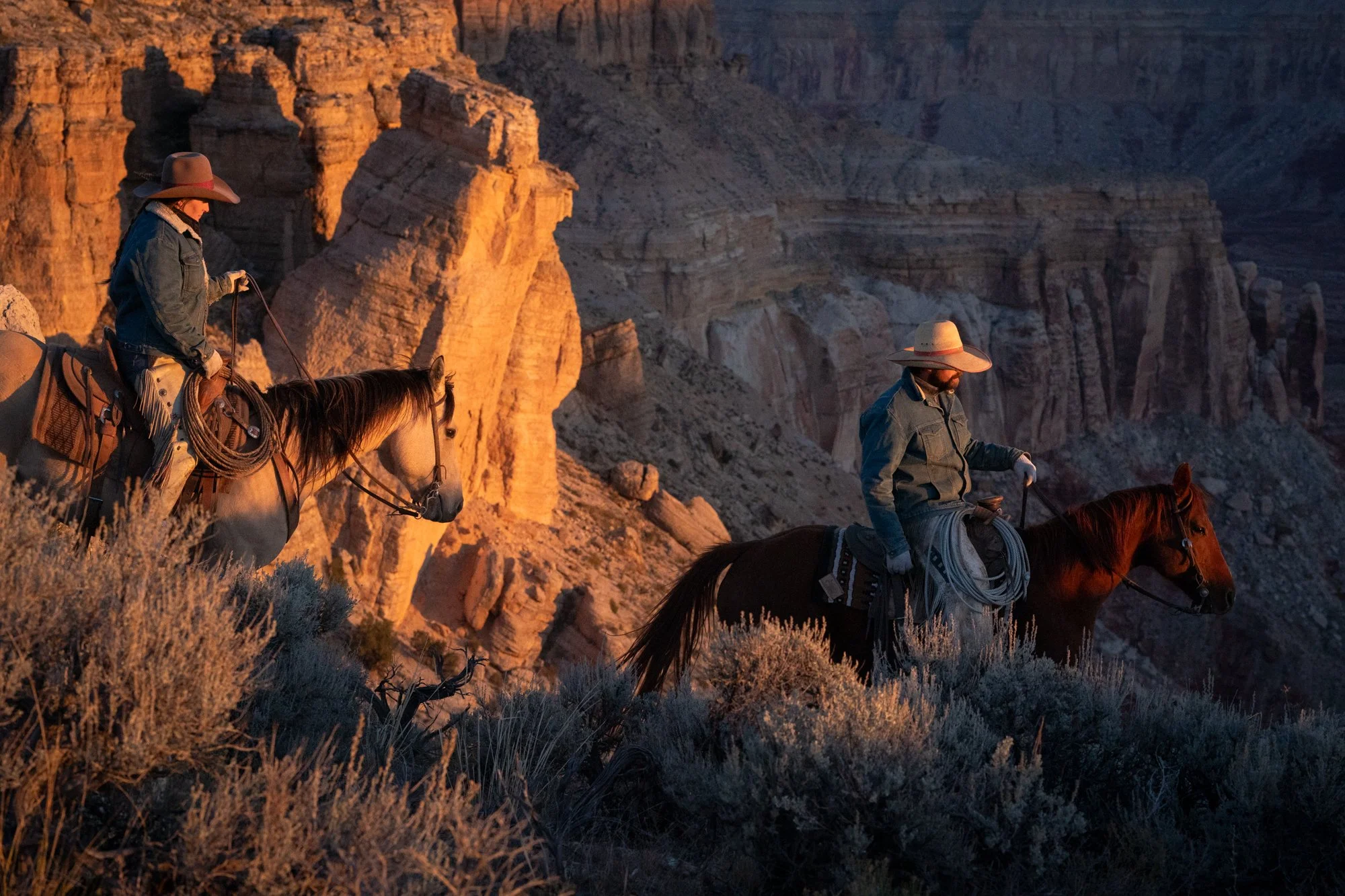
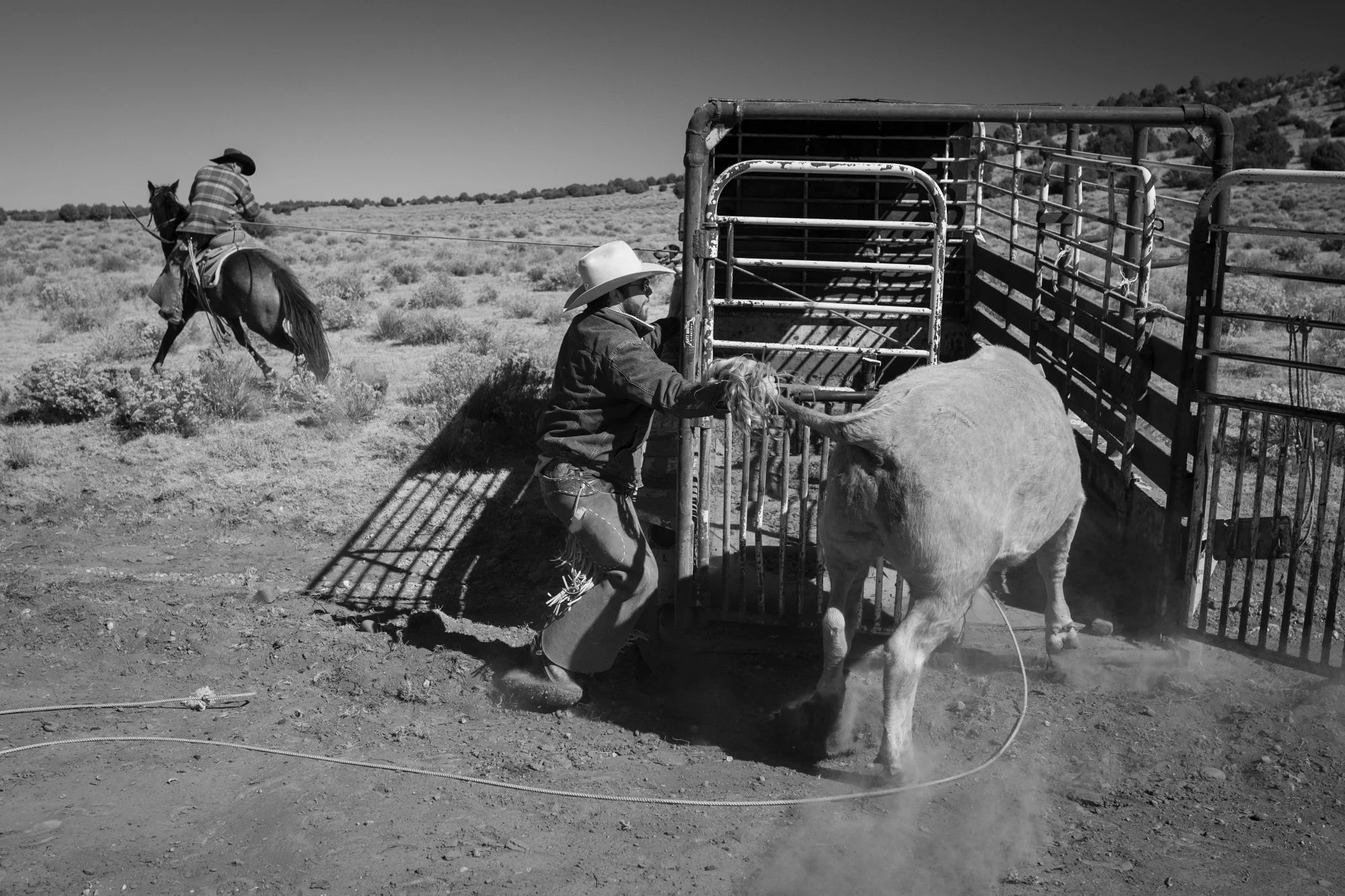
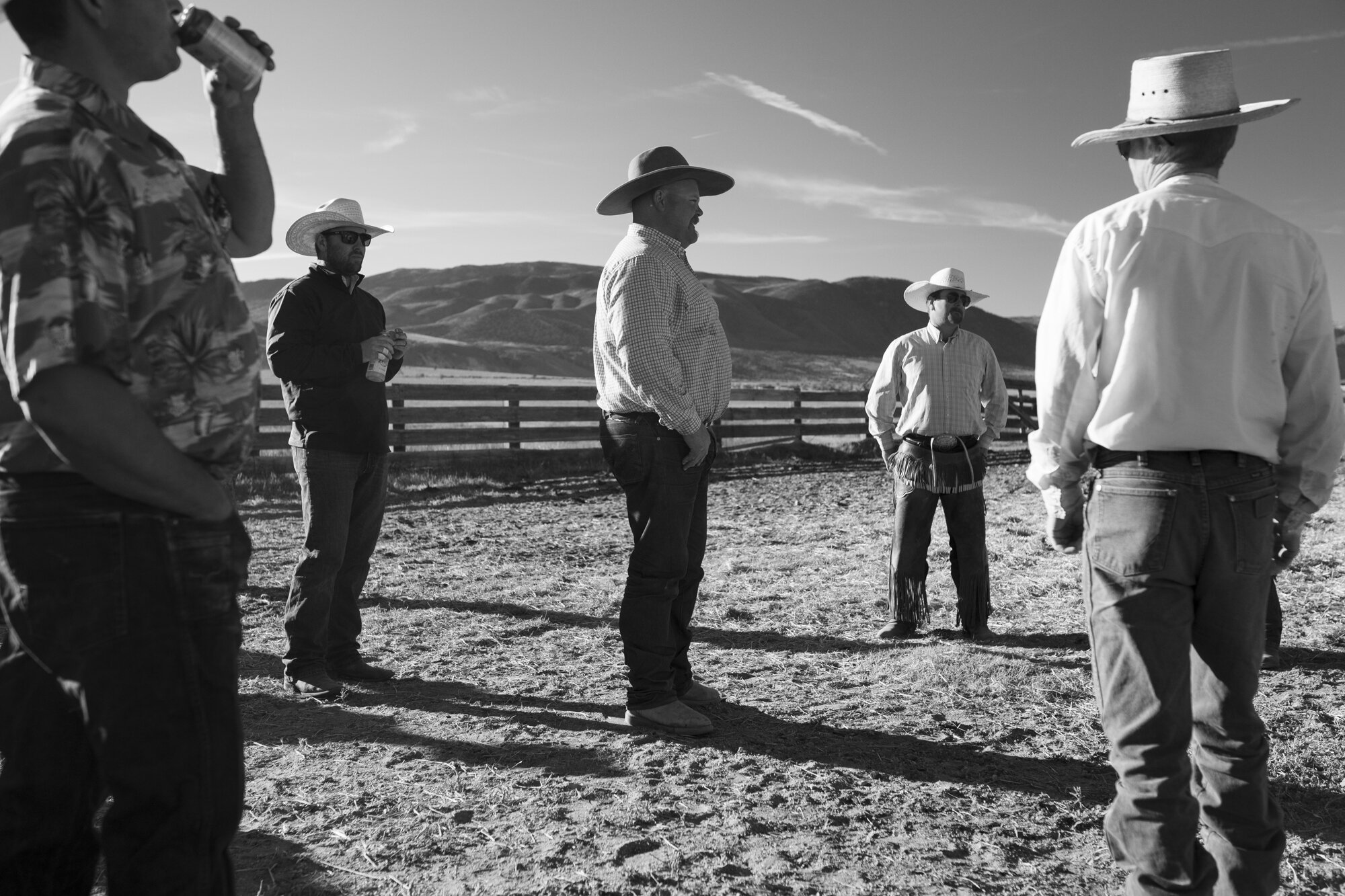
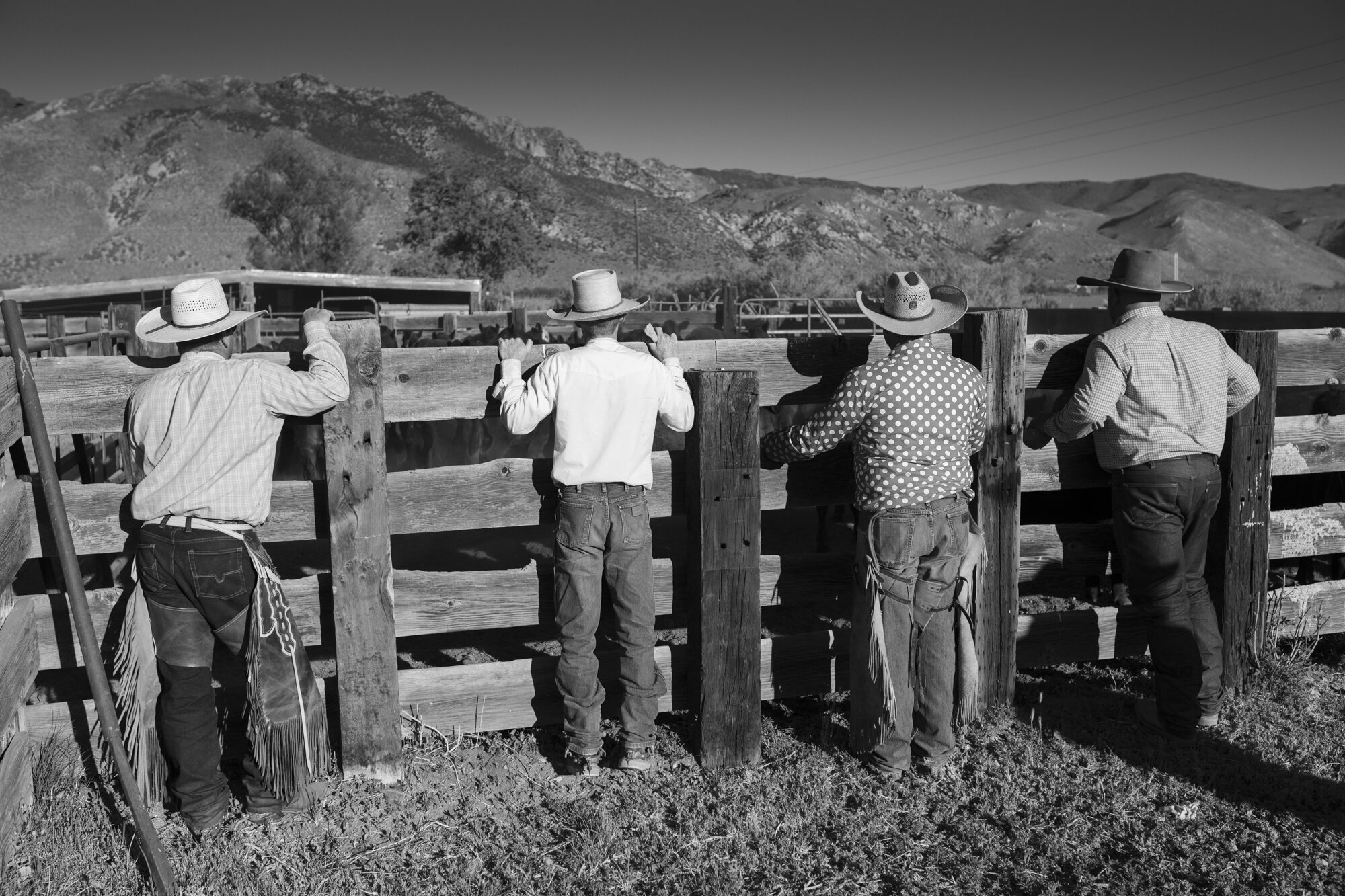
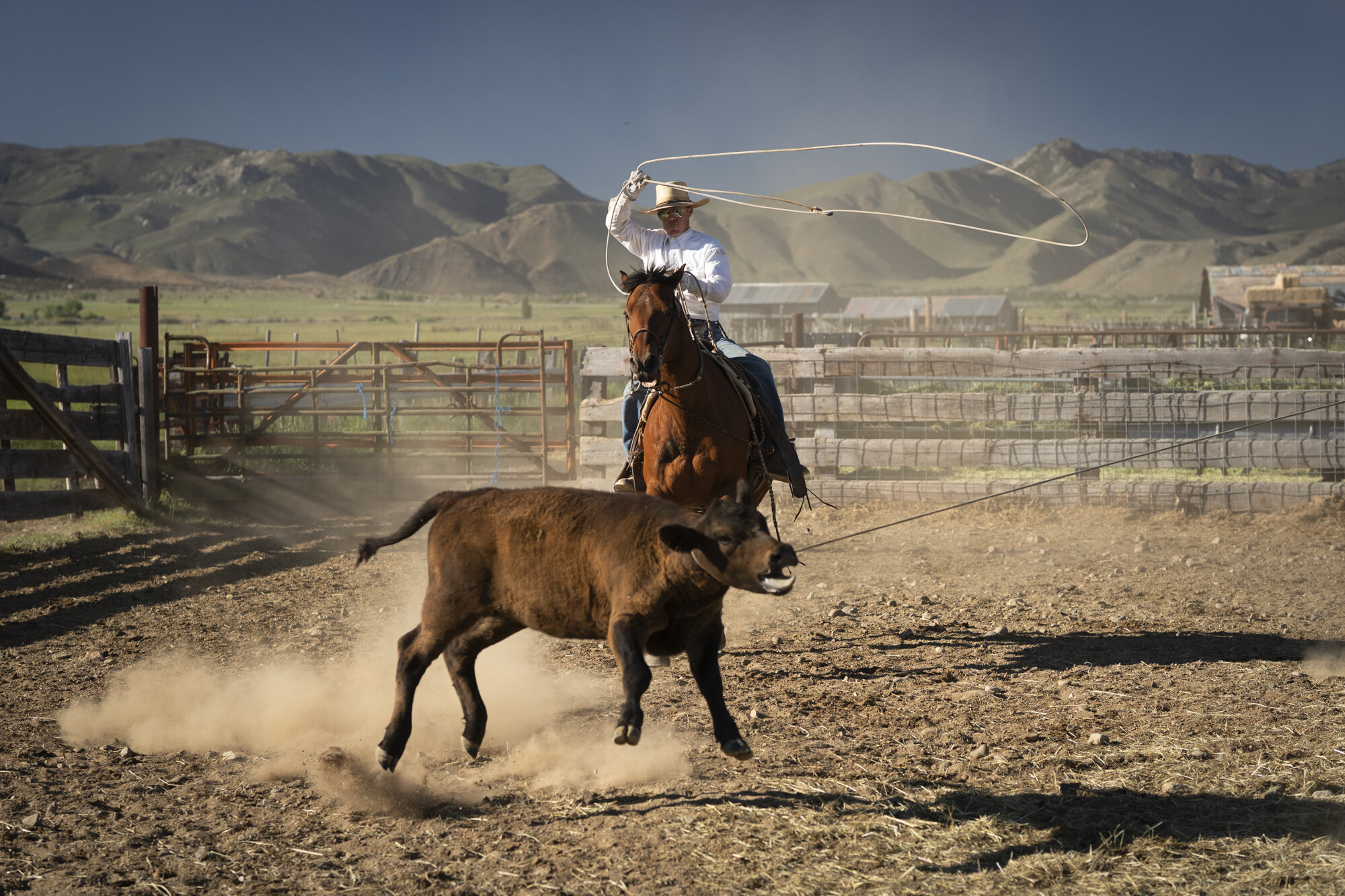
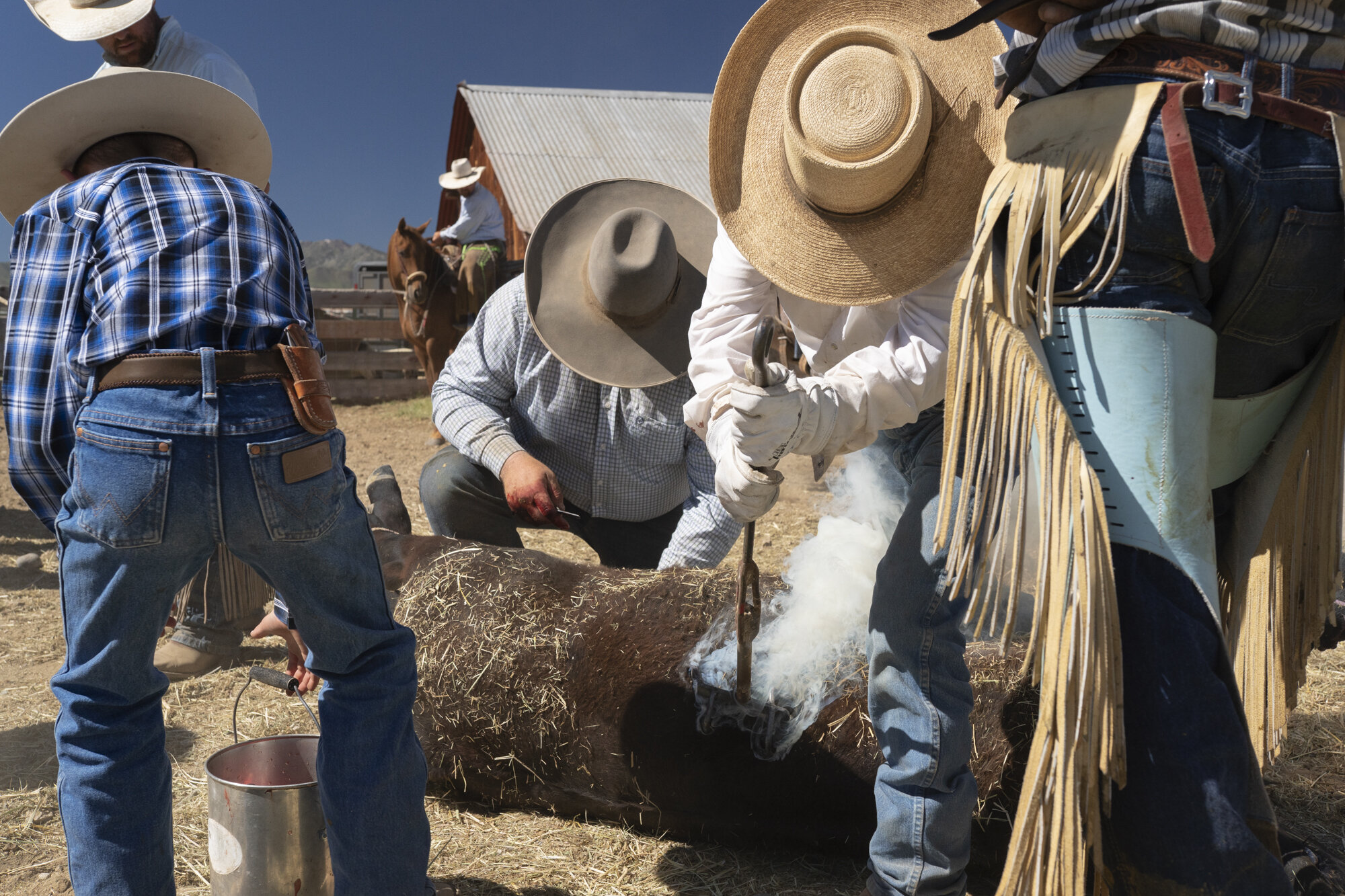
My work as a Western and cowboy photographer has never been about staged moments or romanticized versions of ranch life. I’ve spent years traveling throughout the American West, documenting real working cowboys on historic ranches, often in harsh conditions and far from anything resembling a photo shoot.

These are early mornings, long days, weather-beaten faces, and generations of knowledge passed down through hands that still carry ropes, saddles, and responsibility. Photographing this world requires patience, trust, and a deep respect for the culture.

Western Horseman’s recognition reflects that approach — one grounded in observation, honesty, and time spent earning access.

Photographing the Working Cowboy

Much of my photography focuses on:

  • Cowboys and ranch hands at work

  • Western horsemanship and ranch traditions

  • Historic ranches across Texas, New Mexico, Montana, Wyoming, and beyond

  • Quiet moments between the work — where the culture reveals itself

These photographs aren’t about nostalgia for something lost. They’re about documenting a way of life that still exists, often misunderstood or oversimplified. Cowboys today are as committed, skilled, and resilient as ever, and their stories deserve to be told accurately.

Why This Recognition Matters

Being acknowledged by Western Horseman is different from being featured by a general photography publication. It comes from within the culture itself — from a magazine that understands ranching, horsemanship, and Western life at a granular level.

That distinction matters.

For collectors, editors, and brands working in the Western space, this recognition serves as confirmation that the work is rooted in lived experience rather than surface-level aesthetics.

Western Photography for Editorial, Commercial, and Fine Art Use

In addition to editorial storytelling, my Western photography is used in:

  • Commercial and brand campaigns

  • Museum and gallery exhibitions

  • Fine art print collections

The common thread is authenticity. Every image is created in real environments, with real people, and without manufactured narratives.

Thank You to the Western Horseman Community

I’m grateful to Western Horseman for the acknowledgment and to everyone who supports thoughtful documentation of Western culture. Recognition like this reinforces why it’s important to continue investing time in long-term projects that honor the people and traditions of the American West.
View the Cowboy Photography Gallery

Shop Western Home Decor

Best photographer - Western Horseman Magazine

Western Horseman Magazine nomination badge recognizing Rob Hammer as one of the best Western photographers.
Buck Brannaman Photograph

Buck Brannaman Horse Training Photography

Imagine being a fly on the wall while Marlon Brando rehearses alone. Or having an empty Yankee Stadium while Mickey Mantle takes batting practice.

Witnessing mastery up close is rare. It’s the kind of thing people usually pay for—if they can get access at all.

Every now and then though, it just happens. Right place, right time.

That’s how I found myself watching Buck Brannaman work on a hot, buggy afternoon at the OW Ranch in Montana.

An Unplanned Lesson on the OW Ranch

It wasn’t supposed to be a demonstration.

After a long day of branding calves on the OW Ranch in Montana, the crew was back at headquarters unloading horses when a young mare named Lux refused to cooperate with the trailer. What started as a routine problem quickly turned into something else entirely when Buck Brannaman stepped in.

At first, he stood back, letting the next generation work through it. But as the struggle continued, he quietly asked for a swing.

The energy shifted immediately.

What had been a relaxed end to a branding day became a classroom. Cowboys and cowgirls—many of them highly skilled—gathered in silence, watching closely. Not for spectacle, but for understanding.

What followed wasn’t dramatic. It was slow. Repetitive. Nearly imperceptible at times.

For over two hours, Buck worked inside the tight confines of the trailer, using subtle pressure and release—tap by tap of a flag—asking the horse to think rather than react. Progress came in inches. Then disappeared. Then returned again.

Some people drifted off as the work stretched on. Most stayed, knowing exactly what they were witnessing.

Patience wasn’t just part of the process—it was the process.

Lux wasn’t his horse. There was no audience to impress, no clinic to run. Just a problem that needed solving, and a responsibility to see it through. By the end, the same horse that had been slamming against metal in fear could walk calmly in and out of the trailer.

No celebration. No moment of triumph. Just a quiet acknowledgment: “that’s the one.”

For those who stayed, it was a rare kind of access—watching mastery reveal itself not through intensity, but through discipline, restraint, and time.

What Makes Buck Brannaman Different

Buck Brannaman’s approach to horsemanship helped inspire the film The Horse Whisperer starring Robert Redford, but what you see in a film doesn’t fully translate to real life.

Out here, there’s no script.

His work isn’t built on force or speed. It’s built on timing, feel, and an ability to read subtle changes most people would miss entirely. The kind of discipline that doesn’t look impressive unless you understand what’s happening.

That’s what makes photographing him difficult—and interesting.

There’s no single defining moment. No peak action. The story lives in the small shifts. A release of pressure. A change in posture. A horse beginning to trust.

You don’t chase those moments. You wait for them.

Photographing Real Cowboy Work in the American West

Moments like this are the reason I’ve spent years photographing working cowboys across the American West.

Not staged shoots. Not recreations.

Real ranches. Real work. Long days that start before sunrise and end when the job is done.

The West is often portrayed through extremes—speed, grit, drama—but most of it exists in quieter spaces. In the discipline it takes to do something well. In the repetition. In the patience.

What I saw that day on the OW Ranch wasn’t unusual in the sense that it happens all the time. But being there to witness it—without interruption, without performance—that’s rare.

And that’s what I try to carry into the photographs.

Fine Art Prints & Licensing

This body of work is part of a long-term project documenting working cowboys, historic ranches, and the realities of life in the American West.

For collectors, a selection of museum-quality prints is available here: View Fine Art Prints

For brands, editorial, or commercial use, image licensing is available upon request - rob@robhammerphotography.com

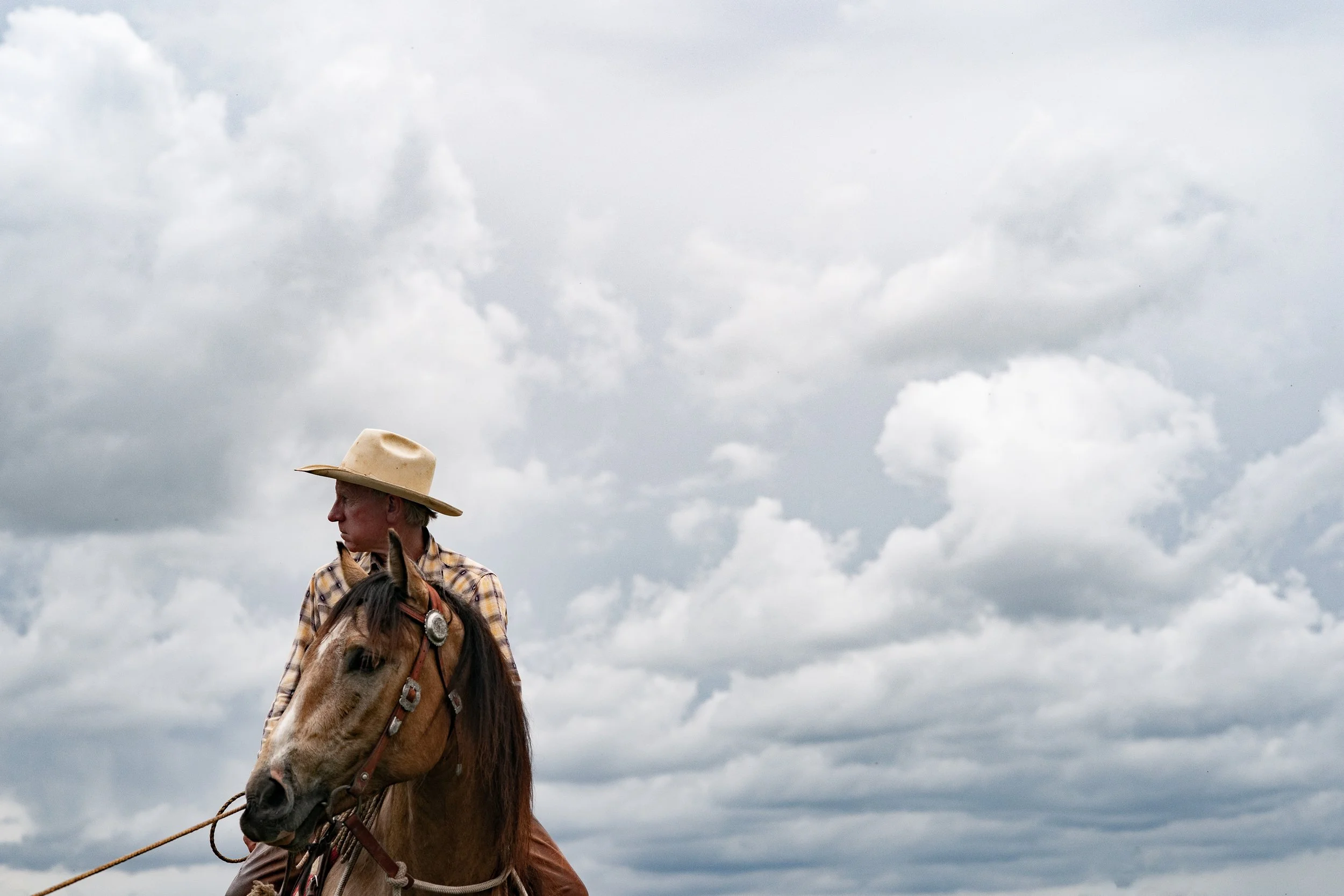
Cowboy sitting on a horse under a wide cloudy sky in Montana, looking off into the distance

Buck Brannaman sitting quiet on horseback under a wide Montana sky, taking in the moment before stepping in. The kind of stillness that comes from knowing when not to act.

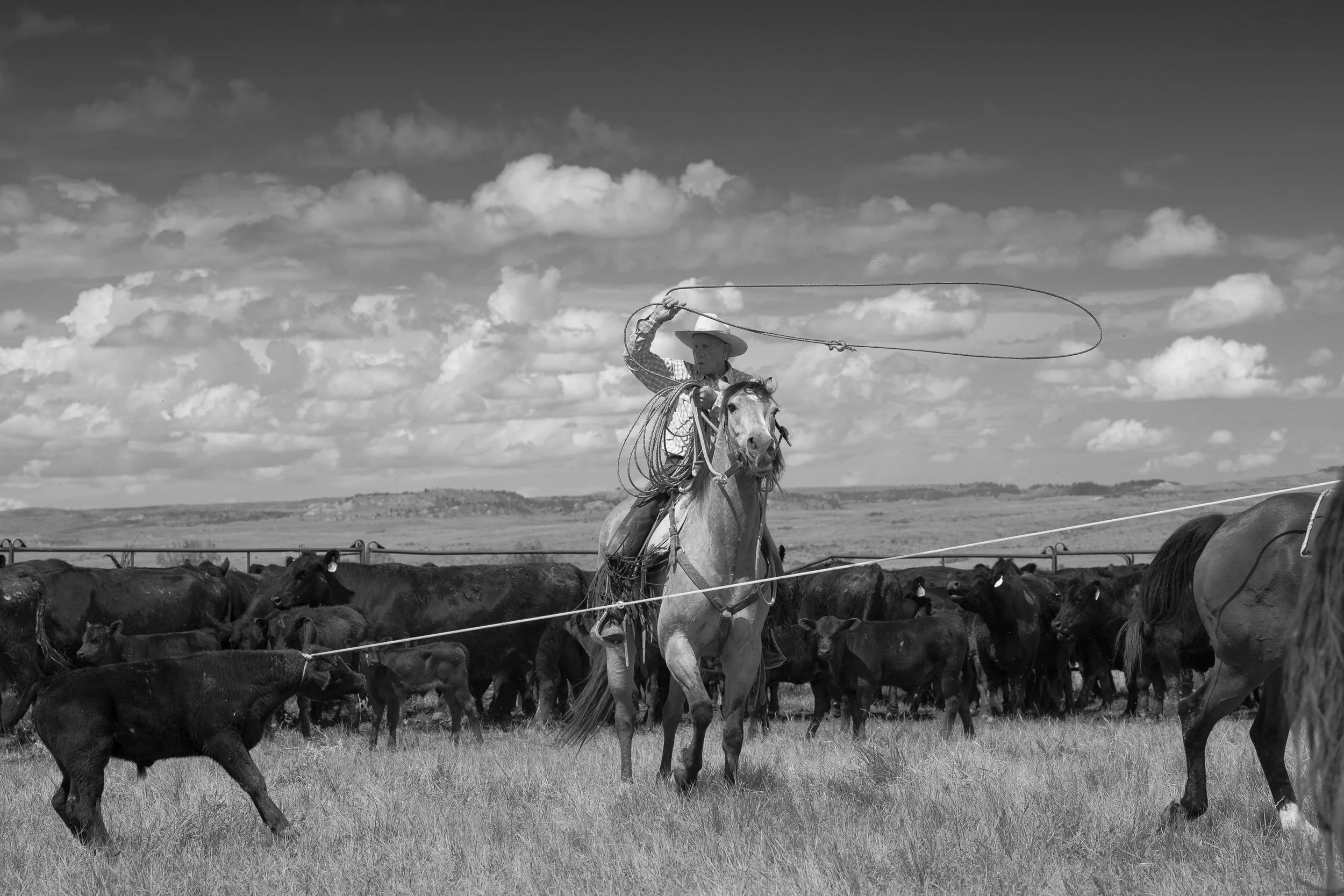
Black and white photo of a cowboy on horseback roping cattle in an open field

Buck Brannaman roping through cattle during the same long day of work. Different task, same rhythm, steady and controlled from horseback.

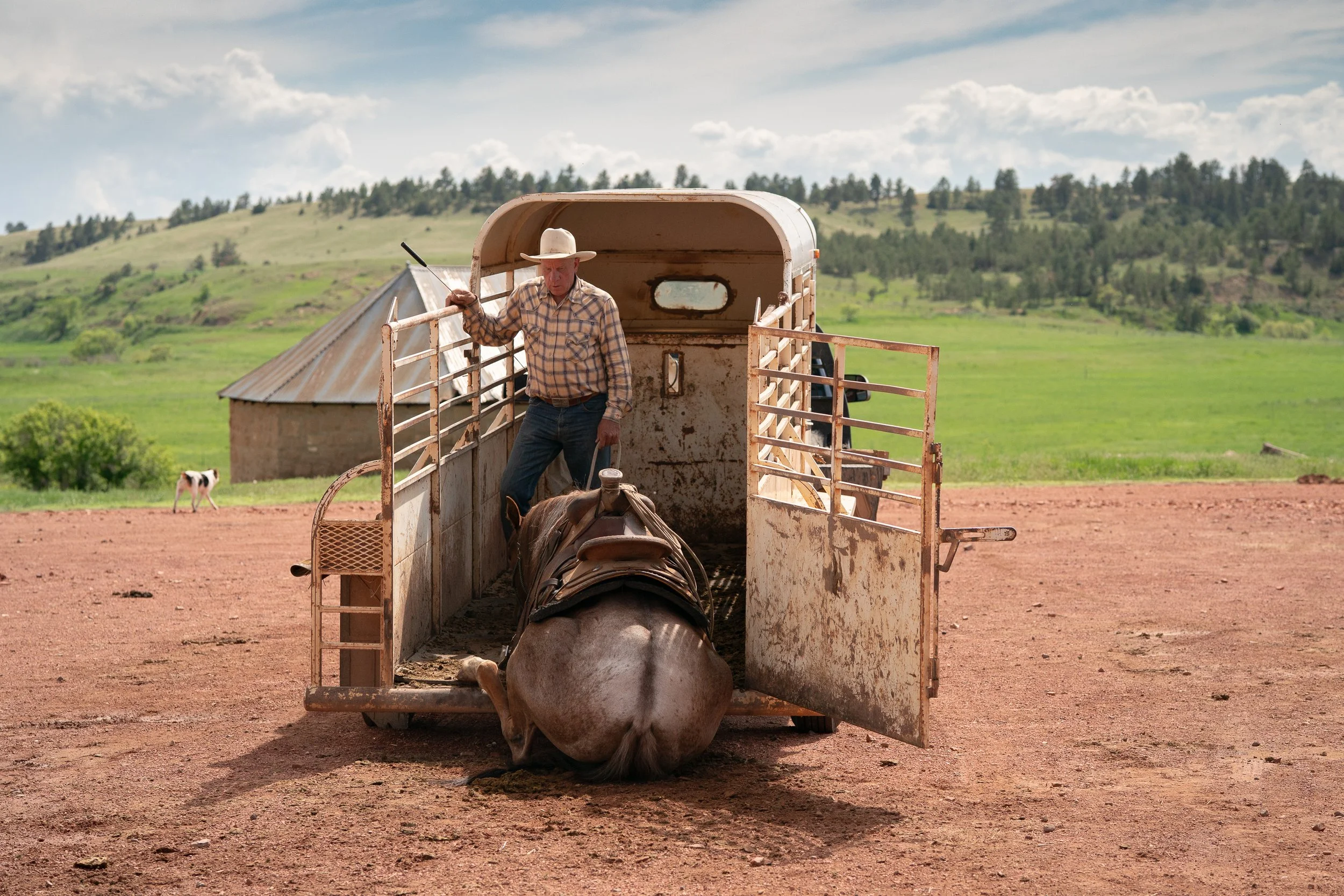
Horse sitting down inside a trailer while Buck Brannaman stands nearby during training in Montana

A horse that shuts down instead of moving forward, sitting back inside the trailer. This is where most would quit, but the work stays the same, steady and patient until something changes.

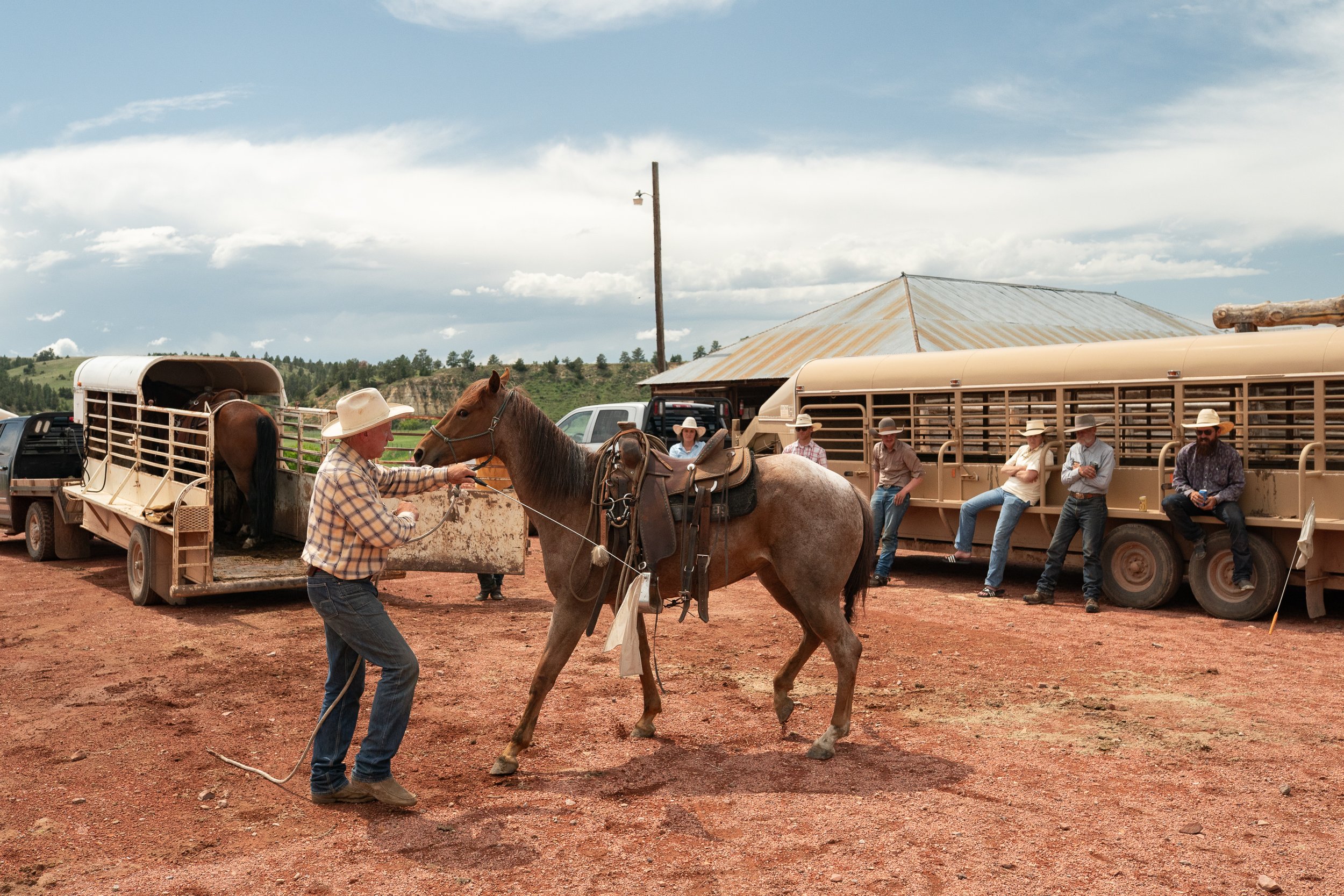
Buck Brannaman working a horse with a lead rope while cowboys sit and watch near trailers on a Montana ranch

Working a young horse away from the trailer while a line of cowboys sits back and watches. No one says much. When someone like this starts working, you pay attention.

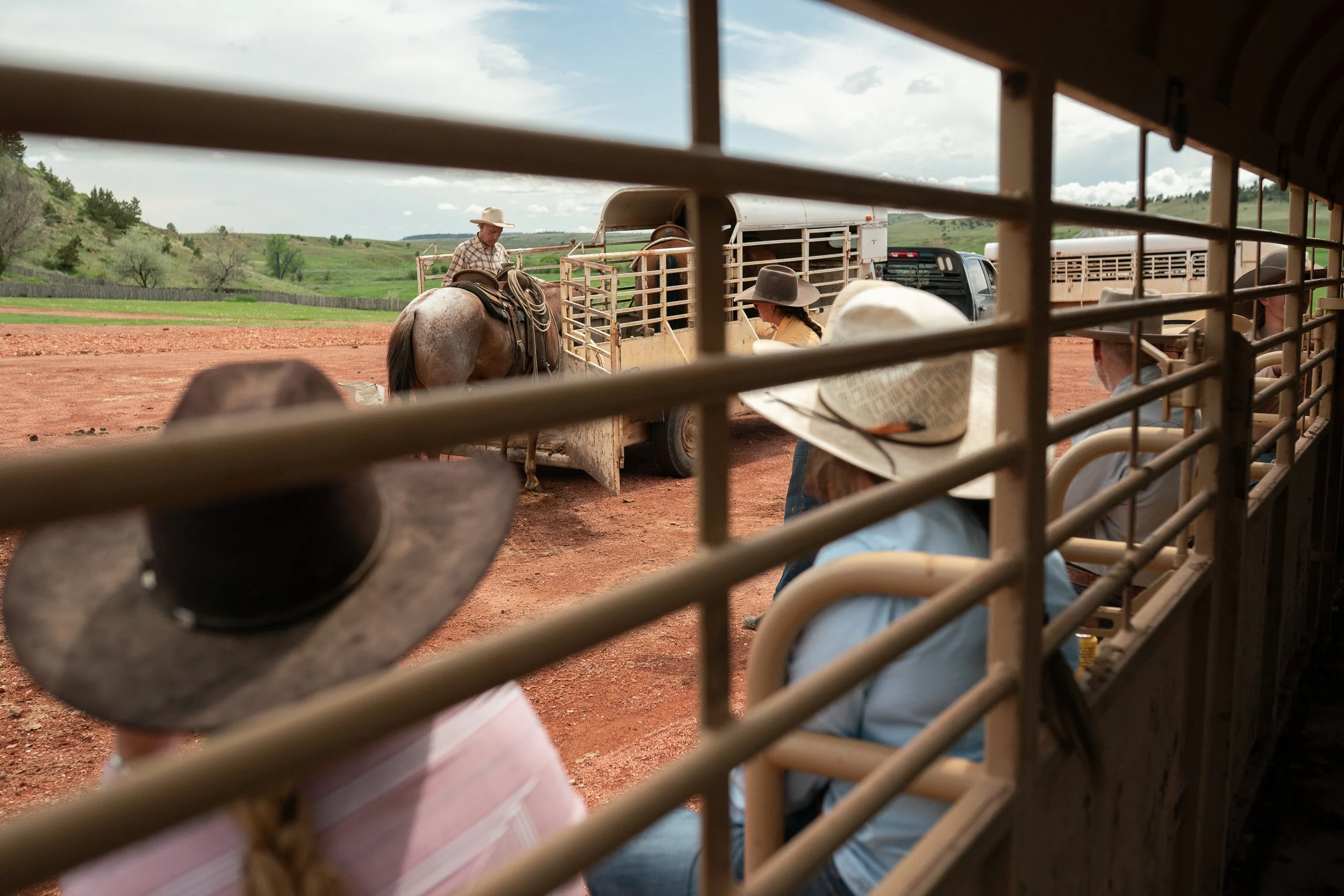
Cowboys watching through the rails of a trailer as Buck Brannaman works a horse near another trailer in Montana

Watching through the rails of a trailer, catching pieces of the work as it unfolds. Not a formal lesson, just a rare chance to see it up close.

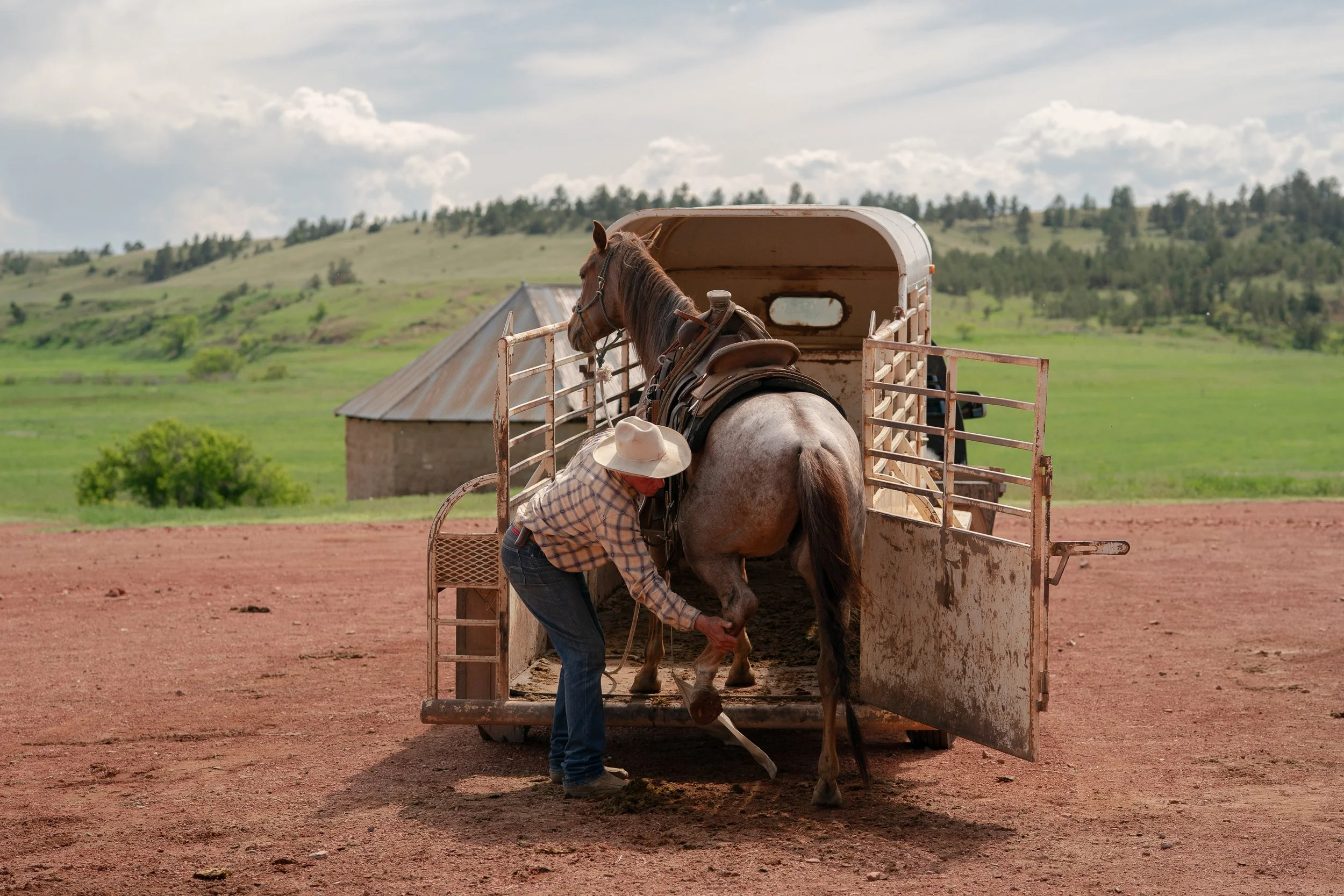
Buck Brannaman guiding a horse stepping into a trailer on a ranch in Montana

Buck Brannaman working at the edge of the trailer, asking the horse forward one step at a time. No force, just timing and feel, the kind of work that builds slowly in the heat after a long day.

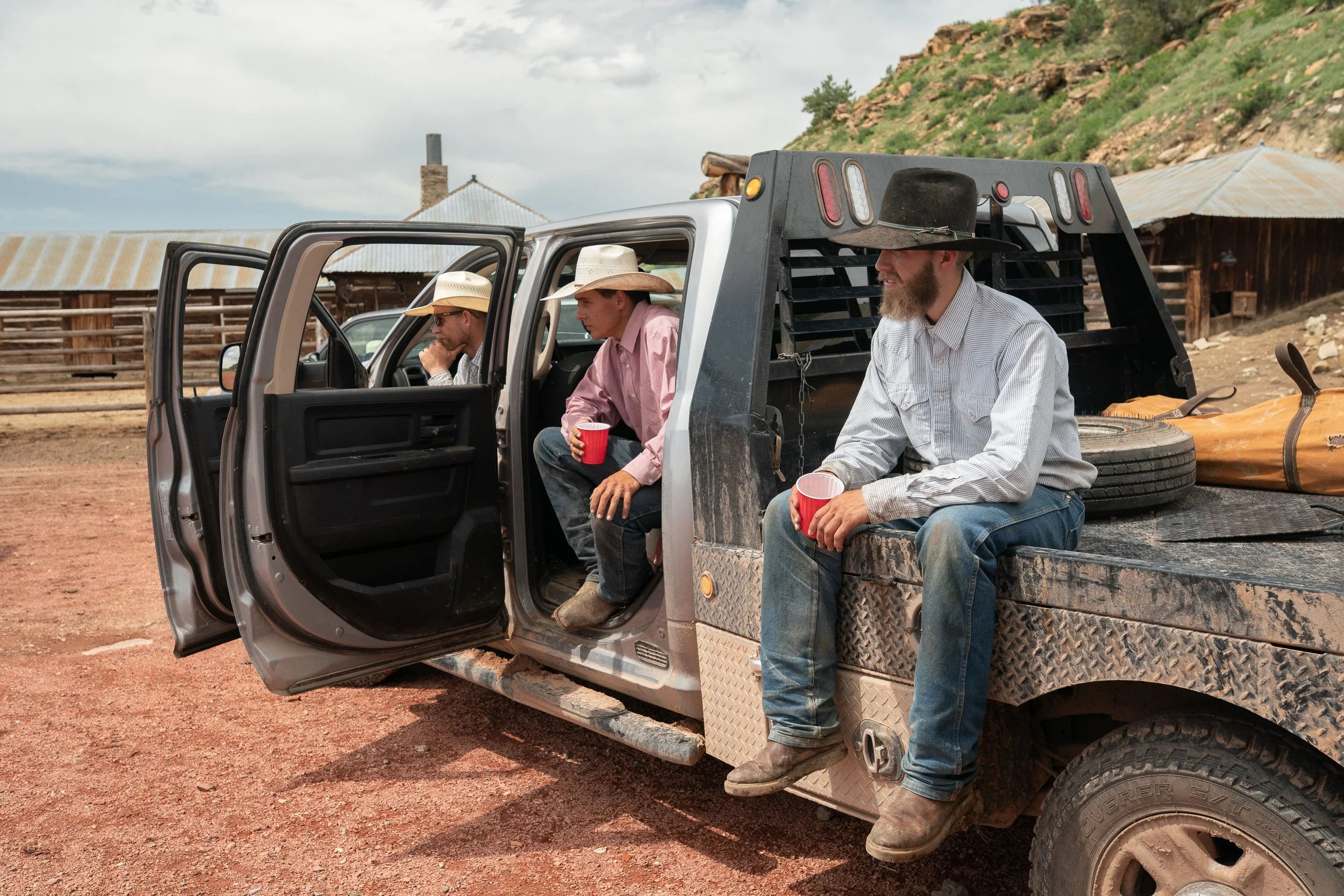
Cowboys sitting on and inside a pickup truck holding drinks while watching horse training on a Montana ranch

Cowboys gathered on a truck, drinks in hand, watching the work unfold from a distance. What started as the end of the day turned into something worth staying for.

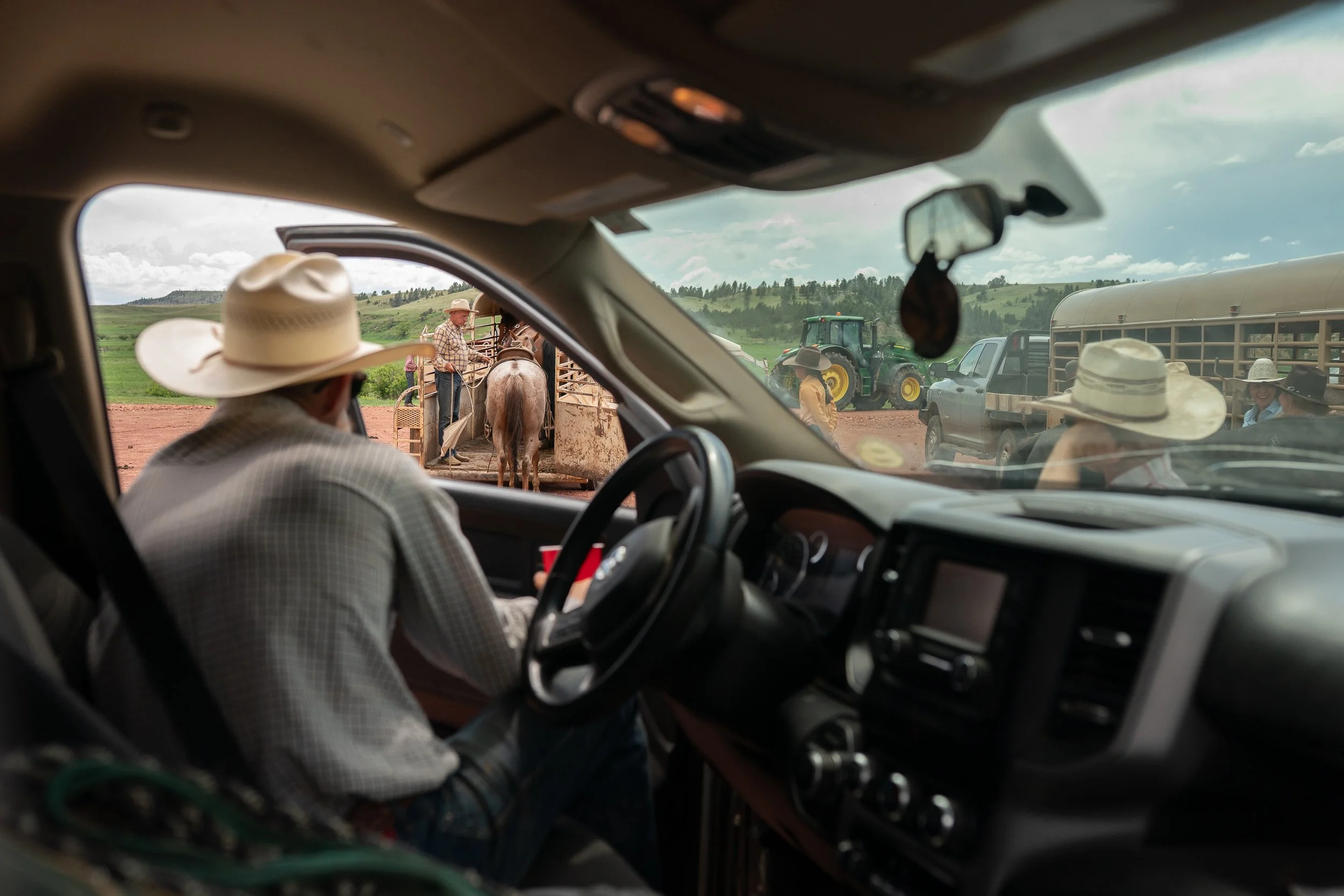
View from inside a pickup truck of a cowboy watching Buck Brannaman work a horse near trailers on a ranch

From inside a truck, looking out at the same quiet process. Different vantage point, same focus, everyone tuned in to the small changes.

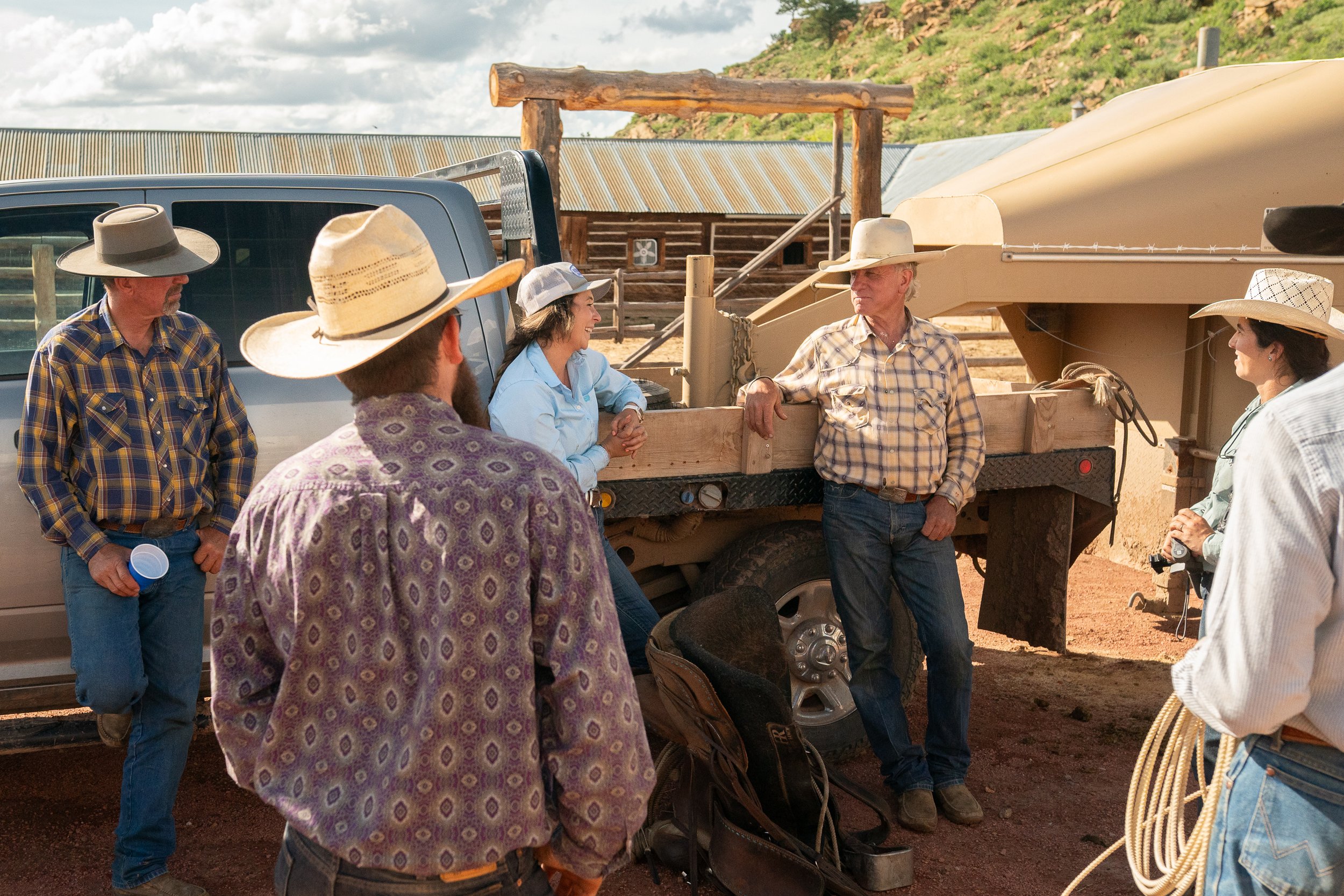
Group of cowboys standing and leaning around a ranch truck talking after work in Montana

Gathered around the truck after the work, talking it through while it is still fresh. The kind of conversations that come from seeing something done right.

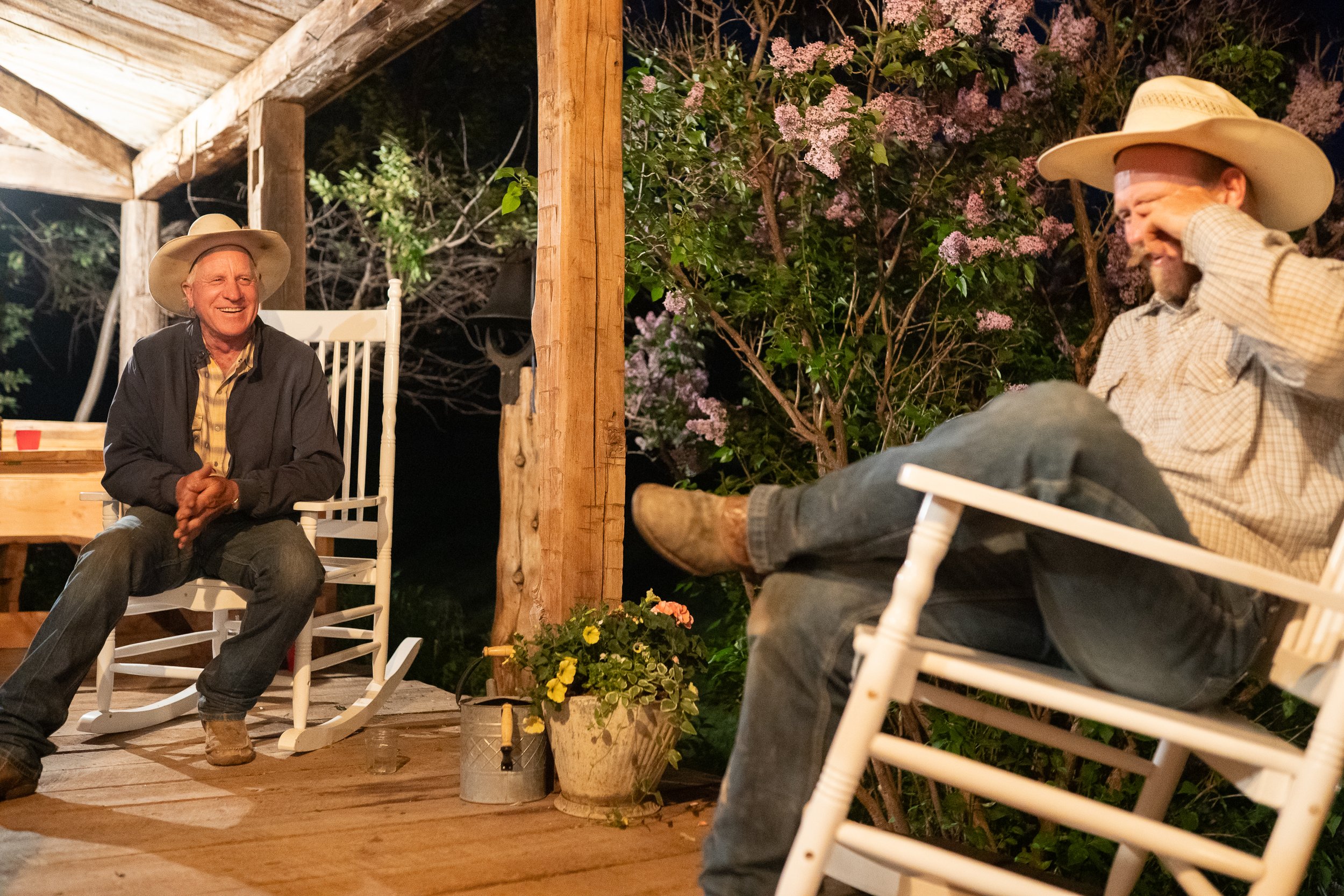
Buck Brannaman sitting on a porch at night talking with another cowboy in rocking chairs

Late evening on the porch, the work behind them and the pace slowed down. Stories, lessons, and time to sit with what the day had to offer.

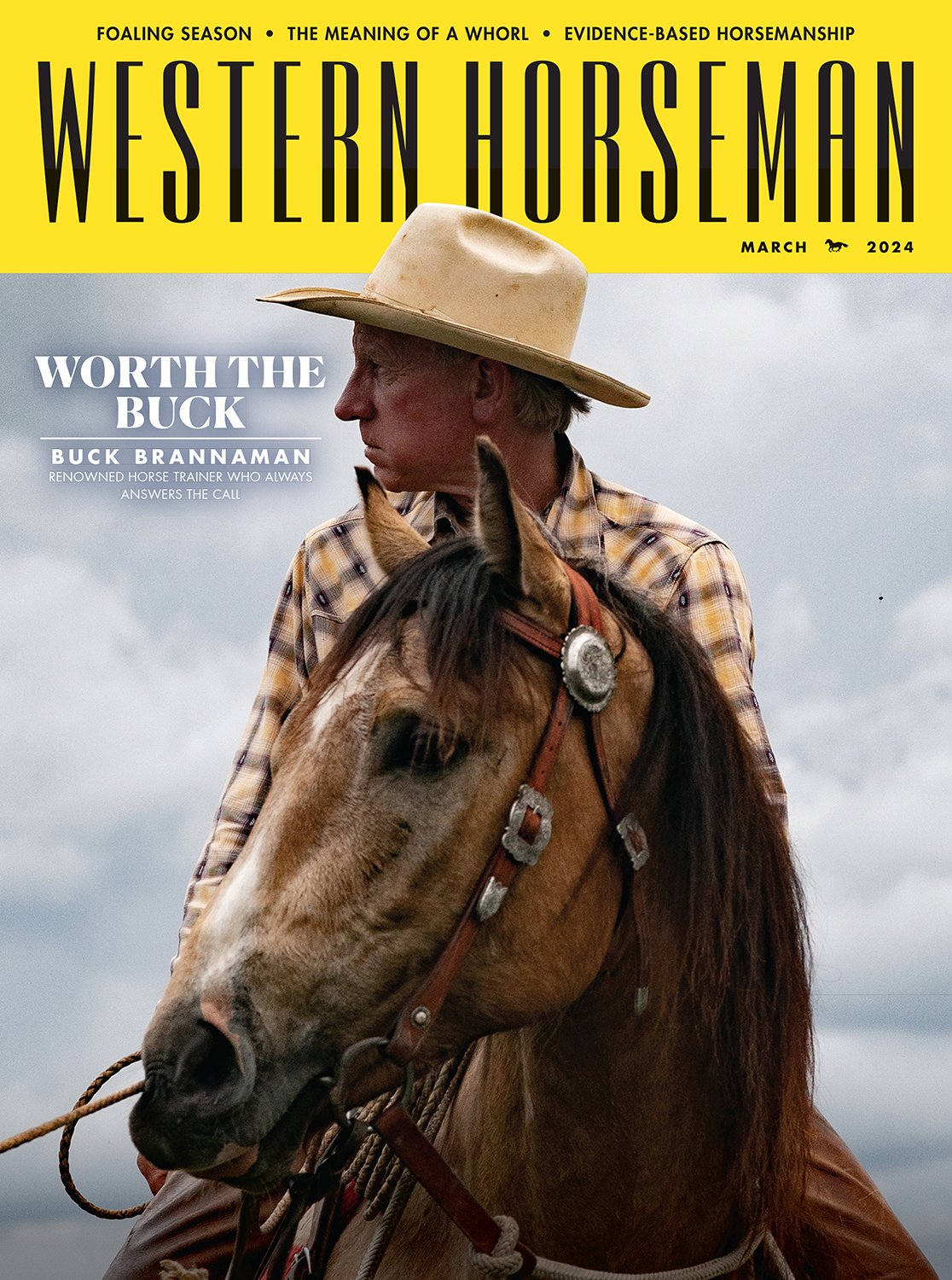
Buck Brannaman on the cover of Western Horseman Magazine

Buck Brannaman - Western Horseman Magazine

Montana Cowboy Photographs

Montana Cowboys through the Lens: Fine Art Prints of Grit, Sky & Tradition

Big Sky Moments & Cowboy Spirit—For Fans of Yellowstone and Real Ranch Life

When I pull up to a Montana ranch with a camera, I'm looking for more than a scene—I’m looking for something true. That first breath of morning air, the way the horizon stretches. Montana cowboys move quietly, with wear on their boots and stories in their hands. They don’t need an audience. Their work—reining, branding, riding out—isn’t performance, but it carries power anyway.

I shoot what feels real: cowboys leaning into saddle leather at sunrise, the sky turning cold and blue above mountain ridges, or riders rounding up cattle under heavy clouds. Moments like that—untouched, gritty, alive—feel like they echo what Yellowstone fans see onscreen: raw Western landscape, ranch life, sweeping skies, authenticity. The Chief Joseph Ranch in Darby plays the role of the Dutton Ranch in the show, but what draws me to Montana is seeing the same rhythm of life behind the scenes.

My prints are made from those moments. Limited edition, archival prints that hold light, dust, sky, and sweat. If you’ve ever watched Yellowstone, the beauty in close‑ups of ranch gear, the way a horse’s muscle works in motion, the golden glow on barn wood—these are the same details I chase. Montana isn’t just setting; it’s character.

Whether you want to hang a Montana cowboy print above a fireplace, in a lodge, or a room that tastes of the outdoors, there’s a piece here for you. A silhouette, a dusty trail, a cowboy’s hat brim catching last light—these aren’t just photographs. They’re windows into a life rooted in land, season, purpose.

Add Western Art to Your Space
Shop Cowboy Wall Art

Montana cowboy wall art

Montana cowboy wall art prints

Cowboy wall art for fans of Yellowstone

Western cowboy photography prints

Editorial Cowboy Photographer

Professional Western / Cowboy Photography Services — Magazine & Commercial Assignments

Capturing Western Stories with Depth

The largest cattle ranch in the Southwest was the backdrop for one of my feature assignments with Western Horseman Magazine. But what that experience taught me goes far beyond one location—it’s proof of what I can bring to any ranch, any story, anywhere.

When a magazine or brand hires me, they don’t just get photos. They get someone who knows how to work in remote country, navigate ranch protocols, gain trust, and produce visuals with authenticity, emotion, and technical quality.

On the Diamond A shoot, I captured wide scenes, close portraits, action frames—each image crafted for storytelling. I’ve licensed those images, seen them published, and held to deadlines and narrative needs. This is the kind of work I’m ready to do for your next piece: whether a feature story, coffee table spread, hospitality branding, or campaign that needs real Western grit.

Let’s talk about your project. I can help with:

  • Editorial assignments (magazine features, online storytelling)

  • Licensing imagery for publications or brand use

  • Commissioned ranch photography for hospitality, books, or design

Scroll through the Diamond A images below and imagine what we could do together for your next Western story and get in touch if you’d like to collaborate - rob@robhammerphotography.com

You can also view a selection of fine art cowboy photography prints or more from cowboy series

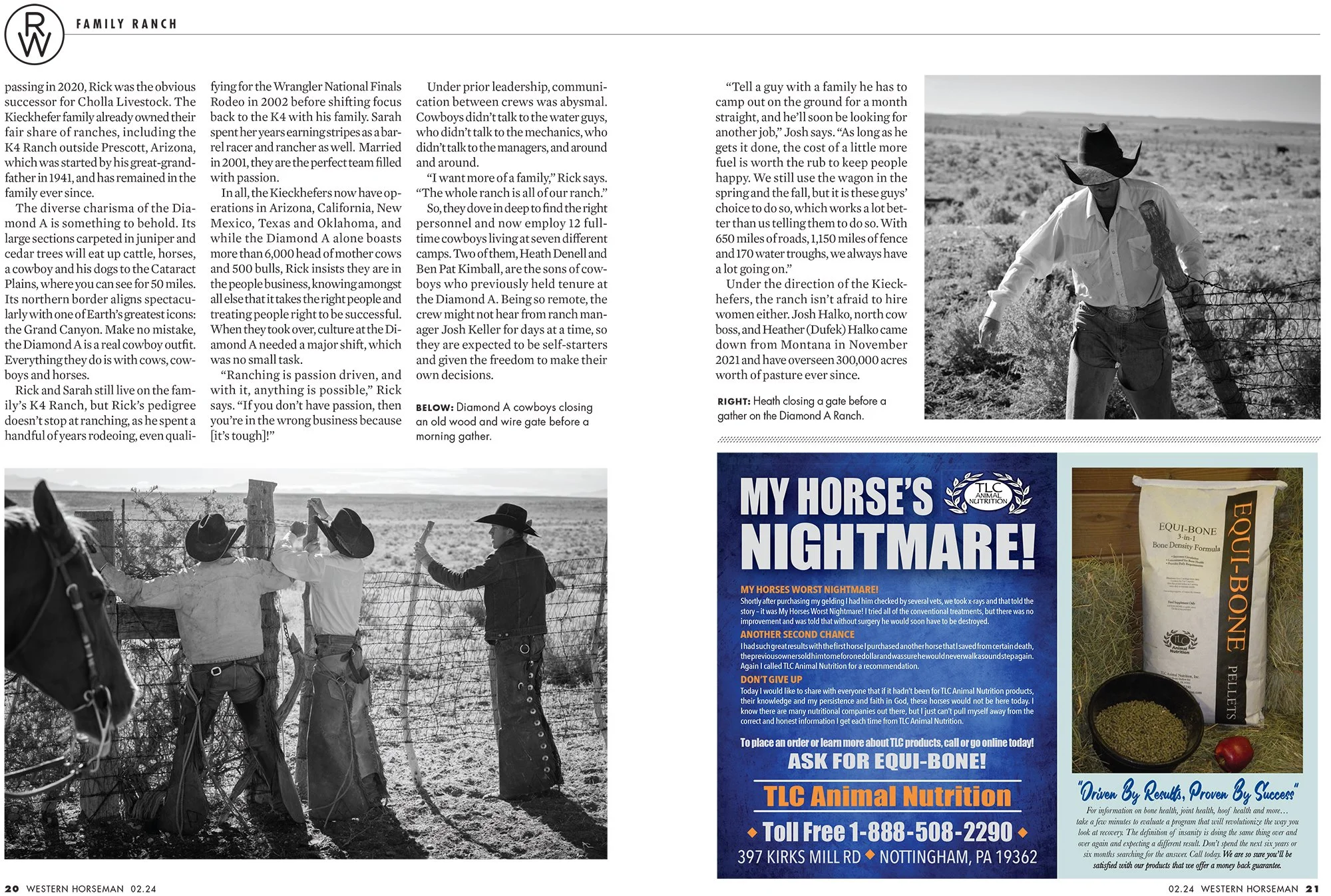
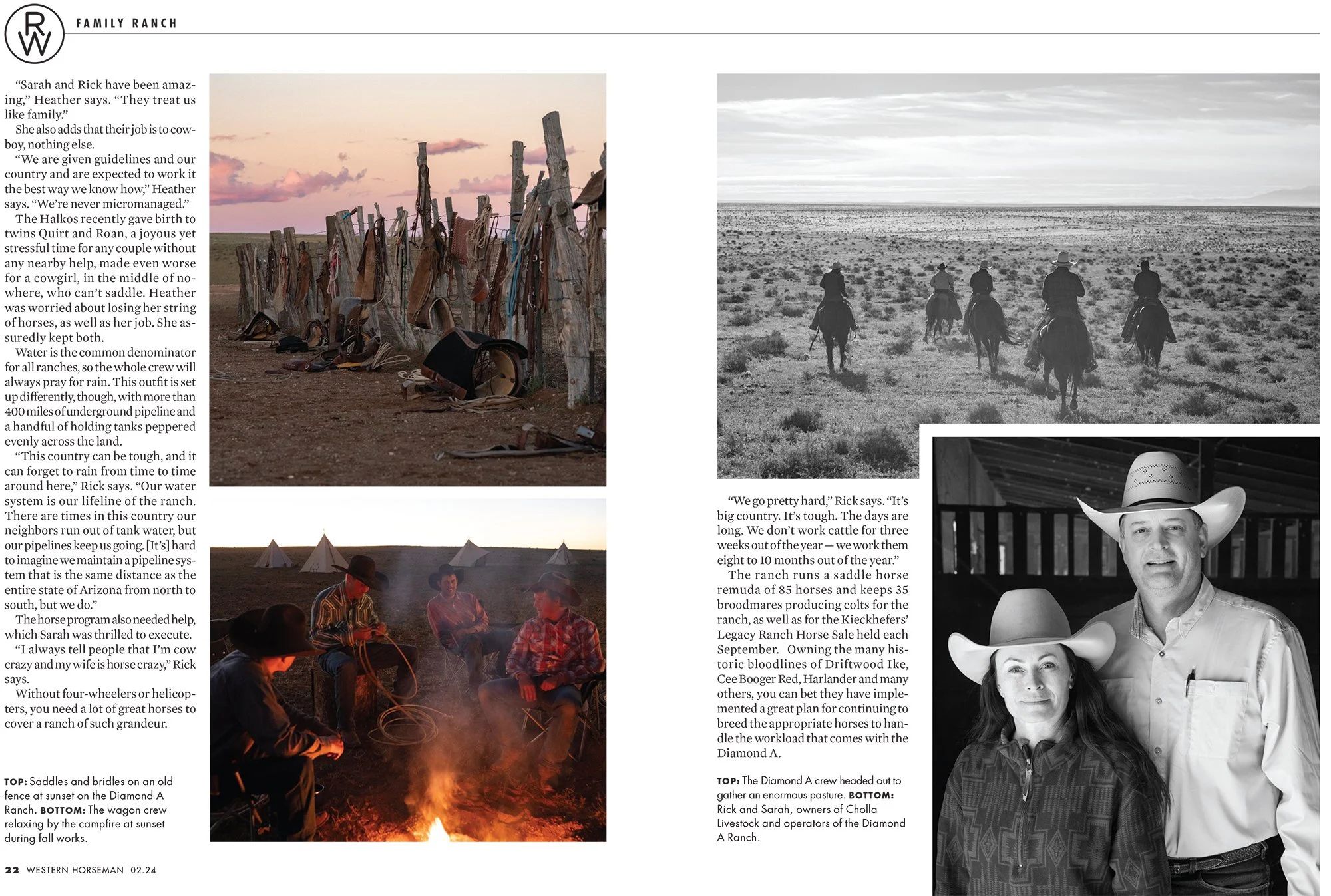
Original article from the magazine:

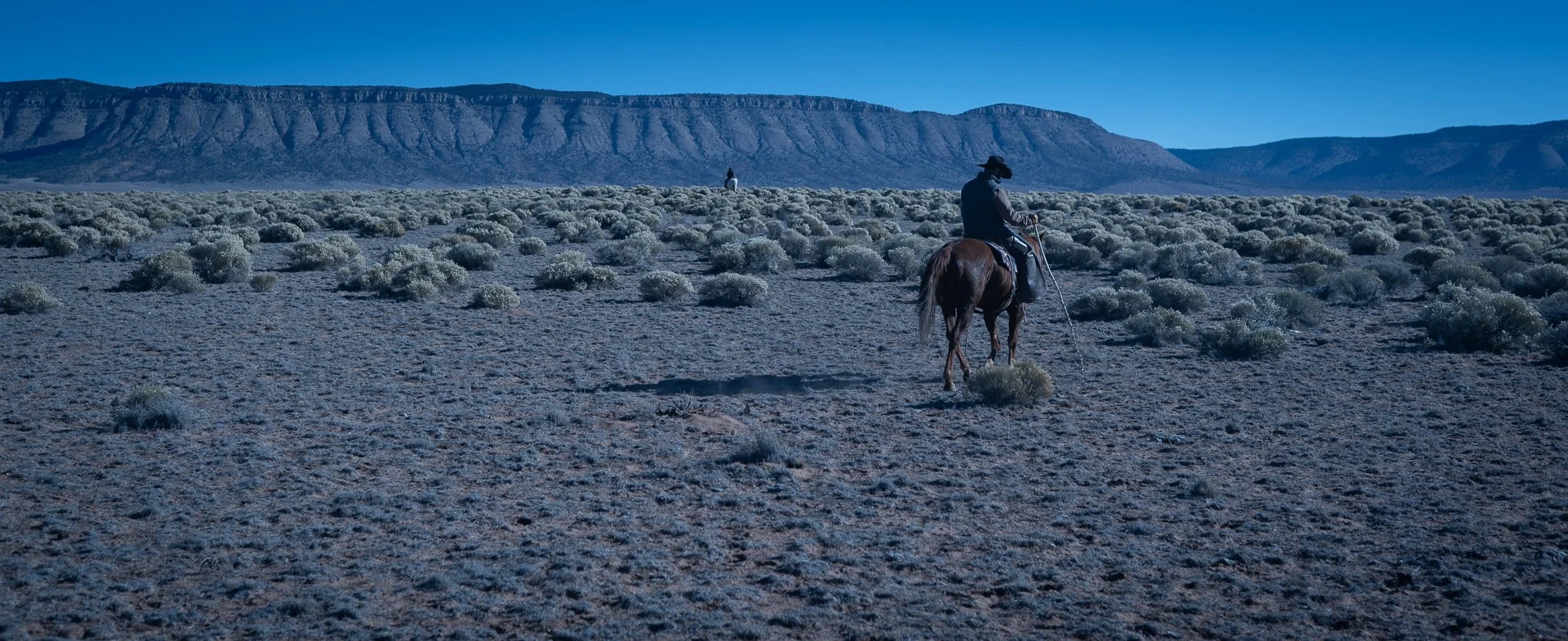
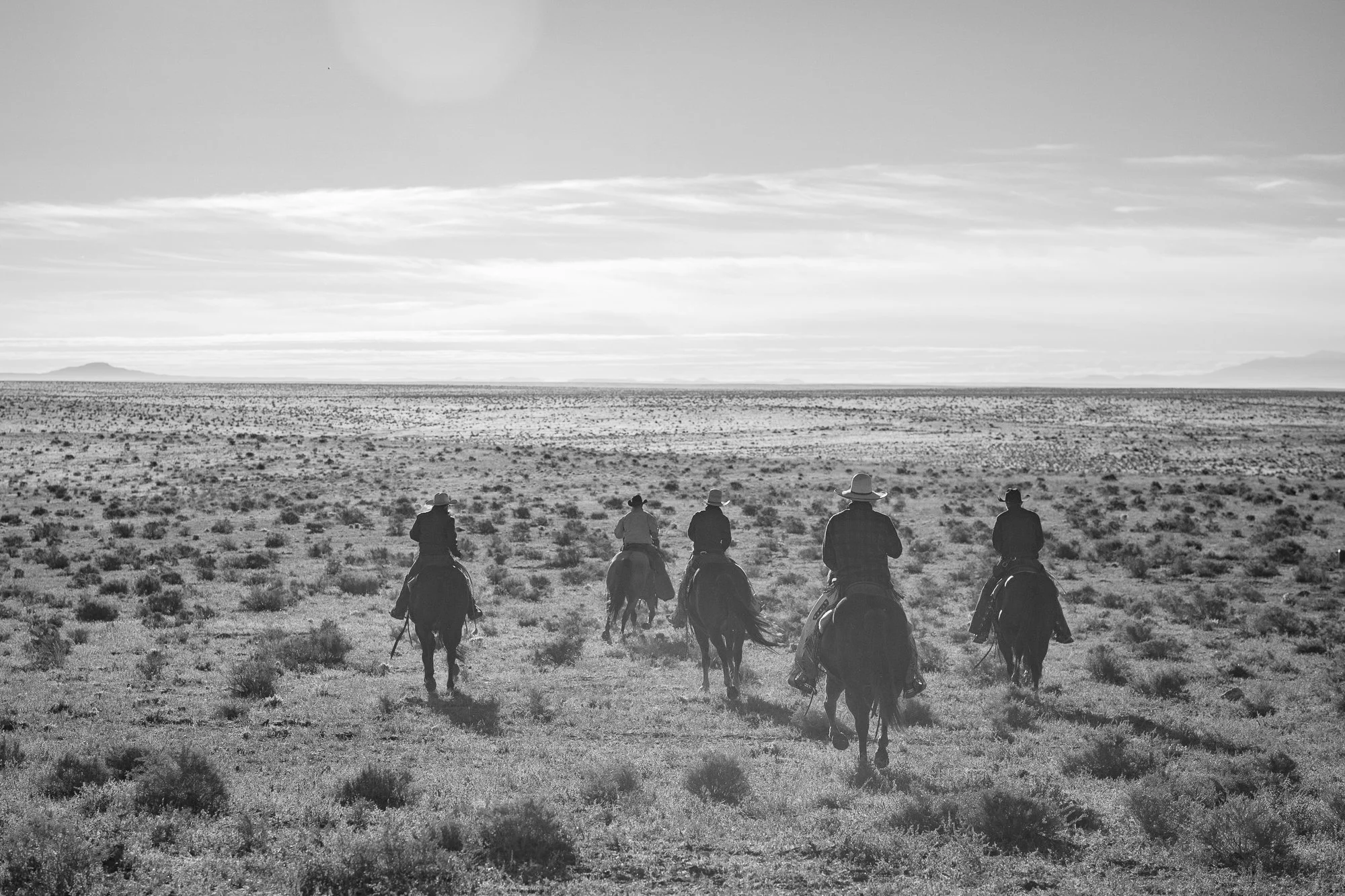
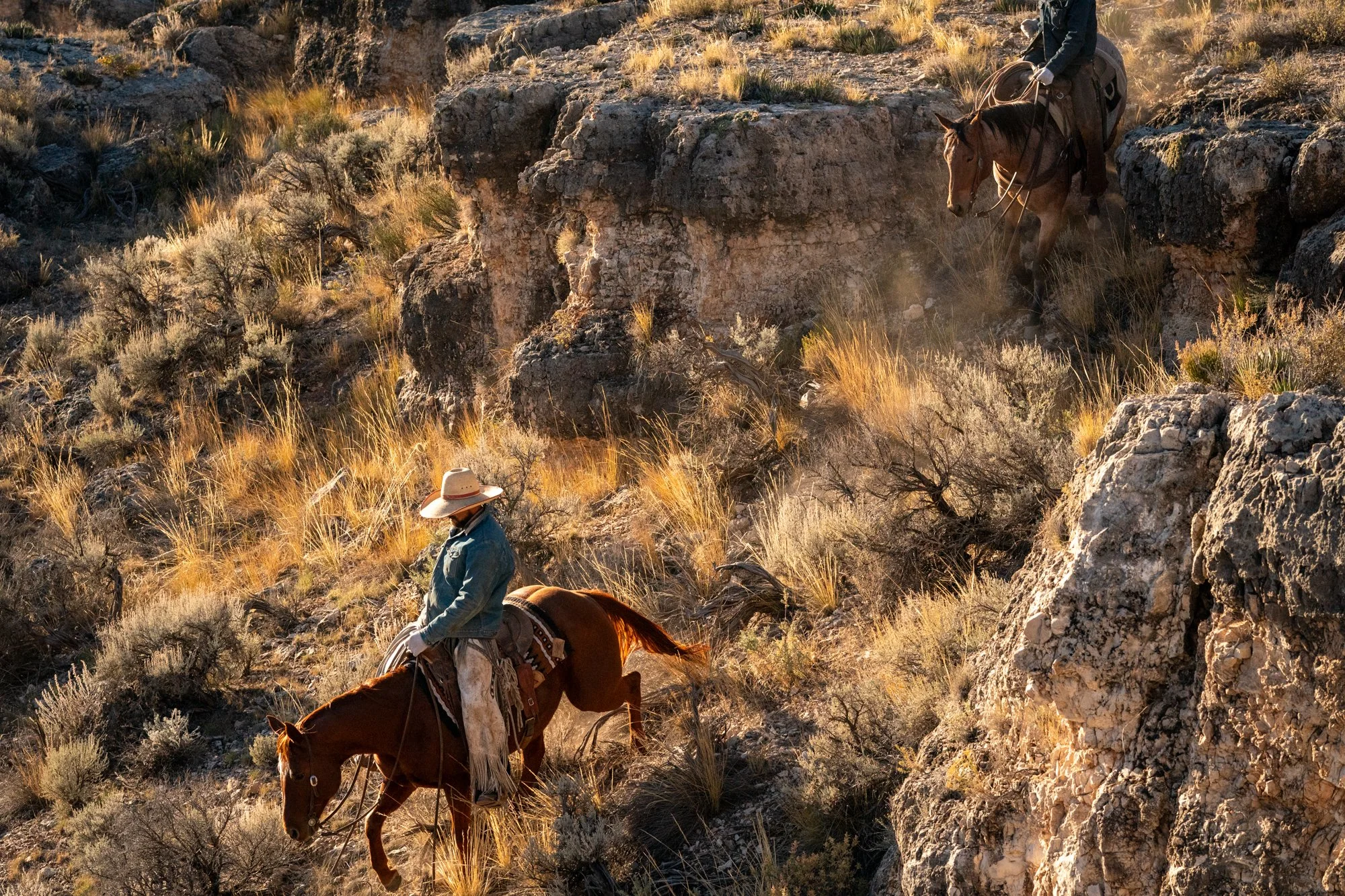
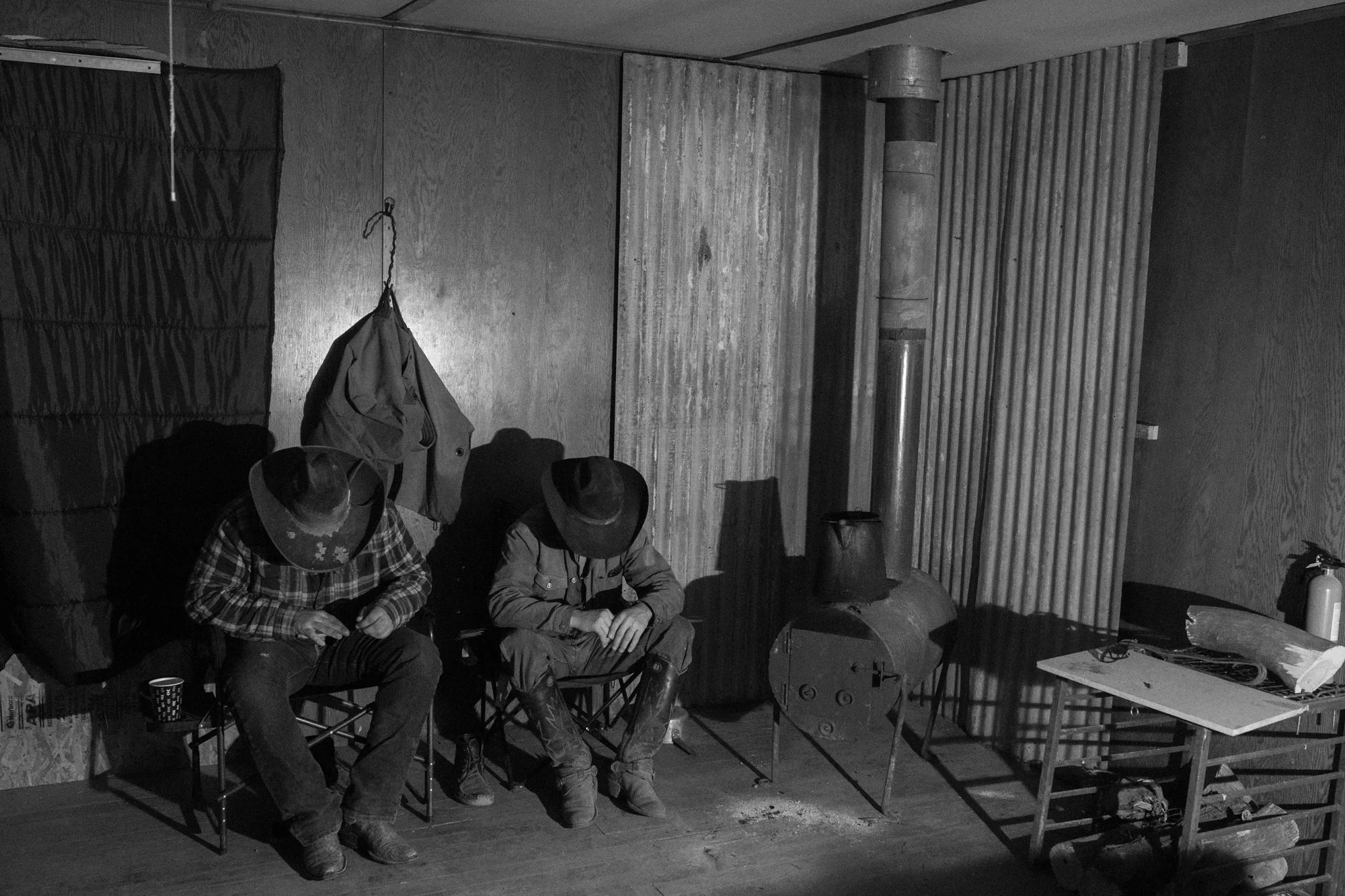
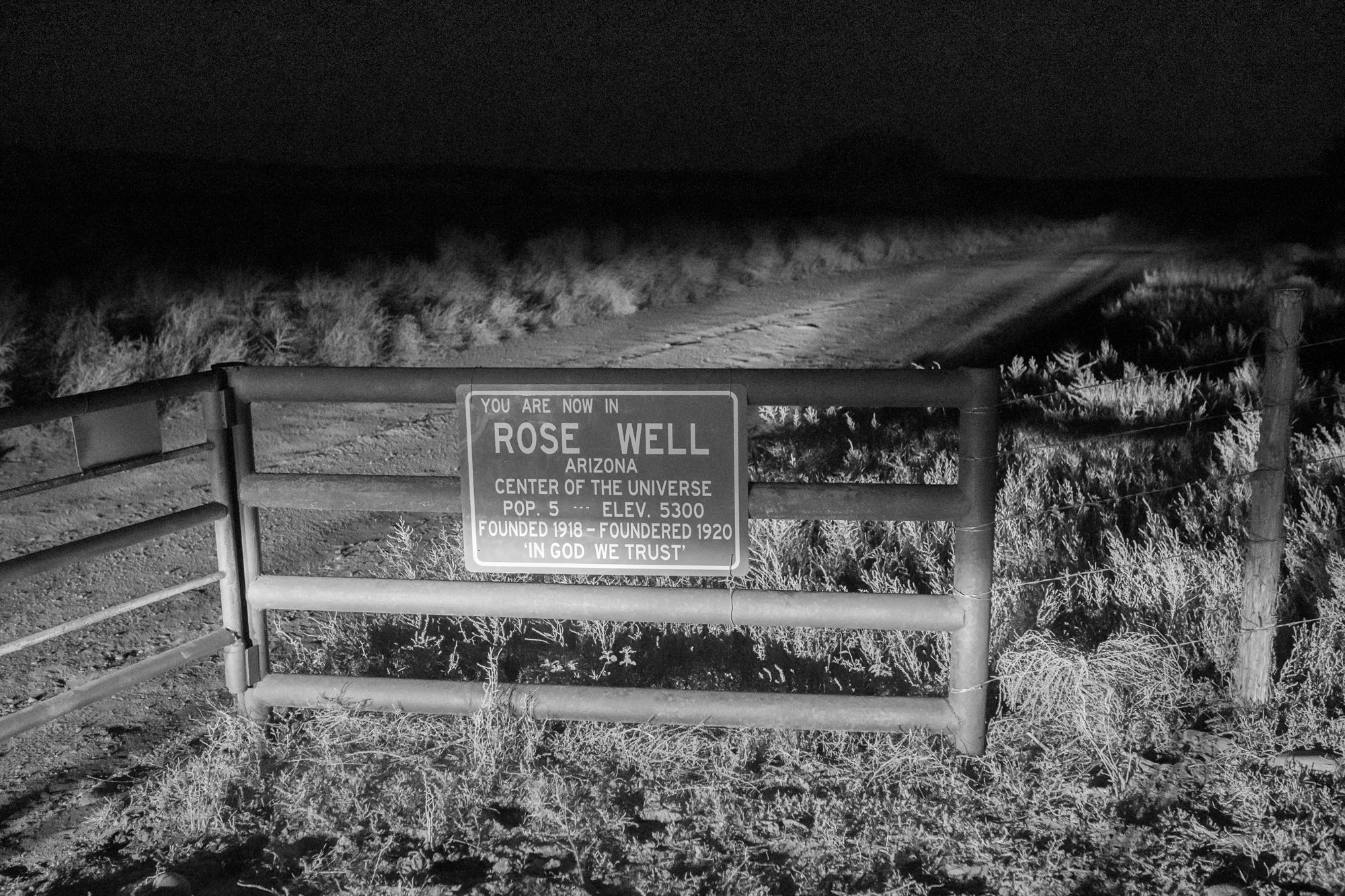
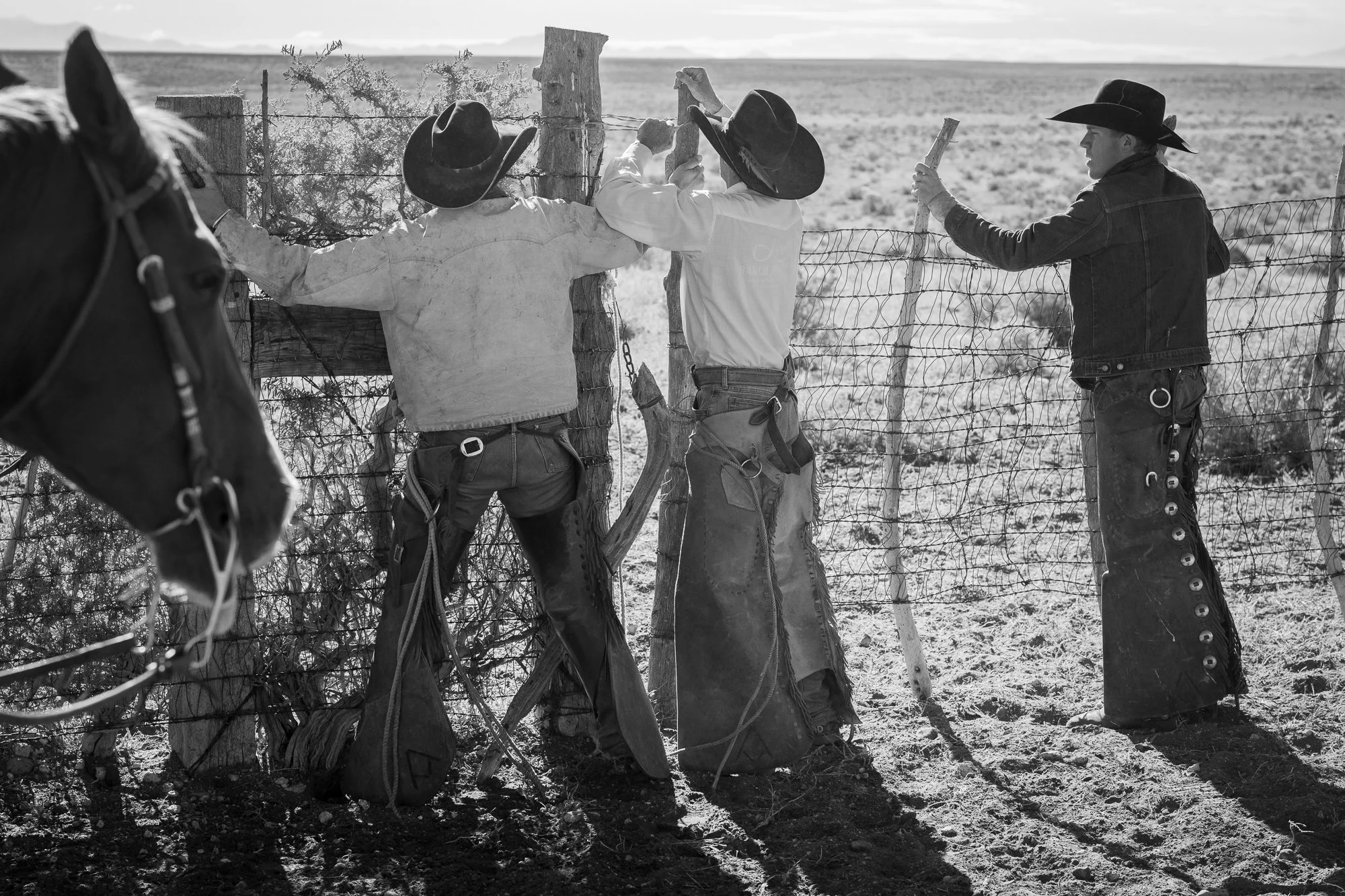
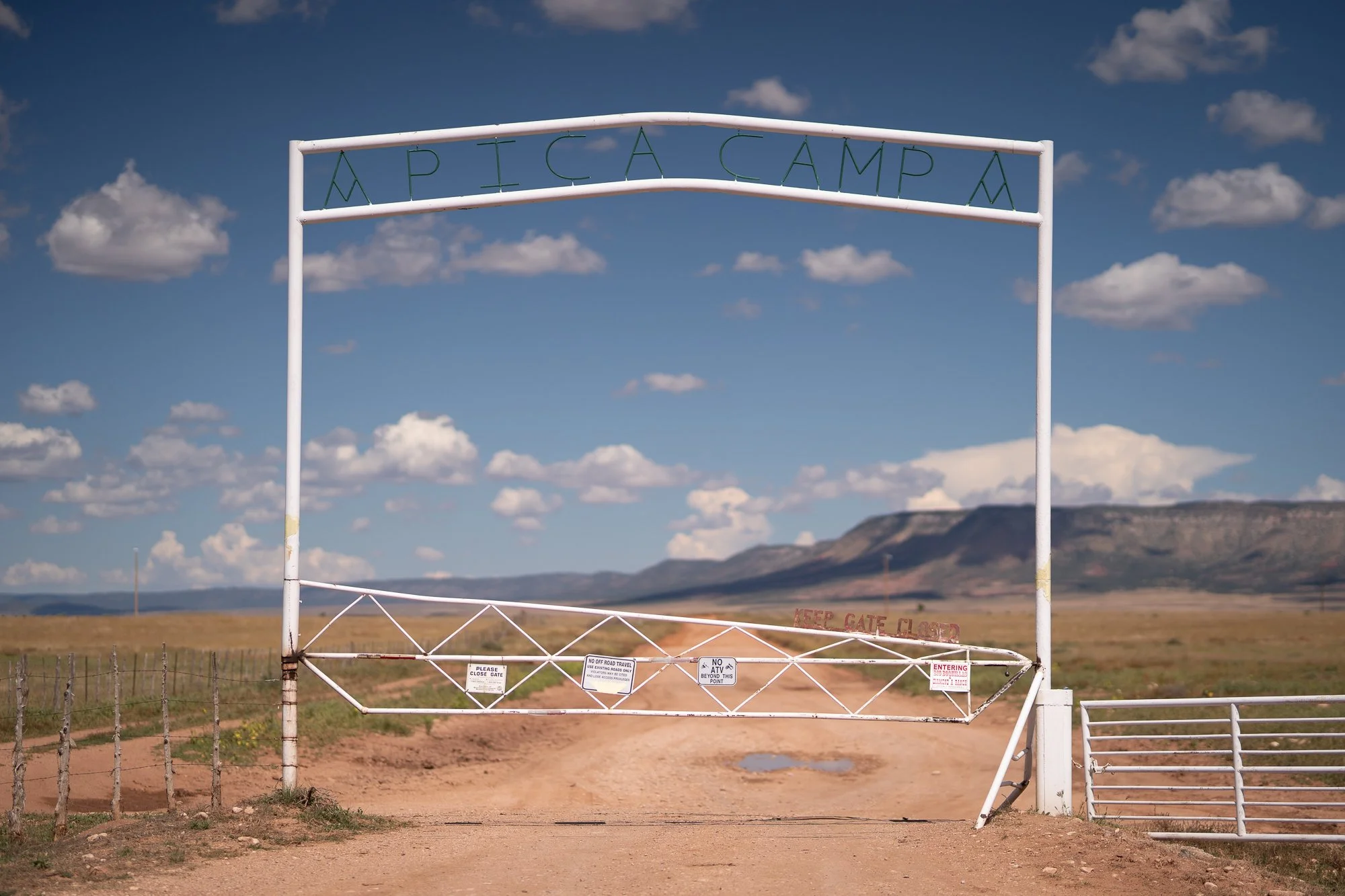
A crew of 5 leaves the corrals at a trot, heading out to gather a pasture that only ends at the morning sun hovering above the horizon. It feels like watching a fleet of sailboats gracefully catch wind from harbor into the open ocean, getting smaller and smaller until they melt into the sea. There’s no telling when or if they’ll ever return. Such is life for cowboys on the Diamond A Ranch outside of Seligman, Arizona. At 725,000 acres it’s the largest in the southwest and aptly nicknamed The Big Boquillas. 

“Don’t hire him if his wife isn’t there for the interview” says Sarah Kieckhefer to her husband Rick - owners of the Diamond A. She knows it takes a special breed to work this kind of spread and deal with such solitude. If the wife shows up sight unseen on day 1 and realizes her camp is 3.5 hours from the nearest town with a grocery store, it doesn’t matter how handy the cowboy is, they won’t be staying long. The land itself is owned by the Navajos and was leased for 32 years by the legendary Harvey Dietrich, who hand picked Rick in 2018 as his successor. The Kiechkefers already owned their fair share of ranches, including the K4 outside Prescott, which has been in the family since his great grandfather started it in1941. So Rick didn’t jump at Harvey’s offer until he said “you know, they aren’t making any more land”. A hard fact to argue for anyone looking to grow, and it’s not everyday that a ranch of this size falls in your lap. So he accepted the full lease in 2021, increasing his acreage overnight by roughly the size of Rhode Island. 

The diverse charisma of the Diamond A is something to behold. From its large sections carpeted in Juniper and Cedar trees that will eat up cattle, horses, a cowboy, and his dogs, to the Cataract Plains, where you can see for 50 miles. Oh, and its northern border collides eloquently with one of planet earth’s greatest icons - The Grand Canyon! But make no mistake about it, The Diamond A is a real cowboy outfit. Everything they do is with cows and horses. There is no oil money like most in Texas. Rick and Sarah still live on the family ranch, so it’s no surprise that they continue the dying tradition of pulling a wagon for the Diamond A’s spring and fall works. Rick’s pedigree doesn’t stop at ranching, as he spent a handful of years rodeoing in the NFR (2001-2006), before shifting focus back to the K4 with mom+dad. Then spreading his wings further with the purchase of a few other leases and a feed yard near the Mexican border. Sarah spent all of her years earning stripes as a barrel racer and rancher as well. The perfect team. And while the Diamond A alone boasts 8,000 head of mother cows, he insists they are in the people business. Knowing amongst all else that it takes the right people, and treating people right. When they took over, culture at The Big Bo needed a major shift,  which was no small task, but as Rick says “Ranching is passion driven. If you don’t have passion then you’re in the wrong business, because it’s a tough son of a buck”. Under prior leadership, communication between crews was abysmal. Cowboys didn’t talk to the water guys, that didn’t talk to the mechanics, and around in a circle. Rick says “I want more of a family. The whole ranch is all of our ranch”. So they dove in deep to find the right personnel and currently employ 12 full time cowboys living at 7 different camps. Two of which (Heath Denell and Ben Pat Kimball) are the sons of cowboys that previously held tenure at the Diamond A.  Being so remote, the crew might not hear from the boss for days at a time, so they are expected to be self starters, but also given the freedom to make their own decisions. Tell a guy with a family he has to camp out on the ground for a month straight, and he’ll soon be looking for another job. As long as he gets it done, the cost of a little more fuel is worth the rub to keep people happy.  The Kiechefers aren’t afraid to hire women either if they come as a team. Josh Halko (cow boss) and Heather (Dufek) Halko came down from Montana in November of 2021 and have overseen 300,0000 acres worth of pasture ever since. “Sarah and Rick have been amazing. They treat us like family” says Heather. She also adds that their job is to cowboy, nothing else. “We are given guidelines and our country, and expected to work it the best way we know how. We’re never micromanaged.” The Halko’s recently gave birth to twins (Quirt and Roan). A joyous yet stressful time for any couple without any nearby help. Even worse for a cowgirl in the middle or nowhere that can’t saddle. So Heather was worried about losing her string of horses as well as her job. She assuredly kept both.

Water is the common denominator for all ranches, so the whole crew will always pray for rain. This outfit is set up a bit differently though, with 400 miles of underground pipeline and a handful of holding tanks peppered evenly across the land. Nevertheless,  genetics were changed by bringing down heifers from Montana and the Dakotas that would be more tolerant of Arizona’s weather conditions. The horse program also needed help, which Sarah was thrilled to execute. “I always tell people that I’m cow crazy and my wife is horse crazy,” says Rick. Without four wheelers or helicopters, you need a lot of great horses to cover a ranch of such grandeur. Rick again adds “We go pretty hard. It’s big country. It’s tough. The days are long. We don’t work cattle for 3 weeks out of the year. We work em’ 8 months out of the year.” Owning the historic bloodlines of Driftwood Ike, you can bet they have implemented a great plan for continuing to breed the appropriate horses. And have already attracted some big names to their own Legacy Ranch Horse Sale. 

Sarah will be the first to tell you that her husband’s greatest asset is progressive thinking. He always gives a considerable amount of his already overflowing days and nights to what will be best for the ranch 1, 5, 10, and 20 years from now. He knows that you need to diversify in order to survive, so he took cues from Dietrich about meat packers suppressing the industry and making record profits, while the producers remained handcuffed. Unfortunately Harvey passed on Christmas Eve of 2020, but the building blocks were already in place to “write their own story”, dedicating 20% of production to boxed beef. And after a few years of figuring out all the moving parts, their gourmet products can now be found in such restaurants as the 5 star - Orange Sky and Phoenician in Phoenix as well as the Royal Palms and Sanctuary in Scottsdale. They’ve even attracted famous chefs like Chris Bianco that want to collaborate because they believe in the story and the product. If that sounds glamorous, think again. Only the middle meats of each cow can be sold to a restaurant, so ranchers need an outlet for the remaining 75%, or they’ll soon be out of business. And, if you can’t  deliver a year round supply, your partners will find someone who can. The Kiechefers want to grow their boxed beef sales to about 30-40%, but the main goal is to be better every day in every aspect of their business through efficiency. And the best way to achieve that in their mind, is having people that want to be there. People that feel ownership and pride in the ranch. Ricks says “the most important thing is that it’s those guys this year, those guys next year, and it’s those guys the year after making the decisions”.

Cowboys on the Diamond A Ranch in Arizona
Western cowboy photographer for brands and magazines

Western photography for magazines and brands

Photographer serving the American cattle industry

Editorial photography services for the cattle industry

Commercial cowboy photographer based in Denver, CO

Cowboy photographer for editorial and commercial assingments

Arizona Cattle Ranch

Cowboy Ranch Life in Arizona — A Working Ranch Photo Essay

Photographing a Working Cattle Ranch in Rural Arizona

Arizona ranching doesn’t look the way most people imagine it. There are no dramatic mountain backdrops or postcard moments waiting around every corner. Most days are quiet. Dry. Spread out. The work blends into the land in a way that feels almost invisible unless you slow down enough to notice it.

These photographs were made on a working cattle ranch in rural Arizona. No staging. No recreations. Just day-to-day ranch life as it happens — early mornings, long distances, and a rhythm that hasn’t changed much because it doesn’t need to.

Ranch work in Arizona is shaped by the environment more than anything else. The land dictates the pace. Heat, dust, and long distances through dense brush are part of every decision, and nothing happens quickly unless it has to. You feel that right away when you’re there.

What struck me most wasn’t any single moment, but how steady everything felt. Horses saddled without ceremony. Gates opened and closed out of habit. Work done without commentary. It’s not dramatic, but it’s real — and that’s what makes it worth photographing.

Ranching in Arizona Isn’t Romantic — It’s Practical

A lot of imagery of the American West leans hard into nostalgia. This place doesn’t ask for that. Ranching here is practical and stripped down. The landscape doesn’t allow for much excess.

The cattle are moved when they need to be moved. The horses are tools as much as companions. There’s very little separation between work and daily life, and no sense that anyone is trying to preserve an image for the sake of outsiders. It simply exists.

That honesty is what drew me to photograph here.

The K4 Ranch

The photographs in this series were made at K4 Ranch, a working cattle operation where ranching still follows the land rather than trends. Like many ranches across Arizona, it operates quietly, without much outside attention, doing the same work it has for generations.

Places like this don’t always make headlines, but they form the backbone of ranching culture in the Southwest. They’re also disappearing faster than most people realize.

Why Photograph Places Like This

I’ve spent years photographing working cowboys and ranches across the American West, and the more time I spend in places like this, the more important it feels to slow down and document them honestly.

Not to turn them into symbols — but to show what’s actually there.

These photographs aren’t meant to romanticize ranch life or explain it. They’re simply a record of people working, land being used, and traditions continuing without much concern for being noticed.

Arizona Cowboy Photography Prints

Photographs from this Arizona ranching series are available as museum-quality fine art prints. Each print is produced in small editions and made to live with — not just be scrolled past.

View available cowboy photography prints

This story is also part of a larger, ongoing project documenting real working cowboys and ranch life across the American West.

View the complete cowboy photography gallery

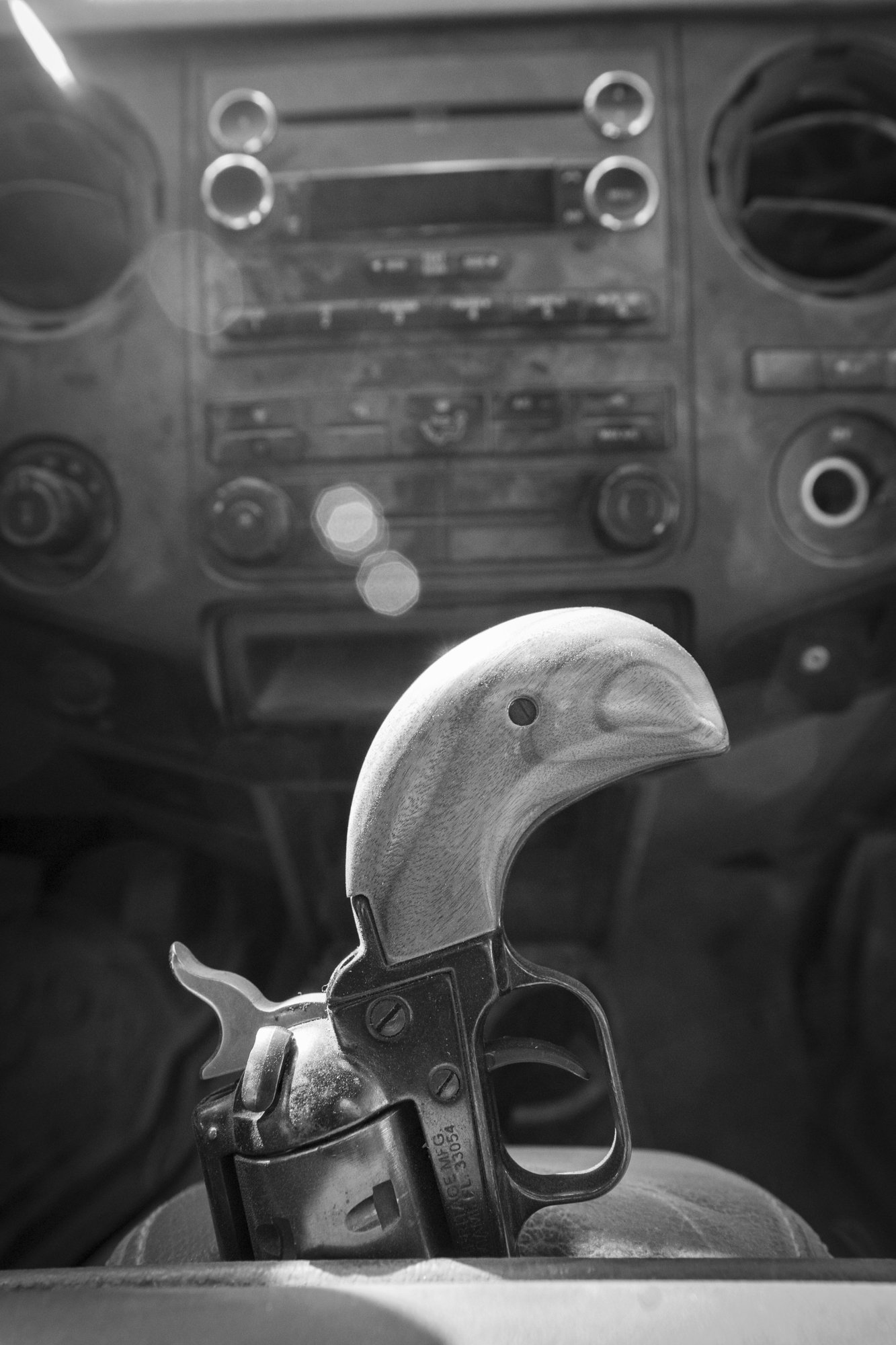
Photograph of a revolver gun in the console of a cowboy's pickup truck

A cowboy’s revolver

Black and white photograph of husband and wife cowboys

Brady and Marianne Clark - Cowboys

Early morning light illuminates corrals on a working ranch in Arizona

Horse corrals on the K4 Ranch in Prescott Arizona

Black and white photograph of a cowboy on an Arizona cattle ranch

Brady Clark - Cowboy

Photograph of a bucket of horseshoes on a cattle ranch in Arizona

Photograph of used horseshoes sitting in a bucket on a cattle ranch in Arizona

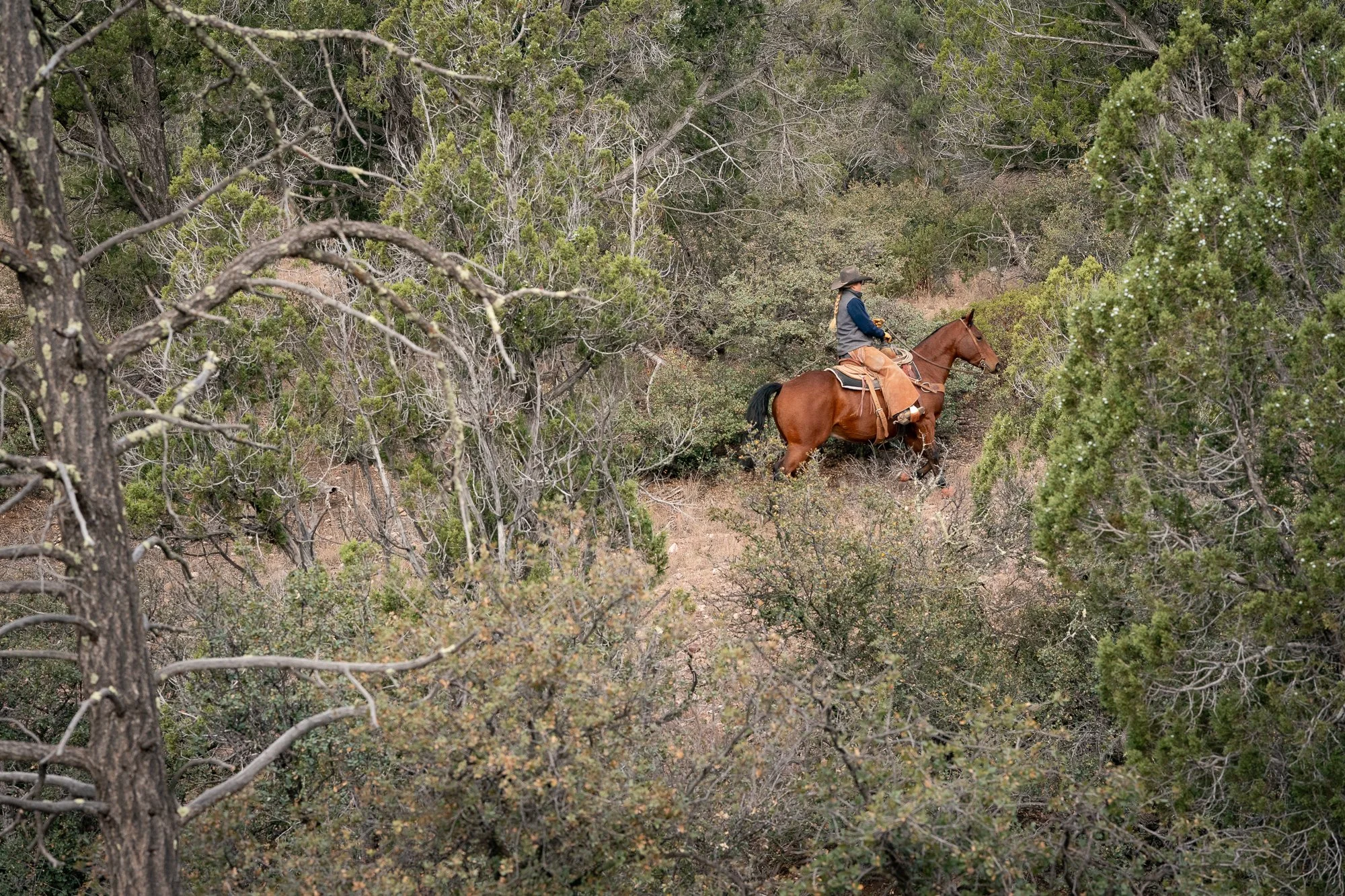
Photograph of a cowboy riding through thick brush on an Arizona cattle ranch

Cowboy riding through thick brush

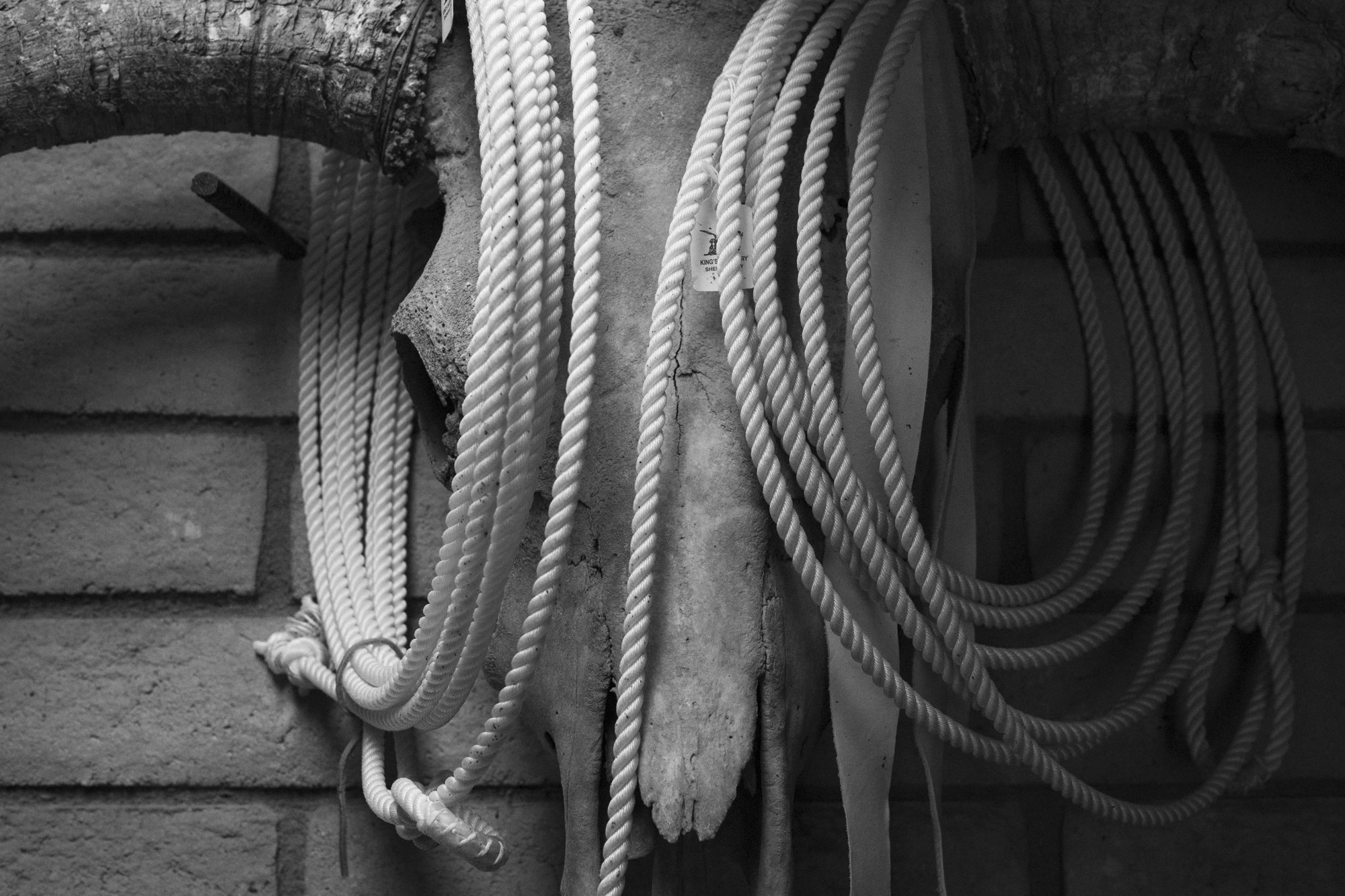
Cowboy lariats hanging on a cattle skull on a working ranch in Arizona

Ropes from King’s Saddlery hang on a cow skull on the K4 Ranch in Prescott, Arizona

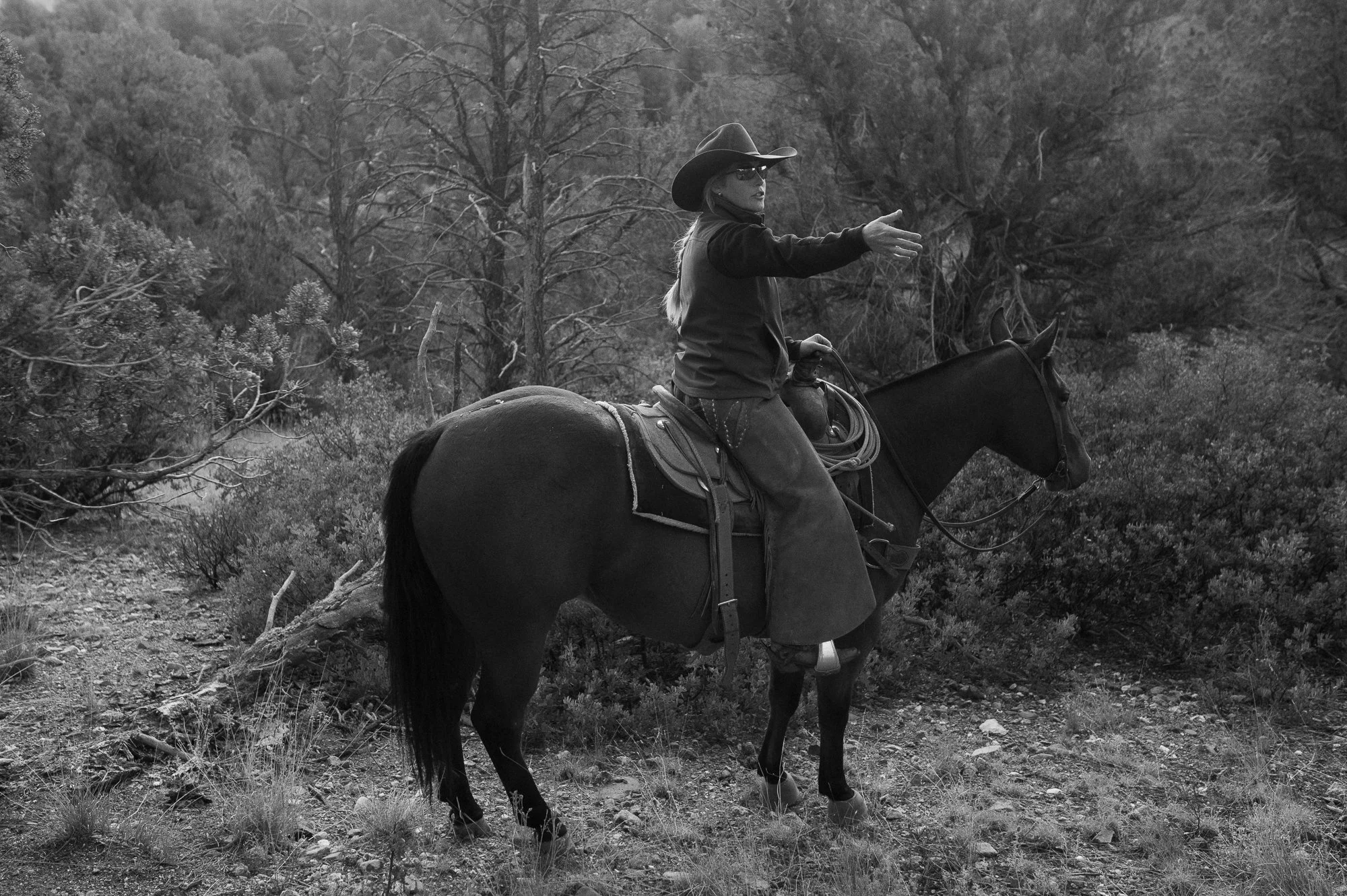
Photograph of a working Arizona cowgirl on her horse in a thick forest

Working Arizona cowgirl - Marianne Clark

Photograph of a cowboys roping dummy

Photograph of a roping dummy on a cattle ranch in the American West

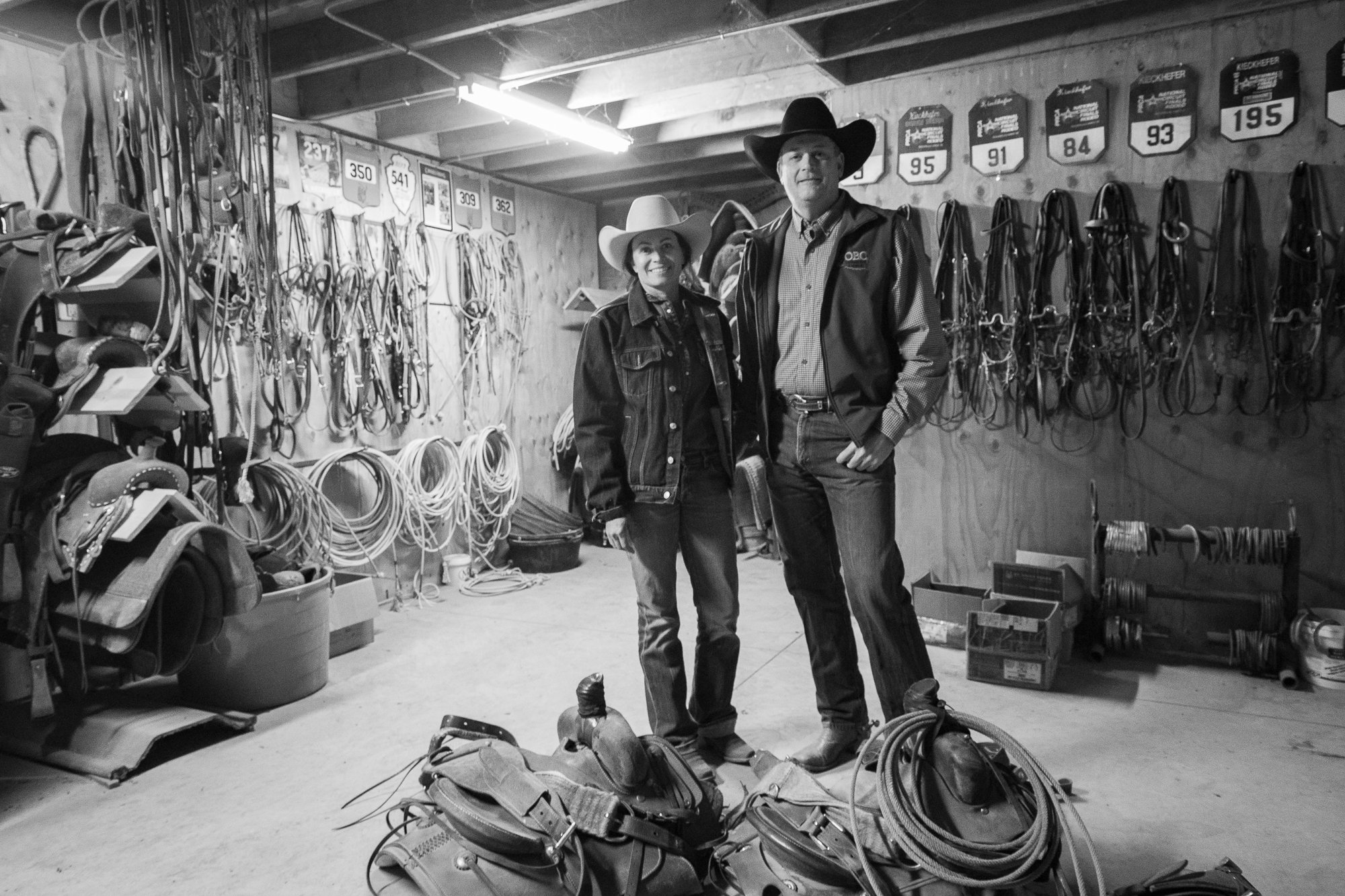
Rick and Sarah Kieckhefer - owners of the largest cattle ranch in the Southwest United States

Rick and Sarah Kieckhefer - Arizona cattle ranchers

Photographs of a cowboys horse shoeing station on a Arizona cattle ranch

A cowboy’s shoeing station for his horse on a cattle ranch in Arizona

Black and white photograph of male and female cowboys mounting horses in Arizona

Arizona cowboys getting on their horses before a day of work

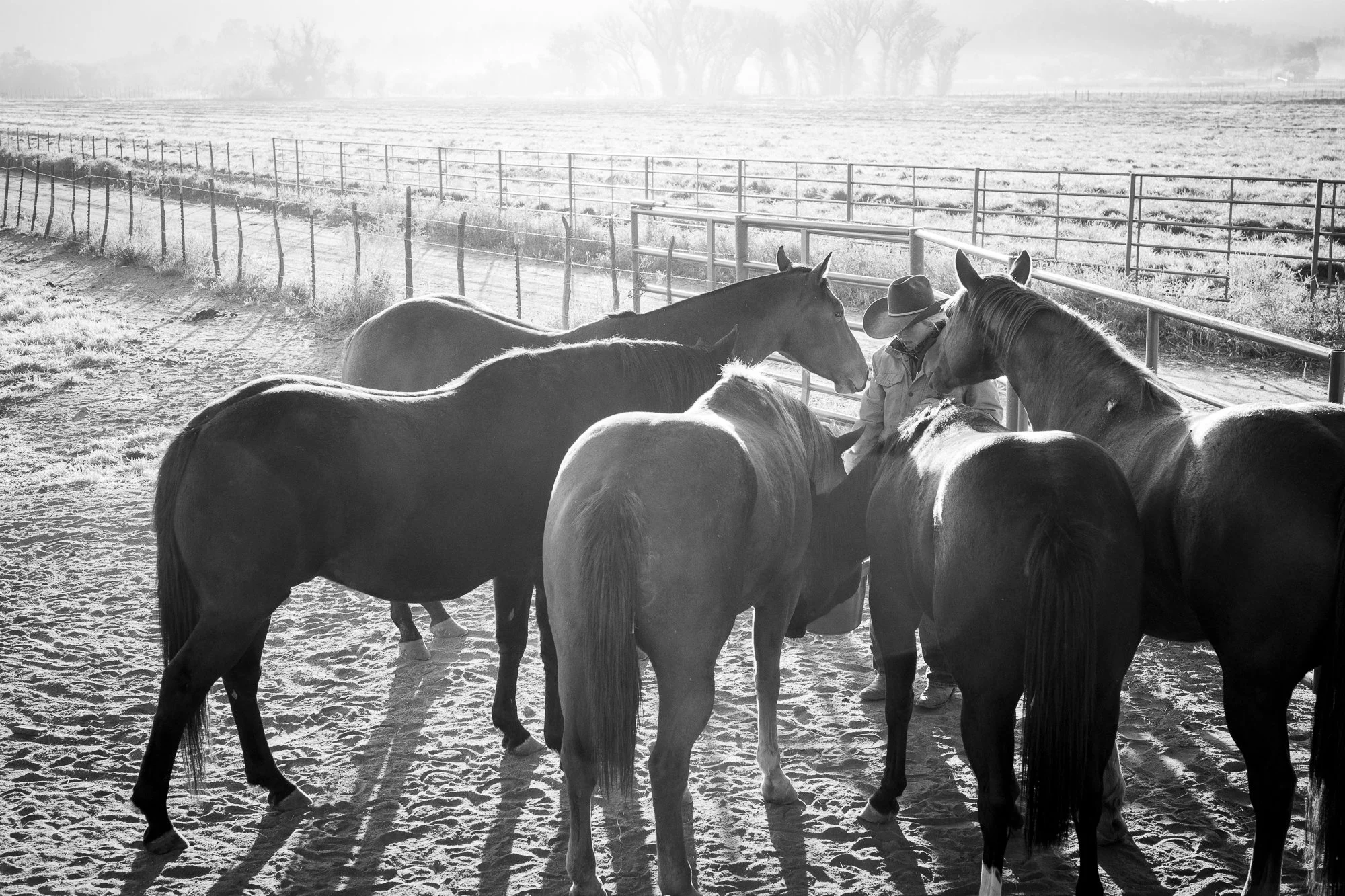
Black and white photograph of a cowgirl feeding horses on a beautiful cattle ranch

Cowgirl feeding horses

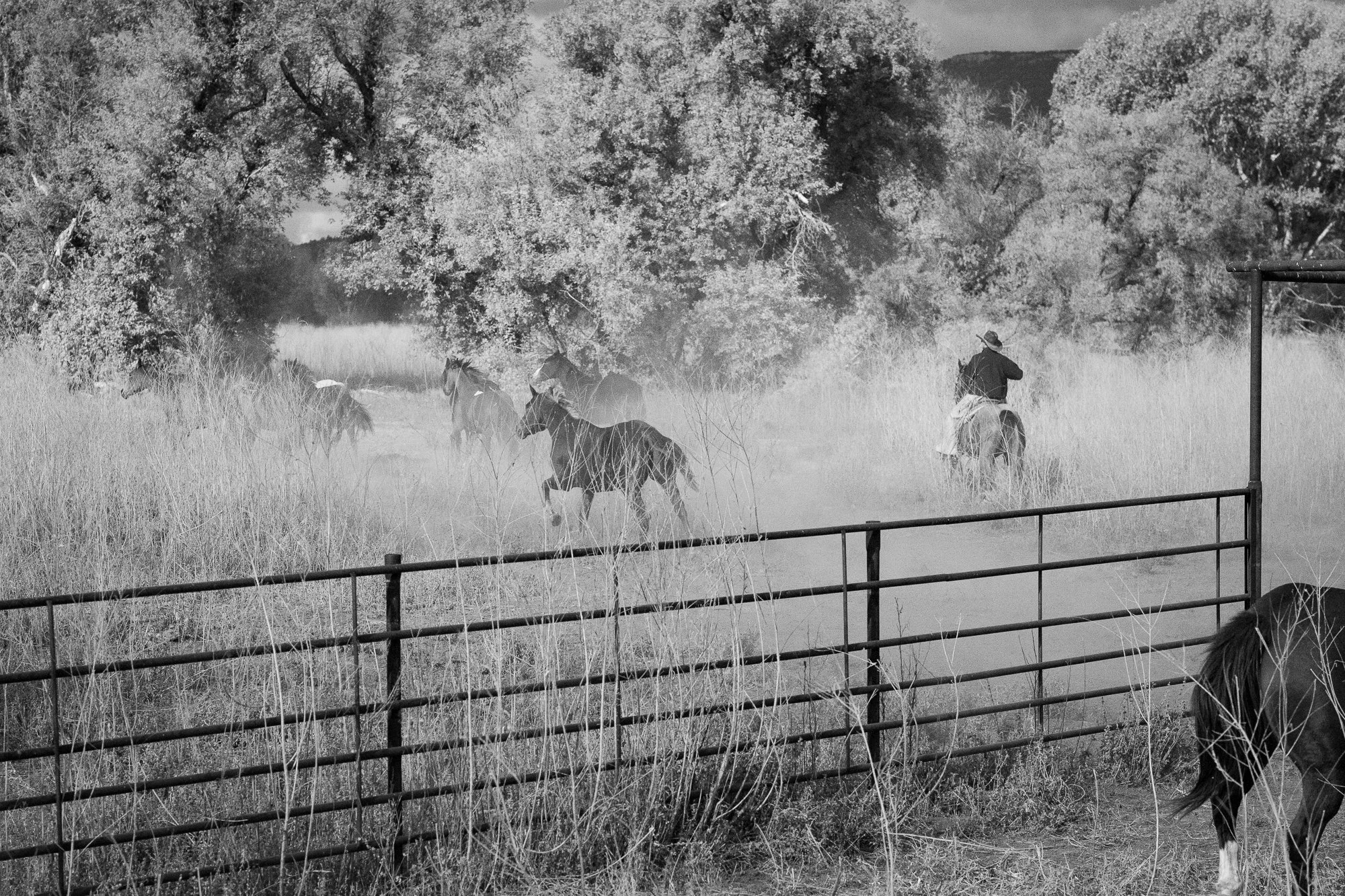
A cowboy riding his horse an an Arizona cattle ranch

Horses running free on an Arizona cattle ranch

A cowgirl puts her world champion saddle back in the saddle house on a cattle ranch

World Champion Cowgirl

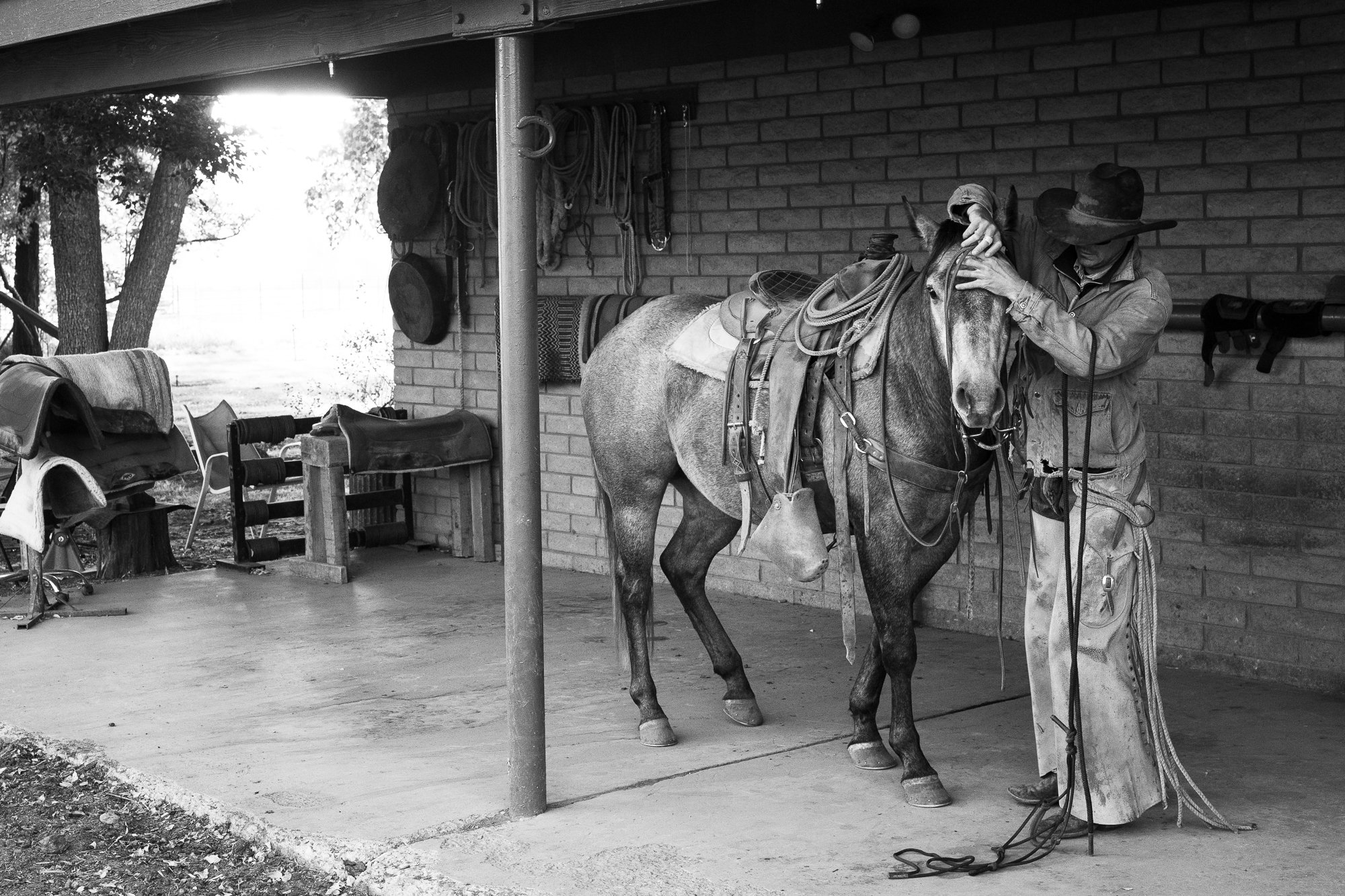
Photograph of a cowboy saddling his horse on the K4 Ranch in Prescott, Arizona

Saddling a horse on the K4 Ranch in Prescott, AZ

Photograph of an Arizona cowgirl riding her horse through dense forest

Arizona cowgirl riding her horse through rough forest

Photograph of a three legged cattle dog

3 legged cattle dog

Boots O'Neal

Boots O’Neal - Cowboy - 6666 Ranch - Texas

Being a photographer has been a great pleasure and an even greater adventure. It’s taken me to some outstanding parts of the earth and allowed me to photograph some of the most famous athletes on it. “Who is your favorite?”, has always been a common question. Until recently that was an impossible question to answer. Now my final is abundantly clear - it’s the legendary Texas cowboy Boots O’Neal. Boots is a 90 year old cowboy on the iconic 6666 Ranch. A more inspiring human you will not meet. To learn more about him continue reading this piece I wrote that was originally published with Wrangler.

View More Cowboy Photography From The American West

Tom Moorhouse - Texas Cowboy

Fine Art Cowboy Prints

Branding Season at the 6666 Ranch

The photographs above are just one piece of a much larger story. Branding season at the 6666 Ranch is a coordinated effort and well oiled machine run by first class cowboys.

→ See the complete 6666 Ranch branding photo series

Photograph of legendary Texas cowboy Boots O'Neal on the 6666 Ranch

Boots O’Neal on his horse working cattle in the corrals at the 6666 Ranch

Boots O’Neal and the Tradition of Ranching in West Texas

Imagine for a moment, waking up in the hospital with 12 broken ribs, a punctured lung, broken vertebrae, and a bleeding brain. Now imagine that pain at 82 years of age. Cal Ripken Jr. was Major League Baseball's “Ironman”. Earning the nickname after playing 2,632 consecutive games. Put those end to end and you’ve got over 7 years of straight baseball. An astonishing stat and impressive feat only possible for a human made from the toughest stock. No offense to Mr. Ripken, but that doesn’t hold a candle to the Texas legend - Boots O’Neal, who's been horseback for the better part of the last 75 years. Despite the aforementioned injuries, piled on a lifetime of other broken body parts, the now 90 year old cowboy shows no desire whatsoever to retire. You’d think someone that’s lived in such a way would have a face much resembling their saddle that’s endured as many miles. Instead, O’Neal’s is endearing, and fixed with a perpetual smile that causes you to do the same. The kind of guy that inadvertently makes you a better person just by being in his presence. 

While we’re on the stat train, let’s dole out a few more just to drive the point home, what an outlier he truly is. The average retirement age in America is 62. The average age of death is 78. And a cowboy will normally take home about $31,466 a year. At a time in life when most folks are either dead or in a nursing home, Boots wakes up every morning with excitement to saddle a horse and work cattle alongside fellow cowpunchers that could be his grandkids. People just aren’t built like him anymore. Not a partier, but it would be safe to put O’Neal in the Keith Richards class. Immortal freaks, in the most beautiful way possible. 

Portrait of Boots O'Neal - Cowboy on the 6666 Ranch in Texas. Available as a photography print.

Portrait of Boots O’Neal

Cowboys in general are a strand of human unlike the rest of us. Born not made. And from birth, it was obvious O’Neal created a category all his own. Growing up in the 30’s he was one of 8 children living in a home without running water. The bathroom was an outhouse, and the bath, a tub filled with water and placed next to the kitchen oven, door open for heat. After 3 or 4 of the kids took their turn, that water was tossed outside to calm down the dust. He was never much for school. The only thing he excelled at was boxing, but usually just looked forward to running off the bus and into the barn to saddle a horse, only coming in when his mother hung a white sheet on the clothesline - their version of a dinner bell. 9th grade was as far as he cared to go, leaving home in August of 49’ at sixteen to cowboy for the JA ($90/week). That job found him on the wagon, sleeping in only a bedroll 6-7 months at a time. A lifestyle that fit him just fine. 

Before we go any further, it would be appropriate to define what makes a real cowboy. The loud mouth sporting a big black hat getting in drunken bar fights makes for good movies, but that’s about it. According to the man himself, a real cowboy is polite. Smooth. Talks gentlemanly to ladies and is good under fire. Dusty Burson (32) - foreman on the Four Sixes and close friend to Mr. O’Neal said it best - “What’s a cowboy? Well, they’re good people. Honest. They do what they say they’re gonna do. If they tell you they’ll be there to help, they’ll be there, and they’ll stay to the end.” If that statement made its way into Websters, the following words should read “also see Boots O’Neal”. 

Photograph of Boots O'Neal branding calves on the 6666 Ranch in Texas. Available for editorial and commercial licensing.

Boots O’Neal branding calves in the early morning on the 6666 Ranch in Texas

Photograph of a famous Texas cowboy

Boots O’Neal’s custom spurs

After the JA, he continued punching cows in different places including a quarter century stay at the Waggoner Ranch. All the while racking up a collection of buckles and saddles from bronc riding in rodeos all over the country. Word is he’s still pretty sticky. A wife (Nelda) also came into the mix as did a daughter (Laurie). Despite being opposites, Boots and Nelda remained in love for 44 years until her passing. She was a proper lady that enjoyed being in town but fully supported his innate need for open country. As their relationship grew, his career did along with it. The 50’s’ found him in Korea with the Army, where he stared out at vast foreign valleys, daydreaming about them filled with 1000 steer, and wondering why in the world they didn’t have any. After two years he was back on a ranch working hard to become a Peace Office and Brand Inspector at a time when cattle were still shipped by railroad. Along with the coveted title came a doubled salary, new clothes, fancy truck, and expense account. A novelty quickly erased by jealousy every time business on a ranch forced him to watch cowboys ride away on horses while he sat in a truck headed back to the office. “I just wanted to punch cows” he said. So he gave back a job that most in the industry would kill for and reclaimed his true love, working cattle from the back of a horse. 

Love is what it takes because the life of a cowboy asks a lot of a person, physically and emotionally. “ Even when I know tomorrow is gonna be a bad deal, and they’re predicting snow, and the wind coming out of the north blowing, and we’re gonna ride straight into it in the morning, I just look forward to getting out there and freezing my tail off” says O’Neal. How many 90 year olds have you ever heard say something like that? Burson again offers some insight - “he wakes up thinking I’m going to be happy today. He doesn’t let circumstances dictate happiness.” Dusty was the one who found the 82 year old O’Neal alone in a pasture, after the horse wreck that would have ended any mortal man. Even if it didn’t put him in the ground, the pain alone would cause a rational person to take a brush with death as a sign and say, ok, it’s been a good run. Burson visited him in the hospital shortly after and recalled the nurse asking why he kept lifting his left leg up in the air. Obviously, it was to keep the mobility of toeing a stirrup. “That’s how bad he wants to be a cowboy when he grows up” says Burson. 6 weeks later, he was back on that same horse and continues riding him today.  

Black and white photograph of Boots O'Neal and Charlie Ferguson talking in the chuck wagon tent on the 6666 Ranch in Texas

Boots O’Neal talks with chuck wagon cook Charlie Ferguson on the 6666 Ranch in Texas

Seems like it came naturally for Boots, but don’t get it twisted, any good cowboy is a student of the trade. Always figuring out a way to get it done better without asking for recognition. All of the best cowboys Boots ever knew and patterned himself after, accomplished unthinkable feats even Taylor Shariden couldn’t script, in the middle of nowhere with only a few people to witness. Another friend and Texas icon Tom Moorehouse (72) is quick to point out “I’ve known Boots almost all my life, and anything I’ve got to say about him is good”. From the outside you might think that cowboying is a physical game. Only for the young. Not so. Sure, you need the gumption to handle extreme physical abuse and relentless weather that doesn’t end after an eight hour shift. But Moorehouse says the thing that separates Boots from the rest is that he’s a “keen observer”. He continues “my dad used to say a real cowboy is somebody that pays attention. Now that doesn’t sound like a good story, but that’s the truth.” There is so much that can go wrong when you’re working with 2,000+lb animals and navigating remote unforgiving terrain. One mistake could mean the end. 

We’ve already established that Boots is an enigma, but for arguments sake, let’s say he got lucky? Somehow the body that’s been broken more times than anyone can count, managed to miss the big one. Even with luck, longevity like his doesn’t just happen. And living on a wagon, eating ranch food, wouldn’t make any blueprint for “healthy living”. Cowboys require hearty meals to get them through their overly demanding lives. So It should be no surprise that beef has made its way to Boots’ plate just about every day for the past 90 years. Along with the beef came biscuits, gravy, and potatoes. Breakfast was peanut butter and syrup sandwiches. All of which goes against everything you’ll read from the so-called nutrition experts. Although pinto beans, prunes, and raisins are foods he now tries to consume regularly along with said beef. The fresh fruit and vegetables he also concentrates on just wasn’t a thing back then.”It wasn’t until I got up in years that I ever worried about putting something bad in my body.”  A chuckle was the only answer given when asked about exercise, but “I’ve never been short on sleep” says O’Neal. Which he believes has been the holy grail to his success. For as long as he can remember, even as a young buck, he’d turn in early, ensuring 8-9 hours of shuteye every night. These days he says “it takes me longer to rest than it does to get tired”, but it becomes obvious shortly after meeting him, that modesty is one of his many virtues. He’ll try and claim that he can’t do this, that, or the other. Then he slips into the saddle and the truth is revealed. “It takes a whole crew to keep me going”, he says. Again, modesty perfected. Perhaps his days aren’t spent aboard wild broncs, but he always gets the job done with grace, and his expertise couldn’t be matched anywhere in the world. Ironic for a guy who’s never considered himself very smart. What Boots has can’t be taught. He’s got a PHD in punching cows. Anybody will tell you he’s on the Mount Rushmore of the cowboy universe, but who the hell else could be up there with him? Is there another human that’s punched cows for almost 8 decades?  “It’s amazing what all he’s got stored up inside him that someone oughta have recorded” Dusty says. A lot of people with such knowledge and history can become high and mighty. Not Boots. He’ll let you mess up, then suggest, in a non degrading way, how to do it better. He knows we’re all in this thing together.

Photograph of the famous Texas cowboy Boot O'Neal

Boots O’Neal offloading his horse from a trailer on the 6666 Ranch in Texas

Photograph of Boots O'Neal dragging a calf to the fire for branding on the 6666 Ranch in Texas

Boots O’Neal roping calves on the 6666 Ranch in Texas

If you think about the human condition and what we’re all after, one of the key ingredients is professional happiness. Everyone wants to spend their waking hours doing something they love. Why is that goal so elusive, so rare? A million dollar question. Even harder than finding that happiness, is keeping it. Somehow Boots O’Neal has managed to do it at one of the most physically demanding jobs on the planet and continues today at a very high level. Maybe the how doesn’t really matter. Maybe we should just use Boots as inspiration to be better humans. The iconic Four Sixes has been his home for the past 26 years. Panhandle, Texas is the closest town to their northern division where we met. The town sign fittingly reads “People of Pride and Purpose”. Just like the dictionary, there might as well be a picture of Boots next to that slogan. He figured IT out and still can’t get enough. He doesn’t need to work in a monetary sense. He wants to work, although it’d be a stretch to hear him use a four letter word like that. Even on a rare day off, he doesn’t look forward to a hobby or a vacation. Instead he’ll watch a rodeo on television or sit in a chair outside his bunkhouse apartment to watch the remuda come in. A sight he says, of 50 horses all running together, is one that most people will never get to see. Bob Dylan wrote a song on this very topic using only 17 words:  

“All the tired horses in the sun…..”

The guy has done it all, taken the beatings, and asked for more. He’s been inducted into every Hall of Fame a cowpuncher could possibly be associated with. Somehow that doesn’t seem enough of an honor though. Boots should be everyone's hero. He’s a national treasure and outstanding human being.  We should all strive to accomplish in our own lives what he has in his. Burson says “Yeah, he’s a cowboy, but he wants to be one tomorrow too”. If more people had that attitude, the world would be a better place. 

We were just about done talking when Boots’ story paused abruptly . A mischievous smile came to his face and the words stopped flowing. His attention fixed on one of the guys in a nearby corral working a young horse that was fixing to blow up. The grin stayed as he reminisced “I rode a lot of bucking horses in years past. I could get on a horse like that, just gather that thing up, and he’d be 3 feet in the air when I got that right stirrup”. Boots is a Christian. If he weren’t, and followed a religion believing in reincarnation, he says that’s what he’d want to come back as, a bucking horse. At 90 years young he knows precisely how good his life has been and isn’t scared of the inevitable. In a very matter of fact way he spoke about his funeral, being buried in the cemetery on the Four Sixes, and the speech by his friend Joe Leathers. When asked what he hopes Joe will say, Boots paused then replied humbly with a far off stare ”He was an honorable man. Done what he said he would. And didn’t mistreat his horses” 
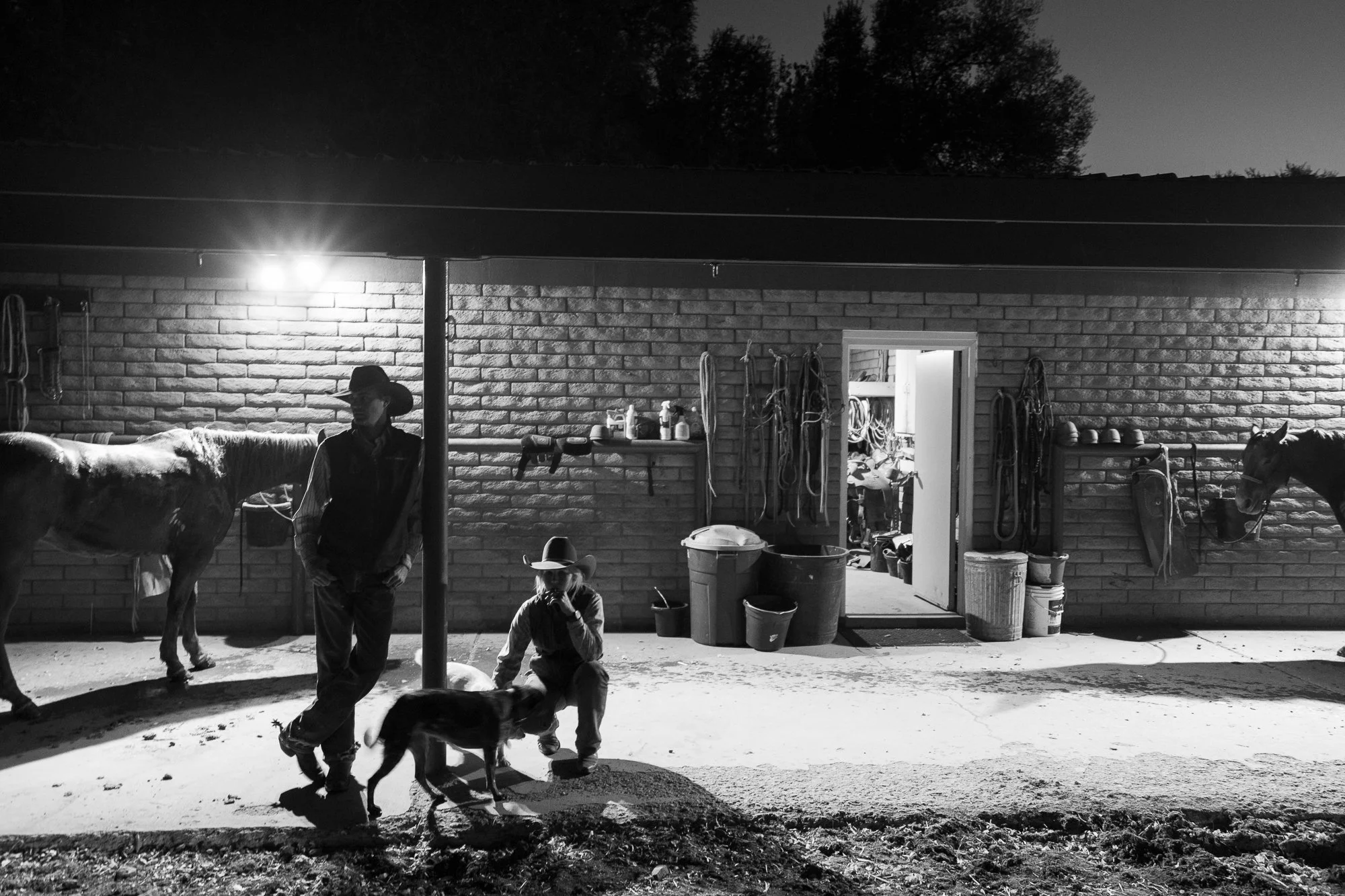
Portrait of Boots O'Neal the famous Texas cowboy

Portrait of Boots O’Neal

Silhouette of a cowboy on his horse at sunrise on a cattle ranch in Texas

Boots O’Neal on his horse at sunrise on the 6666 Ranch in Texas

Boots O'Neal
from $1,200.00

Montana Road Trip

Talking highly about Montana is better left to the most lyrical of wordsmiths because I certainly can’t do that place any justice. Maybe that should be a personal goal? I’m fresh off the road after spending over a week in that glorious state and can’t wait to go back. This trip was particularly visual due to to the heavy winter snowfall that made everything greener than green. I’ve never been to Ireland, but the particular hue off grass felt more like something you could only see there. Check back soon to see images from the two cattle ranches I photographed, but don’t expect any images of trout. Those are only in my head.

Cowboy Photography - American West

Western Cowboy Photography

Photographing cowboys in the American West has been so many adjectives. Just scrolling through images to make this blog post gives me even more appreciation for the work, life, and culture of these people. As of this writing I’ve been lucky to photograph on cattle ranches in Nevada, California, Texas, Arizona, Idaho, and Wyoming. Which has been an education in and of itself, seeing all the differences from region to region. Not sure how long thing has been going on no, but the desire to continue only grows with each ranch visited. Certainly my favorite project to date.

Click here to see more of my cowboy photography and contact me directly to purchase wall art from the American Cowboy series. All of my images are available as prints for your home, office, or commercial space.

Sunrise photograph of two saddled horses with pogonip in the background

Fulstone Ranch - Bridgeport, California

Black and white portrait of a Wyoming cowboy

Dave Ennis - Wyoming Cowboy

Photograph of a cowboy working cattle in a chute

Diamond A Ranch - Seligman, Arizona

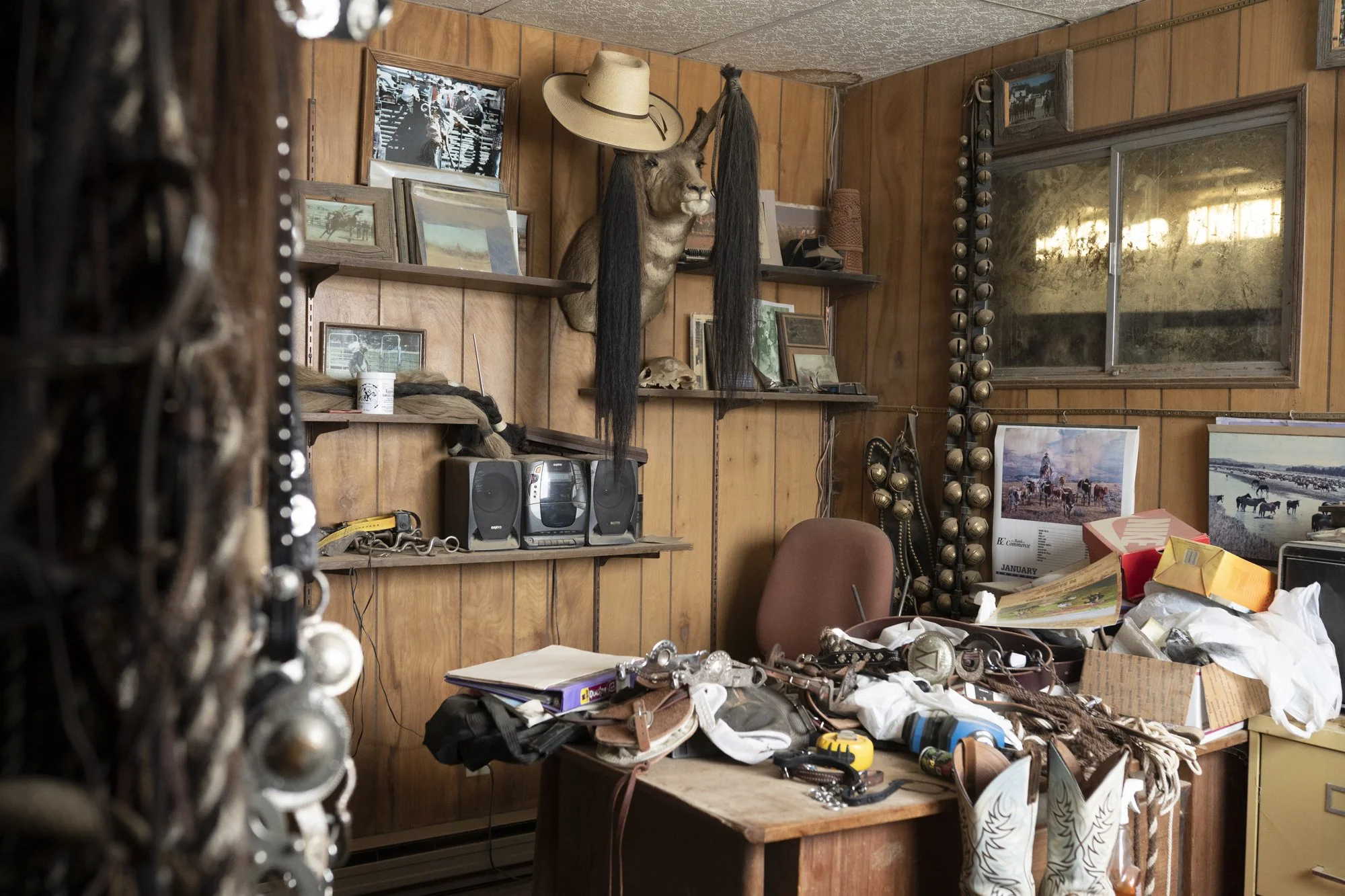
Photograph of the clutter in a cowboys office in Idaho

Cowboy “Office” - Idaho

Photograph of Dwight Hill - Idaho cowboys

Dwight Hill - Buckaroo - Idaho

Black and white photograph of cowboys riding out into open range

Diamond A Ranch - Seligman, Arizona

Photograph of Dwight Hill practicing with his horse in Idaho

Dwight Hill - Buckaroo -Idaho

American West Photography

Cowboy Photography

It’s always great to get press on your work, especially when it’s a big outlet like the Daily Mail. If you want to go on “followers’, they come in at 22+million on Facebook, whatever that means. Either way, I’m honored to have them do a feature on my cowboy photography - a project I love. It’s also quite young compared to some of the others like Barbershops of America or American Backcourts, which have both been going on now for ten years!

Click here to see more of my cowboy photography. Or contact me directly if you’re looking Western prints / wall art for your home, office, or commercial space.

Doug Monson - Western Charcoal Artist

A Charcoal Artist in Wyoming Preserving the Spirit of the American West

Western Art That Comes From Experience, Not Interpretation

There’s a noticeable difference between Western art made from observation and Western art made from experience. The best work doesn’t try to explain the West. It comes from living in it.

Doug Monson’s charcoal drawings aren’t romanticized versions of cowboy life. They carry the weight of real work—long days, unpredictable conditions, and a deep familiarity with cattle, horses, and the land itself.

That’s something I’ve seen again and again while photographing ranches across the West. The people who live this life don’t exaggerate it. And the artists closest to it don’t either.

A Chance Encounter With a Western Charcoal Atist

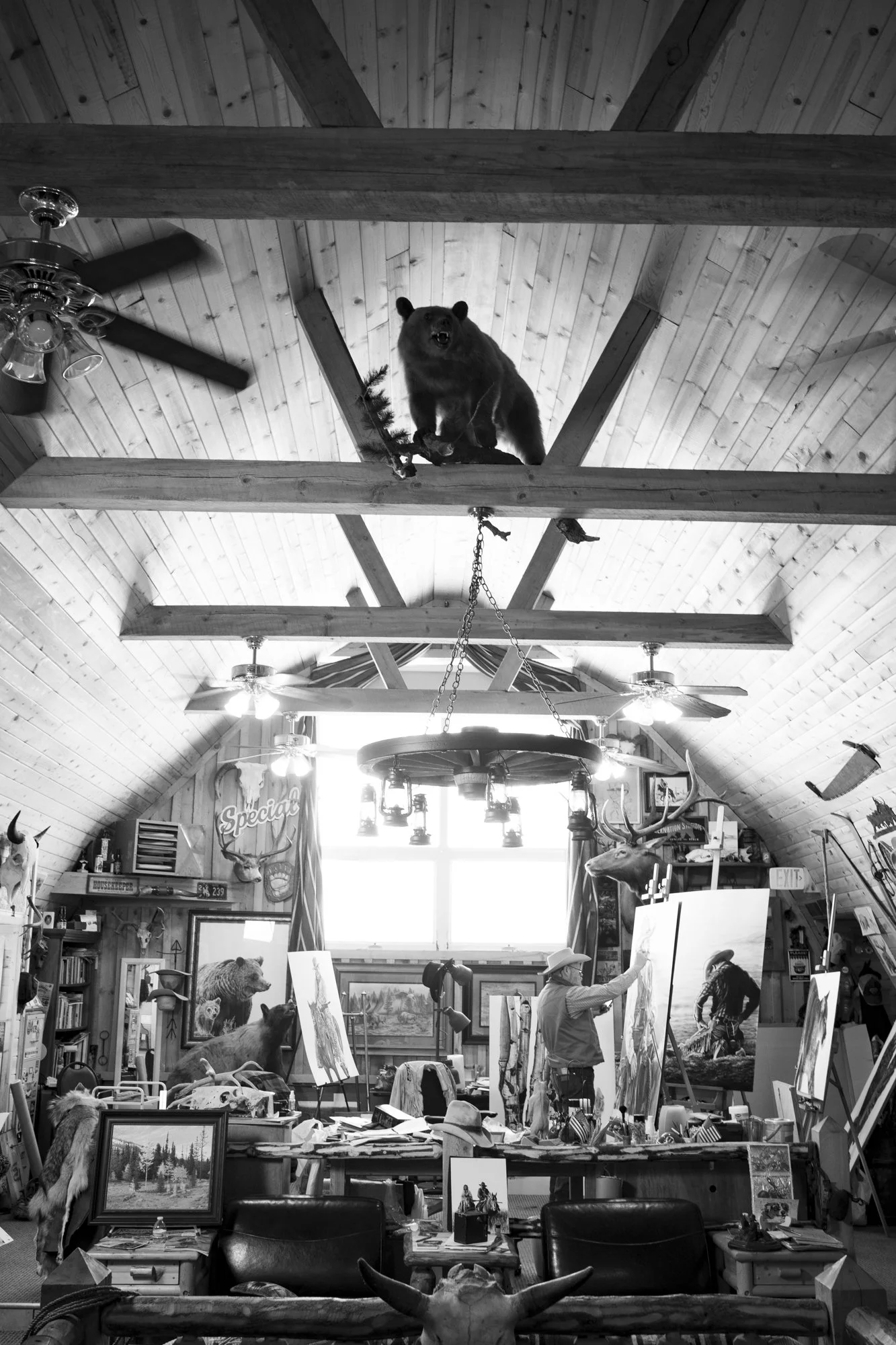
It’s always amazing how the universe brings people together. During a trip to Jackson Hole I was on a big gallery kick and spent quite some time taking in the top tier art that Jackson’s galleries have to offer. After the trip was over I began the drive back home. At the time I was living in San Diego and decided on a route that happened to go through Afton, WY - home of the Western Skies Fine Art - a gallery I had no knowledge of. Still having a thirst for art though, I popped in and was greeted by the owner Doug Monson He showed me around the gallery and his breathtaking studio upstairs. Next thing you know, I pulled the camera gear out of the track and was photographing Doug at work. Prior to that day I never even knew who Monson was. It was a pleasure spending time with him though. He’s a talented artist and a hell of a nice guy.

Why Wyoming Still Matters for Western Artists

Wyoming holds onto something a lot of places have already let go. There’s still space. Still working ranches. Still a culture that hasn’t been completely reshaped for an audience.

For artists—whether working in charcoal, photography, or anything else—that matters.
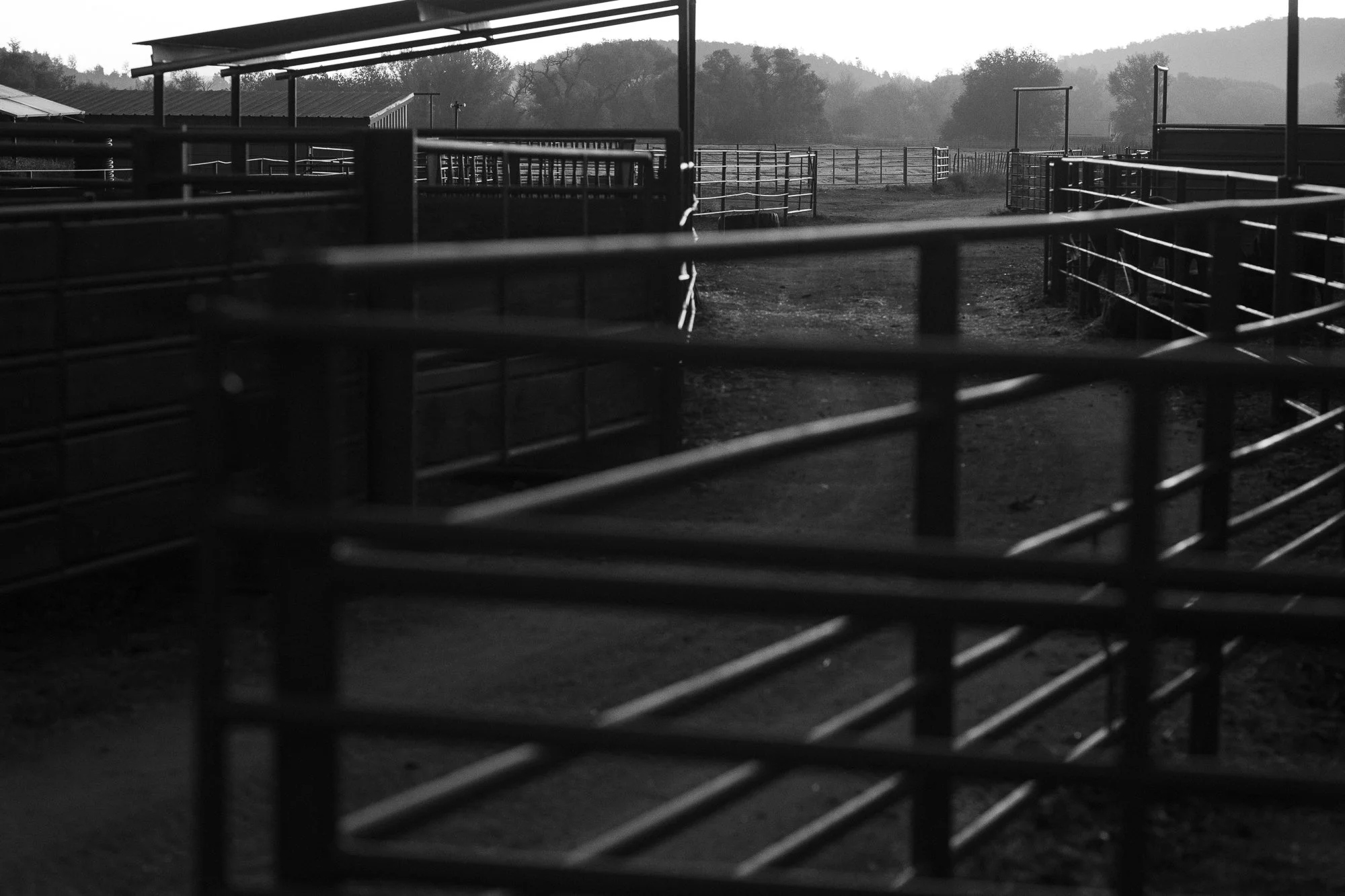
It means the subject isn’t manufactured. You’re not documenting a version of the West built for tourists. You’re seeing something that still functions the way it always has.

That’s why so much of my own work continues to bring me back to places like this.

Documenting the Same World Through Photography

While Monson works in charcoal, the intent overlaps closely with what I’ve been building through photography. For the past several years, I’ve been documenting working cowboys across the American West—on ranches where traditions like branding, roping, and horsemanship are still part of daily life. It’s not staged. It’s not styled. It’s not built for content. It’s just the work, as it happens. That same honesty is what makes both forms of work resonate. Whether it’s a drawing or a photograph, the goal is the same: create something that holds up over time because it’s rooted in reality.

The Importance of Western Crafts and Artists

There’s a broader ecosystem around cowboy culture that often gets overlooked — Saddle makers. Rawhide braiders. Bootmakers. And artists like this one working in charcoal.
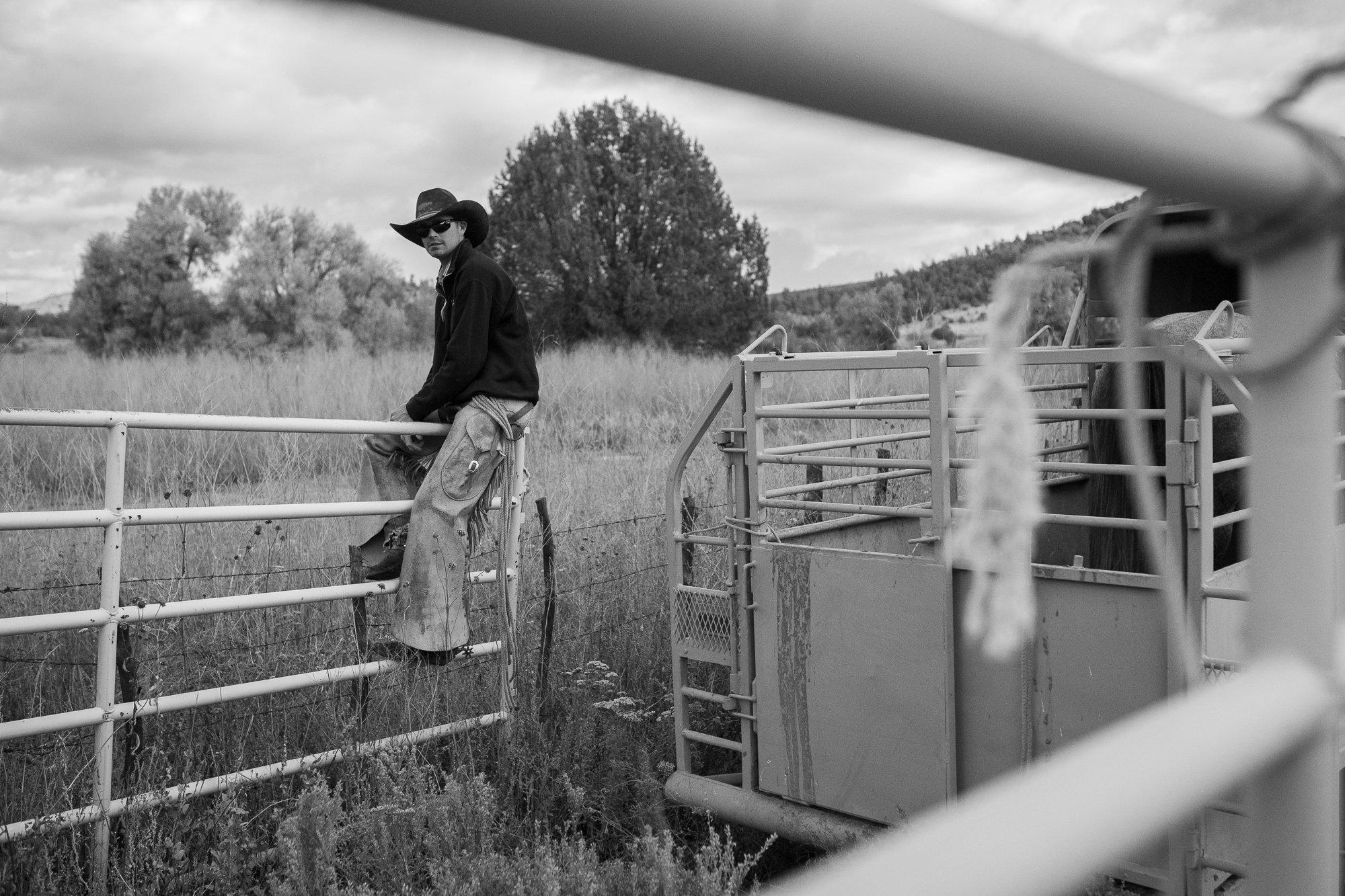
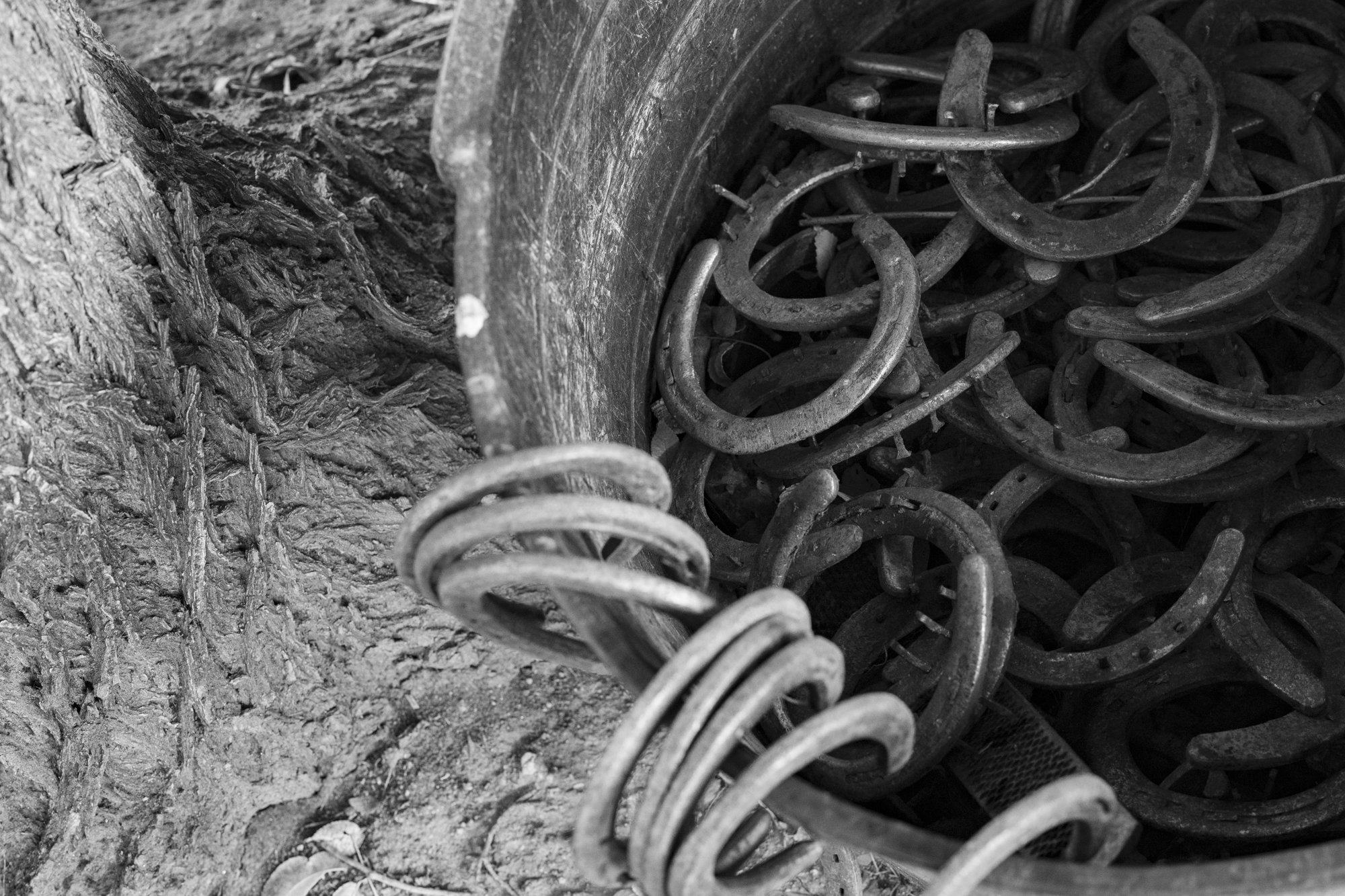
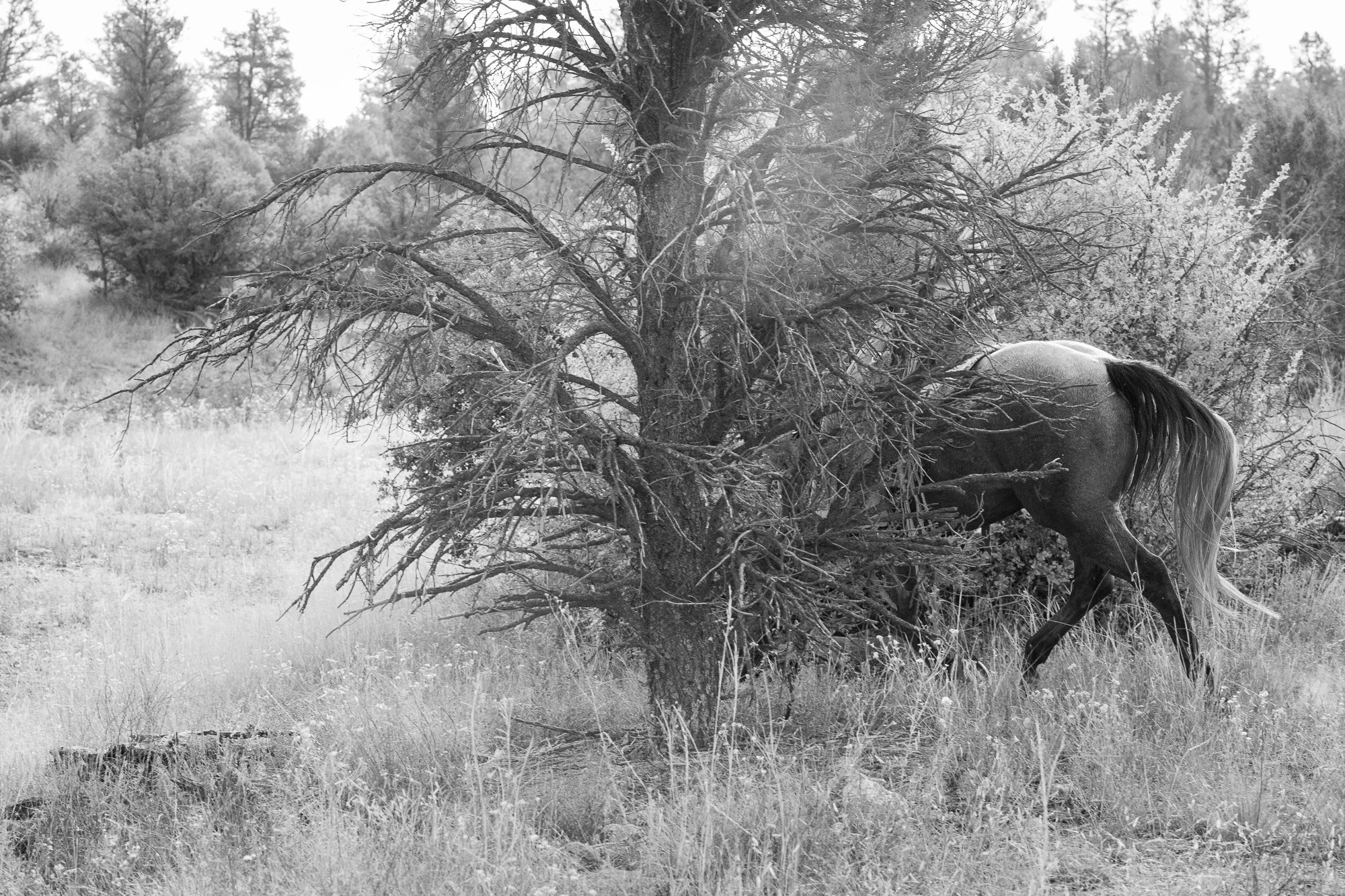
These aren’t separate from Wester culture—they’re part of it. And as fewer people continue these traditions, documenting them becomes more important. Not in a nostalgic way. In a factual one. Because once these skills disappear, they don’t come back.

Collecting Authentic Western Art and Photography

For collectors, there’s a difference between work that references the West and work that comes directly out of it.

That difference shows up over time.

It’s in the details. The restraint. The lack of exaggeration.

Whether it’s a charcoal drawing or a photograph, the strongest pieces tend to be the ones that don’t try too hard. They just reflect what’s there.

If you’re interested in collecting work like this, it’s worth paying attention to where it comes from—and who made it.

A Larger Project Documenting the American West

This visit is part of a much larger body of work focused on documenting the people, places, and traditions that still define the American West.

It’s taken me across ranches in multiple states, often working in remote environments where this way of life still operates largely unchanged.

If you’re interested in seeing more:

Charcoal artist Doug Monson at work in his studio at the Western Skies Gallery in Afton, Wyoming

Charcoal artist Doug Monson at work in his daylight studio

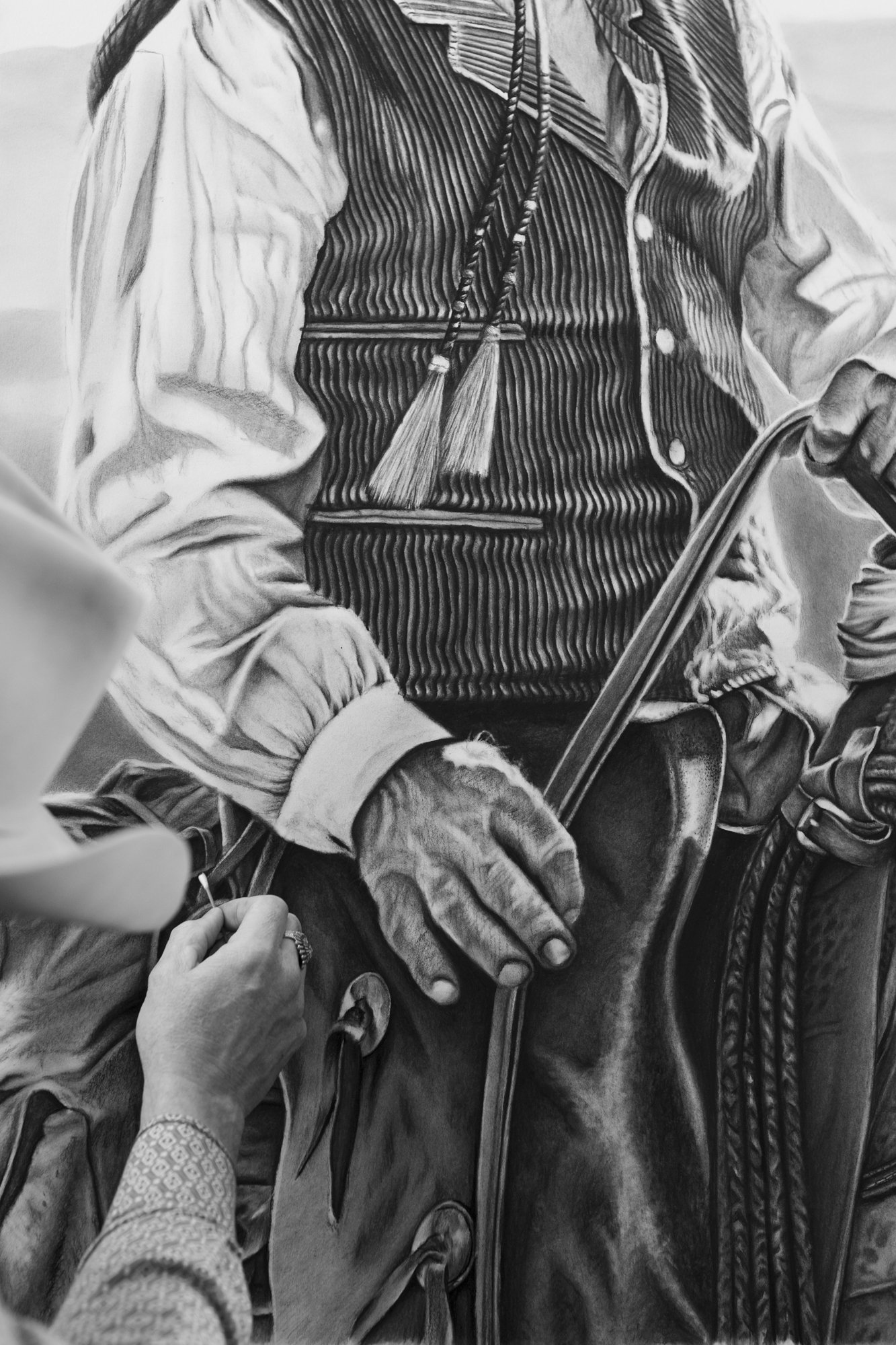
A western charcoal artist drawing a cowboy

Monson drawing a cowboy with charcoal on paper

Portrait of a Western charcoal artist

Portrait of artist Doug Monson

Western charcoal artist Doug Monson working on a drawing at the Western Skies Gallery

Doug Monson at work on a drawing in the Western Skies Gallery

Black and white photograph of a Western artist in his studio surrounded by drawings and art supplies

Doug Monson surrounded by art in his studio


Cowboy Photography - Buckaroos

Nevada Buckaroo Photos | Authentic Great Basin Cowboy Photography

Buckaroo Photography from the American West

The Great Basin is a special part of the American West, particularly as it applies to cowboy culture and the buckaroos that call it home. Among the few remaining iconic ranches still left in northern Nevada are the C-Punch Ranch in Lovelock and the Winecup Gamble Ranch in Montello. Both are jaw dropping beautiful and incomprehensibly large. The C-Punch, the biggest I’ve been to so far, is 1.8 million acres. Yeah. Try wrapping your head around that. Seeing all these properties in different parts of the country has been amazing. Each region has its own allure. Nobody ever said to pick a favorite, but there’s something about the land in northern Nevada that really does it for me. Still working on putting that into words, but it’s exceptional, to say the least and took a few years to truly understand. At first, places that big, open, and seemingly void of life are difficult to grasp. Then something clicks and you can’t get enough of it. The muted colors, textures, and vibes of the Sage Brush Sea are intoxicating.

Nevada Buckaroos and Great Basin Ranch Culture

A Nevada buckaroo is not a costume or a posture. It is a way of working that developed in wide country where distance matters and horses are tools, not accessories. The Great Basin shaped this culture the way weather shapes a face—slowly, without asking permission. These photographs were made in that context, among people whose days are structured around stock, seasons, and the quiet competence required to make both endure.

The buckaroo tradition in Nevada carries deep vaquero roots, visible in gear, horsemanship, and the small details that separate function from style. While every worn saddle mark, coil of rope, and dirty Garcia bit does a job it has already done many times, make no mistake, buckaroo gear has a style all it’s own. A style that’s worm with immense pride, not just because it’s part of their very identity, but also because they know it’s the visual element that separates them from cowboys in every other region of the West.

Photographing Working Buckaroos in Nevada

Photographing buckaroos is less about chasing moments and more about staying put long enough for the work to reveal itself. The rhythm is slow, punctuated by long stretches of waiting and brief intervals where everything happens at once. These images come from time spent standing off to the side, watching cattle move, horses settle, and men do what they’ve always done without commentary.

There is no staging here. The photographs are made in real working conditions, often dictated by weather, dust, and the simple fact that ranch work does not stop for a camera. That constraint is part of the appeal. It keeps the photographs honest and the subjects unbothered.

Nevada Buckaroos Within the American West

Within the larger story of cowboy culture, Nevada buckaroos occupy a particular corner—one defined by style, scale, isolation, and continuity. This body of work fits within a broader project photographing working cowboys across the American West, but these images belong specifically to the Great Basin and the people who know it well.

Taken together, the photographs function less as individual moments and more as a quiet record of a way of life that persists without announcement. They are not meant to explain or romanticize the work, only to show it as it appears when you spend enough time around it. I am forever grateful that these these buckaroos have allowed me to spend time with them.

View More Nevada Buckaroo Photography

Shop Cowboy Photography Prints

Photograph of a cowboy working cattle on the C-Punch Ranch - Nevada

Cowboys roping cattle on the C-Punch Ranch in Lovelock, Nevada

C-Punch Ranch

Winecup Gamble Ranch - Montello, Nevada

Winecup Gamble Ranch - Montello, Nevada

Photograph of a buckaroo catching horses

Photograph of Great Basin Buckaroos branding cattle

Buckaroos branding cattle in Nevada

Cowboys working on the Winecup Gamble Ranch in Montello, Nevada

Black and white photograph of cowboys on the Winecup Gamble Ranch

Cowboy moving cattle on the Winecup Gamble Ranch

A cowboy working on the C-Punch Ranch in Lovelock, Nevada

C-Punch Ranch

Cowboys working colts in a round pen on the C-Punch Ranch in Lovelock, Nevada

C-Punch Ranch - Cowboys working horses in a round pen

A cowboy on the C-Punch Ranch in Lovelock, Nevada

C-Punch Ranch

American West Cowboys

Trapper Rogers - Winecup Gamble Ranch - Montello, Nevada

Portrait of Trapper Rodgers

A cowboy lets his horse drink water after branding on the C-Punch Ranch in Lovelock, Nevada

C-Punch Ranch - a cowboy waters his horse

A cowboy pets his cattle dog after a day of work on the C-Punch Ranch in Lovelock, Nevada

C-Punch Ranch

Photograph of a cowboy riding his horse through a huge pasture on the C-Punch Ranch - Lovelock, Nevada

A cowboy riding his horse on the C-Punch Ranch in northern Nevada

Catching Horses
from $1,200.00

Wyoming Cattle Ranch

Wyoming Cowboy Photography

American West

A cowboy gathering cattle on a ranch outside Laramie, Wyoming. Cowboy Photographer Rob Hammer.

Wyoming cattle drive

Wyoming is a land rich in rugged beauty, where open plains meet towering mountain ranges, and the cowboy way of life still thrives. One of the most iconic images that evokes the spirit of the American West is that of a working cowboy on a Wyoming cattle ranch. These photos not only showcase the breathtaking landscapes but also the hard work, dedication, and heritage that define ranch life.

A cattle drive on a large ranch in Wyoming by cowboy photographer Rob Hammer.

Cowboys moving cattle on a ranch in Wyoming

A cowboy lets his horse drink from a pond during a long cattle drive on a ranch in Wyoming by cowboy photographer Rob Hammer.

Black and white cowboy photography print

Cowboys herd cattle on a rugged section of open ranch in Wyoming by cowboy photographer Rob Hammer

Wyoming cowboys

Kurt Markus

KURT MARKUS - COWBOY PHOTOGRAPHER

In the realm of Western/Cowboy photography there are a small handful of names that stand above all the rest: William Albert Allard, Bank Langmore, John Langmore, and Andy Anderson, but in my opinion Kurt Markus is the G.O.A.T. Few would argue. He passed away today. Not sure how it’s possible, but I didn’t learn about him until October 2021 during a road trip to Montana. Emily, Mojo, and I were staying at an old cabin Airbnb (1st picture) near Glacier National Park. Kurt’s book “Cowpuncher” was sitting on the coffee table. After looking through it for 30 seconds I put it down and instantly ordered myself a copy, feeling grateful that we even had cell service enough to do so. Since then, Markus has been the photographer I’ve studied/taken inspiration from more than anyone else on the planet. He is truly exceptional. What sets him apart is that his writing is just as strong as his images. Looking through his books and reading his stories makes the reader feel like they are right there experiencing the same thing he did. A special talent. I’m honored to own two of his books - Cowpuncher and Buckaroo. I believe his crown jewel though, is After Barbed Wire. A couple months ago I looked it up to buy, but was dissuade by the $150 price tag. No doubt, it’s worth every penny and more, but an honest effort has been made to cut back on my photo book “problem”. A while later another search went out in hopes of a better deal, resulting in the lowest price tag of $350. Yikes! During a recent road trip in Idaho, I found myself in an antique shop and spotted the book resting quietly in a locked cabinet. This is it, I thought! The owner couldn’t possibly be asking the same as the internet!? $400 - a signed 1st edition. Damnit!! The search continued. Now I check almost every antique shop that crosses my windshield from California to New York in hopes of finding the White Whale. So far, the results haven’t produced, and Google shows it valued as high as $800. On days like today, it seems like I should just fork it up. Rest in power, Kurt!

Click HERE to see some of my cowboy photography greatly inspired by Kurt Markus.

Cowboy Portraits

Authentic Cowboy Portraits

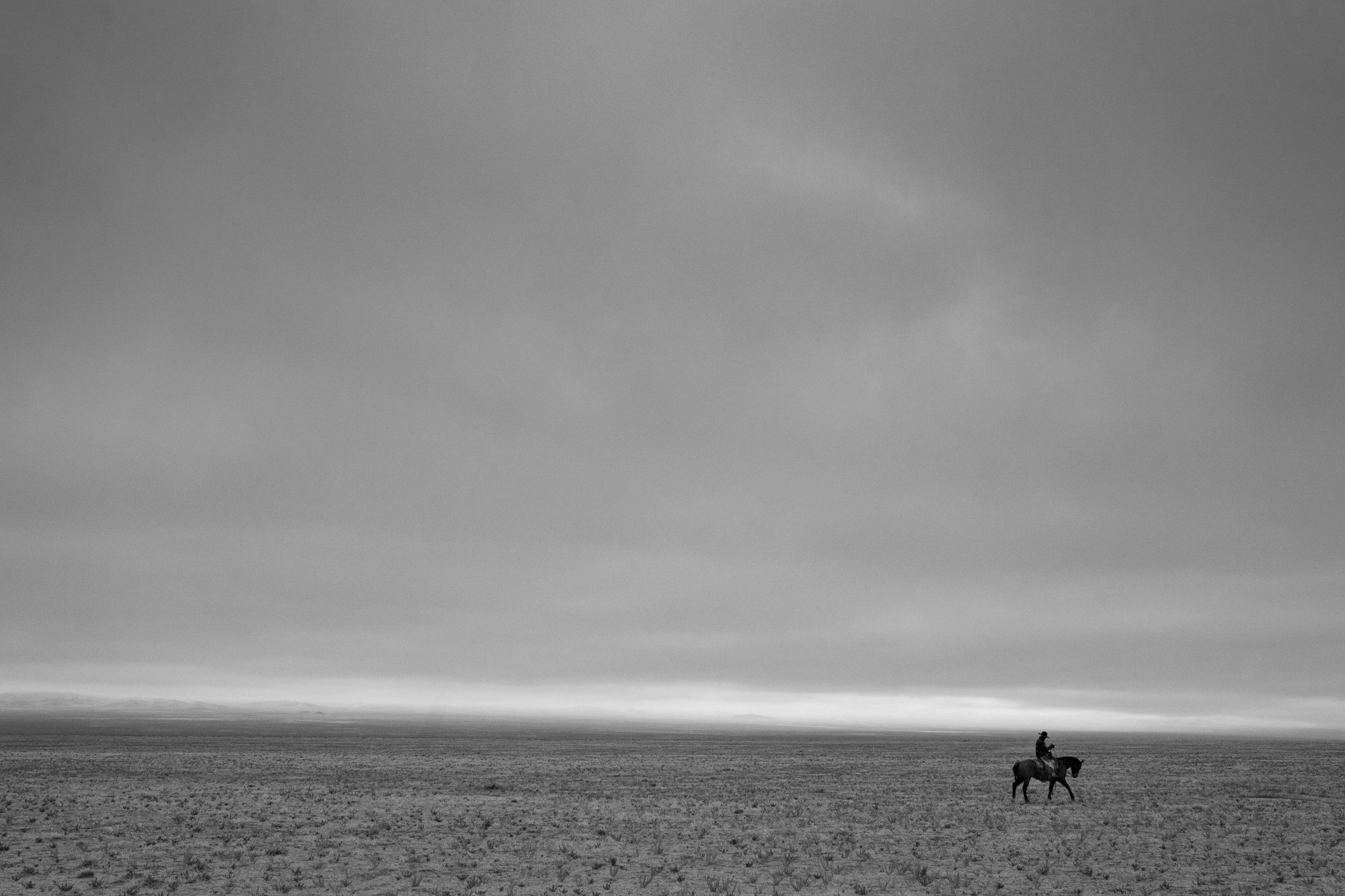
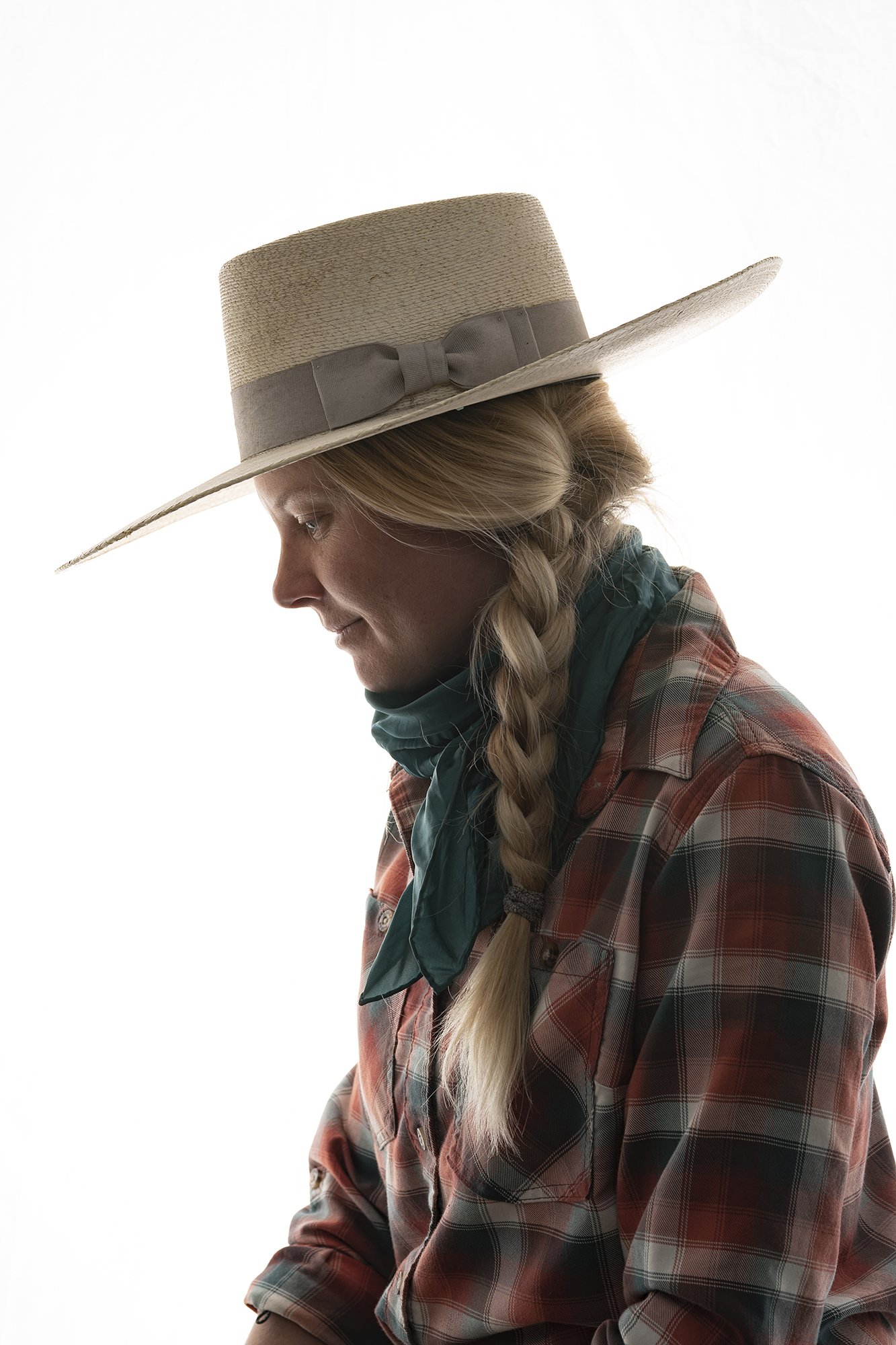
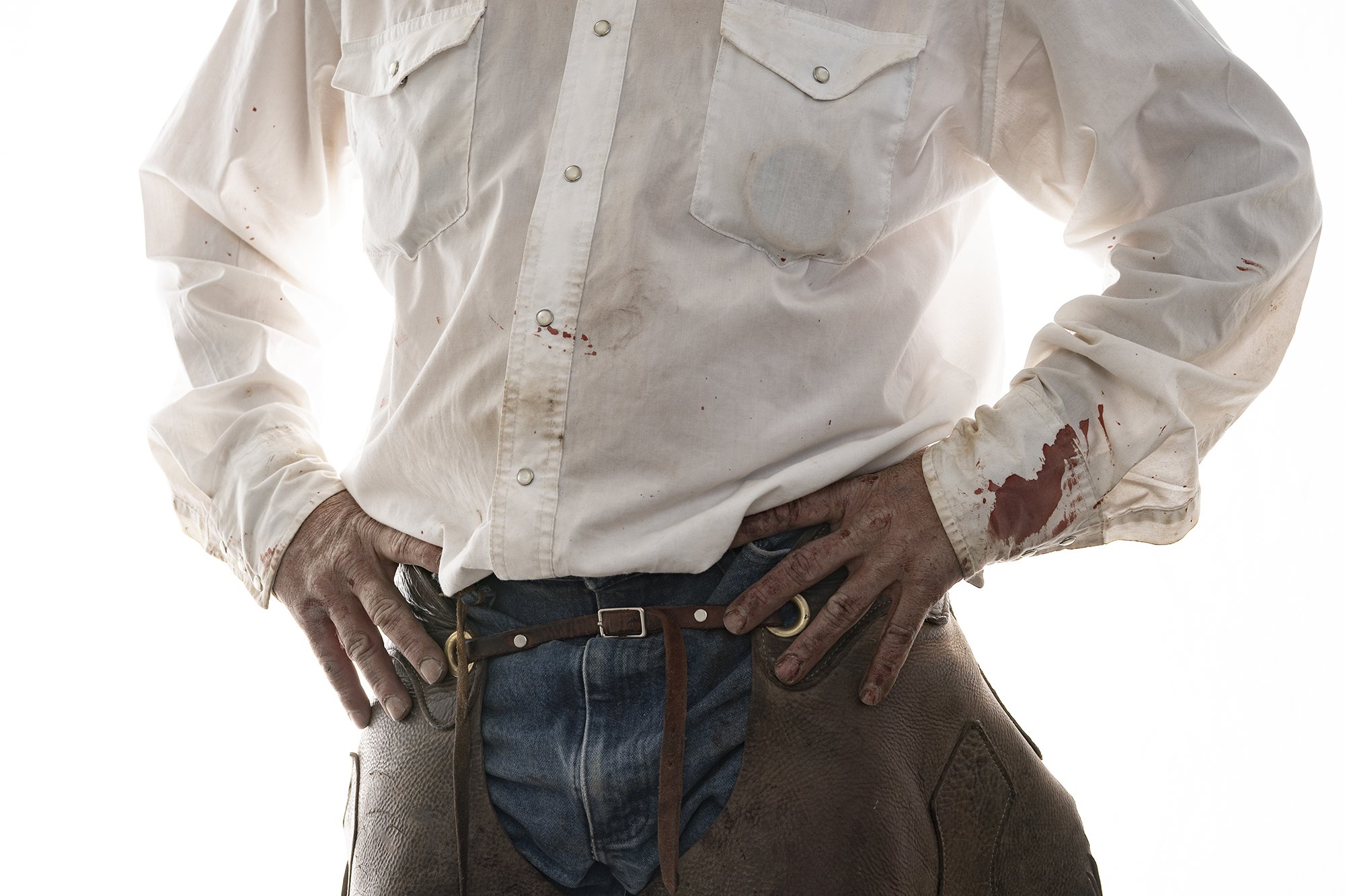
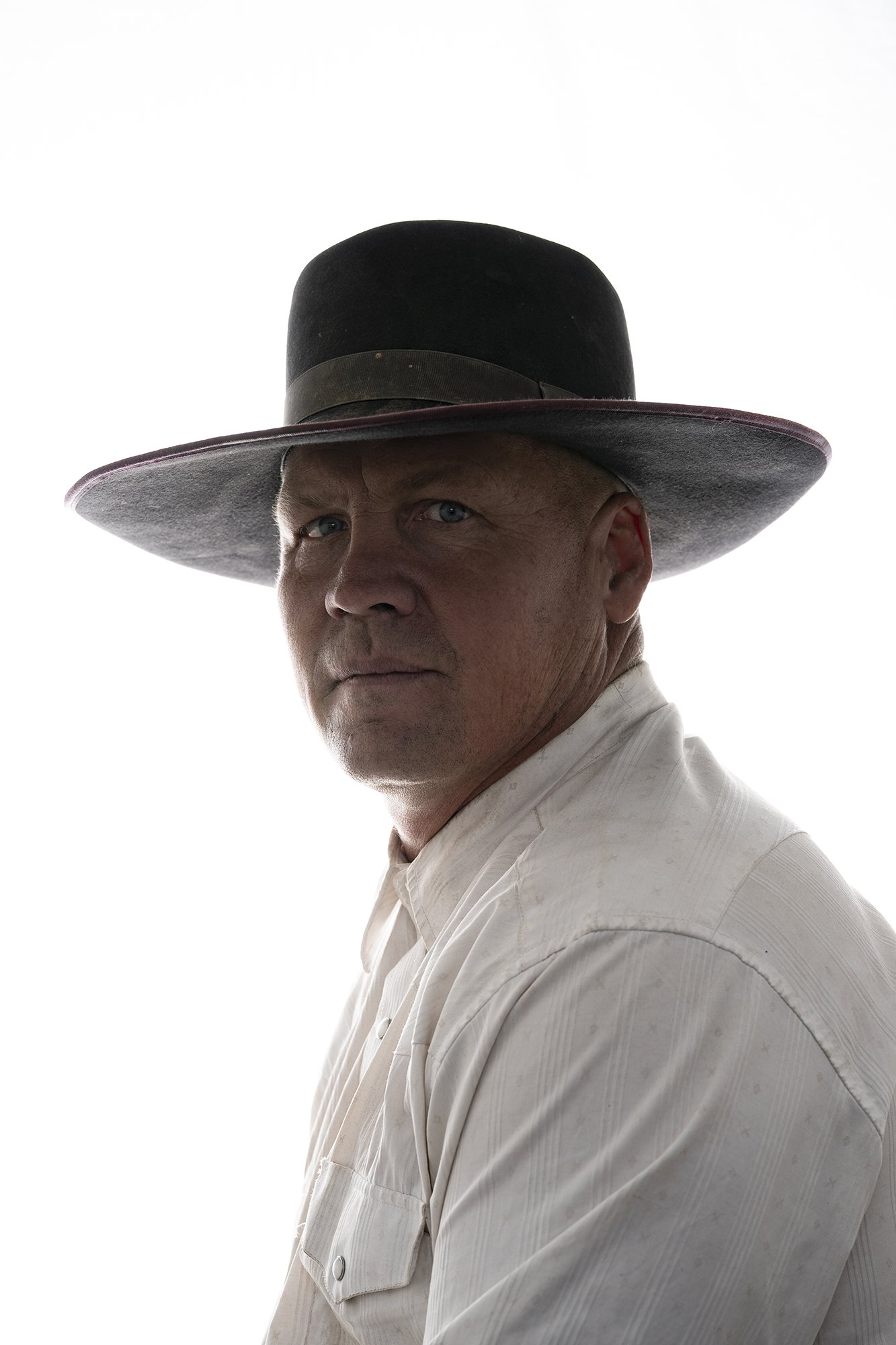
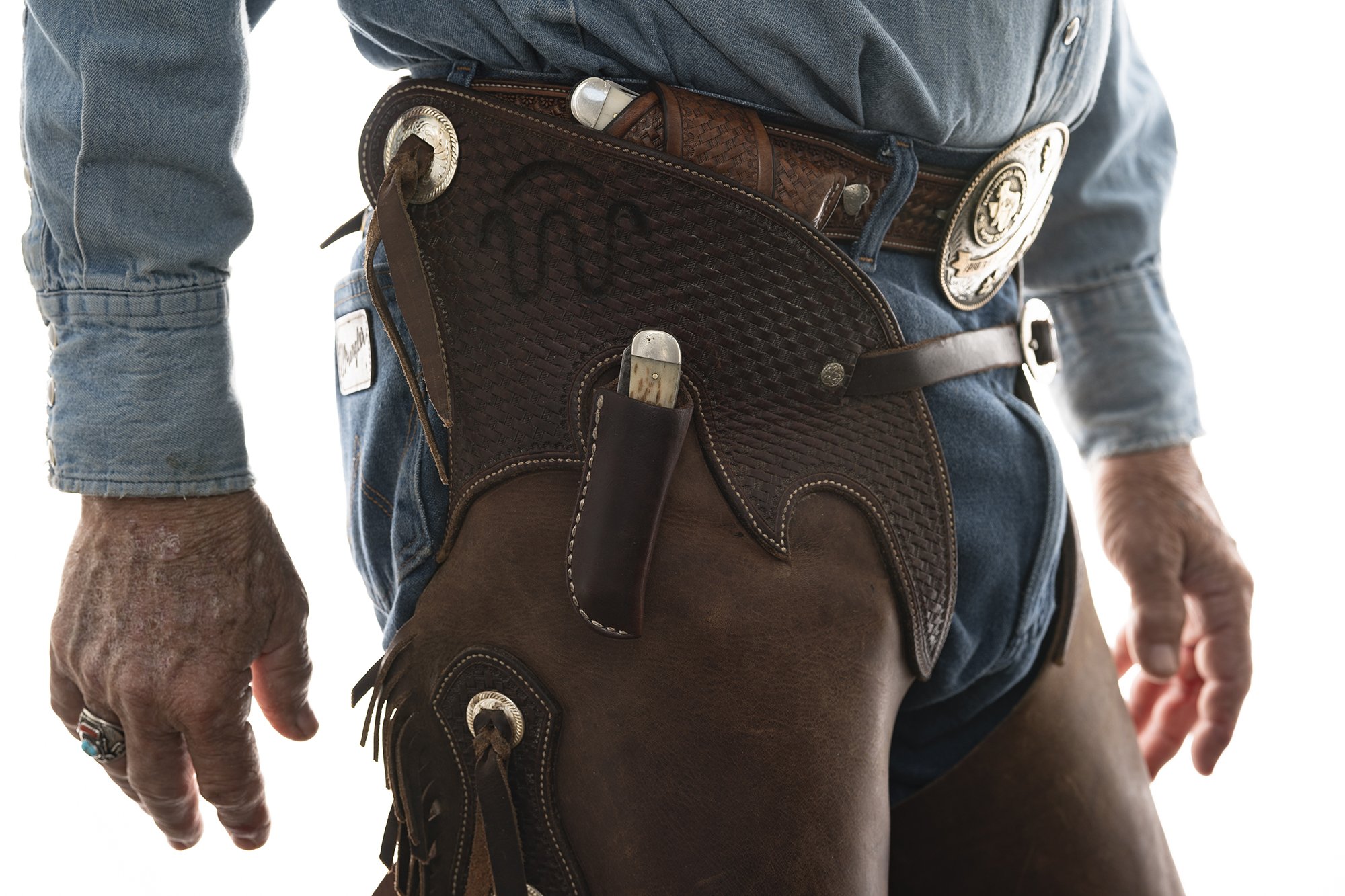
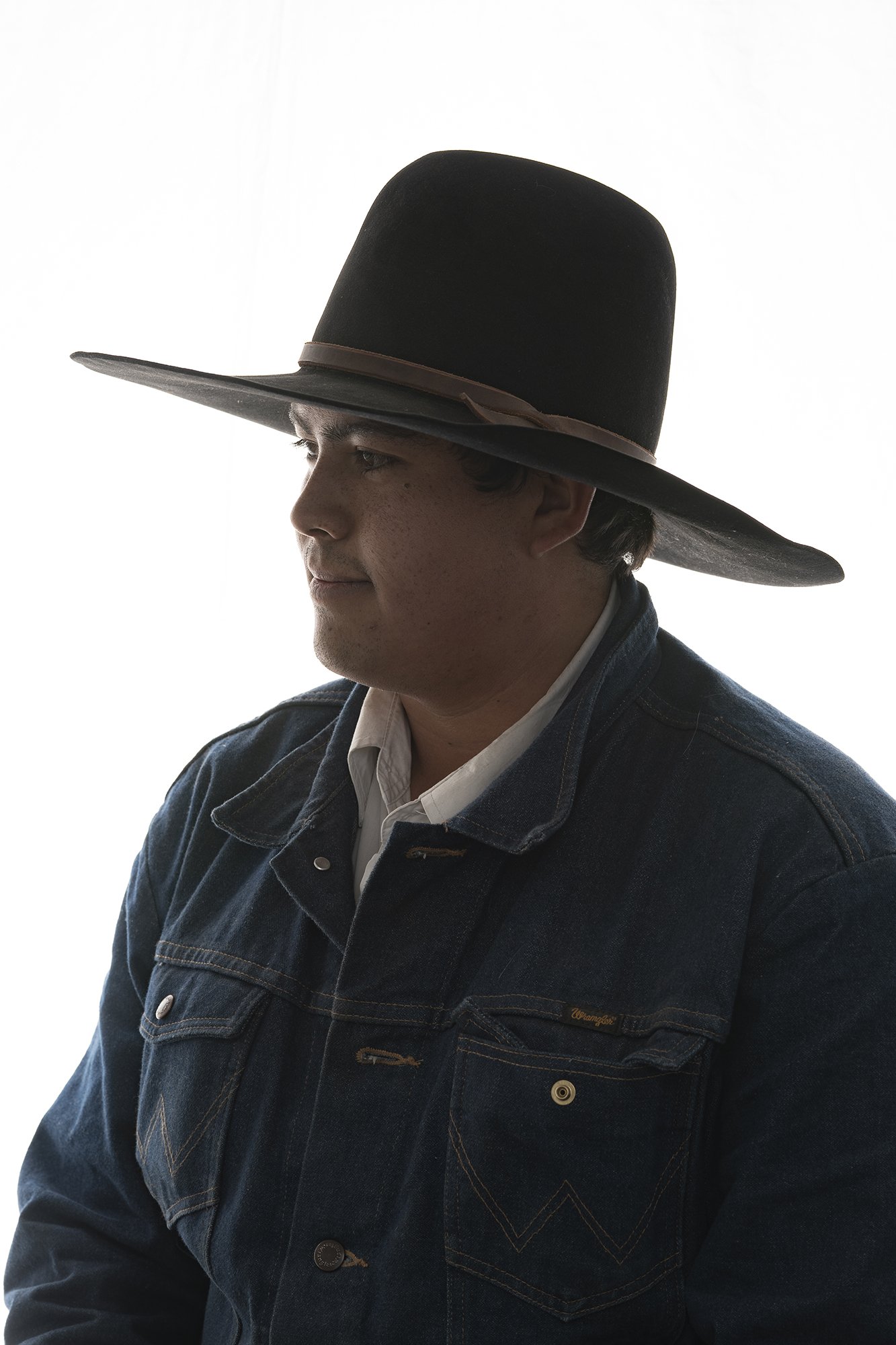
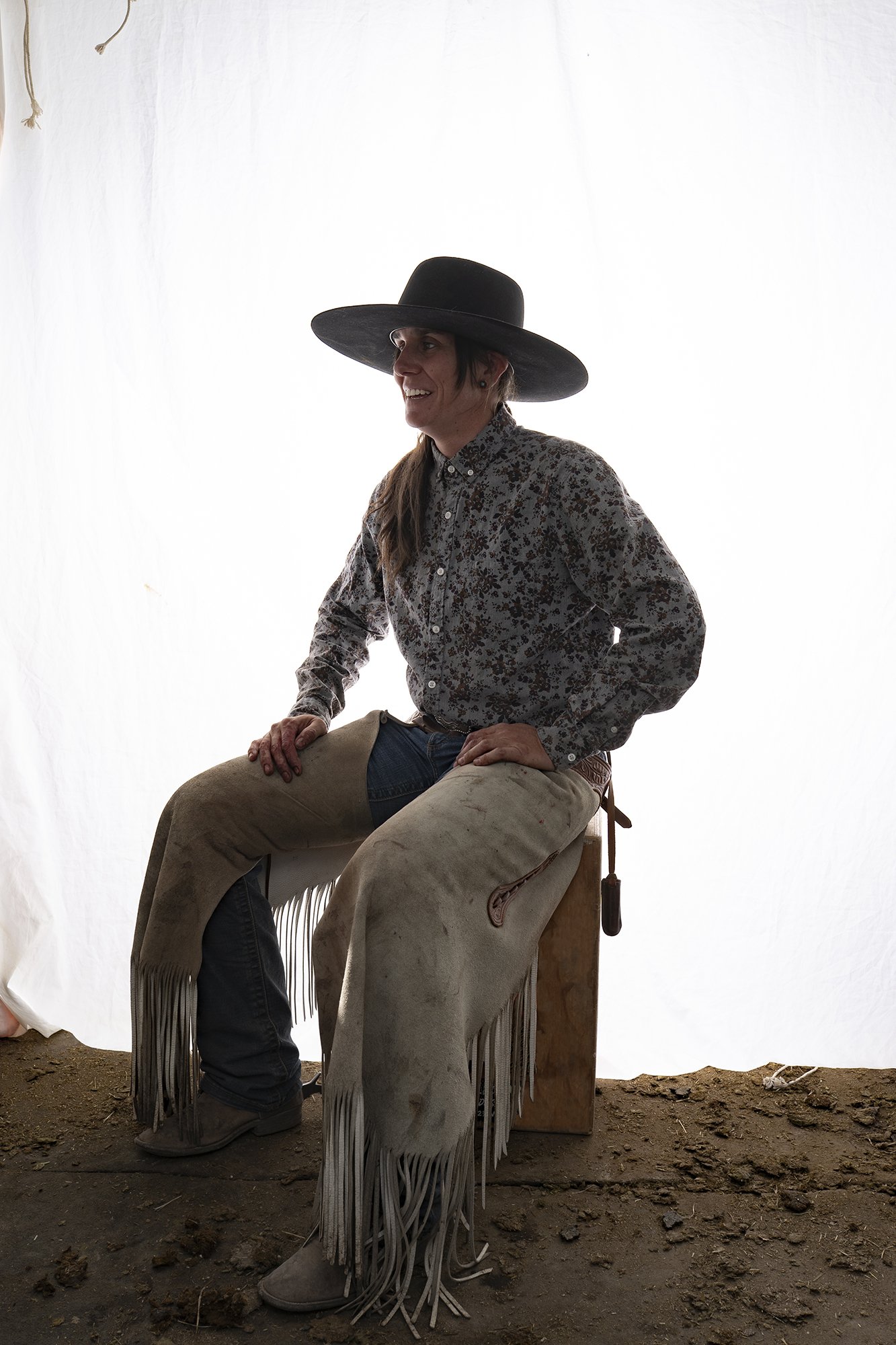
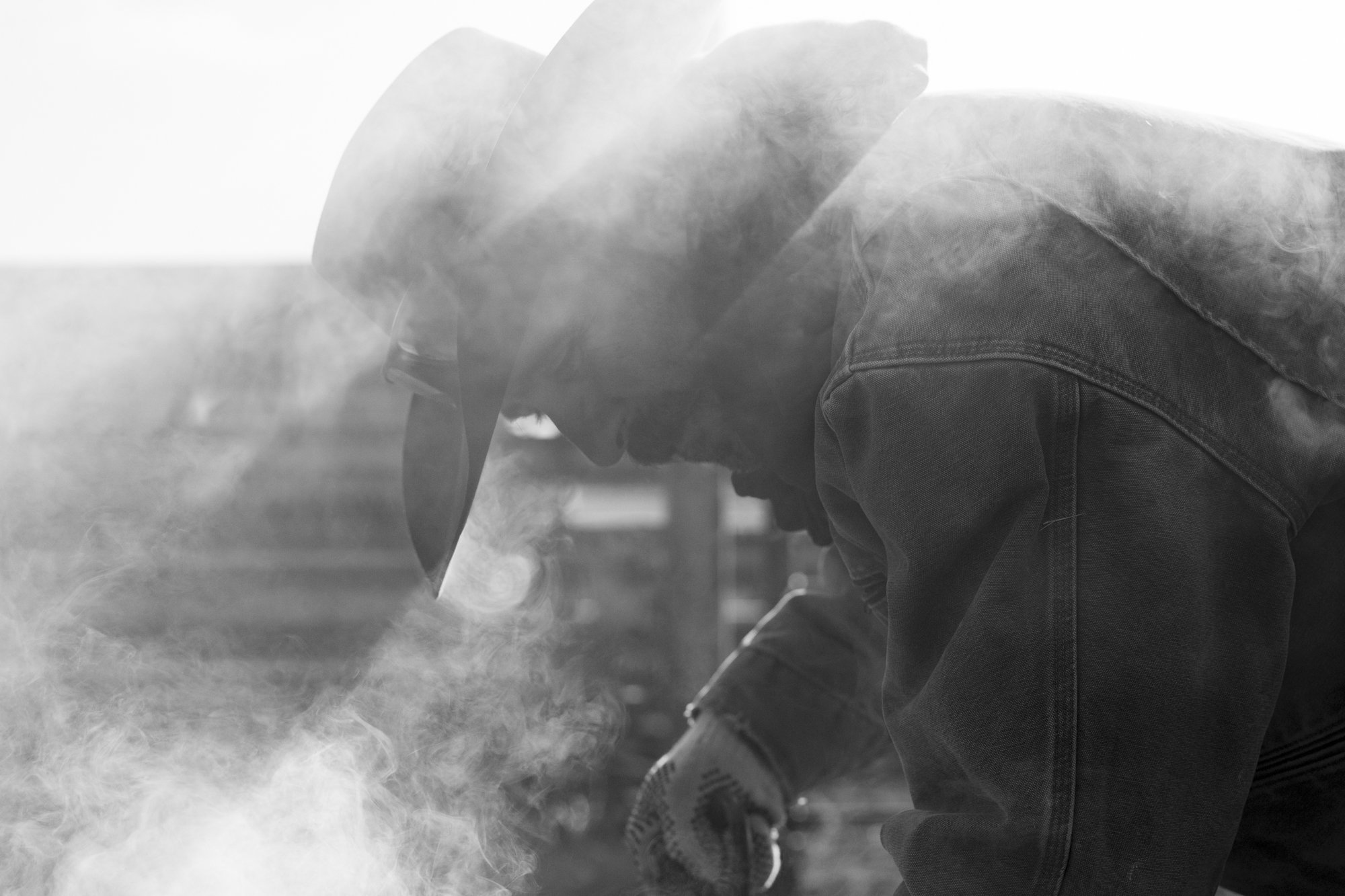
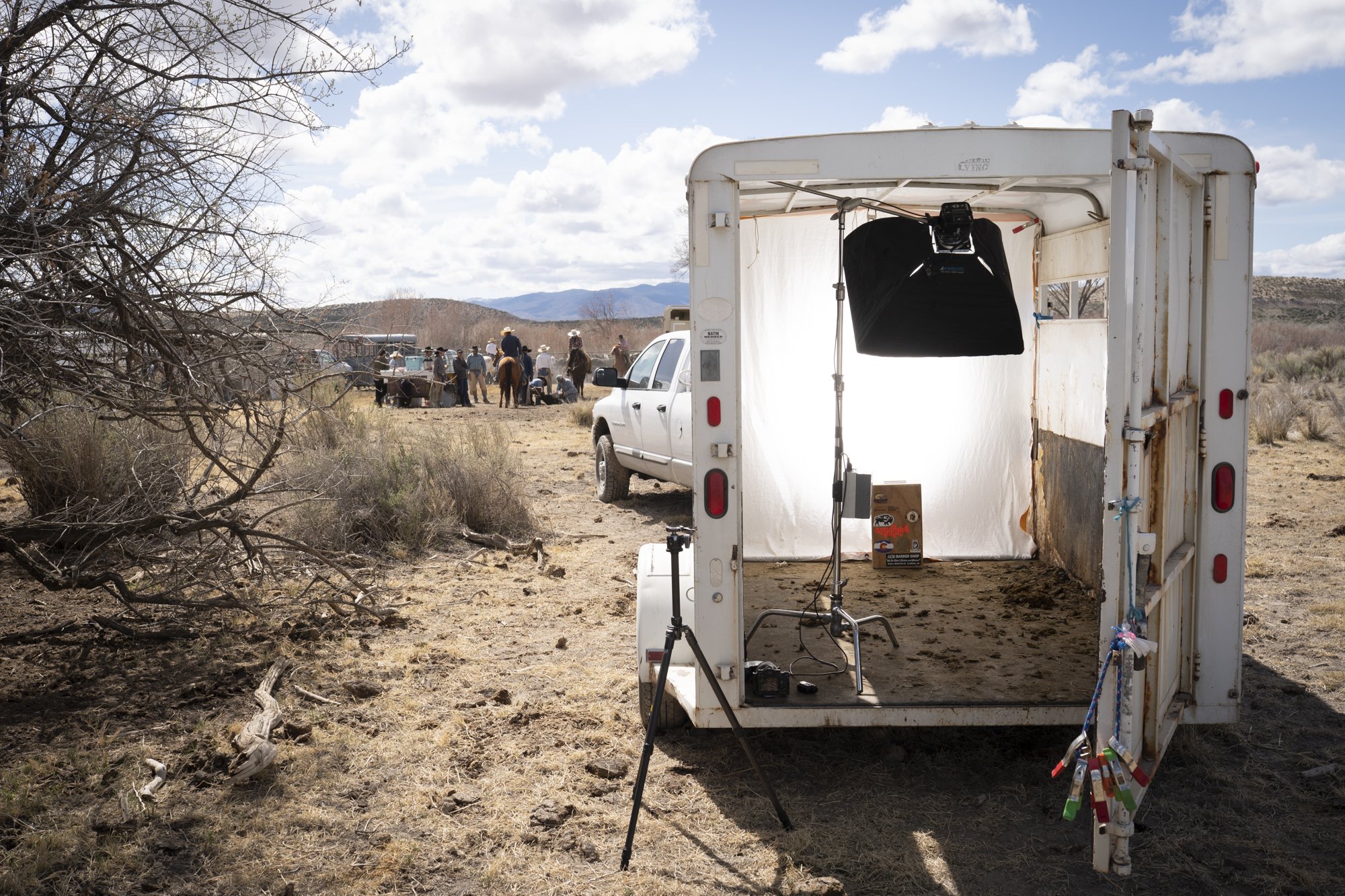
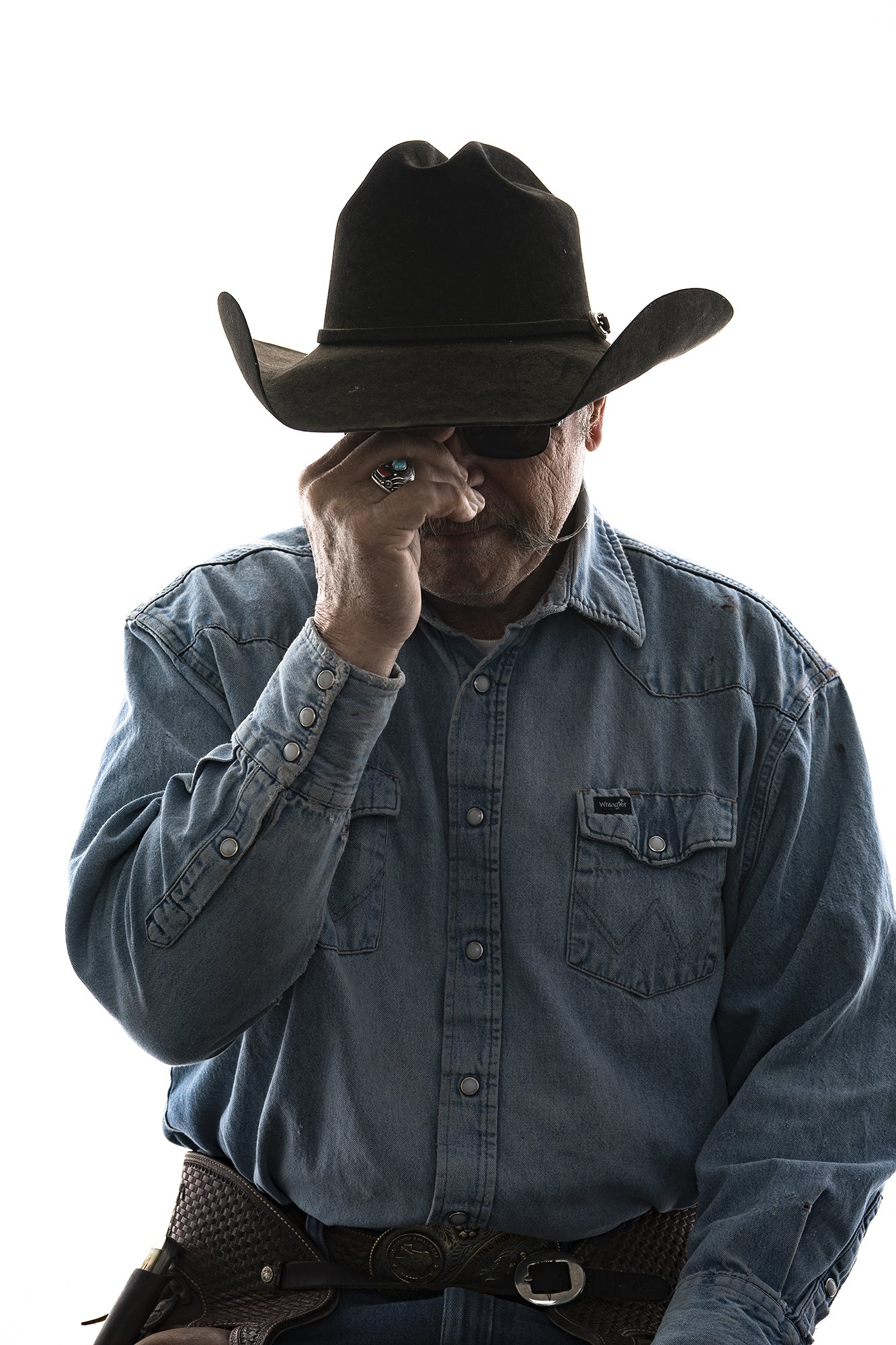
Brought the lighting gear out to a cattle branding a few months ago to make some portraits of all the cowboys and cowgirls working on the ranch. Wanted the focus to just be the people and their gear without anything else to distract from that. Had a blast setting it all up and shooting in a horse trailer, but still undecided if I’ll stick with this style or not.

Click HERE to see more from this series.

Cowboy Culture Photography

Cattle Branding - Cowboy Photography

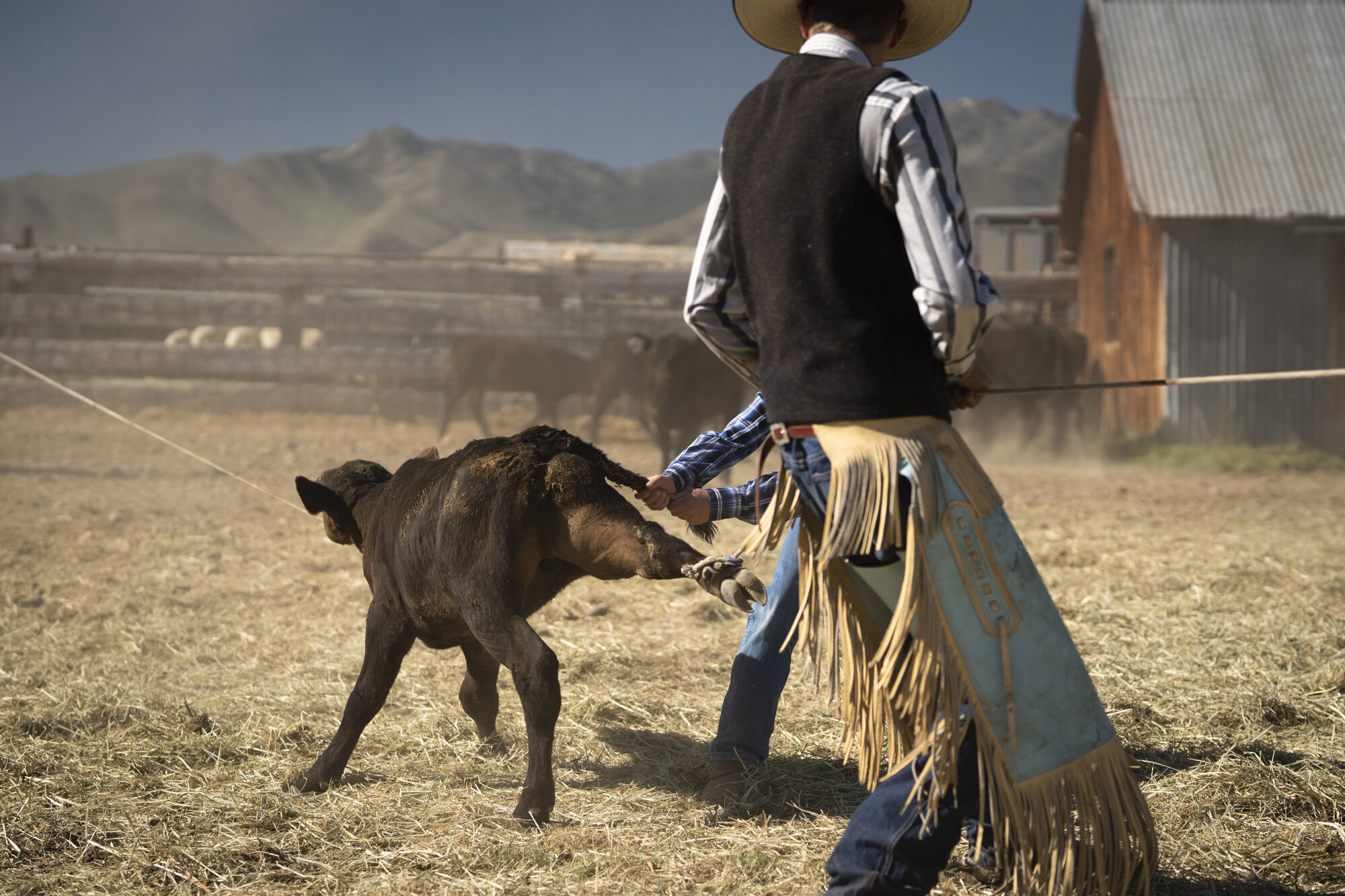
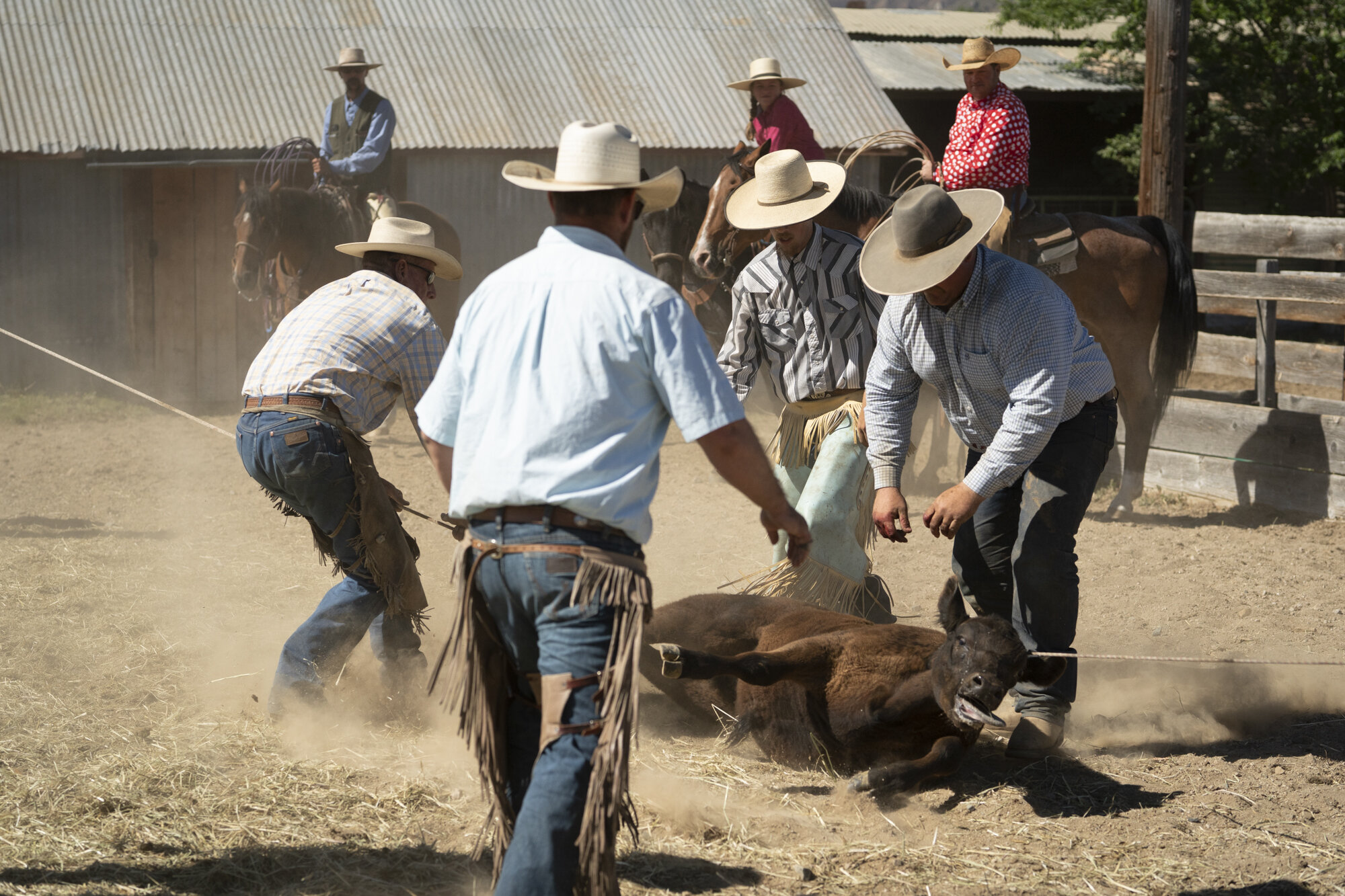
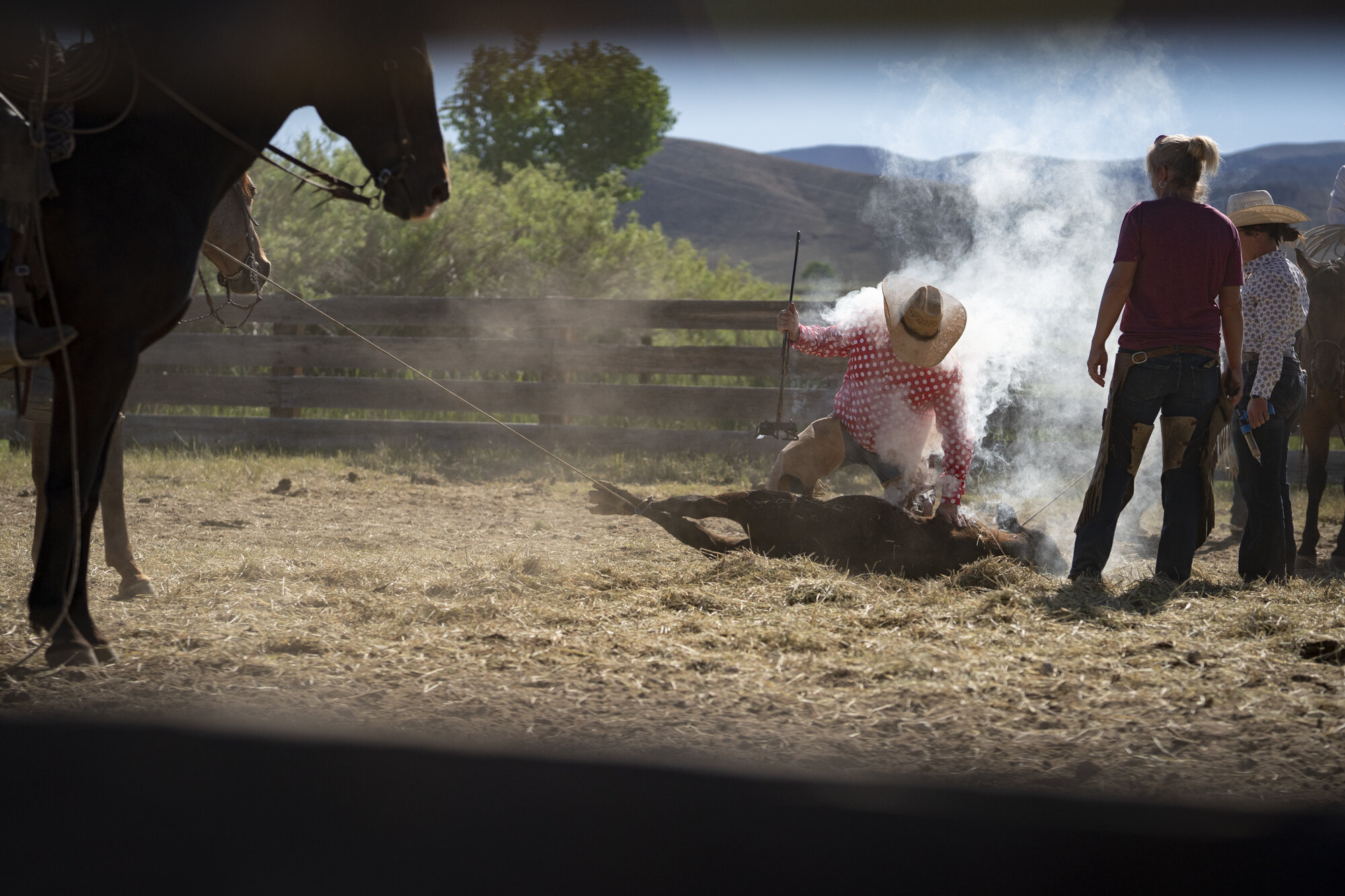
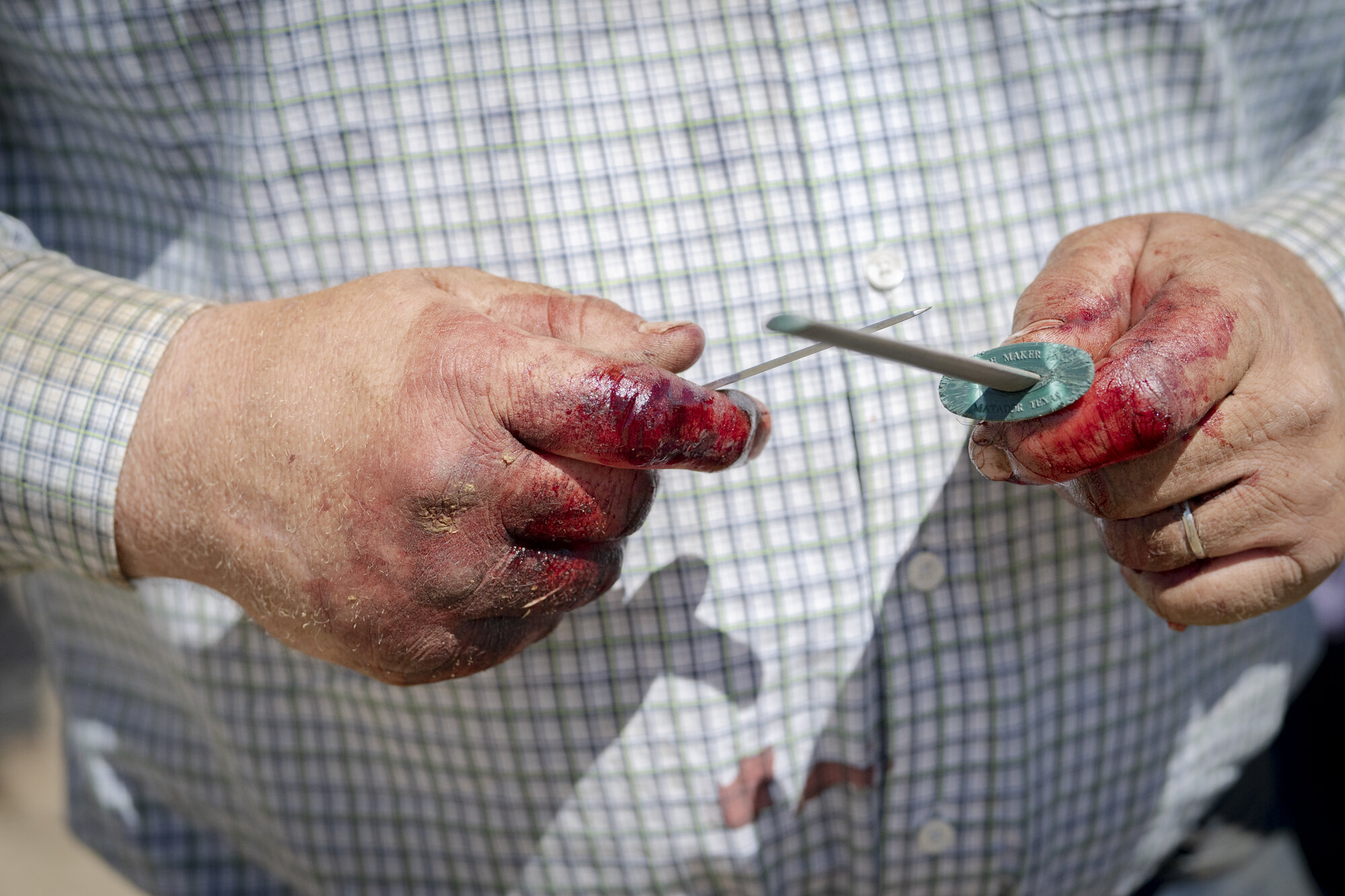
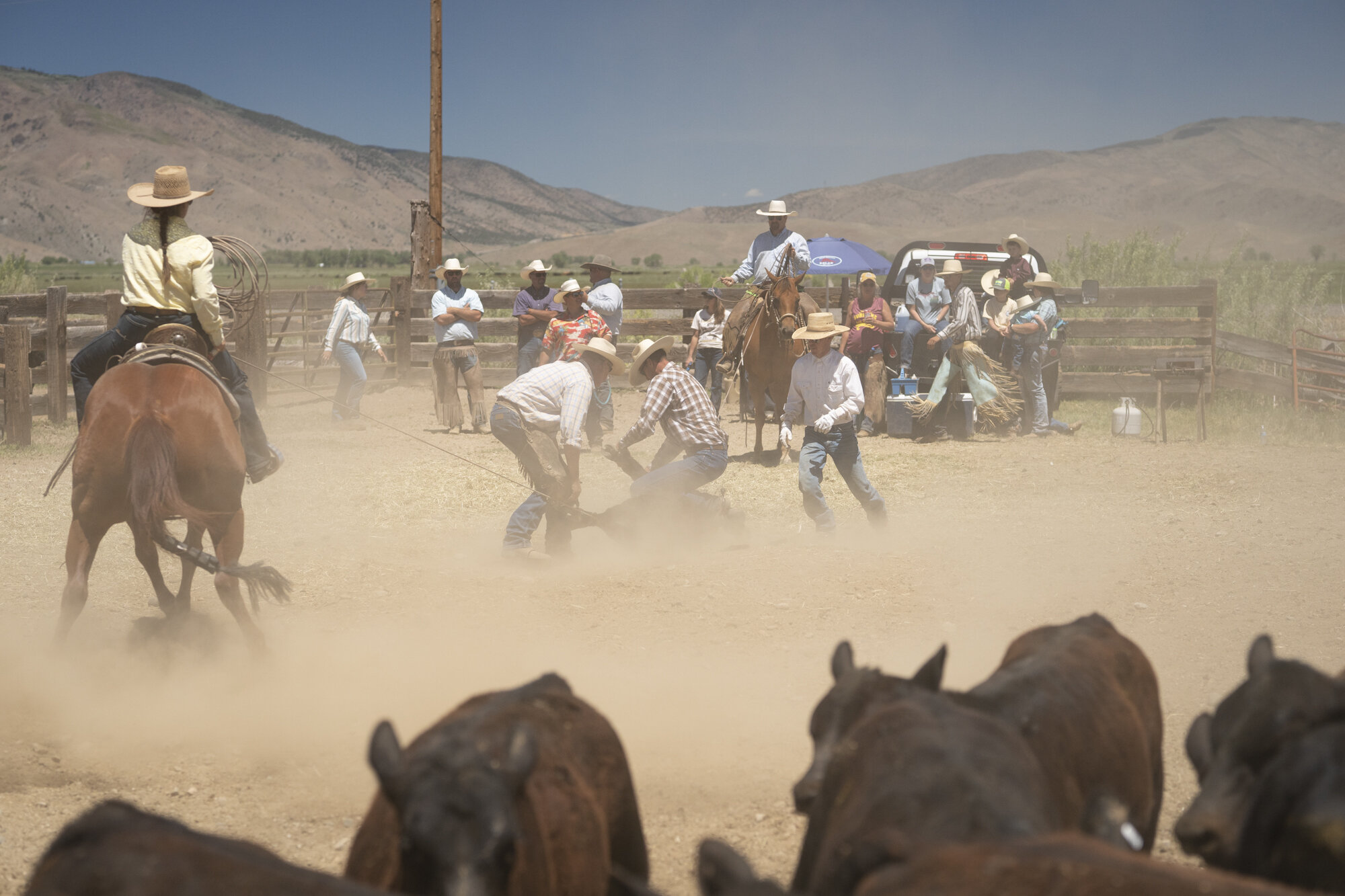
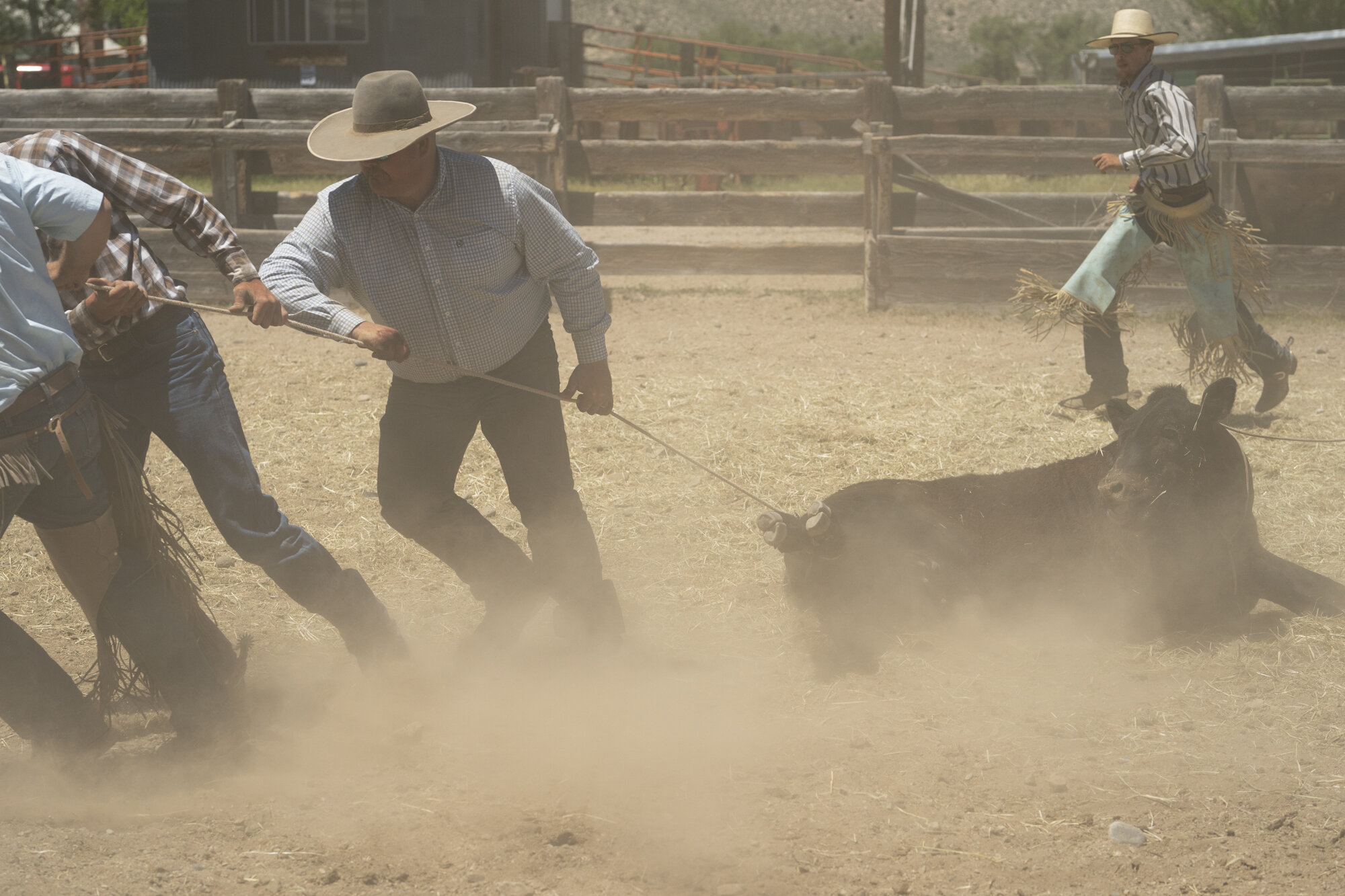
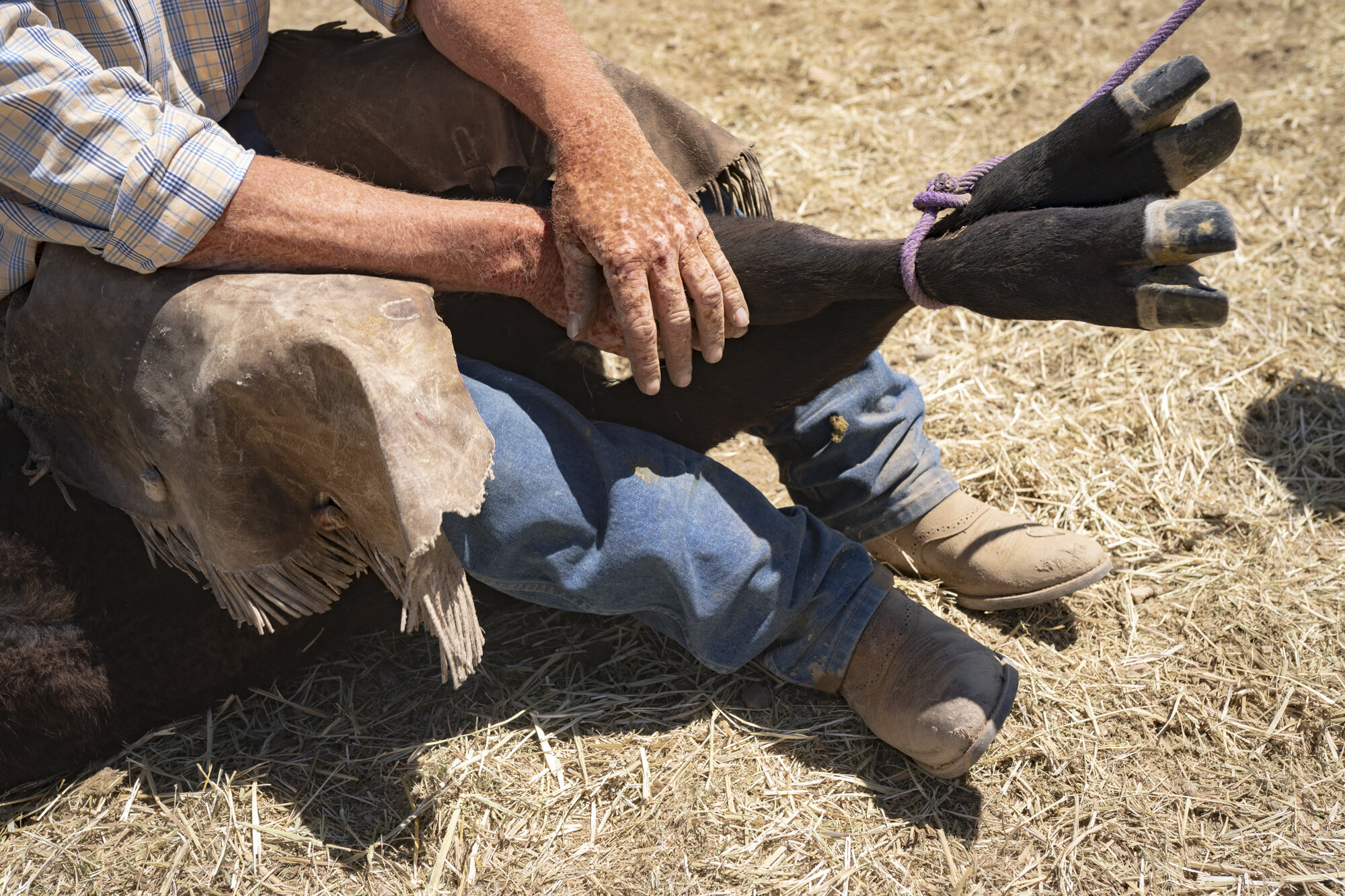
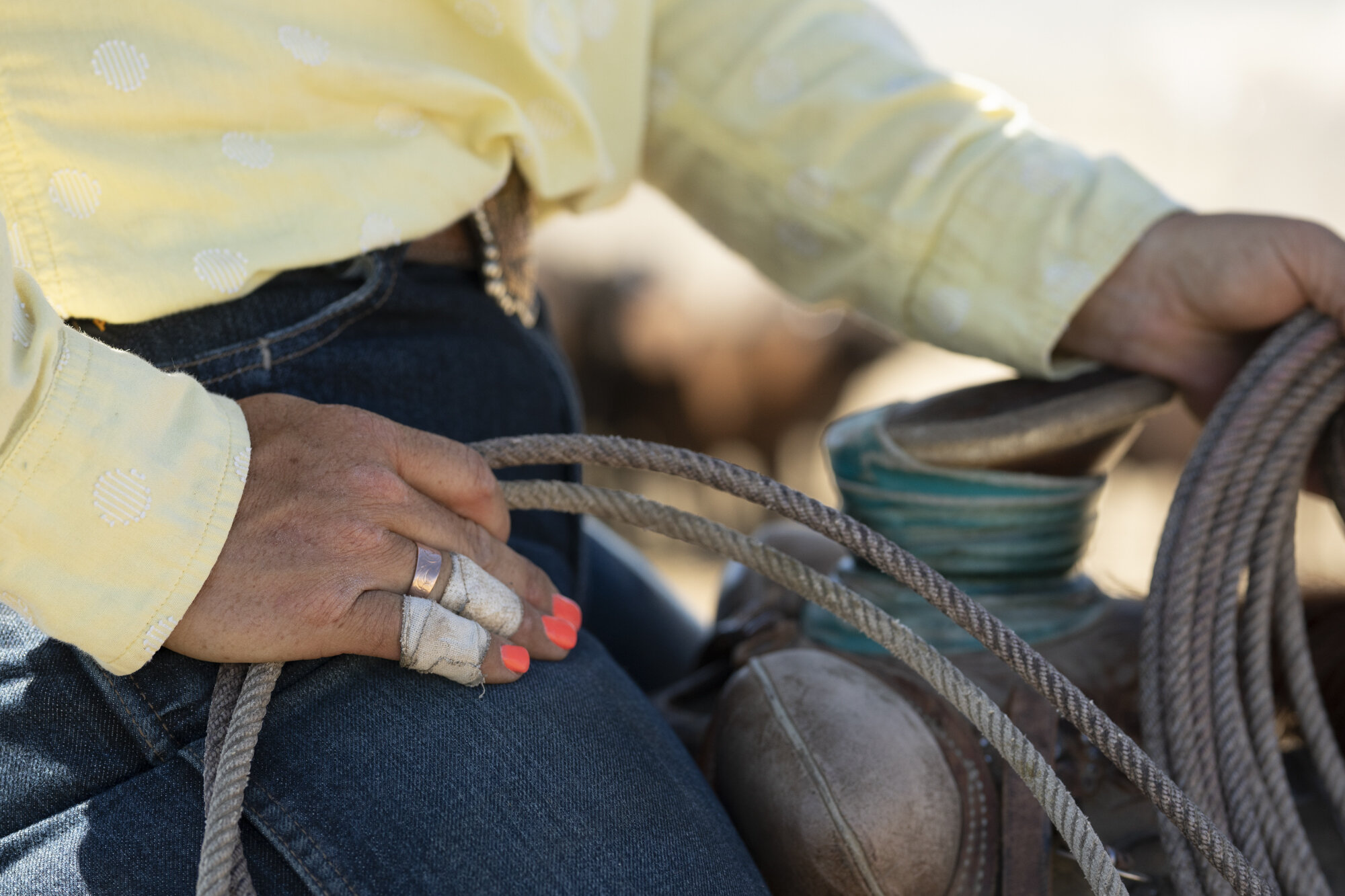
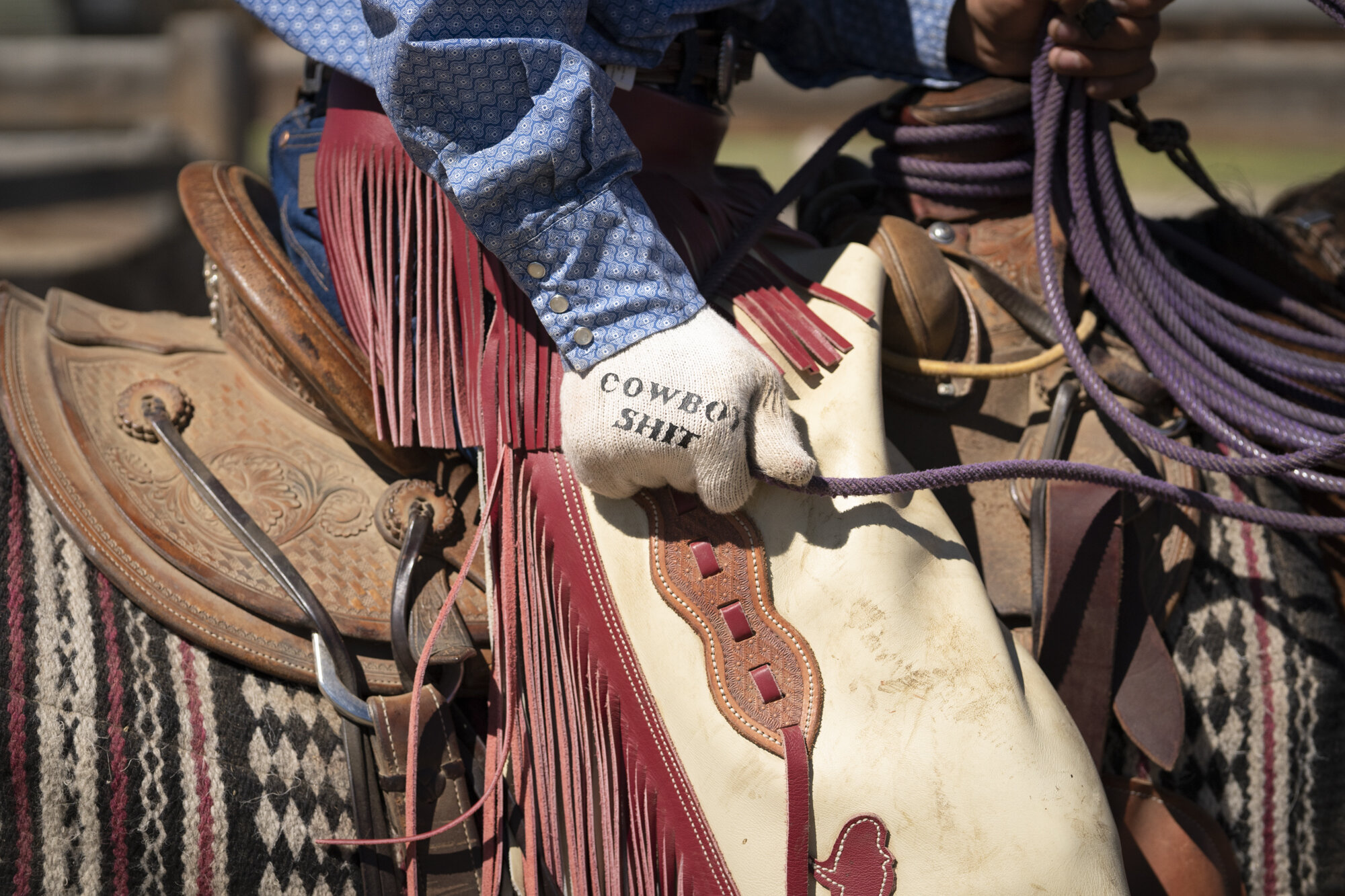
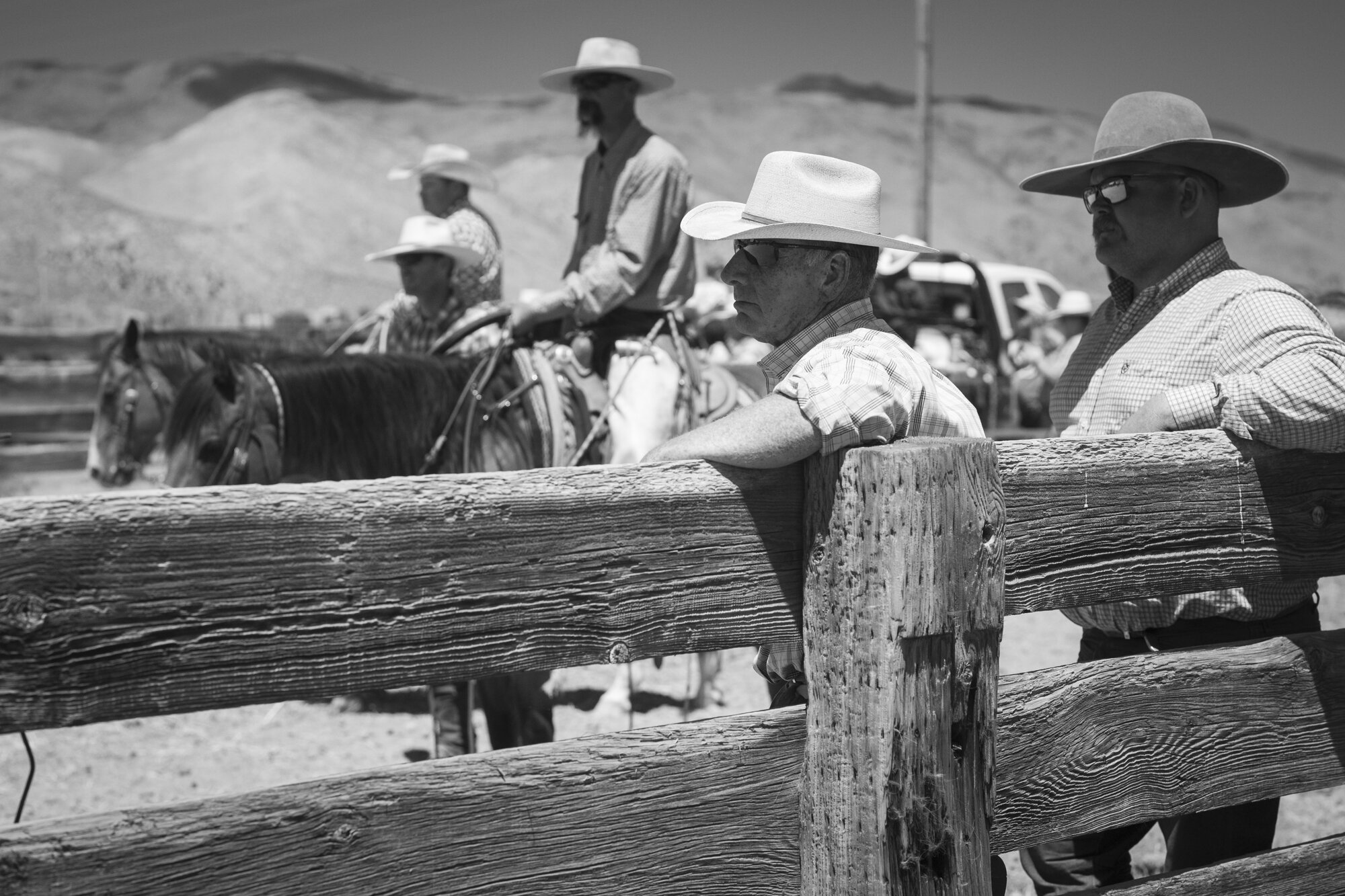
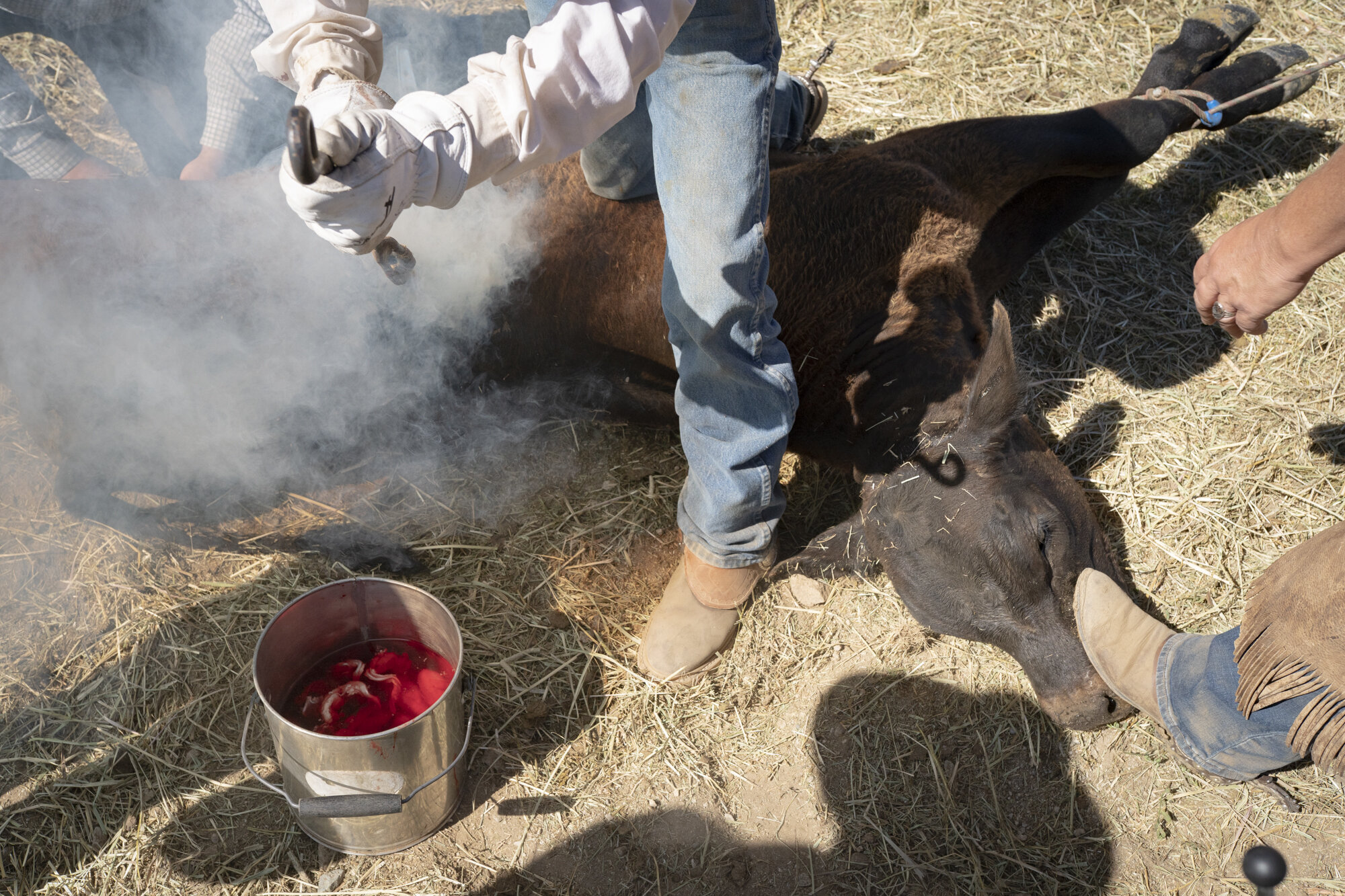
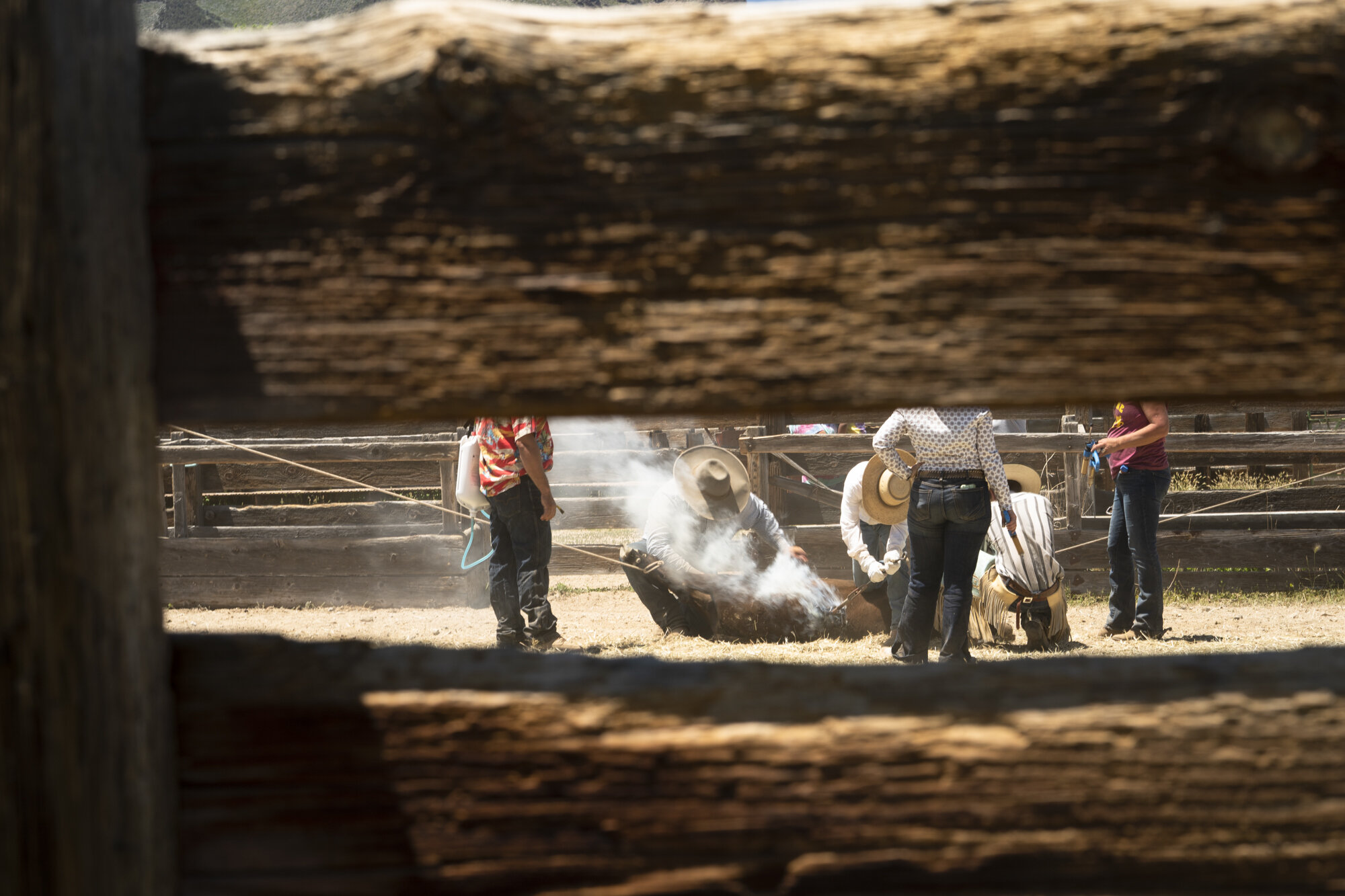
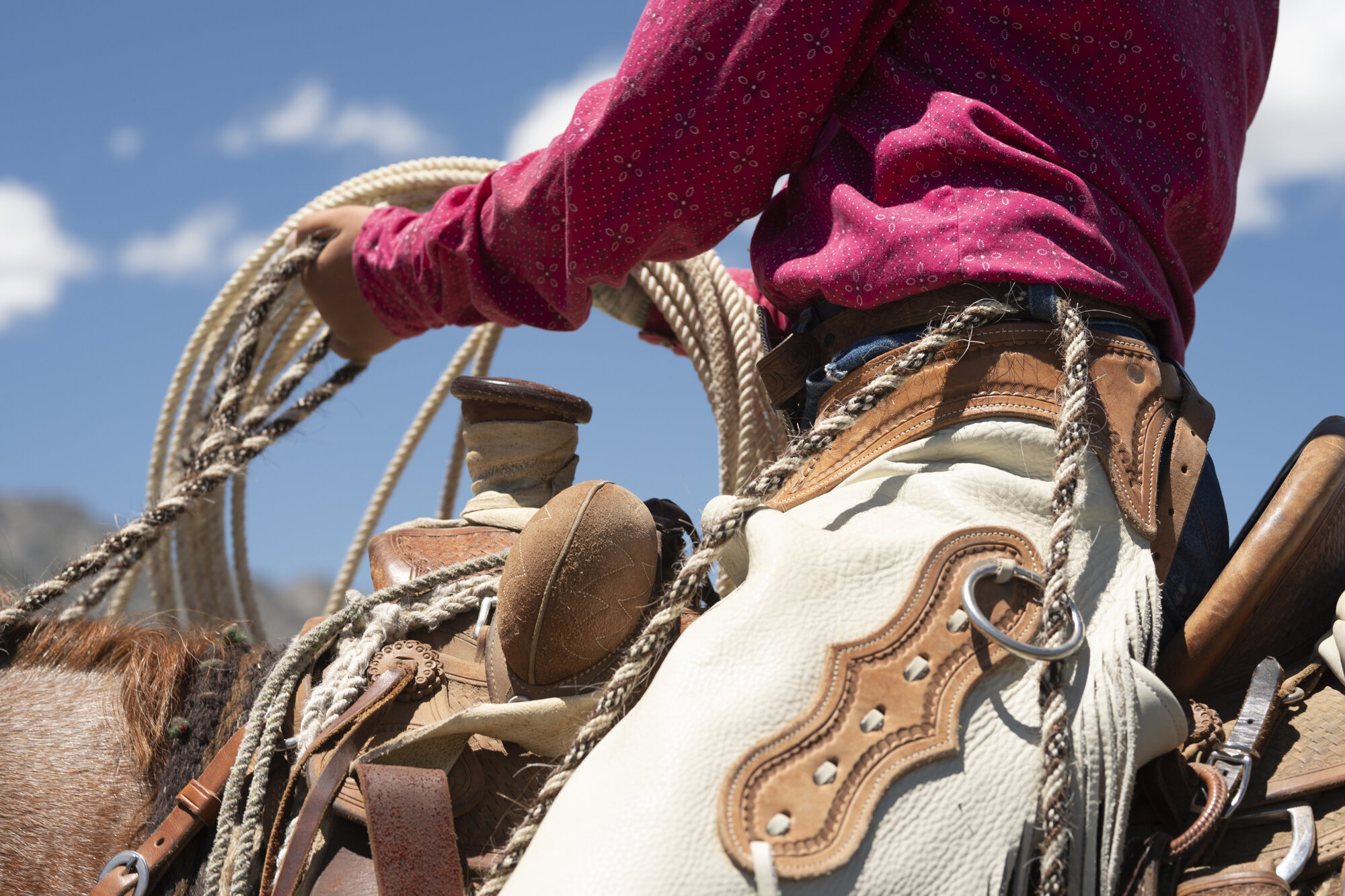
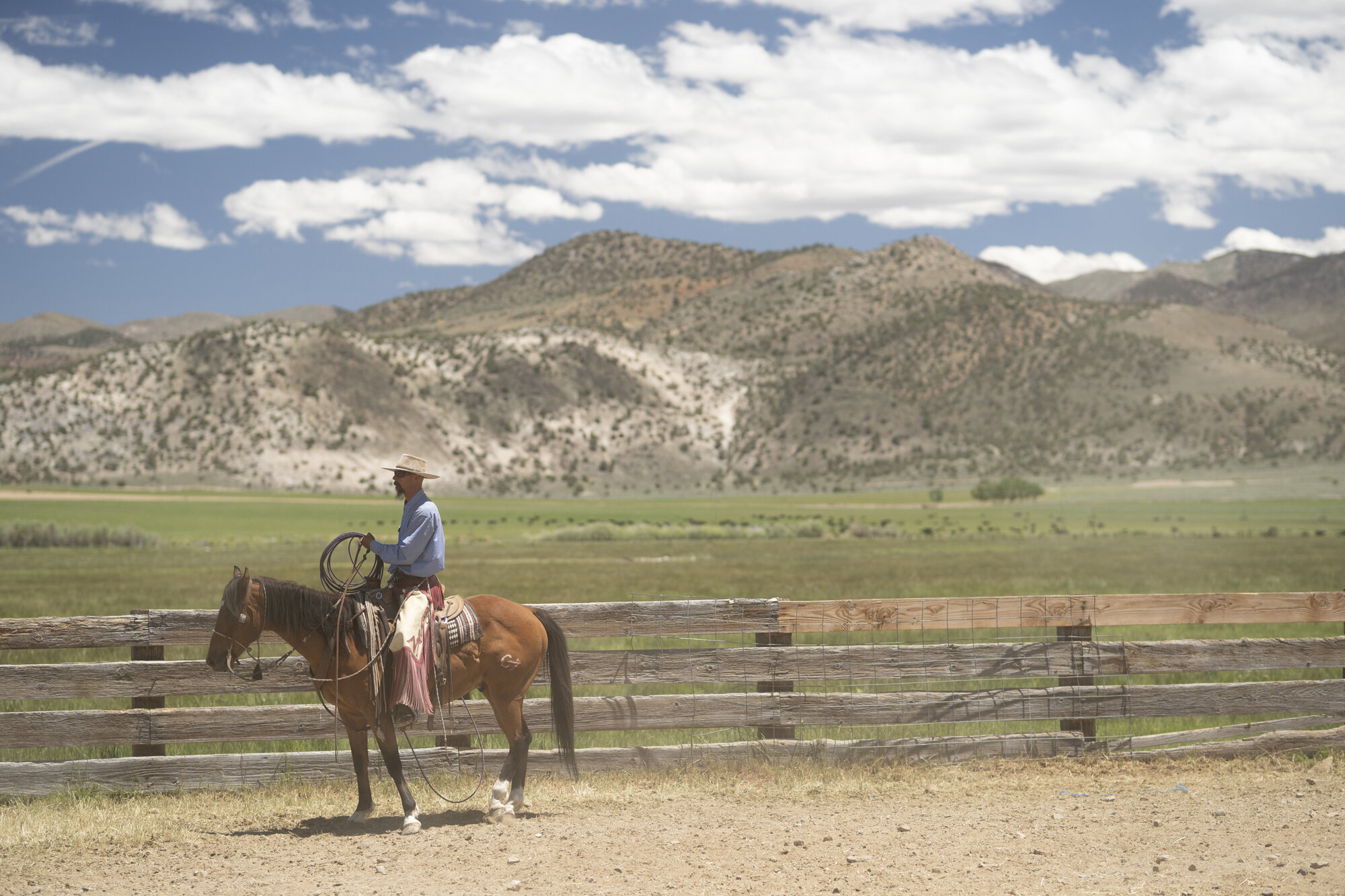
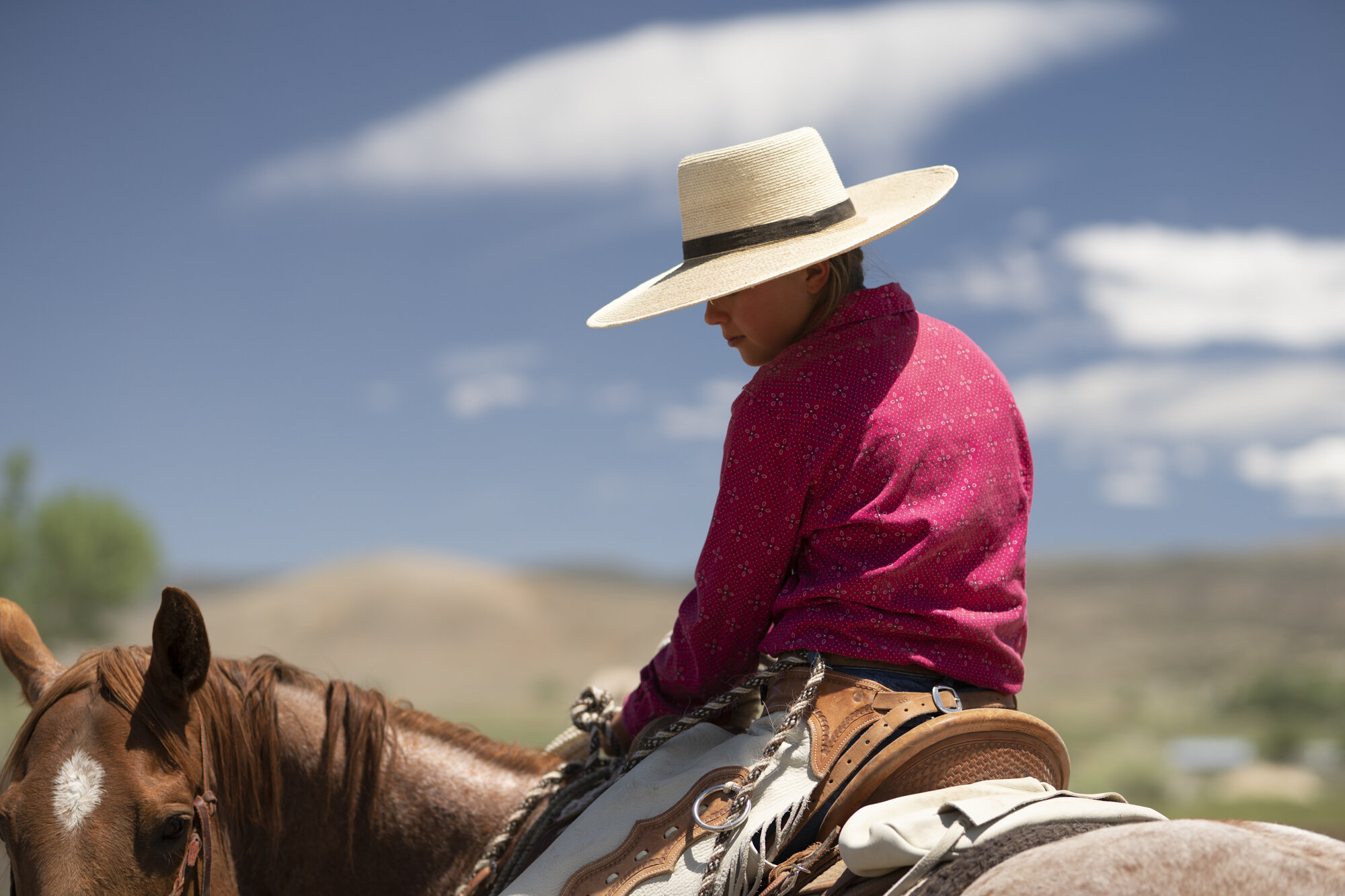
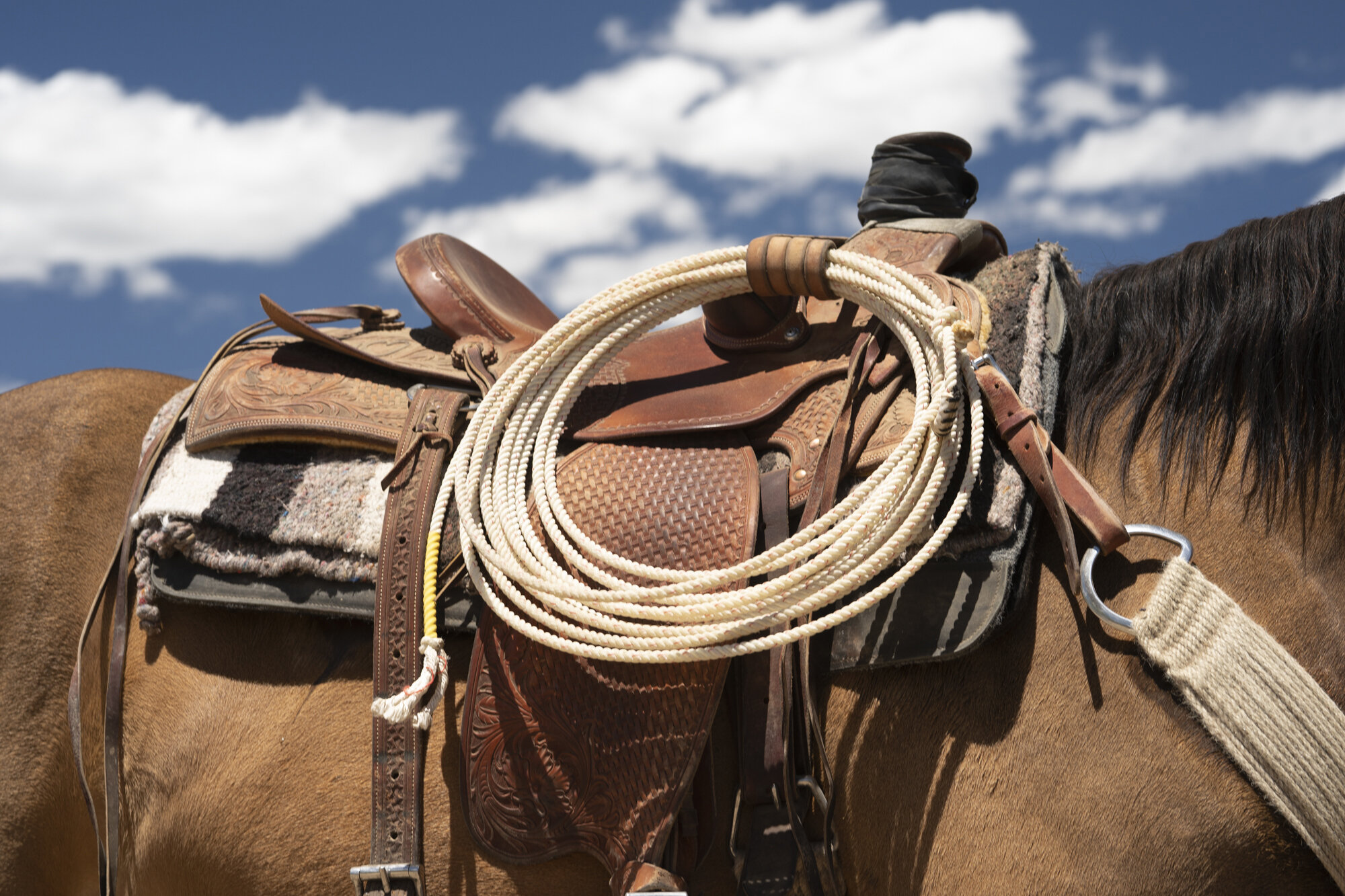
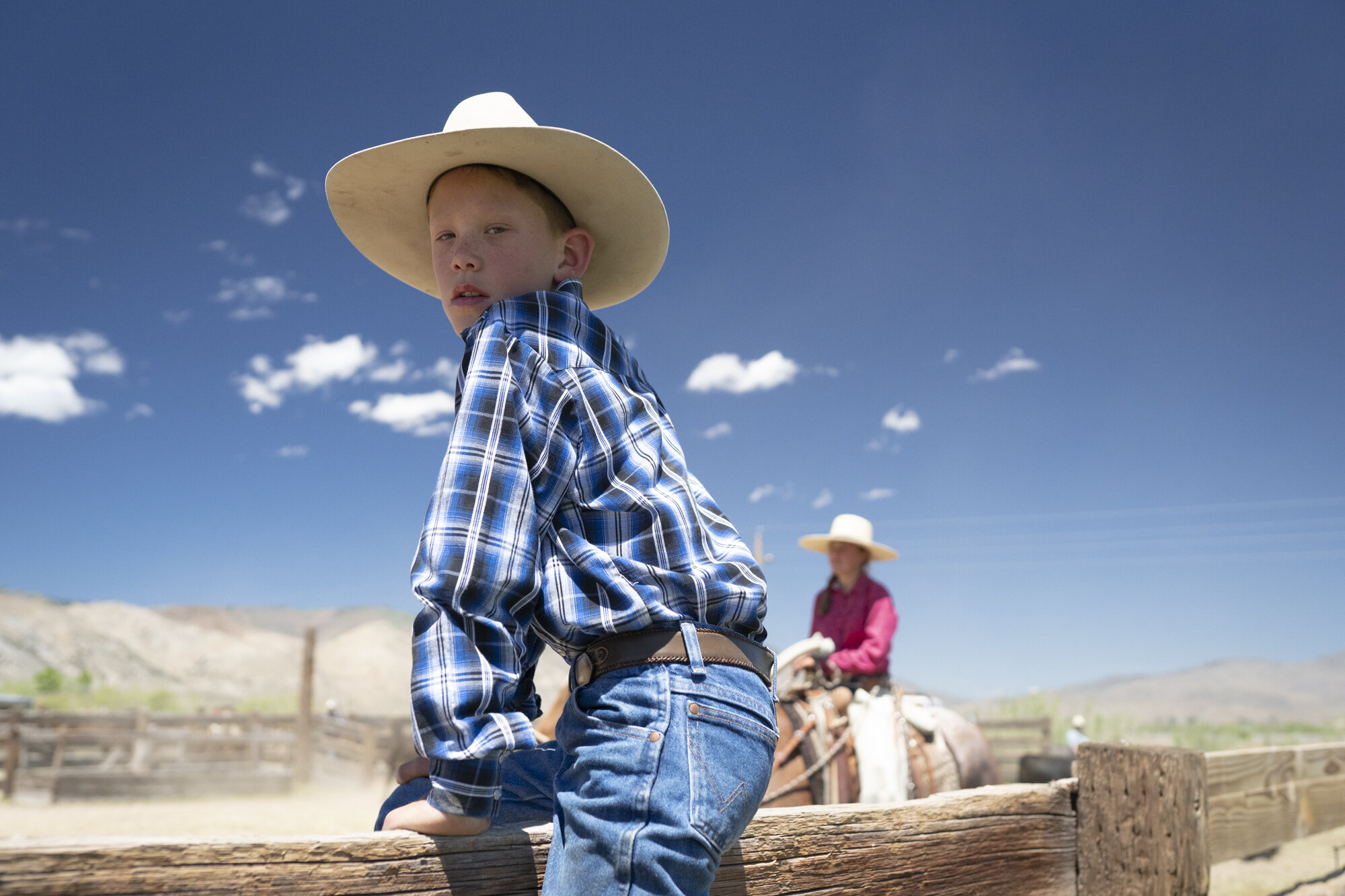
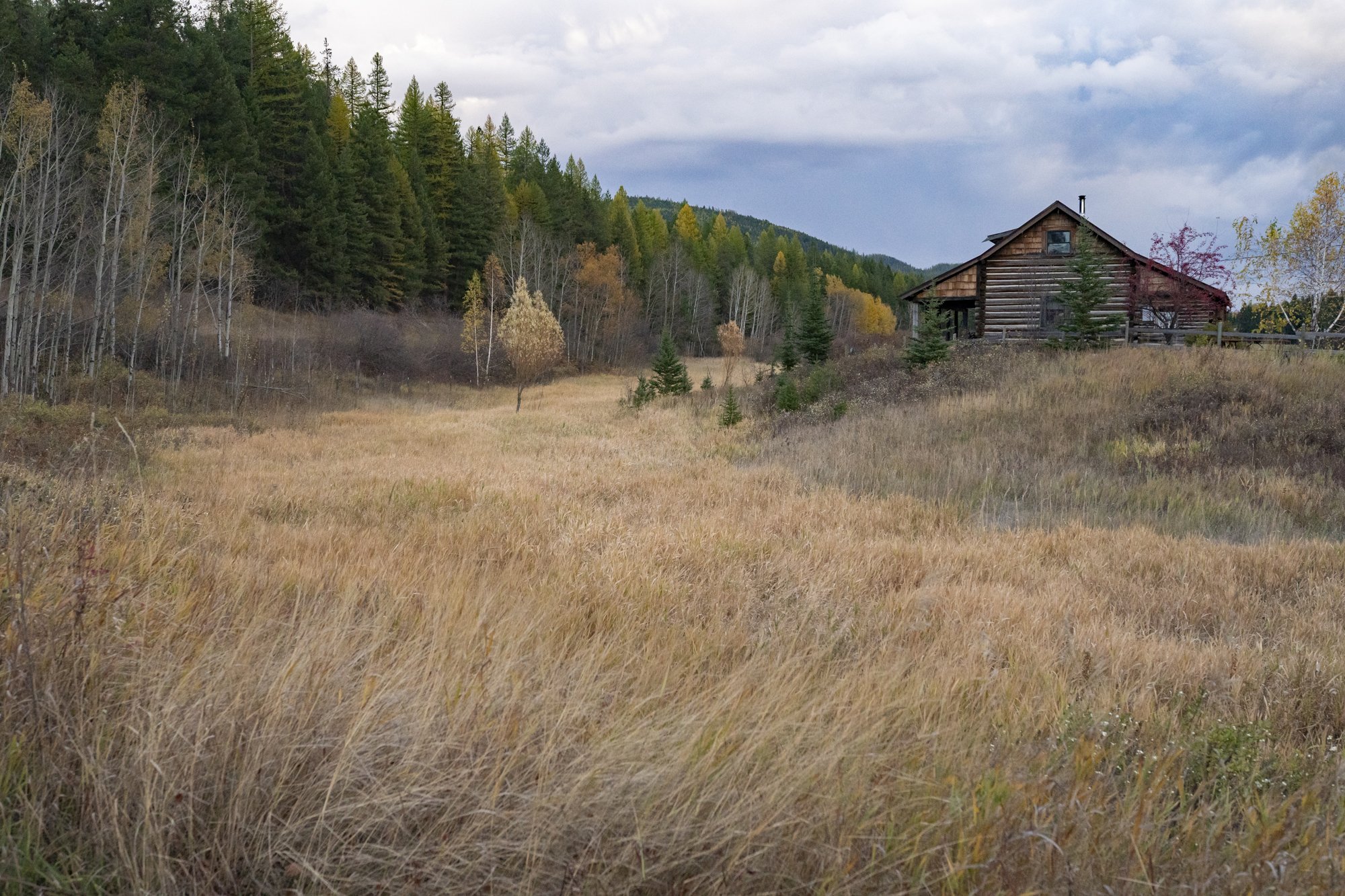
There’s nothing staged about the kind of cowboy photographs I make. No hired models in brand-new hats. No one pretending to ride for the brand. Just real people doing real work day in and day out, in weather that doesn’t care if you’ve got a camera slung over your shoulder.

For the past 5 years I’ve been photographing working cowboys on ranches across the American West. Not for the sake of nostalgia or myth-making, but because this way of life still exists, and it’s worth documenting. It’s early mornings, long days, sore horses, busted hands, and wind that doesn’t quit. It’s also pride, precision, and an unspoken connection between the people, the animals, and the land.

Most of the time, I’m just trying to stay out of the way. The goal isn’t to direct or interrupt—it’s to be quiet, to watch, and to make images that feel true. The kind that a cowboy can look at and say, “Yeah, that’s how it really is.”

These photographs aren’t just about cowboy hats and boots (though those are in there too). They’re about culture. About people whose lives are shaped by purpose, place, and tradition. And if you spend enough time around it, you realize it’s not just a job. It’s a commitment. A way of seeing the world.

If you're interested in cowboy culture—not the romanticized version, but the actual, hard-earned life behind it, this collection of photographs is for you. No frills, no filters. Just the truth of the West, one frame at a time.
Click HERE to see more of my cowboy photography.

Click HERE to shop my collection of cowboy photography prints

ROAD TRIP

THE BAD:This past week was the first time in a while since I’ve been on this particular route through Arizona, New Mexico, and Texas. The findings were not good economically. It was hard to see so many familiar small town restaurants and hotels closed, boarded up, or in the process of being demolished. Maybe the timing was a coincidence, but you have to wonder if it was all the result of COVID? Either way it’s a shame.

THE GOOD: Road trips are always so much fun, educational, and therapeutic. This one had me shooting on a cattle ranch (The Four Sixes) in the Texas panhandle where I met some great people and had a hell of a lot of fun shooting with them. Will be a while until I can post those images. So for now you can click HERE to see more of my Cowboy photography.

Western Photography

Cowboy Photography - American West - Cattle Ranching

Maybe it’s the nostalgia? Maybe it’s the hats? I don’t know. However you spin it though, I appreciate everything going on in the pictures here. To really boil it down though, there are a couple factors that turn me on to this culture and lifestyle. First is the freedom. Cowboys/ranchers/farmers. Whatever you want to call them. They work their asses off, but they do so on their own terms, not someone else’s. They freelance, like me. I always say that if I’m not exhausted, dirty, or bloody by the end of a shoot, then chances are it wasn’t that much fun. And I wouldn’t dare to compare the work I do in a day to that of a cowboy, but I certainly connect with it. Another part is their “work” hasn’t changed that much since the old days. Sure there are more laws and guidelines, especially in California, but the bones of it is pretty much the same. And there’s a lot to be said for that, especially since everything else in the world changes minute by minute, and not usually for the better. The simplicity of their trade is another parallel to draw. That’s not to say that what they do is easy, because it certainly isn’t. Quite the opposite. With photography everyone is so focused on gear, gear, gear. Gotta get the latest and greatest piece of gear. Gotta light this with 12 strobes or it won’t look good! Admittedly, I was guilty of that in the past too. At a certain point though, I realized that was all about false impressions. Yes, your equipment needs to be at a certain level to operate as a professional, but that doesn’t mean you constantly need to be upgrading. Having a better camera doesn’t make you a better photographer. Hell, if you know what you’re doing, you could make an entire career with one camera and one lens. So you don't need that new 150 megapixel Medium Format bullshit. Fun to play around with? Yup. Not what matters though. Focus on making images not on the gear. That’s what I mean by simplicity. Location is the last thing I’ll mention. In general, the places where these people live and work is also something I connect with. Living in San Diego has a lot of pluses, but I’d much rather be out in the mountains or the country. It feels more like home and fits my personality/interests much more. Along with the location comes a certain type of attitude or lack there of. City people and country people are just different. No way around it. I prefer the later.
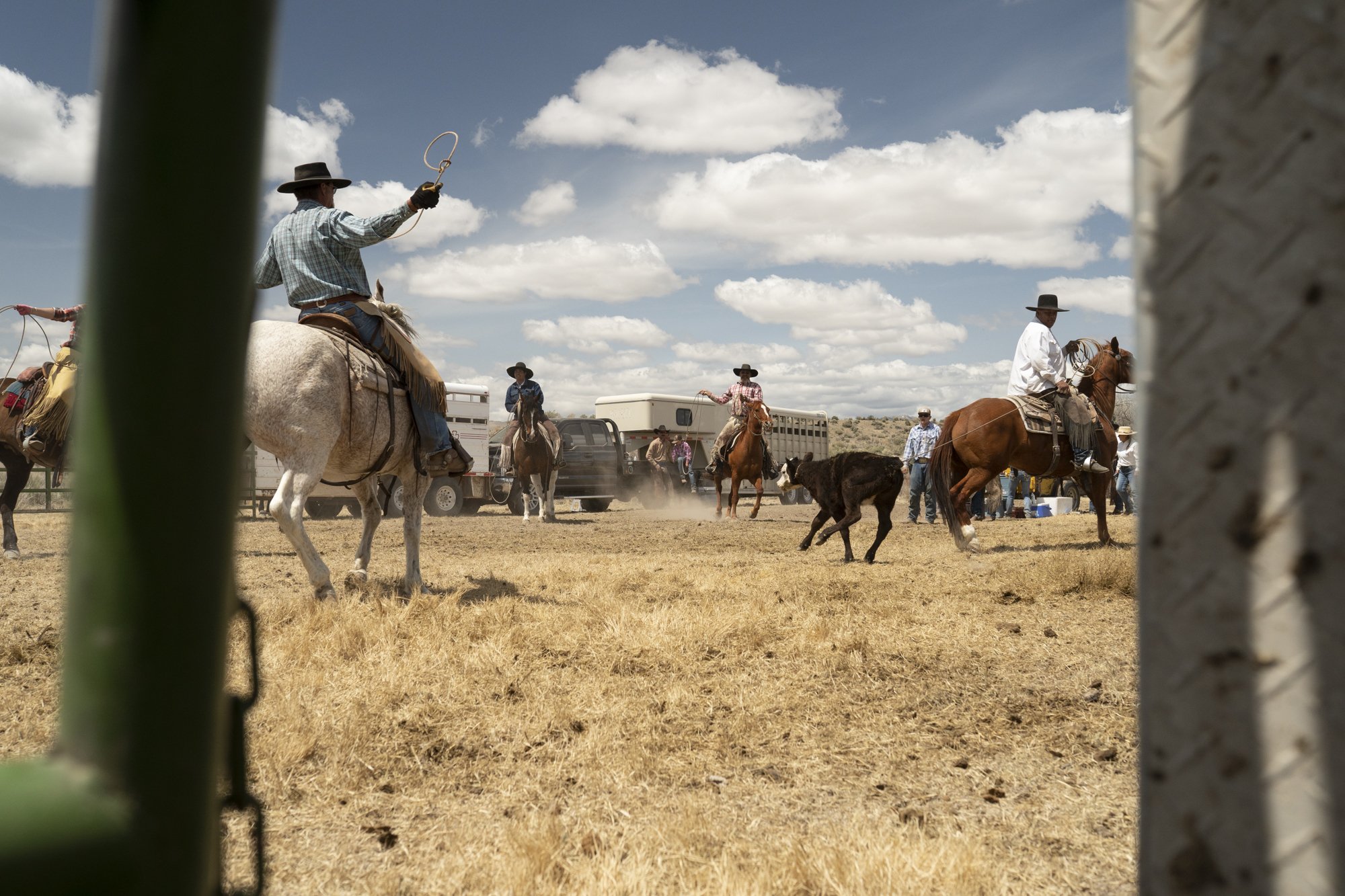
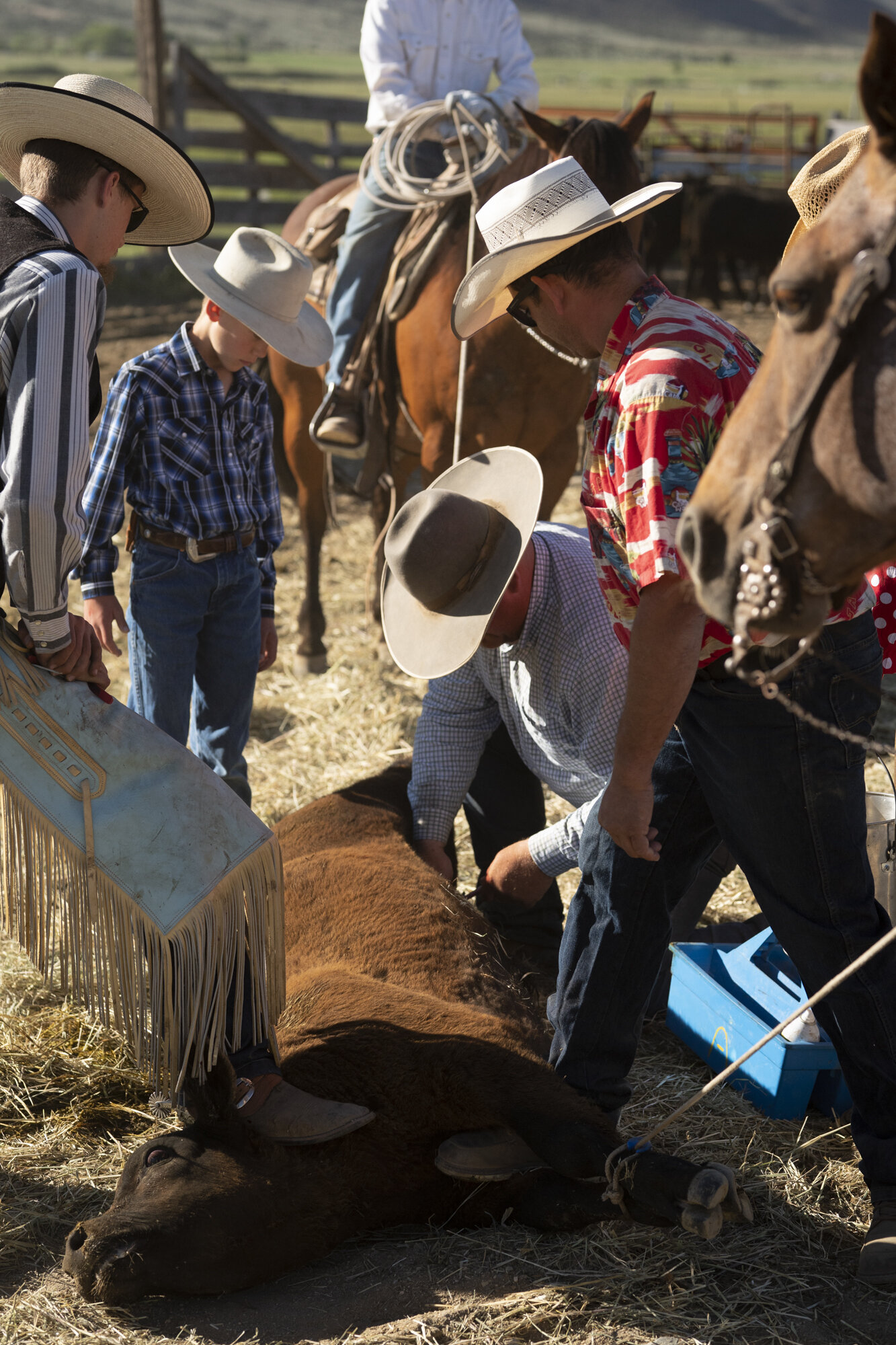
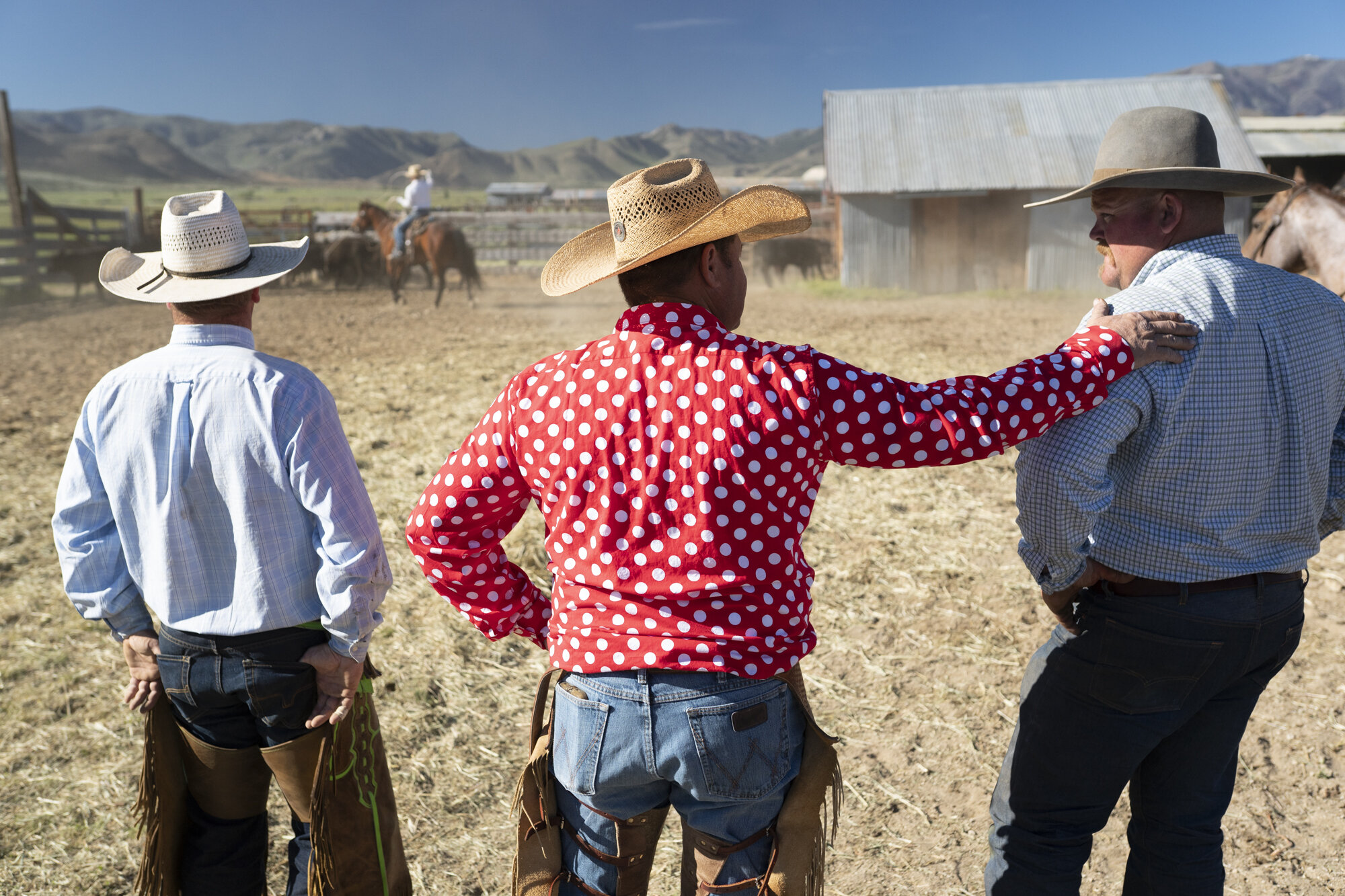
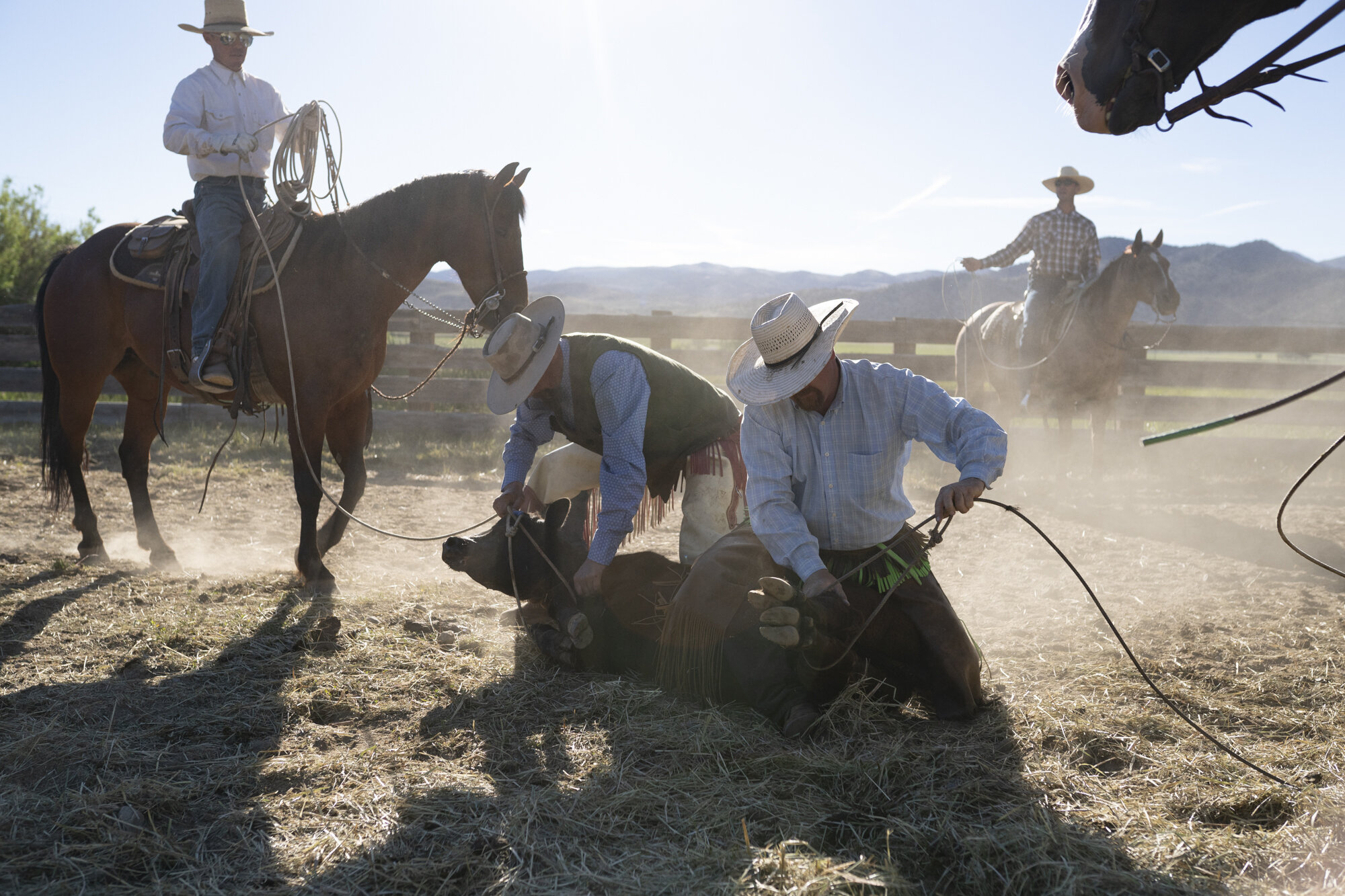
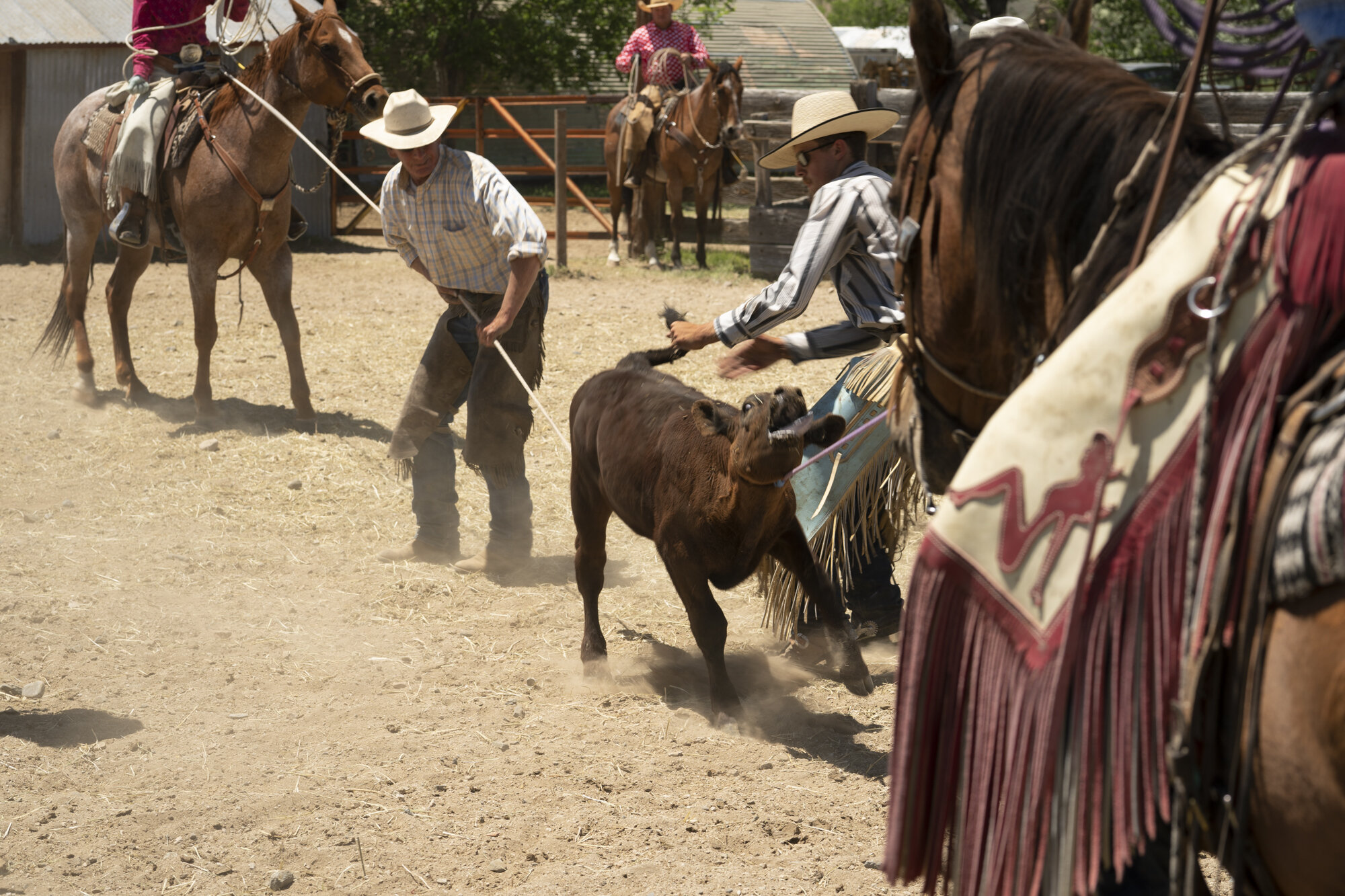
What a day this was with Spencer and Jessica of the Anderson Cattle Company (click to buy some of their beef) and their crew. Really grateful to have documented the work done by these folks. Not only was it fun, but also incredibly impressive. Watching the control they had over their horses and the way they used them as vehicles was a pleasure. That goes for the women too. They can rip. At the end of the day I asked one of the guys how long it took until he was comfortable with that sort of environment. To which he replied that you don’t, really. “Controlled chaos”. You just get use to the controlled chaos, he said. A very fair and accurate way to describe that type of event.

Something well worth noting in my opinion is that none of the people you see in these pictures were paid to be there. They are all friends of the Anderson’s and volunteered to work their asses off in the hot sun. A favor that is always returned over and over again throughout their lifetimes. On this day they helped on their ranch, but next time the Anderson’s will be the one’s lending a hand. The way life should be.

One of my favorite photographers of all time is William Albert Allard. He made a great deal of photographs in the American West documenting the lifestyle and I’d argue that nobody has ever done it better. In one of his books he talked about time spent on a ranch with some cowboys in Nevada. He asked one of the guys if he was ever afraid of being replaced by a machine. “Bill, they just ain’t come up with nothin’ yet that’ll take as much abuse as a cowboy”.

Follow along with the Anderson’s on IG @2aranchwife

More Western Cowboy Photographer here

Bull Sale - Nevada

Bull Sale Photography

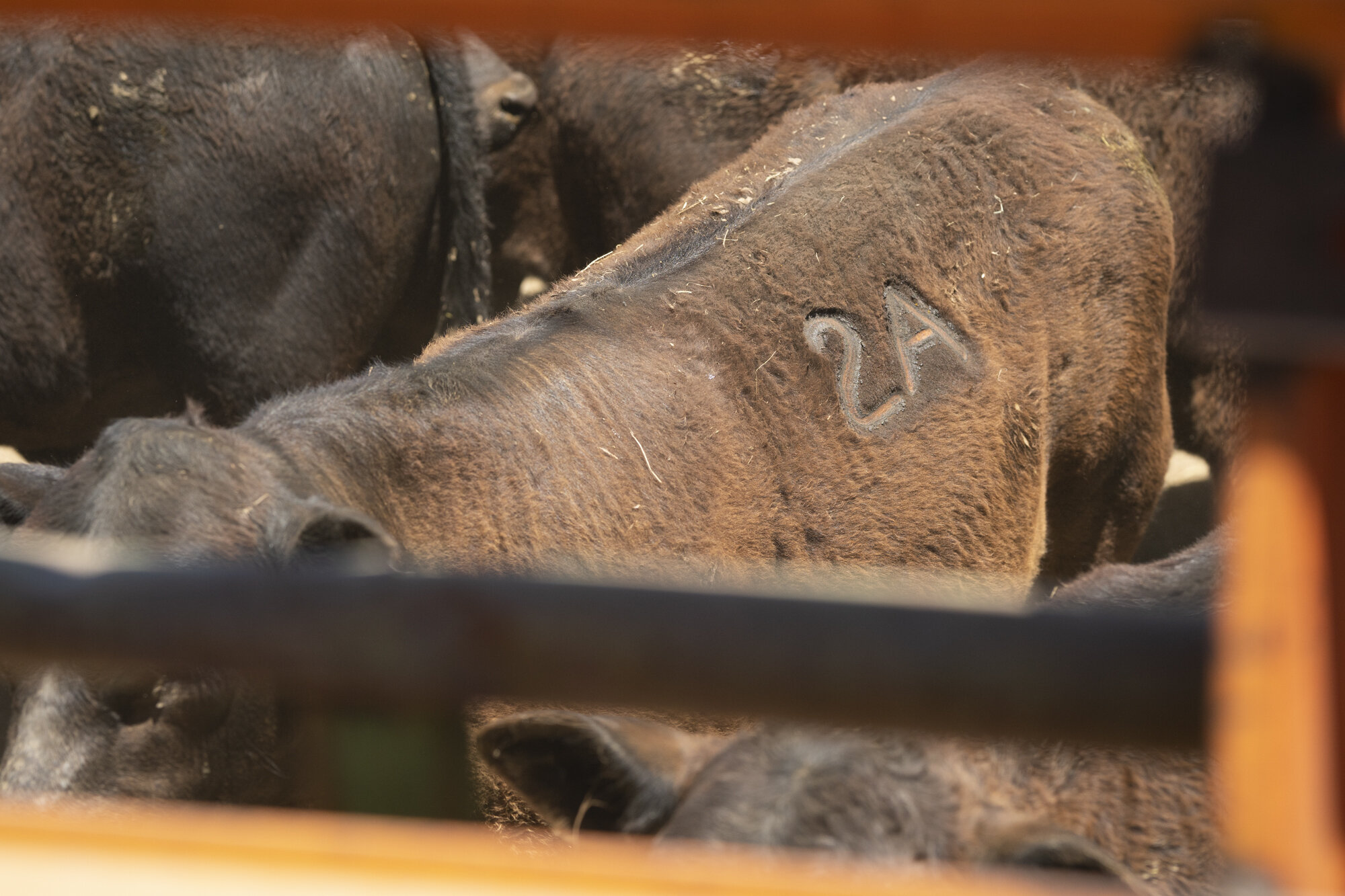
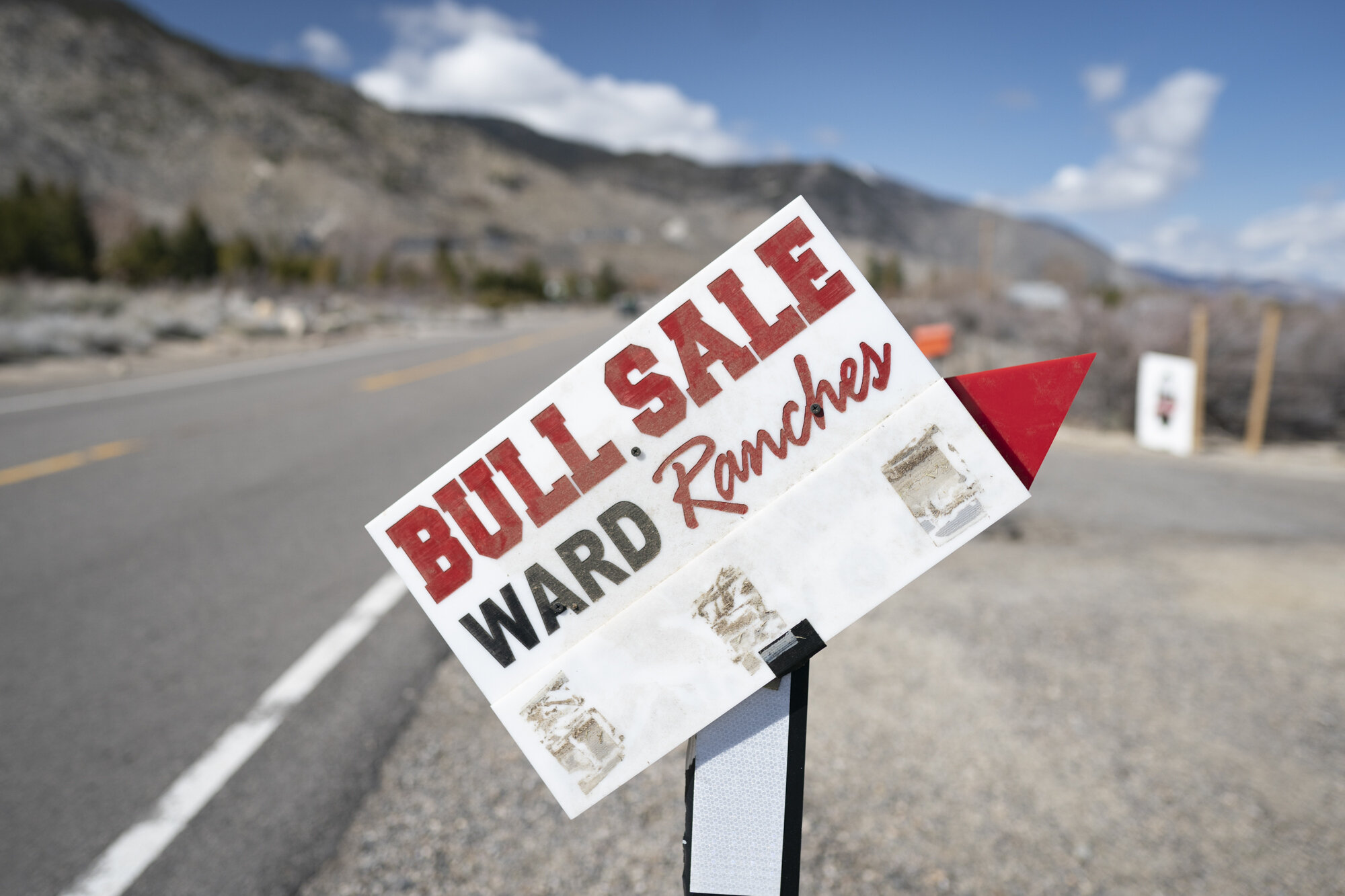
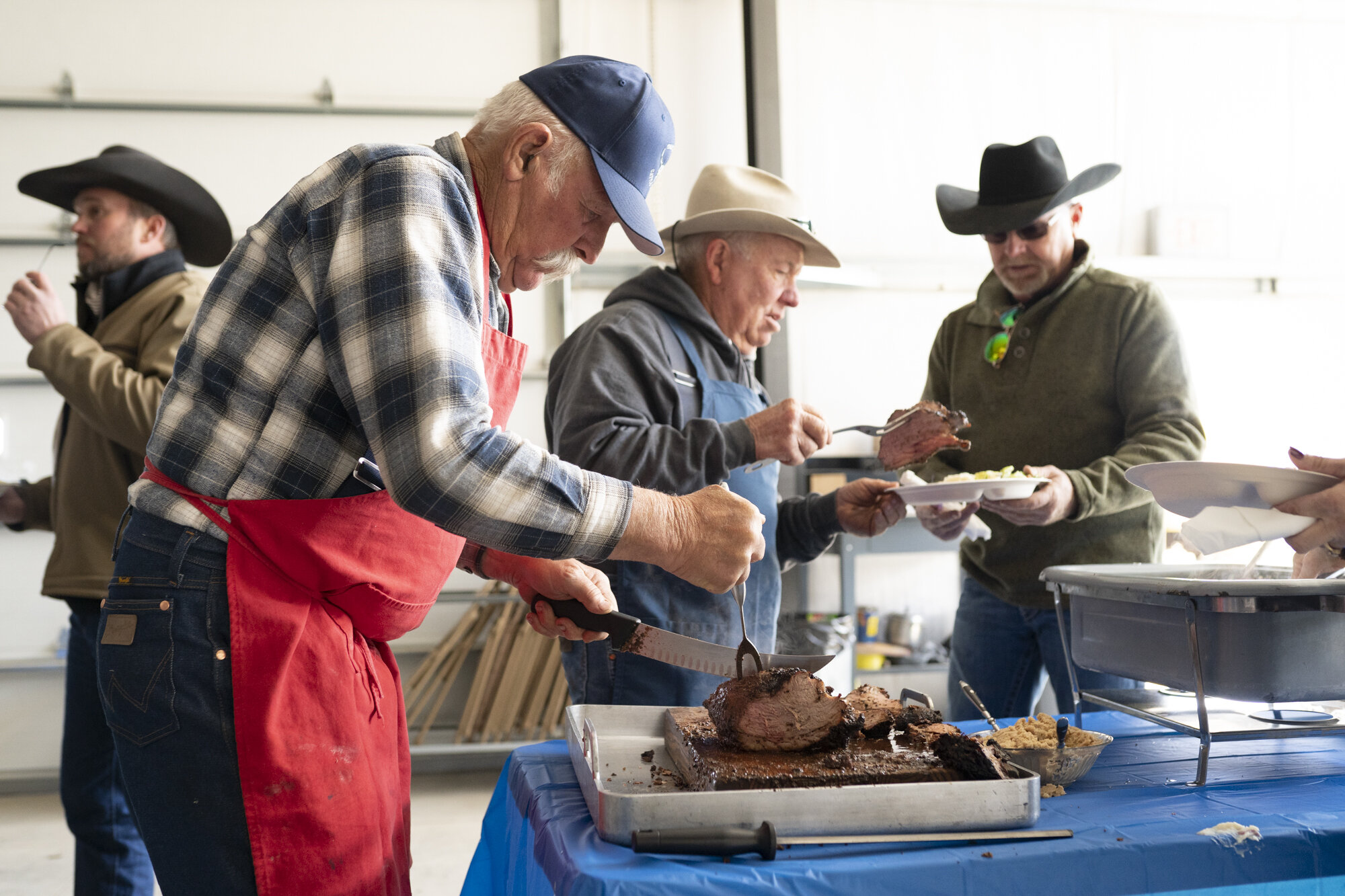
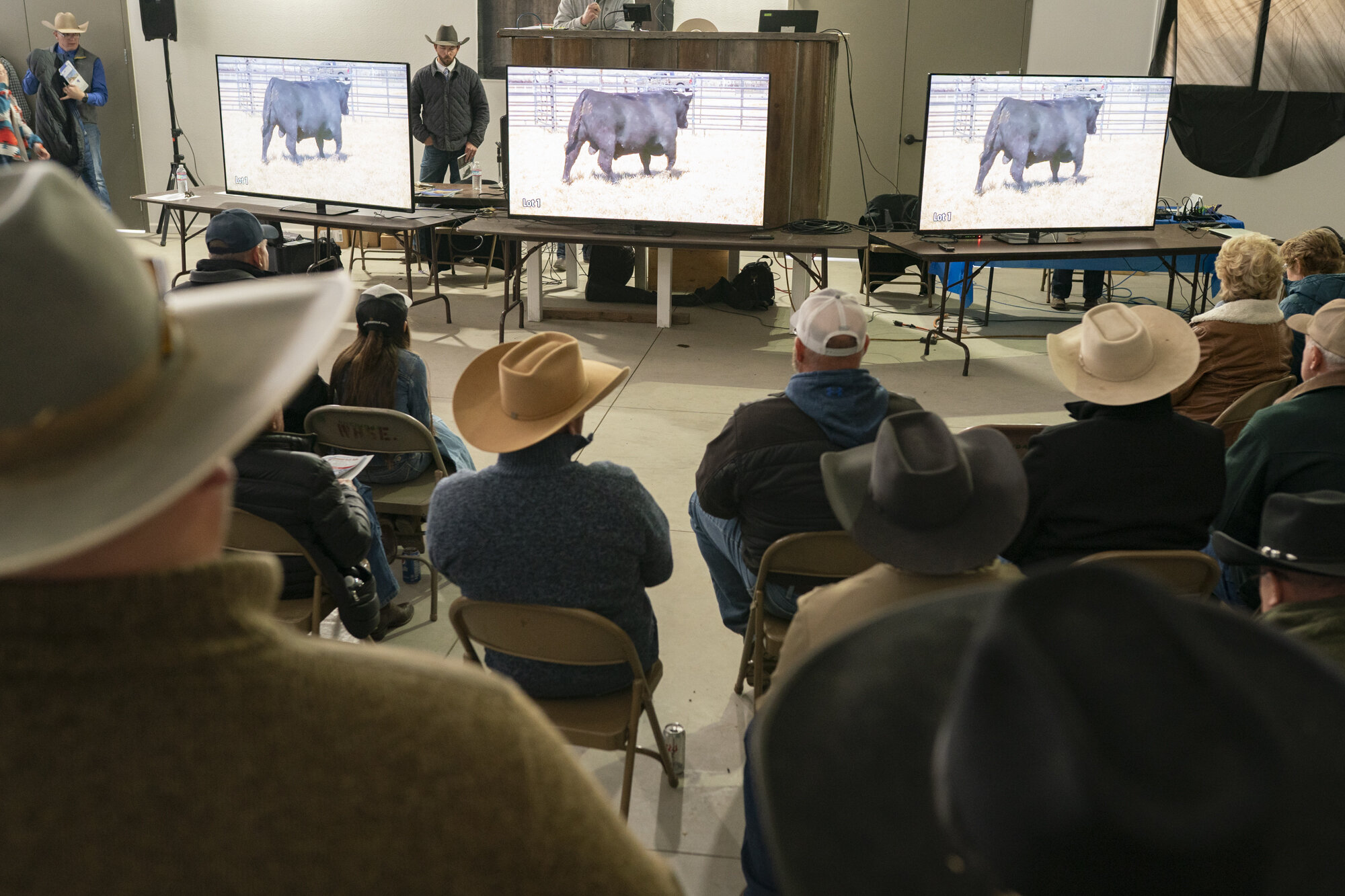
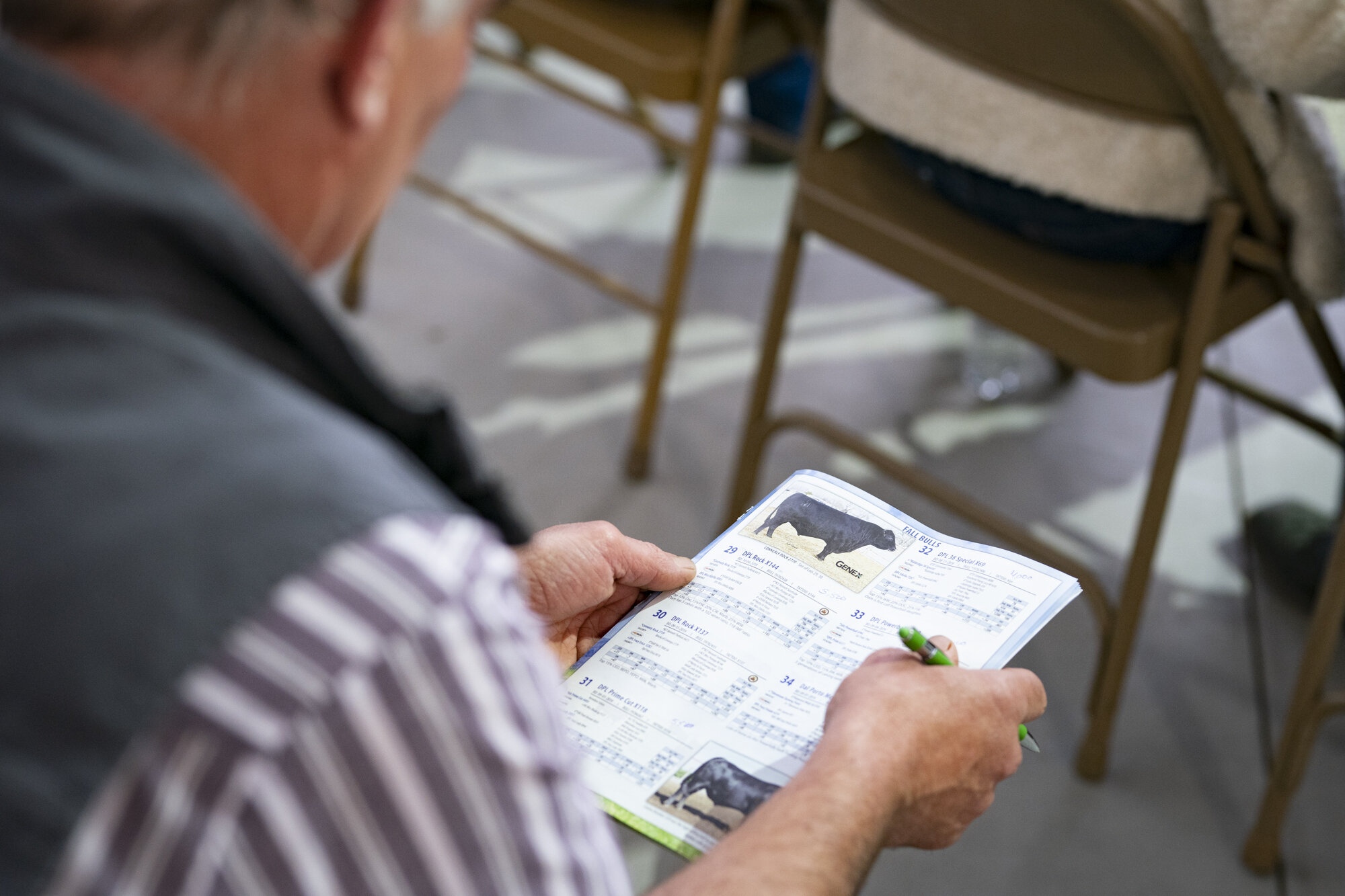
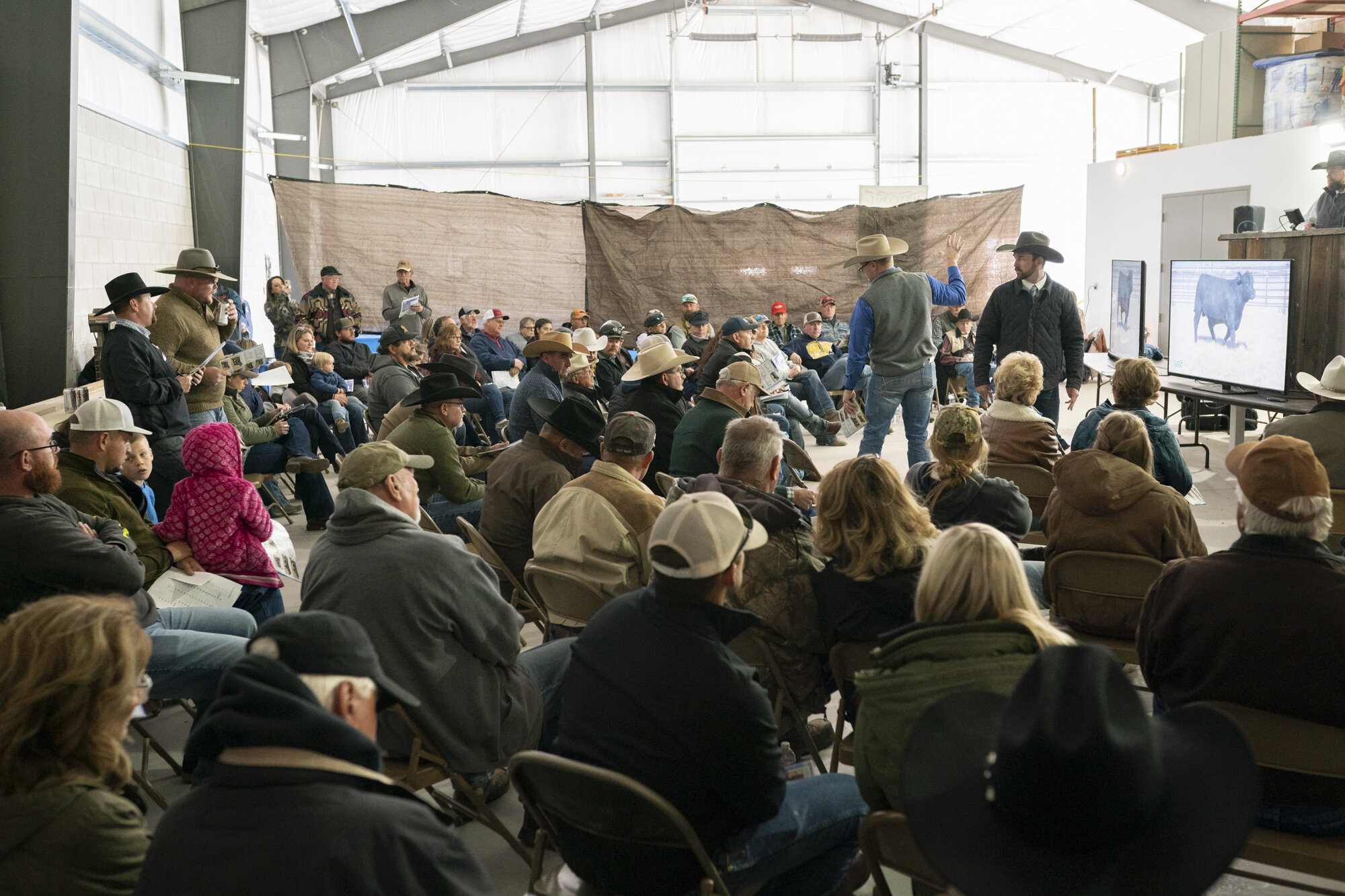
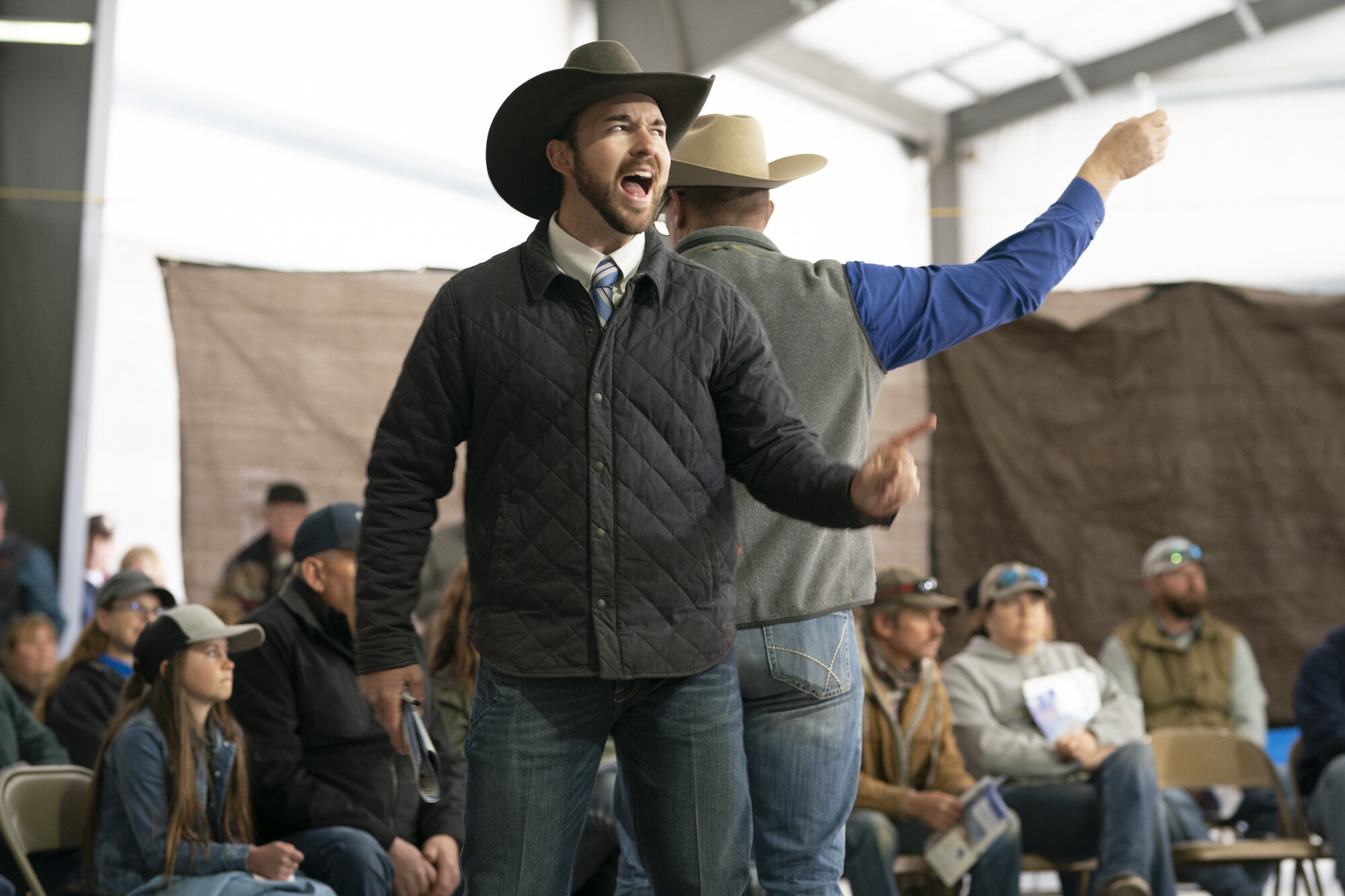
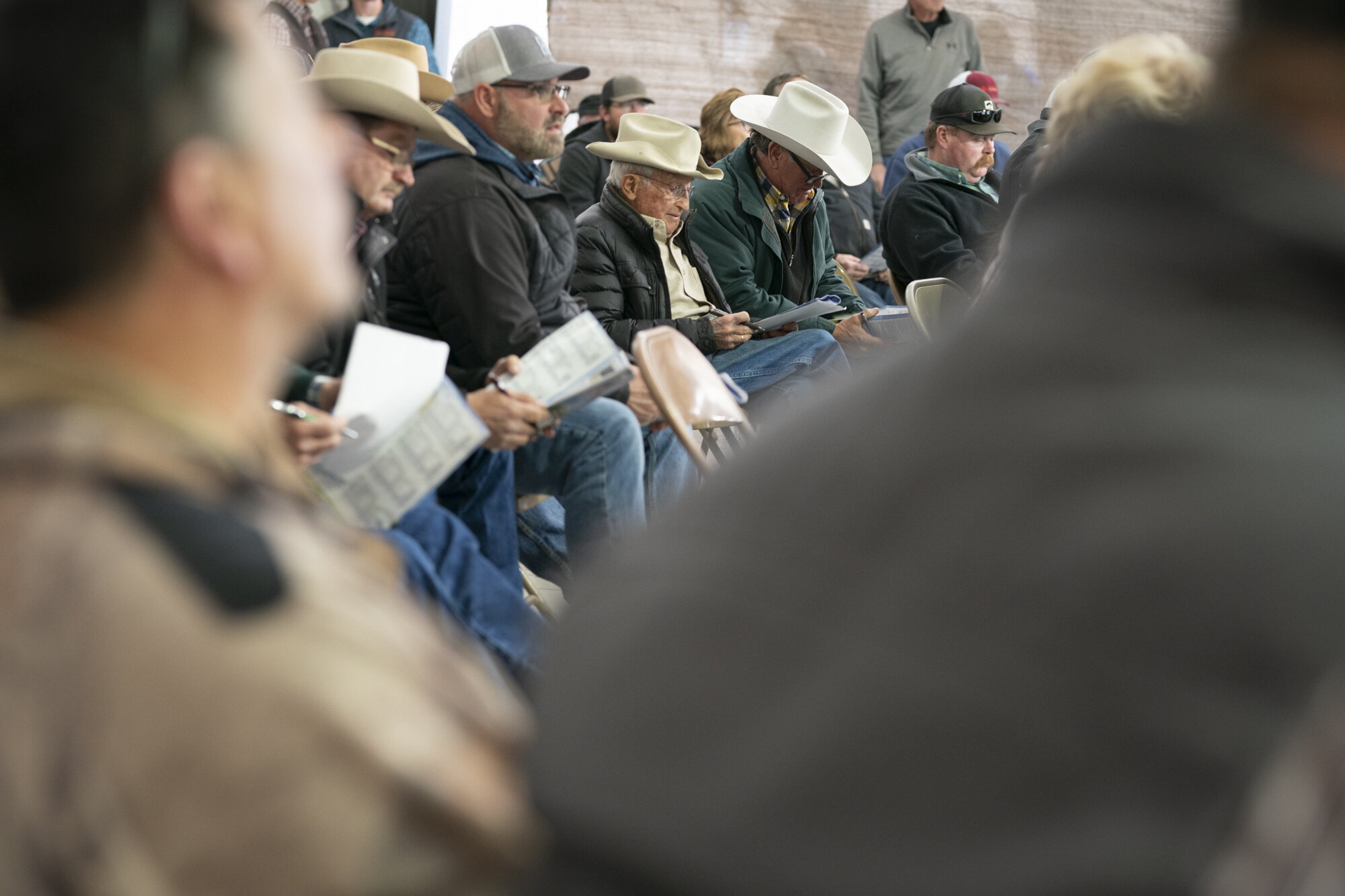
Been spending a lot of time up in Nevada outside of Lake Tahoe for a commercial client, but it’s grown into a lot more than that. I really enjoy the country up there and have taken to photographing various aspects of it. Not the land so much, but everything that goes along with it. The ranches, horses, people. etc. One morning I was shooting with a girl who owned a couple wild mustangs (will be posting those images soon). We finished shooting by about 9 am, so I had the rest of the day to kill, with the commercial shoot following the next day. Was pretty beat from not sleeping much the night before, so I pulled off into the local firehouse parking lot to make a tailgate sandwich. That’s where the day took a turn. Two guys in a truck rolled up and asked if I knew where the bull auction was. We talked for a minute or two, and next thing you know I was at the bull auction. Figured why the hell not? It’s a world completely foreign to me, so why not check it out. I have no plans on buying a bull, but it sure sounded like a fun event to photograph.

If I haven’t said this before, the camera is a passport. One of the many things I love about photography. It’s opened doors and taken me to places I never would have thought about. And the older I get, the more curious I become about interacting with and documenting other people and other cultures that are the opposite of my own. It’s so much fun to learn how other people live in different parts of the world. Sure, this part of Nevada is only 8 hours away from my home in San Diego, but it’s a different world. I used to be obsessed with the need to travel to far off countries in order to experience other cultures. Exotic travel is great, but there is so much culture right here in America that can easily be taken for granted.

I loved being a silent witness at the bull auction right from the start. The people were so inviting when I introduced myself and told them what I was doing. Everything about the event was stimulating. The sights, sounds, and smells. I’m from a small town in Upstate New York, and prefer to spend as much time as possible in the country/mountains, but have never seen anything like this in person. Hope to be showing you a lot more of this in the future.

Click here to see more of my Western photography

Poway Rodeo

Poway Rodeo

Poway, San Diego, California

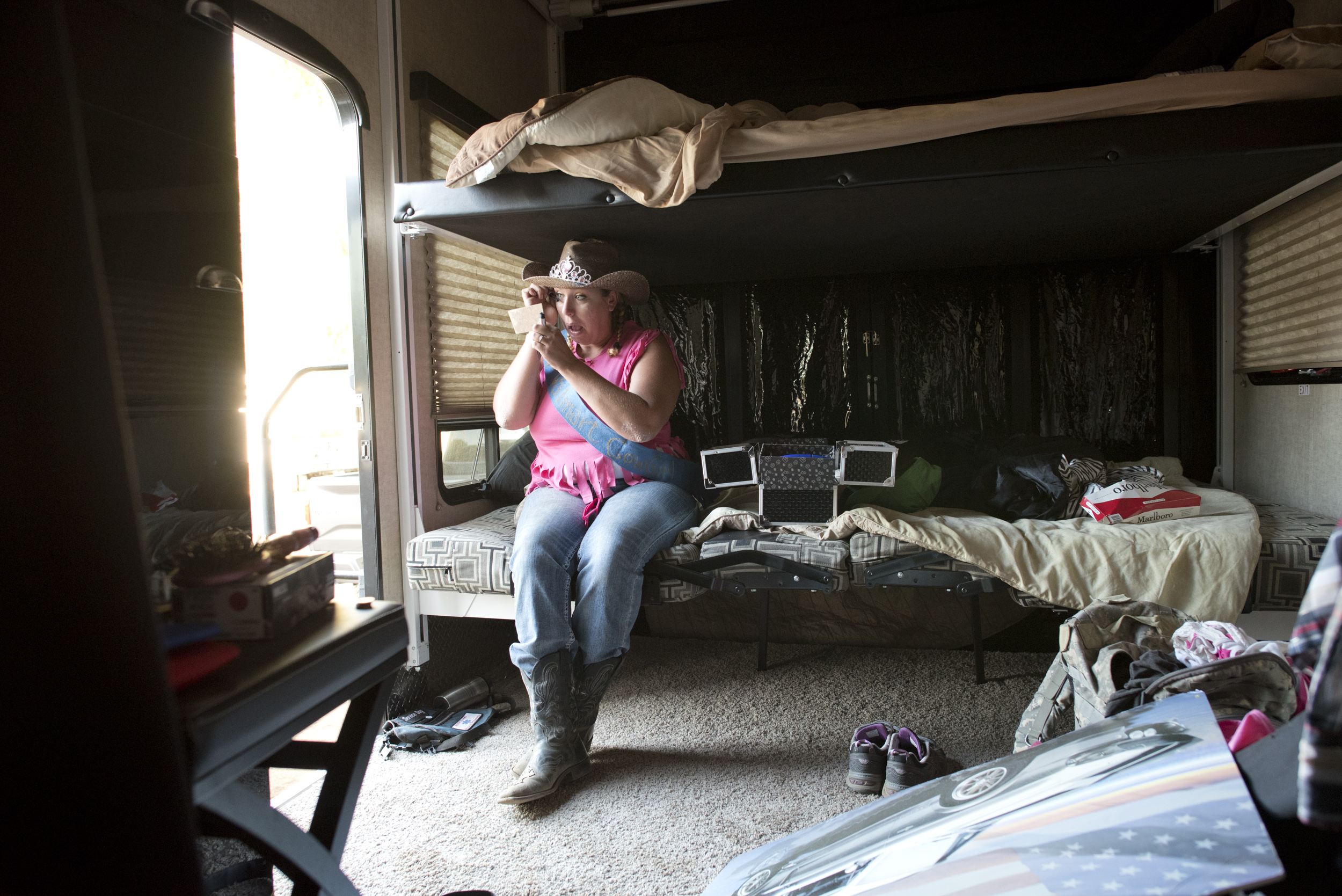
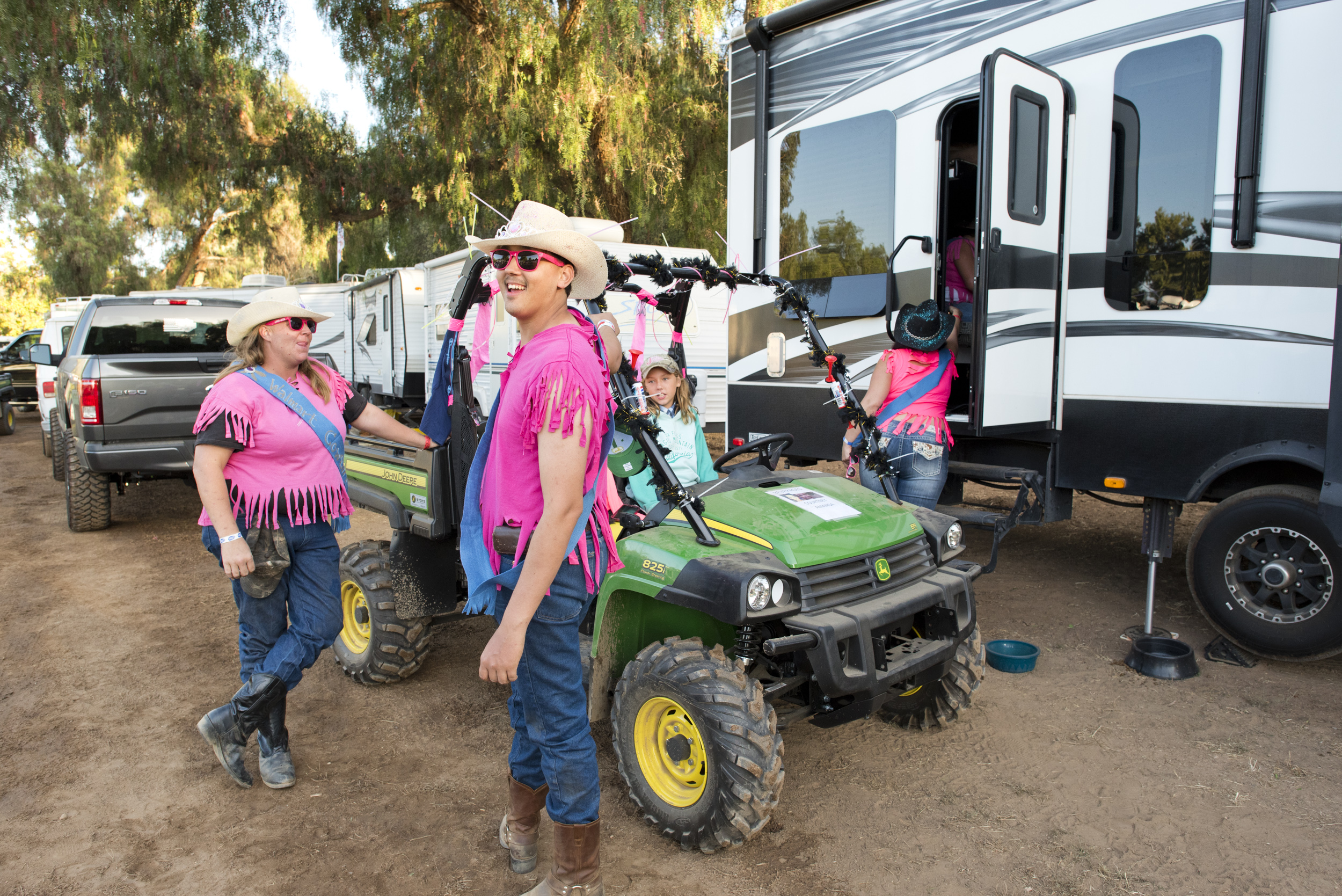
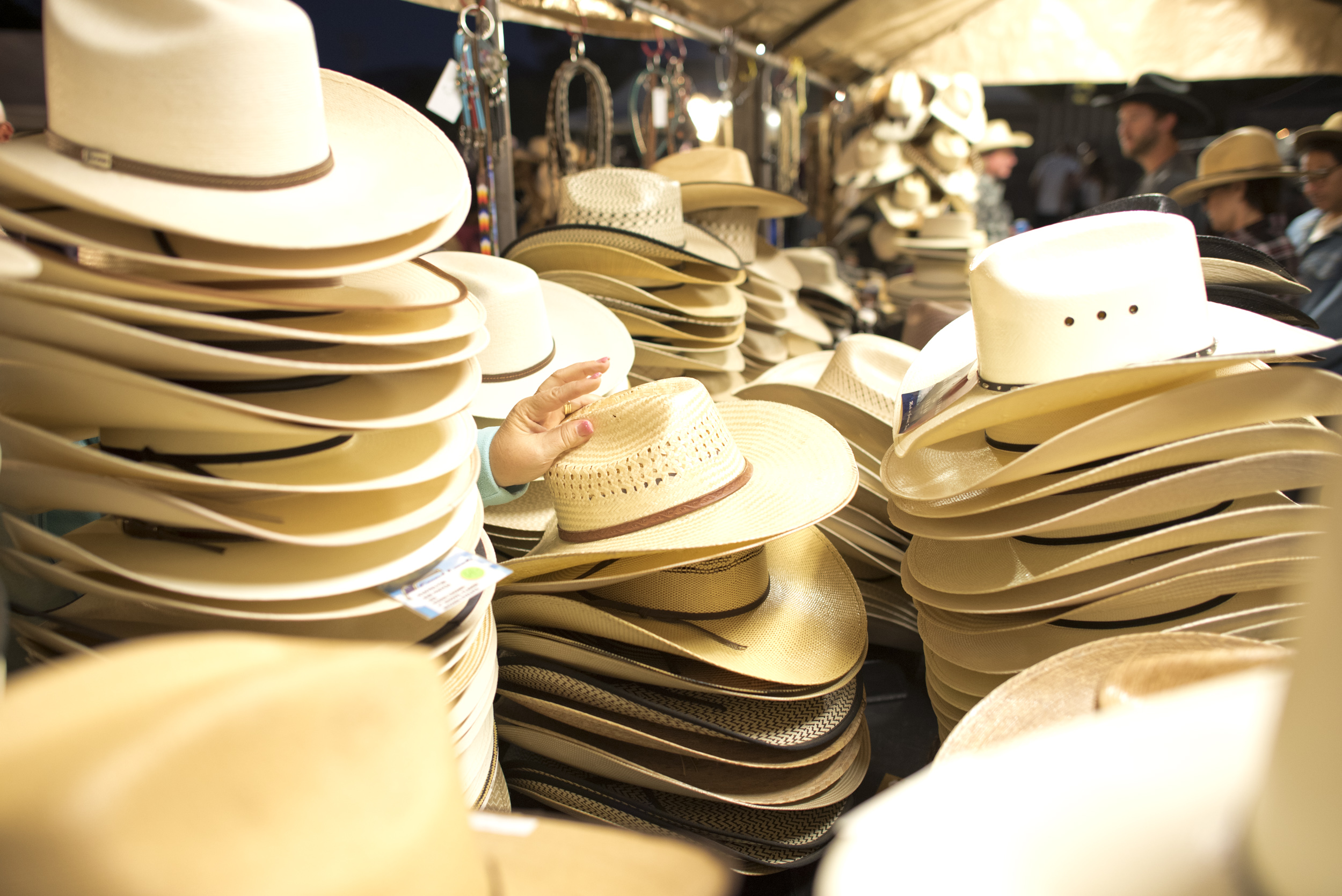
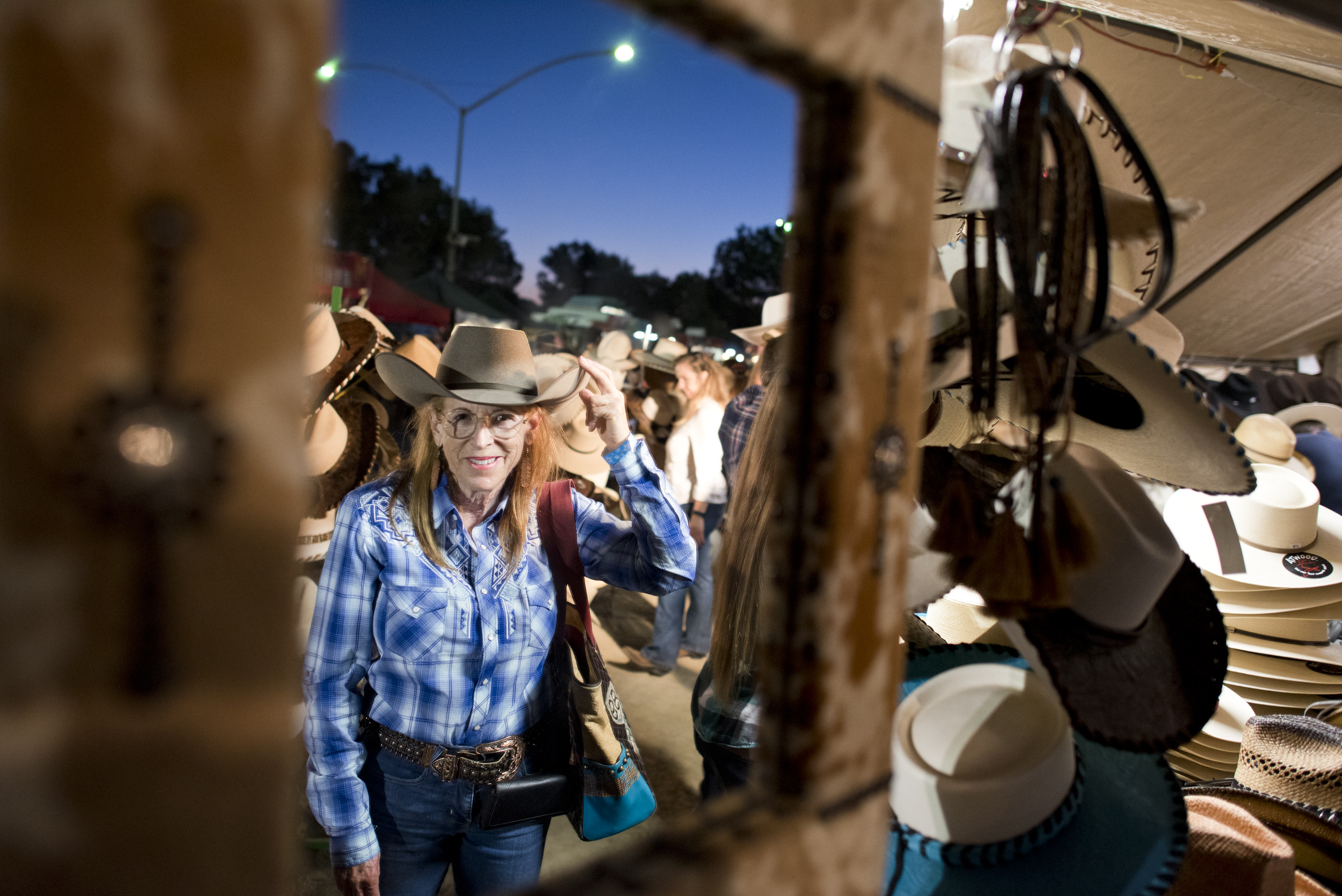
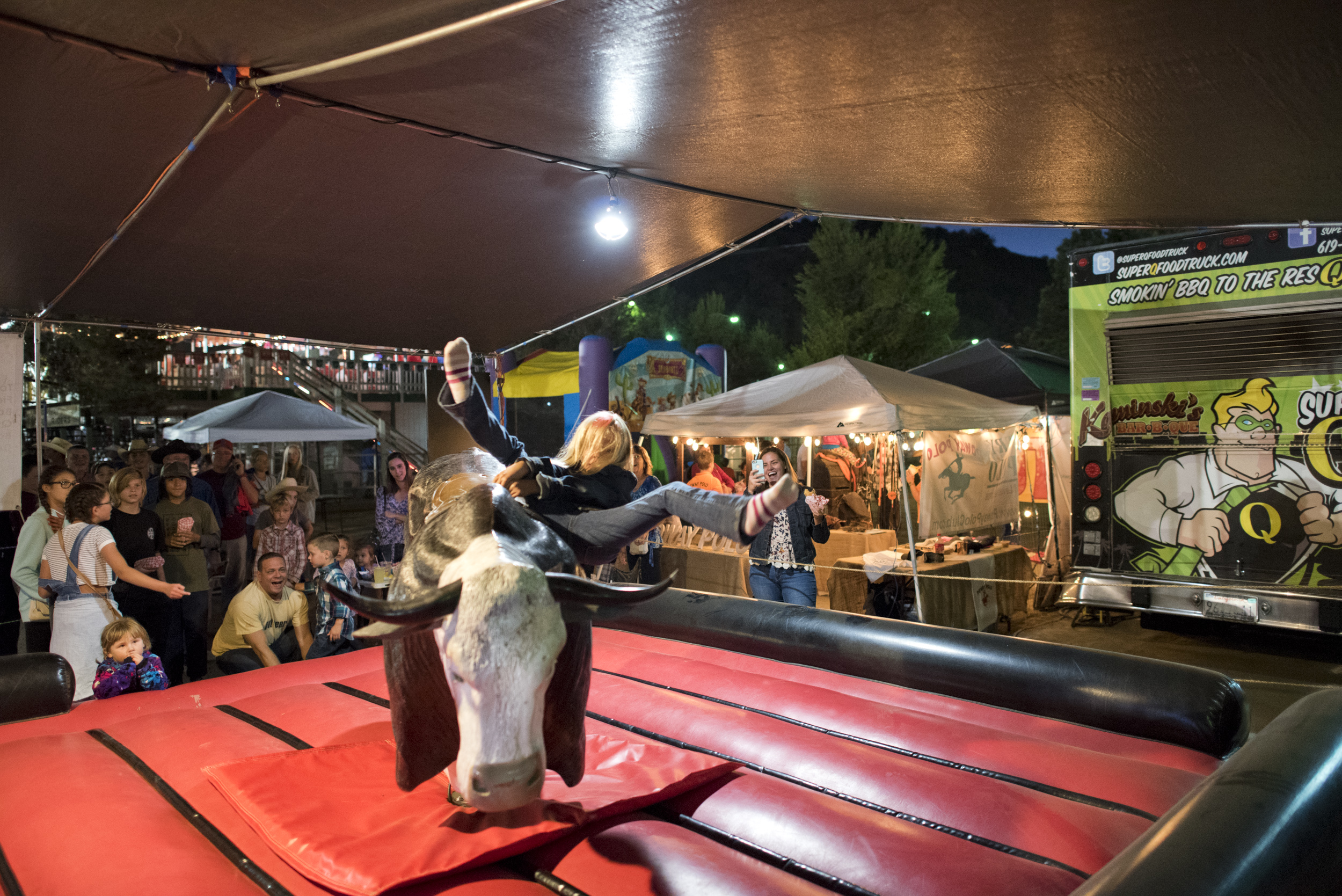
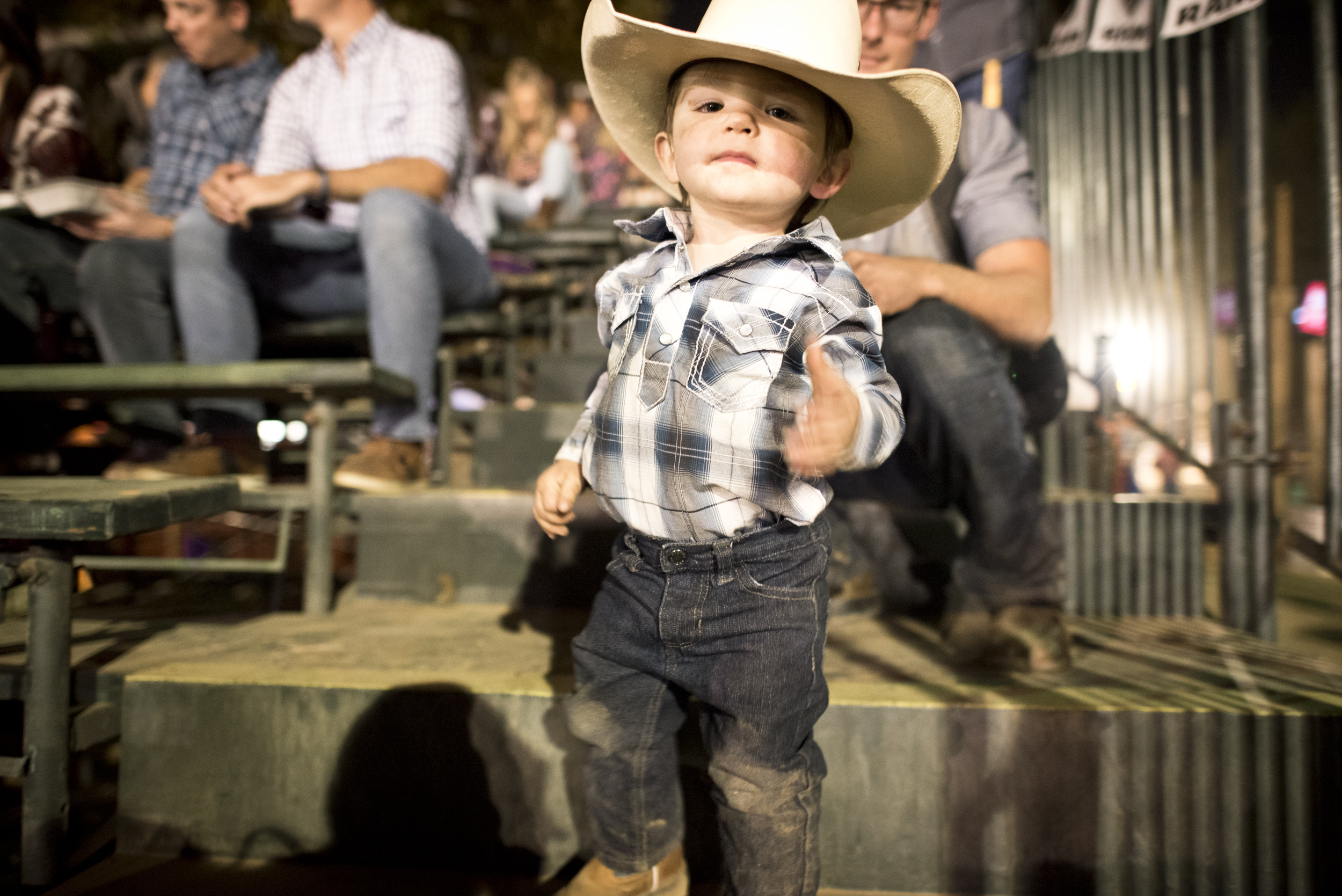
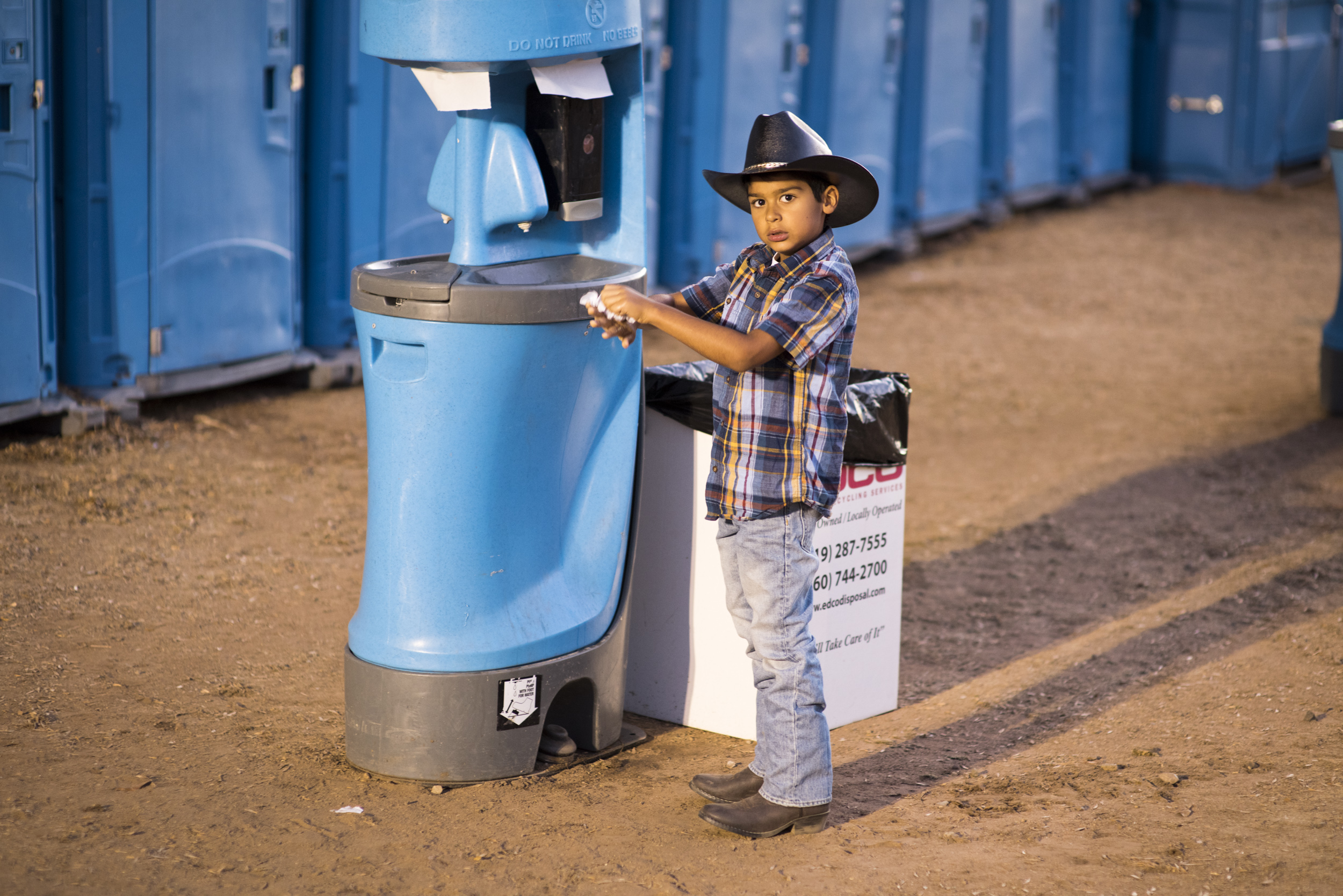
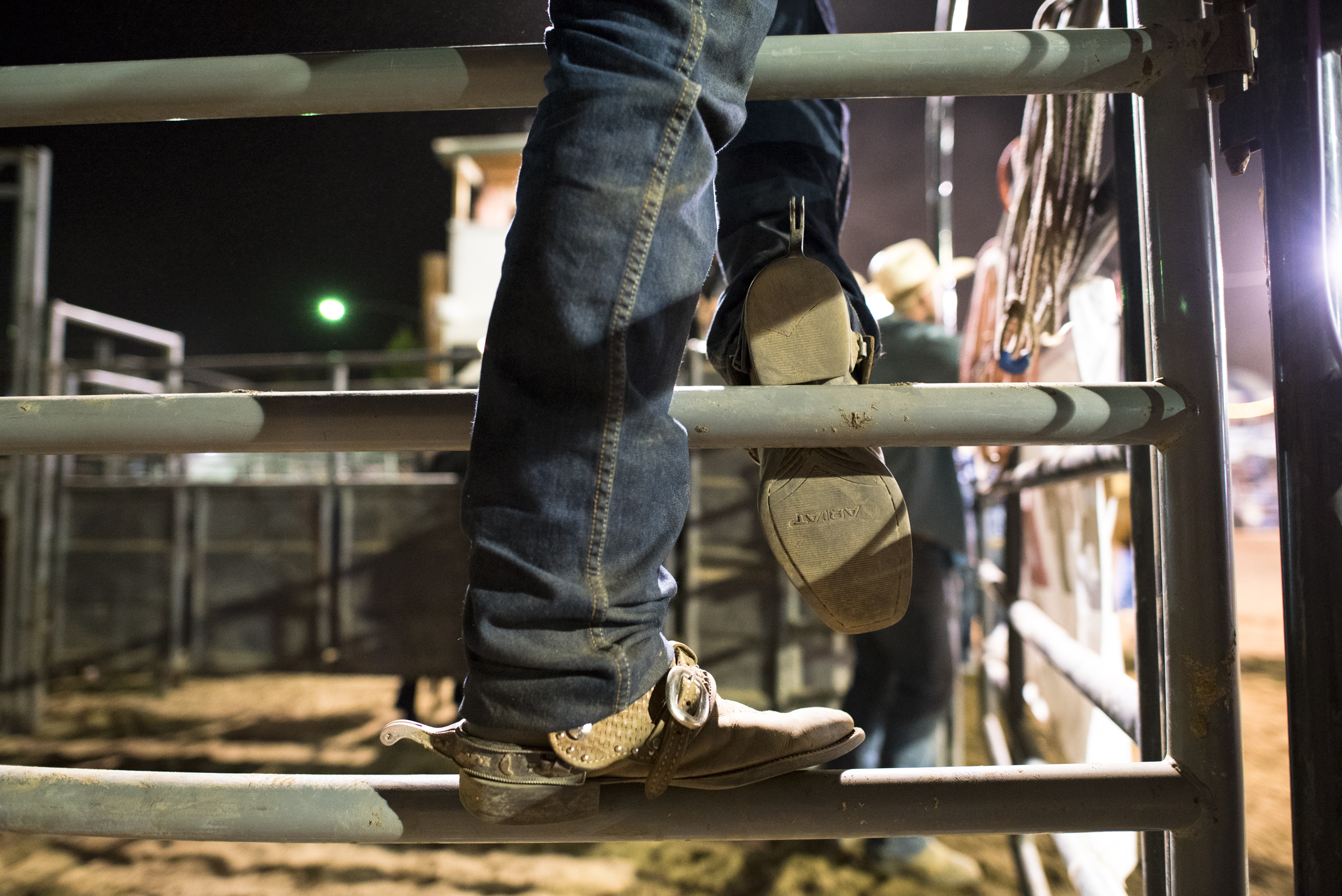
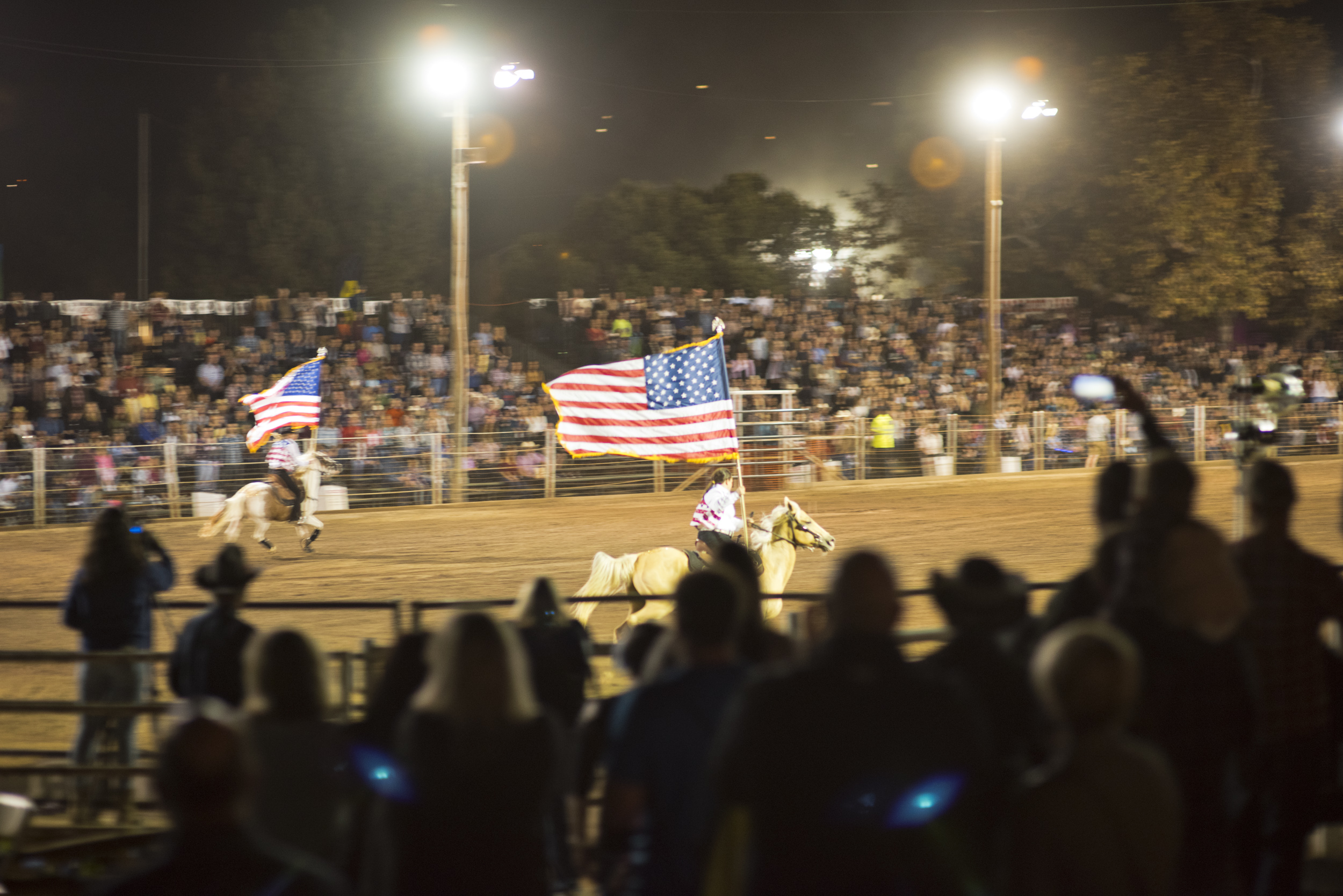
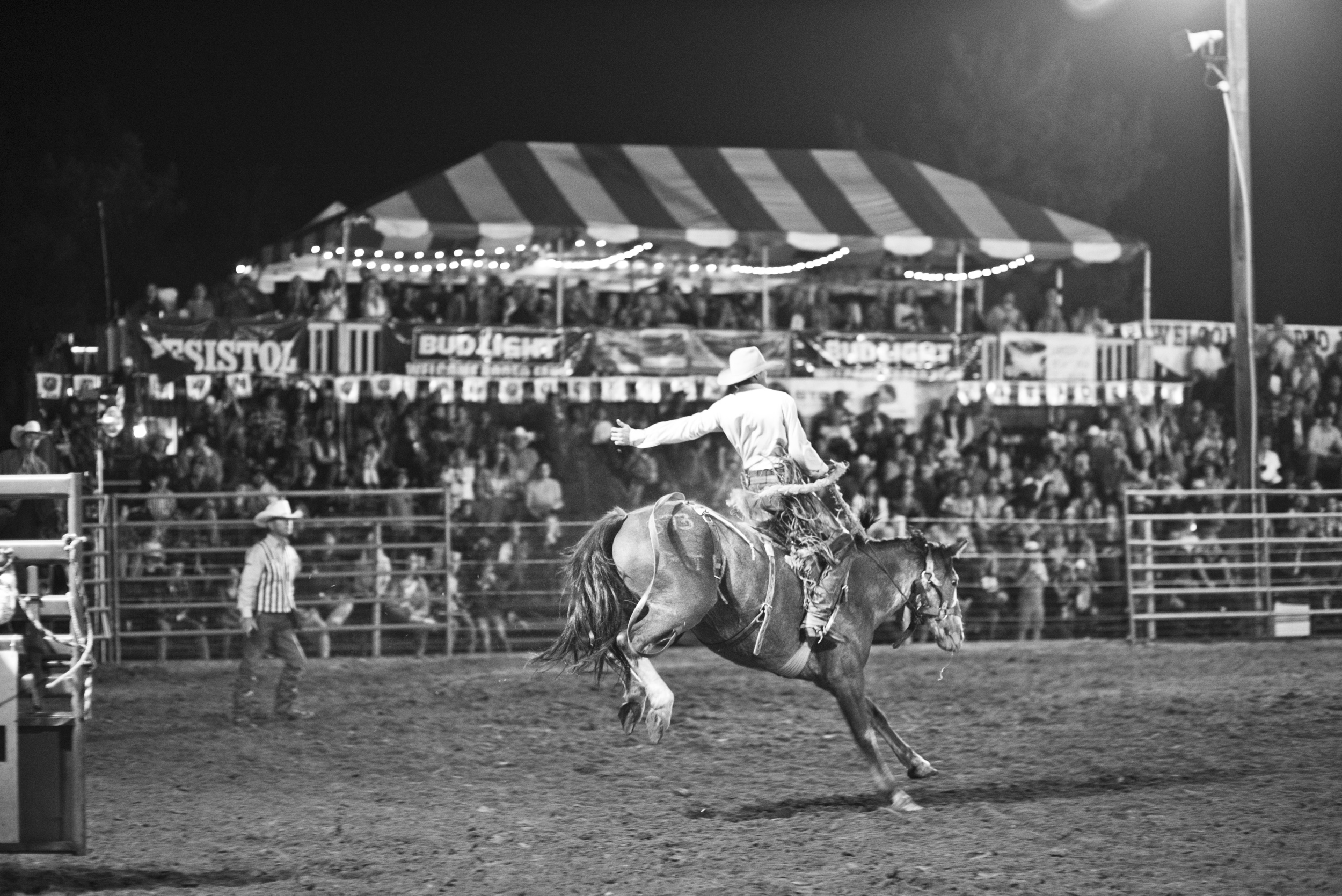
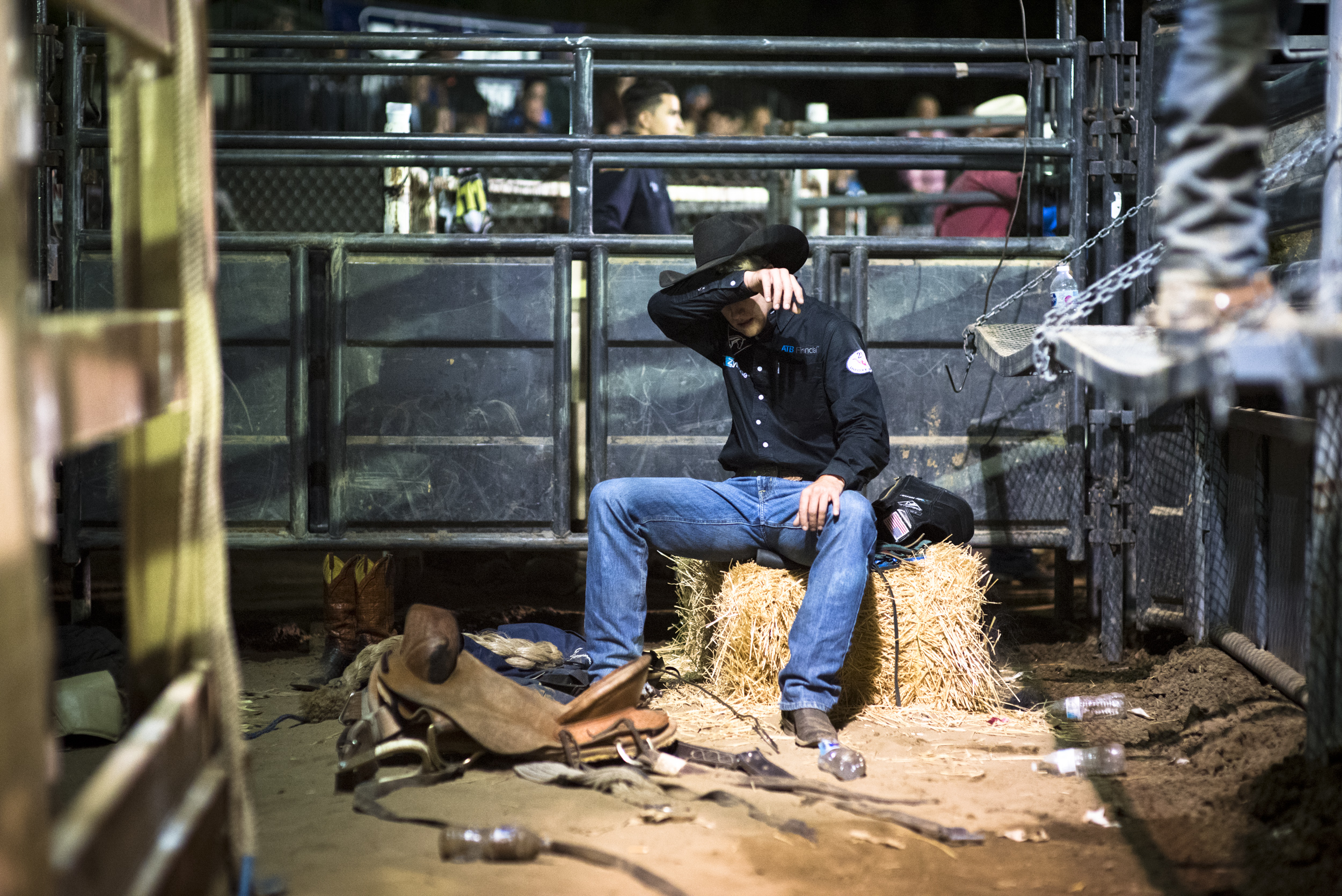
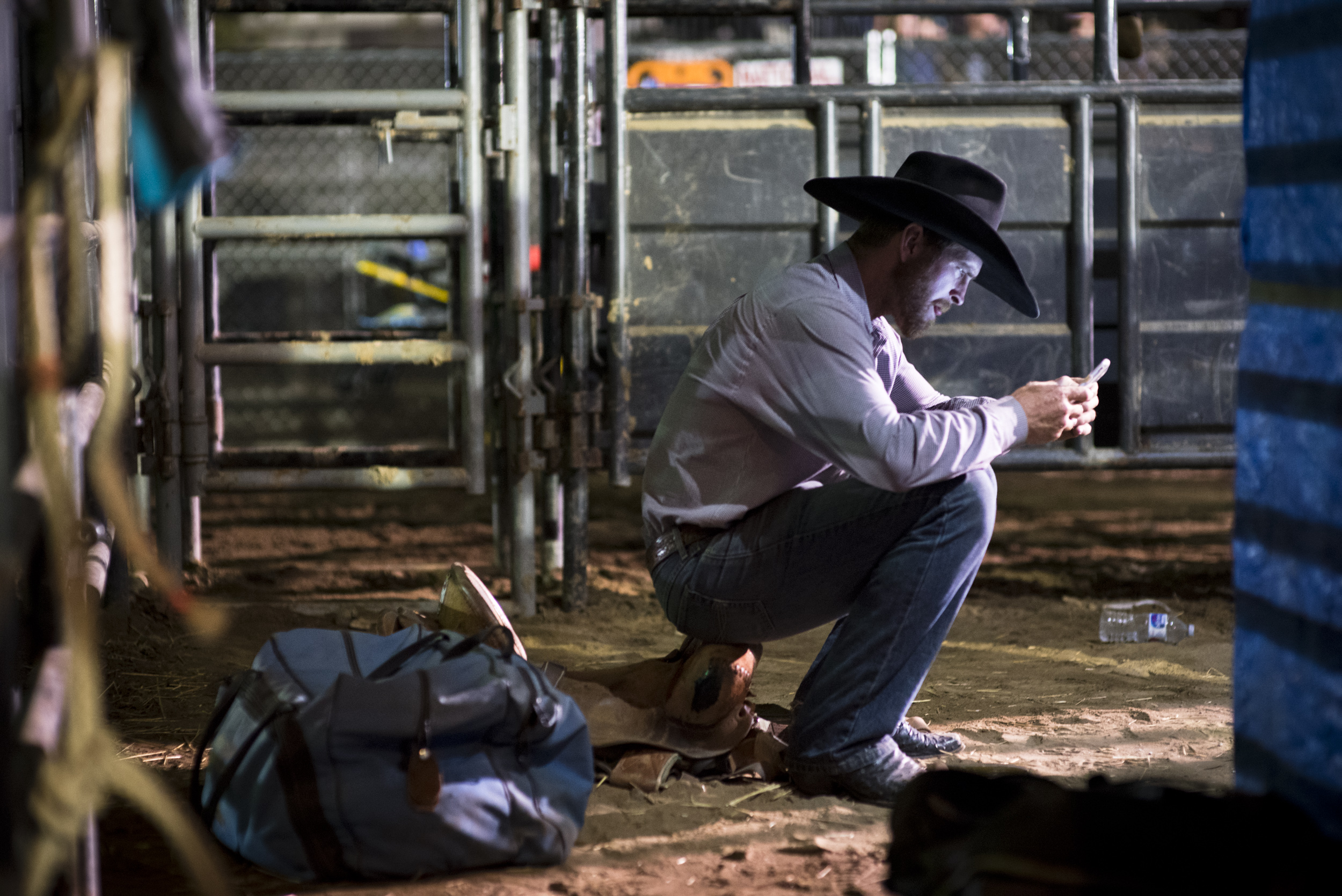
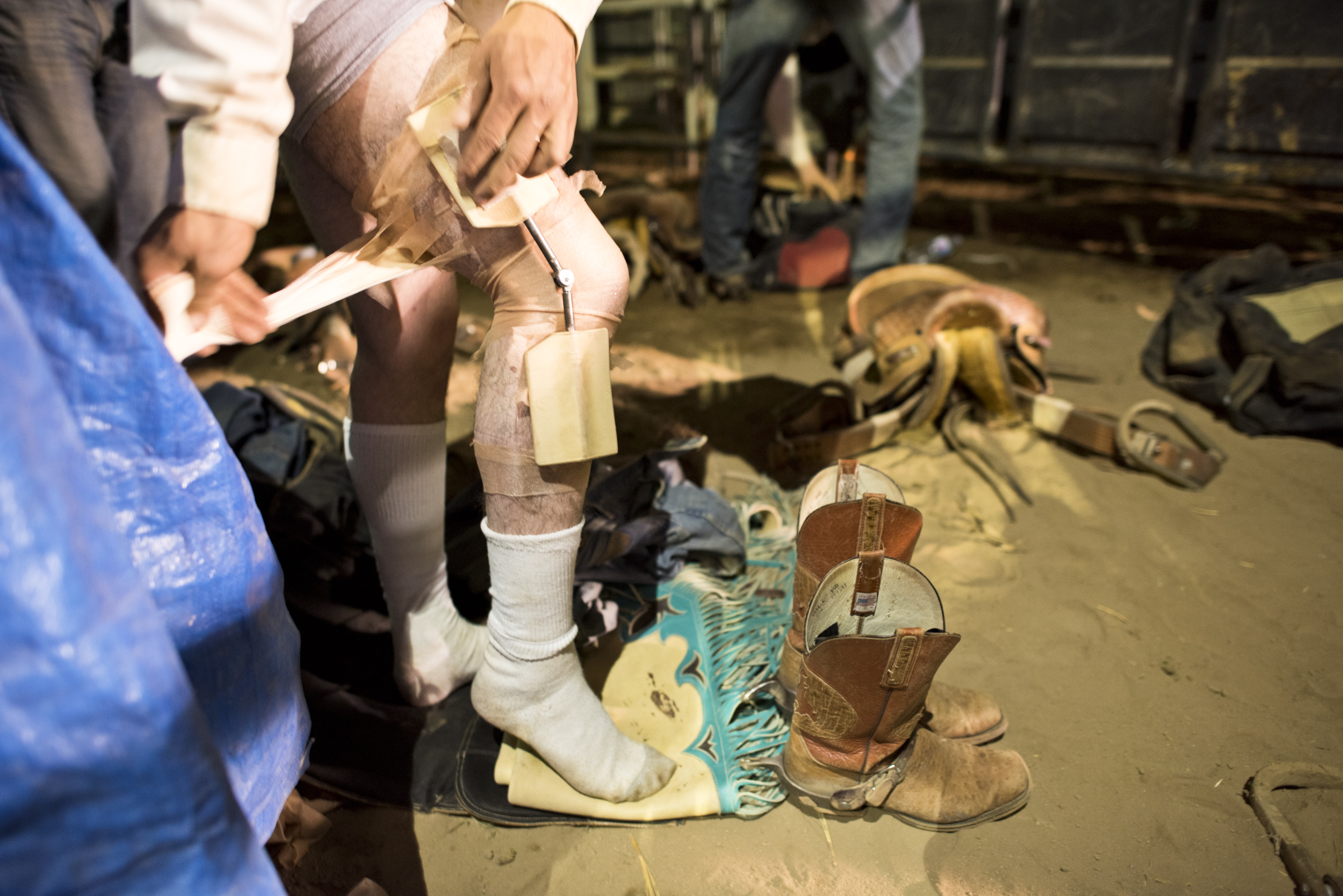
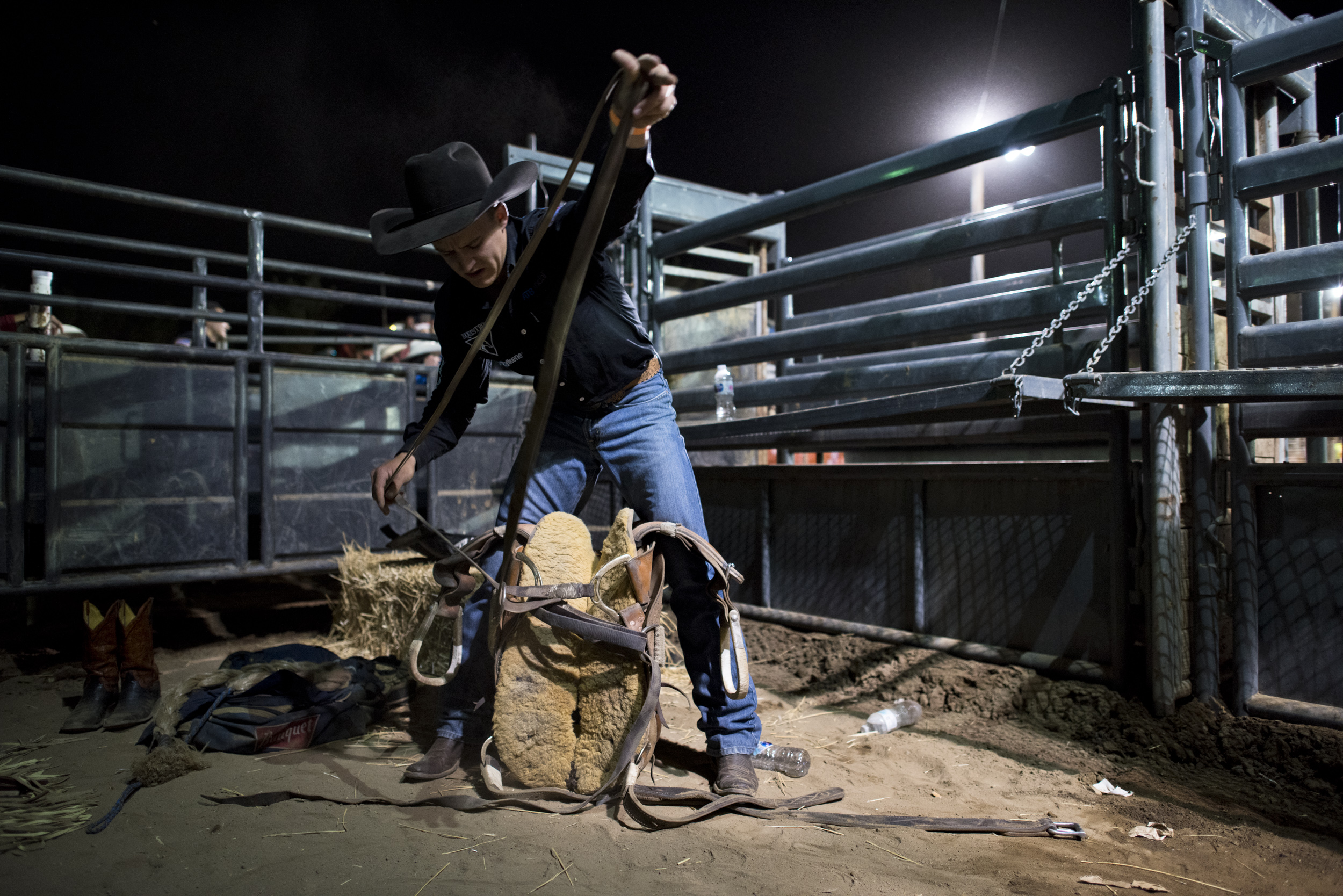
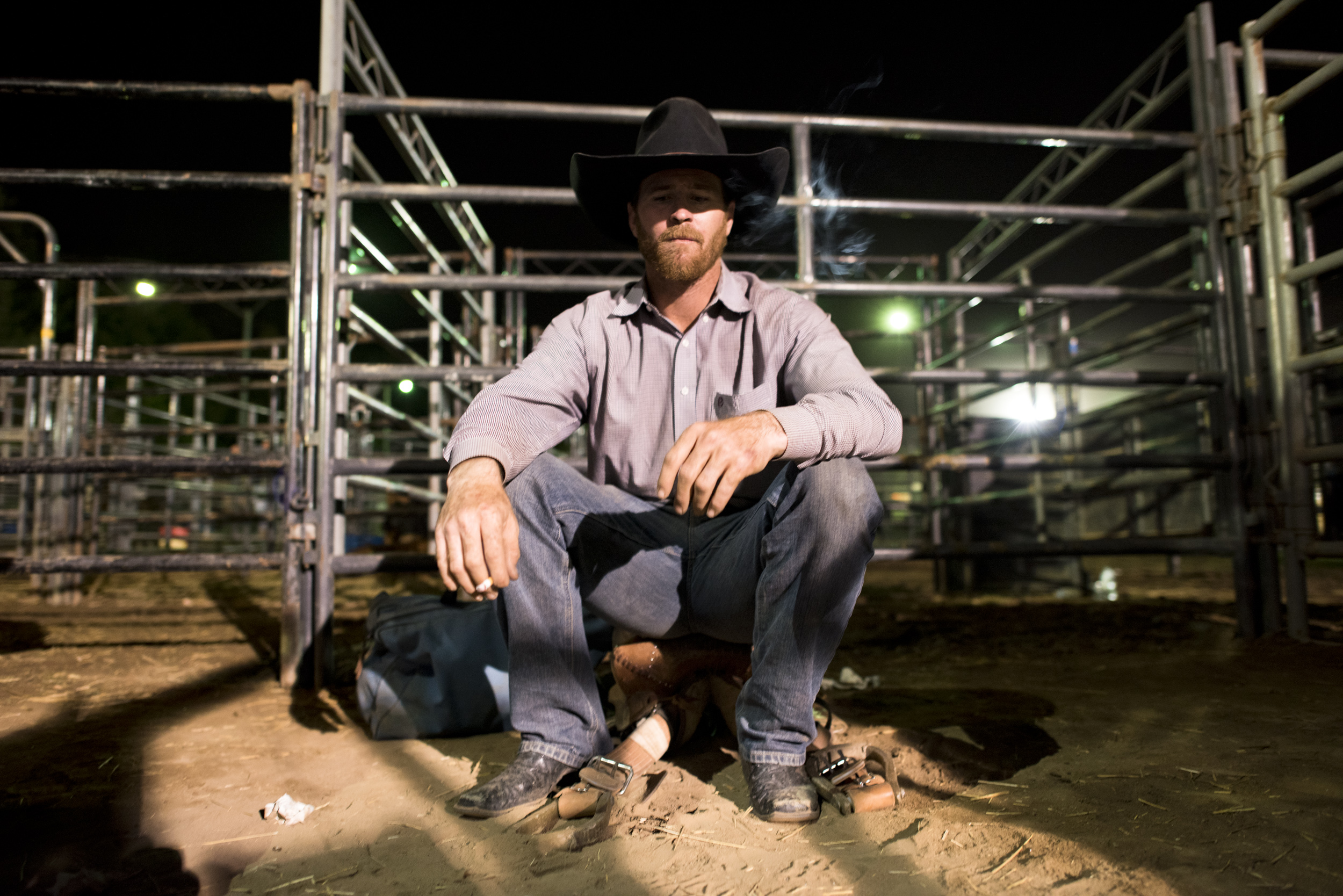
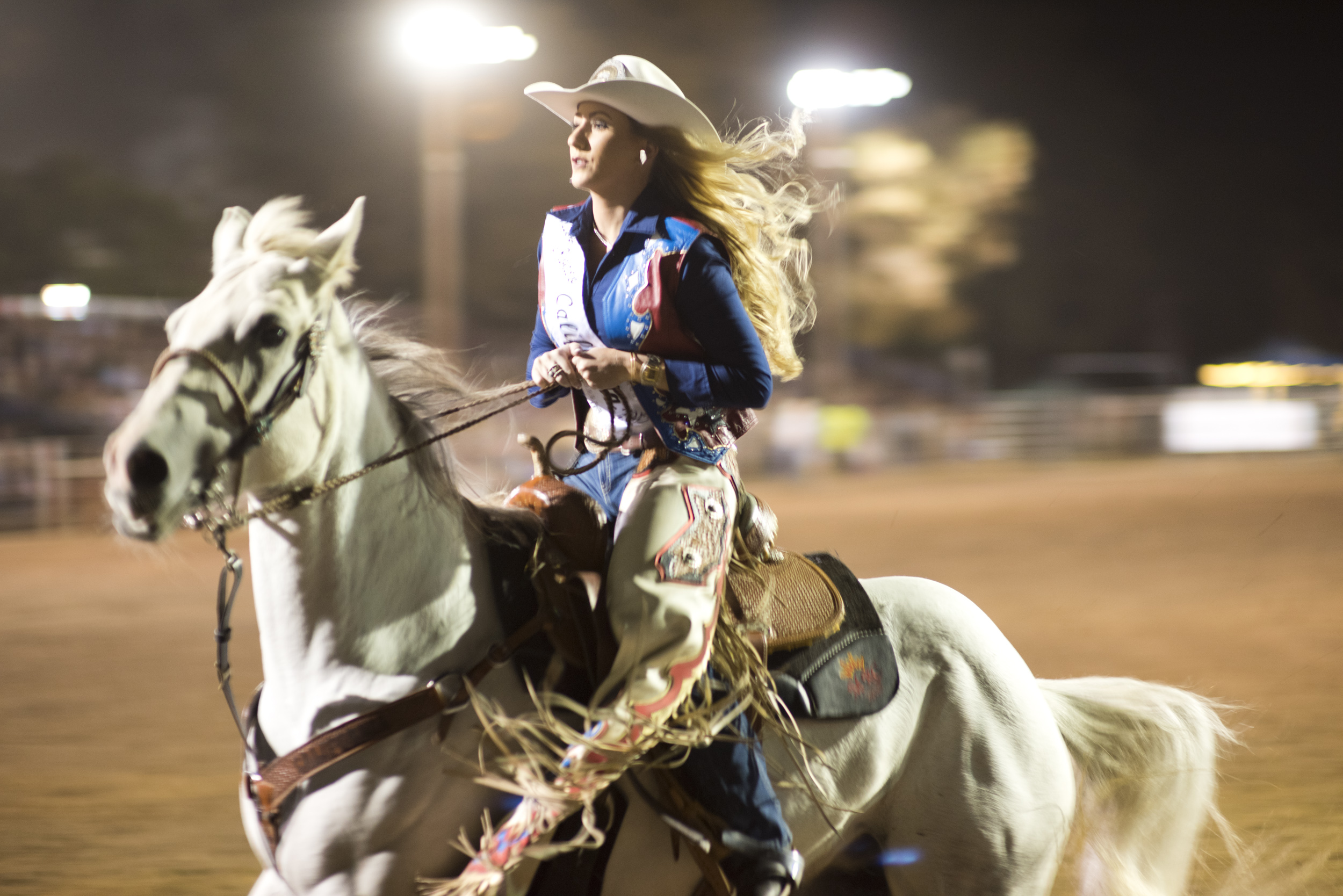
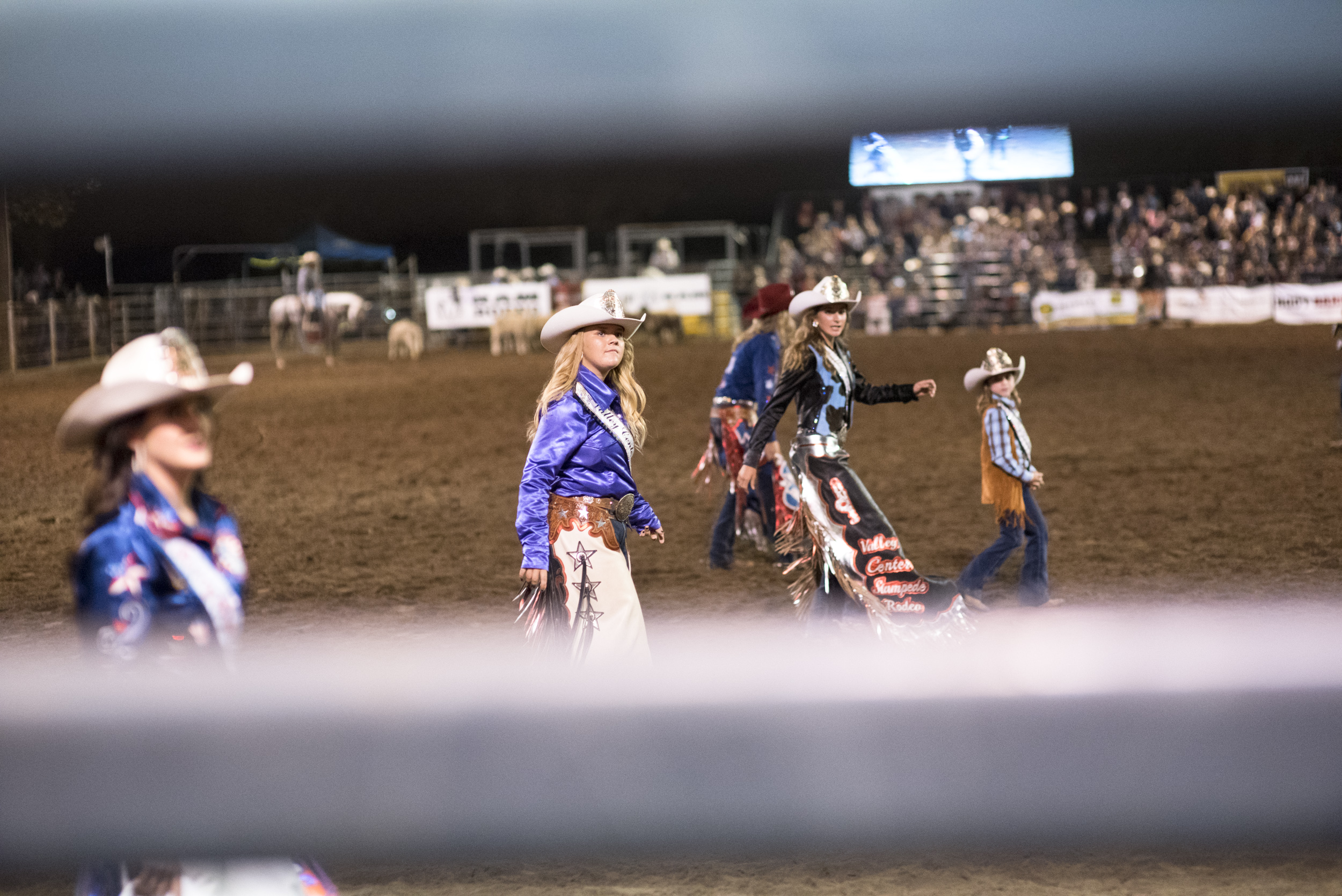
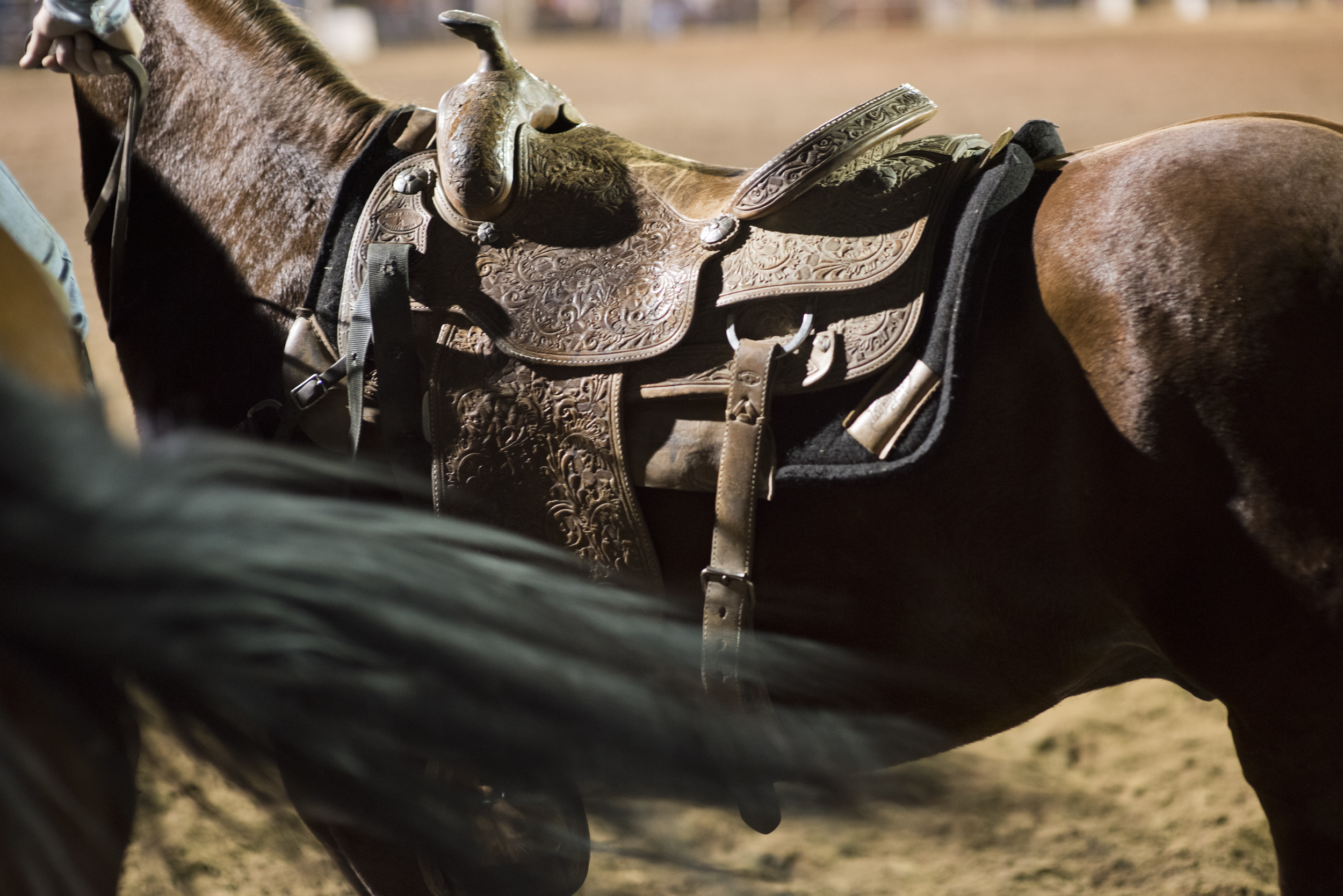
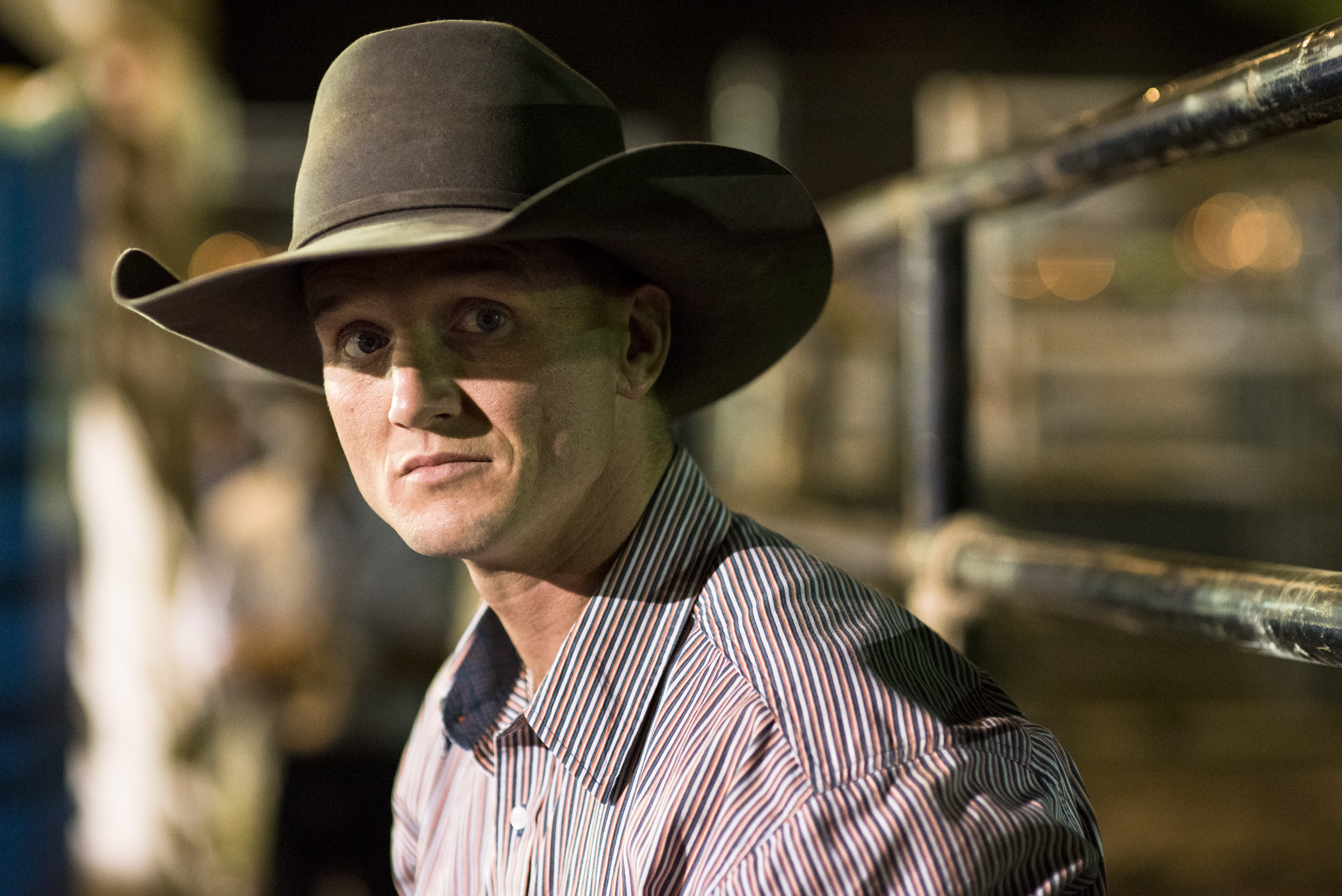
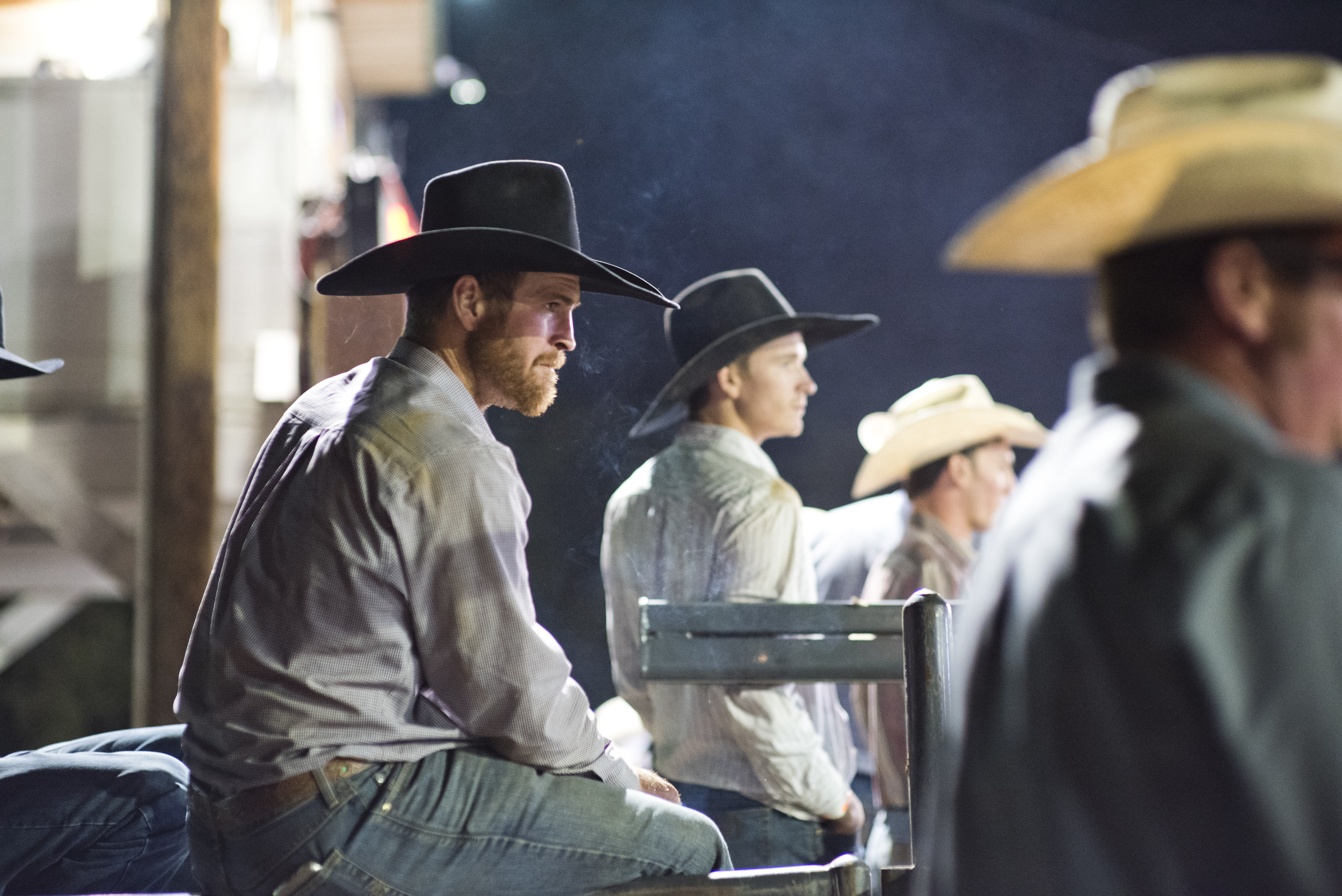
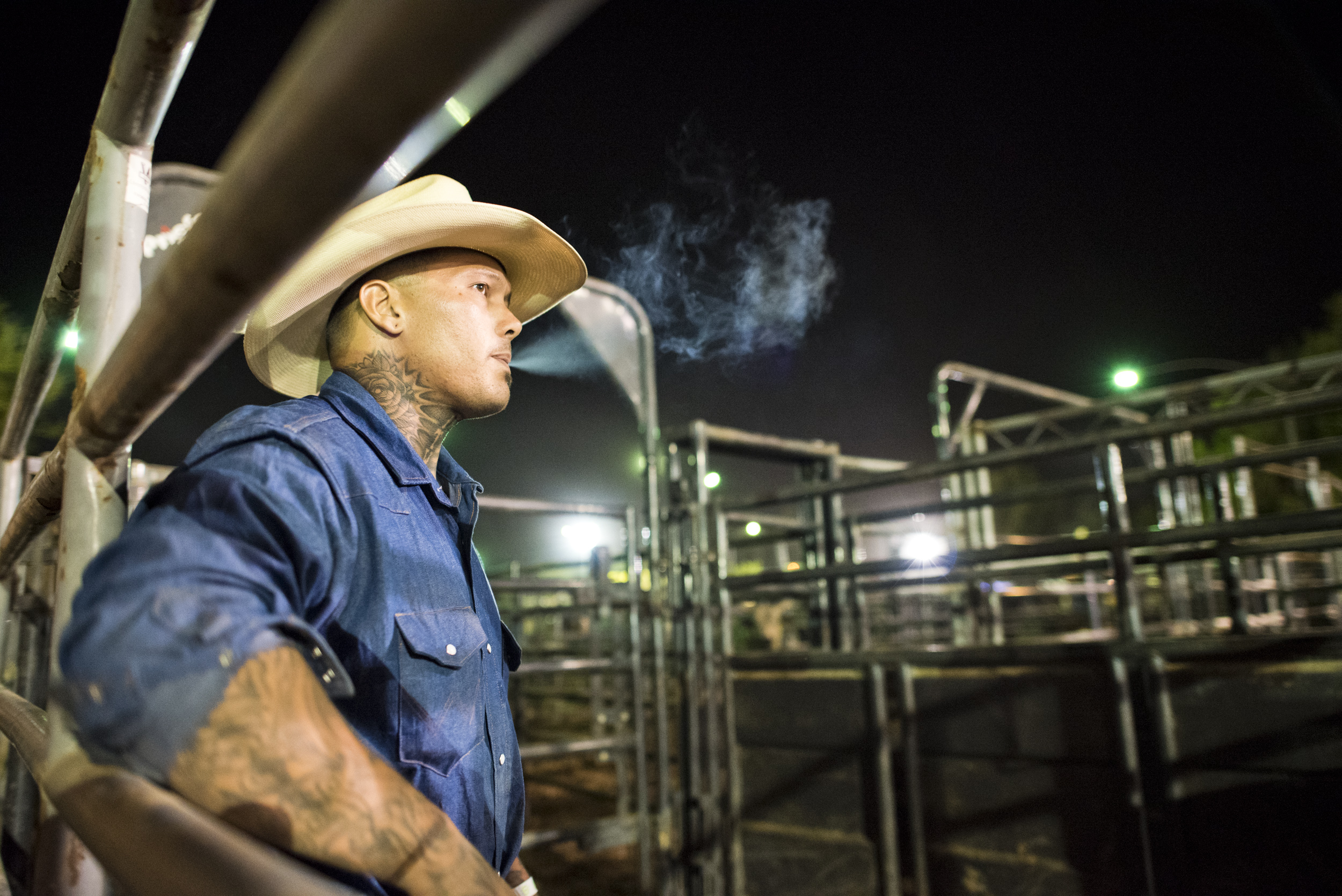
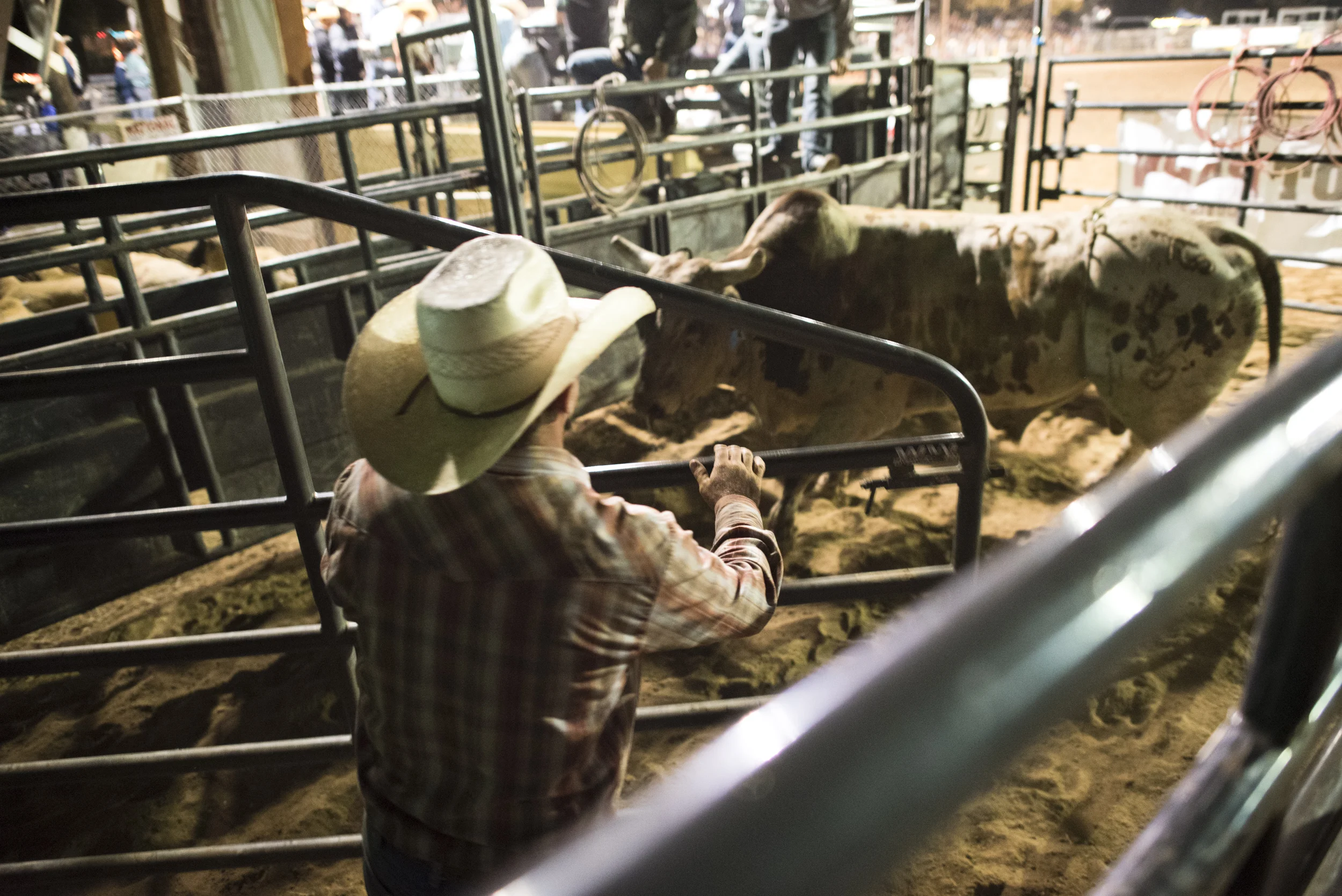
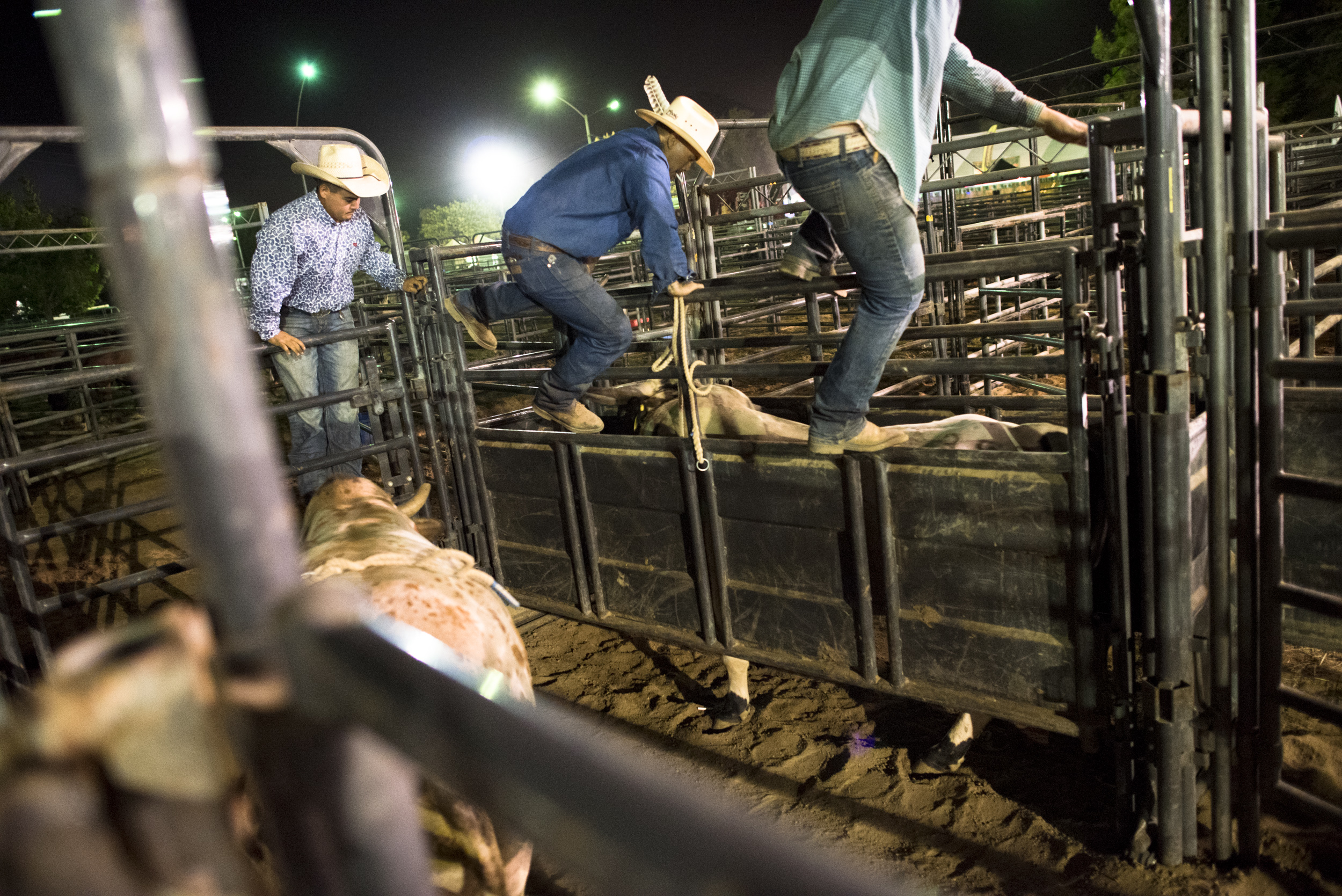
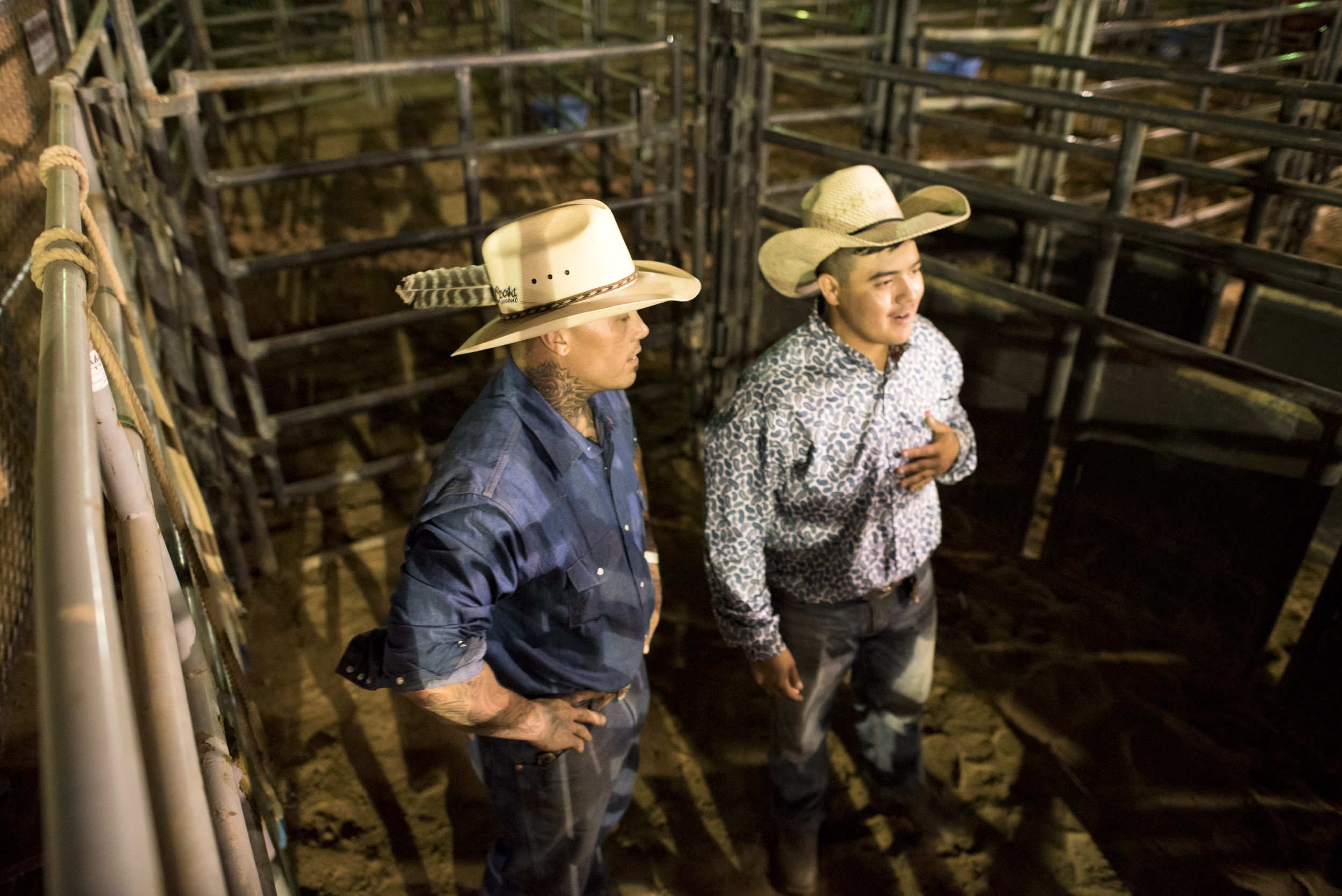
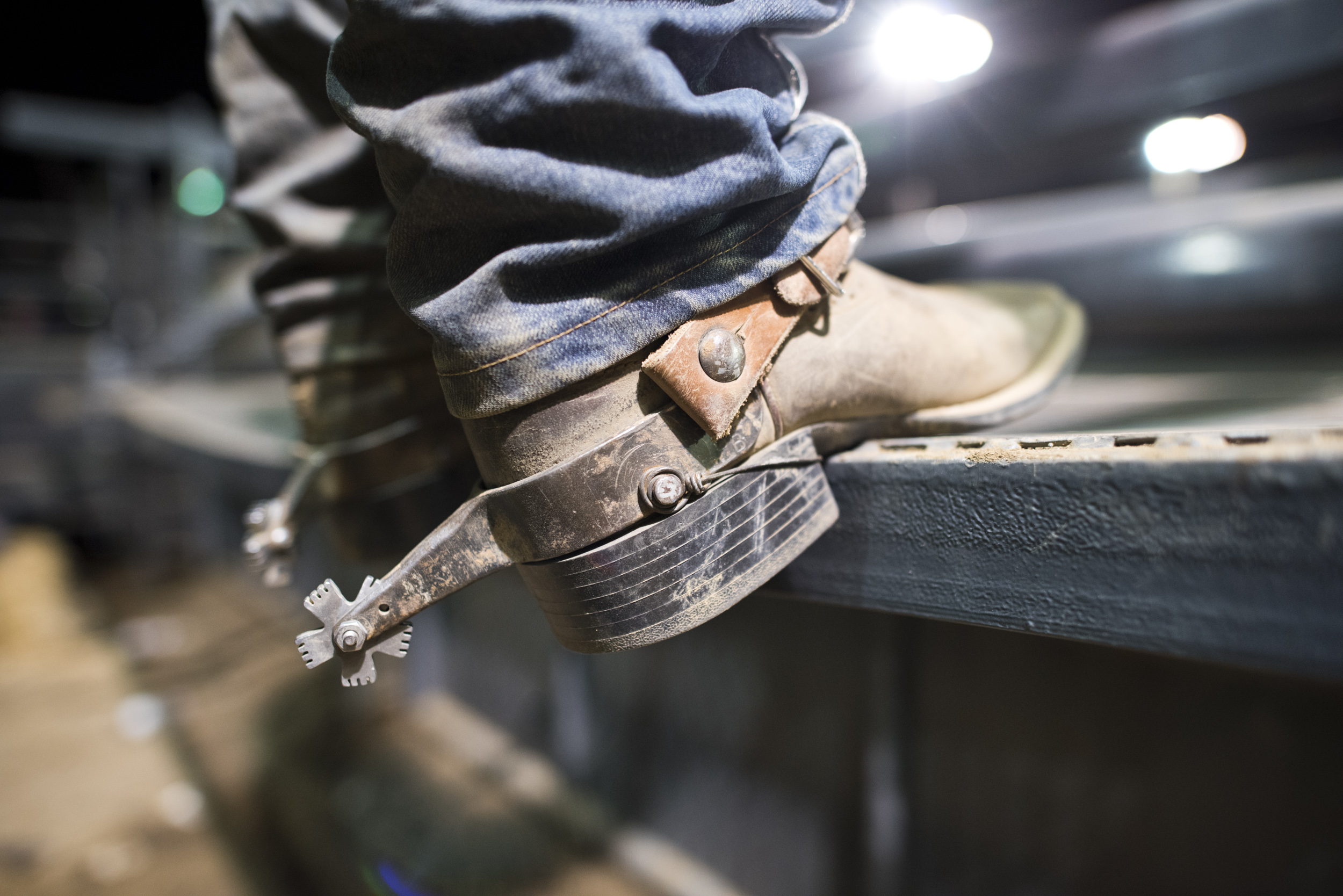
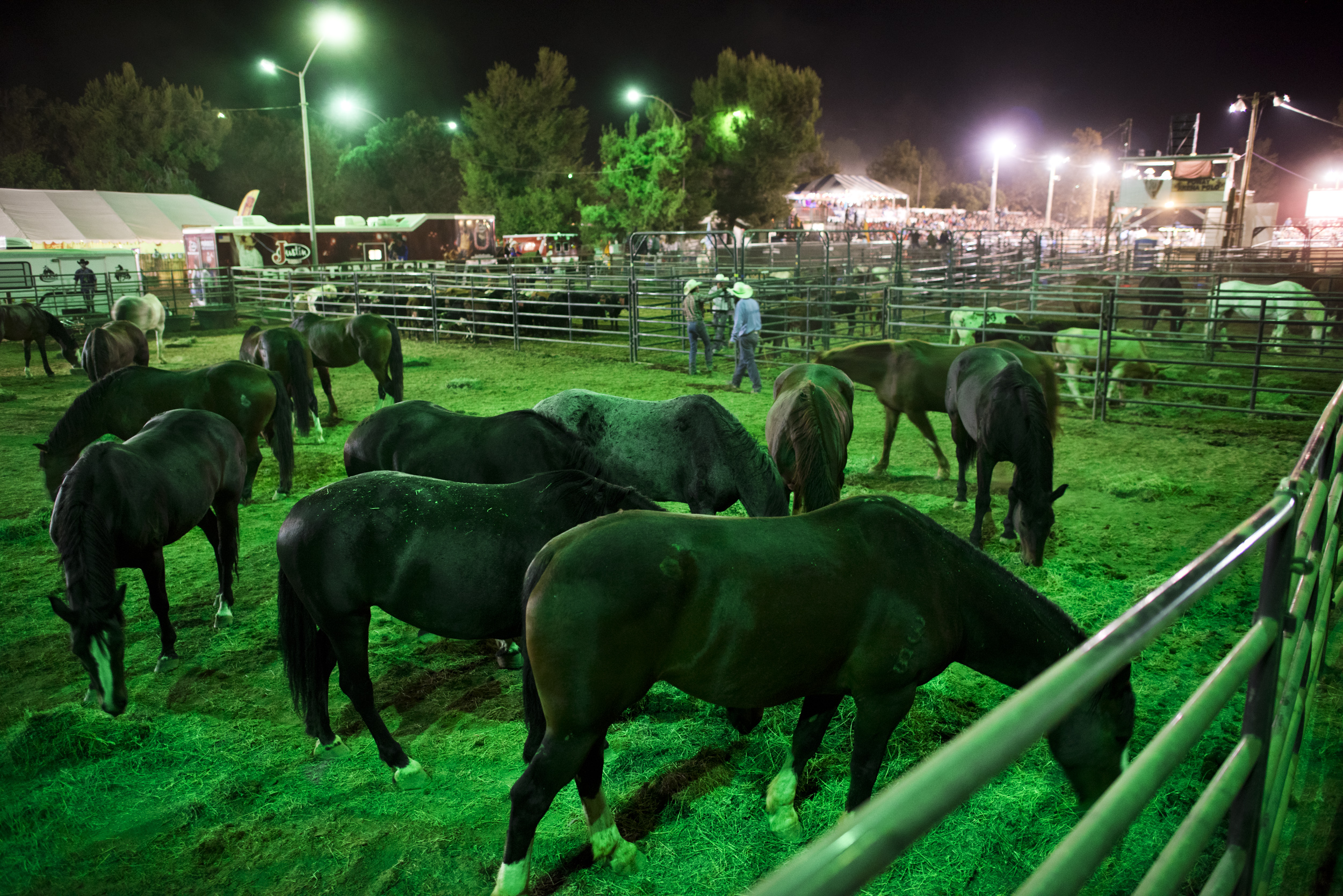
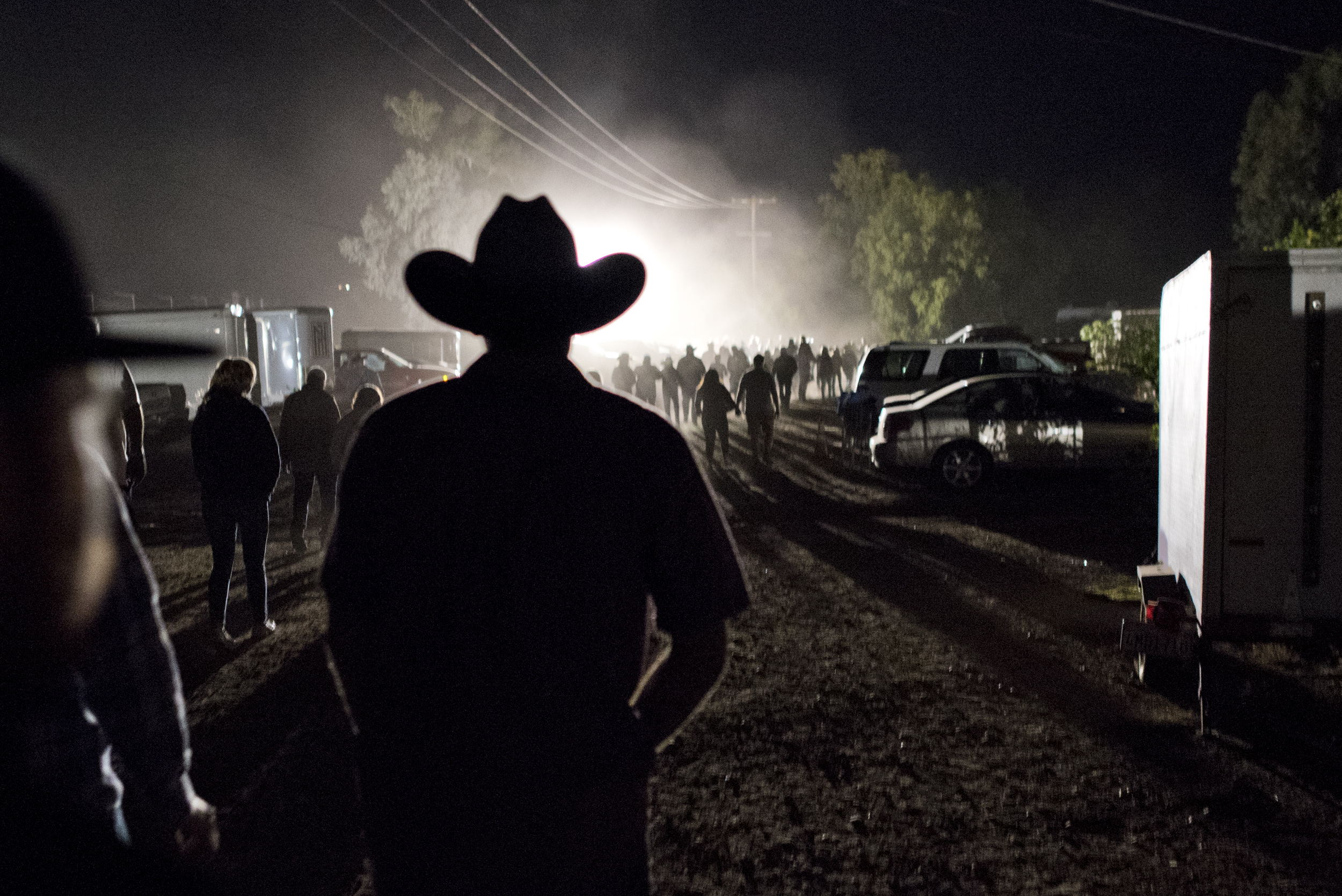
Getting outside your comfort zone is a beneficial thing in all aspects of life. Without it growth is not possible. The rodeo in Poway was last week, and I thought it would be a fun thing to shoot. Certainly something I've never done, but was very drawn to. So I reached out and found someone who needed some coverage. Like most things I shoot, my focus was not so much on the action, but behind the scenes. The little things that add to the culture but aren't really noticed or seen by most people. I loved everything about shooting this event. Being back where the riders were was awesome. Such a foreign culture that I've never experienced. And all the auxiliary stuff was great too. I got there really early and just wondered around the grounds, where I ran into a lot of characters. Everything I shot was natural light, and after the sun went down it was cool to see how much the color temperature of the "house" lights changed so quickly as they fell off. Learned a lot, most of which is that I'd shoot something like this again in a second. The grittiness of it is right up my alley. And everything felt so authentic. These aren't showy athletes on multi million dollar contracts. They are cowboys being cowboys.