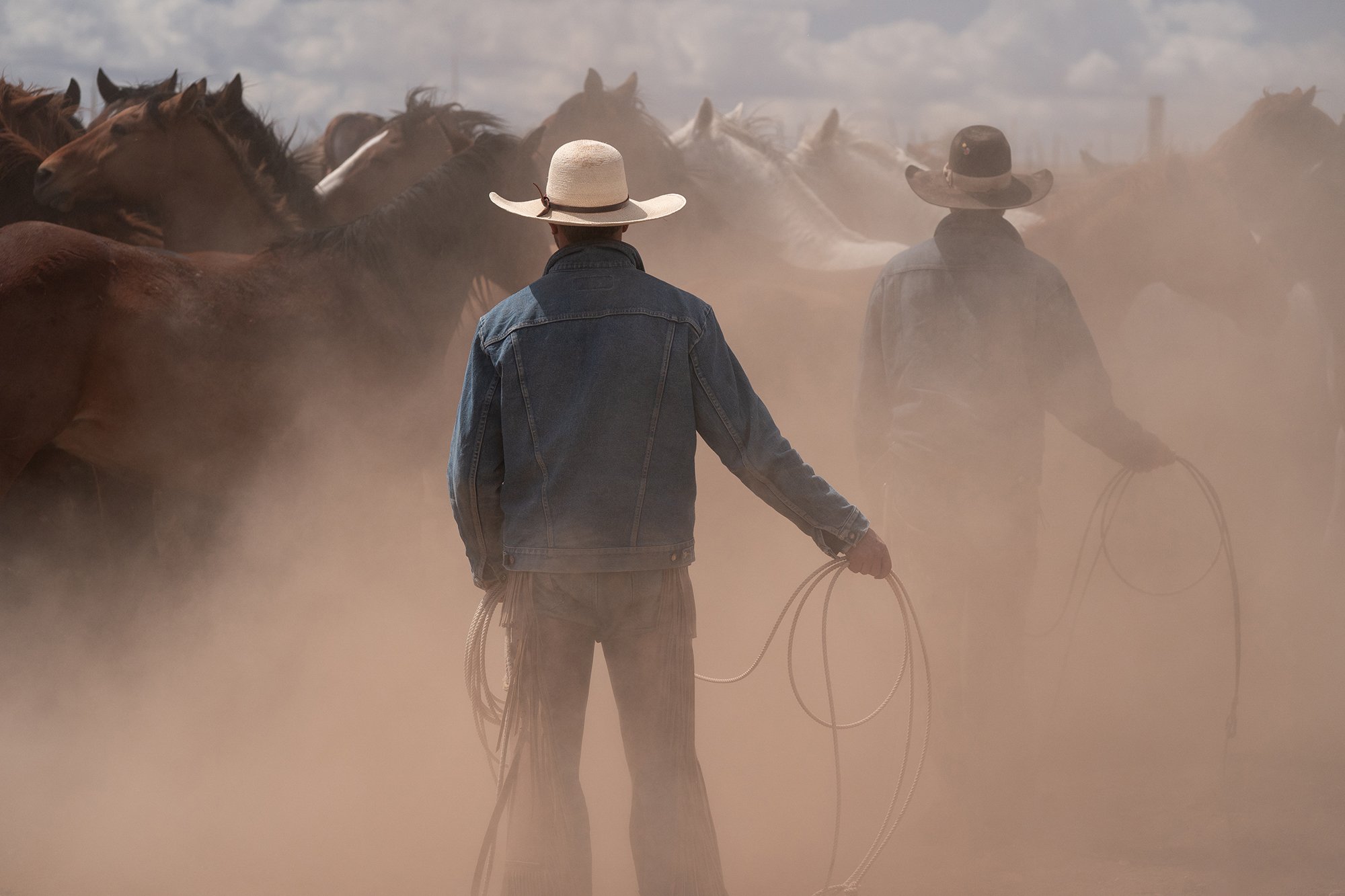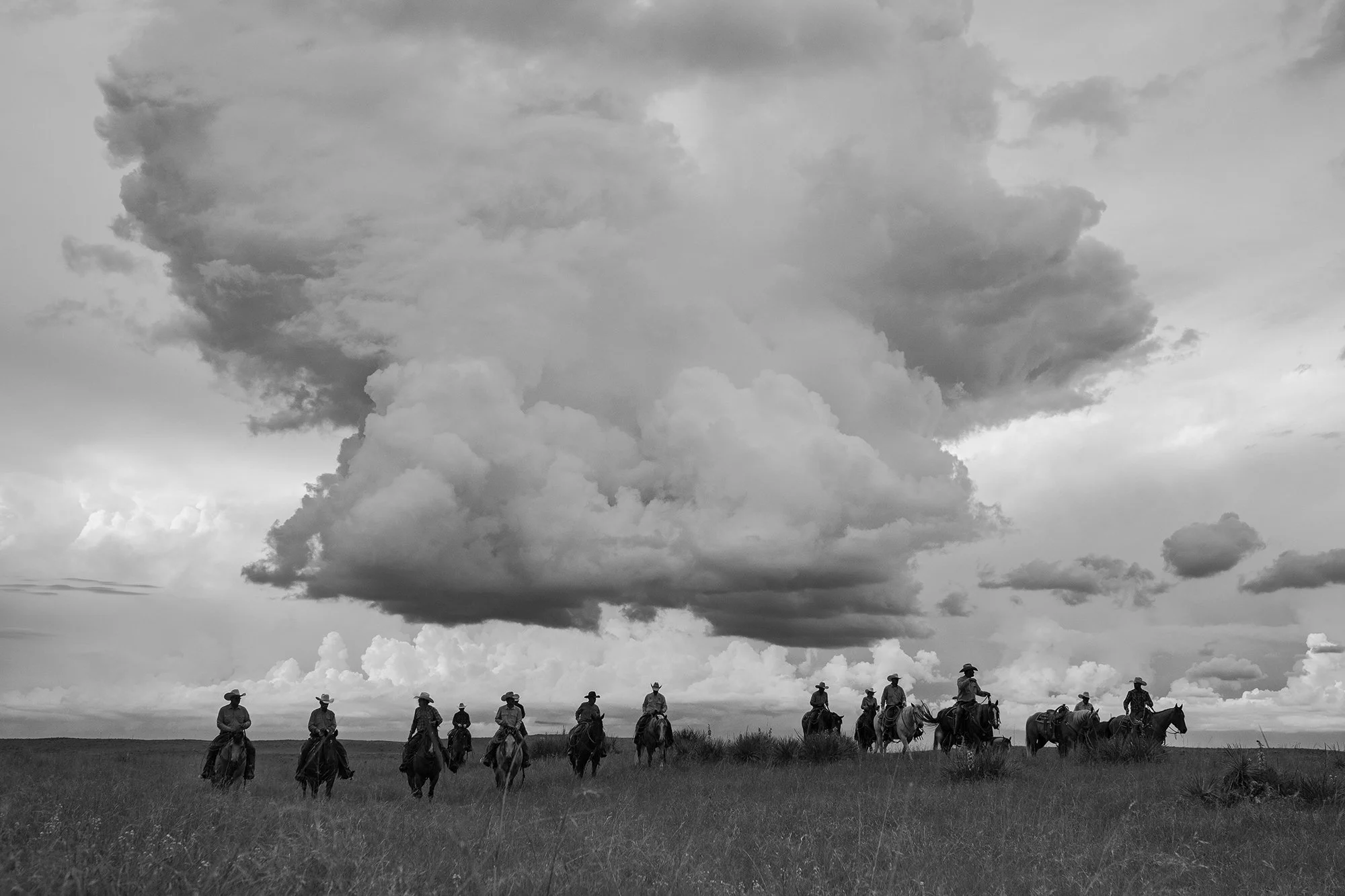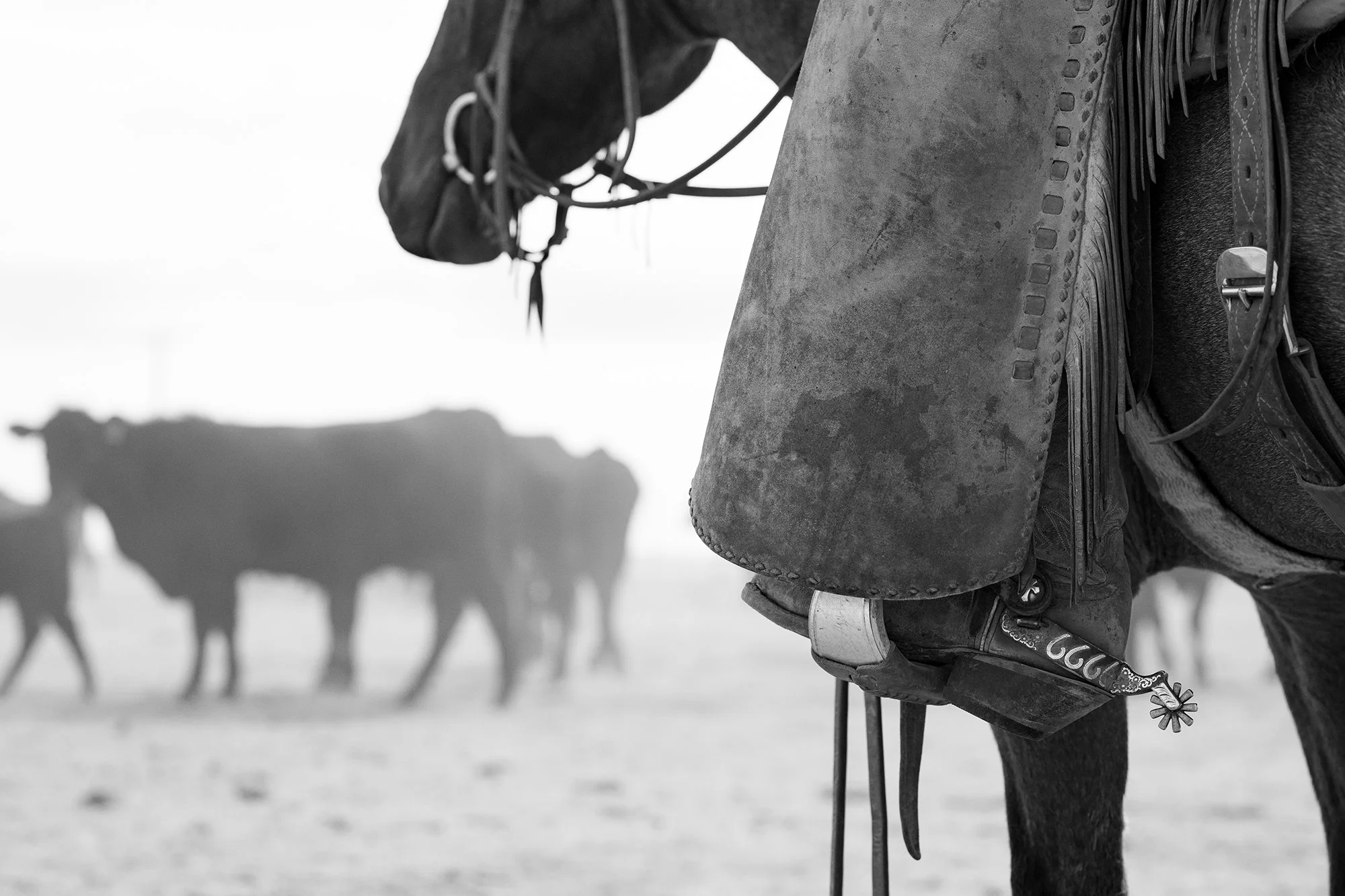
Old Corrals of the American West | Western Photography Prints for Sale

Corral Photography Prints for Western Wall Art


Fine Art Western Photography Prints

“I like old corrals and sagebrush,” Ian Tyson once sang, and that line has stayed with me for years. Not because it’s poetic—though it is—but because it’s accurate. Old corrals say more about the American West than most people realize.

This collection of corral photography prints focuses on structures shaped by work, weather, and time. Built to serve a purpose rather than to last, these corrals now remain as quiet markers of a working past—sun-bleached posts, worn rails, and enclosures slowly returning to the land.

These images are part of a larger body of work documenting corrals across the American West.
View the full corral photography gallery

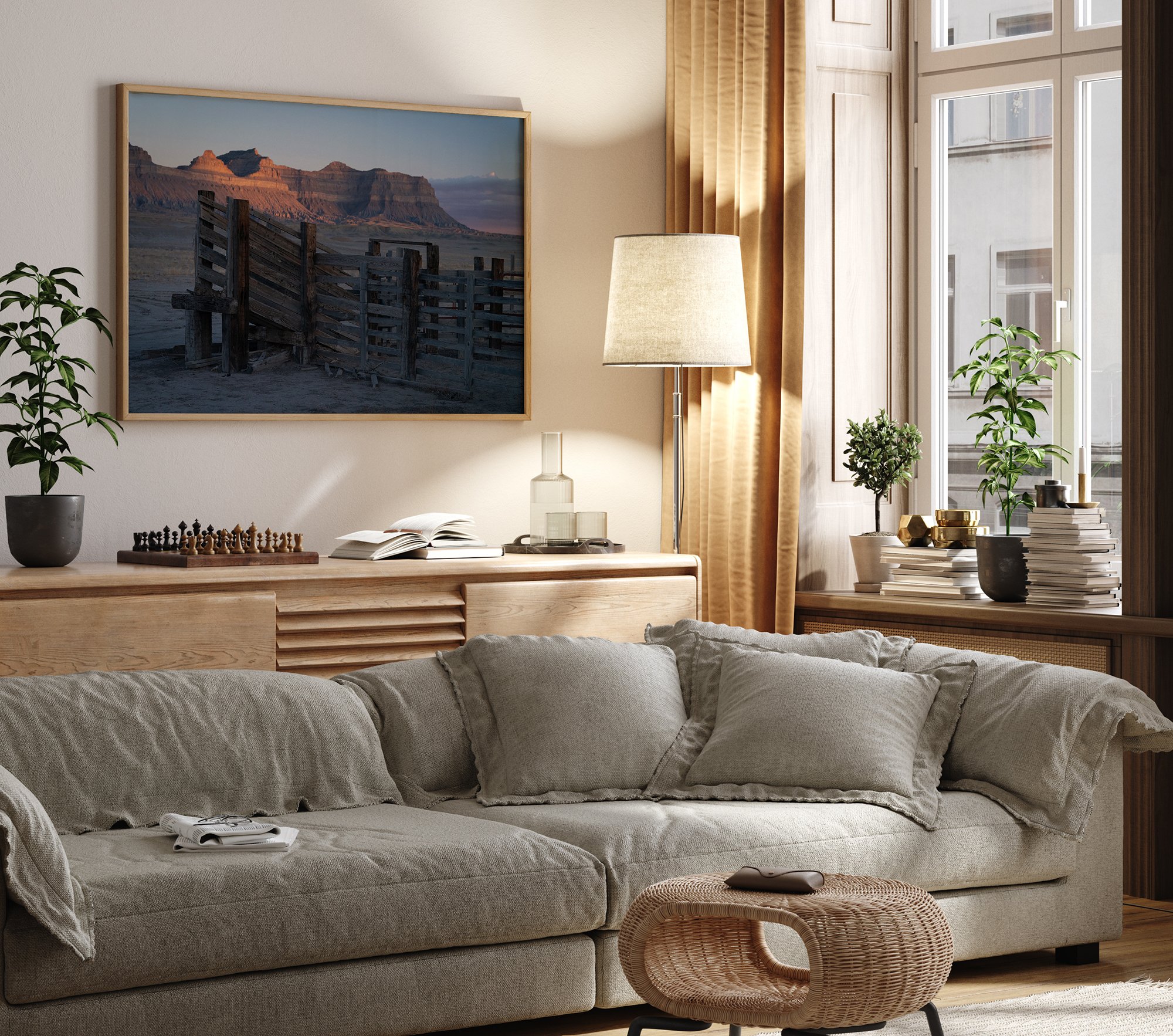
Corral photography print shown in a modern western interior, highlighting how authentic working landscapes translate into refined wall art

Photographing Old Corrals in the American West

I’ve spent years photographing working landscapes across the West—ranches, grazing land, water sources, and the structures that support them. Corrals often sit in the places you least expect, easy to pass without notice. But when you slow down, they begin to reveal something deeper.

Most of this work was made on active or former ranches, where access is limited and the structures still carry a functional history. There’s no staging, no reconstruction—just what remains.

These corral photographs are made using natural light and a documentary approach. I’m not interested in recreating the past, but in acknowledging it as it exists now.

An old corral isn’t nostalgia. It’s evidence.

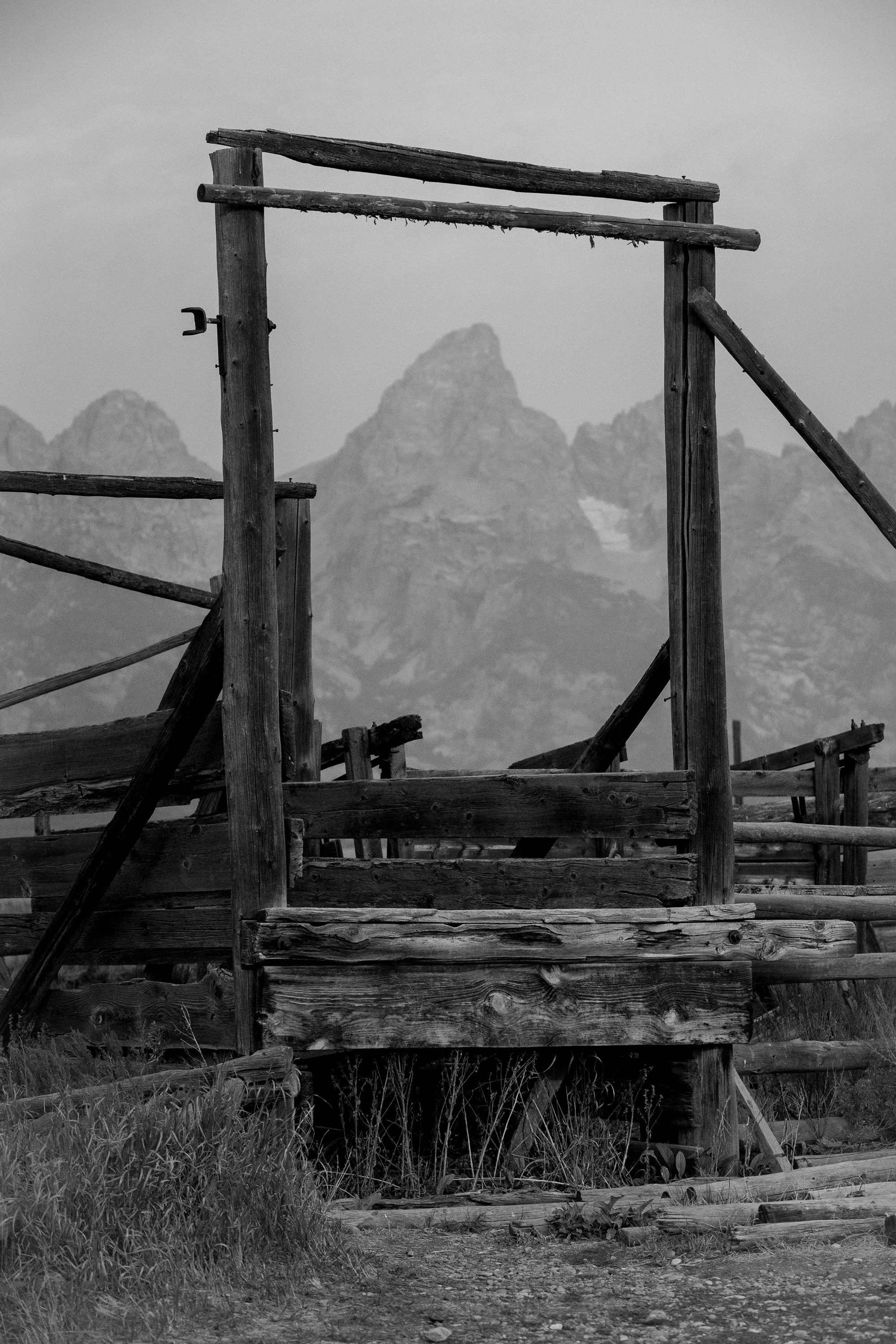
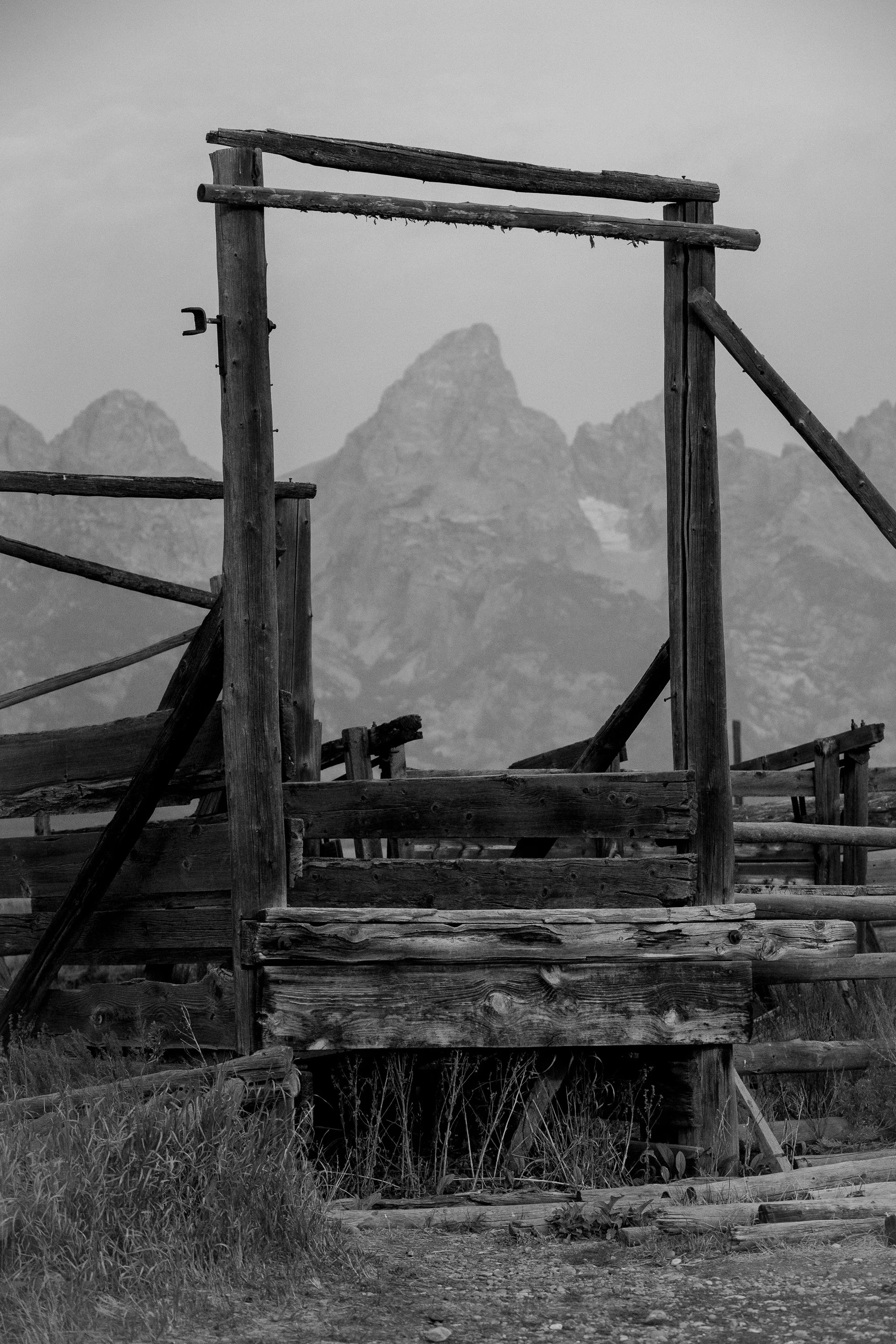
Black and white fine art photograph of the a wood cattle corral with the Grand Tetons in the background

An old wood cattle corral in front of the Grand Tetons in Wyoming - Black and White Fine Art Photography

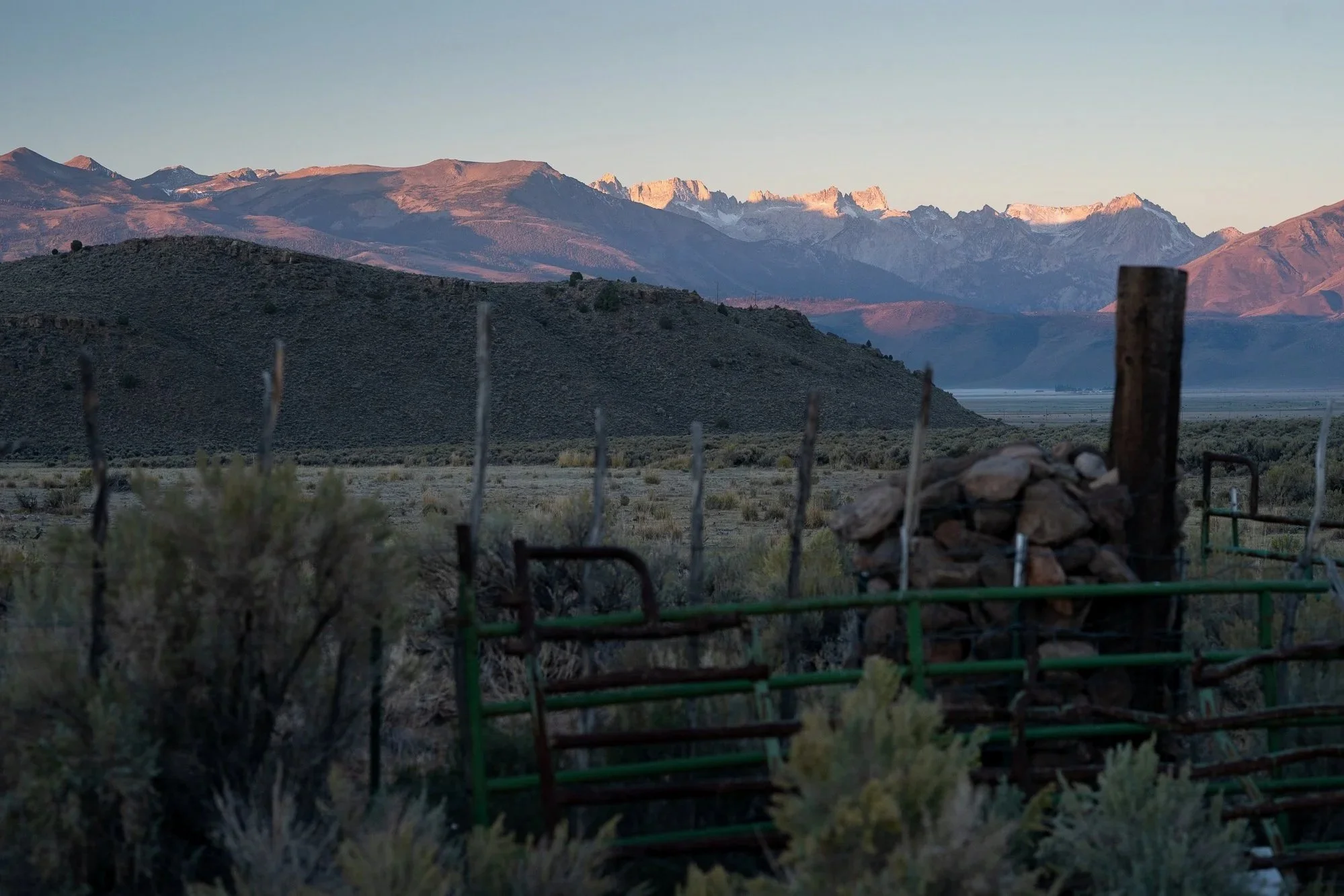
An old corral gate and stone post on a remote ranch, photographed at dusk with the mountains of the American West beyond.

Why Old Corrals Still Matter

Corrals are where cattle were gathered, sorted, branded, treated, and shipped. They are places of work—defined by repetition, pressure, and routine. Over time, many have been replaced or abandoned as ranching operations changed.

What remains tells a quieter story:

  • Land use shifting over time

  • Families moving on or adapting

  • Work that once defined entire regions

Corrals are rarely photographed as standalone subjects, yet they hold the structure of the work itself. Photographing them preserves a record of a West that still exists—but is increasingly easy to overlook.

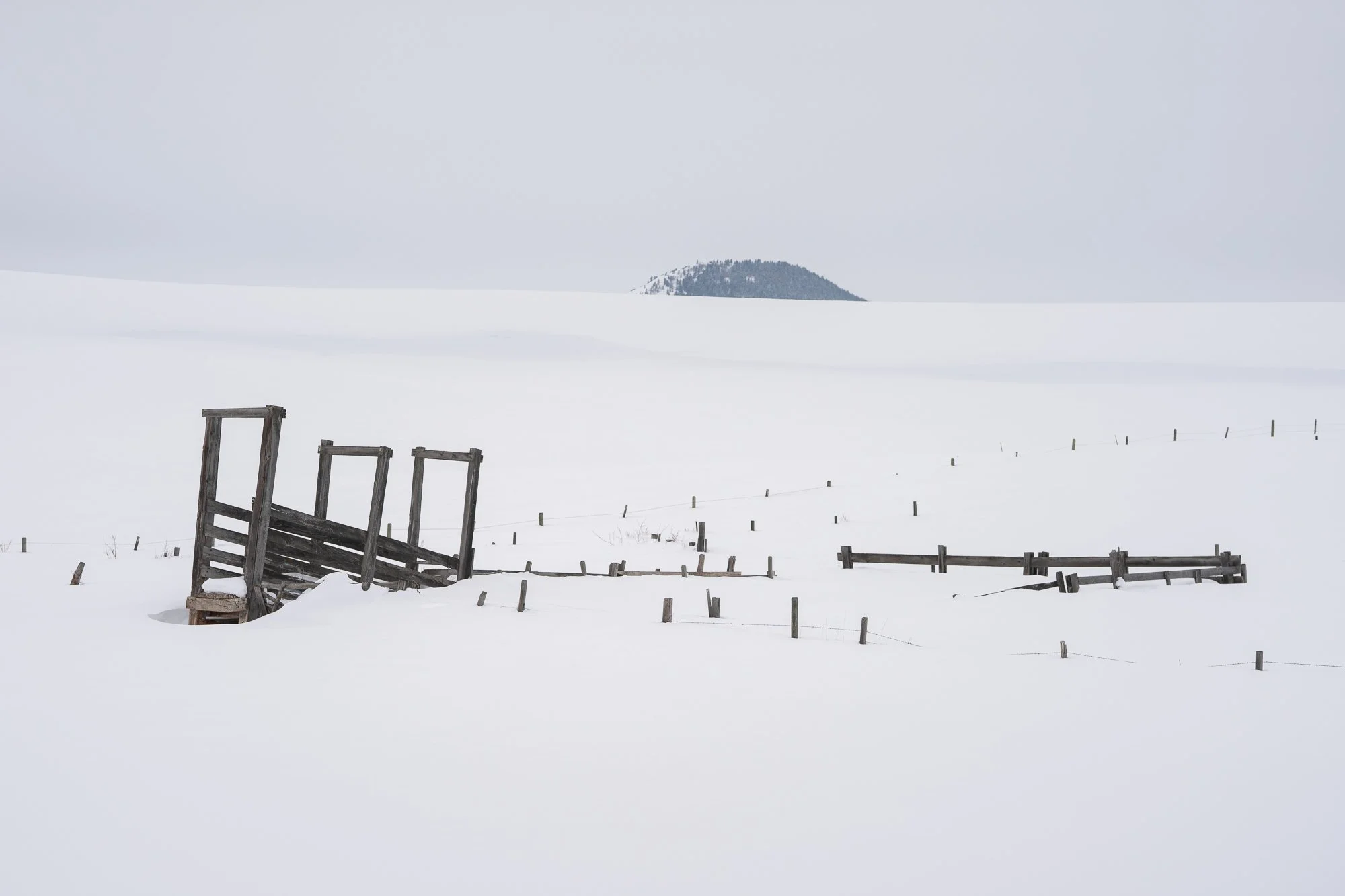
Old corral partially buried in snow on an open ranch landscape in the American West

An abandoned ranch corral slowly disappearing beneath winter snow, photographed in the American West

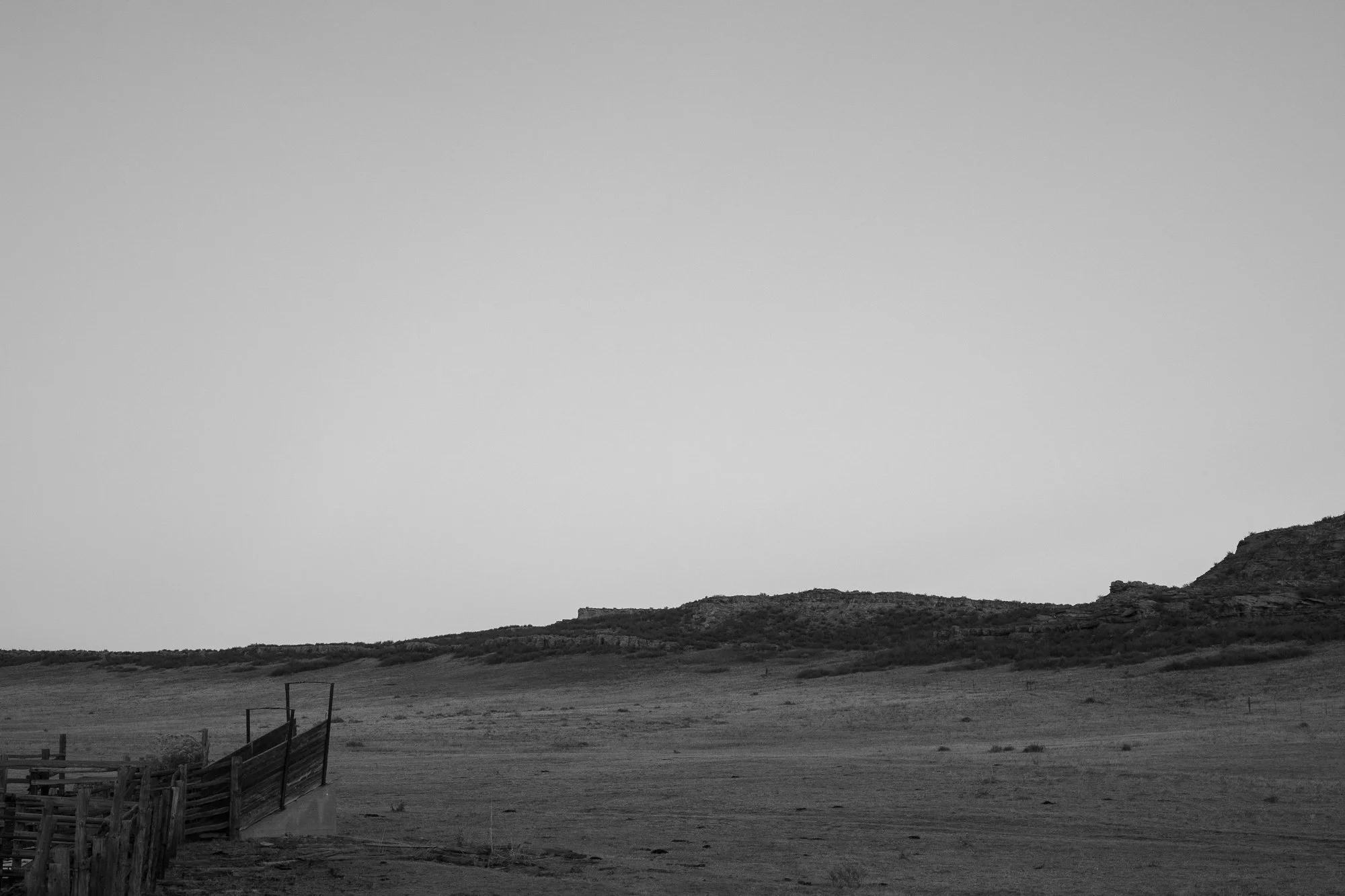
Black and white photograph of a corral set within an open Western landscape

A corral set into a wide, open Western landscape, photographed in black and white.

Why Corral Photography Works as Western Wall Art

Corral photography offers something different from traditional Western imagery.

Instead of action or portraiture, these photographs focus on structure, space, and restraint. Weathered wood, repeated lines, and open landscapes create compositions that feel grounded rather than decorative.

That’s why they tend to work well in a range of spaces:

  • Western homes and ranch properties

  • Modern interiors looking for texture and depth

  • Hospitality spaces and lodges

  • Offices and environments shaped by regional identity

The imagery doesn’t rely on spectacle. It holds attention more quietly—through detail, balance, and a strong sense of place.

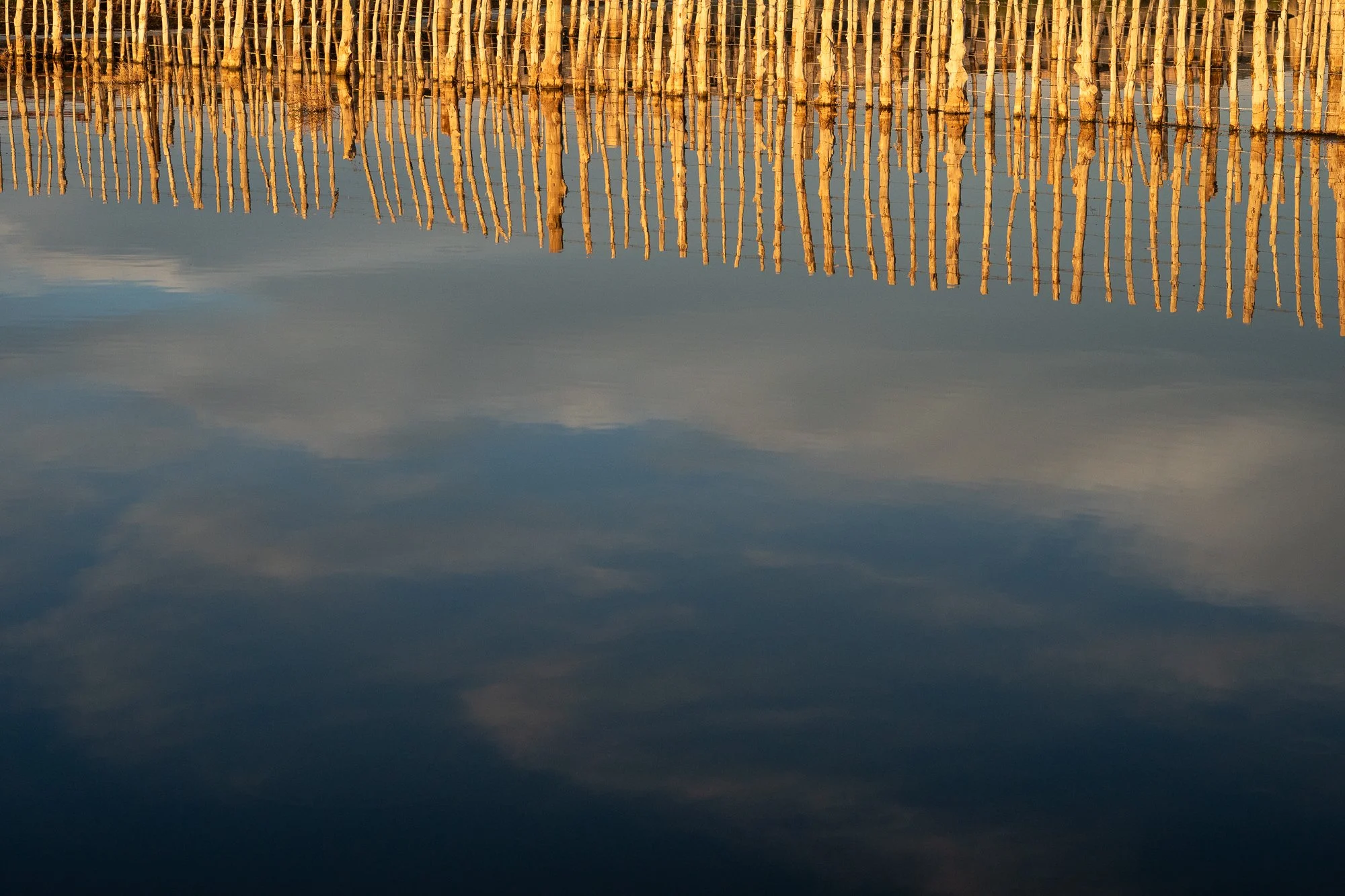
Wooden corral fence posts reflected in still water on a ranch in the American West

Wooden corral fence posts reflected in still water, photographed on a ranch in the American West.

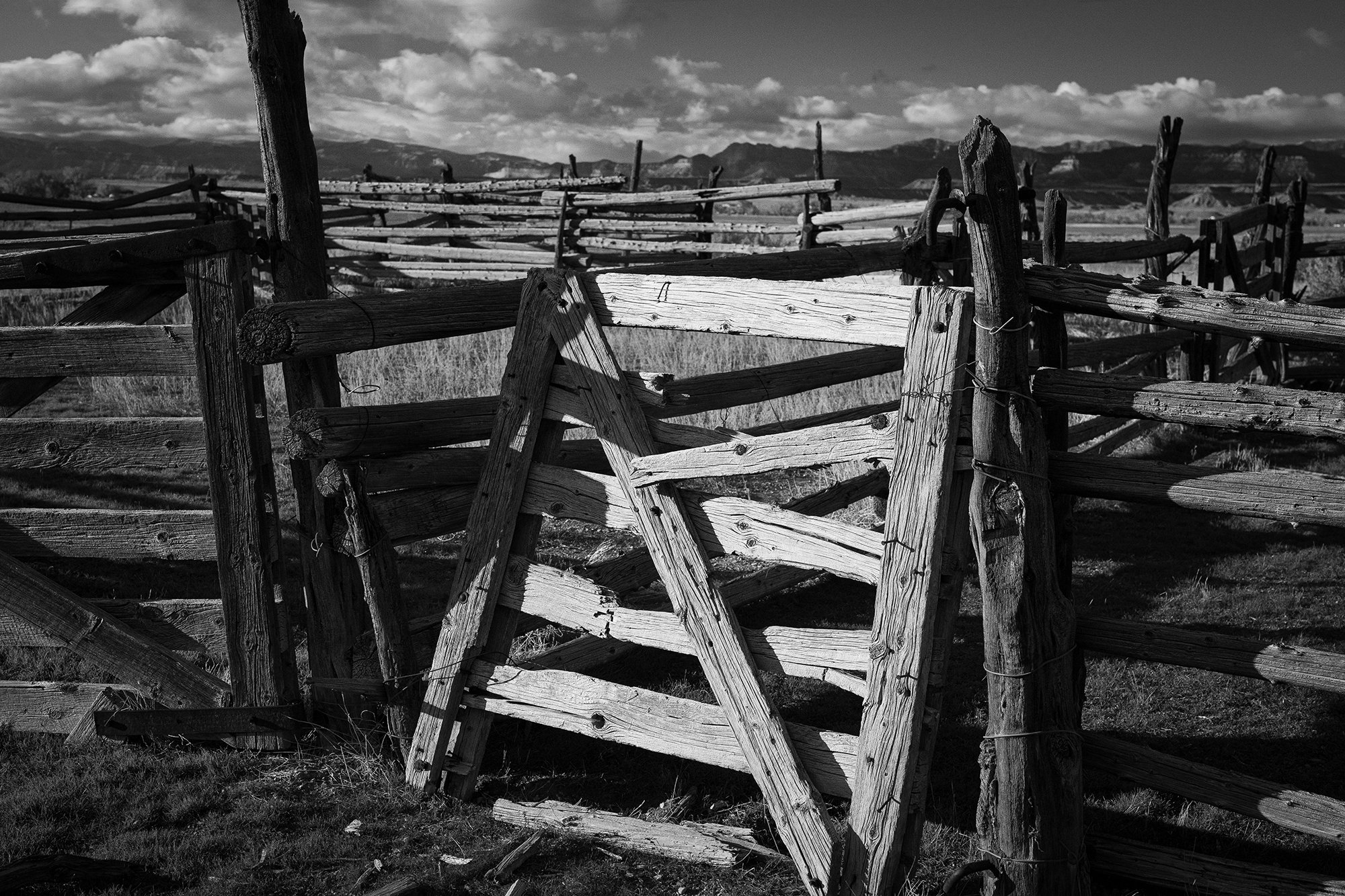
Black and white photograph of a weathered wooden cattle corral in the American West

A weathered cattle corral built from rough-cut timber and wire, photographed in black and white.

Fine Art Corral Photography Prints

A selection of these corral photographs is available as limited-edition fine art prints.

Each print is produced using archival materials and a museum-quality process, intended to reflect the tone and detail of the original photograph.

  • Printed on archival fine art paper

  • Limited editions

  • Multiple sizes available

  • Signed by the photographer

These are not mass-produced reproductions. They are part of a long-term body of work, created to last and to hold meaning over time.

A selection of corral photography prints is available to view online.

View Available Corral Photography Prints
Explore the Full Cowboy Photography Project

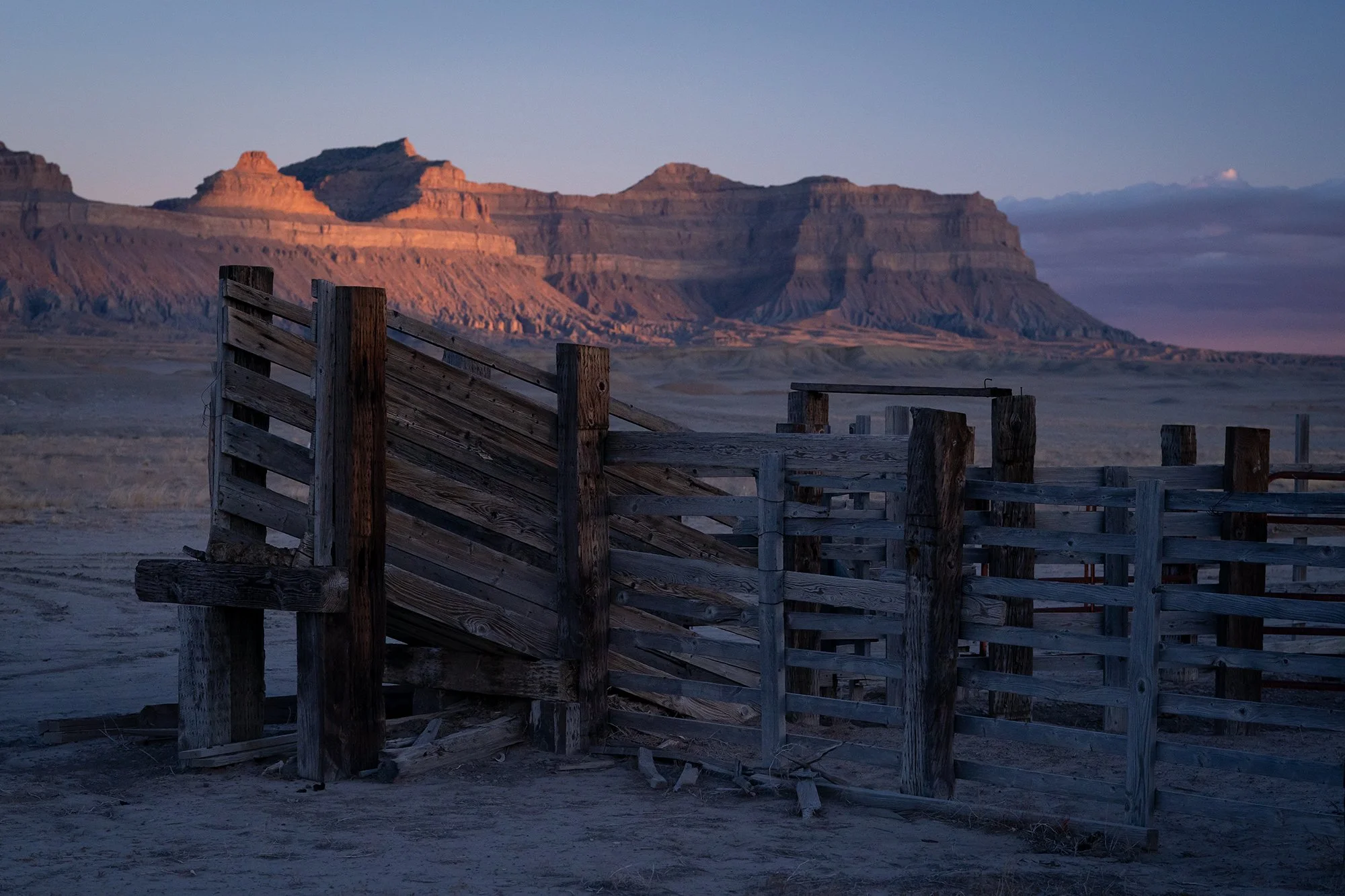
Fine art photography of a wood cattle corral at sunset in front of a beautiful desert mesa in the American West

An old cattle corral on a remote Utah ranch, set against the layered desert landscape of the American West.

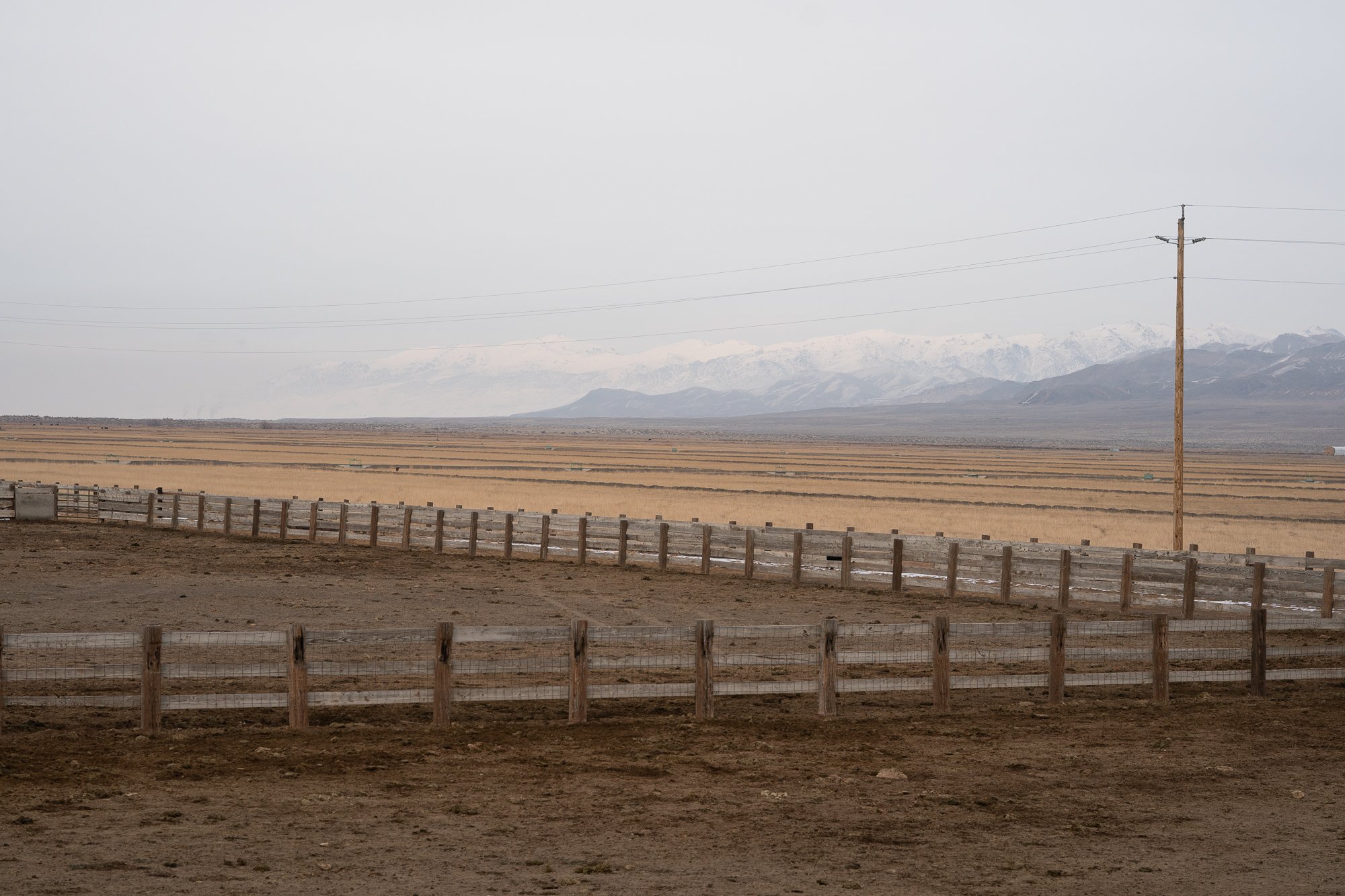
Wooden corral fencing on a working ranch with open agricultural land and distant mountains in the American West

Corral fencing stretching across a working ranch landscape, with open fields and distant mountains in the American West.

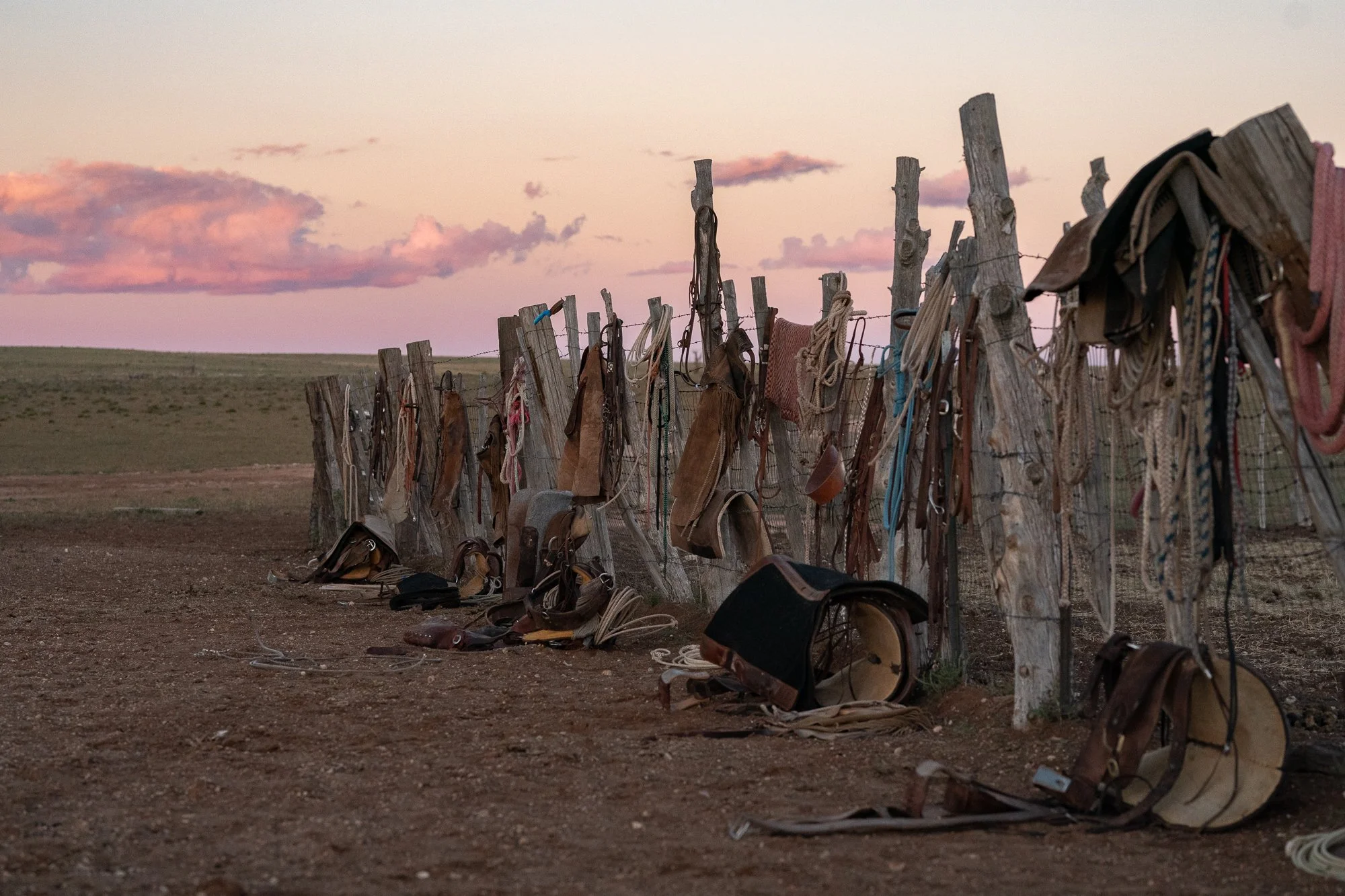
Saddles and ranch tack hanging along a corral fence at sunset on a working ranch in the American West

Saddles and working ranch tack hanging along a corral fence at sunset, part of daily life on a working Western ranch.

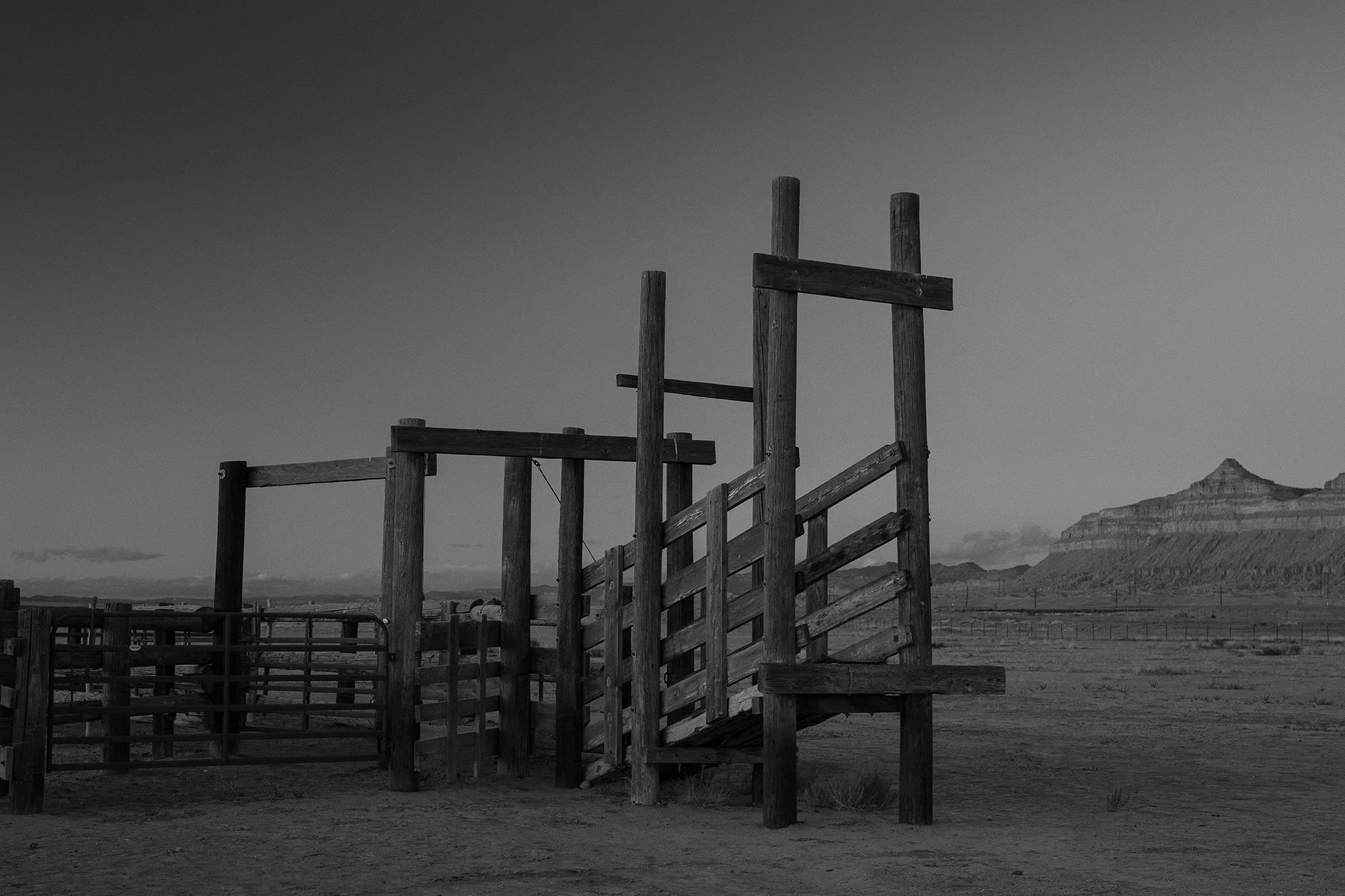
Wooden cattle loading chute and corral structure on a working ranch in the American West

A wooden cattle loading chute and corral structure used in everyday ranch work in the American West.

Basketball Photography Exhibition at the Western Spirit Museum

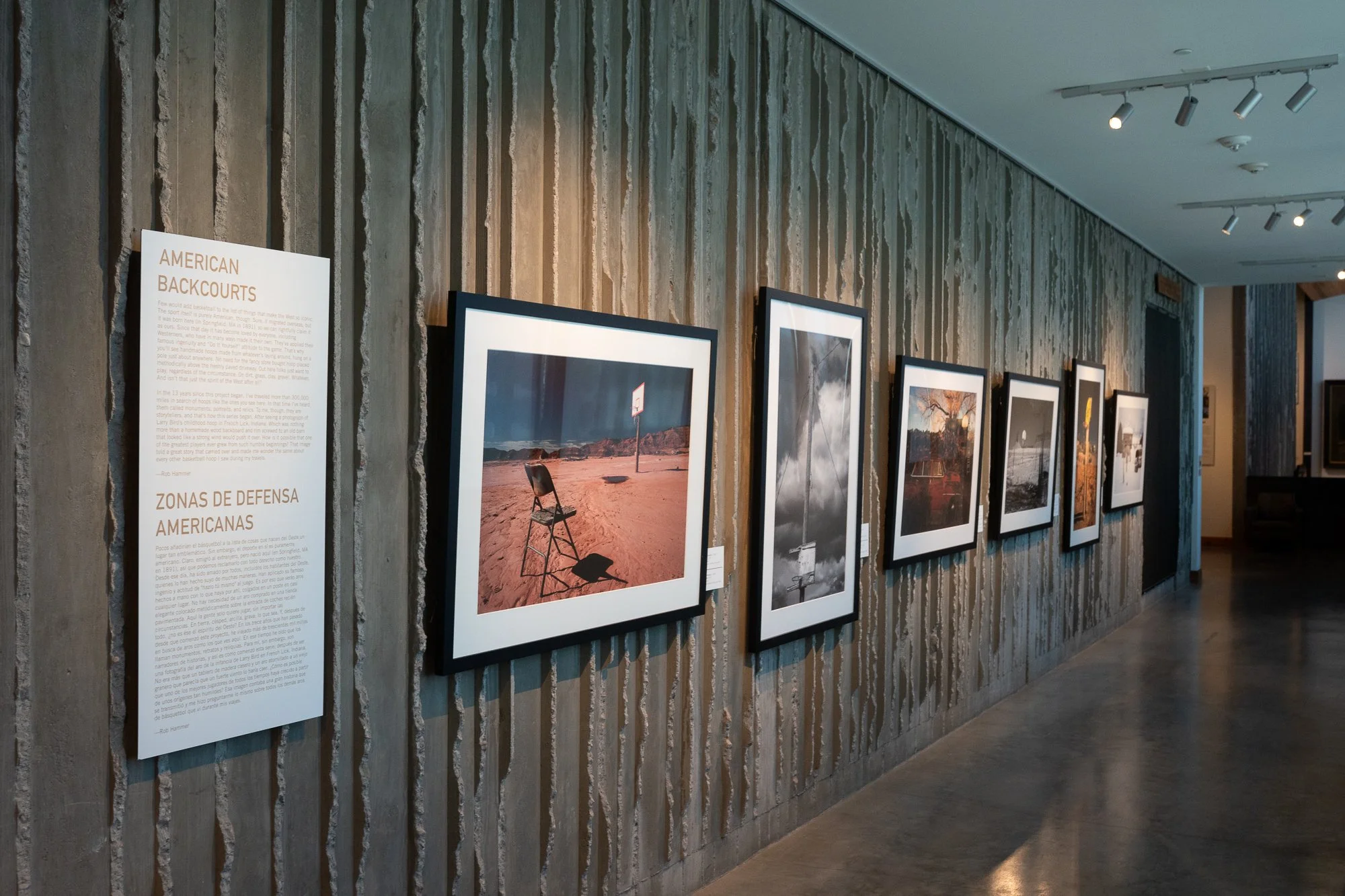
American Backcourts at Scottsdale’s Museum of the West

A Museum Exhibition from the Long-Term Basketball Hoop Photography Project

I was honored to exhibit selections from American Backcourts at Western Spirit: Scottsdale’s Museum of the West in Scottsdale, Arizona.

This exhibition meant a great deal to me, not only because it brought the project into a respected museum setting, but because it placed basketball inside a conversation where many people do not expect to find it: the American West. That tension has always been part of what interests me about this body of work. Over the past fifteen years, I’ve photographed basketball hoops in backyards, alleys, farms, deserts, small towns, and overlooked corners of the country, often in places where the game feels quietly woven into everyday life rather than presented as spectacle.

American Backcourts was on view at Western Spirit from August 26, 2024 through April 13, 2025. The show brought together photographs from across the West that reflect the resourcefulness, beauty, and persistence I’ve found again and again while working on this series. Handmade rims, weathered backboards, empty courts, and improvised places to play all become part of a bigger story about how deeply basketball belongs to American culture.
What I particularly appreciated about this exhibition was the setting. Western Spirit has built its reputation around art, history, and ideas connected to the West, so it was meaningful to see these photographs presented there. The show offered a chance to frame basketball not only as sport, but as part of the visual language of the region.
This exhibition is one chapter in the larger American Backcourts project, an ongoing body of work documenting basketball hoop photographs from across the United States.

To see more from the project, visit the main American Backcourts gallery.
For collectors, available works can be viewed on the basketball photography prints page.

American Backcourts basketball hoop photography exhibition installed at Western Spirit: Scottsdale’s Museum of the West

American Backcourts on display at Western Spirit: Scottsdale’s Museum of the West in Scottsdale, Arizona.

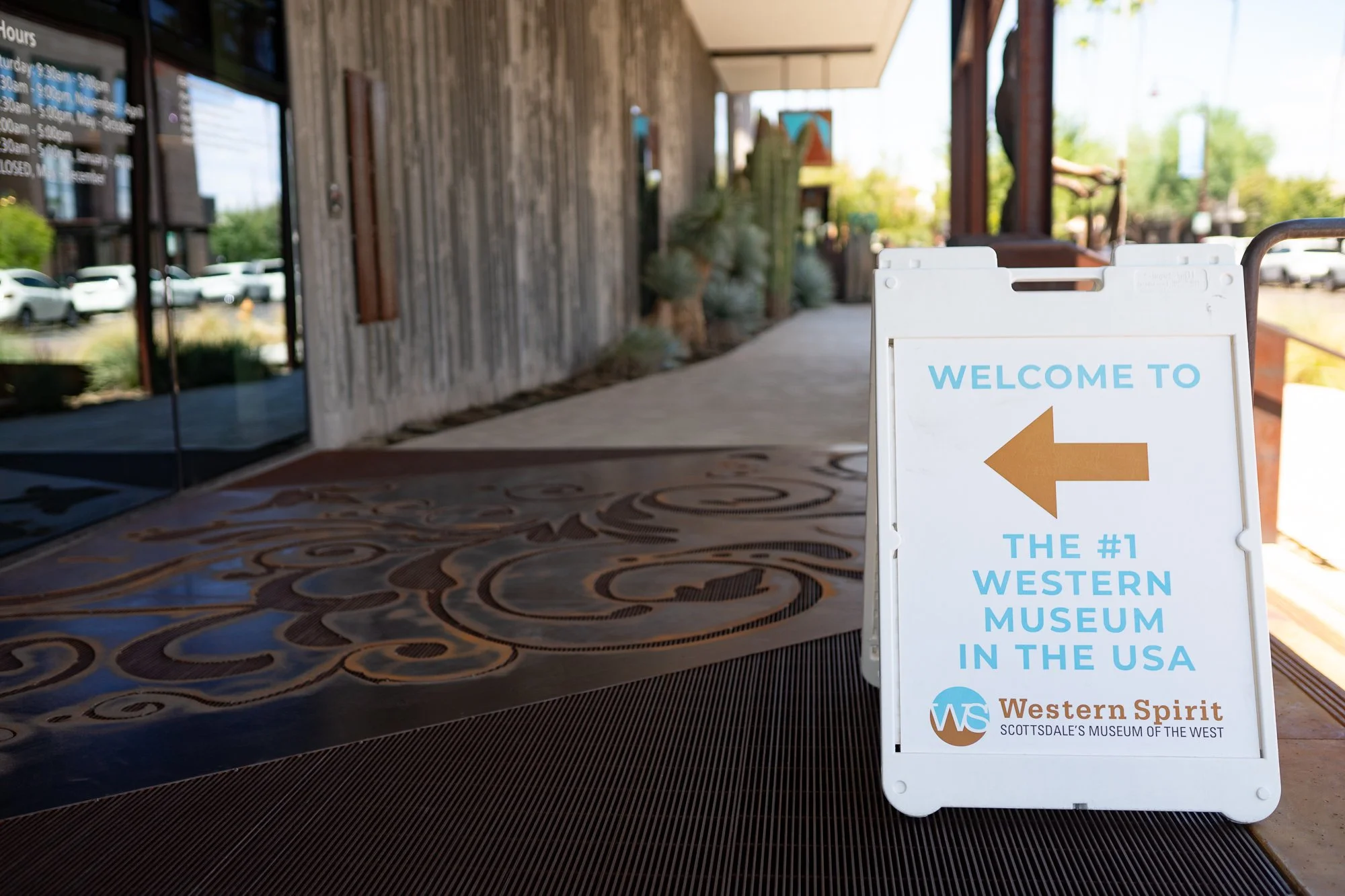
Exterior of Western Spirit: Scottsdale’s Museum of the West with “#1 Western Museum in the USA” sign

Western Spirit: Scottsdale’s Museum of the West in Scottsdale, Arizona, where the American Backcourts exhibition was presented.

A Traditional American Barbershop - A Neighborhood Fixture

An Old School Neighborhood Barbershop

I first photographed this barbershop in San Diego in 2011, early on in what would eventually become the Barbershops of America project. At the time, I didn’t fully realize how important these photographs would become. I was simply drawn to places like this — shops that felt unchanged, where time moved a little slower and the barber knew everyone who walked through the door.

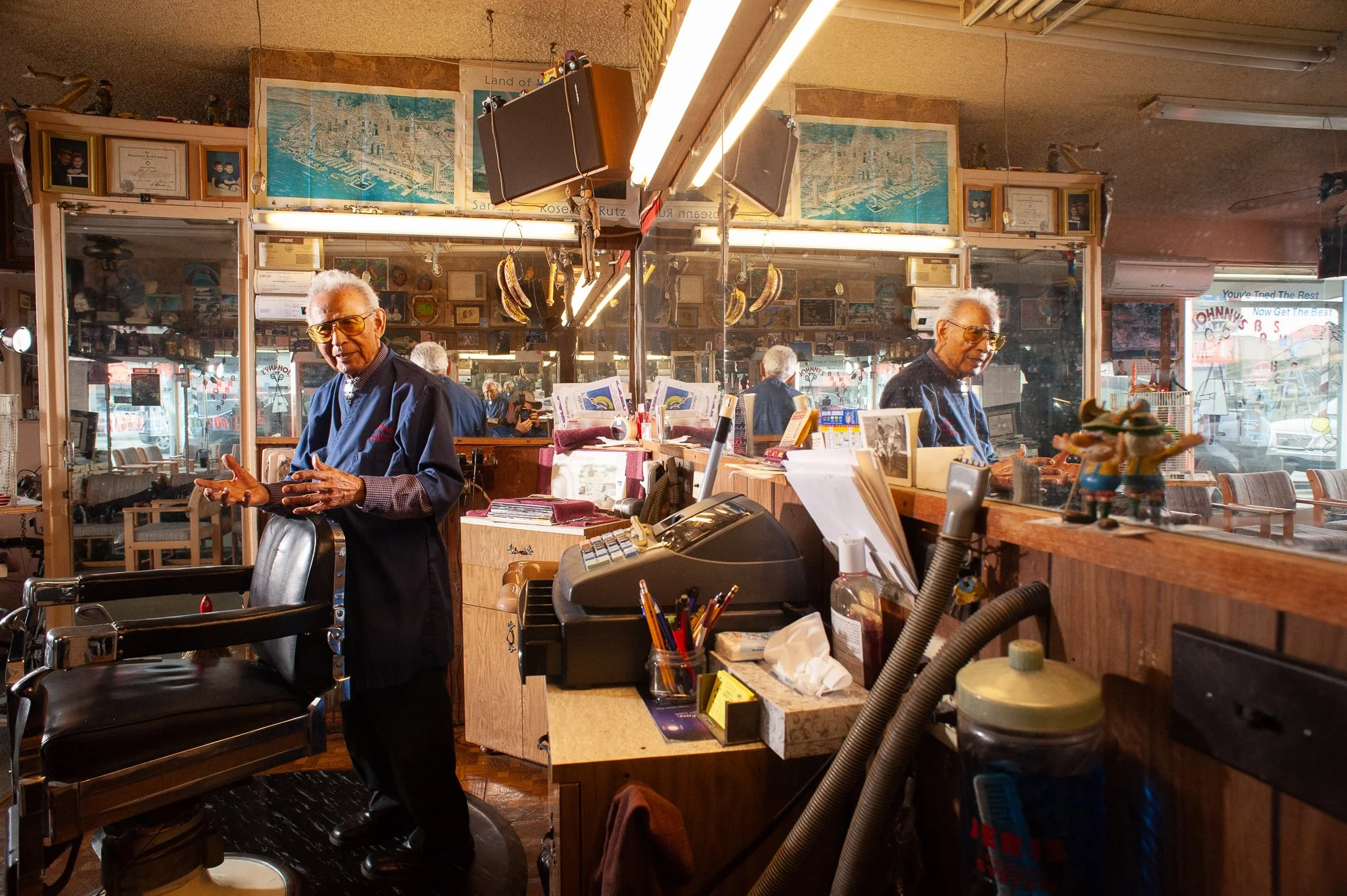
This shop, run by Johnny Lovato, was one of those places.

A Shop That Felt Lived In

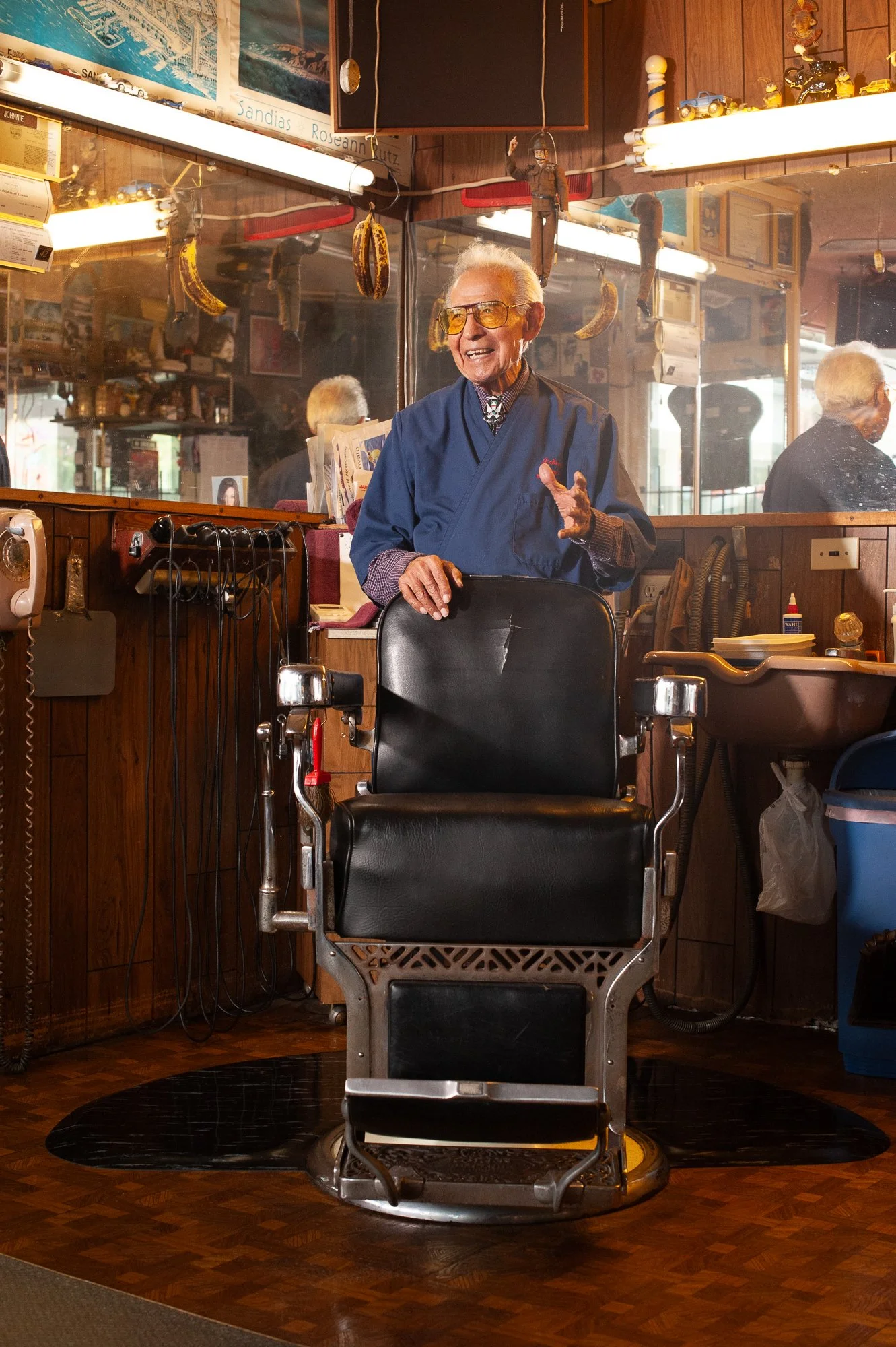
Walking into Johnny’s barbershop felt like stepping into another era. The space wasn’t curated or styled — it was simply lived in. The chairs, the mirrors, the worn floor, the little personal details scattered throughout the shop all told a story without trying to.

These weren’t decorations meant to evoke nostalgia. They were just the things that had accumulated over time. That honesty is what made the shop special and what kept the doors open to the same neighborhood of friendly customers for decades.

The Barber and the Community

Johnny was always kind and welcoming, the type of barber who made time for conversation as easily as he made time for a haircut. His shop wasn’t just a place people came to get cleaned up — it was a place where stories were shared and relationships were maintained.

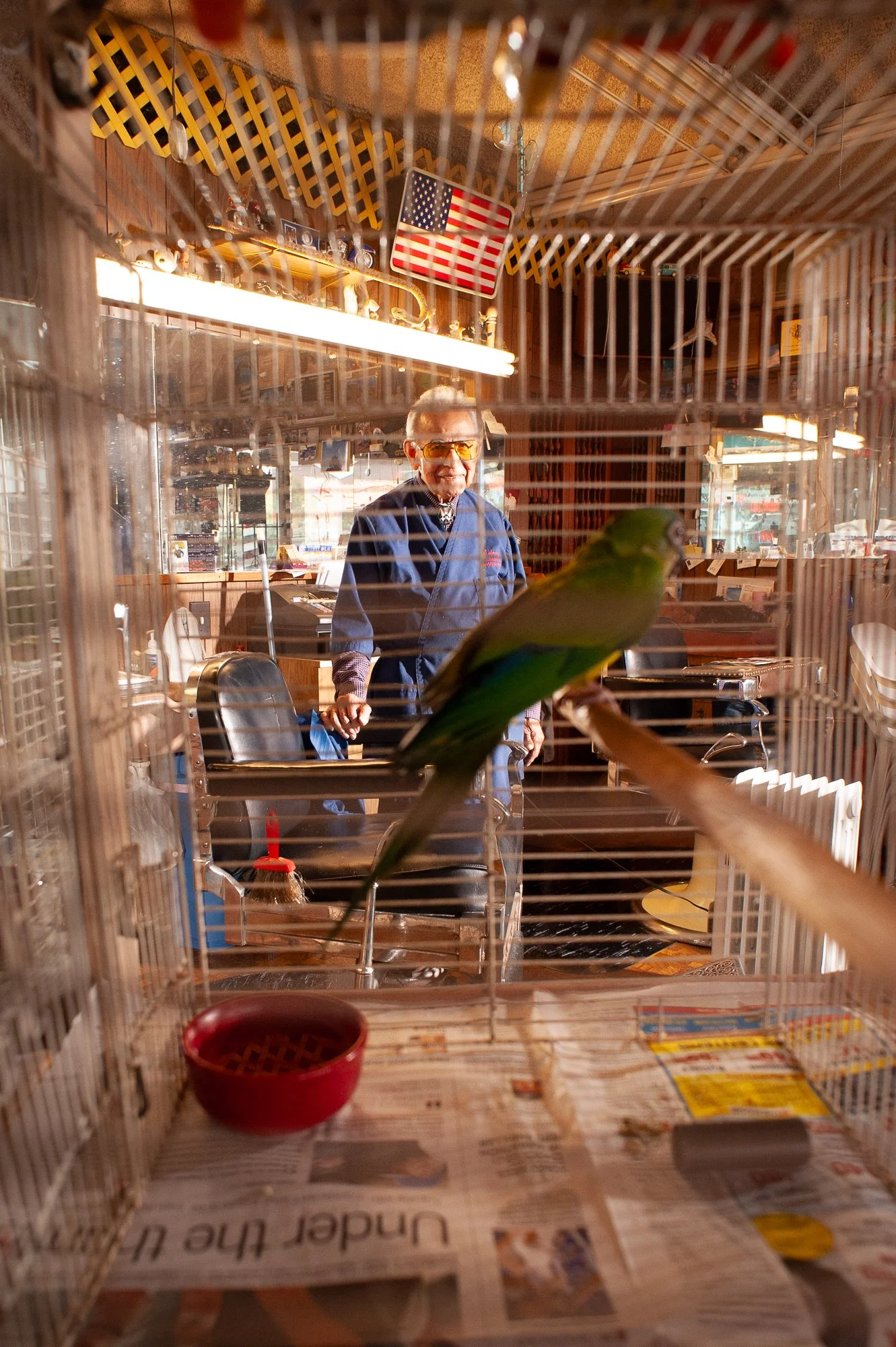
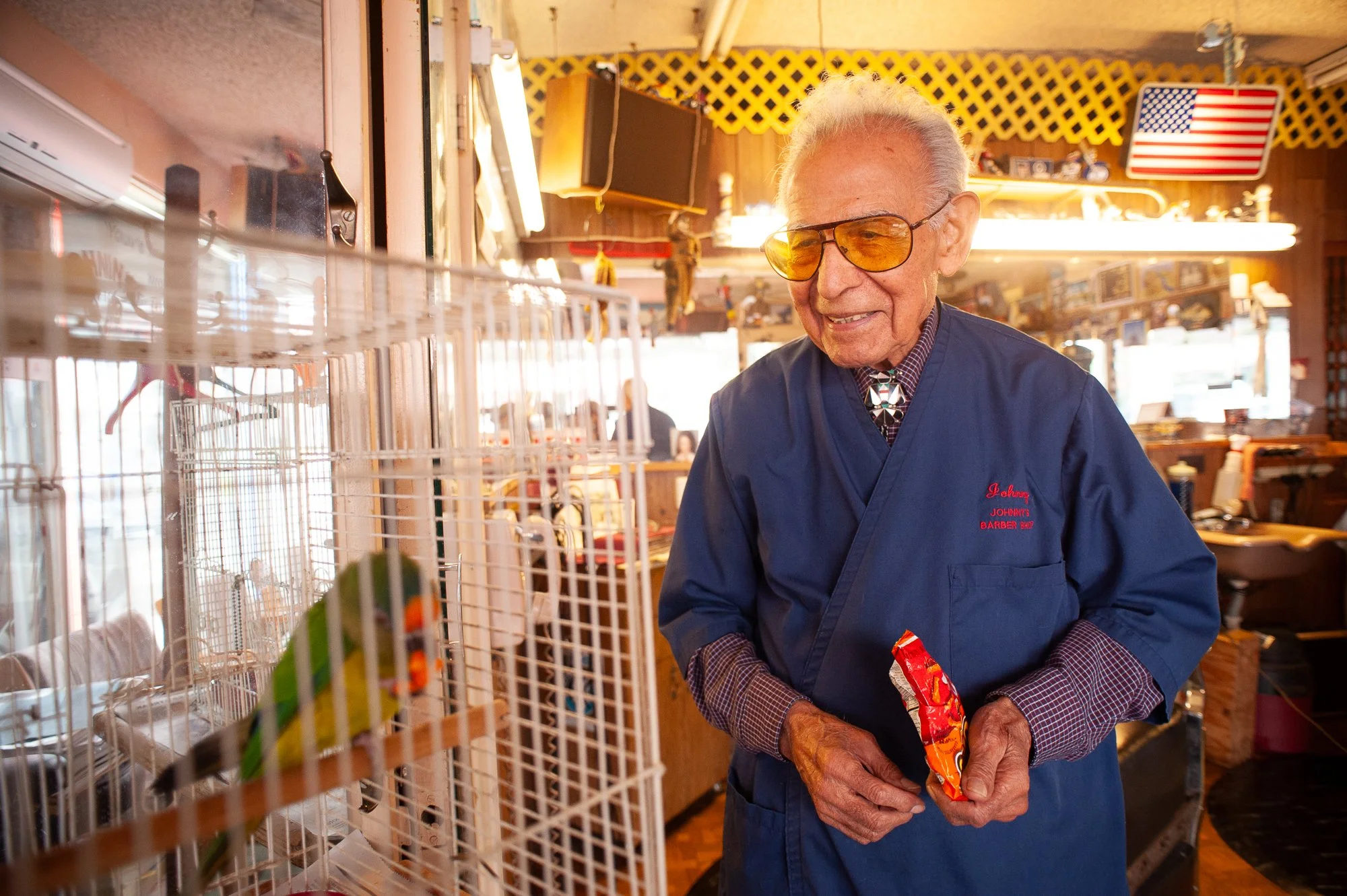
One of the small details I always remember is how happy Johnny was feeding his bird Cheetos. It’s a simple moment, but it perfectly captures the personality of the space and the rhythm of the shop. Those are the moments I’m always looking for when I photograph places like this.

Returning Years Later

I returned to photograph the shop again in 2019. By then, Johnny’s son had taken over the business. Much of the spirit of the shop remained, but time had clearly moved forward — as it always does.

Not long after, the barbershop closed, and the space was eventually transformed into something new, and in my opinion, soulless. That’s the reality for many traditional barbershops across the country. Rising rents, retirement, and redevelopment quietly erase places that once anchored their neighborhoods. Luckily another barber took over the space, so it remains a barbershop, just without the decades of character and memories that once filled it.

Why These Photographs Matter

Barbershops like this rarely close with ceremony. They disappear quietly, often without anyone realizing that a piece of local culture has gone with them.

This series exists so that those places aren’t completely lost. These photographs are not about nostalgia for nostalgia’s sake — they’re about acknowledging the importance of everyday spaces that shaped communities for generations.

Part of a Larger Archive

Johnny Lovato’s barbershop in San Diego is just one small part of a much larger body of work documenting traditional barbershops across the United States. Together, these images form an archive of a disappearing American tradition — one shop, one barber, one story at a time.

More Barbershops of America

View The Book

View The Gallery

Old-school American barbershop interior, Point Loma San Diego documentary photograph

Interior of a traditional barbershop in Point Loma, San Diego, where time-worn chairs and details reflect decades of community history.

Johnny Lovato feeding his pet bird inside his barbershop in San Diego, California

Johnny Lovato, the barber, shares a moment feeding the shop’s pet bird — a small gesture emblematic of daily life in the space.

An old school barber smiles while watching his pet bird

Johnny Lovato smiles after feeding his pet bird at his barbershop in San Diego

Portrait of a barber standing behind his chair in a traditional San Diego barbershop

Portrait of a barber standing behind his chair — a quiet testament to the people who made these shops more than just businesses.

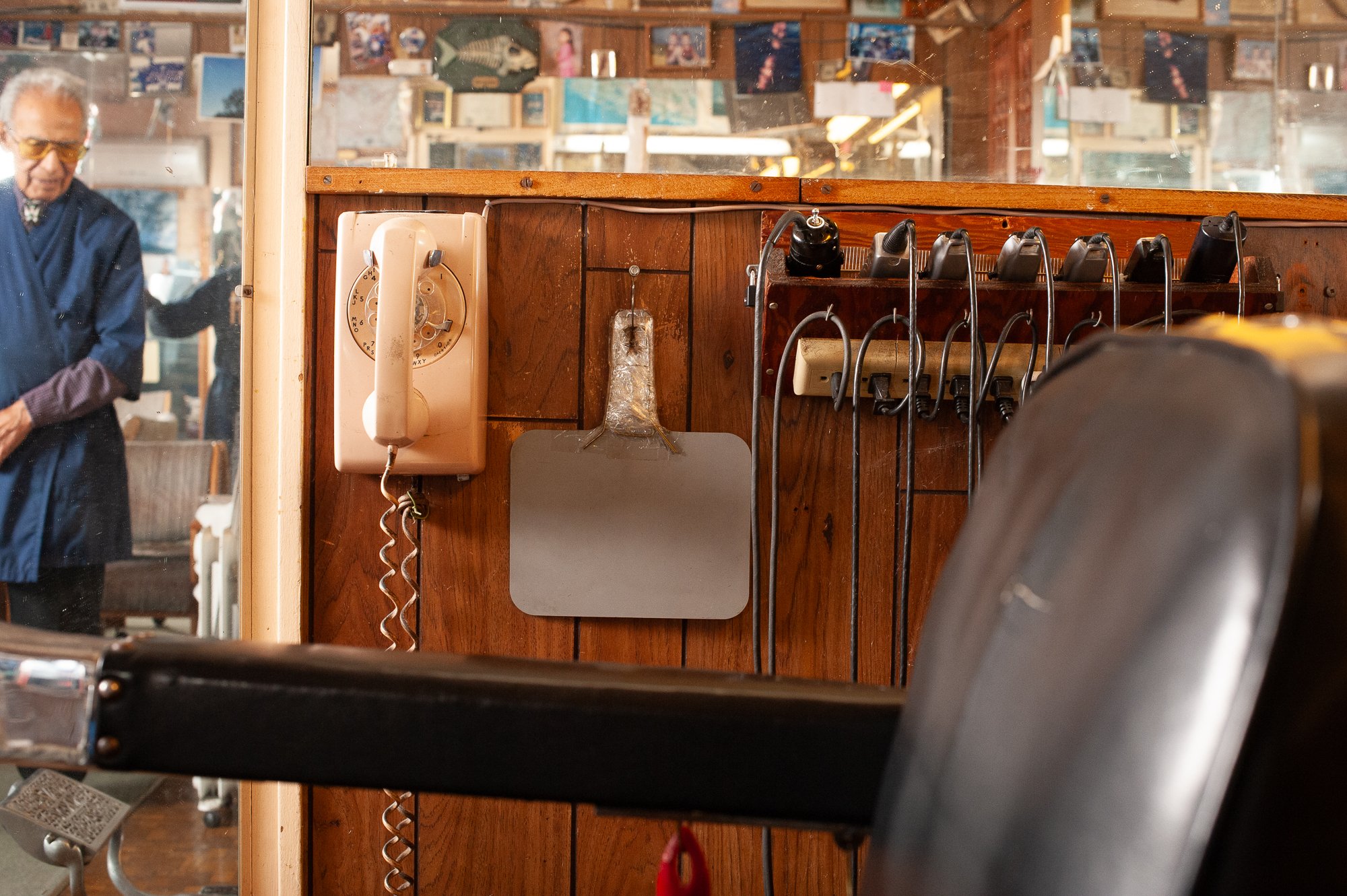
Rotary telephone inside a traditional barbershop, documentary detail photo

An old rotary telephone inside the shop — one of the many small artifacts that speak to the barbershop’s lived-in past

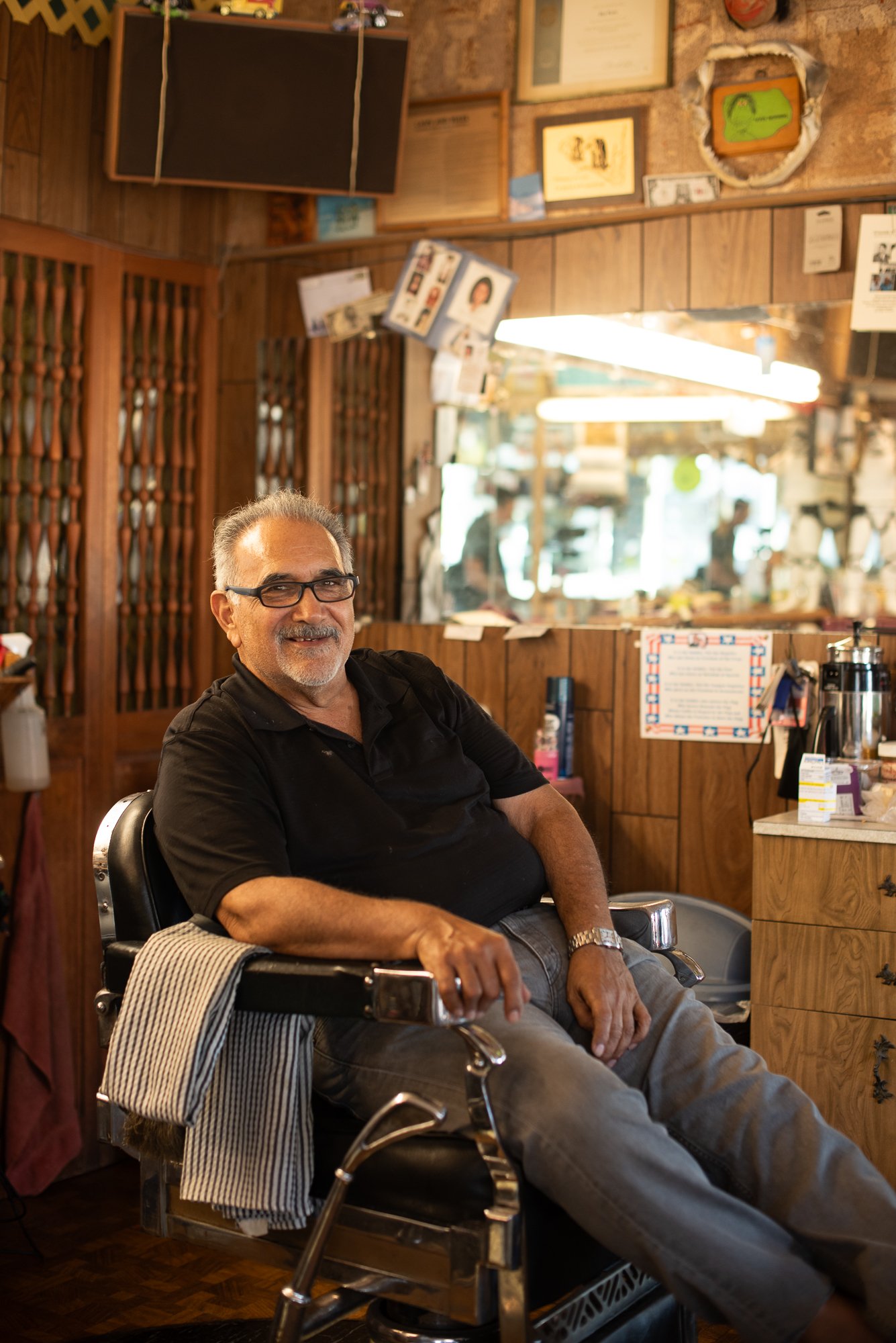
Barber sitting in his chair at a traditional barbershop in San Diego, California

A barber sits in his chair during a quiet moment — a human pause captured in the rhythm of the shop.

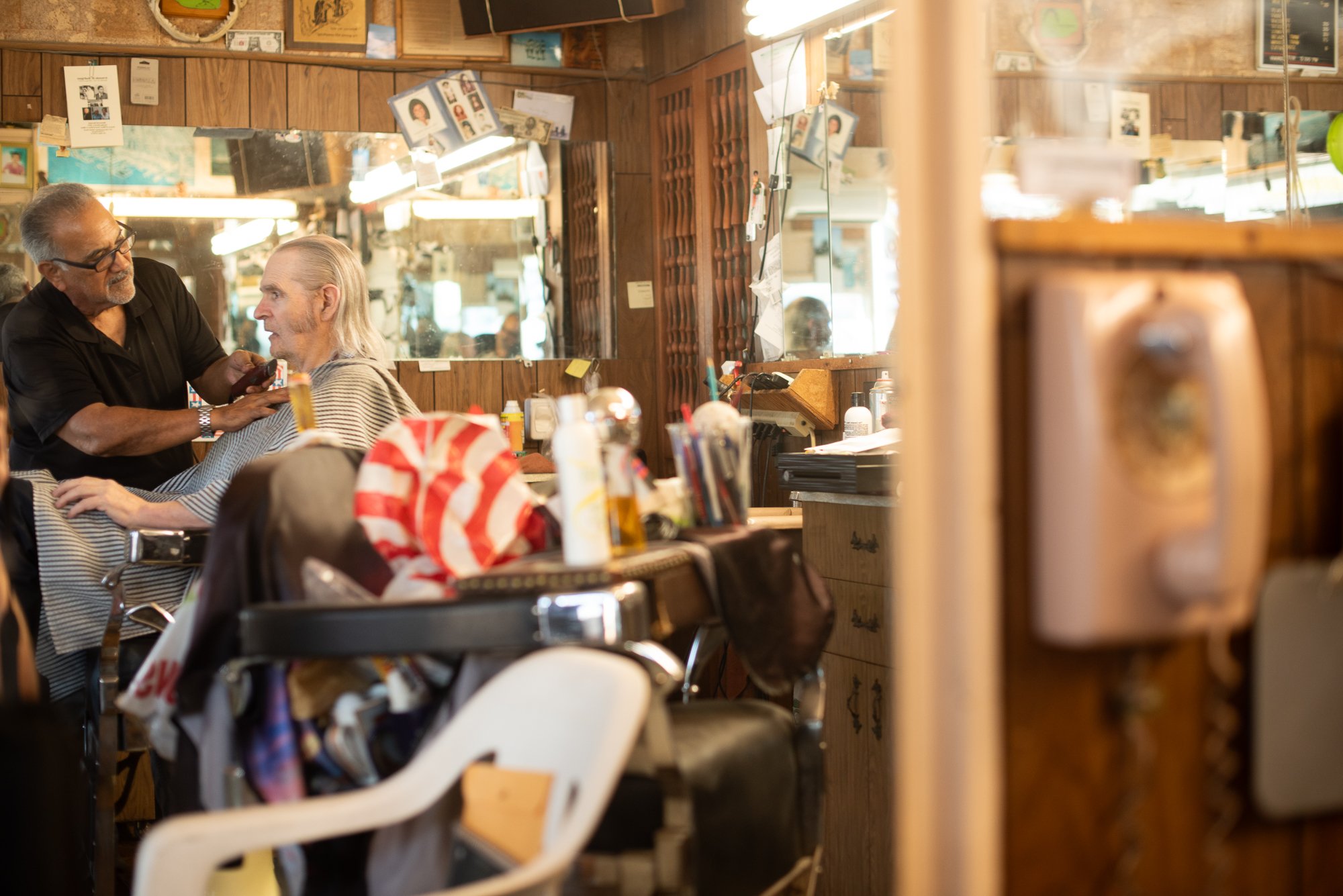
Customer getting a haircut in a traditional barbershop in San Diego, California documentary image

A customer receives a haircut — a simple everyday moment that also anchors the narrative of barbershop culture.

Paris Street Photography

Paris Street Photographs — An Intimate Visual Journey

Paris in Candid Street Photographs

Paris moves quickly, but its most revealing moments happen quietly.

Away from the monuments and postcards, the city reveals itself in passing glances, small gestures, and the subtle choreography of people moving through shared space. These Paris street photographs were made while walking without an agenda — observing light, waiting for alignment, and responding instinctively when form, expression, and atmosphere briefly came together.

Rather than chasing iconic scenes, this body of work focuses on the in-between moments that define everyday Paris: café conversations, solitary figures crossing wide intersections, brief pauses along the Seine, and the unspoken language of posture and movement.

These photographs are not souvenirs. They are visual records of time and place, created to live on the wall as fine art prints.

What You’ll See in This Paris Street Photography Series

This ongoing collection reflects a broad, honest view of the city as it is lived:

  • Quiet exchanges at cafés and sidewalk tables

  • Figures moving alone through architectural space

  • Subtle interactions between strangers

  • Parisian streets shaped as much by people as by buildings

  • Moments of stillness within constant motion

Each image exists as both a documentary moment and a compositional study — balancing structure with spontaneity.

The Process Behind the Photographs

These images were made through patience rather than pursuit.

Street photography, at its core, is about observation — learning how light moves through a space, understanding how people occupy it, and waiting for those elements to align naturally. Many of these photographs came from standing in one place, or simply letting scenes unfold rather than forcing them.

The goal is not spectacle, but authenticity. Nothing staged. Nothing repeated. Each frame represents a singular moment that will never occur again in quite the same way.

Fine Art Prints of Paris Street Photography

All photographs in this series are available as museum-quality fine art prints, produced with longevity and tonal depth in mind.

  • Printed on archival, gallery-grade paper

  • Professional pigment inks for rich blacks and subtle midtones

  • Available in multiple sizes, including large-scale statement prints

  • Select images available as signed, limited editions

These prints are designed for collectors, interior spaces, and anyone who values photography as a lasting object rather than a disposable image.

Custom sizing, framing guidance, and edition details are available upon request.

Collecting Paris, One Moment at a Time

Street photography preserves what would otherwise disappear — a look exchanged, a pause mid-step, a moment of reflection before the city moves on.

If you’re drawn to Paris not as a destination, but as a living, breathing place shaped by human presence, these photographs offer a quieter way to bring the city into your space.

Explore the images below to view available fine art prints, or contact me directly to discuss editions, sizing, and framing options.

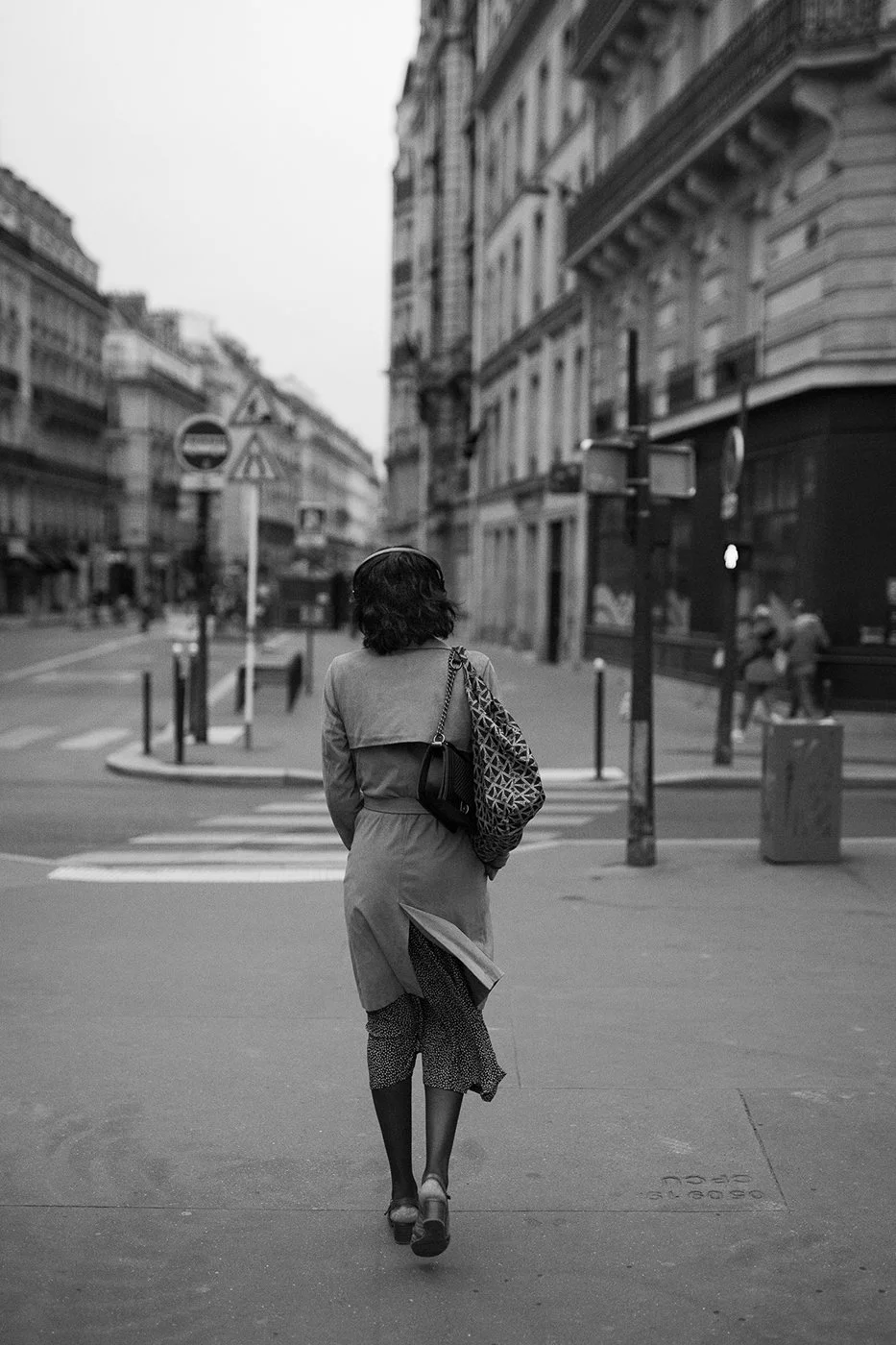
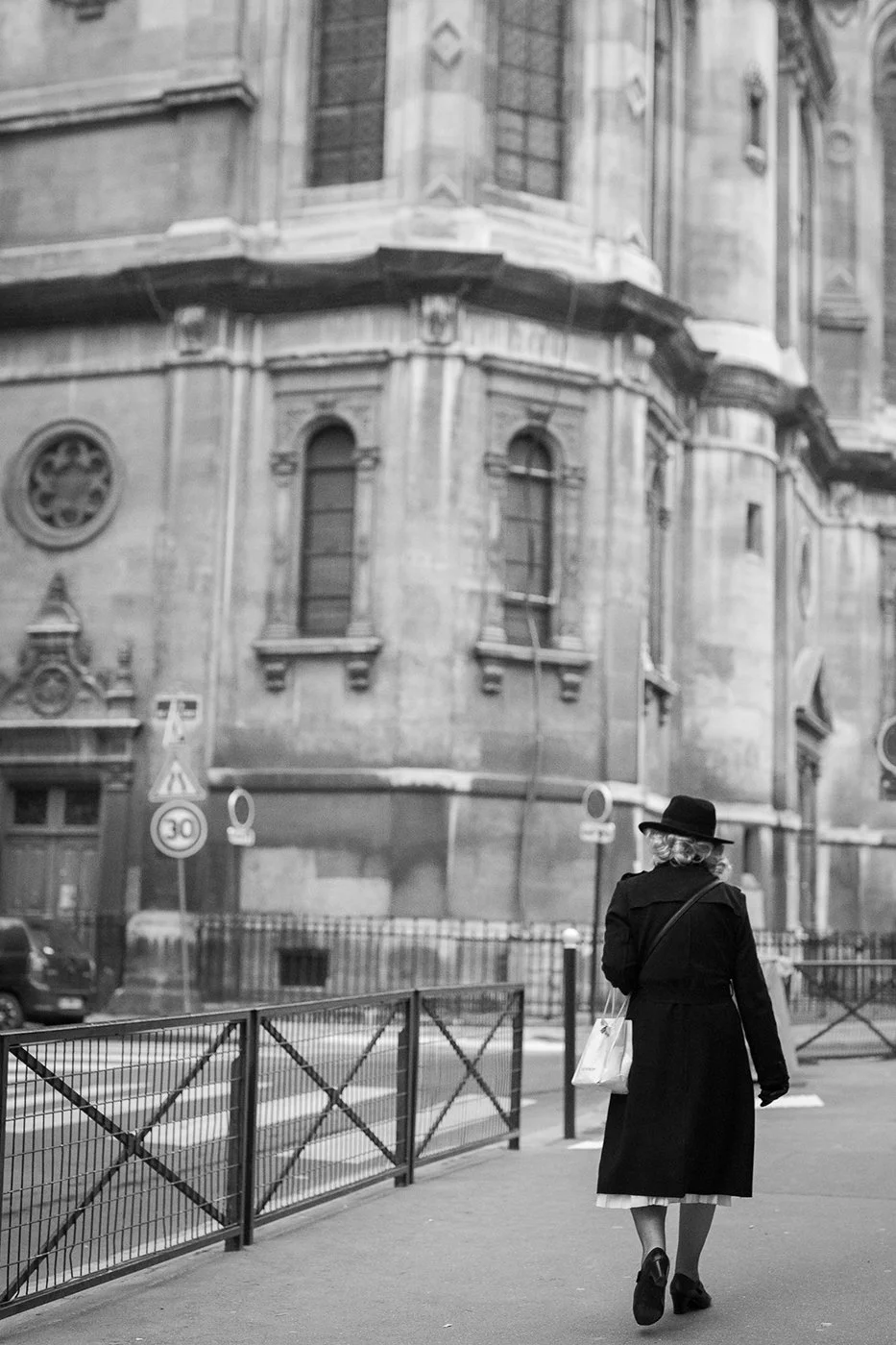
Black and white photograph of a fashionable woman walking alone through a Paris intersection

A solitary figure moves through Paris, framed by architecture and empty space.

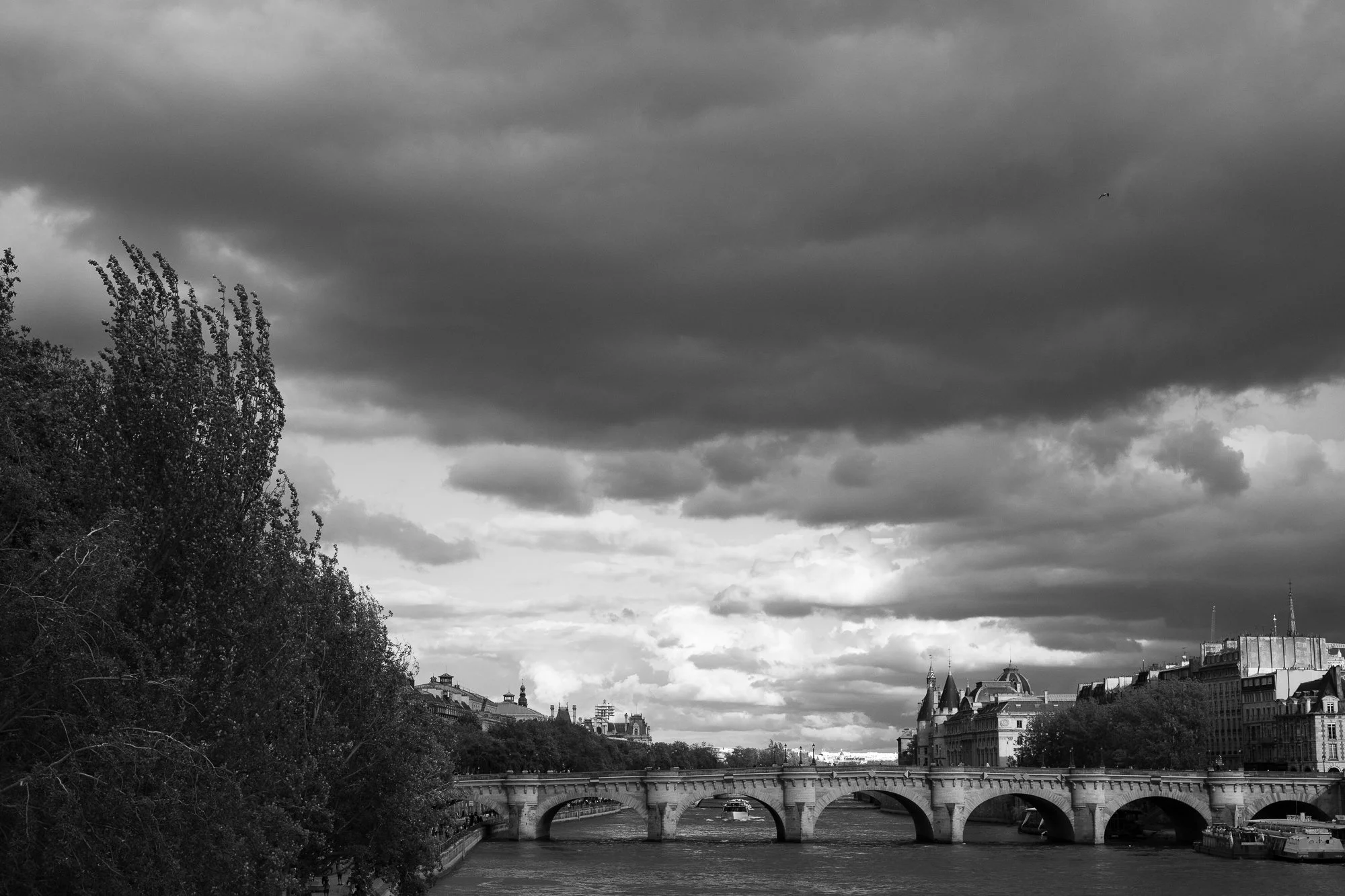
Black and white photograph of a bridge over the Seine beneath dramatic clouds

A quiet moment along the Seine as dark clouds gather over Paris.

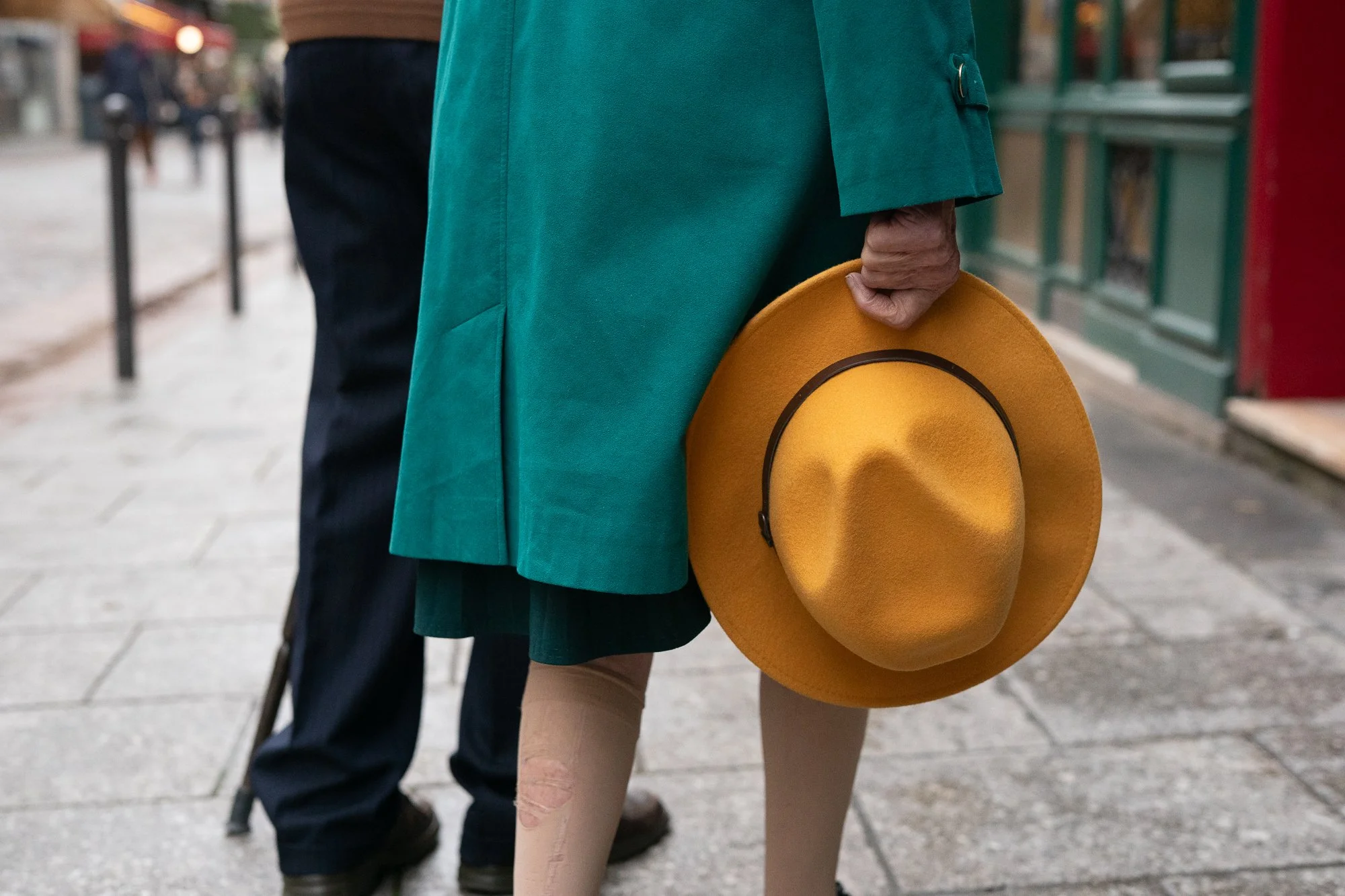
Woman in a green coat holding a mustard yellow hat on a Paris sidewalk

A fleeting Paris moment—color, posture, and gesture captured without interruption.

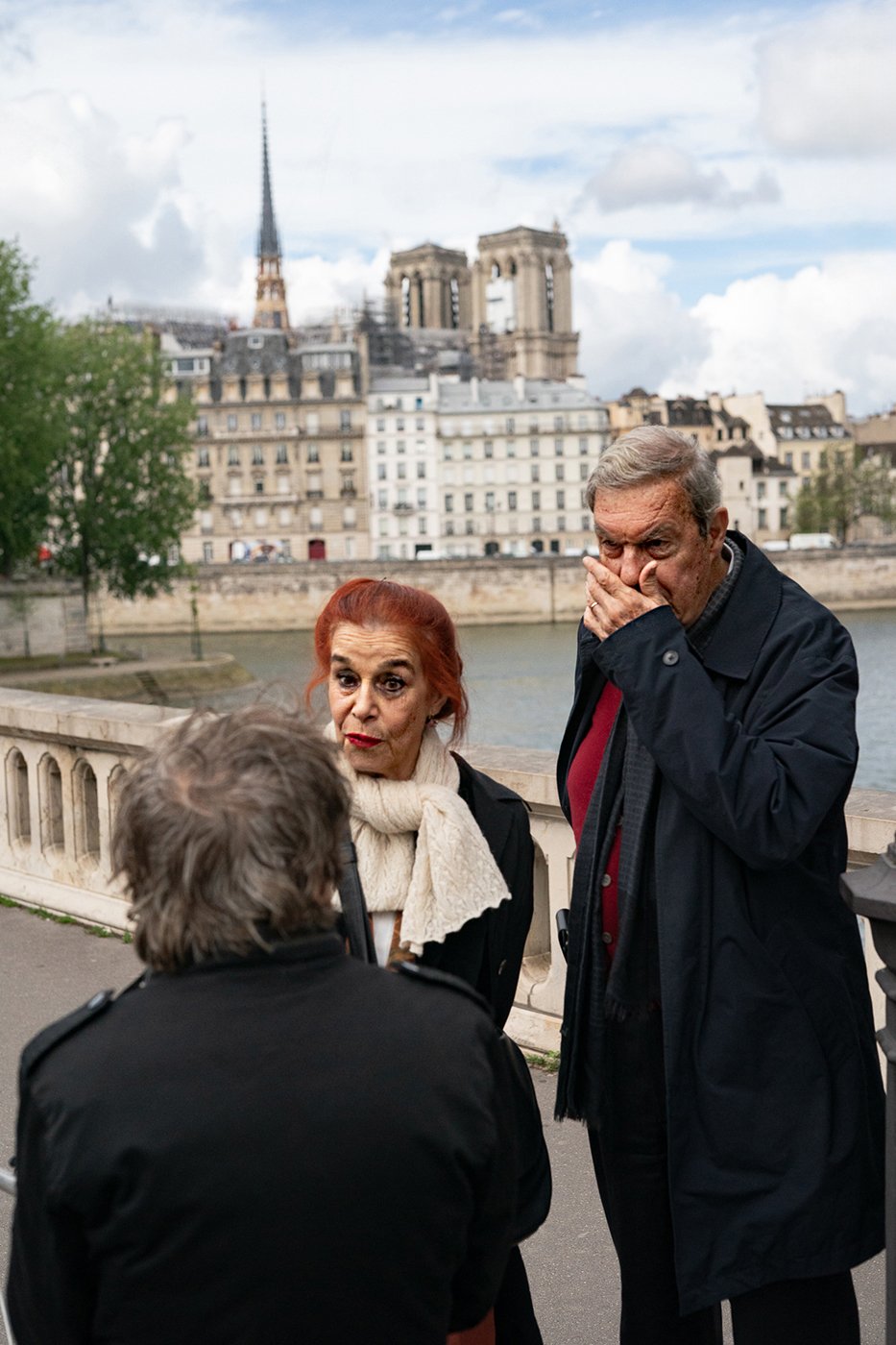
Candid street portrait of people talking along the Seine in Paris

An unguarded exchange along the Seine, framed by the city’s familiar architecture.

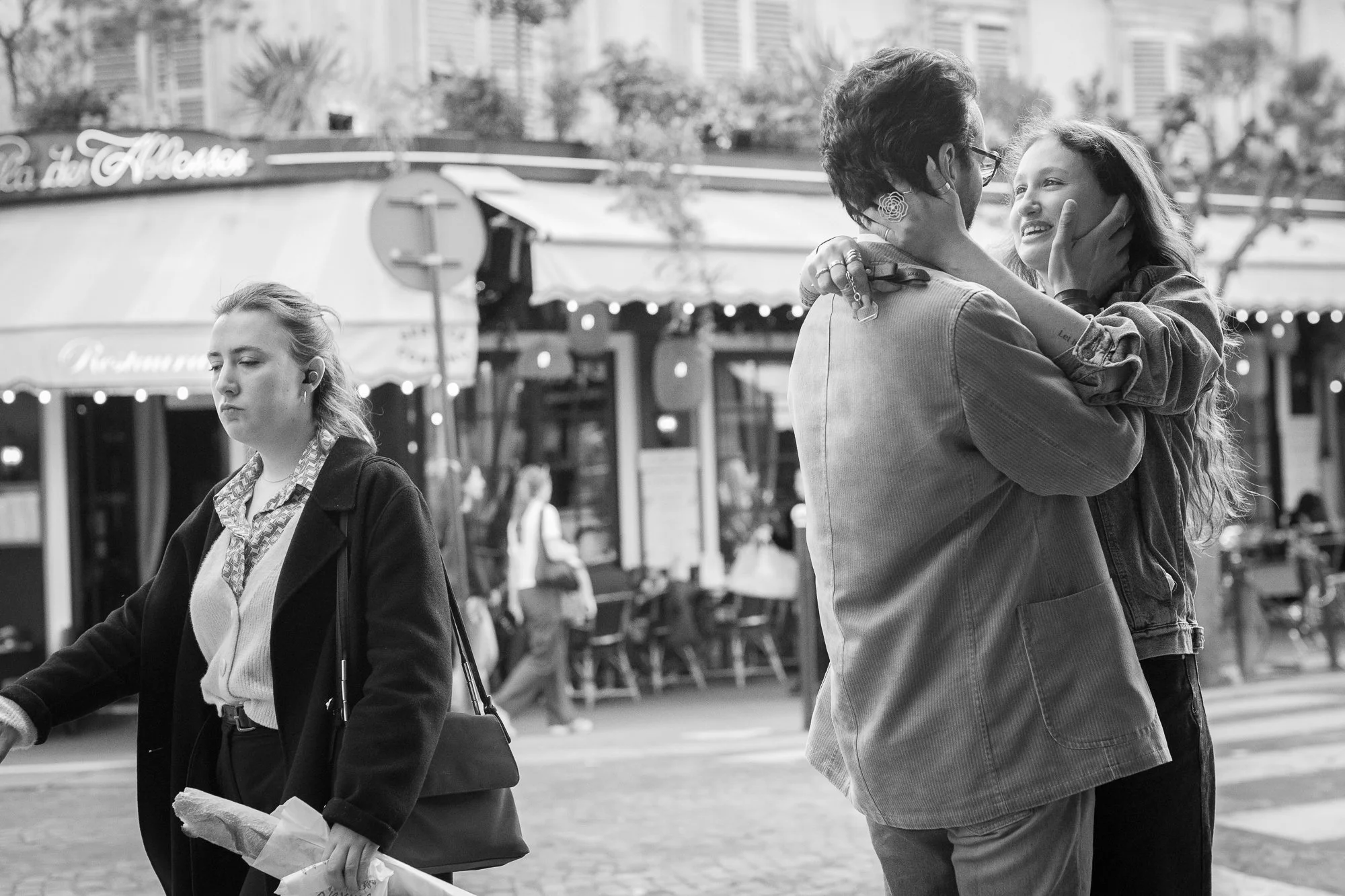
Black and white photograph of a tender moment between two people on a Paris street

Photograph of a couple embracing on the street in Paris, France

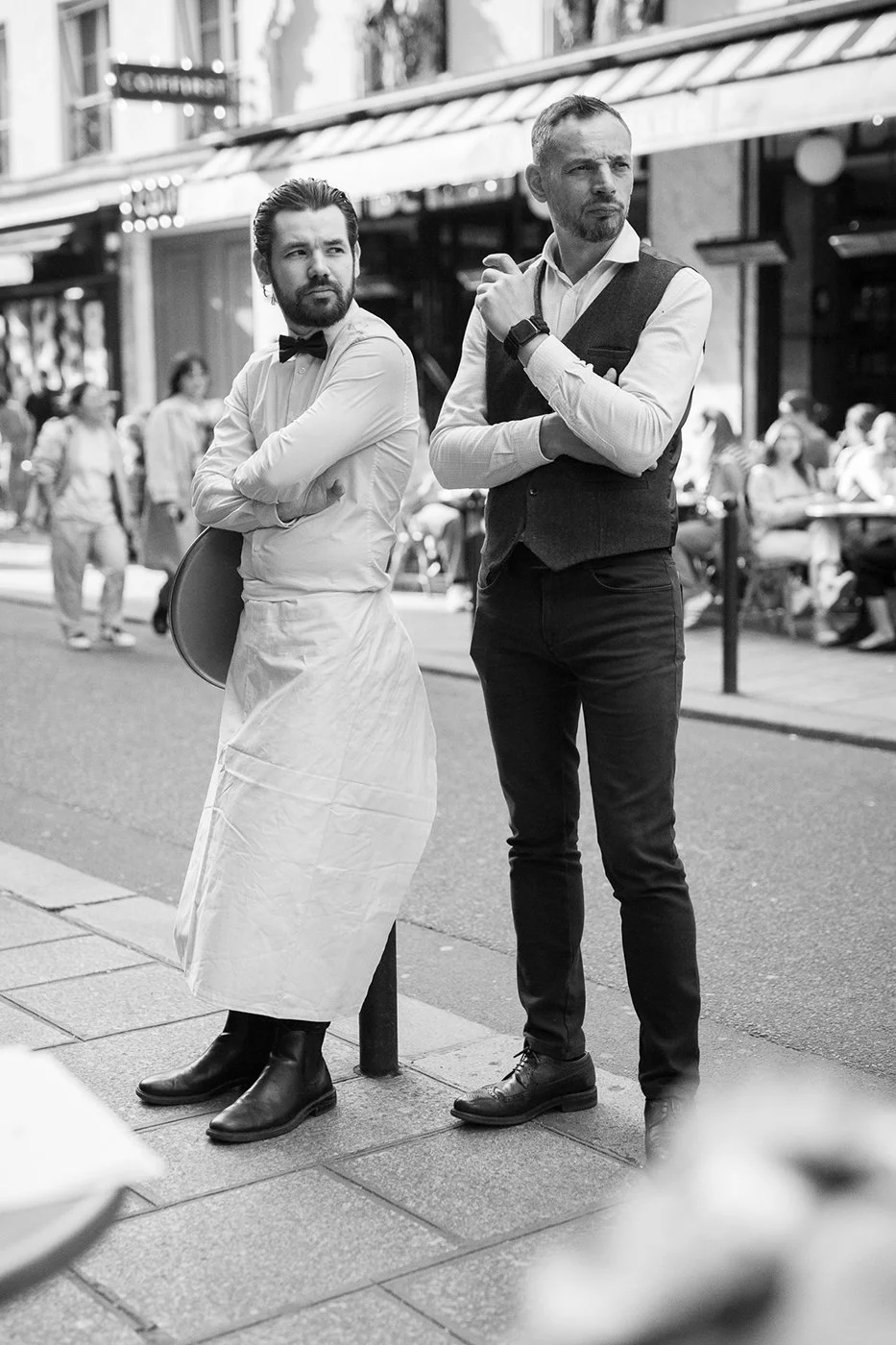
Black and white photograph of café workers standing on a Paris street

Café workers pause between moments, grounded in posture and presence.

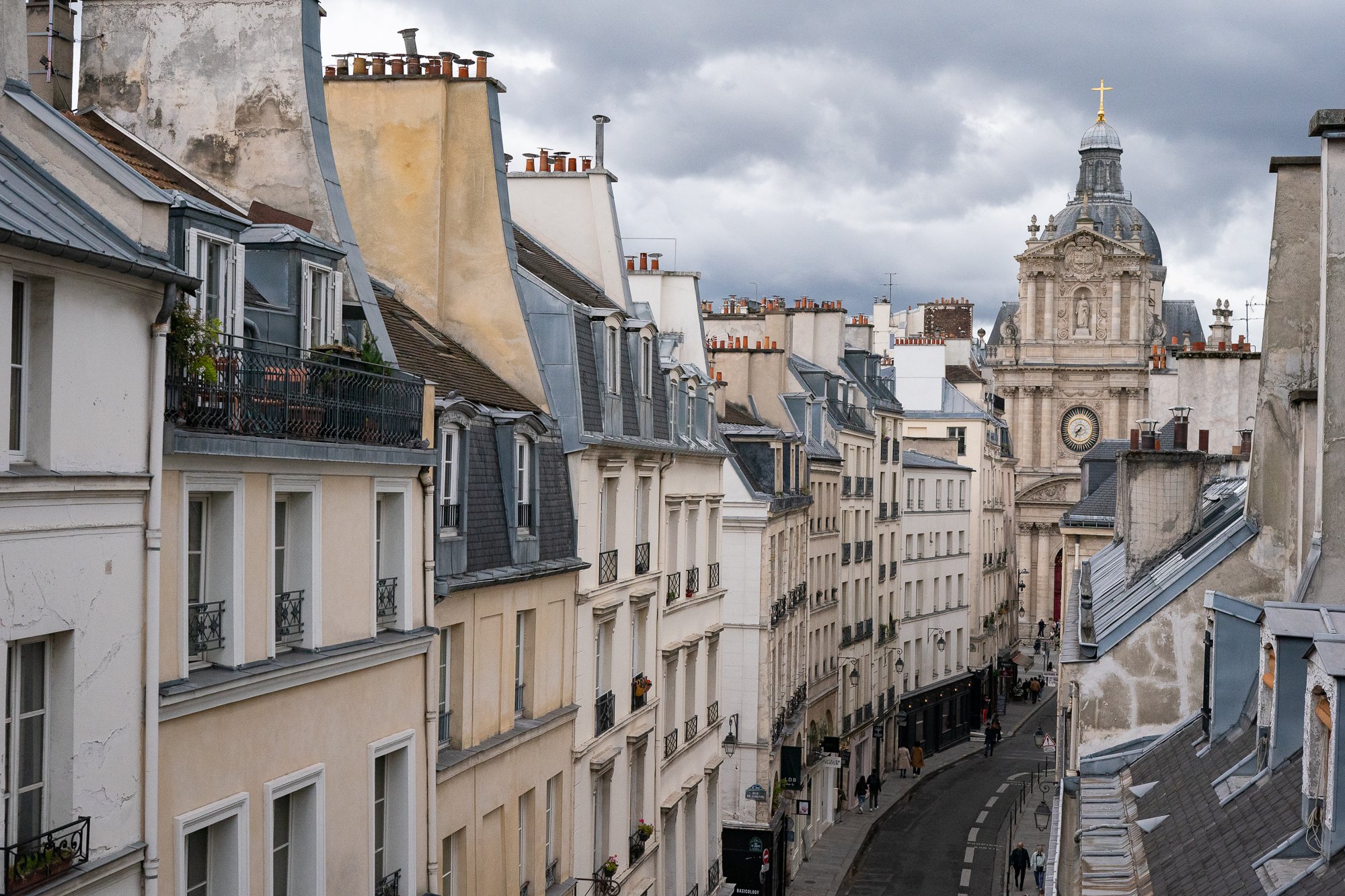
Paris rooftops leading toward Saint-Étienne-du-Mont under a cloudy sky

Paris rooftops unfold toward Saint-Étienne-du-Mont, capturing the layered geometry and muted tones of the city.

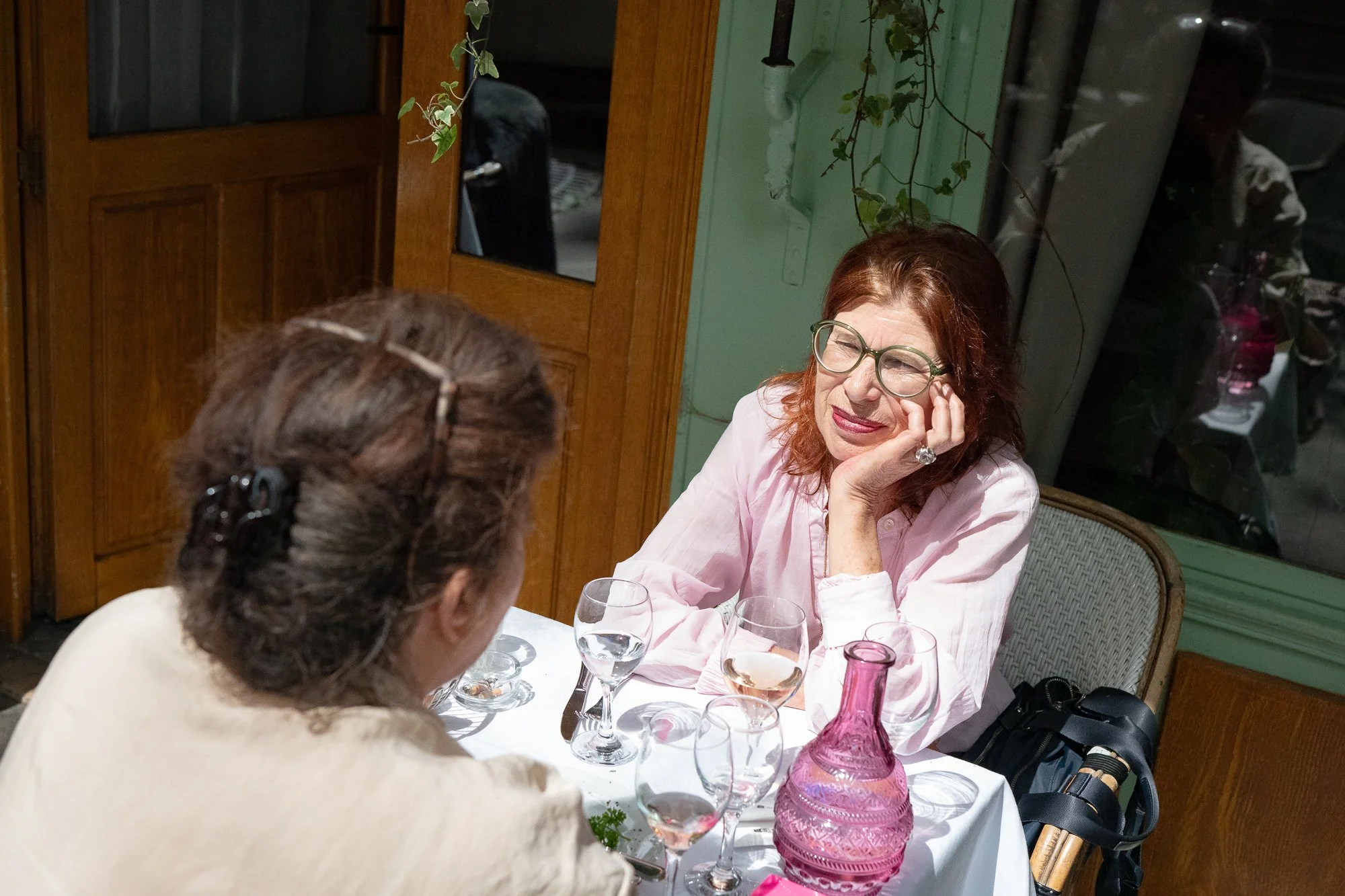
Two women seated at a café table in Paris, engaged in quiet conversation

Photograph of two women drinking at a cafe in Paris, France

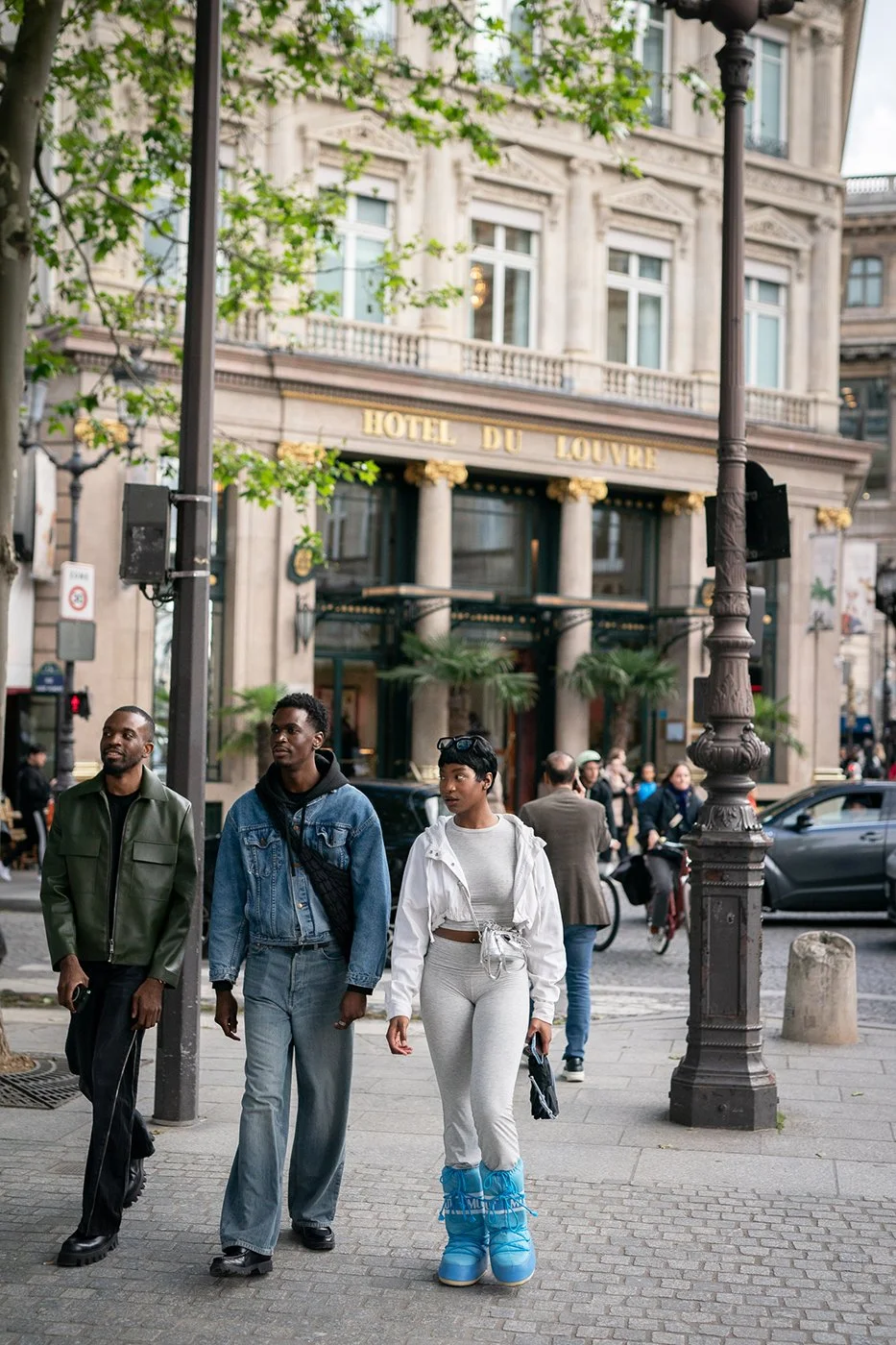
People in fashionable clothing walking near Hôtel du Louvre on a Paris street

Pedestrians move through central Paris, where historic architecture meets modern pace and fashion

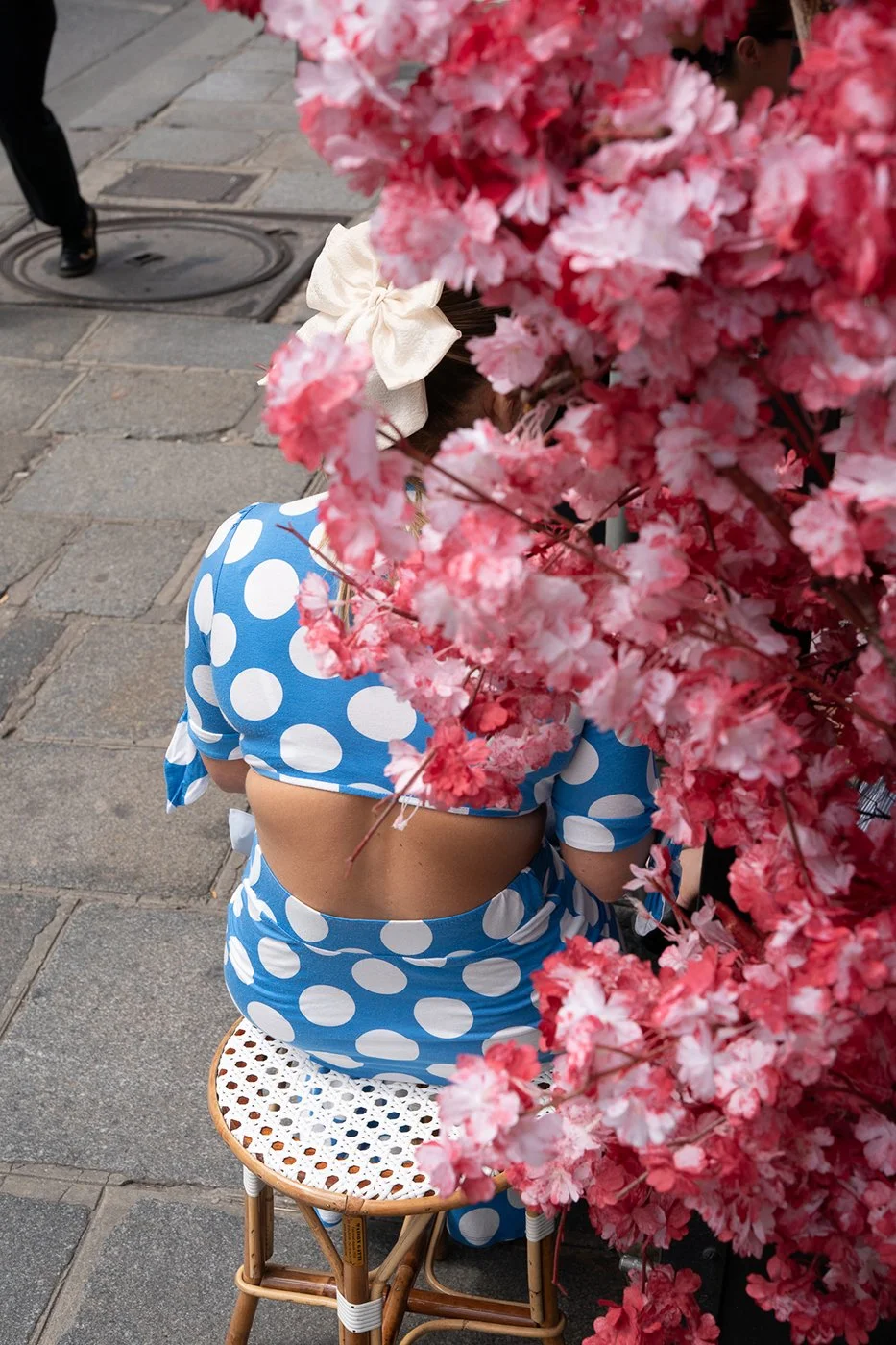
Woman in a polka dot dress partially obscured by pink flowers in Paris

Color and form intersect as a passerby blends into the visual rhythm of the street.

Black and white photograph of a woman walking past historic Paris architecture

Photograph of a well dressed woman walking in Paris, France

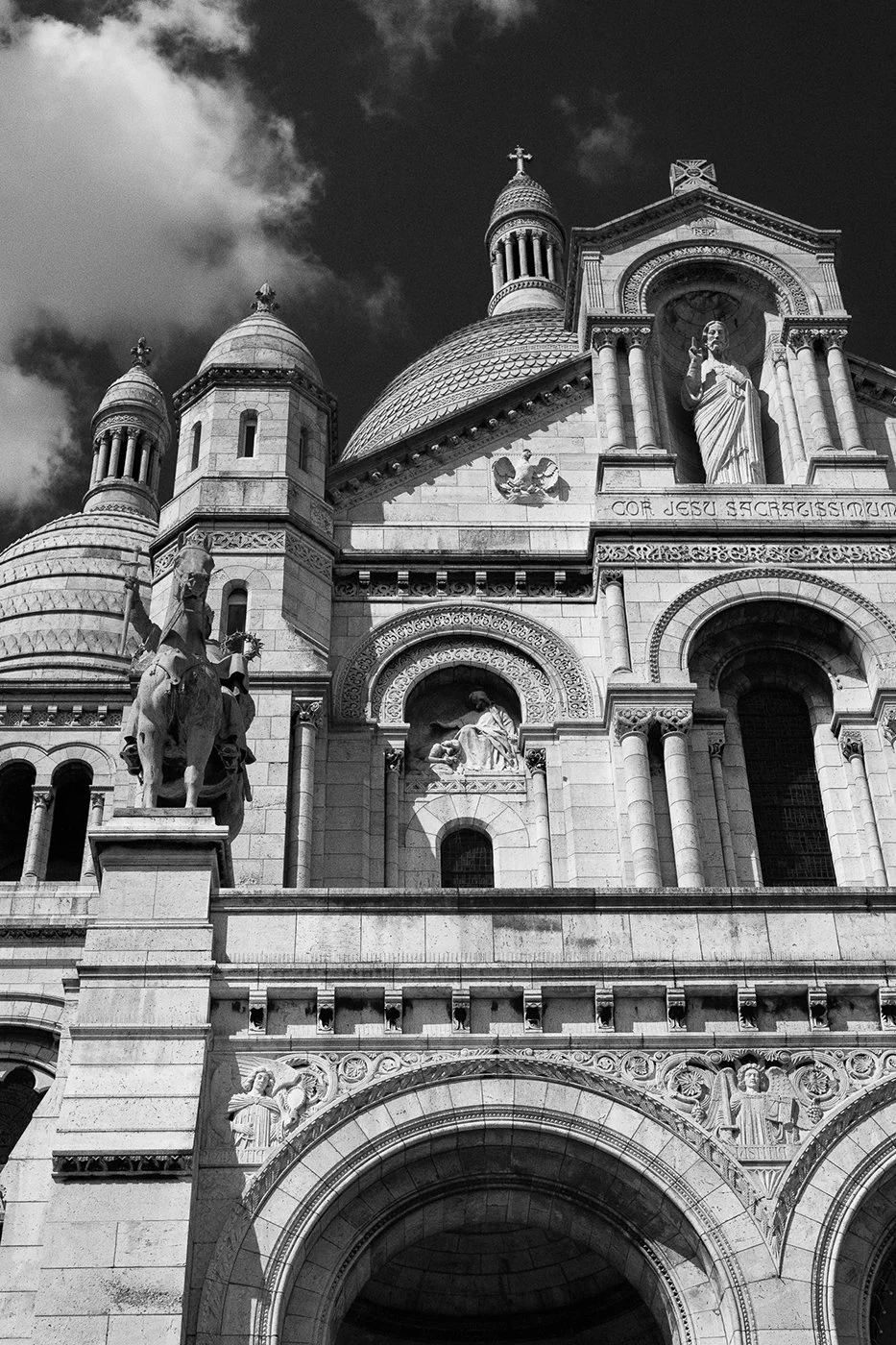
Black and white photograph of Sacré-Cœur Basilica in Paris under dramatic clouds

The Basilica of Sacré Coeur de Montmartre

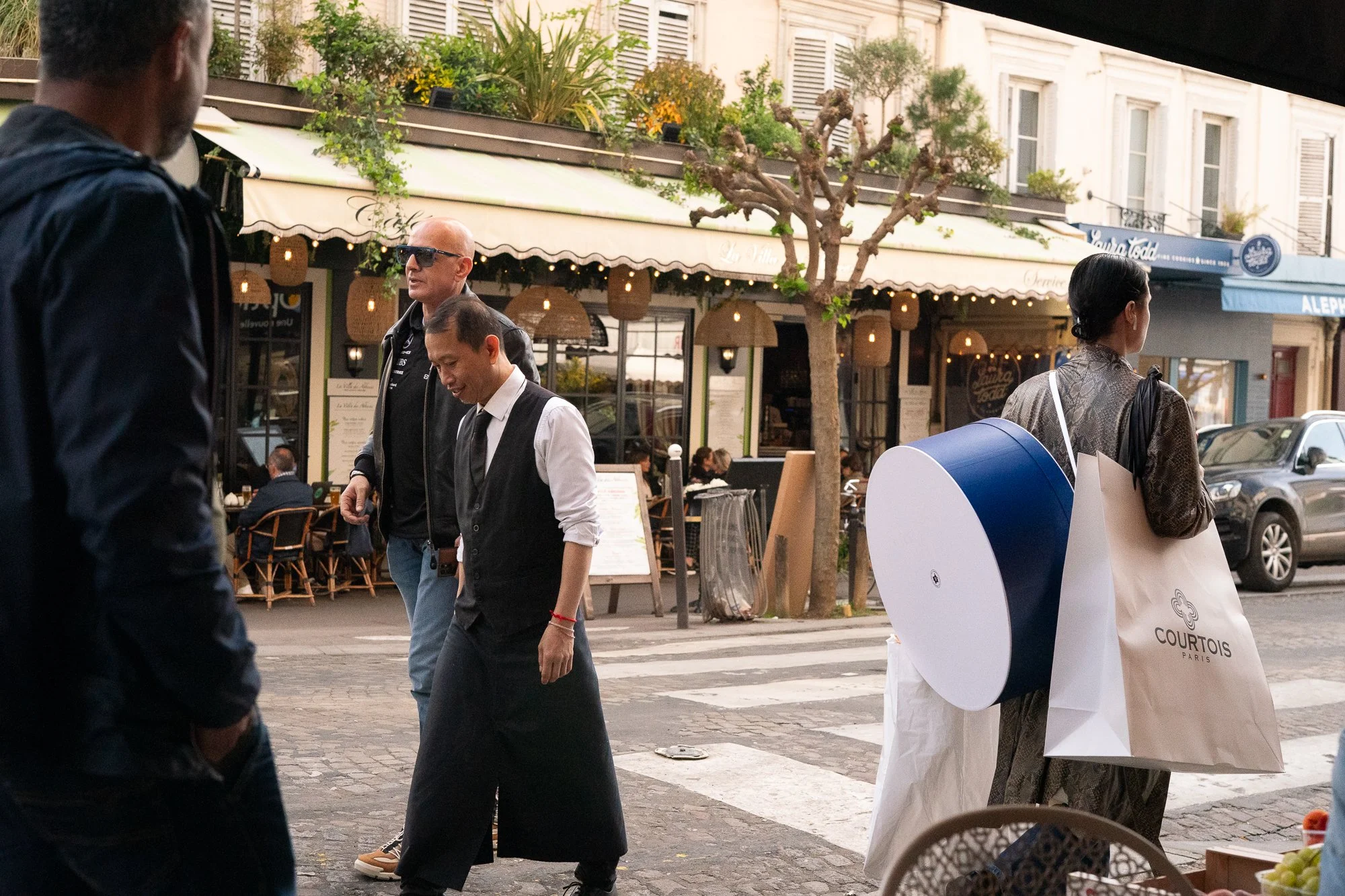
Woman carrying a large hat box crosses a Paris street in front of a neighborhood café, capturing a candid moment of everyday Paris life.

A woman carrying an oversized hat box moves through a café-lined crosswalk in Paris, a small, surreal detail that turns an ordinary street moment into something quietly cinematic.

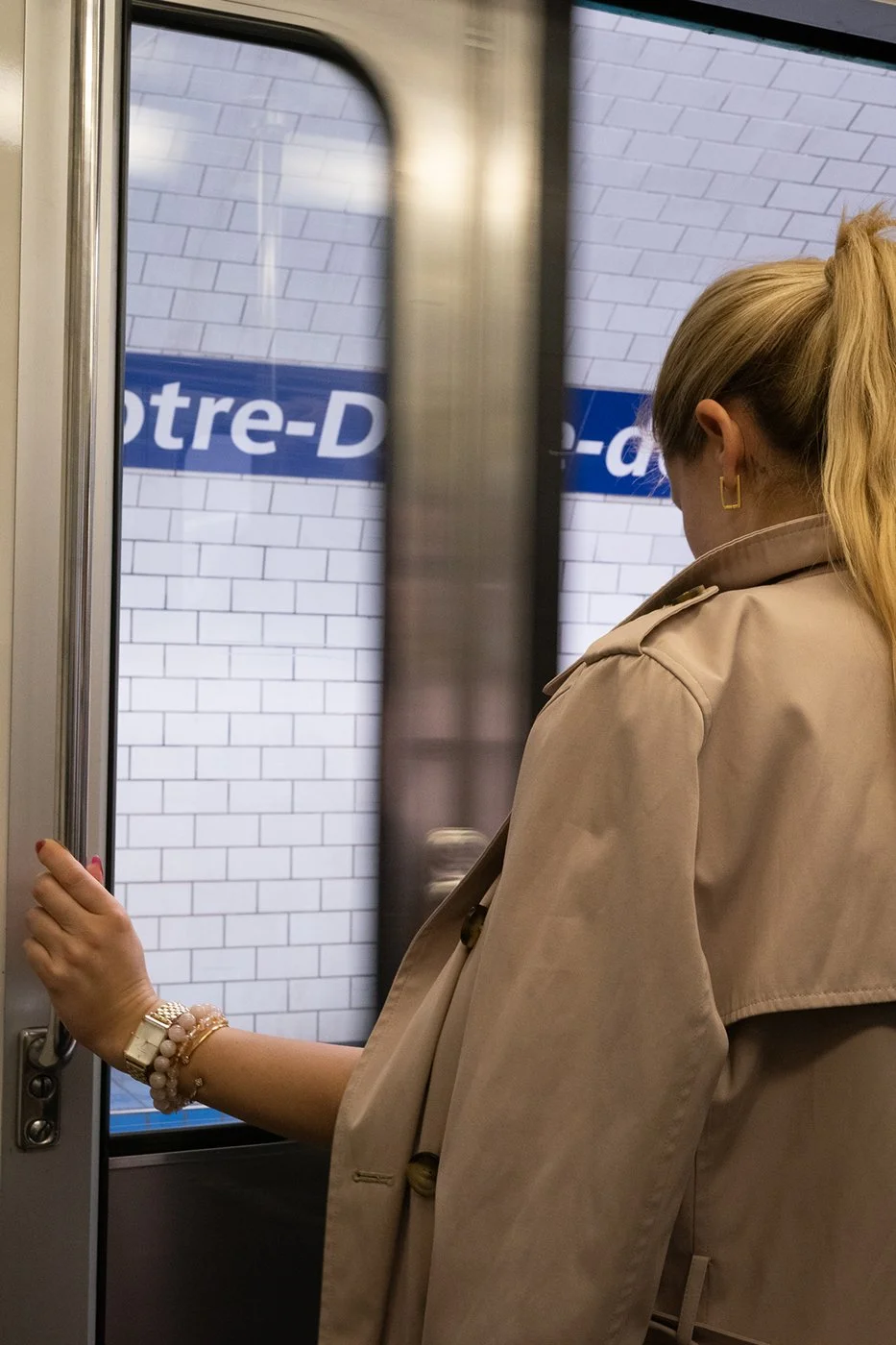
Woman standing inside a Paris metro car near the Notre-Dame station

A fleeting pause inside the Paris metro, where movement and stillness briefly align.

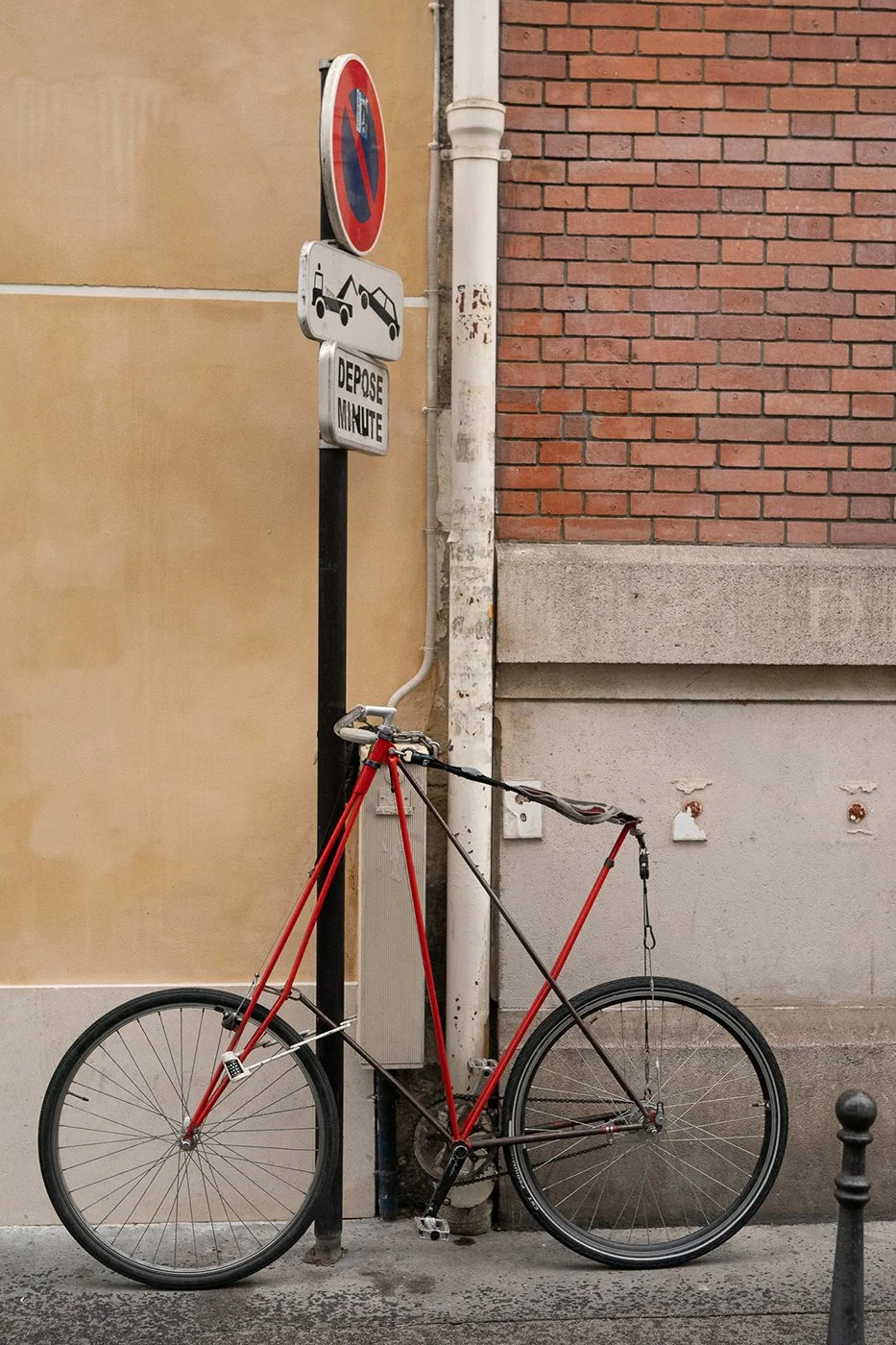
Red bicycle locked to a street sign against textured Parisian walls in France

A red bicycle rests against a worn Paris wall, a quiet study of color, texture, and everyday city life.

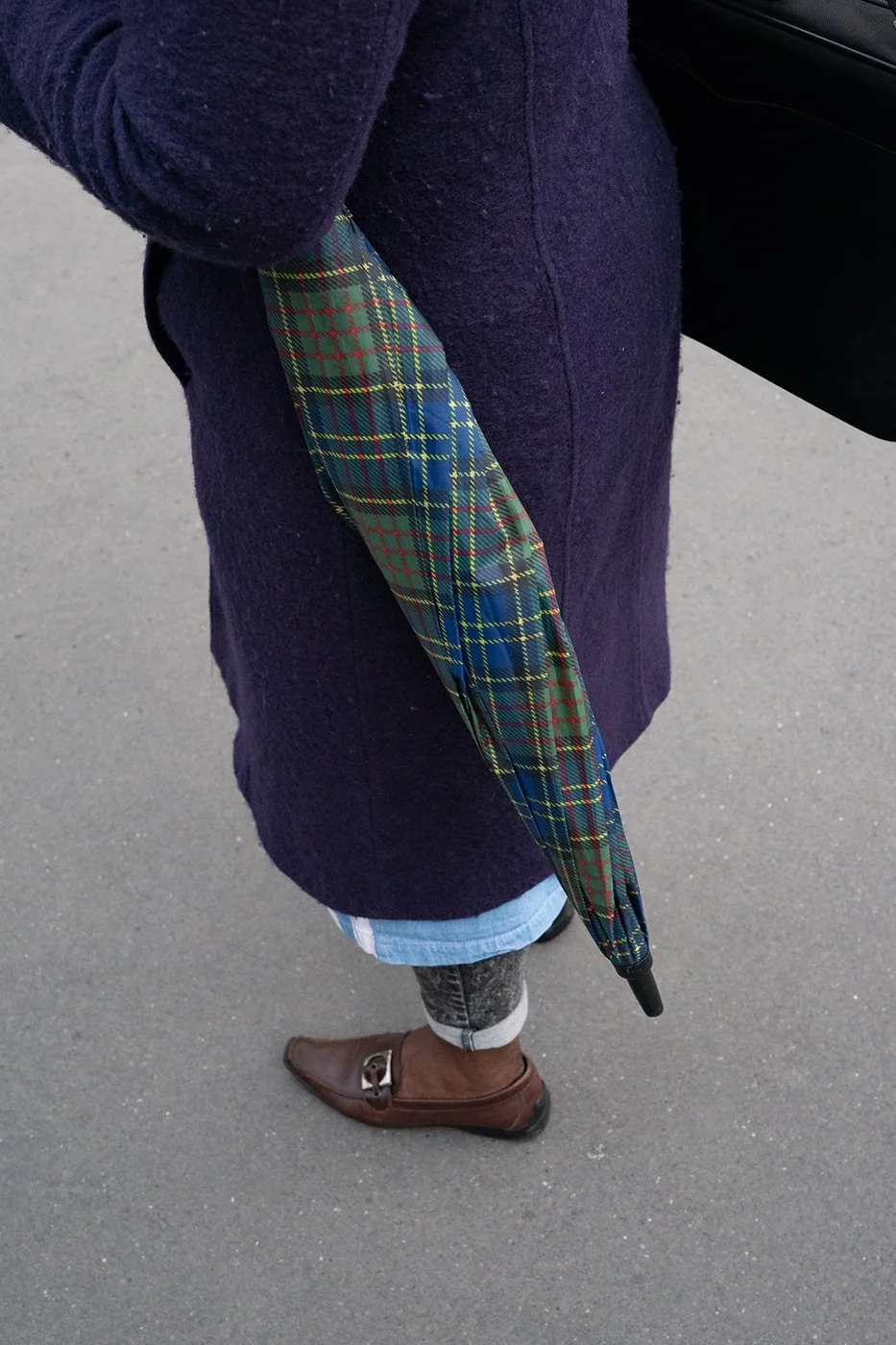
Close-up of a folded umbrella and clothing details on a Paris street

A study of pattern and texture—small details that define everyday Paris.

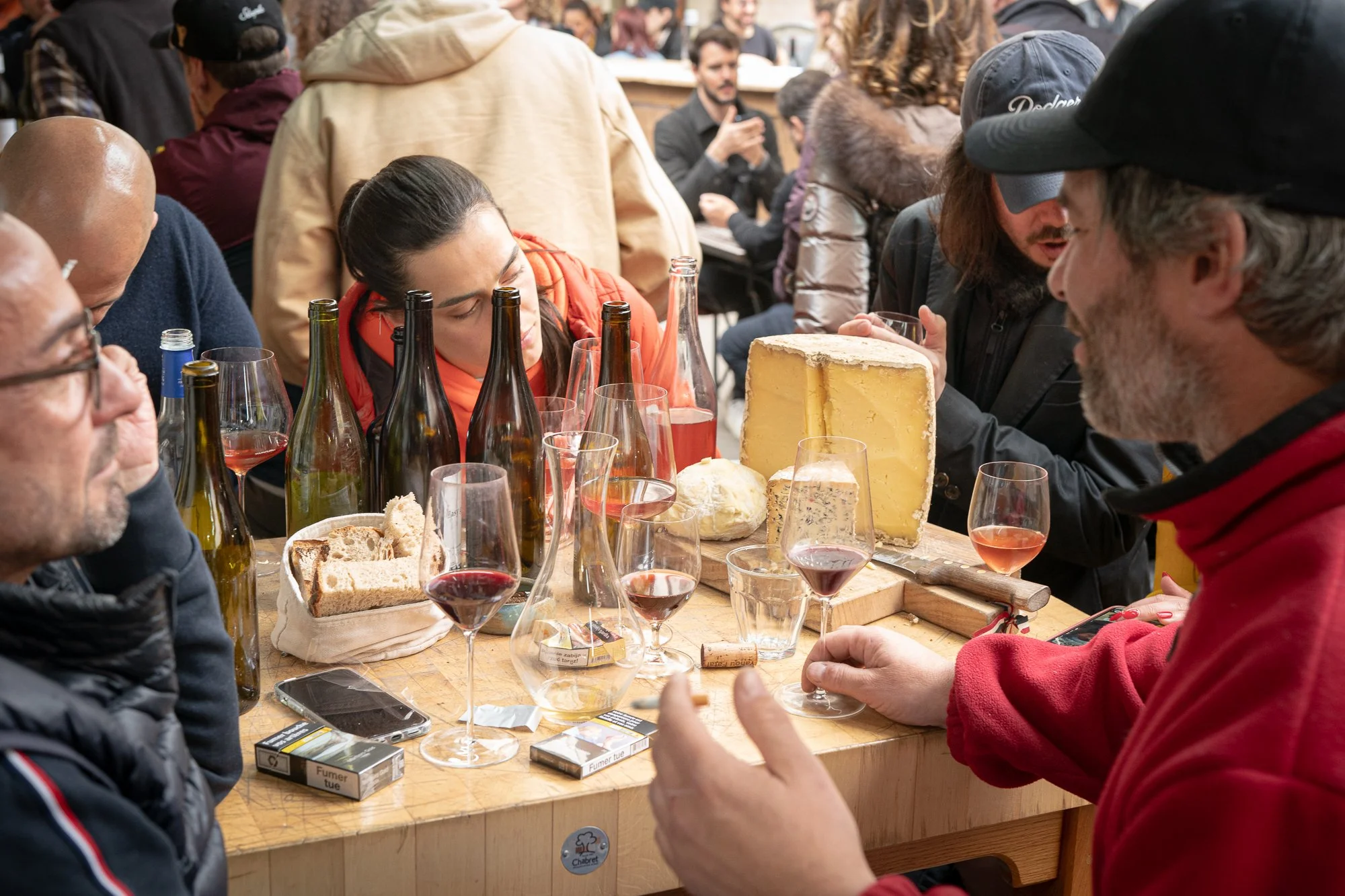
Group of people sharing wine and cheese at an outdoor table in Paris

An afternoon unfolds around wine and cheese, capturing the social rhythm of everyday Paris.

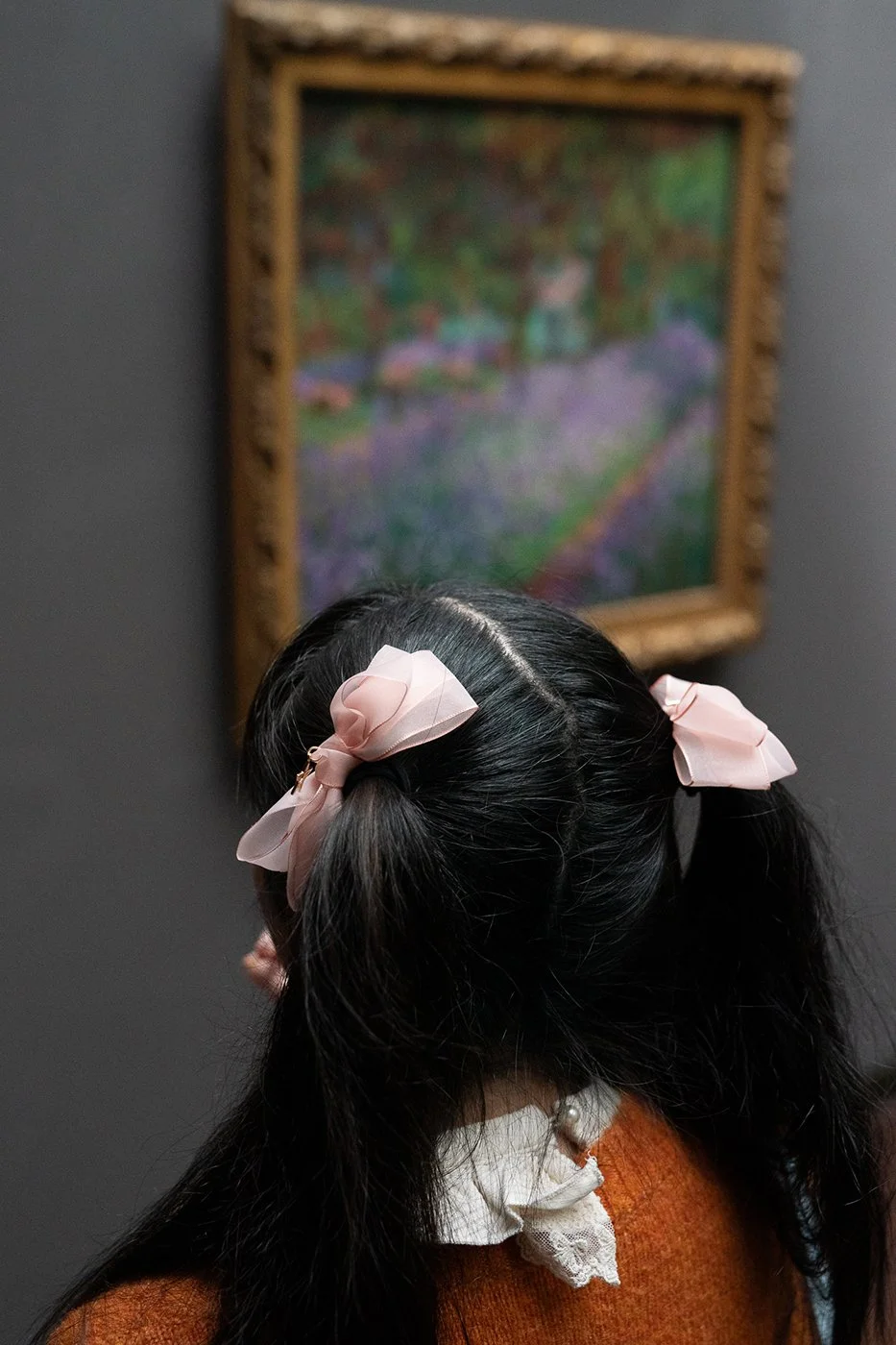
Visitor viewing a painting inside a Paris museum, seen from behind

A quiet exchange between viewer and artwork inside a Paris museum (La Louvre)

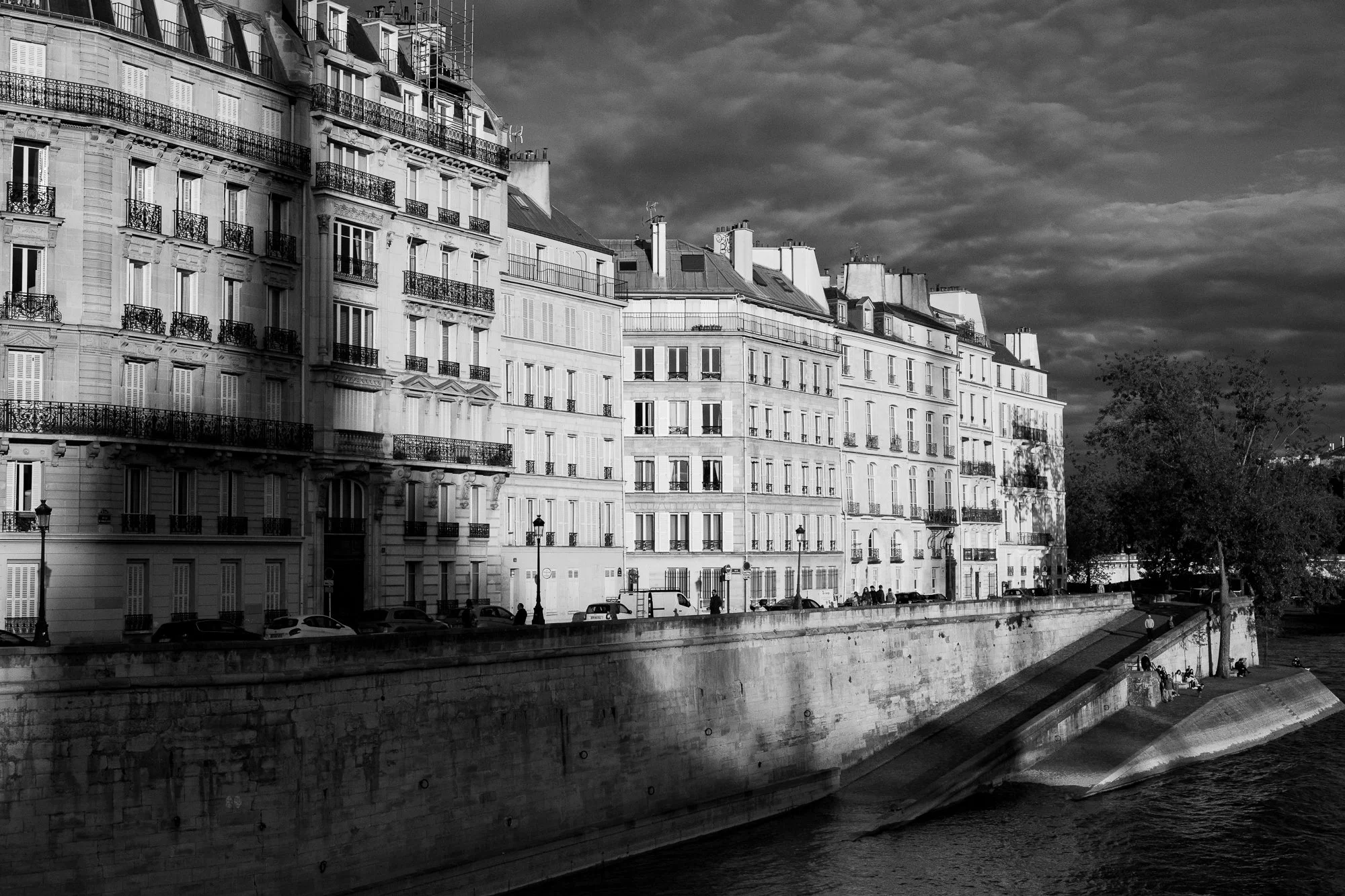
Black and white photograph of classic Paris buildings along the Seine River

Shadow the Notre Dame Cathedral on buildings along the Siene River in Paris, France

The Griffin Museum of Photography

Photography Museum - Winchester, Massachusetts

13+ years now I’ve been photographing traditional barbershops in all 50 states of the USA and the layers continue to peel. In the beginning it was just a thing to do because I love barbershops. Then as time went on I felt responsible for documenting them before they all disappeared. Now, in 2024, I see the collective body of work as a historical document of the barbers and shops that served as a staple in their respective communities for 30, 40, 50, 60+ years. On the surface the theme of this project is about a place to get your haircut. Really though, it’s about community, friendship, and human connection. So I’m honored to announce that a selection of these photographs will be shown at the Griffin Museum of Photography in Winchester, MA for their upcoming group show “Vision(ary) which focuses on communities, cultures, and environments. Please go check out the show as well as the other great exhibitions from June 7th-September 27th.

Click here to purchase a copy of Barbershops of America (photo book) and HERE to purchase prints from this series.

Exhibition at the Griffin Museum of Photography

Barbershops of America at The Griffin Museum of Photography

Photography Books - American Culture

American Photography - Documenting Traditional Barbershops

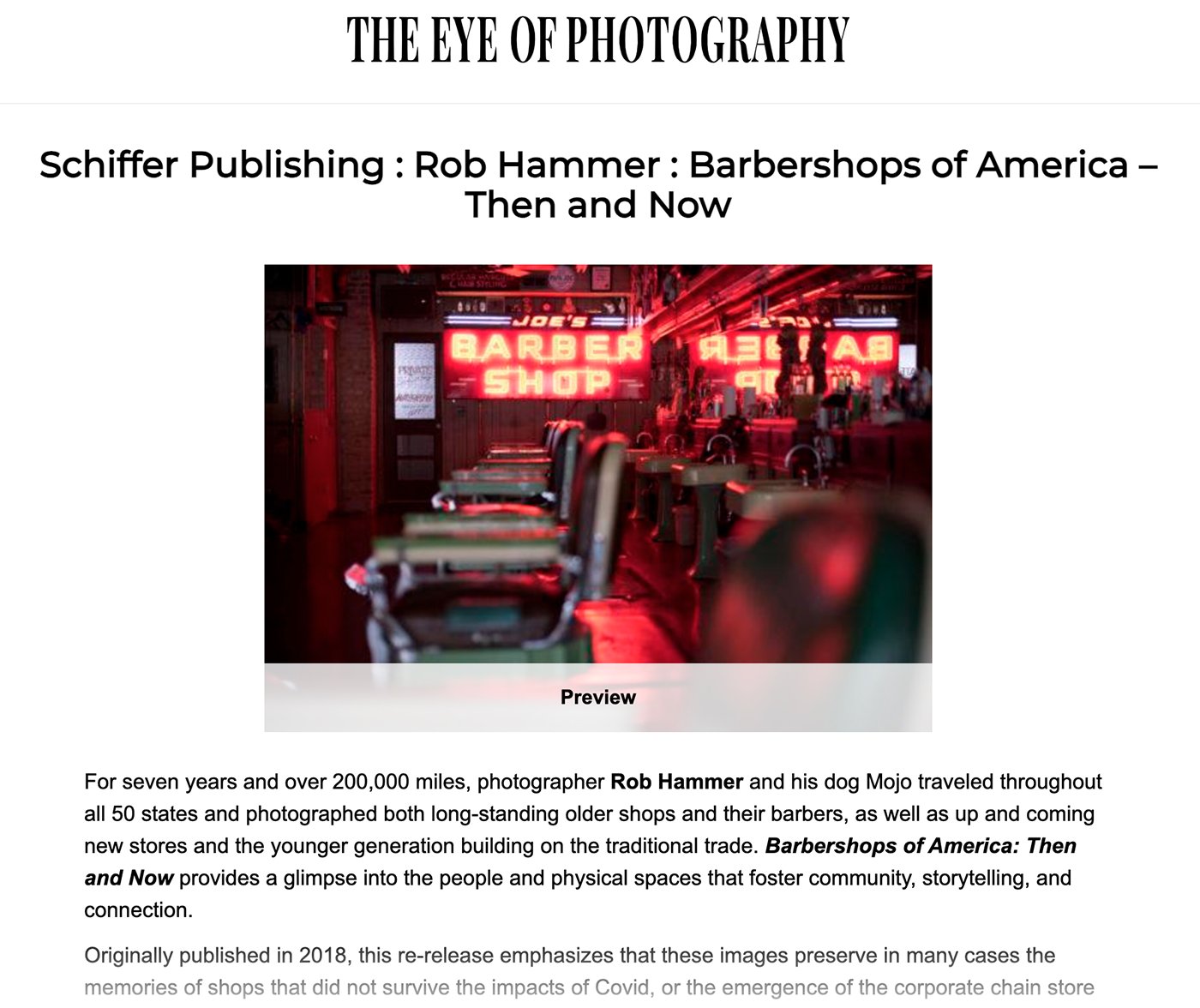
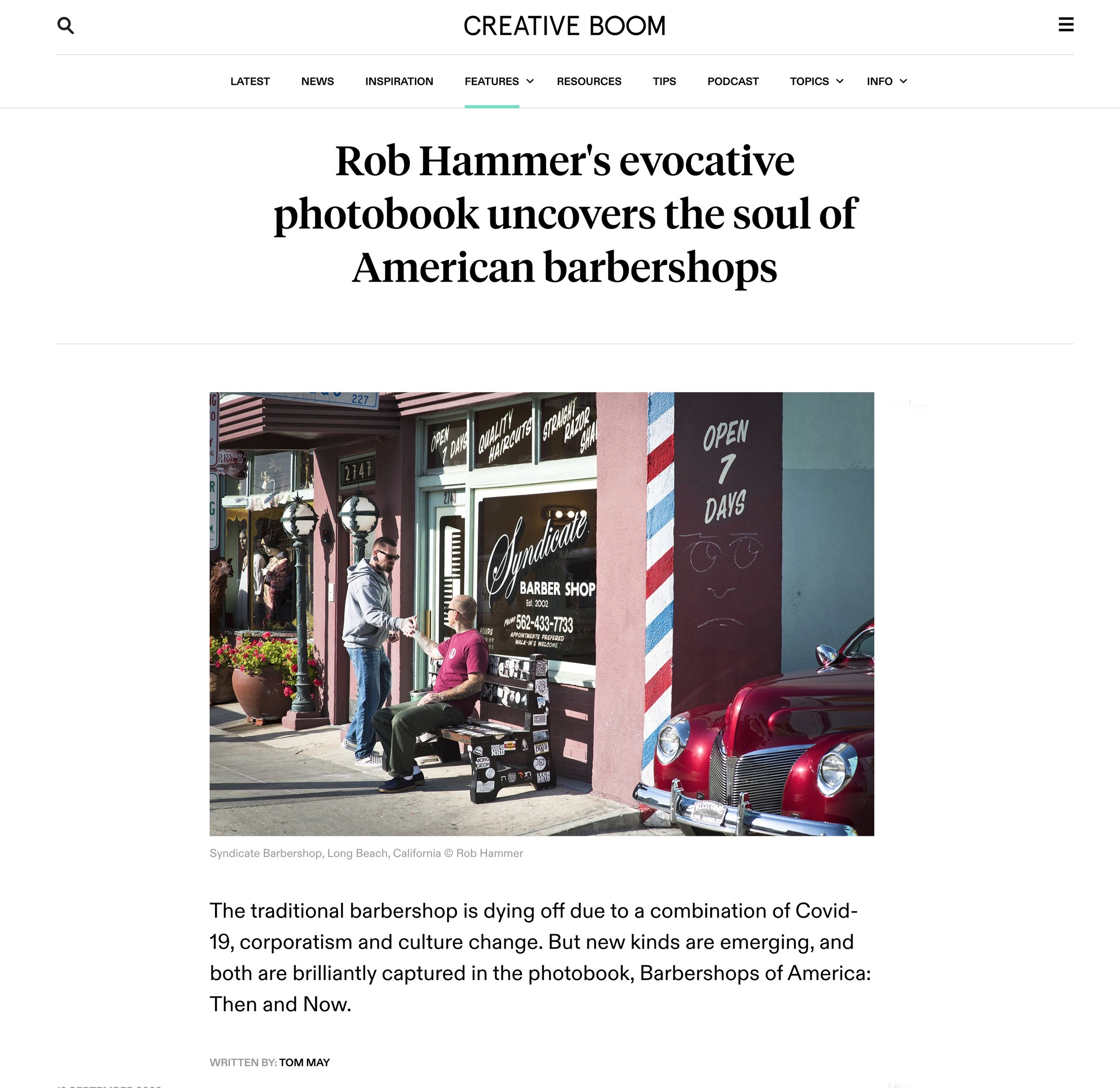
American photography as a genre is hard to define, especially when it comes to art collection and fine art photography. The term is so broad and leaves plenty of room for interpretation. One of my longest running series Barbershops of America fits into that category. Although it’s only been recently that I realized what’s been put together with this series is as much American photography as it is a historical document of a niche piece of American culture. And it occured to me the other day that getting a haircut is just a bonus to the experience you receive from being in a traditional barbershop. Grateful to see this project getting some exposure on Creative Boom and The Eye of Photography.

Click HERE to purchase a copy of Barbershops of American or HERE to purchase fine art prints.

Arizona Cattle Ranch

Cowboy Ranch Life in Arizona — A Working Ranch Photo Essay

Photographing a Working Cattle Ranch in Rural Arizona

Arizona ranching doesn’t look the way most people imagine it. There are no dramatic mountain backdrops or postcard moments waiting around every corner. Most days are quiet. Dry. Spread out. The work blends into the land in a way that feels almost invisible unless you slow down enough to notice it.

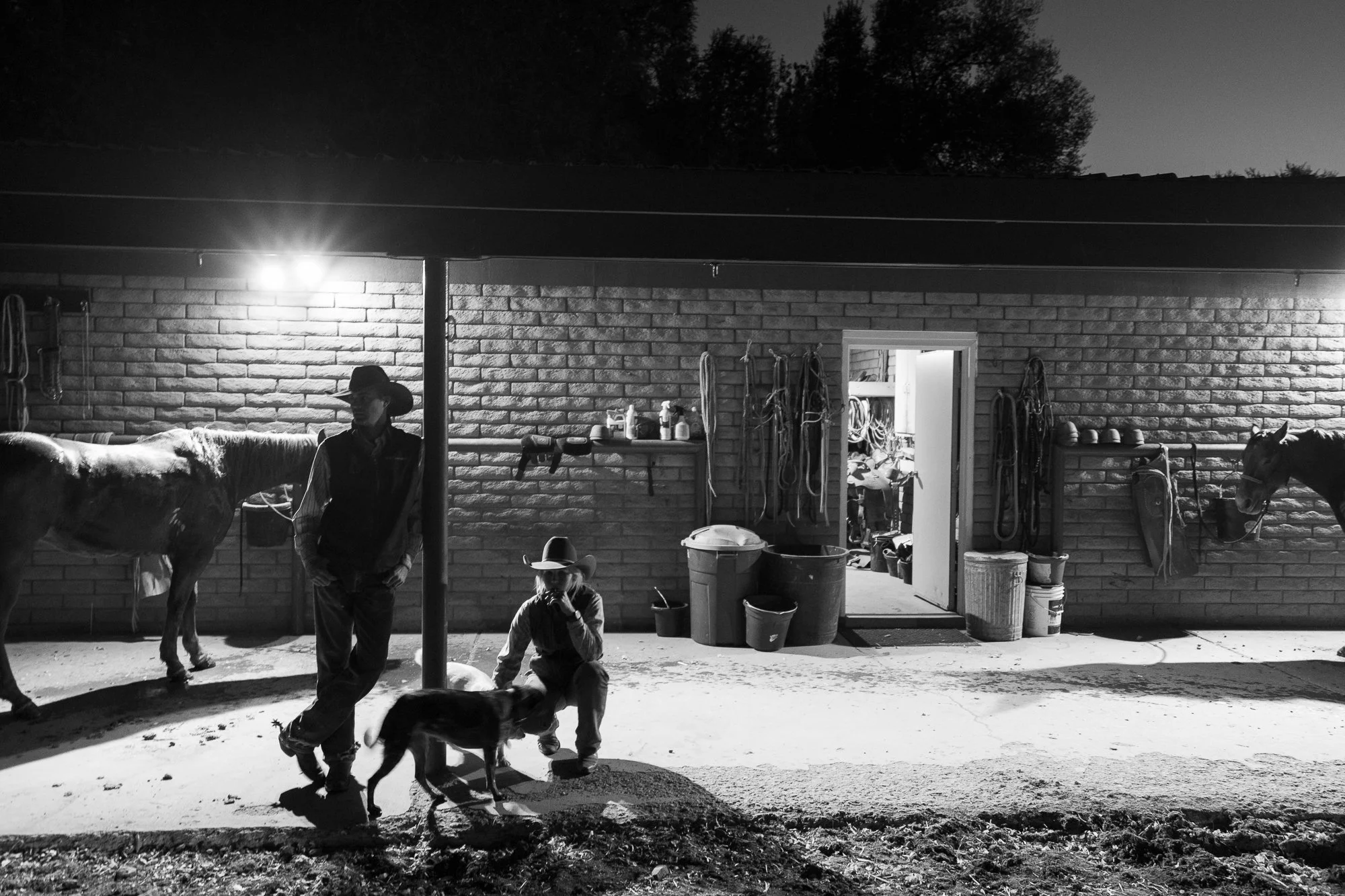
These photographs were made on a working cattle ranch in rural Arizona. No staging. No recreations. Just day-to-day ranch life as it happens — early mornings, long distances, and a rhythm that hasn’t changed much because it doesn’t need to.

Ranch work in Arizona is shaped by the environment more than anything else. The land dictates the pace. Heat, dust, and long distances through dense brush are part of every decision, and nothing happens quickly unless it has to. You feel that right away when you’re there.

What struck me most wasn’t any single moment, but how steady everything felt. Horses saddled without ceremony. Gates opened and closed out of habit. Work done without commentary. It’s not dramatic, but it’s real — and that’s what makes it worth photographing.

Ranching in Arizona Isn’t Romantic — It’s Practical

A lot of imagery of the American West leans hard into nostalgia. This place doesn’t ask for that. Ranching here is practical and stripped down. The landscape doesn’t allow for much excess.

The cattle are moved when they need to be moved. The horses are tools as much as companions. There’s very little separation between work and daily life, and no sense that anyone is trying to preserve an image for the sake of outsiders. It simply exists.

That honesty is what drew me to photograph here.

The K4 Ranch

The photographs in this series were made at K4 Ranch, a working cattle operation where ranching still follows the land rather than trends. Like many ranches across Arizona, it operates quietly, without much outside attention, doing the same work it has for generations.

Places like this don’t always make headlines, but they form the backbone of ranching culture in the Southwest. They’re also disappearing faster than most people realize.

Why Photograph Places Like This

I’ve spent years photographing working cowboys and ranches across the American West, and the more time I spend in places like this, the more important it feels to slow down and document them honestly.

Not to turn them into symbols — but to show what’s actually there.

These photographs aren’t meant to romanticize ranch life or explain it. They’re simply a record of people working, land being used, and traditions continuing without much concern for being noticed.

Arizona Cowboy Photography Prints

Photographs from this Arizona ranching series are available as museum-quality fine art prints. Each print is produced in small editions and made to live with — not just be scrolled past.

View available cowboy photography prints

This story is also part of a larger, ongoing project documenting real working cowboys and ranch life across the American West.

View the complete cowboy photography gallery

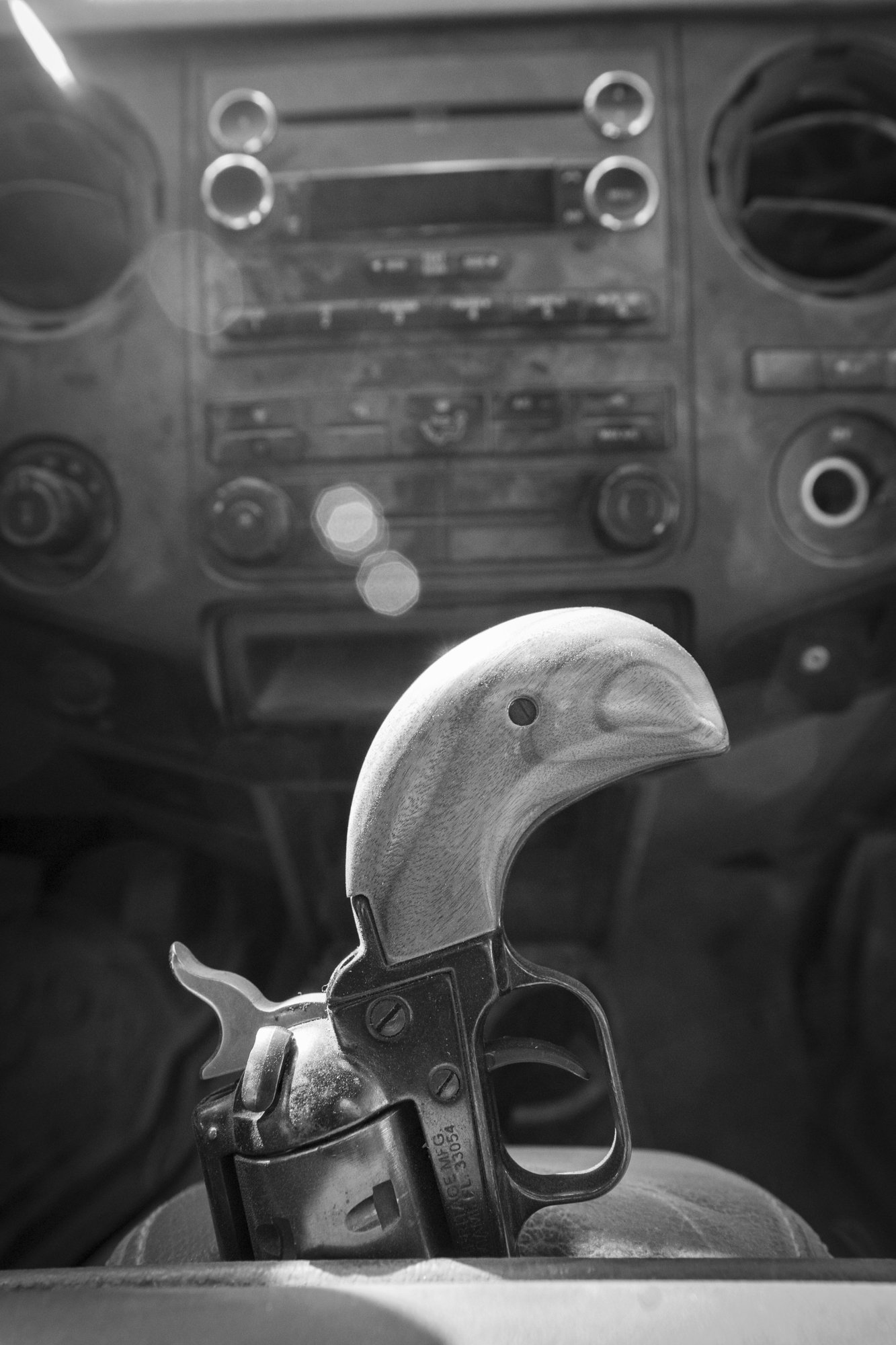
Photograph of a revolver gun in the console of a cowboy's pickup truck

A cowboy’s revolver

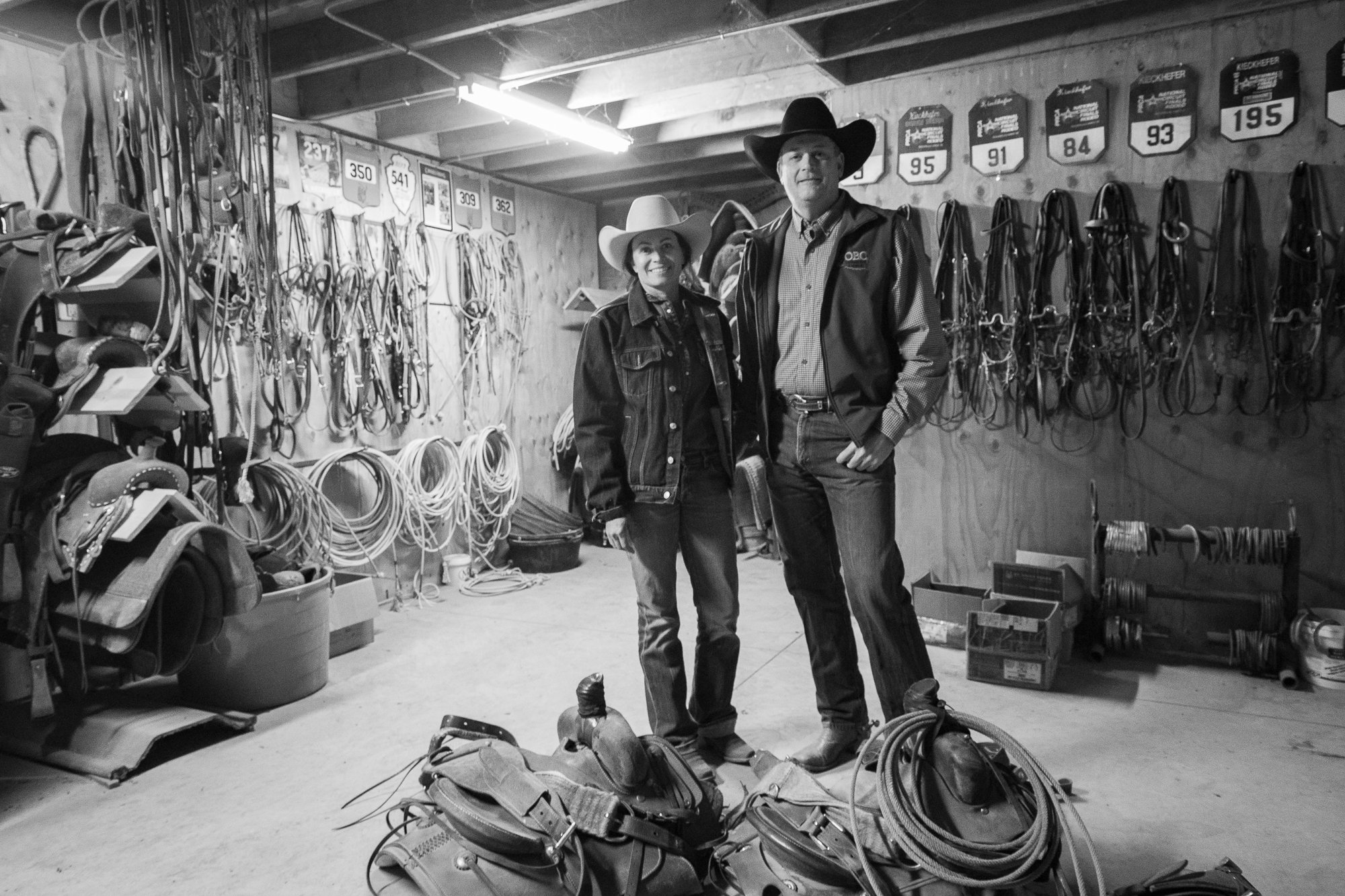
Black and white photograph of husband and wife cowboys

Brady and Marianne Clark - Cowboys

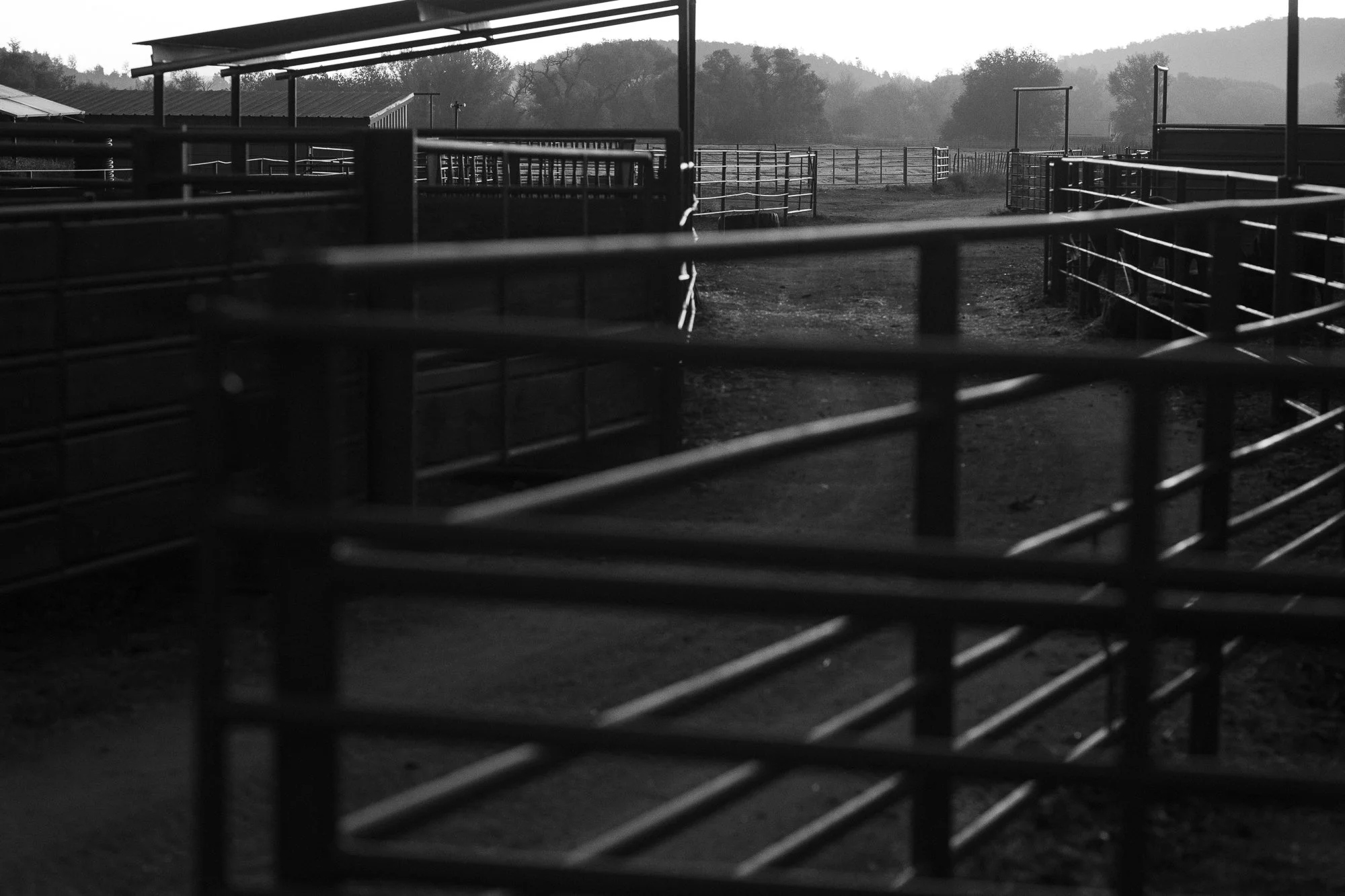
Early morning light illuminates corrals on a working ranch in Arizona

Horse corrals on the K4 Ranch in Prescott Arizona

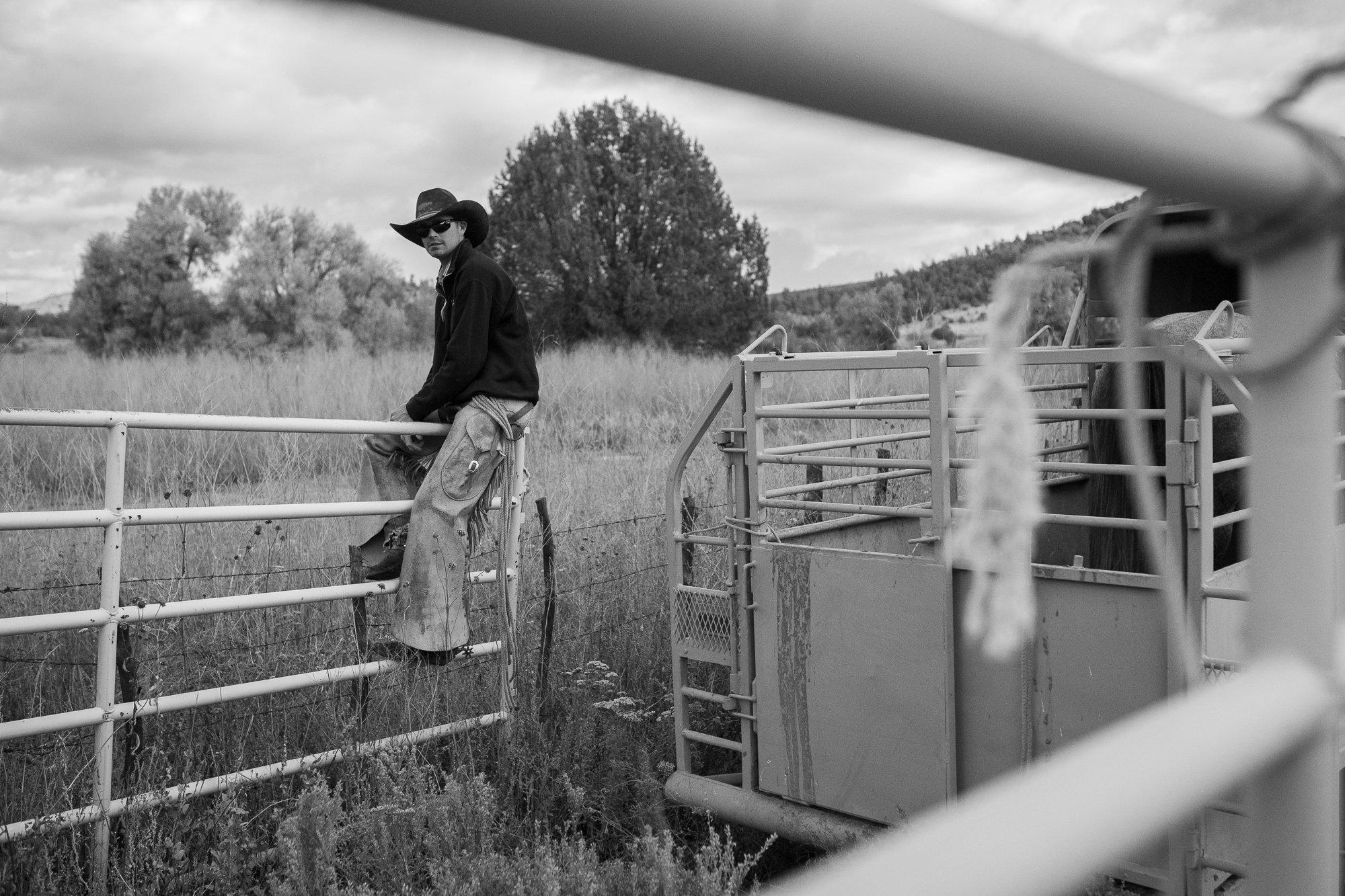
Black and white photograph of a cowboy on an Arizona cattle ranch

Brady Clark - Cowboy

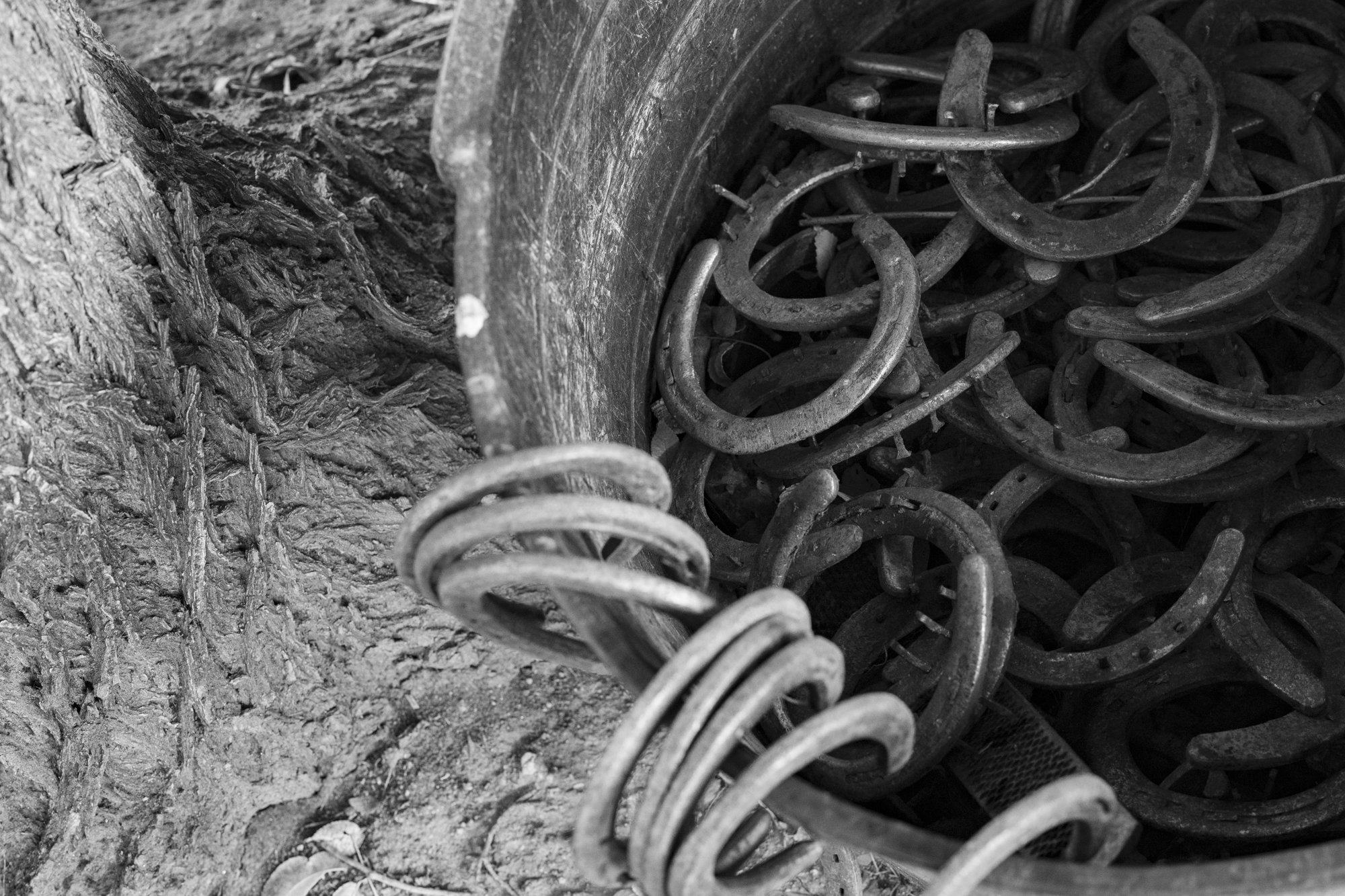
Photograph of a bucket of horseshoes on a cattle ranch in Arizona

Photograph of used horseshoes sitting in a bucket on a cattle ranch in Arizona

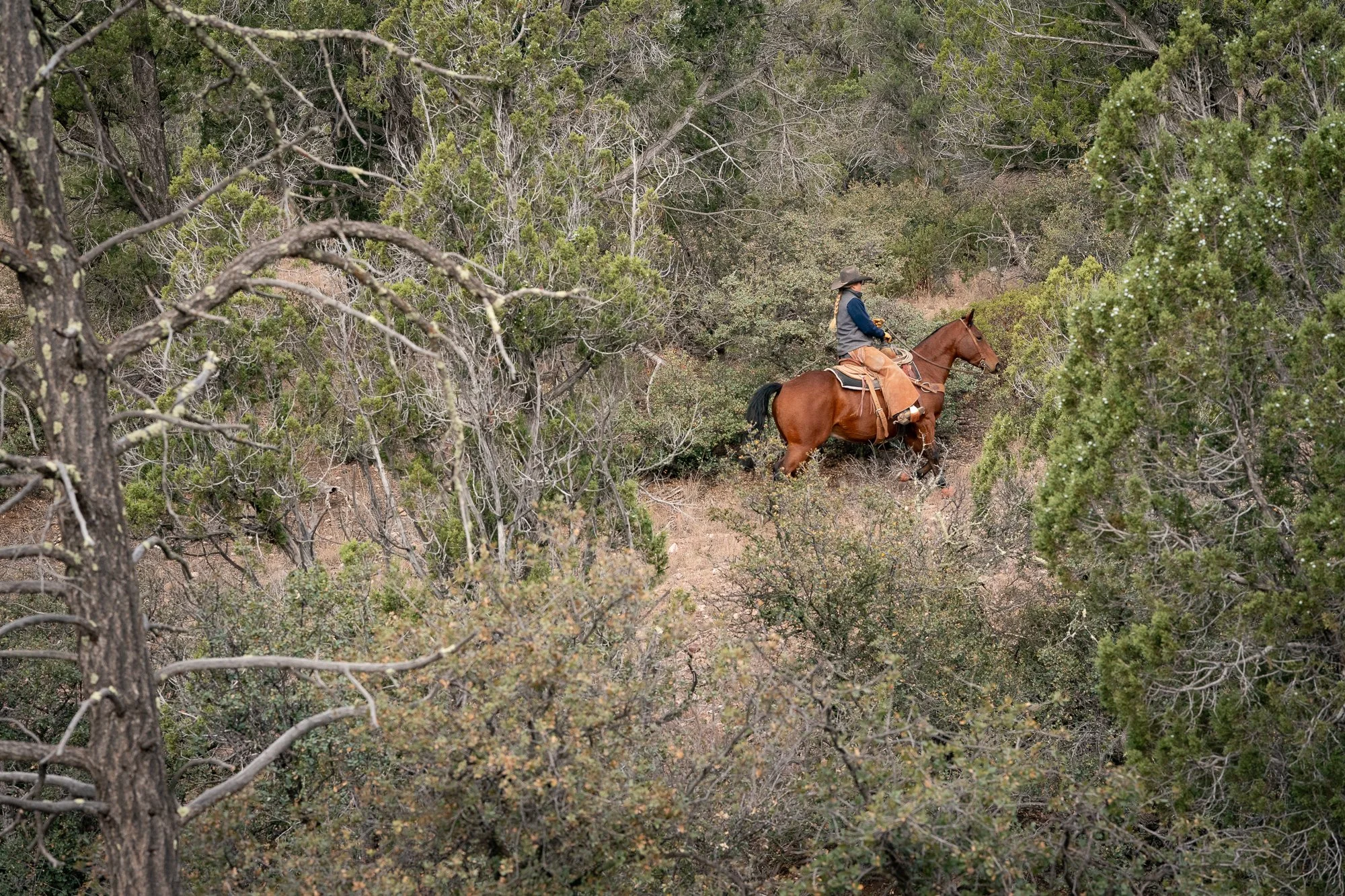
Photograph of a cowboy riding through thick brush on an Arizona cattle ranch

Cowboy riding through thick brush

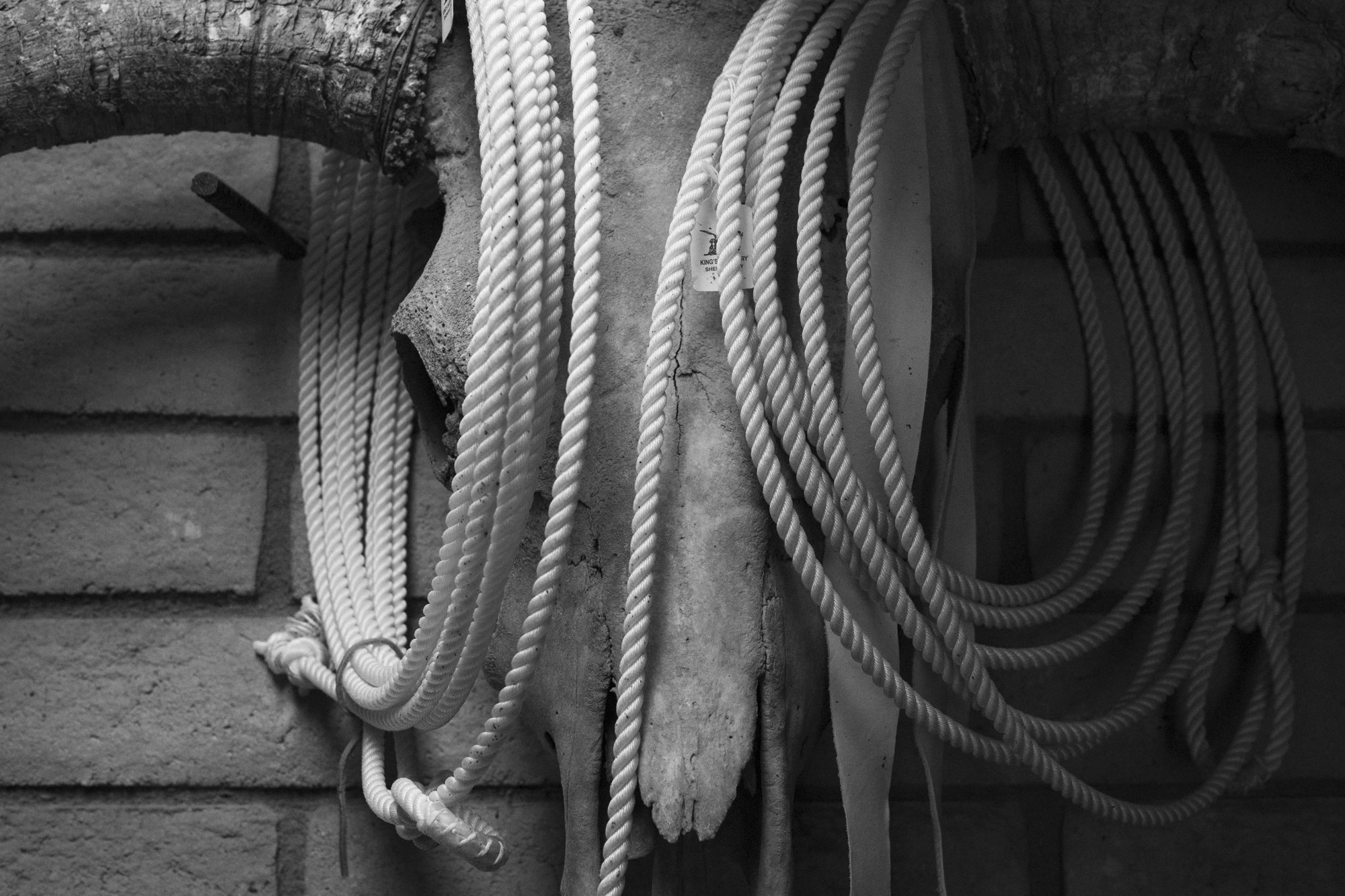
Cowboy lariats hanging on a cattle skull on a working ranch in Arizona

Ropes from King’s Saddlery hang on a cow skull on the K4 Ranch in Prescott, Arizona

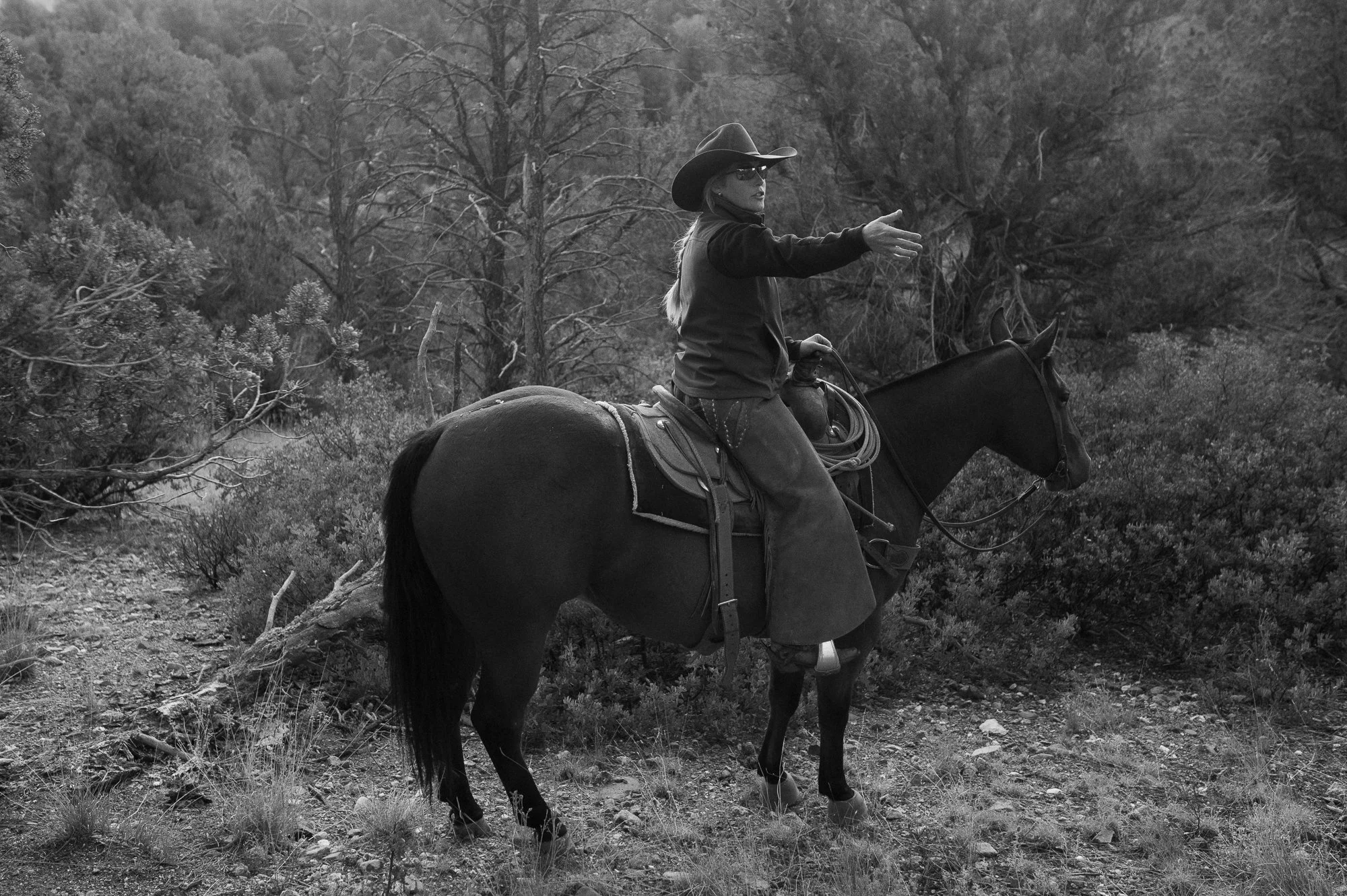
Photograph of a working Arizona cowgirl on her horse in a thick forest

Working Arizona cowgirl - Marianne Clark

Photograph of a cowboys roping dummy

Photograph of a roping dummy on a cattle ranch in the American West

Rick and Sarah Kieckhefer - owners of the largest cattle ranch in the Southwest United States

Rick and Sarah Kieckhefer - Arizona cattle ranchers

Photographs of a cowboys horse shoeing station on a Arizona cattle ranch

A cowboy’s shoeing station for his horse on a cattle ranch in Arizona

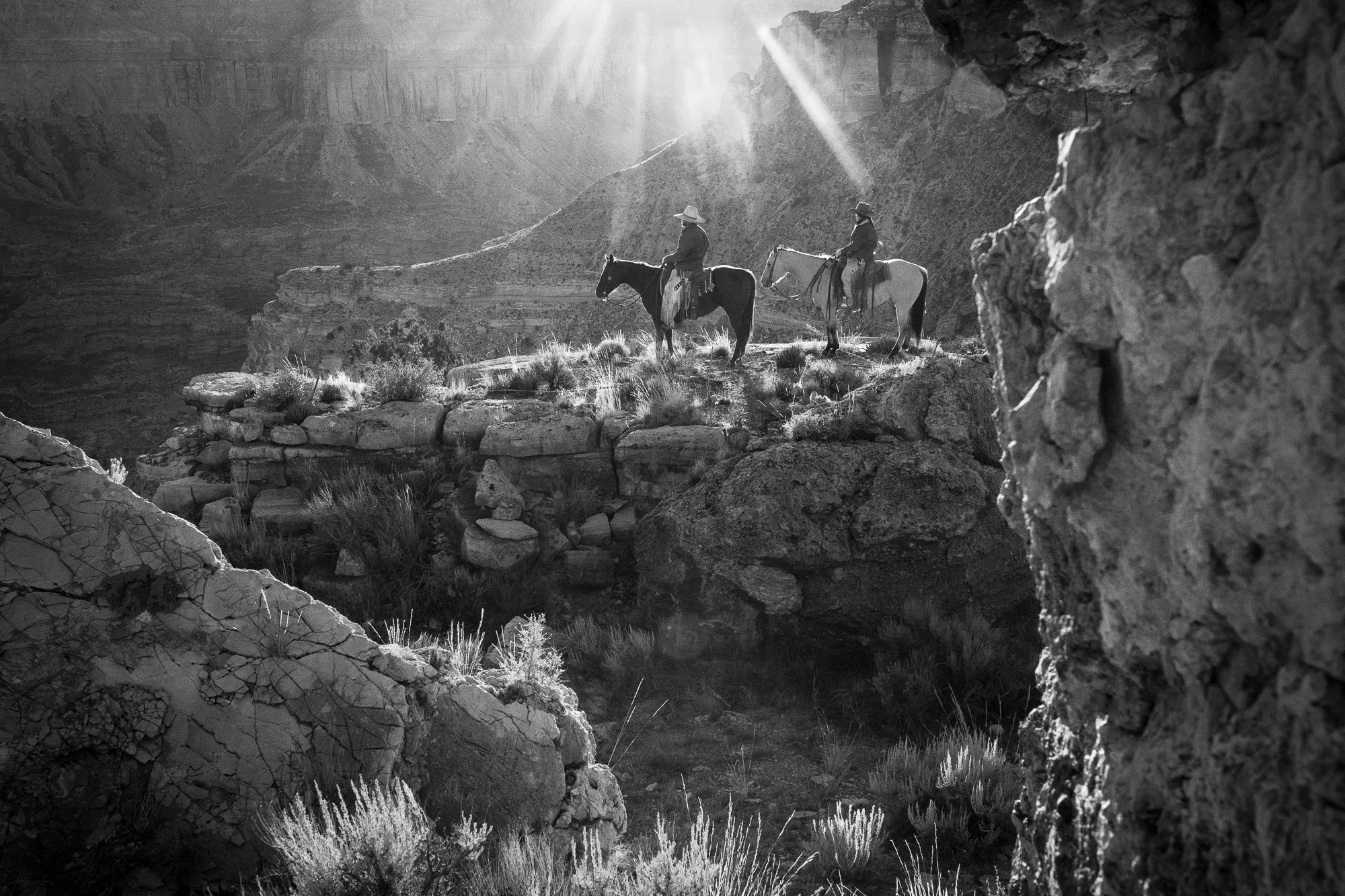
Black and white photograph of male and female cowboys mounting horses in Arizona

Arizona cowboys getting on their horses before a day of work

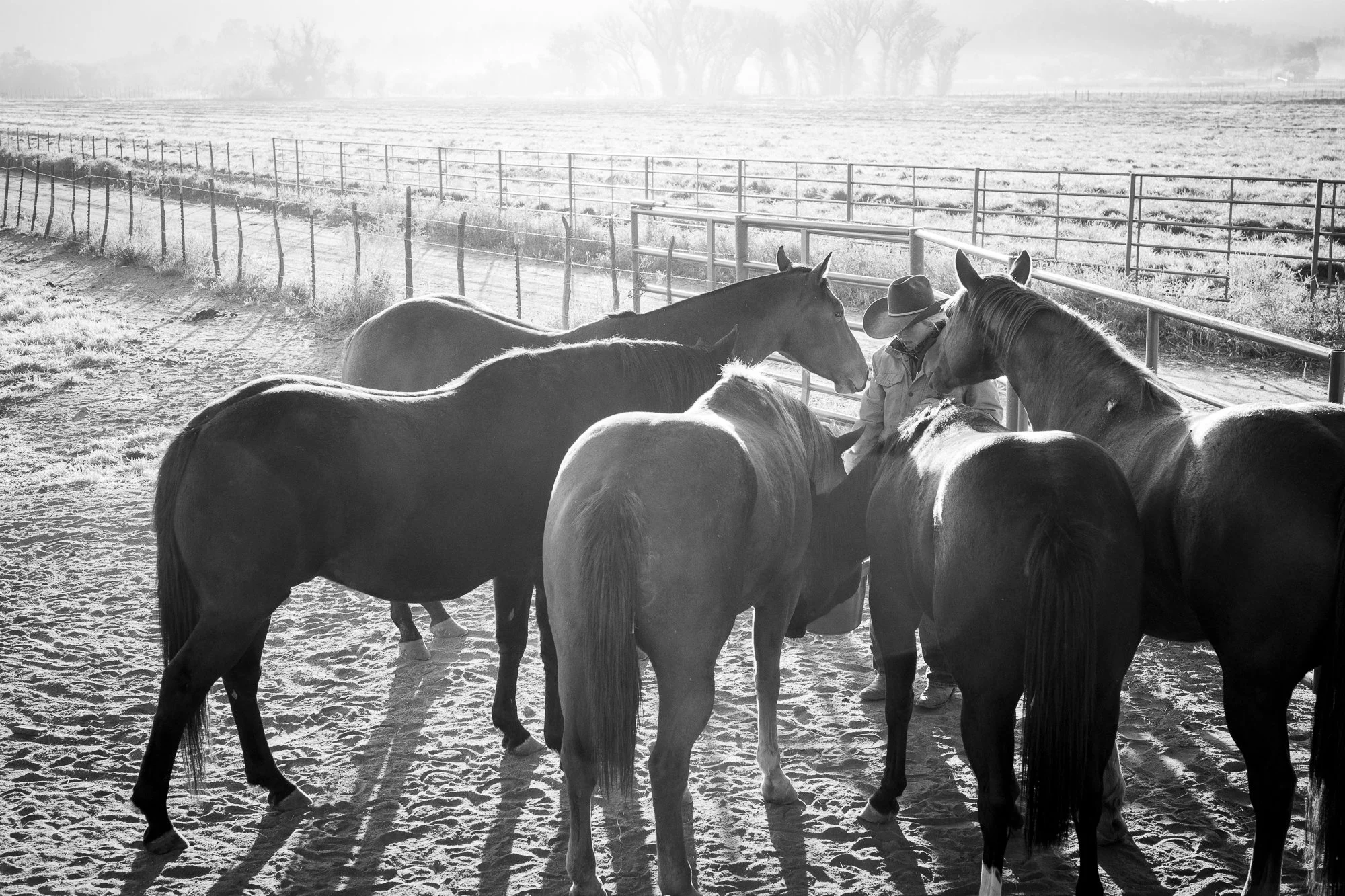
Black and white photograph of a cowgirl feeding horses on a beautiful cattle ranch

Cowgirl feeding horses

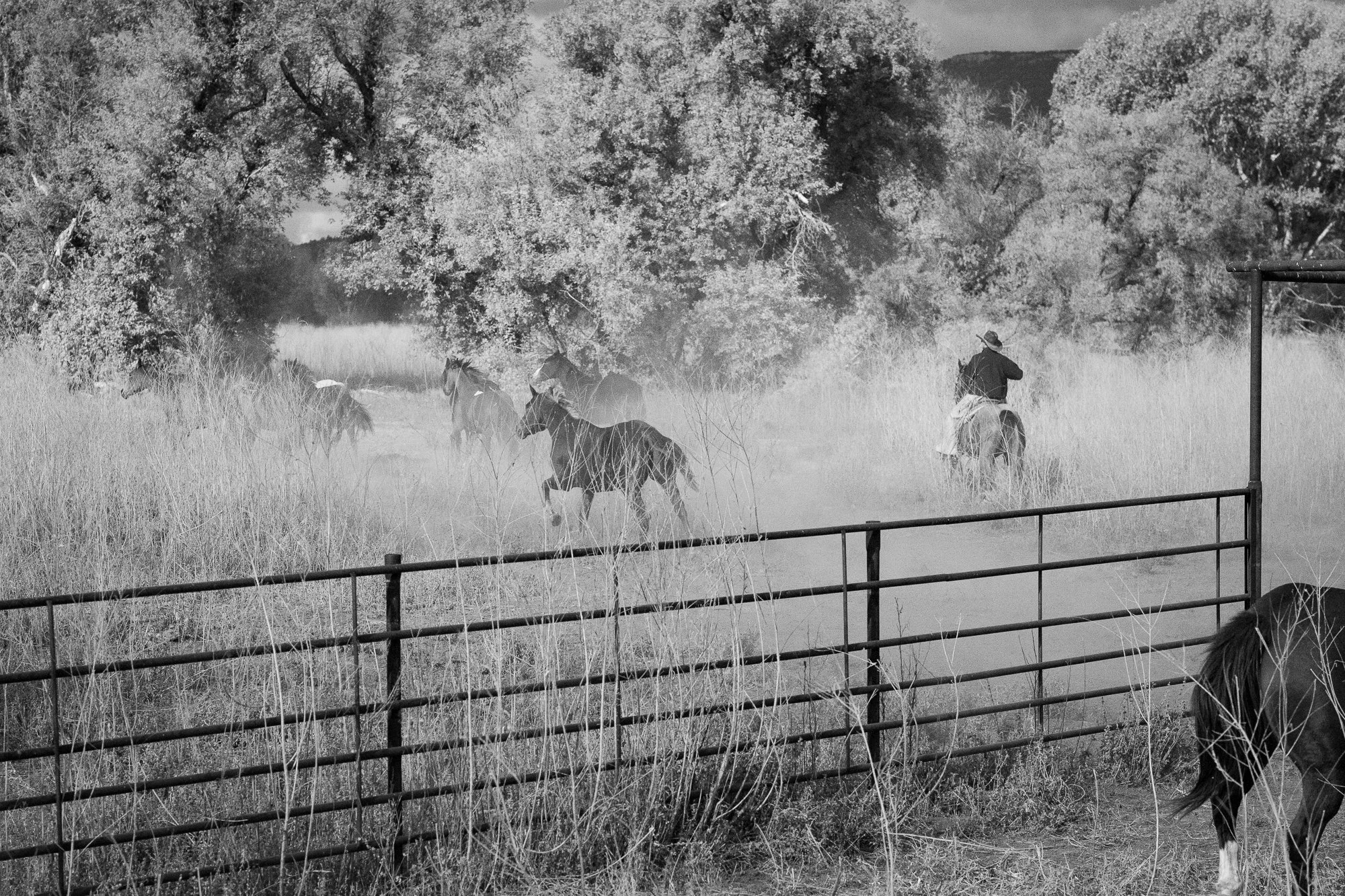
A cowboy riding his horse an an Arizona cattle ranch

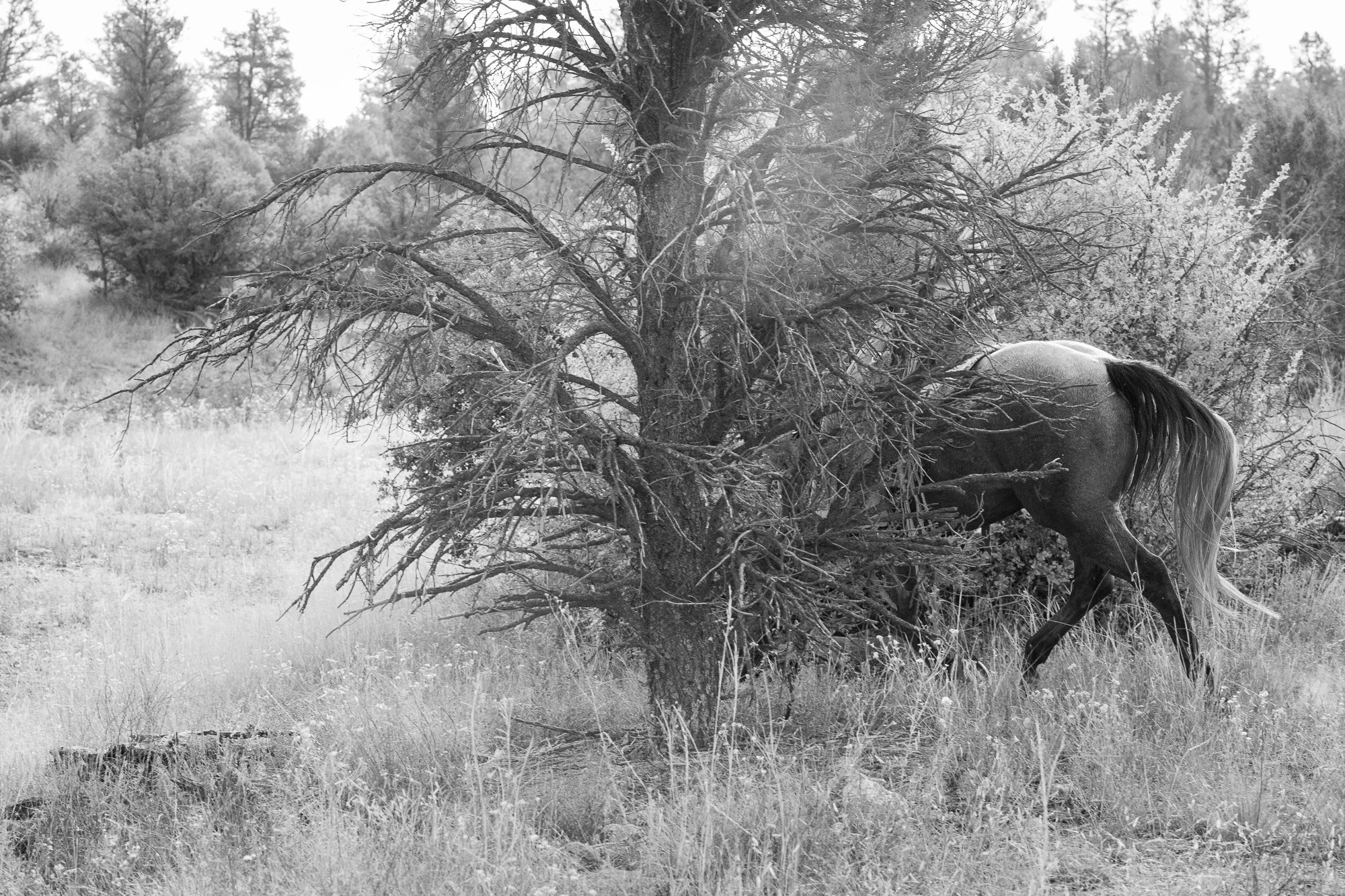
Horses running free on an Arizona cattle ranch

A cowgirl puts her world champion saddle back in the saddle house on a cattle ranch

World Champion Cowgirl

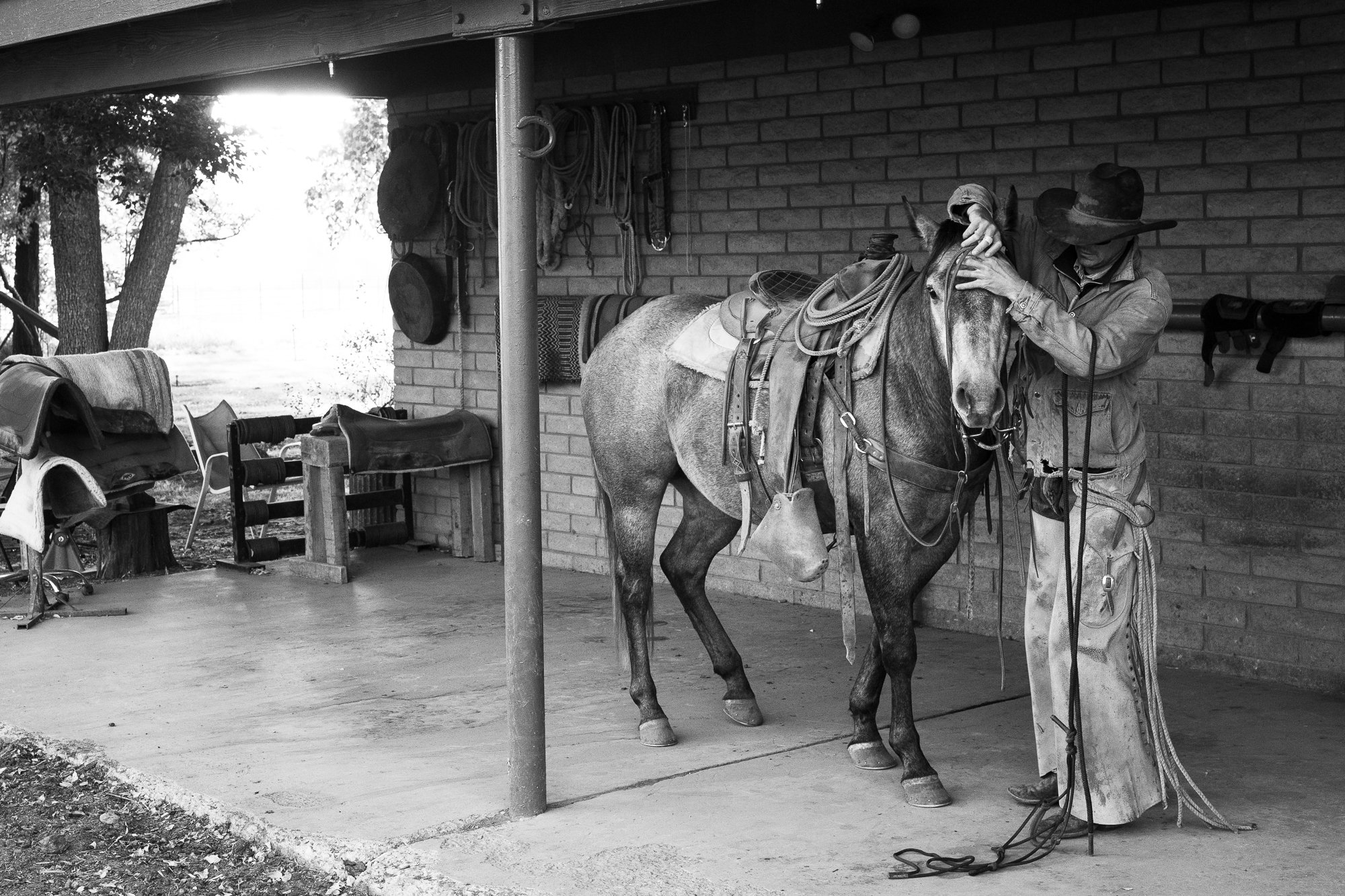
Photograph of a cowboy saddling his horse on the K4 Ranch in Prescott, Arizona

Saddling a horse on the K4 Ranch in Prescott, AZ

Photograph of an Arizona cowgirl riding her horse through dense forest

Arizona cowgirl riding her horse through rough forest

Photograph of a three legged cattle dog

3 legged cattle dog