Buck Brannaman Photograph

Buck Brannaman Horse Training Photography

Imagine being a fly on the wall while Marlon Brando rehearses alone. Or having an empty Yankee Stadium while Mickey Mantle takes batting practice.

Witnessing mastery up close is rare. It’s the kind of thing people usually pay for—if they can get access at all.

Every now and then though, it just happens. Right place, right time.

That’s how I found myself watching Buck Brannaman work on a hot, buggy afternoon at the OW Ranch in Montana.

An Unplanned Lesson on the OW Ranch

It wasn’t supposed to be a demonstration.

After a long day of branding calves on the OW Ranch in Montana, the crew was back at headquarters unloading horses when a young mare named Lux refused to cooperate with the trailer. What started as a routine problem quickly turned into something else entirely when Buck Brannaman stepped in.

At first, he stood back, letting the next generation work through it. But as the struggle continued, he quietly asked for a swing.

The energy shifted immediately.

What had been a relaxed end to a branding day became a classroom. Cowboys and cowgirls—many of them highly skilled—gathered in silence, watching closely. Not for spectacle, but for understanding.

What followed wasn’t dramatic. It was slow. Repetitive. Nearly imperceptible at times.

For over two hours, Buck worked inside the tight confines of the trailer, using subtle pressure and release—tap by tap of a flag—asking the horse to think rather than react. Progress came in inches. Then disappeared. Then returned again.

Some people drifted off as the work stretched on. Most stayed, knowing exactly what they were witnessing.

Patience wasn’t just part of the process—it was the process.

Lux wasn’t his horse. There was no audience to impress, no clinic to run. Just a problem that needed solving, and a responsibility to see it through. By the end, the same horse that had been slamming against metal in fear could walk calmly in and out of the trailer.

No celebration. No moment of triumph. Just a quiet acknowledgment: “that’s the one.”

For those who stayed, it was a rare kind of access—watching mastery reveal itself not through intensity, but through discipline, restraint, and time.

What Makes Buck Brannaman Different

Buck Brannaman’s approach to horsemanship helped inspire the film The Horse Whisperer starring Robert Redford, but what you see in a film doesn’t fully translate to real life.

Out here, there’s no script.

His work isn’t built on force or speed. It’s built on timing, feel, and an ability to read subtle changes most people would miss entirely. The kind of discipline that doesn’t look impressive unless you understand what’s happening.

That’s what makes photographing him difficult—and interesting.

There’s no single defining moment. No peak action. The story lives in the small shifts. A release of pressure. A change in posture. A horse beginning to trust.

You don’t chase those moments. You wait for them.

Photographing Real Cowboy Work in the American West

Moments like this are the reason I’ve spent years photographing working cowboys across the American West.

Not staged shoots. Not recreations.

Real ranches. Real work. Long days that start before sunrise and end when the job is done.

The West is often portrayed through extremes—speed, grit, drama—but most of it exists in quieter spaces. In the discipline it takes to do something well. In the repetition. In the patience.

What I saw that day on the OW Ranch wasn’t unusual in the sense that it happens all the time. But being there to witness it—without interruption, without performance—that’s rare.

And that’s what I try to carry into the photographs.

Fine Art Prints & Licensing

This body of work is part of a long-term project documenting working cowboys, historic ranches, and the realities of life in the American West.

For collectors, a selection of museum-quality prints is available here: View Fine Art Prints

For brands, editorial, or commercial use, image licensing is available upon request - rob@robhammerphotography.com
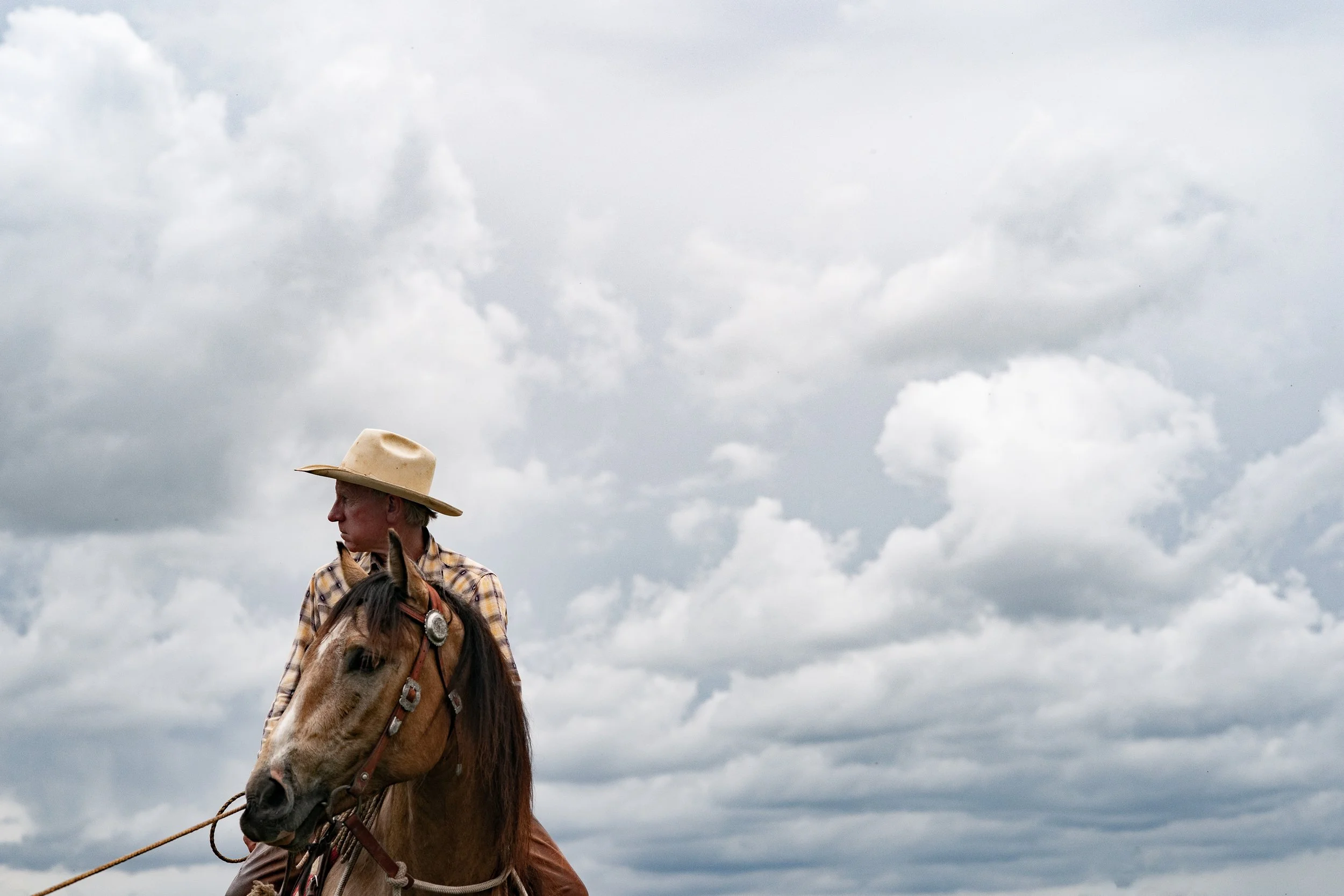
Cowboy sitting on a horse under a wide cloudy sky in Montana, looking off into the distance

Buck Brannaman sitting quiet on horseback under a wide Montana sky, taking in the moment before stepping in. The kind of stillness that comes from knowing when not to act.
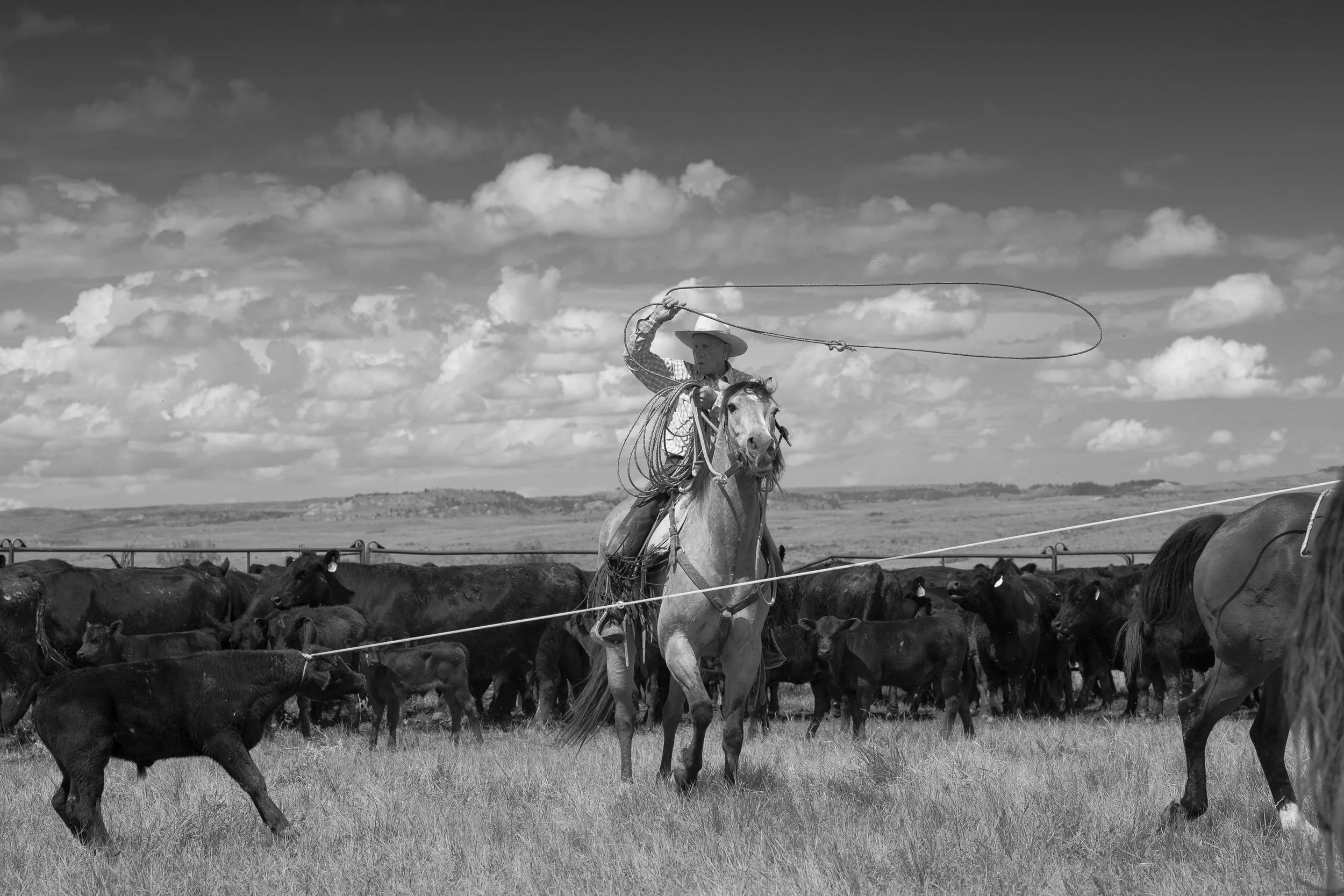
Black and white photo of a cowboy on horseback roping cattle in an open field

Buck Brannaman roping through cattle during the same long day of work. Different task, same rhythm, steady and controlled from horseback.
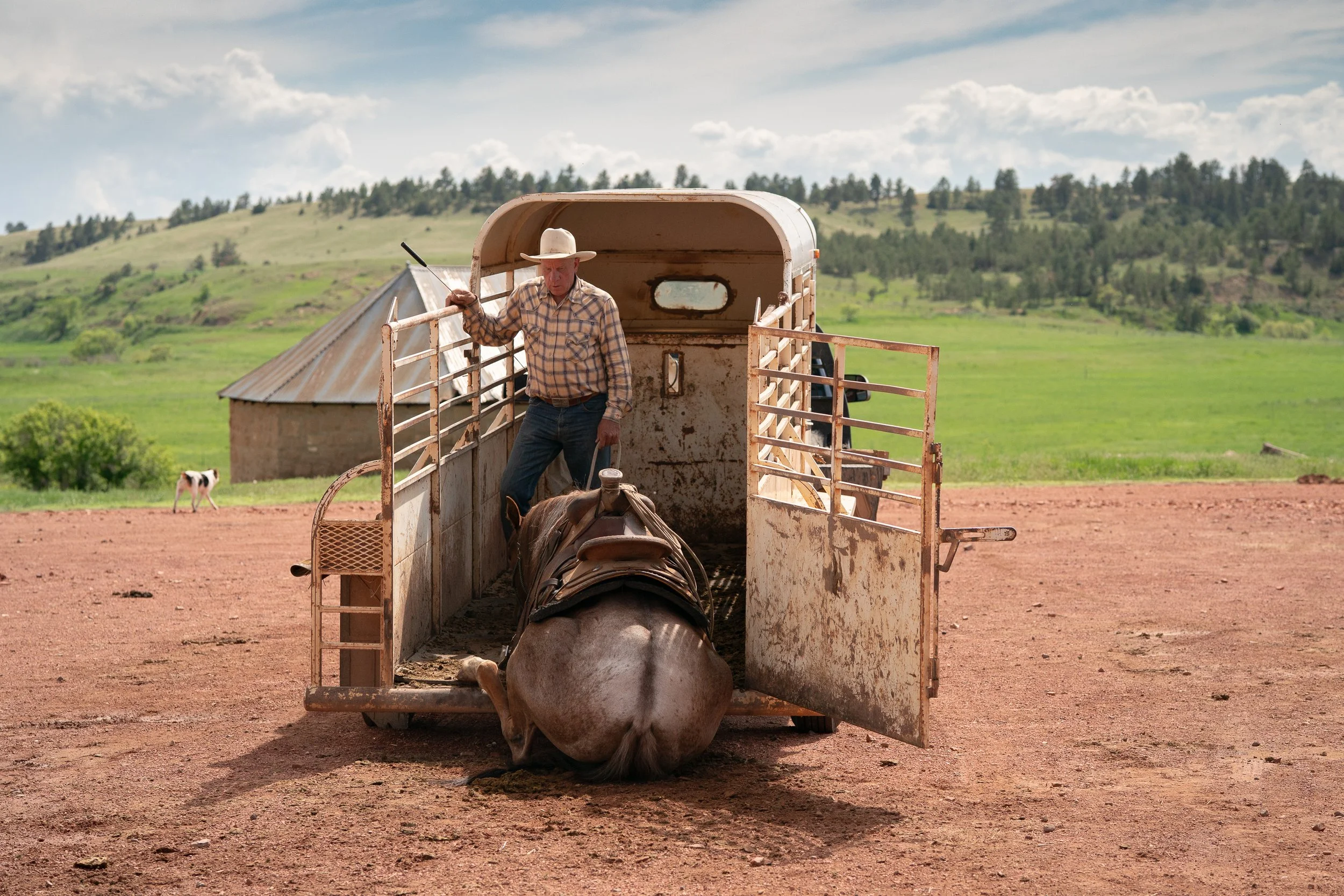
Horse sitting down inside a trailer while Buck Brannaman stands nearby during training in Montana

A horse that shuts down instead of moving forward, sitting back inside the trailer. This is where most would quit, but the work stays the same, steady and patient until something changes.
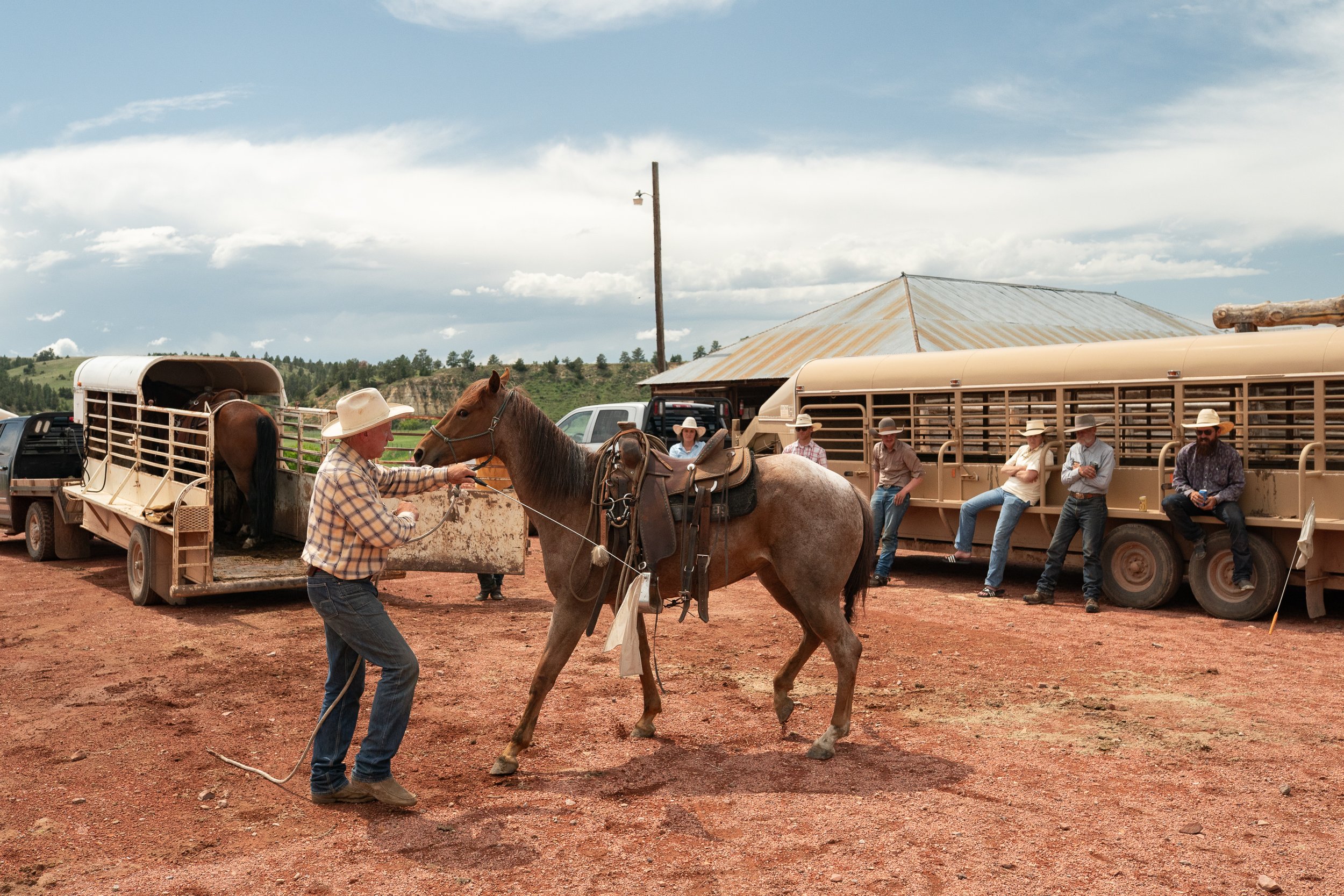
Buck Brannaman working a horse with a lead rope while cowboys sit and watch near trailers on a Montana ranch

Working a young horse away from the trailer while a line of cowboys sits back and watches. No one says much. When someone like this starts working, you pay attention.
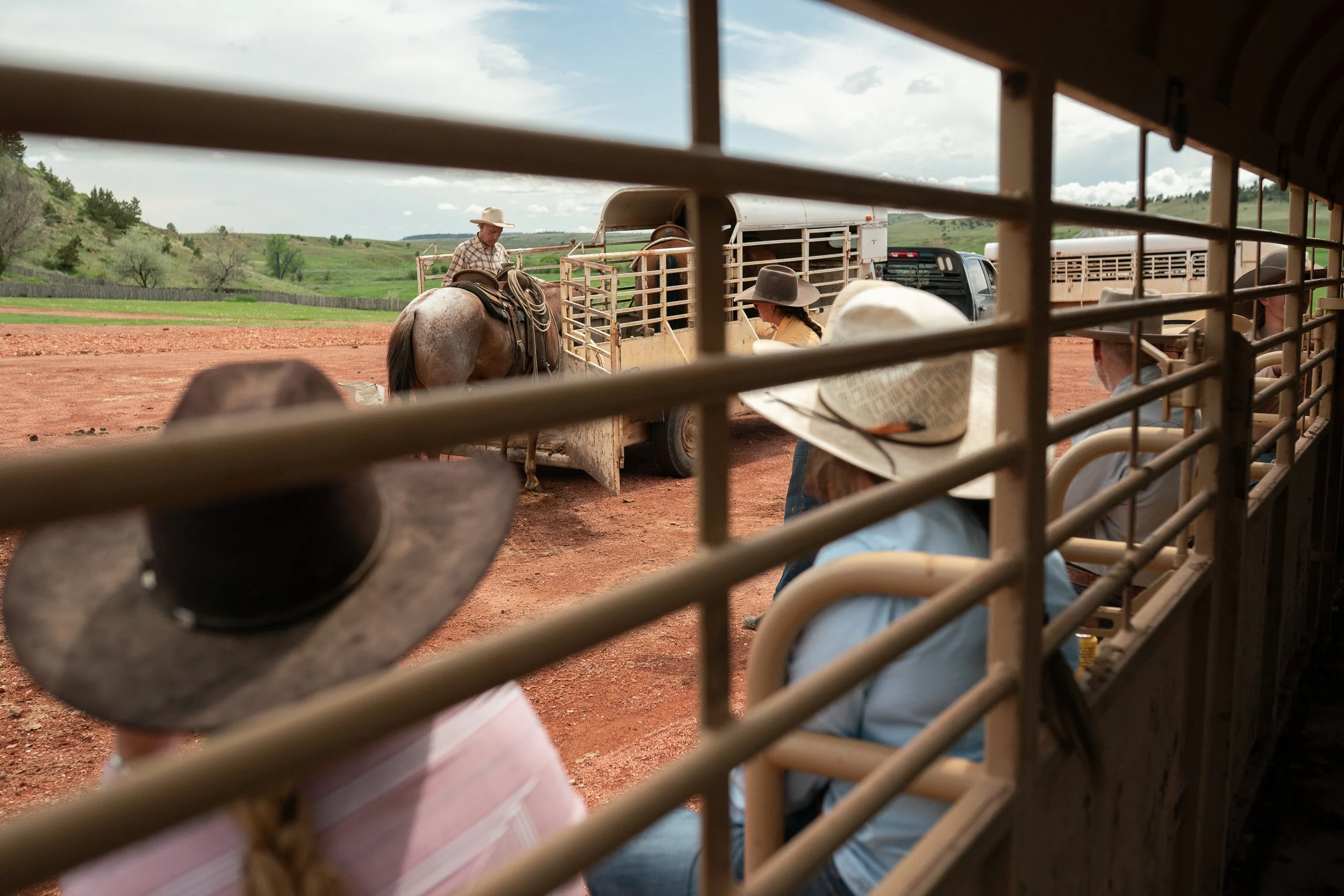
Cowboys watching through the rails of a trailer as Buck Brannaman works a horse near another trailer in Montana

Watching through the rails of a trailer, catching pieces of the work as it unfolds. Not a formal lesson, just a rare chance to see it up close.
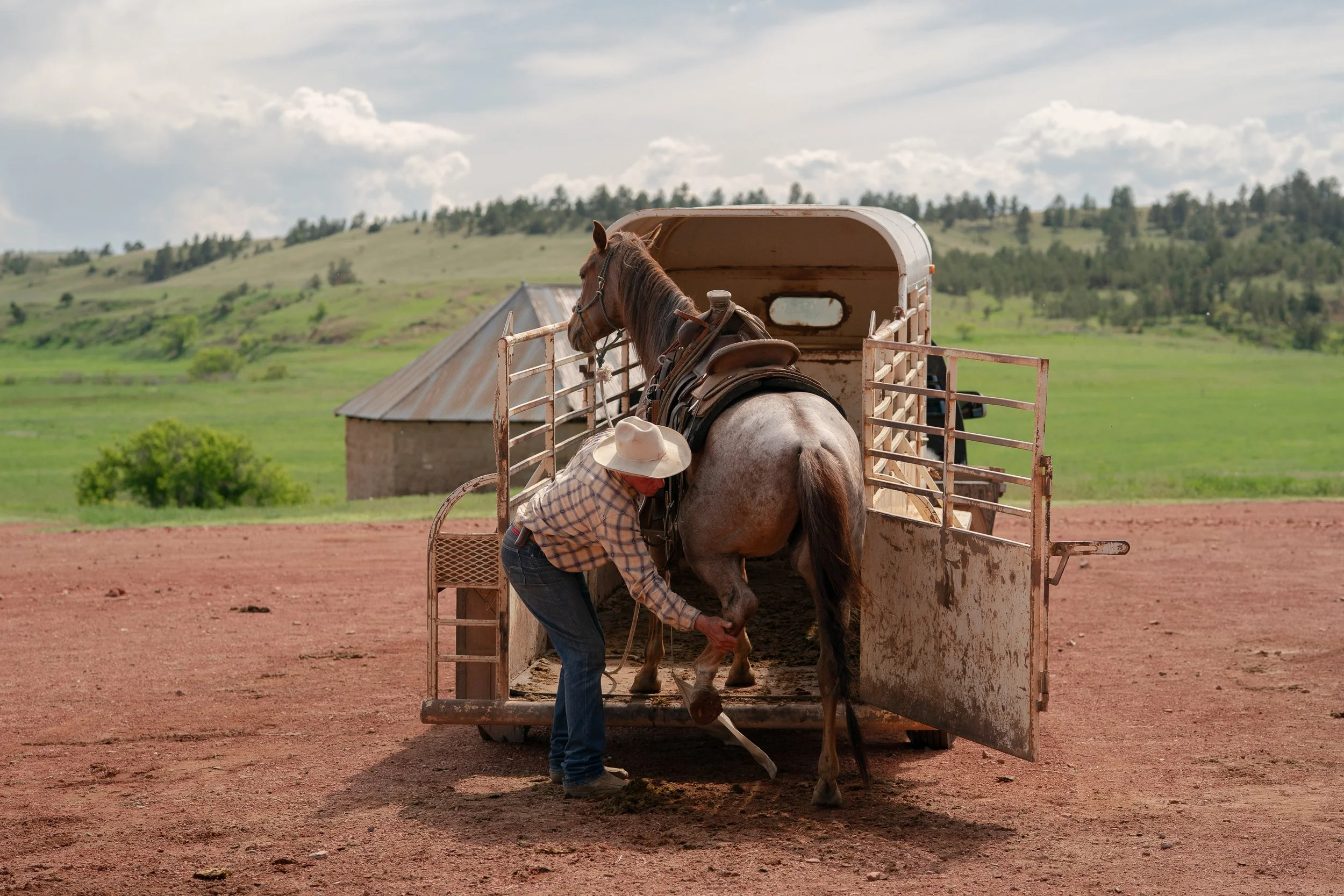
Buck Brannaman guiding a horse stepping into a trailer on a ranch in Montana

Buck Brannaman working at the edge of the trailer, asking the horse forward one step at a time. No force, just timing and feel, the kind of work that builds slowly in the heat after a long day.
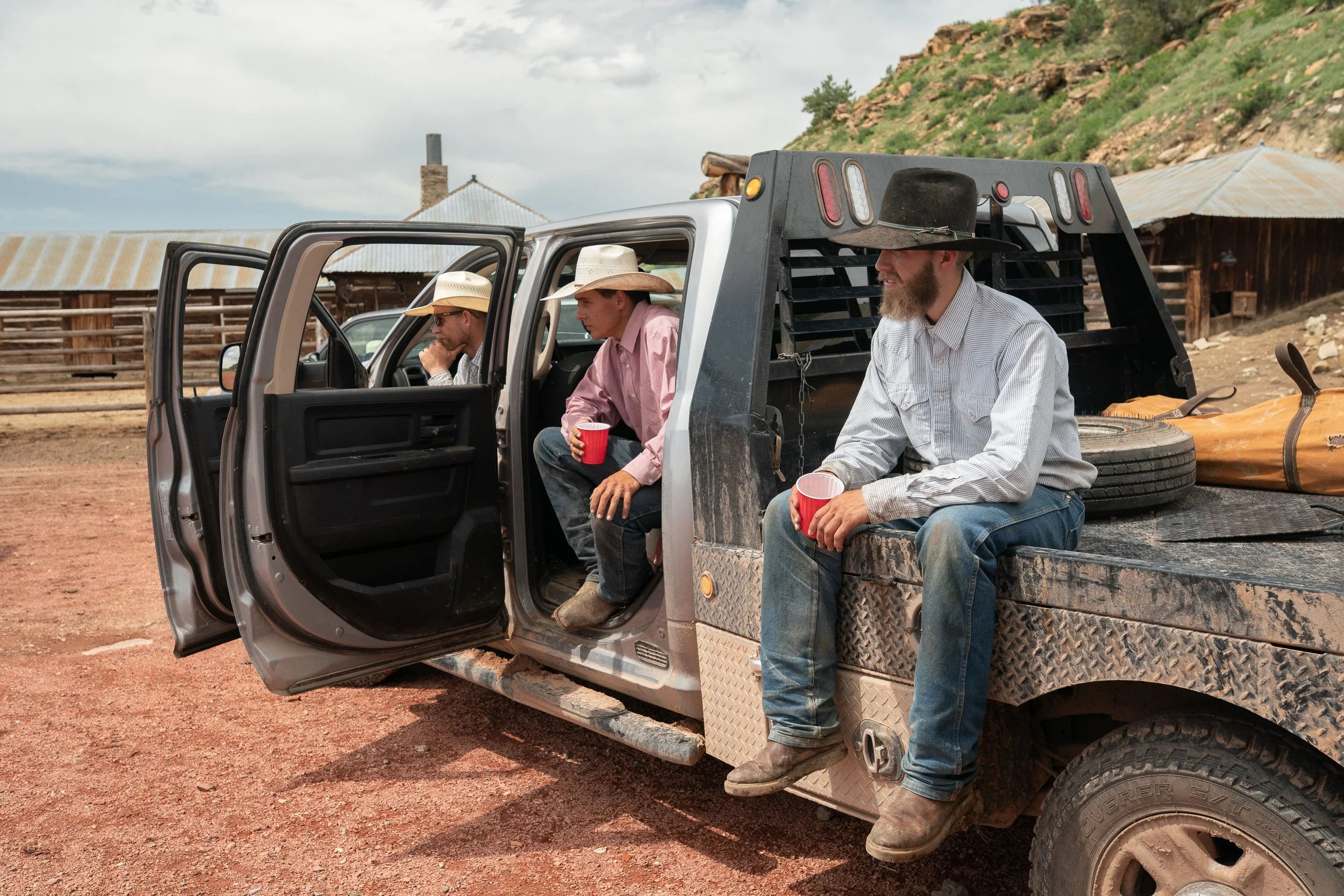
Cowboys sitting on and inside a pickup truck holding drinks while watching horse training on a Montana ranch

Cowboys gathered on a truck, drinks in hand, watching the work unfold from a distance. What started as the end of the day turned into something worth staying for.
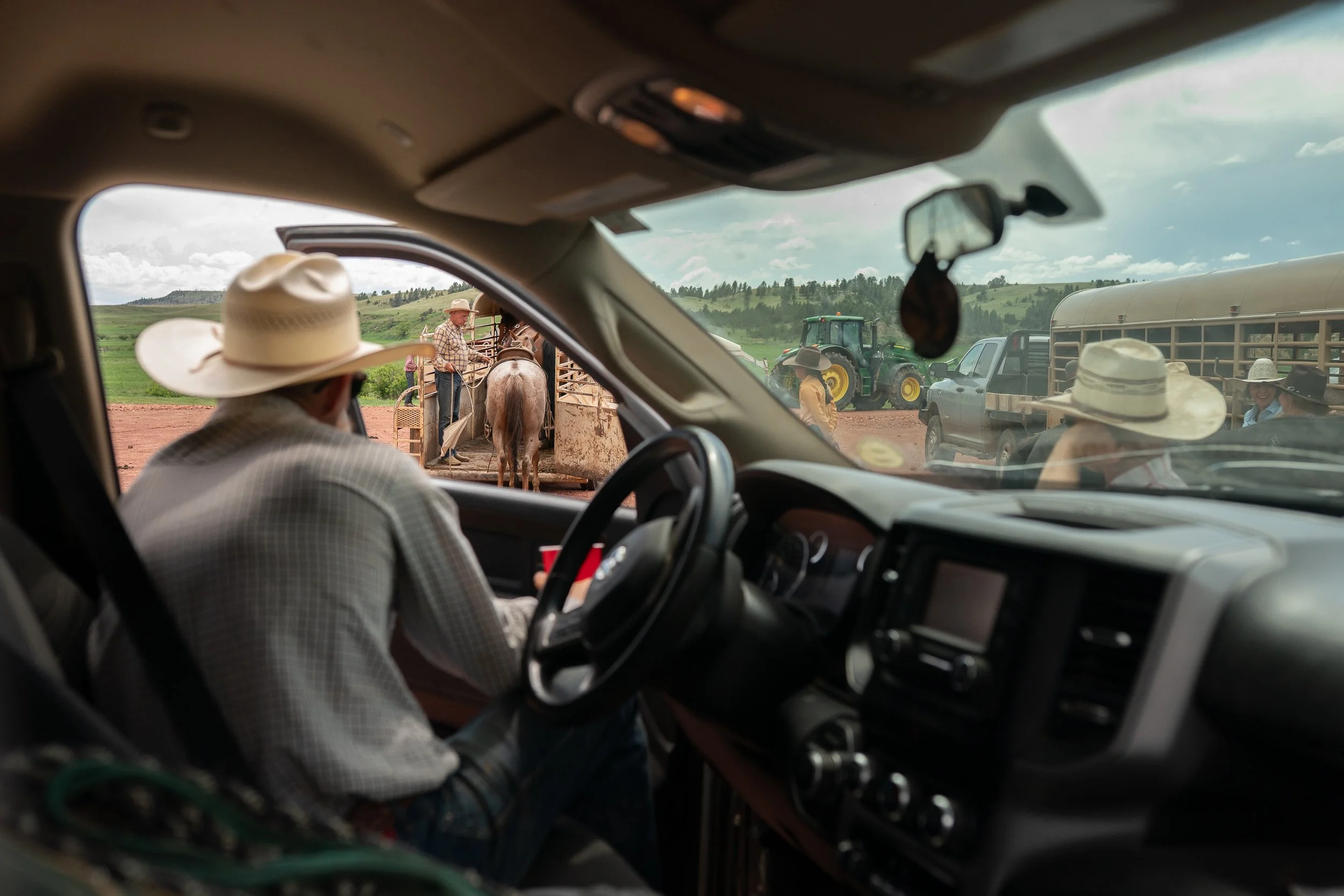
View from inside a pickup truck of a cowboy watching Buck Brannaman work a horse near trailers on a ranch

From inside a truck, looking out at the same quiet process. Different vantage point, same focus, everyone tuned in to the small changes.
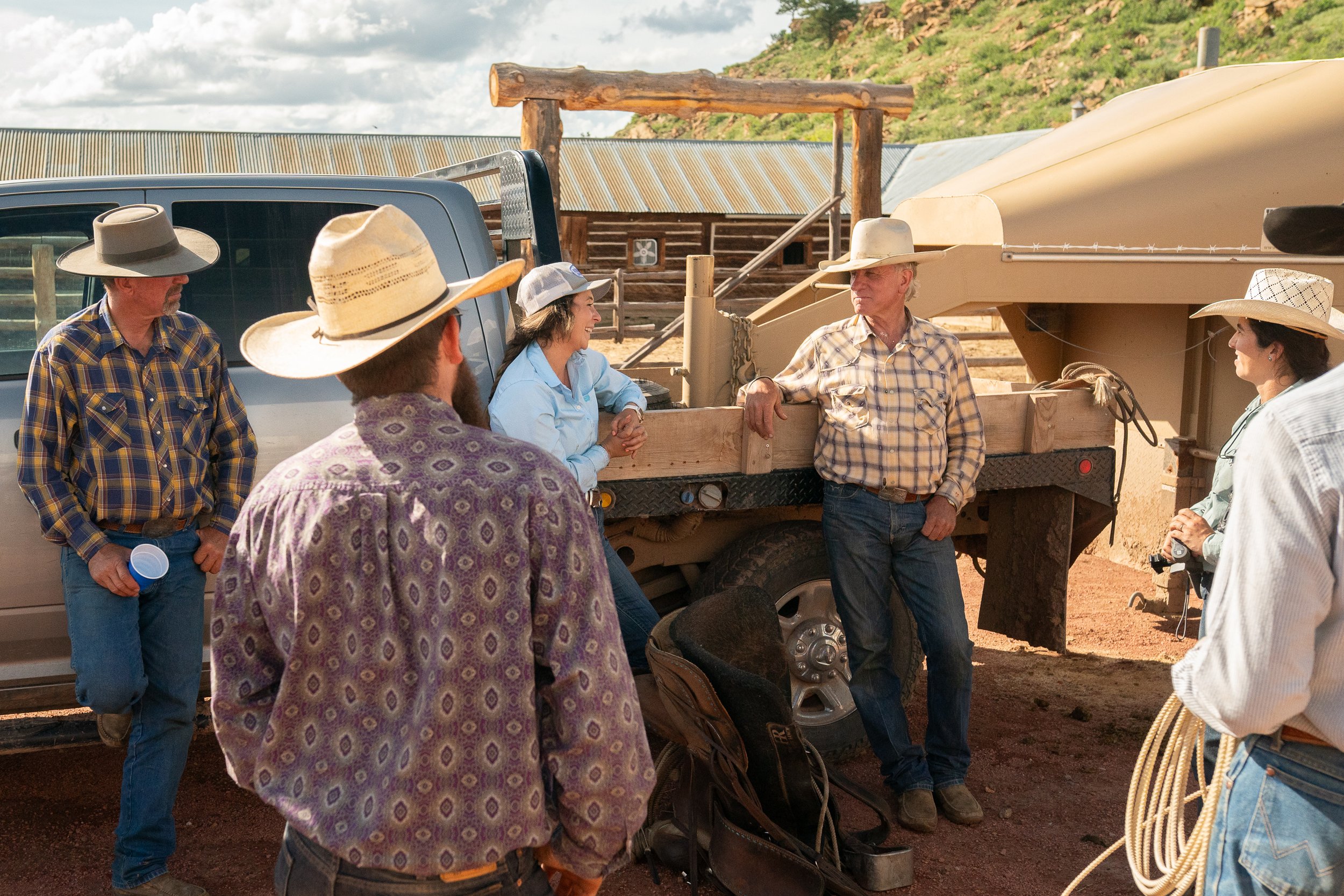
Group of cowboys standing and leaning around a ranch truck talking after work in Montana

Gathered around the truck after the work, talking it through while it is still fresh. The kind of conversations that come from seeing something done right.
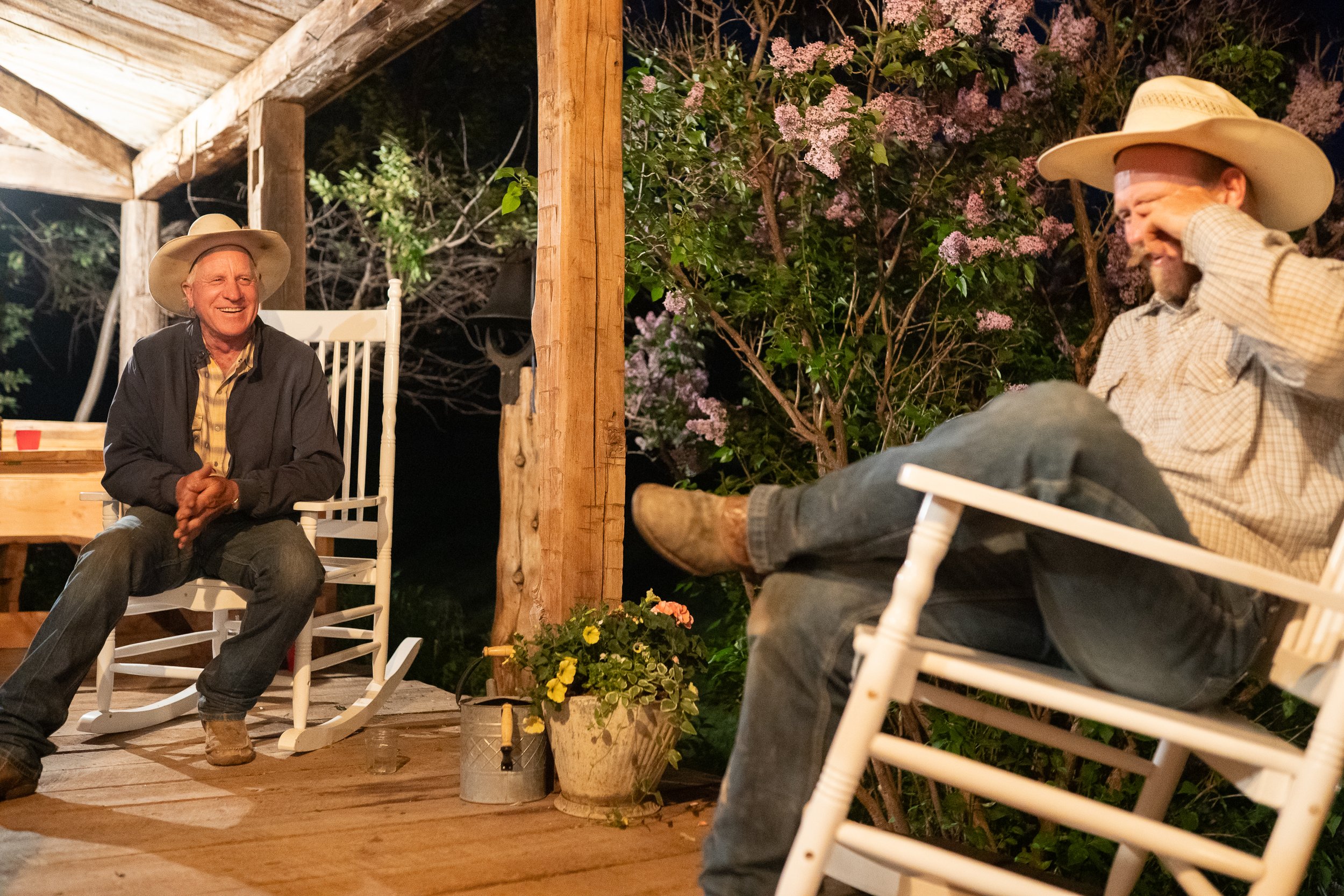
Buck Brannaman sitting on a porch at night talking with another cowboy in rocking chairs

Late evening on the porch, the work behind them and the pace slowed down. Stories, lessons, and time to sit with what the day had to offer.
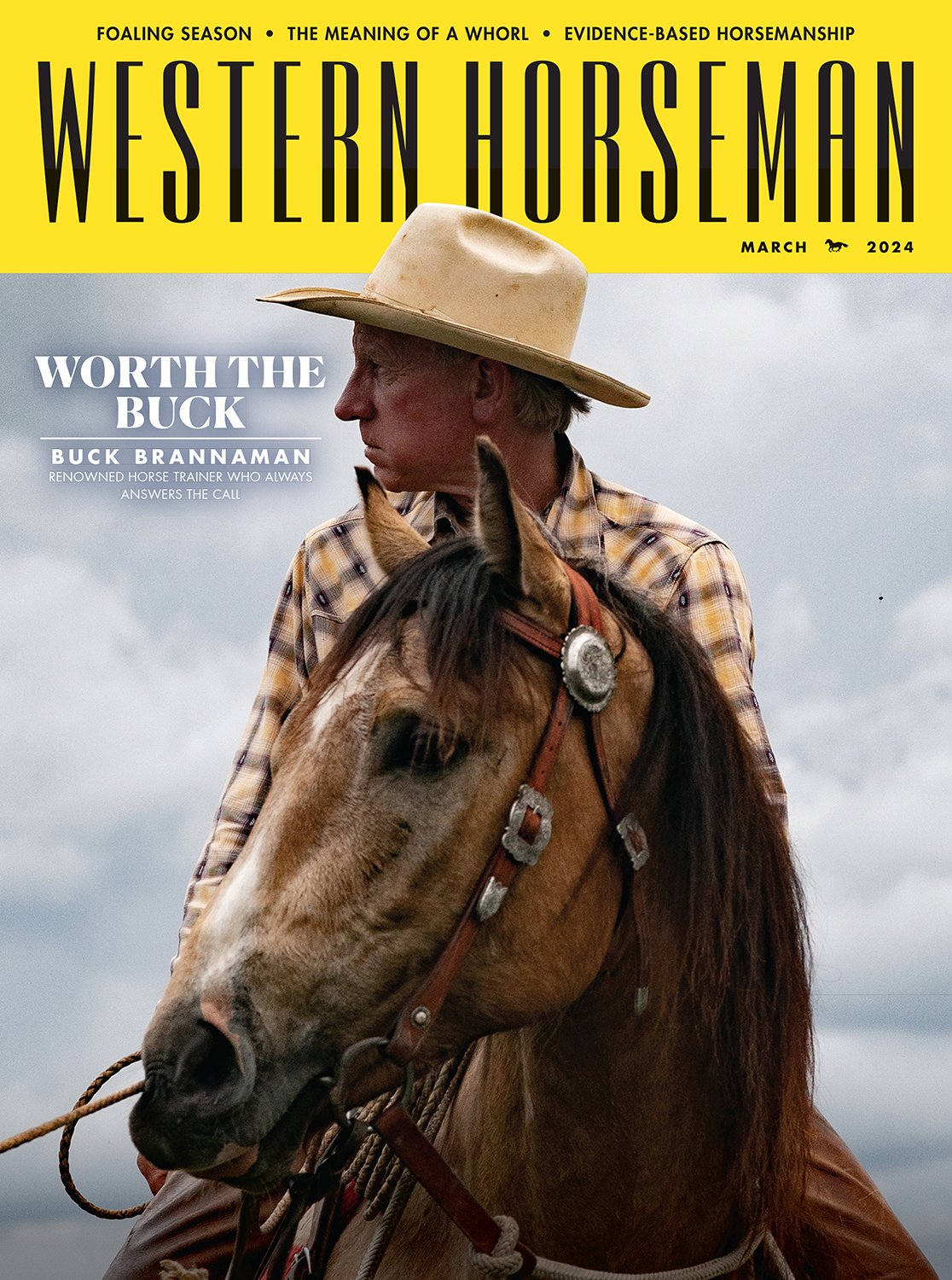
Buck Brannaman on the cover of Western Horseman Magazine

Buck Brannaman - Western Horseman Magazine

American Road Trip Photography

The Great American Road Trip - Photography

When are you supposed to say enough is enough and move on to another subject? Roadside Meditations was published a few months back, which would (should?) be the logical line in the sand stating ok, you did the thing, now try something else! And a person smarter than myself would probably do that! History thus far does not comply. My long term personal project are just that, personal. So I might partially focus on a new subject, but I’m always on the look-out for images that fit the older projects too. It’s not intentional. It just is. I love these projects and can’t help myself.
Click HERE to purchase a copy of Roadside Meditations or contact me directly to inquire about prints of my American road trip photography.

Photograph of a road going through a beautiful cattle ranch in Montana

Wyola, Montana

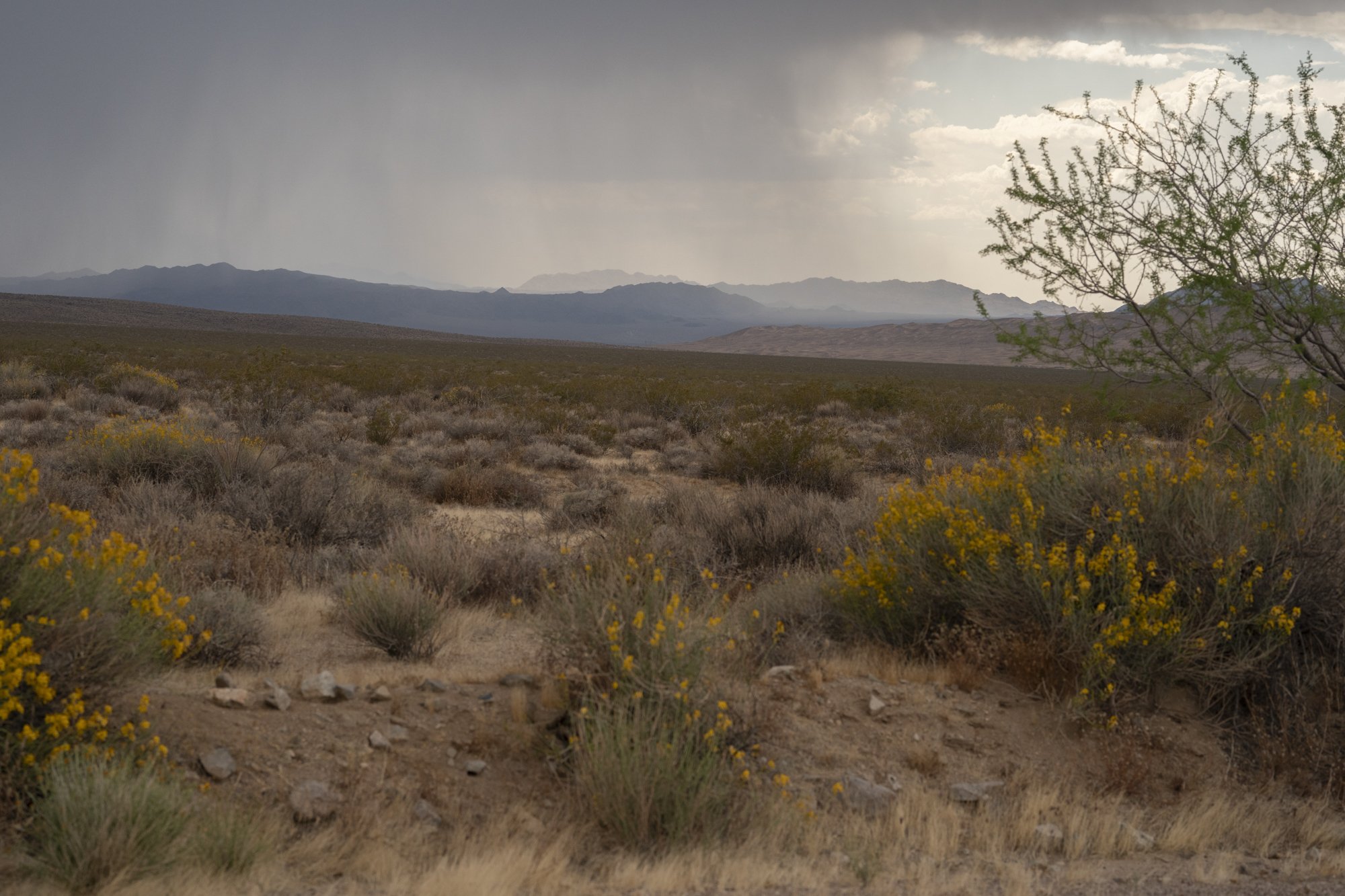
Landscape photo of the California desert

California desert

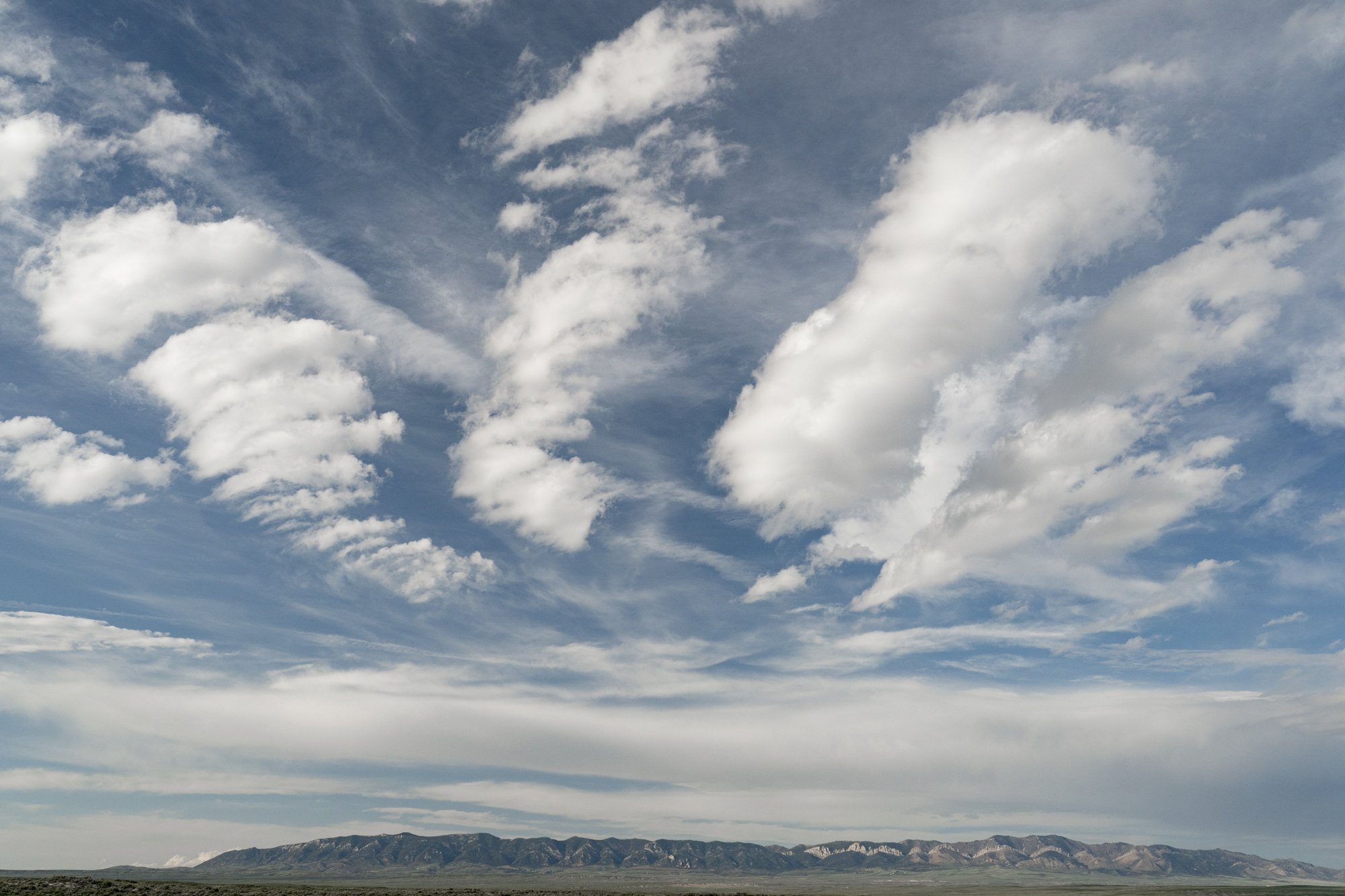
Photograph of a vast Wyoming landscape

Wyoming

Landscape photo of the California desert

California desert

Photograph of a train going through the landscape of Parker, Wyoming

Parker, Wyoming

California desert road trip photo

California desert

Photograph of plants in the California desert

California desert

Aerial Photograph of a road going through a desolate section of the California desert

California desert

Montana Road Trip

Talking highly about Montana is better left to the most lyrical of wordsmiths because I certainly can’t do that place any justice. Maybe that should be a personal goal? I’m fresh off the road after spending over a week in that glorious state and can’t wait to go back. This trip was particularly visual due to to the heavy winter snowfall that made everything greener than green. I’ve never been to Ireland, but the particular hue off grass felt more like something you could only see there. Check back soon to see images from the two cattle ranches I photographed, but don’t expect any images of trout. Those are only in my head.

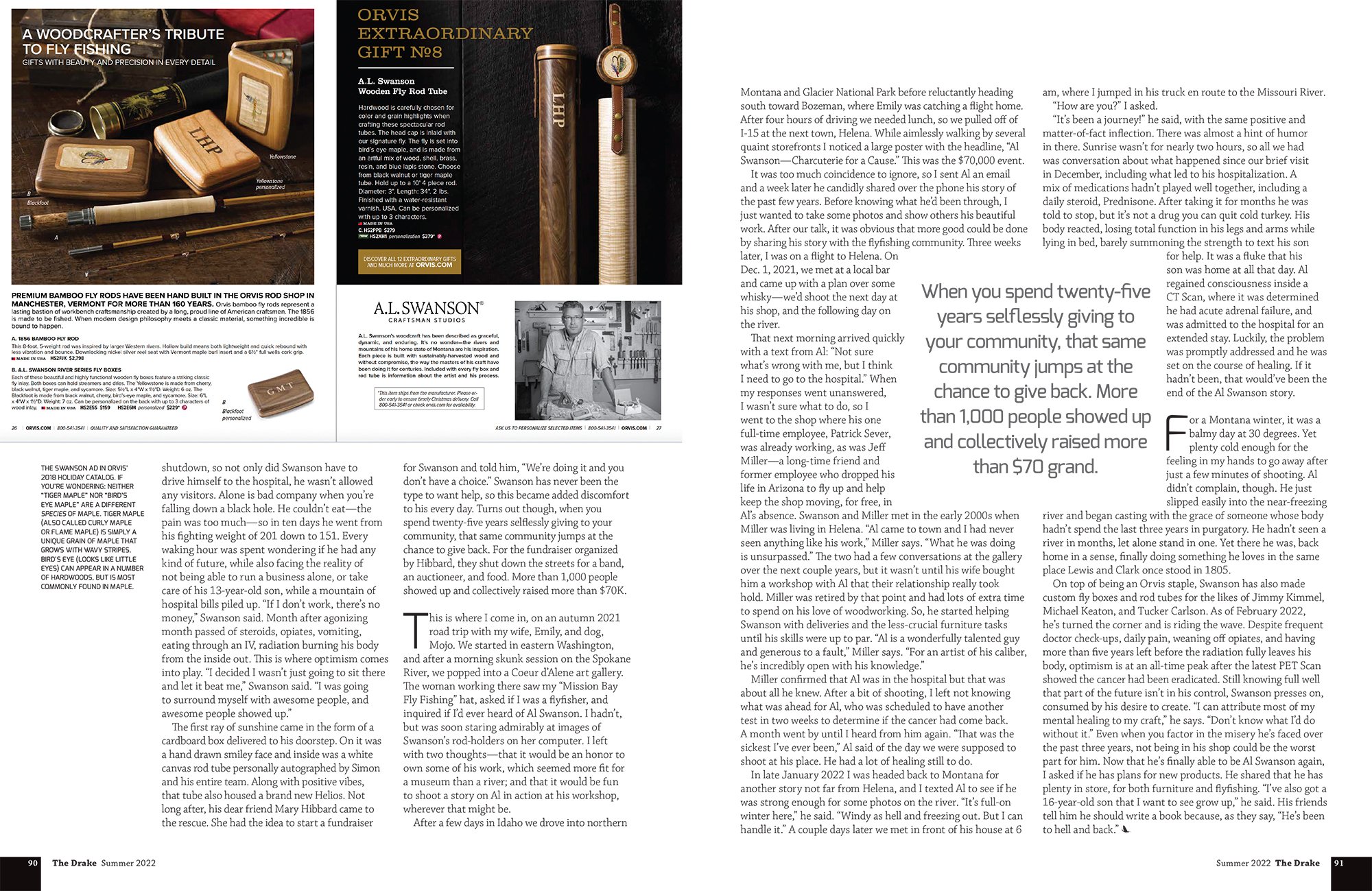
Al Swanson - Master Wood Worker

American Woodworker and Craftsman

Al Swanson - Helena, Montana

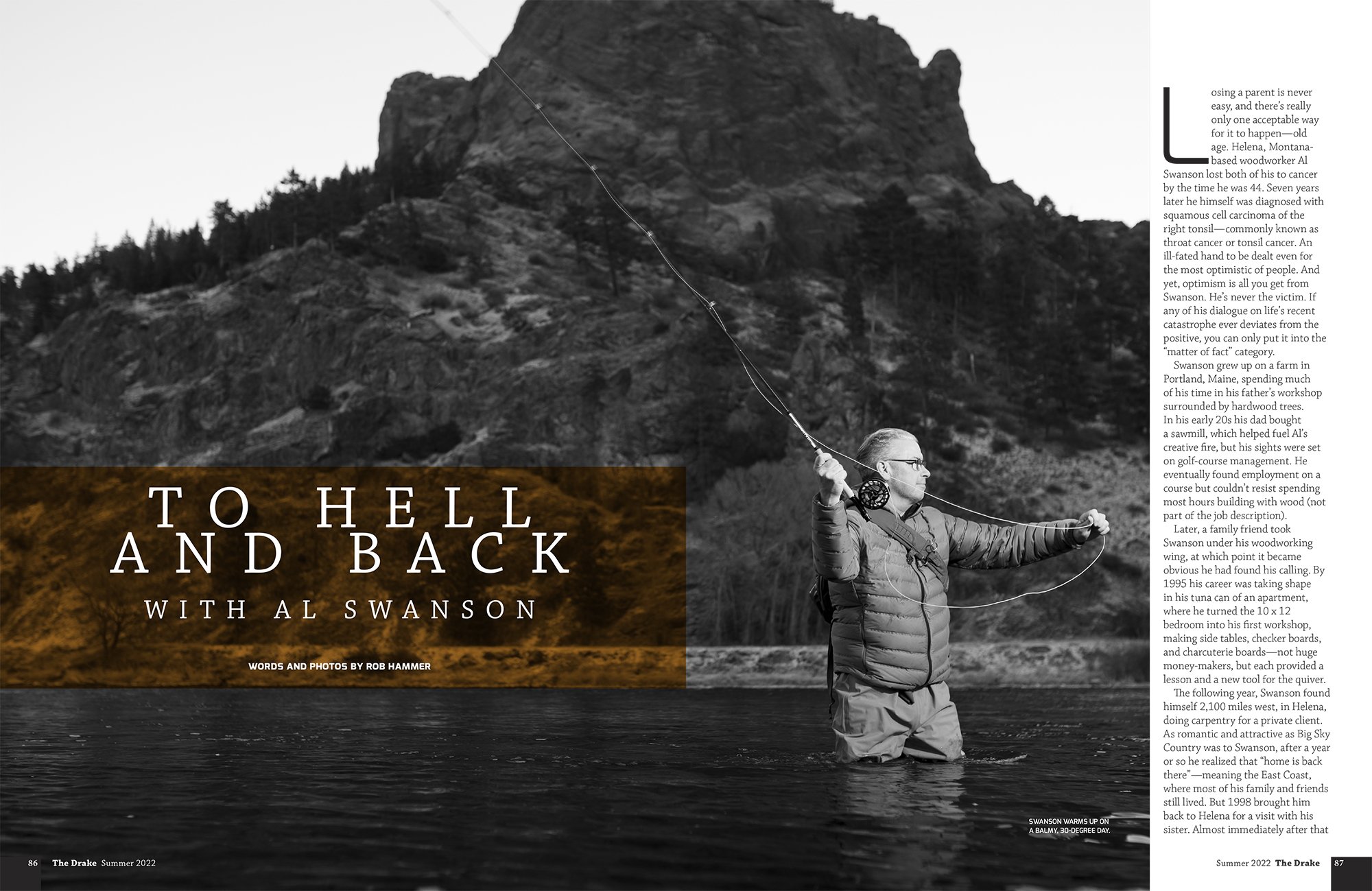
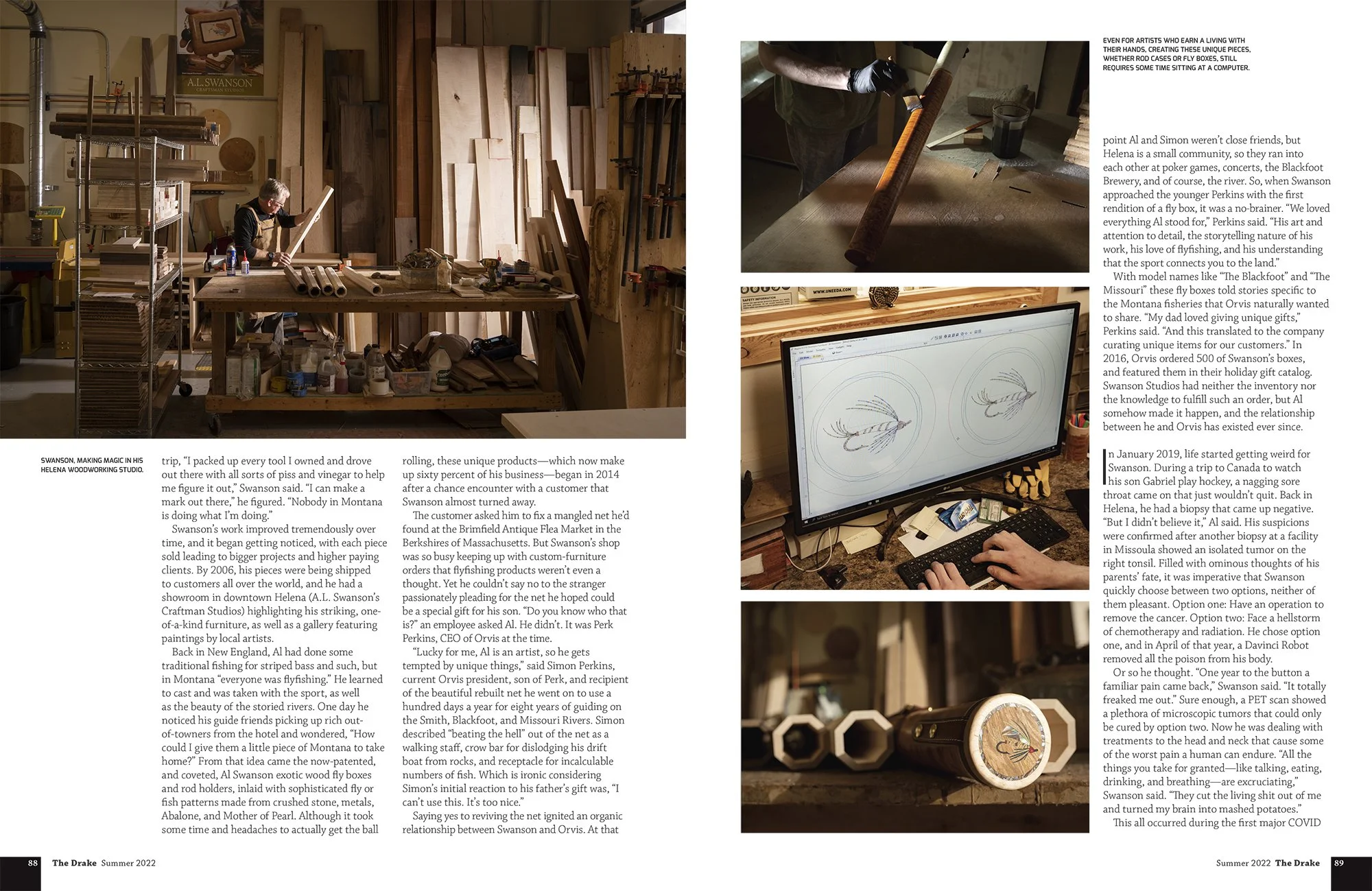
It’s been such a pleasure working with and getting to know Al Swanson. If you’re in the fly fishing world, and don’t know who he is, take some time to learn about his work. It’s exceptional. And the way we came to know each other makes this even better. I’m honored to share his story with words and photos in the latest issue of the Drake Magazine. Here is the unedited version of that story:


Losing a parent is never easy, and really there’s only one acceptable way for it to happen - old age. Al Swanson lost both of his to cancer by the time he was 44. Seven years later he himself was diagnosed with squamous cell carcinoma of the right tonsil. A baneful hand to be dealt even for the most optimistic of people. Yet optimism is all you get from Al. He’s never the victim. If any of his dialogue on life’s recent catastrophe ever deviates from the positive, you can only go as far as putting it into the “matter of fact” category. 

Swanson grew up on a farm in Portland, Maine in his fathers workshop surrounded by hardwood trees where they would make necessities out of necessity. In his early 20’s dad bought a sawmill which helped fuel the creative fire, but his sights were set on golf course management. He eventually found employment on a course yet couldn’t resist spending most hours building with wood (not part of the job description). Later a family friend took Al under his woodworking wing, at which point it became obvious he had found his calling, and the stage was set. 1995 was the year things took shape in a tuna can of an apartment where he turned the 10x12 bedroom into his first workshop making side tables, checker, and charcuterie boards. Not huge money makers, but each one a learning lesson that would afford a new tool for the quiver and unhappy neighbors.


1996 found him 2,100 miles west in Montana doing odd and ends carpentry for a private client where Big Sky Country genuinely flowed into his yet cancerless body. As romantic as the country was, a year or so passed and he realized “home is back there” - speaking of the east where most of his family and friends still lived. 98’ brought him again back to Helena for a visit with his sister. Almost immediately after that trip “I packed up every tool I owned and drove out there with all sorts of piss and vinegar to help me figure it out. I can make a mark out there. Nobody is doing what I’m doing in Montana.” Turns out that piss and vinegar did the trick. The work improved exceedingly over time and began getting noticed, with each piece sold leading to bigger projects and higher paying clients. His road was also paved with plenty of discouragement as every worthwhile venture is. Nevertheless by 2006 he had a showroom/gallery space in downtown Helena highlighting his striking one of a kind furniture as well as paintings by other local artists he personally invited in. Business was boomin’. Al’s work was being shipped to customers all over the world. 

Back east Al had done some traditional ocean fishing for striped bass and such. In Montana “everyone was fly fishing”. He was taken with the sport, as well as the magnetic beauty of the storied rivers, and thus learned to cast. Al was in. All in. One day he noticed his guide friends picking up rich out of towners from the hotel to go fishing and wondered “How could I give them a little piece of Montana to take home?” From that the idea was eventually born for the now patented and coveted Al Swanson exotic wood fly boxes and rod holders inlaid with sophisticated fly/fish patterns made from crushed stone, metals, Abalone, and Mother of Pearl.  Although it took quite some time and even more headaches to actually get the ball rolling. The products that now make up 60% of his business were ultimately sent afloat by a chance encounter in 2014 with a customer Al almost turned away when he asked him to fix a mangled net found at the Brimfield Antique Fly Market in the Berkshires (Massachusetts). The shop was so busy keeping up with custom furniture orders that fly fishing products weren’t even a thought. Yet he couldn’t say no to the stranger passionately pleading for the net he hoped could be a special gift for his son. “Do you know who that is?” an employee asked Al afterward. Enter Perk Perkins - CEO of a little fly fishing company called Orvis. “Lucky for me Al is an artist, so he gets tempted by unique things'' -says Simon Perkins (the son and current president of Orvis) of the beautiful rebuilt net he went on to use 100 days a year for 8 years of guiding on the Smith, Blackfoot, and Missouri Rivers. Where he “beat the hell” out of the net as a walking staff, crow bar for dislodging his drift boat from rocks, and netting incalculable numbers of fish. Ironic considering the initial reaction to his fathers gift was “I can’t use this. It’s too nice”. Saying yes to the net ignited an organic relationship between Al and a company that shared a high commitment to quality and a synergy of beliefs. At that point Swanson and Simon weren’t close friends, but Helena is a small community, so they ran into each other at the Blackfoot Brewery, poker games, concerts, and of course, the river. So later on when Al approached Simon with the first rendition of the fly box, it was a no brainer. “We loved everything Al stood for. His art and attention to detail, the story telling nature of the work, love of fly fishing, and his understanding that the sport connects you to the land” said Simon. Of course with model names like “The Blackfoot” and “The Missouri” they told stories specific to the Montana fisheries that Orvis naturally wanted to share. Perkins said “My dad loved giving unique gifts, which translated to the company’s cultural desire to curate unique products for our customers.”  In 2016 Orvis ordered 500 boxes from Swanson to be featured in their holiday gift catalog. Swanson Studios had neither the inventory or knowledge to fulfill such an order, but he figured it out and that relationship is still alive today. 

January 2019 life started getting weird during his son Gabriel’s hockey trip to Canada when a nagging sore throat came on that just wouldn’t quit. Back in Helena he had a biopsy done which came up negative, “but I didn’t believe it” Al said. His suspicions were confirmed after another biopsy at a facility in Missoula showed an isolated tumor in the right tonsil. Filled with ominous thoughts of his parents fate it was imperative he quickly make one of two choices: do the operation to remove the cancer or deal with the hell storm of chemotherapy and radiation. He chose option one and in April of that same year a Davinci Robot removed all the poison from his body. Or so he thought. “One year to the button a familiar pain came back that totally freaked me out”. Sure enough, a PET Scan showed a plethora of microscopic tumors that could only be cured by option number 2. The first go round wasn’t so bad, but now he was dealing with treatments to the head and neck that cause some of the worst pain a human can endure. “All the things you take for granted like talking, eating, drinking, and breathing are excruciating. They cut the living shit out of me and turned my brain into mashed potatoes.” This all occurred during the first major COVID shutdown, so not only did Al have to drive himself to the hospital, he wasn’t allowed to have any visitors. Alone is bad company when you’re falling down a black hole. Eating was no longer a matter of need, it was a matter of can’t. The pain was too much, so he went from his fighting weight of 201 down to 151 in ten days. Every waking hour was spent  wondering if he had any kind of future, while also facing the reality of not being able to single handedly run a business or take care of his 13 year old son while a glacial mountain of hospital bills piled up. “If I don’t work, there’s no money”. Month after agonizing month passed of eating through an IV, steroids, opiates, vomiting, radiation burning his body from the inside out and “not knowing what tomorrow is going to bring until it comes. Then you wake up and realize all it’s brought is pain”. That was his immediate and unavoidable truth. It’s also where optimism comes into play. “I decided I wasn’t going to sit there and let it beat me. I was going to surround myself with awesome people, and awesome people showed up.” The first ray of sunshine came in the form of a cardboard box delivered to his doorstep. On it was a hand drawn smiley face and inside was a white canvas rod tube personally autographed by Simon and his entire team. Along with positive vibes that tube also housed a brand new Helios. Not long after his dear friend Mary Hibbard came to the rescue. She had the idea to start a fundraiser for Al and said “we’re doing it and you don’t have a choice”. Swanson has never been the type to want help so this became added discomfort to his every day. Turns out though, when you spend 25 years selflessly giving to your community, that same community jumps at the chance to give back. Mary did the thing right. They shut down the streets for a band, auctioneer, food, and over 1,000 people showed up that collectively raised over 70k for Al.

This is where I come in. A photographer and writer on a trip with my wife and dog. Mojo and I drove from San Diego. She flew. After a morning skunk session on the Spokane River we popped in a Coeur d’ Alene art gallery. The kind women working there looked at my “Mission Bay Fly Fishing” hat and asked if I was a fly fisherman. Not wanting to be hassled into buying one of their arresting Mel McCudden paintings I said “yes, but I’m not very good”, and kept moving. She followed and inquired if I ever heard of Al Swanson. I hadn’t, but that was where the conversation took a turn and led to me drooling over images of Al’s rod holders on the computer behind their front desk. Before she could talk me into pulling my credit card out, I left  with two thoughts - it would be an honor to own some of his work that seemed more fit for a museum than the river, but also that it would be fun to shoot a story on Al in action at his workshop, wherever that might be. After a few days in Idaho we drove on to northern Montana and Glacier National Park. Fall was in its prime. Everywhere you looked nature was putting on a show. Colors. Wildlife. Rainbows. Sunshine one minute and snow the next. Needless to say we didn’t want to leave when the time came. Nevertheless, our reluctant trek started down to Bozeman where Emily was scheduled for her return flight home. After 3 or 4 hours of driving through Montana’s majesty all 3 of us needed to stretch our legs and eat some lunch. So we pulled off The 15 into the next town that just happened to be Helena. Aimlessly walking by several quaint storefronts my eyes looked up just long enough to notice a large poster with the headline  “Al Swanson - Charcuterie for a Cause” - aka the $70,000 event. It was all too much to ignore, so I sent Al an email. A week later we spoke on the phone for about an hour when he candidly shared his transmigration of the past few years. Before knowing the destruction he’d been through I just wanted to document him at work to be able to show others his art. After our talk it was obvious that more good could be done by sharing his story with the fly fishing community. 3 weeks later I was on a flight to Helena. December 1, 2021 we met at a local bar, came up with a plan over whisky to shoot the next day at his shop, and the following on the river. That next morning arrived quickly with a text from Al “not sure what’s wrong with me, but I think I need to go to the hospital”. My responses were unmatched. Not knowing what to do I went to the shop where his one full time employee and CNC master Patrick Sever was already at it along with Jeff Miller- a long time friend and former employee who dropped his life in Arizona to fly up and help keep the shop moving (for free) in Al’s absence.  Al and Jeff met in the early 2000’s when Jeff was living in Helena. ”He came to town and I had never seen anything like his work. What he was doing is unsurpassed”. They had a few conversations at the gallery over the next couple years, but it wasn’t until Jeff’s wife bought him a workshop with Al that their relationship really took hold. Miller was retired by that point and had lots of extra time to spend on his love of woodworking. So he started helping Swanson out with deliveries and the less crucial furniture tasks until his skills were up to par. “Al is a wonderfully talented guy and generous to a fault. For an artist of his caliber, he’s incredibly open with his knowledge” says Miller. He also stressed how much Al cares about the final product. “If it’s not right, it’s not going out the door”. A few hours later he confirmed that Al was in the hospital but that was about all he knew. I spent some time making images at the shop, which from the outside, is quite inconspicuous. Any passerby would have no idea that world class wooden art is continuously made and shipped from something so nondescript.  After a bit of shooting I left not knowing what was ahead for Al who was scheduled to have another test in 2 weeks to determine if the cancer had come back. A month went by until I heard from him again. “That was the sickest I’ve ever been” he said of the day we were supposed to shoot at his place. He had a copious amount of healing still to do. 

Late January 2022 I was headed back up to Montana for another story not far from Helena and text Al to see if he was strong enough for some action on the river. “It’s full on winter here. Windy as hell and freezing cold………whatever, I can handle it”. Couple days later we met in front of his house at 6am where I jumped in his truck on the way to the Missouri River and asked “How are you?” “It’s been a journey!” he said with that same positive and matter of fact inflection. There was almost a hint of humor in there too. Things were changing for the better. Sunrise wasn’t for almost two hours so all we had was conversation about what happened since our brief visit in December, including the debauchery leading to his hospitalization that morning. A battery of medication that didn’t play well together including a daily steroid (Prednisone) mouth rinse to help with the open lesions and ulcers prescribed by an outside doctor unbeknownst to his inhouse team. After taking it for months he was told to stop, but it’s not a drug you can quit Cold Turkey. His body reacted, losing total function in his legs and arms while laying in bed, barely summoning the strength to text his son for help. It was a fluke that his son was home at all that day. Al regained consciousness inside a CT Scan where it was determined he had acute adrenal failure, then admitted to the hospital for an extended stay. Al’s insides were once again shattered but he had dodged another bullet. Luckily the problem was promptly addressed and he was set on the course of healing. If not, there’s zero doubt that would be the end of his story.  

For a Montana winter it was a pretty balmy day at 30 degrees. Yet plenty cold enough for the feeling in my hands to go away after just a few minutes of shooting. Al didn’t complain though. He just slipped fluidly into the near freezing river and began casting with the grace of someone half his age whose body didn’t spend the last three years in purgatory. He hadn’t seen a river in months, let alone stand in one. Science just wouldn’t allow it. Yet there he was, back home in a sense, finally doing something he loves in the very same place Lewis and Clark once stood in 1805. And as long as we’re name dropping I’ll do it for Al because he won’t. On top of being an Orvis staple he’s also made custom boxes and tubes for people like Jimmy Kimmel, Michael Keaton, and Tucker Carlson. Today, at least as of our latest phone conversation,  he’s really turned the corner and is riding the wave. Despite frequent doctor check-ups, daily pain, weaning off opiates, and having 5+ years left before the radiation fully leaves his body, optimism is at an all time peak after the latest PET Scan showed the cancer had been eradicated. Still knowing full well that part of the future isn’t in his control,  he presses on, consumed by his desire to create. “I can attribute most of my mental healing to my craft. Don’t know what I’d do without it.” Even when you factor in the merciless misery he’s faced over the last 3 years, not being in his shop could be the worst part for him. Now that he’s finally able to be Al Swanson again, I asked if he has plans for new products. To which he ensures there is plenty in store, for both furniture and fly fishing. “I’ve also got a 16 year old son that I want to see grow up”. His friends all tell him he should write a book because, as they say, “he’s been to hell and back”.   


Driving across America

Cross Country Road Trip - America - Photography

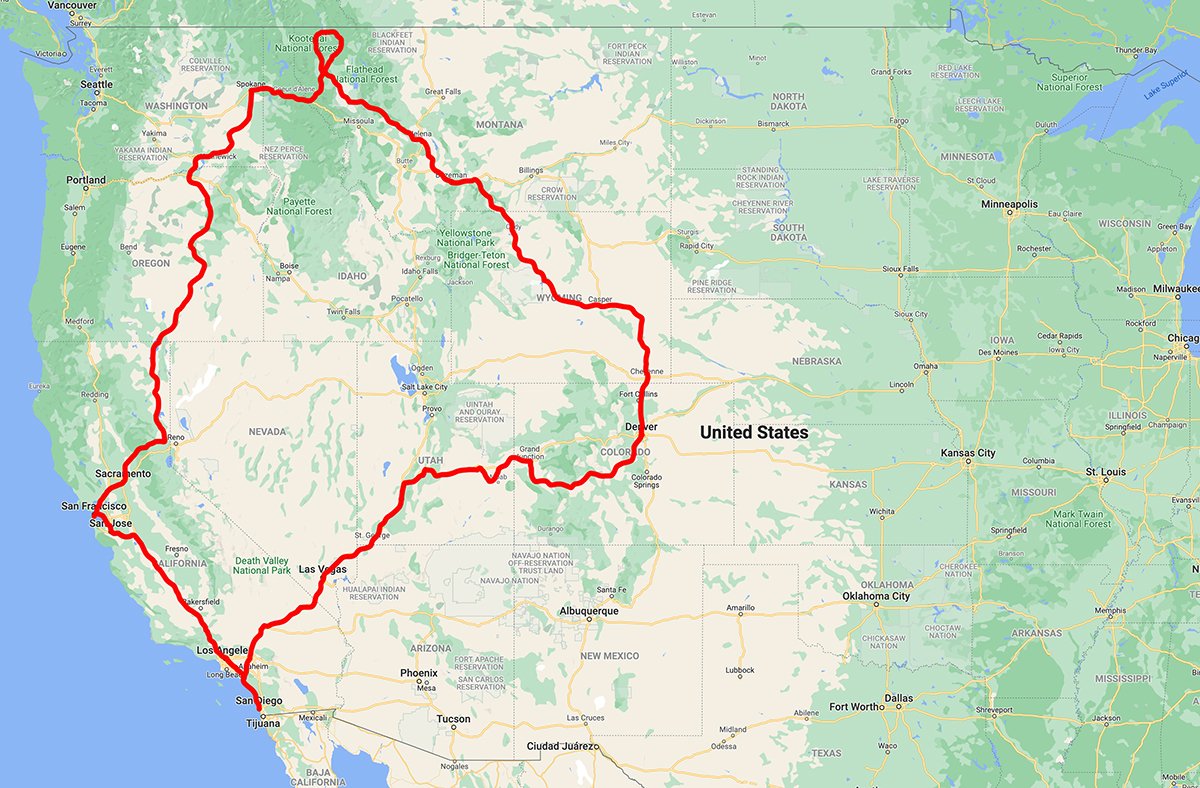
There aren’t a lot of positive things things to say about American highways. Whenever possible I try avoid the soulless stretches of poorly maintained pavement that teach you very little about the country and the towns/people that inhabit it. The 15 on the other hand is something special. It’s one very long stretch of highway that’s as fascinating as any “blue highway” (backroad) in the USA. I’ve personally been traveling this road since 2006 during the move from Upstate, NY to San Diego, CA. It blew my mind then and still does today. Once you get north of the clusterfuck that is Los Angeles /Riverside County and into the desert, there’s a lot to love. Images can be made from the highway or, if you want to get more intimate, try ducking off into one of the many small towns along the way.

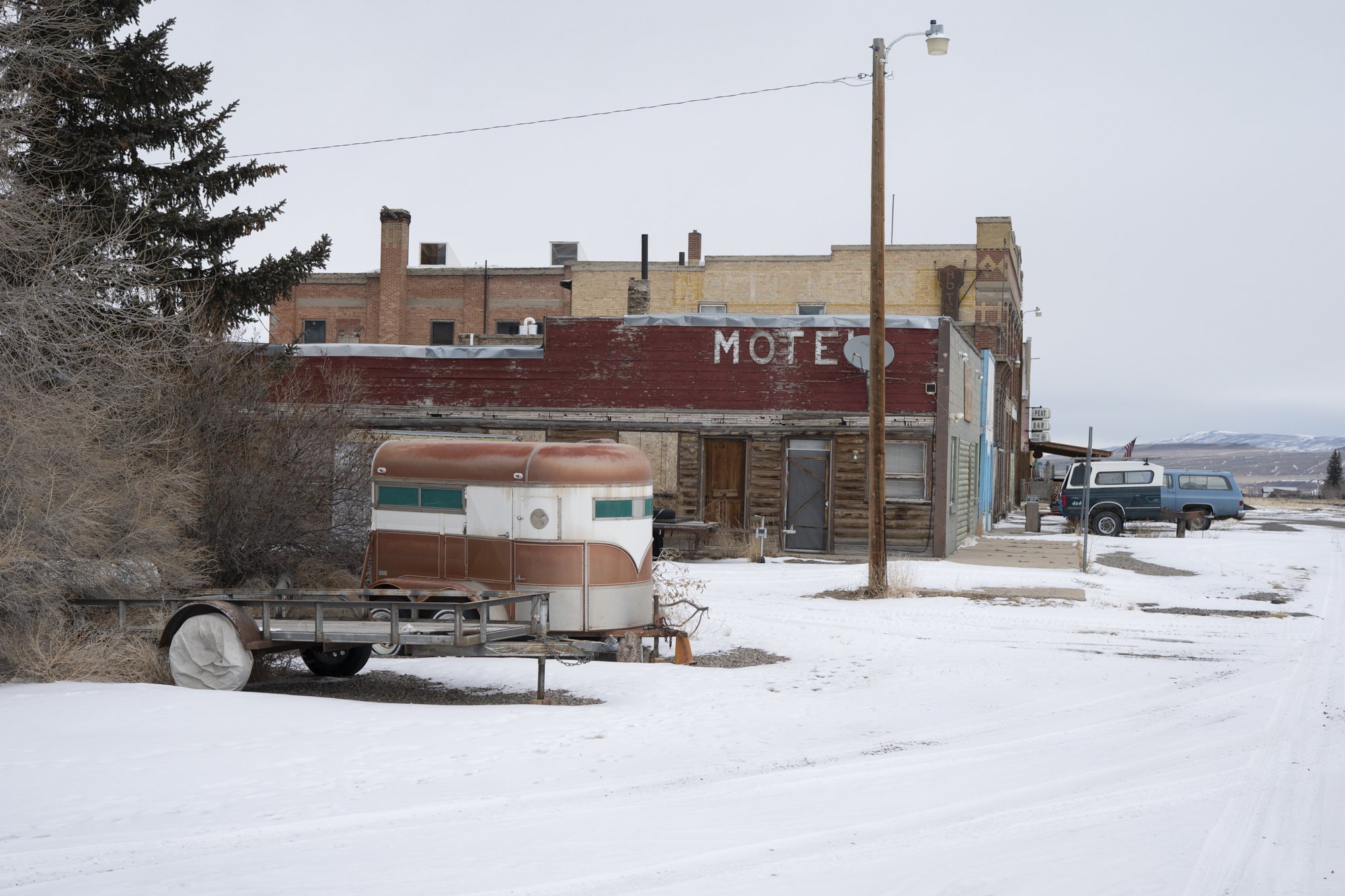
Last month I was working on a a few stories up in Montana without a ton of time to get there, so The 15 it was, straight up north from southern California. Regardless, I ALWAYS find time in-between destinations for one or many of my ongoing series. This trip found images that will fit nicely into the “America” and “Hotel” series.

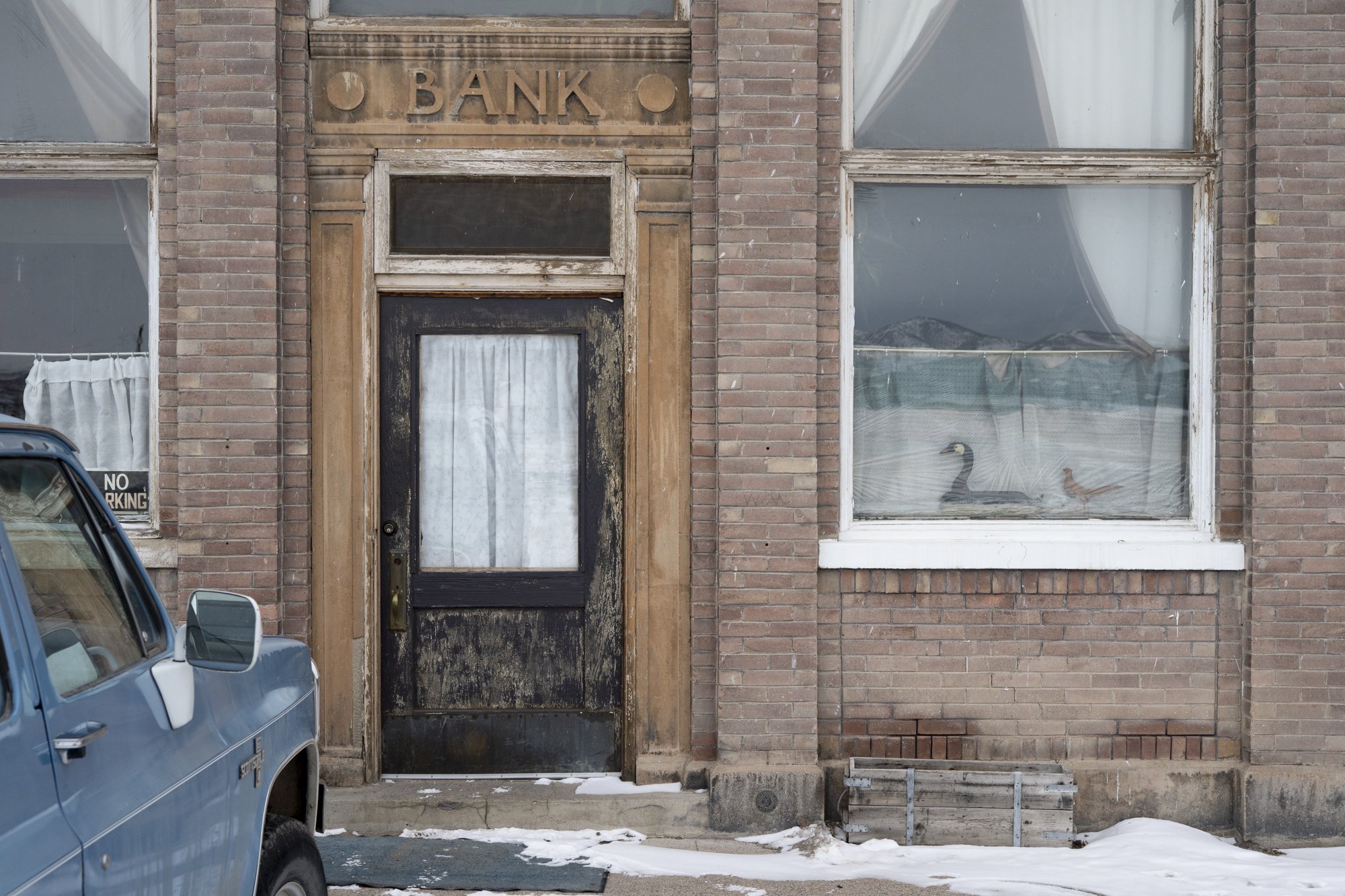
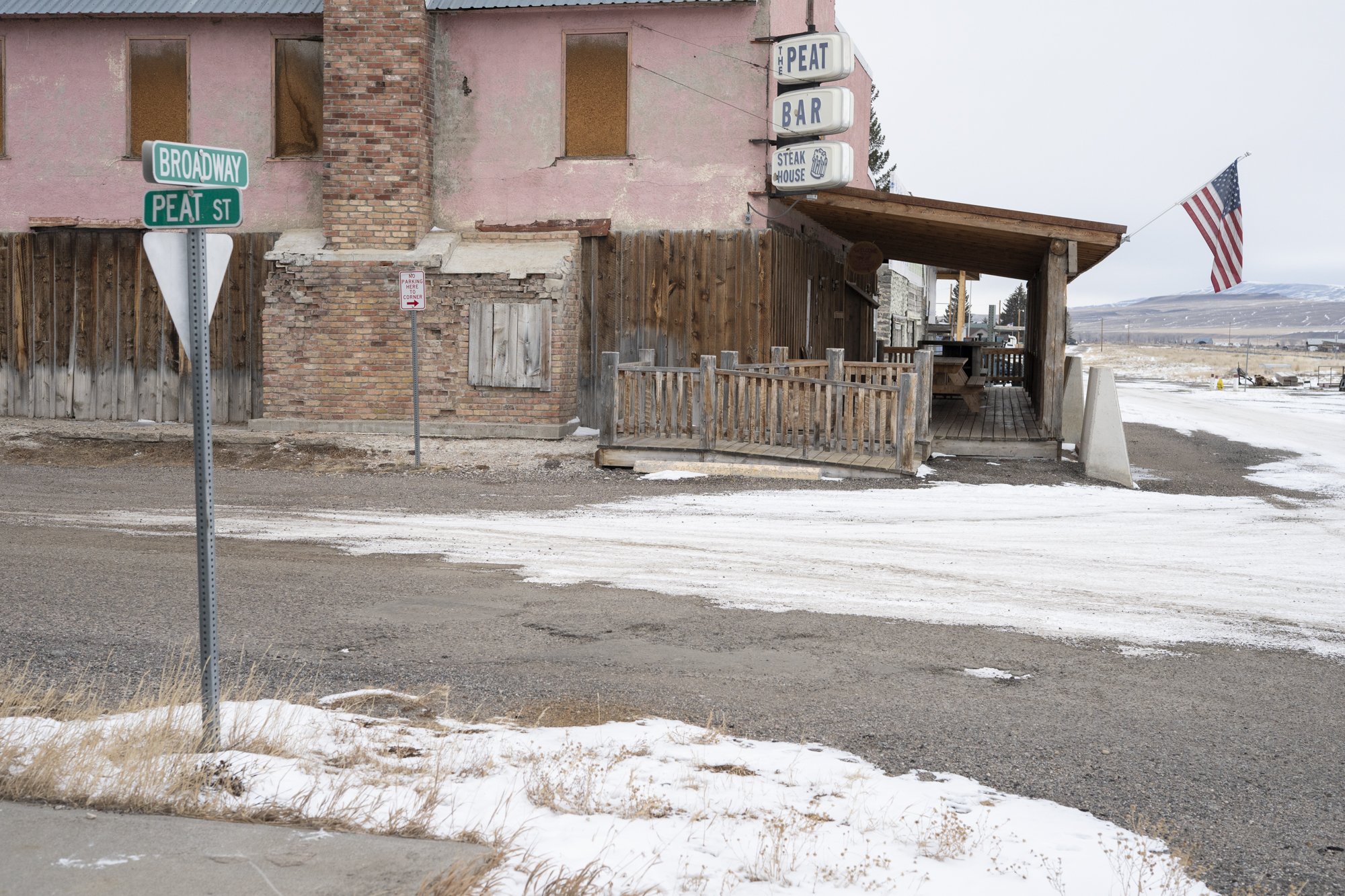
Places like Lima, Montana are endlessly fascinating no matter how many small towns I see. As someone who lives in a frustratingly populated place, it’s stimulating to stand in and see the beginning and end of a town only 75 yards long surrounded by nothing but rolling hills. You can’t help but wonder what everyday life is life for the people of that community.

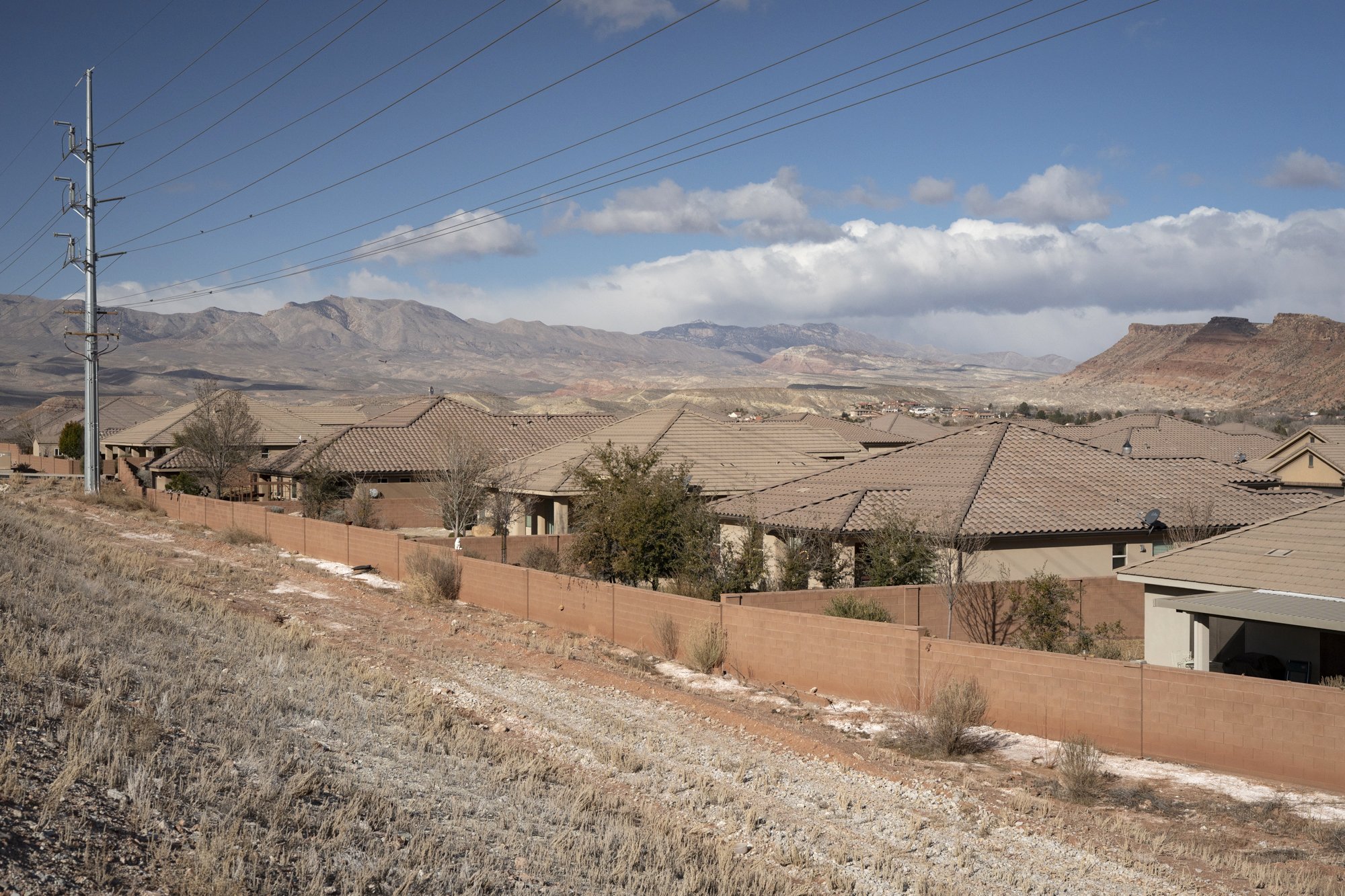
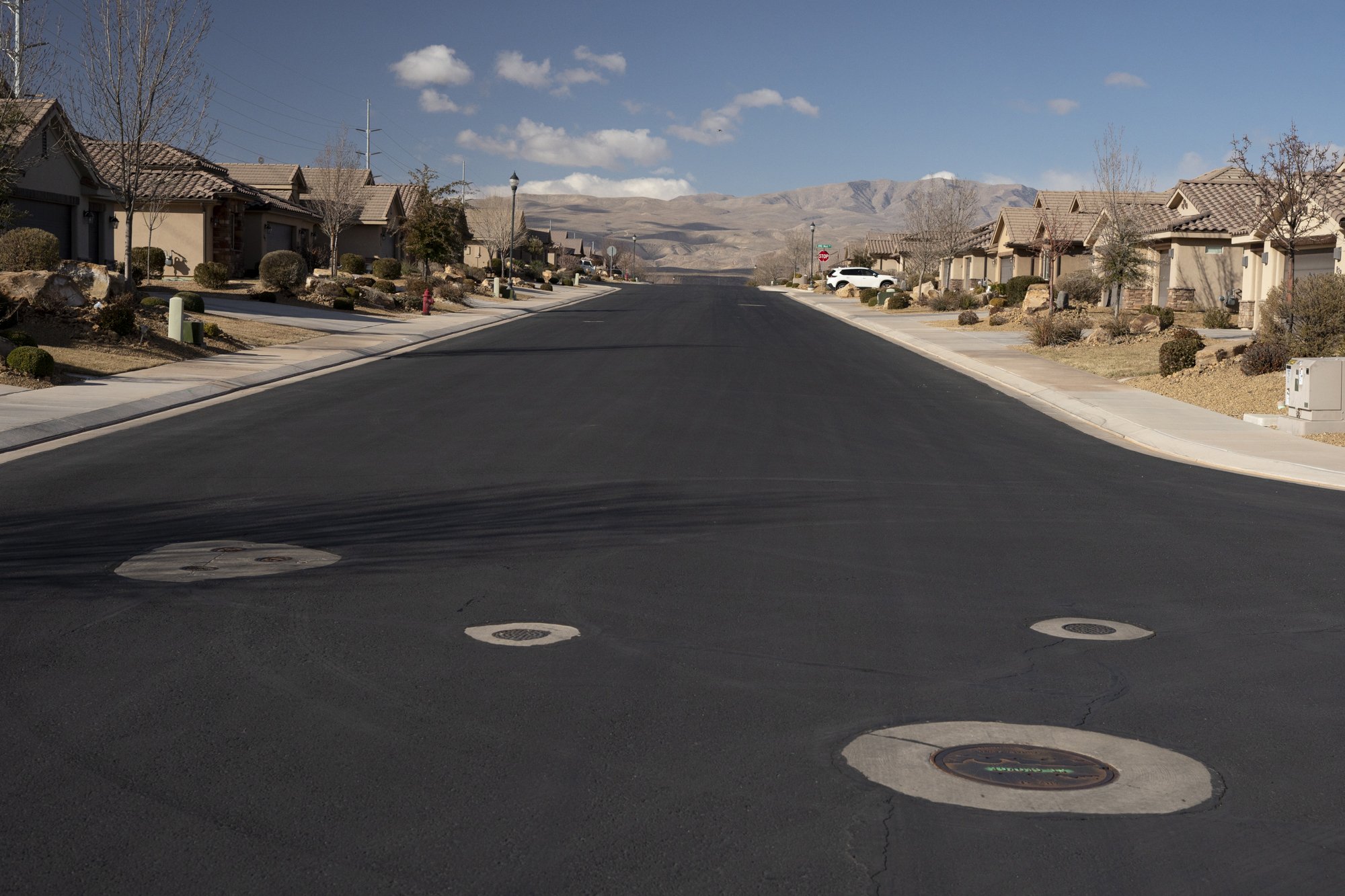
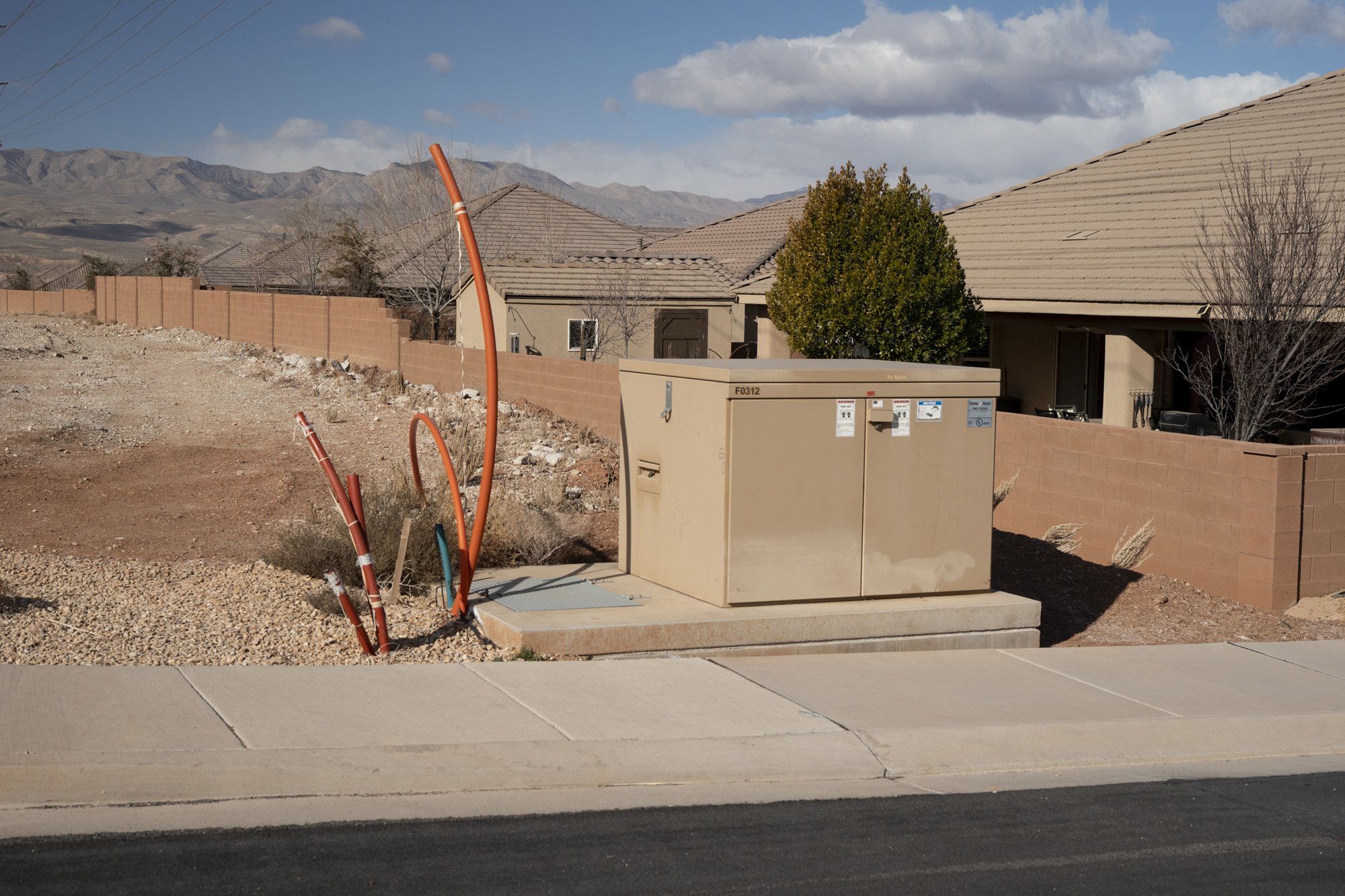
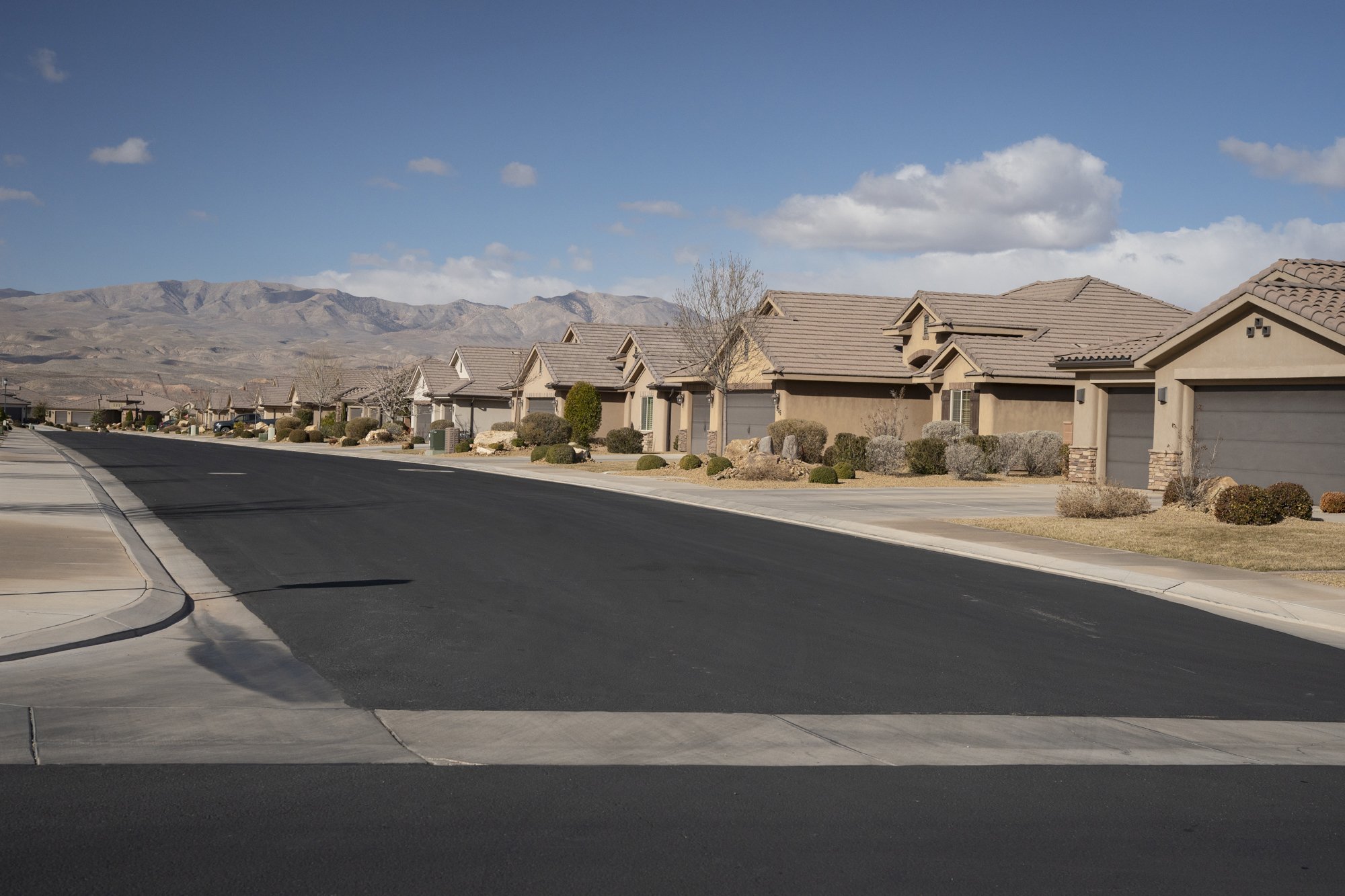
The second set of images were made in St. George, Utah. Also interesting for different reasons. Although much bigger than Lima, it’s still a small town “in the middle of nowhere”. One thing that stands out is the way they build homes there to blend in to the environment. The color palette matches almost seamlessly.

American Photography

American Photography - Road Trip - Travel

Americana - Wall Art - Photo Prints - Open Road

Taking time to think about a body of work is such and important part of the process as you continue to build it. And as time goes on attention needs to be given to the “holes” that are inevitably lurking in said work. Interiors are one of the many holes that I need to fill. For ten years now I’ve happily traveled around America photographing various aspects of it. And lately, collaboration in the form of outside eyeballs/opinions has been a major focus in order to figure out exactly what is or isn’t working. When we create in a bubble as so many photographers do, it’s easy to get lost on a track that might not be going the right direction. There are so many questions we need to ask ourselves all along the way, which probably won’t get brought up if we don’t receive input from other unbiased people. So, while I never plan on stopping my America series, I’m trying to be much more focused and open about what to shoot and what horses I’ve already beaten to death. Much more than that though, how many other photographers have already done what you’re doing? If the answer is “a lot”, then how can you change your contribution to offer the viewer something different?

Click here to see more from my AMERICA series.

Montana Photography

Montana Photo Gallery

Road Trip Photography - America - Prints

Where is the line between selfishness and responsibility? As a photographer that’s had the great fortune to travel more than most I’ve always felt a responsibility to share my experiences (good and bad) in hopes that it might motivate other people to get outside their comfort zone or travel to places they’ve never been. Social media has changed my stance on that though. Instagram specifically, which I consider to be the greatest and worst thing ever invented. People will always be people, but it’s possible that Instagram has turned a lot of us into the worst version of ourselves, always trying to one up or outdo. Always trying to paint that perfect picture of a dream life.

During my travels it’s become very obvious that most humans have no interest in actually being in or enjoying a place they visit. All that matters is whether you can show others that you’re in a place better than they are. Snap a selfie and continue on. Fuck off. What kind of life is that?

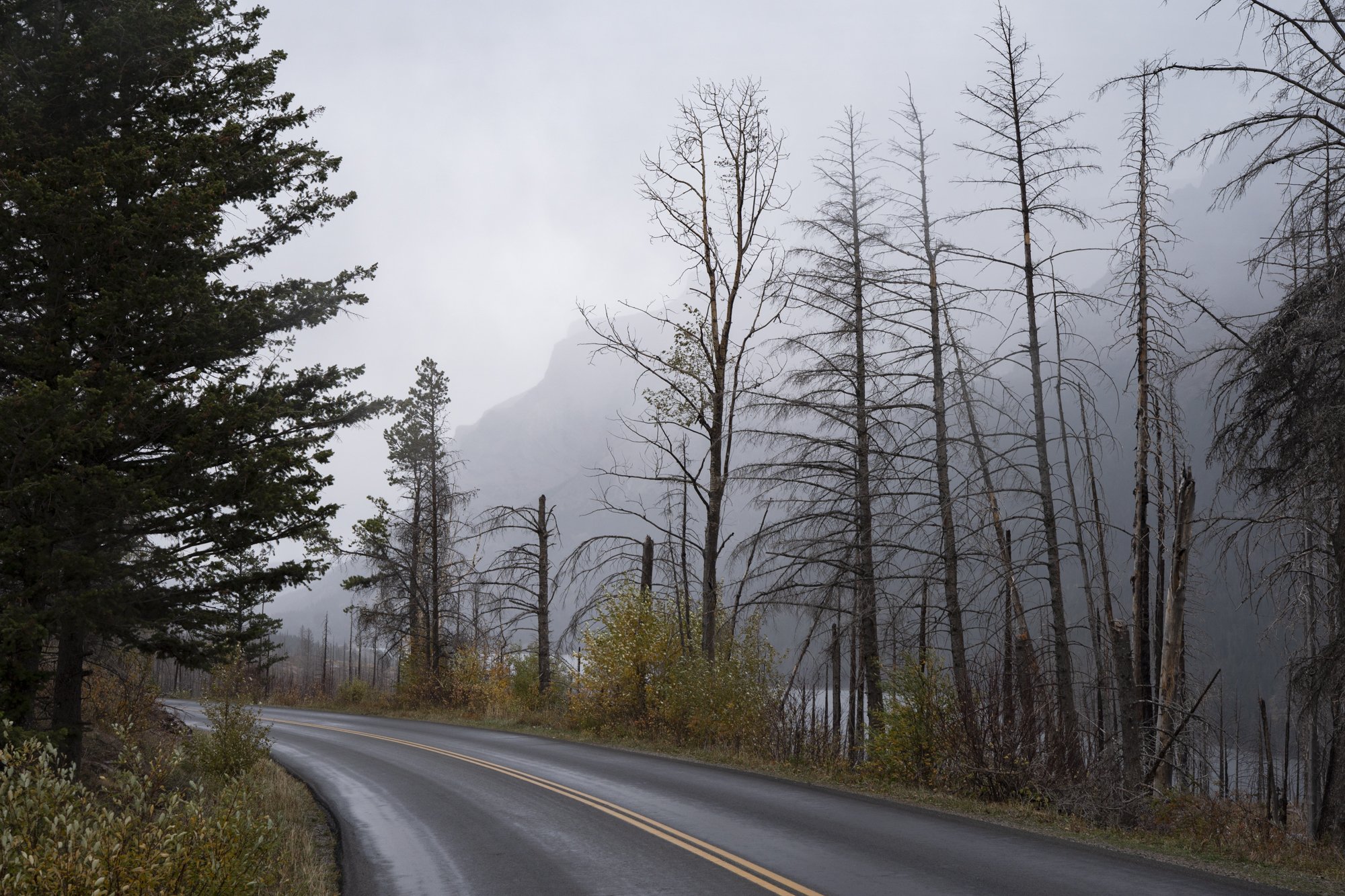
A few weeks ago I had a photoshoot for a client in San Francisco then drove (with Mojo) to Spokane, Washington where I picked up Emily at the airport. Actually, that’s not really true. Her flight was delayed again, and again, and again. So I went fly fishing then relaxed at our Airbnb in Coeur d’ Alene, Idaho. She wound up taking a quick Uber from the airport at about 1am because it was just easier for all of us. The next couple days were great. Afterward we were sad to leave, but only for a minute because the rest of the trip put us in a cabin (featured below) in northern Montana near Glacier National Park. The fall colors were out and we had nothing to complain about. Showing all of the amazing things I (we) do along the way is not my strong point. Most of that is because I’d rather be present than on my phone. Nothing is worse than being in a world class location and looking around to see 95% of the humans around you with their neck hanging down in the blue light. The other part is that I don’t like what Instagram can do to a place. I’m not The Rock. Meaning I don’t have the ability to reach 227 million people with every post. Wouldn’t be able to handle that kind of power either, but imagine what happens to a place that is exploited by the wrong person? A quiet mountain town all of a sudden becomes the next Instagram hot spot where thousands of assholes are running around with selfie sticks. Thus ruining the entire culture and reason locals want to live there.

So do you live selfishly or become part of the problem? It’s important to me to share what I do for the right reasons, but there is also that other side. Many a good backcountry ski run have been ruined because it became taggable (is that a word) on social media. The same goes for thousands of low key locations all across the world. Montana as a state certainly doesn’t need any help with sales as “desirable”. It would be daunting to think how many people have moved there over the last 5-10 years and that number probably won’t slow down any time soon. I love Montana. Like a lot. Maybe more than anywhere in the US. For those reasons I hesitate to talk about it. In fear that the small towns will wind up feeling like Los Angeles. Is that selfish?

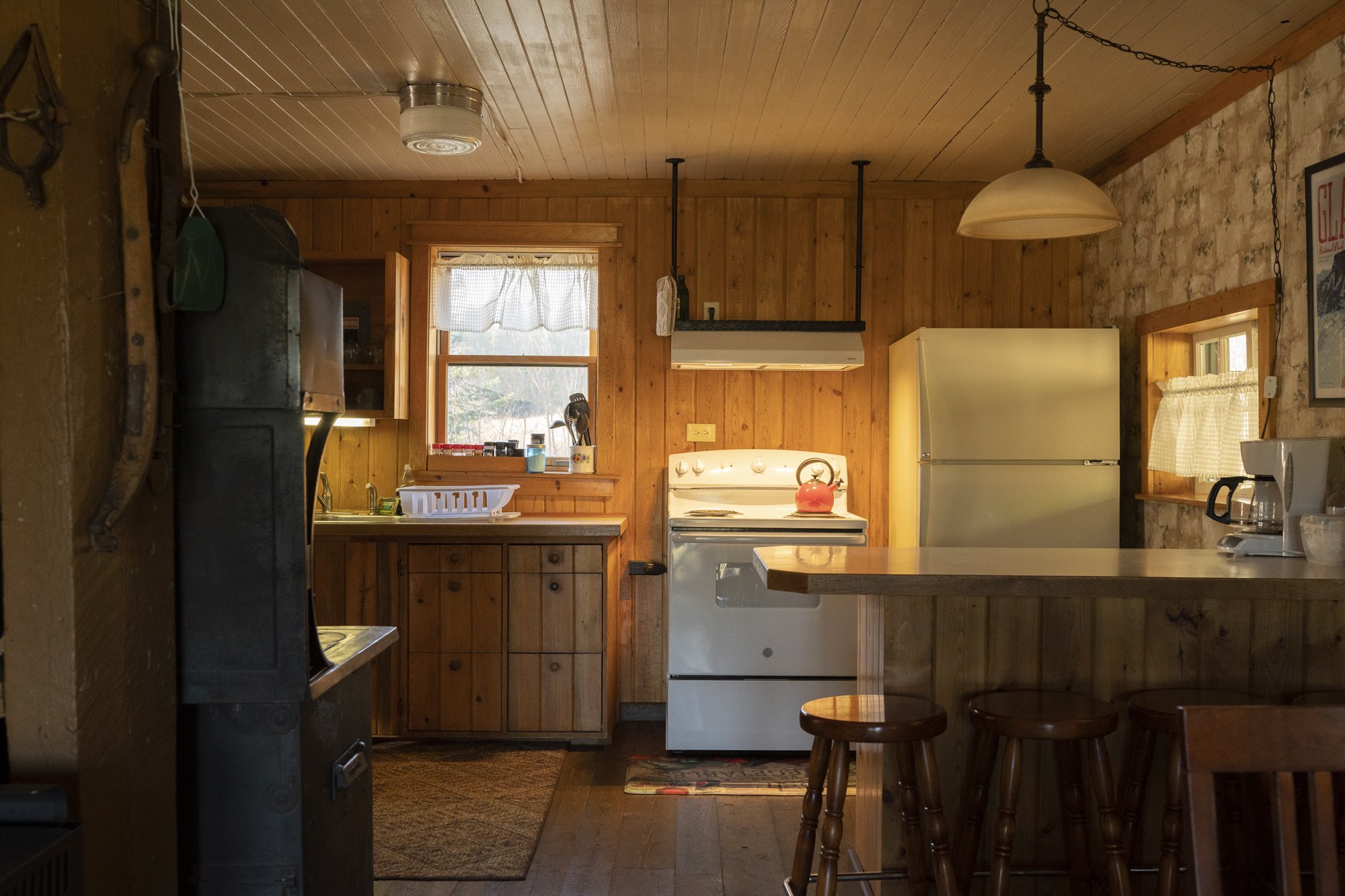
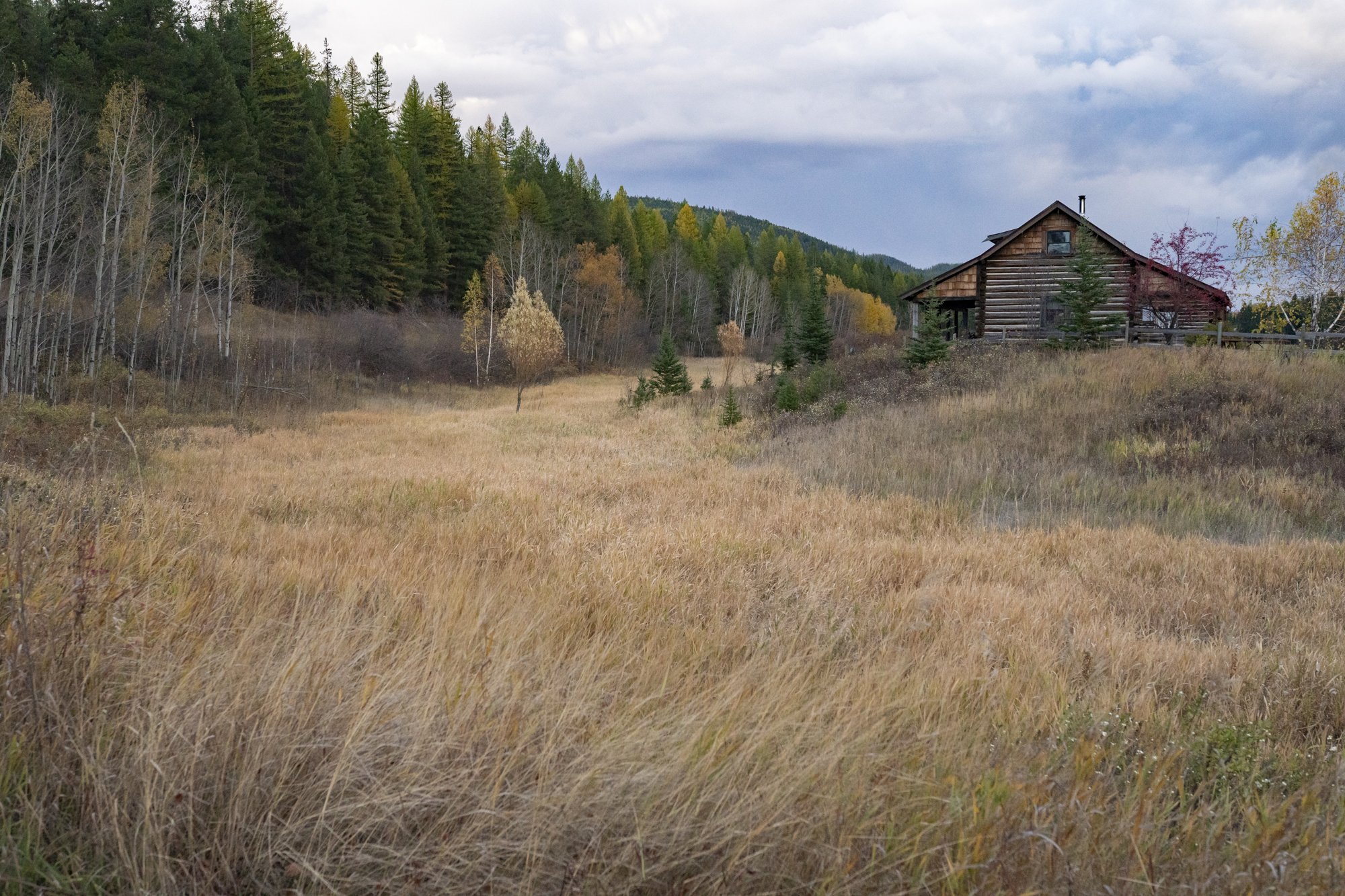
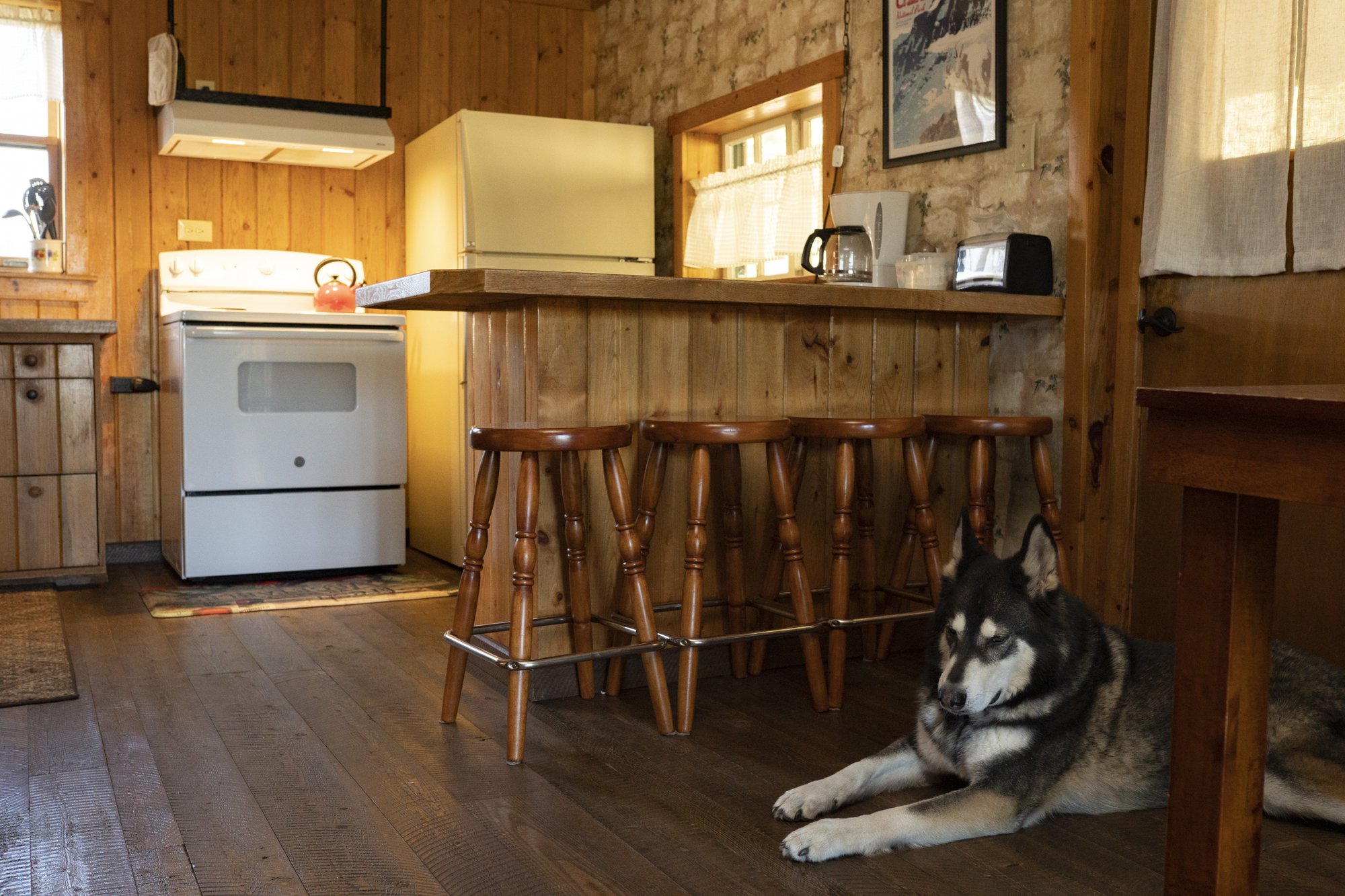
This is the cabin we stayed at in Montana. It was built in 1910 and had it’s own barn for chopping wood. Heaven. Love the muted colors of the dead grass in front of the frame. 2

American Road Trip

So grateful for this time on the road especially when it can incorporate the trifecta of shooting for a client, shooting for myself, and vacation time with Emily and Mojo. There really is nothing better. Our main destinations were Idaho/Montana and what a special time of year to be up there. The color and weather make you appreciate the seasons so much as people who live in southern California where we don’t get those drastic changes. Also made me realize how much I need to plan for this every year to shoot some fly fishing in locations surrounded by fall foliage. Maybe it’s just getting older (aka wiser), but that fall beauty was lost on me while going to school in Vermont where people would visit from all over the world. The “leaf peepers”. It makes a lot more sense once you start to pull your head out of your own ass. Check back soon for images from this trip.

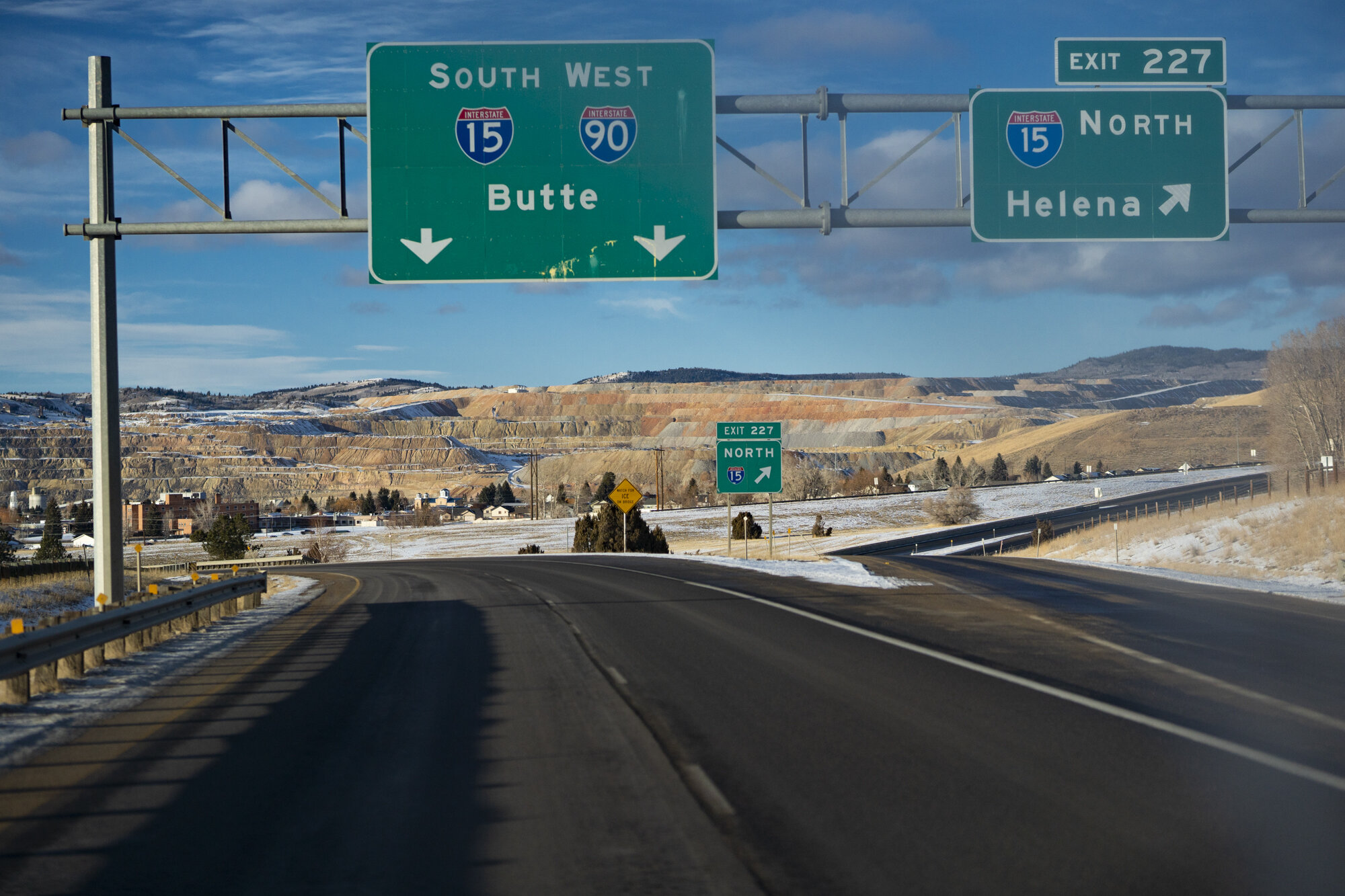
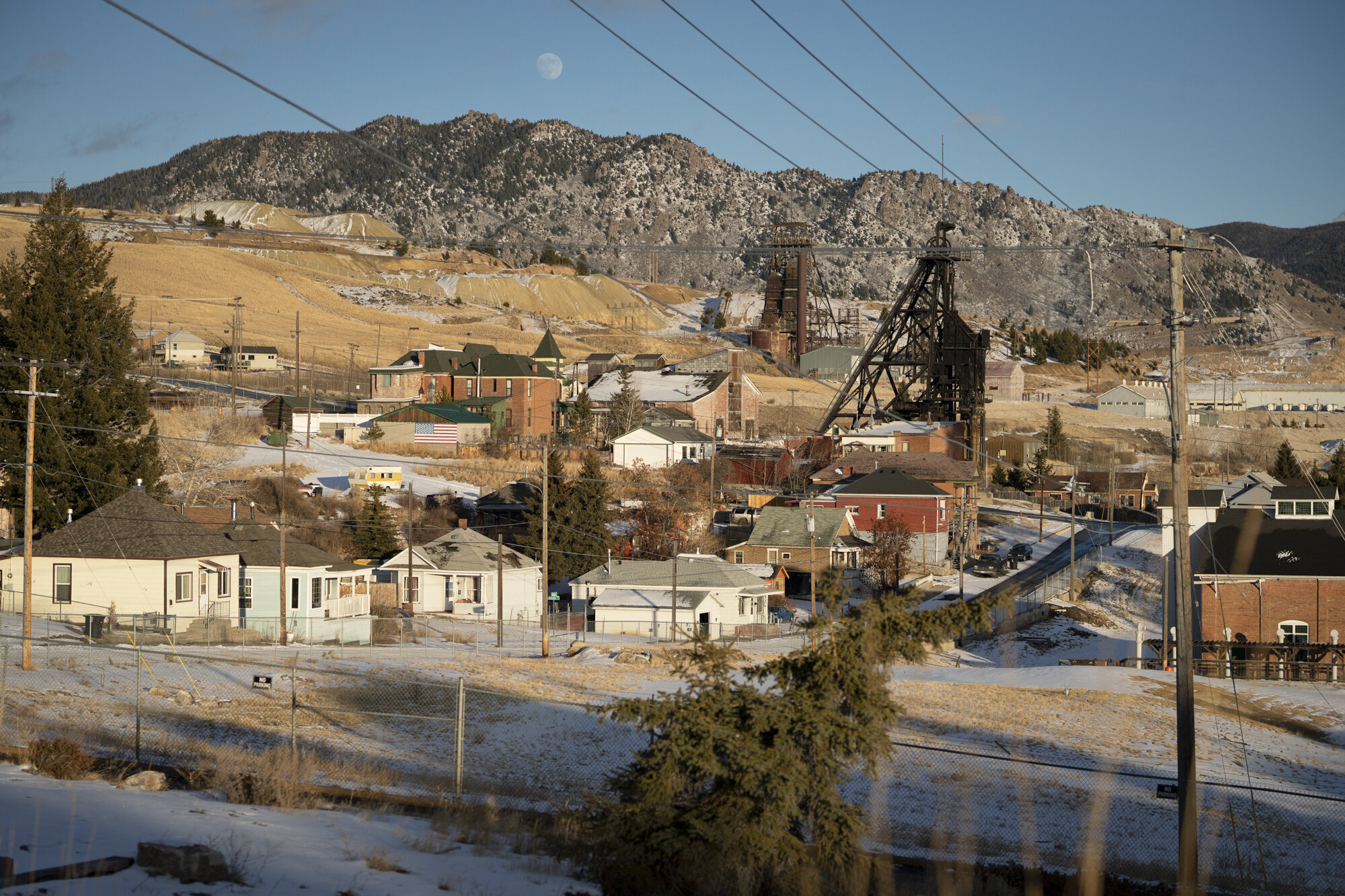
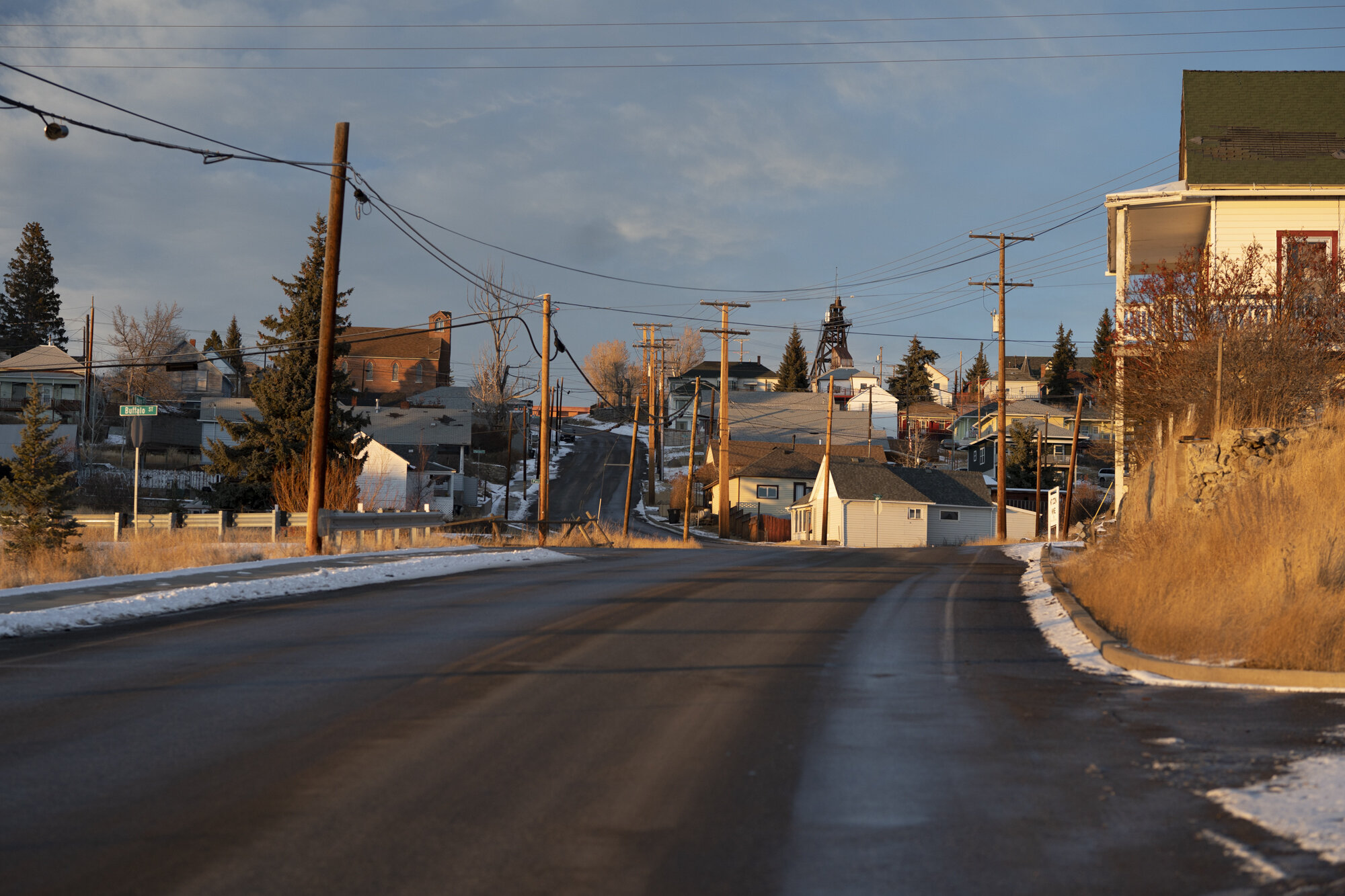
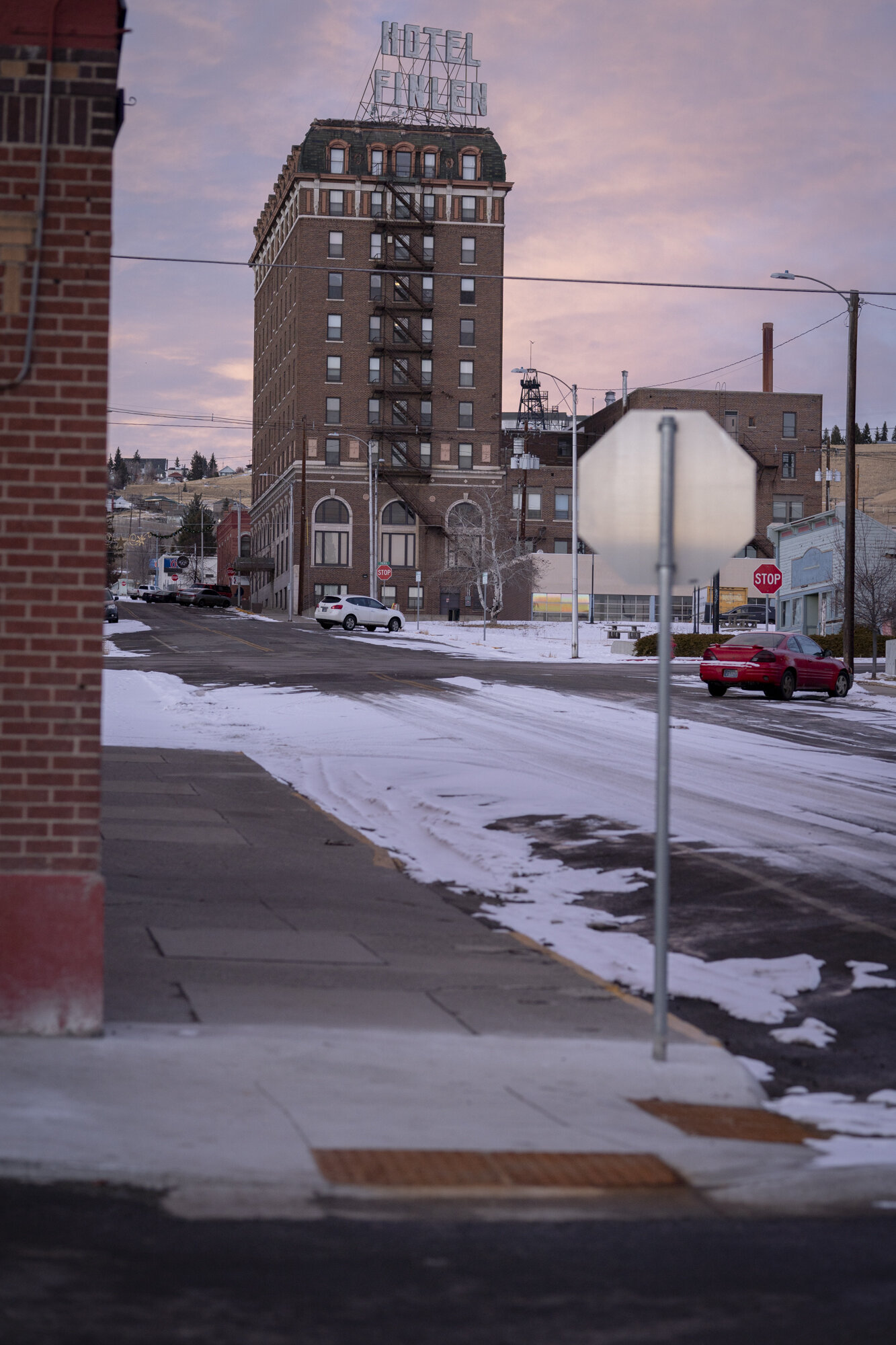
Butte, Montana

Butte, Montana Photo Gallery

American Photography

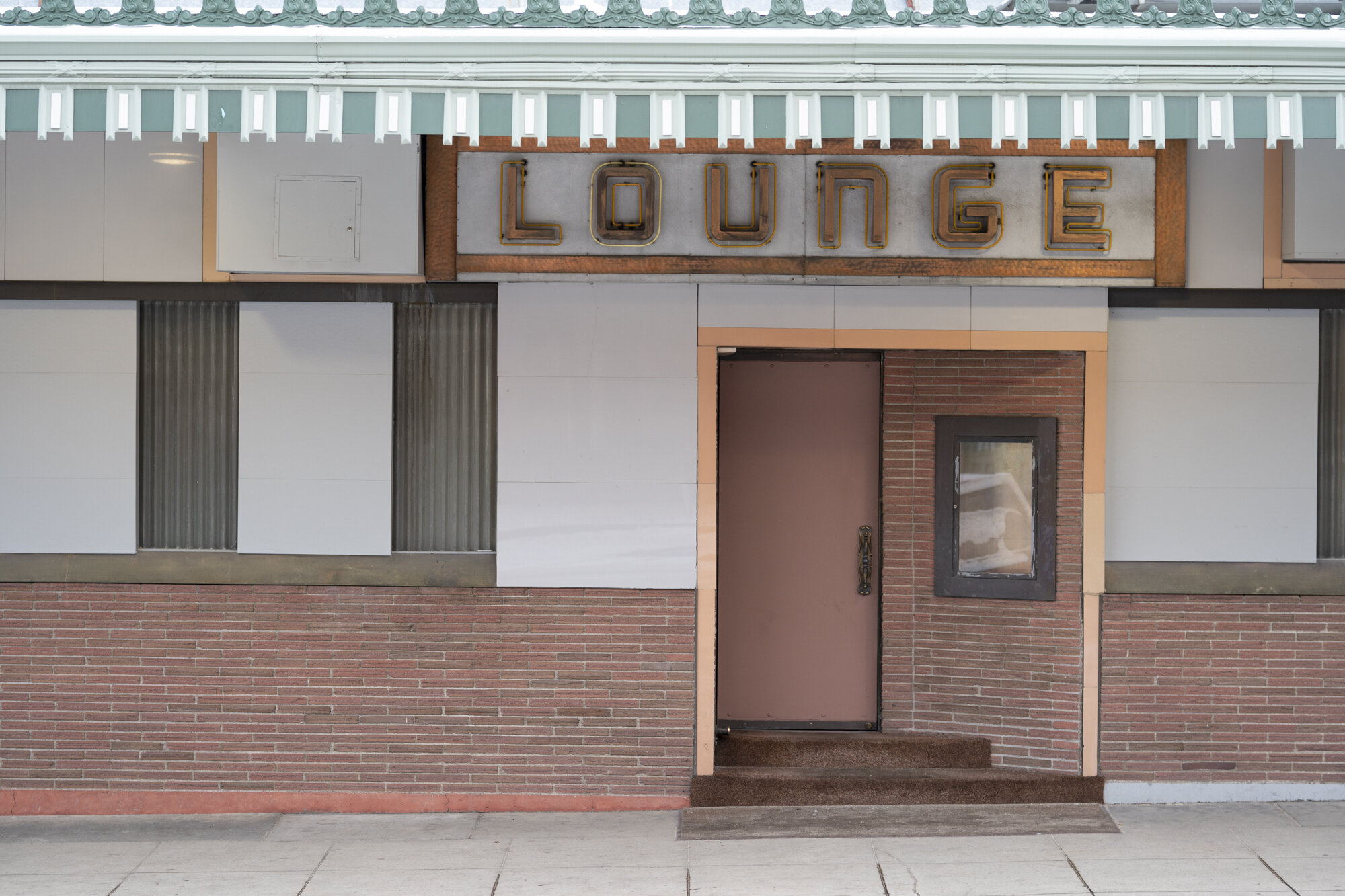
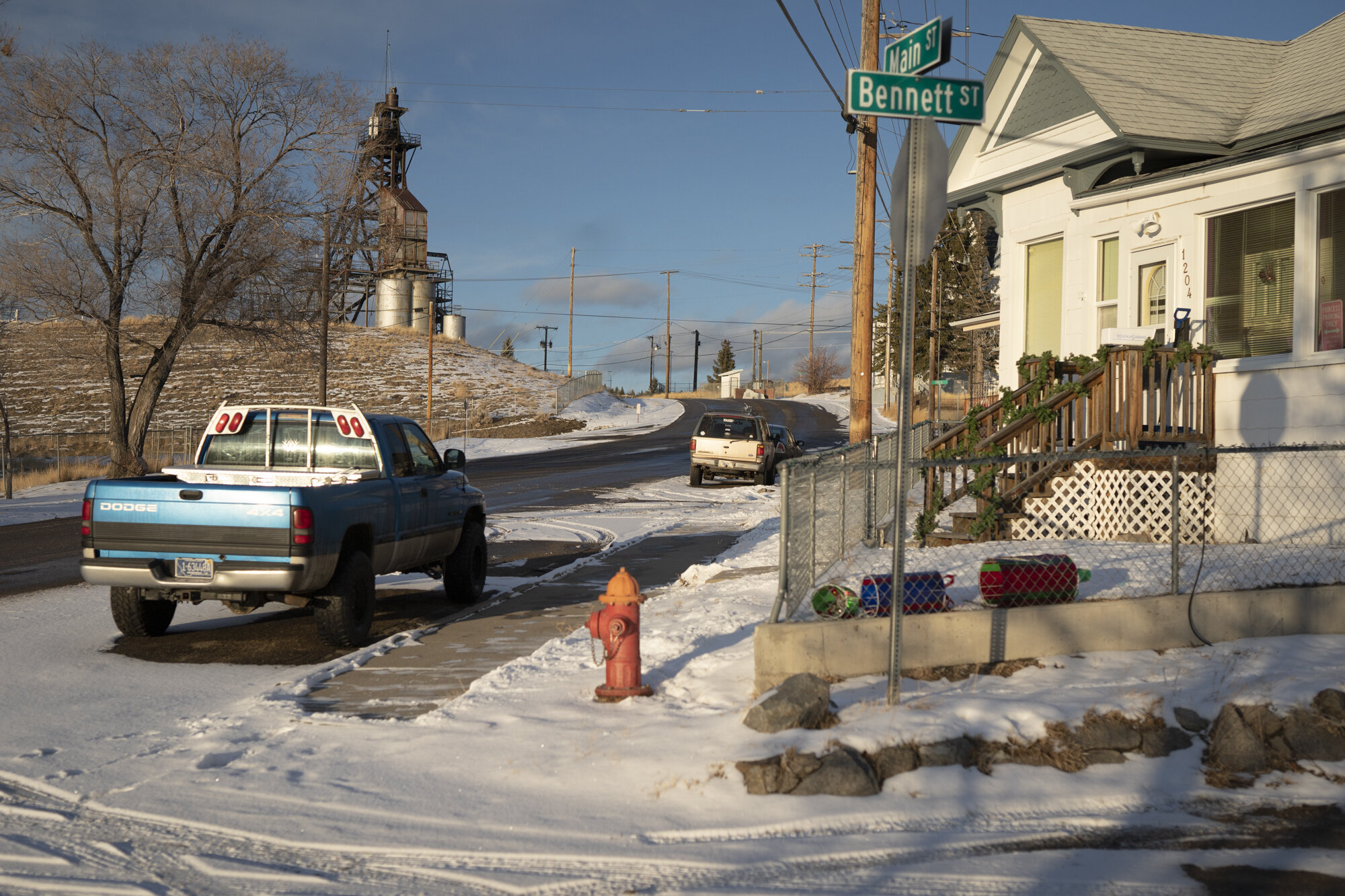
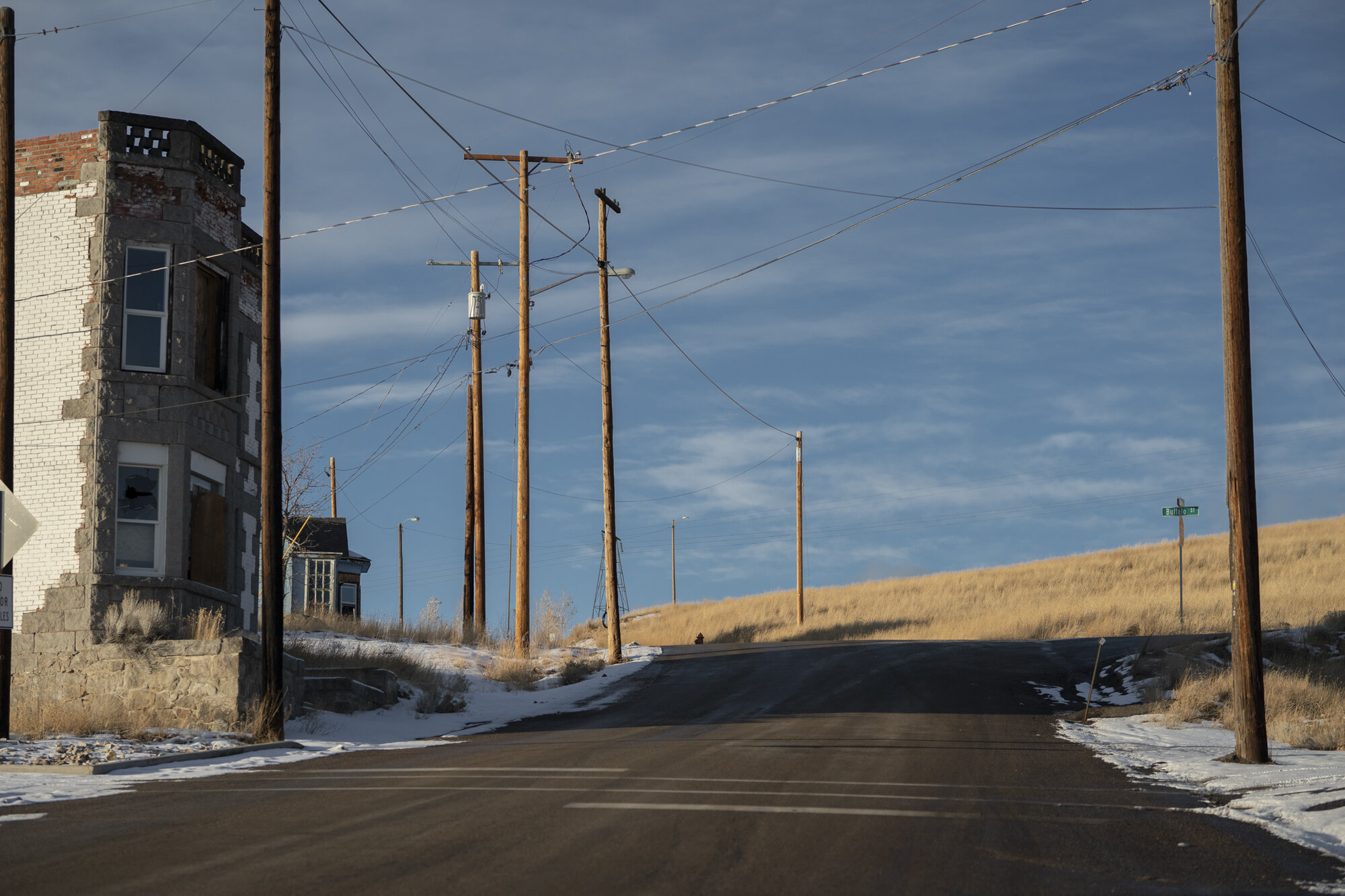
Butte is a fun name for a town. It’s fun to say. Where you going? Butte! Back in 2012 or 2013 I wound up in Butte while shooting for Barbershops of America, but didn’t get to spend much time there. Found a hell of a shop for the book with an all time character of a barber - “The Butcher” - Joe Bugni. Legend. If you want some free entertainment, go hang out with Joe for an hour at the Amherst St. Barbershop. Anyway, after leaving Joe’s it was late and I planned on getting a hotel. Went into the lobby of one of the few that are downtown and asked first to use the bathroom. The place was dead quiet without a sign of another person besides the girl behind the desk. She directed me downstairs, which I quickly saw was almost pitch black except for the almost extinct exit sign at the far end of the very long hallway. After searching for 30 seconds or so a very dim flickering bulb came on that barely illuminated the lifeless bathroom and a very strange feeling came over me. Not sure if it was a combination of the darkness and the unexplainable noises coming from the building, but I was scared out of my mind. That’s never once happened to me and I’ve been in some of the strangest places you could image. The feeling was so strong that I exited the bathroom and sprinted down the hallway for the exit and straight back to my car. Still to this day there is no explanation.

That inability to describe the situation is how I feel about Butte in general after this most recent trip. To be sure, I’m quite taken with the town in a very positive way. But I just can’t figure out a way to explain it with words. This also happened to me with the entire state of Texas until I read “Travels with Charley”, where Steinbeck hit the nail directly on the head. Butte is a unique place to say the least. It’s gotten a certain vibe. A tangible feeling about it that you won’t experience in other places. The history of the town is quite long, which is something you can look up on the internet, but that won’t do anything to replace the feeling of being there. We spent a couple hours roaming around, during which I cracked off some frames that I’m happy with. But in order to do the town justice, I’d like to spend a month there. Maybe I should? Butte is as American a town as you’ll ever find, and I’ll no doubt be adding a few of these to my ongoing “America” series.

Side note: if you find yourself in the area and like beer, stop into the Butte Brewery. Their german style Hefeweizen is one of the best I’ve had in the States.