The Mother Hubbard Saddle: A Piece of Western History
The last time I photographed saddle maker Doug Cox at his shop in Nevada, he was already thinking about the next challenge he wanted to create for himself.
At 75, after more than 900 saddles and five decades working with leather, Doug doesn't exactly need another challenge. But he had decided to build a Mother Hubbard, an early style of Western saddle rarely made today.
When I asked him why, his answer was simple.
“Just because.”
That answer makes more sense once you understand what a Mother Hubbard saddle actually is.
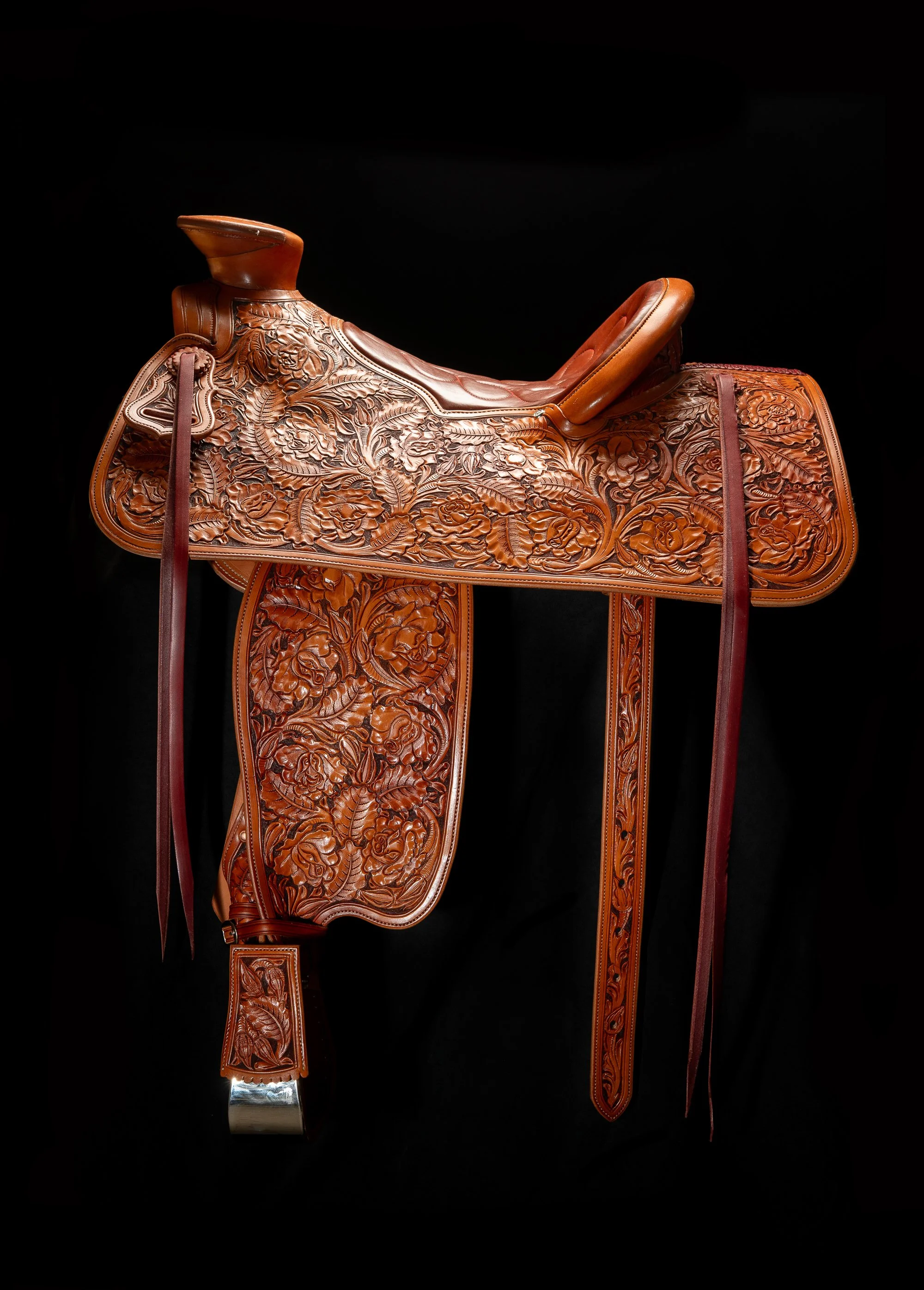
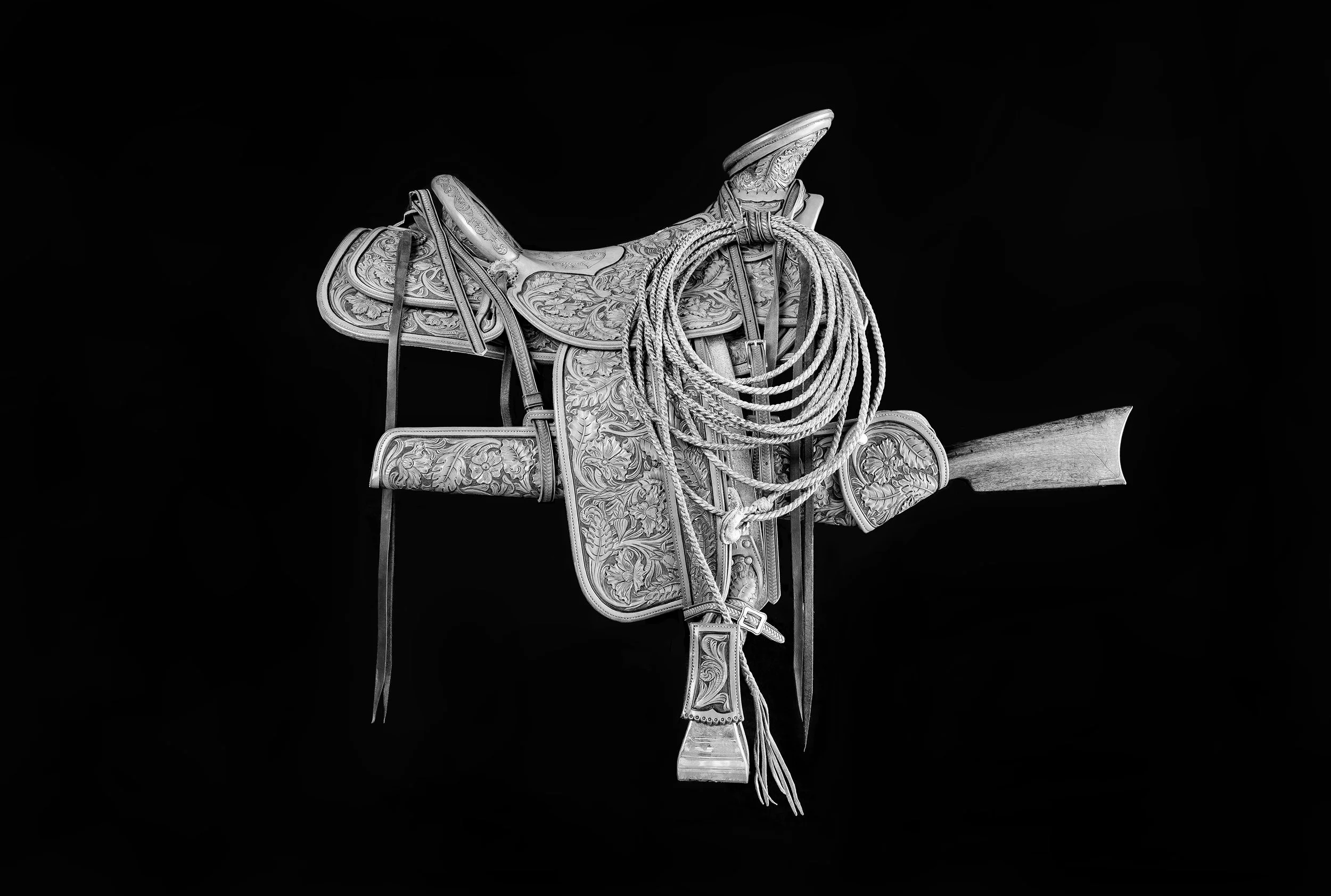
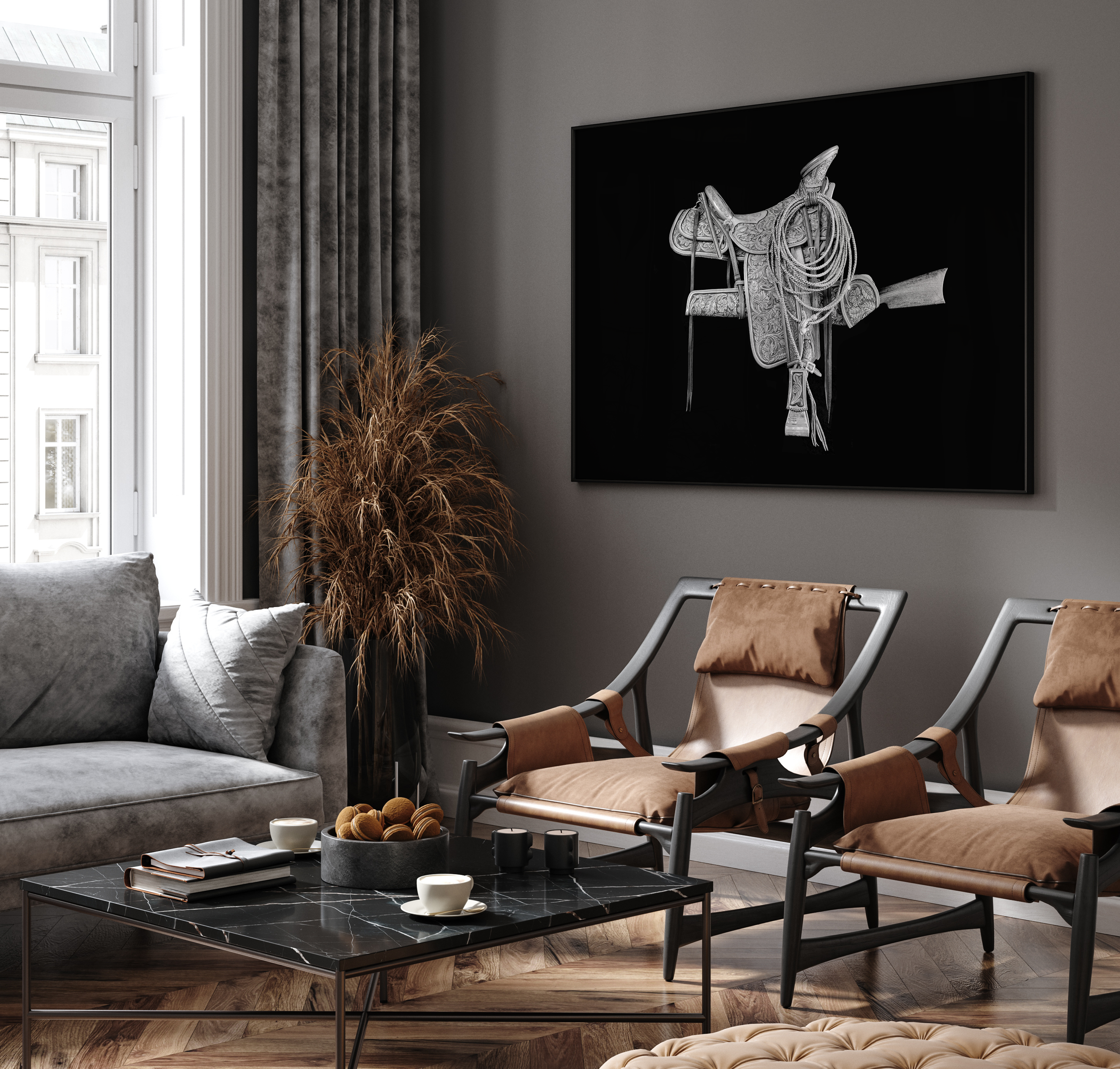
The finished Mother Hubbard shows the broad leather coverage that distinguishes the early saddle design, with floral tooling covering much of its surface.
What Is a Mother Hubbard Saddle?
The Mother Hubbard comes from an early period in the development of the American Western saddle, before the familiar cowboy saddle evolved into the form most people recognize today.
Its most obvious characteristic is the amount of leather surrounding the saddle tree. One single large piece of leather extends down, creating a distinctive covered appearance and silhouette. It's immediately different from a modern Western saddle, where the individual components and shape of the tree are much more apparent.
Mother Hubbards emerged during the 19th century and became associated with the developing saddle-making traditions of the American West. Their unusual name is generally connected to the loose, full-coverage “Mother Hubbard” dresses of the period, an appropriate description for a saddle whose leather seems to drape around and cover much of its structure.
But what makes the saddle interesting isn't simply its age or appearance.
It's the way it's built.
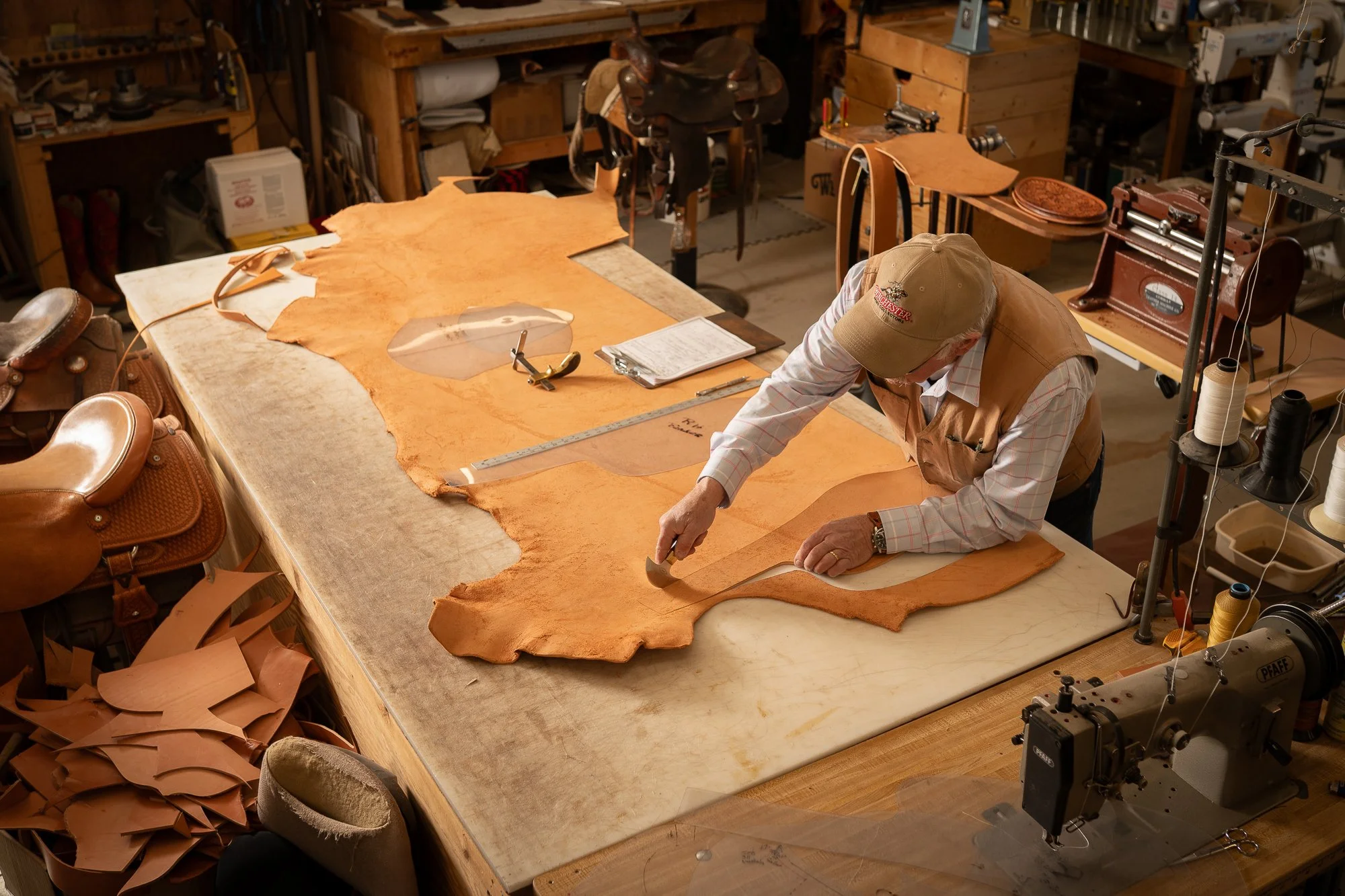
Cutting patterns from a large piece of leather, Doug works at the center of his saddle-making bench.
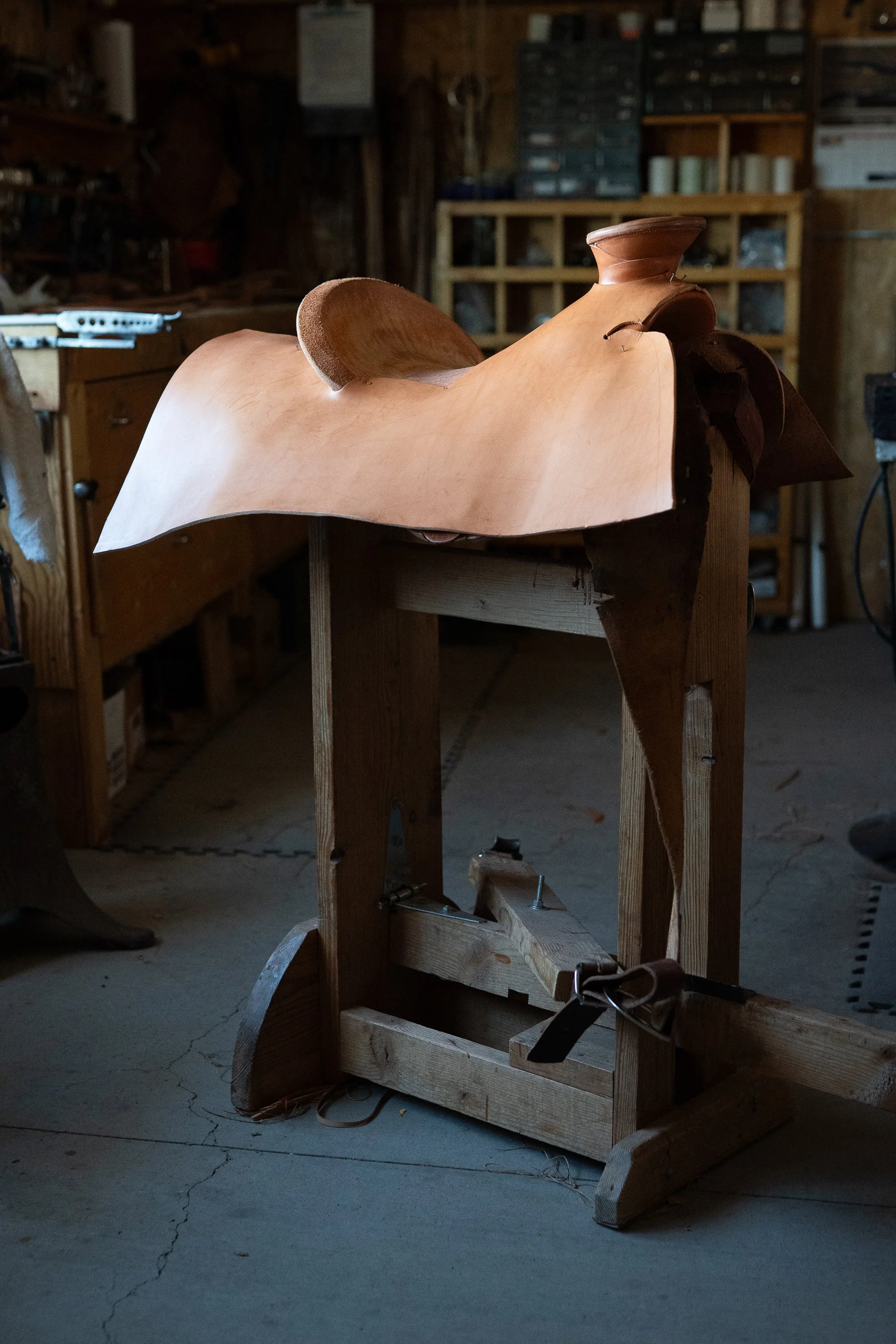
Before the tooling and finishing, a broad piece of leather is fitted over the saddle tree in Doug Cox's workshop.
Why a Mother Hubbard Is So Difficult to Make
Modern saddle makers benefit from generations of refinement. Over time, Western saddles evolved as makers learned what worked for horses, riders, ranch work, construction, and repair.
Building an earlier design means stepping backward into a very different way of solving those problems.
The single broad piece of leather that give the Mother Hubbard its characteristic appearance also make fitting and shaping the saddle particularly demanding. Leather has to conform around compound curves and transition cleanly across the saddle without looking forced or poorly fitted. Small mistakes become increasingly difficult to hide as the work progresses.
It requires a combination of leather working ability, an understanding of saddle construction, and the patience to figure out techniques that few working saddle makers dare to conquer anymore.
Doug described building one as “absolutely hellacious.”
Coming from someone who has made more than 900 saddles, that carries some weight.
And that's precisely why he wanted to do it.
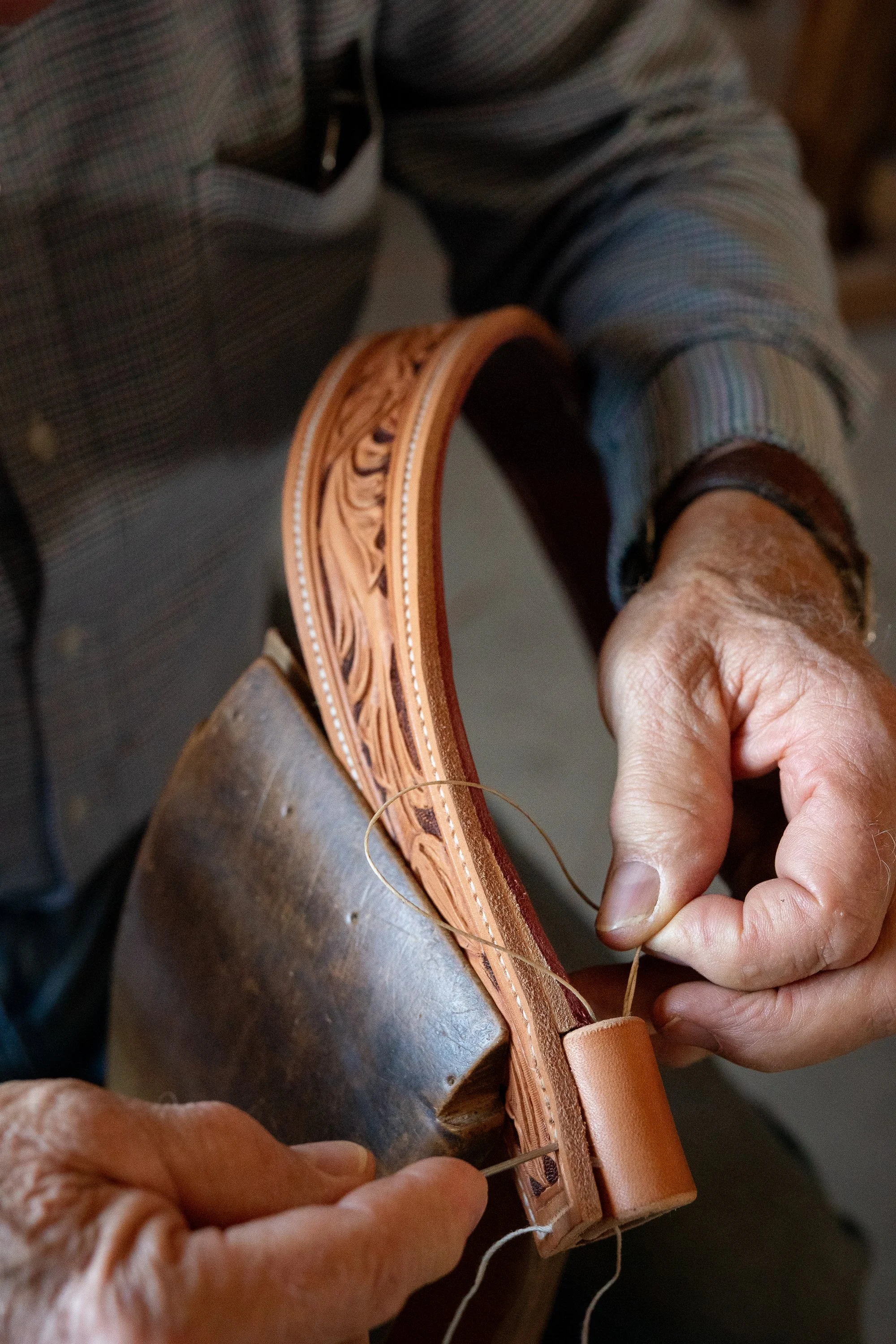
Working by hand, Doug stitches a curved section of leather as he builds the Mother Hubbard saddle.
Doug Cox Builds a Mother Hubbard
The first time Doug told me about the project, the saddle didn't exist yet.
It came up toward the end of a larger story I'd been photographing about him and his career. Doug has spent more than five decades building saddles, repairing them, studying historic examples, and developing his own ideas about what makes a saddle work.
That larger story became Western Saddle Maker, my original piece about Doug, his Nevada shop, and a career spent learning a craft that can't really be mastered quickly.
The Mother Hubbard was different.
There wasn't an order to fill or a customer waiting for a working ranch saddle. This was about curiosity and scratching an itch.
After a lifetime spent building saddles, Doug was going backward to understand one.
That's something I've always found interesting about people who become exceptionally good at a craft. Experience doesn't necessarily make them less curious. Sometimes it gives them the confidence to tackle things that make absolutely no economic sense.
The Mother Hubbard was one of those things.
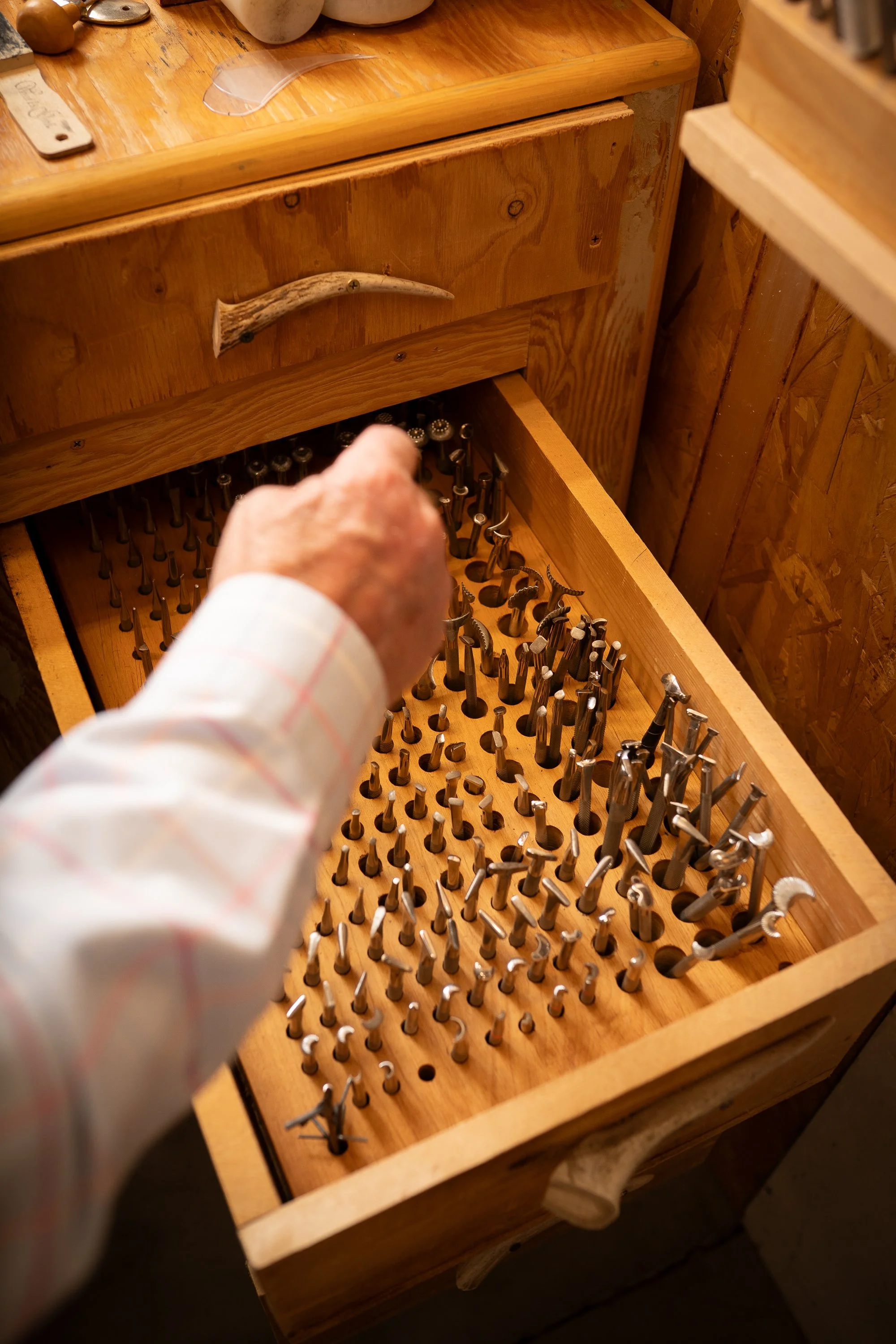
Leatherworking tools fill the wooden drawer beneath the bench as Doug reaches for one of them.
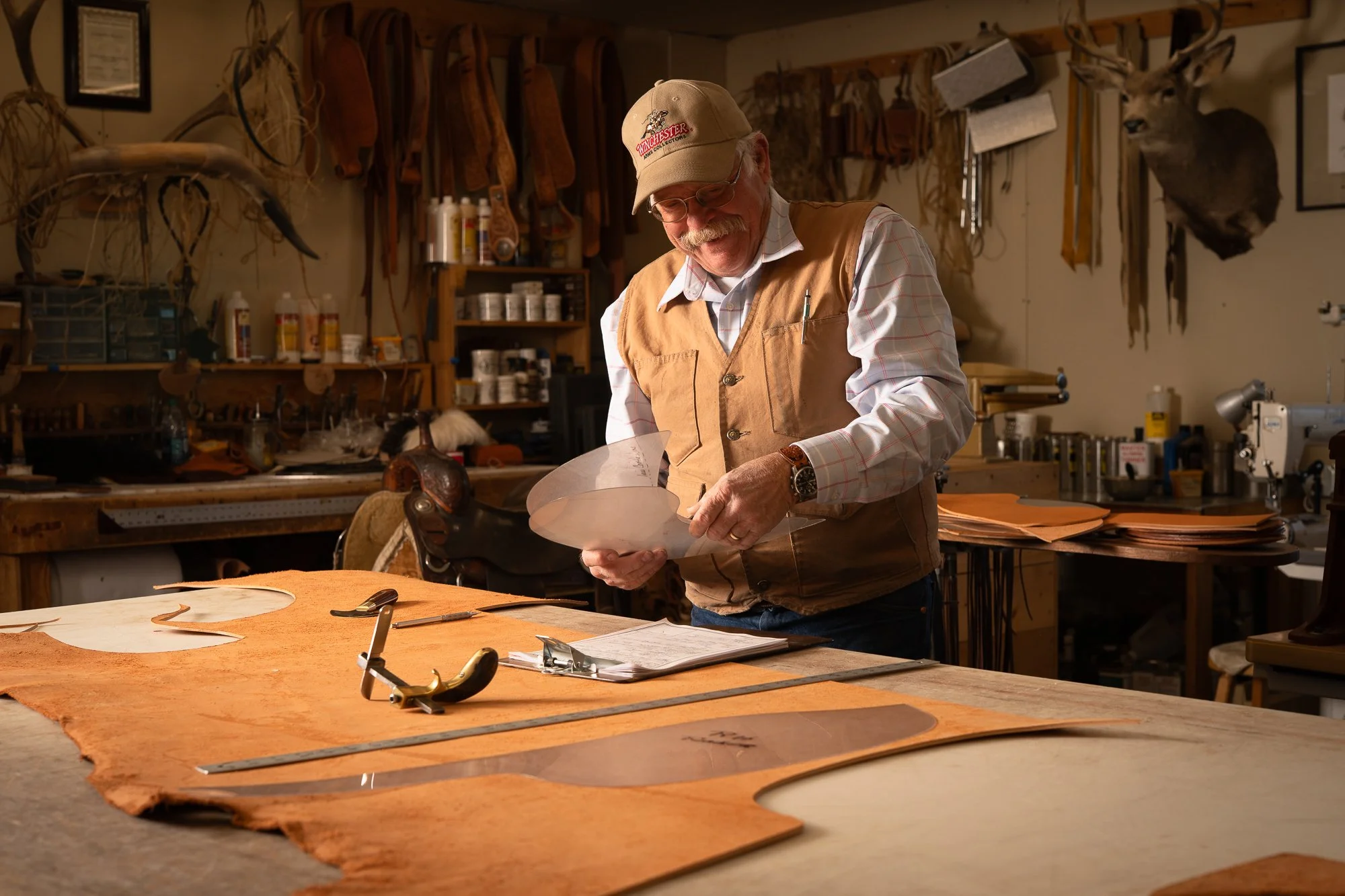
Pattern pieces and measurements cover the workbench as Doug works out the construction of the Mother Hubbard.
An Old Saddle Built Again
By the time I returned, the pieces I'd previously heard Doug talking about had become a finished saddle.
Seeing it completed makes the oddity of the design much easier to understand.
It doesn't look quite like the Western saddle most of us carry around in our heads. The proportions are different. The mass of leather changes the silhouette. Details that might disappear on a contemporary saddle become part of the visual identity of the Mother Hubbard.
And yet it isn't simply a museum reproduction.
It was made by a man who understands saddles from the perspective of someone who has spent his life building them to be used.
That's an important distinction.
There is a difference between making something look old and understanding why an old object was made the way it was. Doug has spent decades studying saddle construction, taking saddles apart, repairing them, riding them, building them, and learning from the craftsmen who came before him.
The Mother Hubbard gave him an opportunity to apply all of that knowledge to a form from another era.
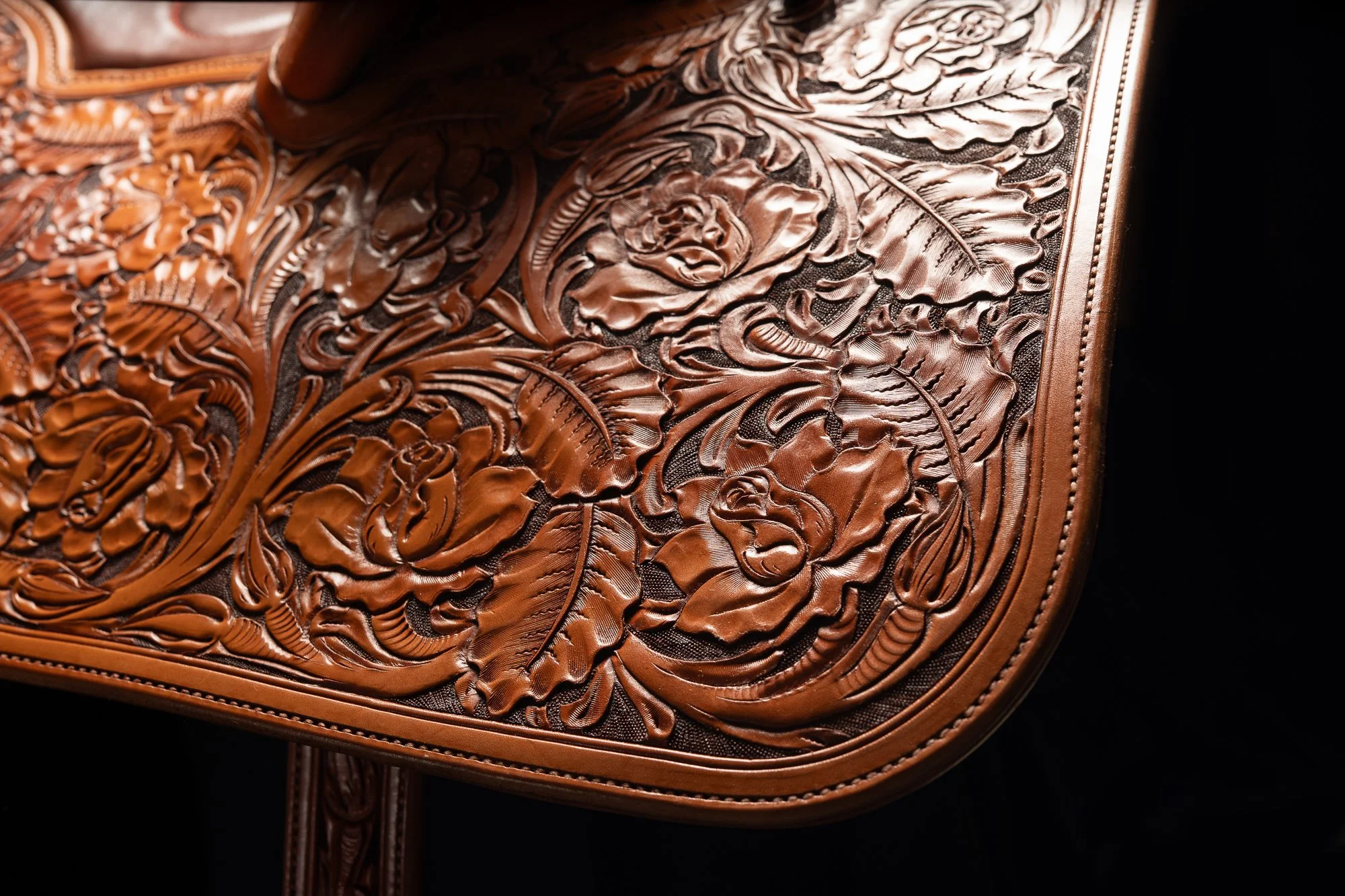
Flowers, leaves and carved lines fill the leather along the skirt of the finished saddle.
Photographing the Mother Hubbard
That's also what interested me about photographing it.
My ongoing work in the West has never been solely about cowboys or cattle. The culture is also defined by people who make the objects that allow it to function: saddles, boots, hats, bits, spurs, silverwork, ropes, and countless other things that are easy to overlook until you meet someone who has devoted a lifetime to making them.
A finished saddle can be beautiful.
But the real story is the knowledge inside it.
The cuts and stitches are visible. The decades required to know where those cuts and stitches belong are not.
That's what makes someone like Doug worth documenting.
And it's what makes this particular saddle more interesting than simply being an unusual antique design.
Someone still knows how to make one.
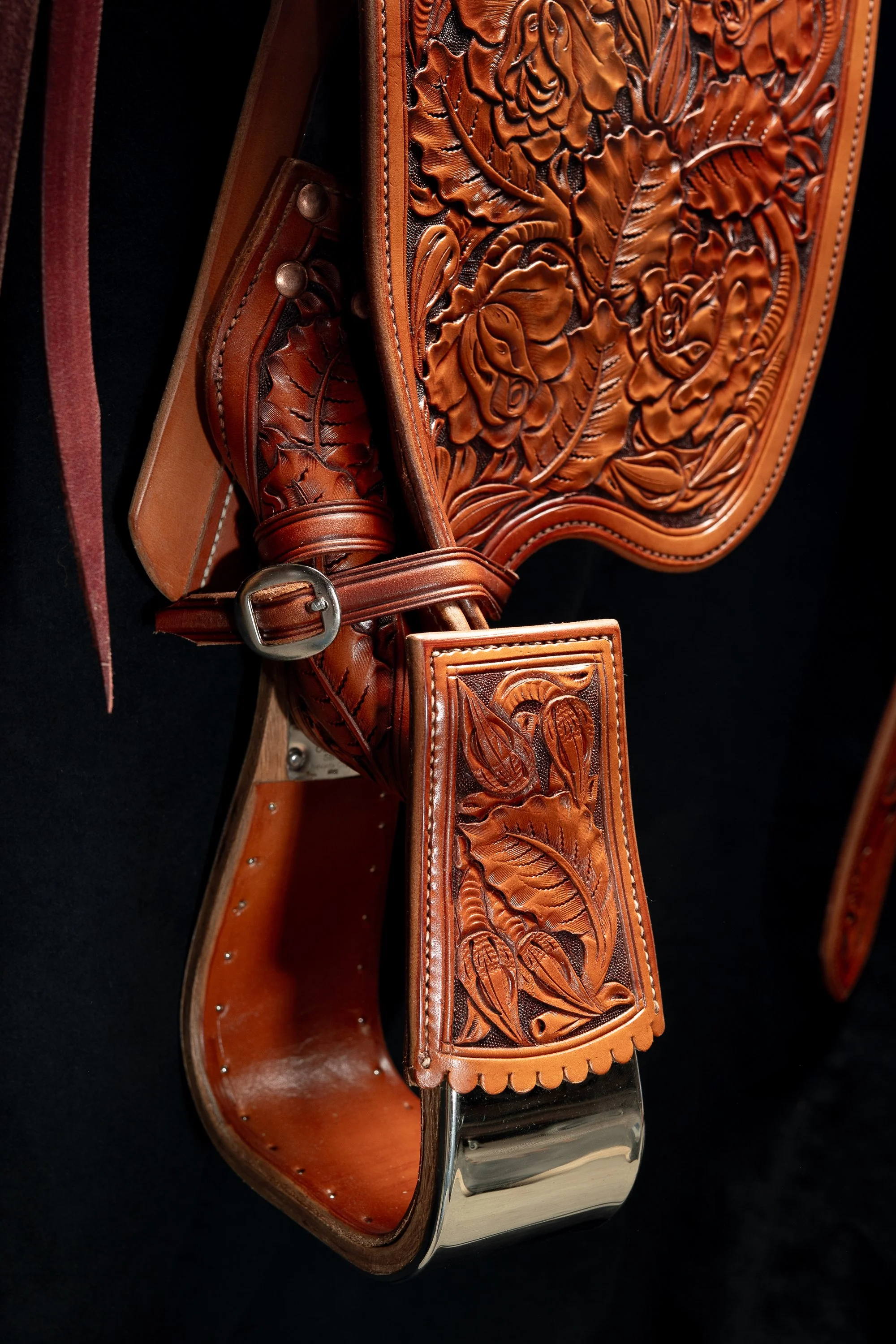
Polished metal stirrup hangs below the tooled leather and buckled strap of the Mother Hubbard saddle.
The Mother Hubbard in Cowboys & Indians
The finished Mother Hubbard and my photographs of Doug were recently featured in Cowboys & Indians magazine.
For me, the significance of the story goes beyond having the photographs published.
The Mother Hubbard represents something that's becoming increasingly difficult to find: knowledge passed down through people rather than preserved only in books, museums, or old objects.
Historic saddles can tell us a great deal about the American West. But there is something different about watching a living craftsman study one, understand it, wrestle with its problems, and then make another with his own hands.
Doug didn't need to build a Mother Hubbard.
There probably aren't many people who do.
Which brings the story back to the question I asked him before he'd made it.
Why go through all that trouble?
“Just because.”
After seeing the finished saddle, that still seems like the best answer.
More From the American West
My earlier story, Western Saddle Maker, goes deeper into Doug Cox's life, his Nevada shop, and more than five decades spent building saddles.
This work is part of Calves to the Fire, my ongoing photographic documentation of working cowboys, ranches, craftsmen, artists, and traditions throughout the American West.
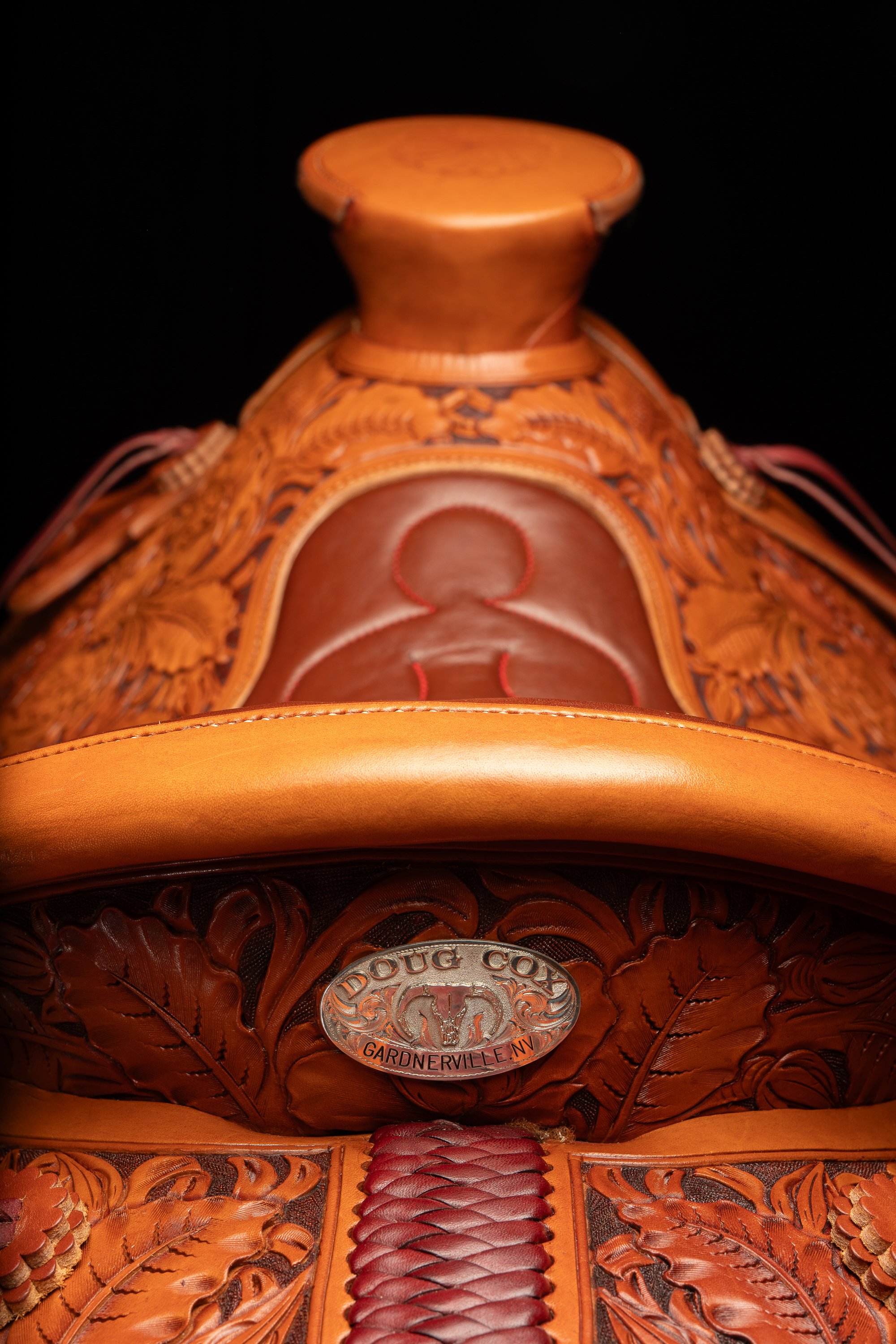
Below the cantle, a Doug Cox maker's badge is set into the carved leather above a braided section.