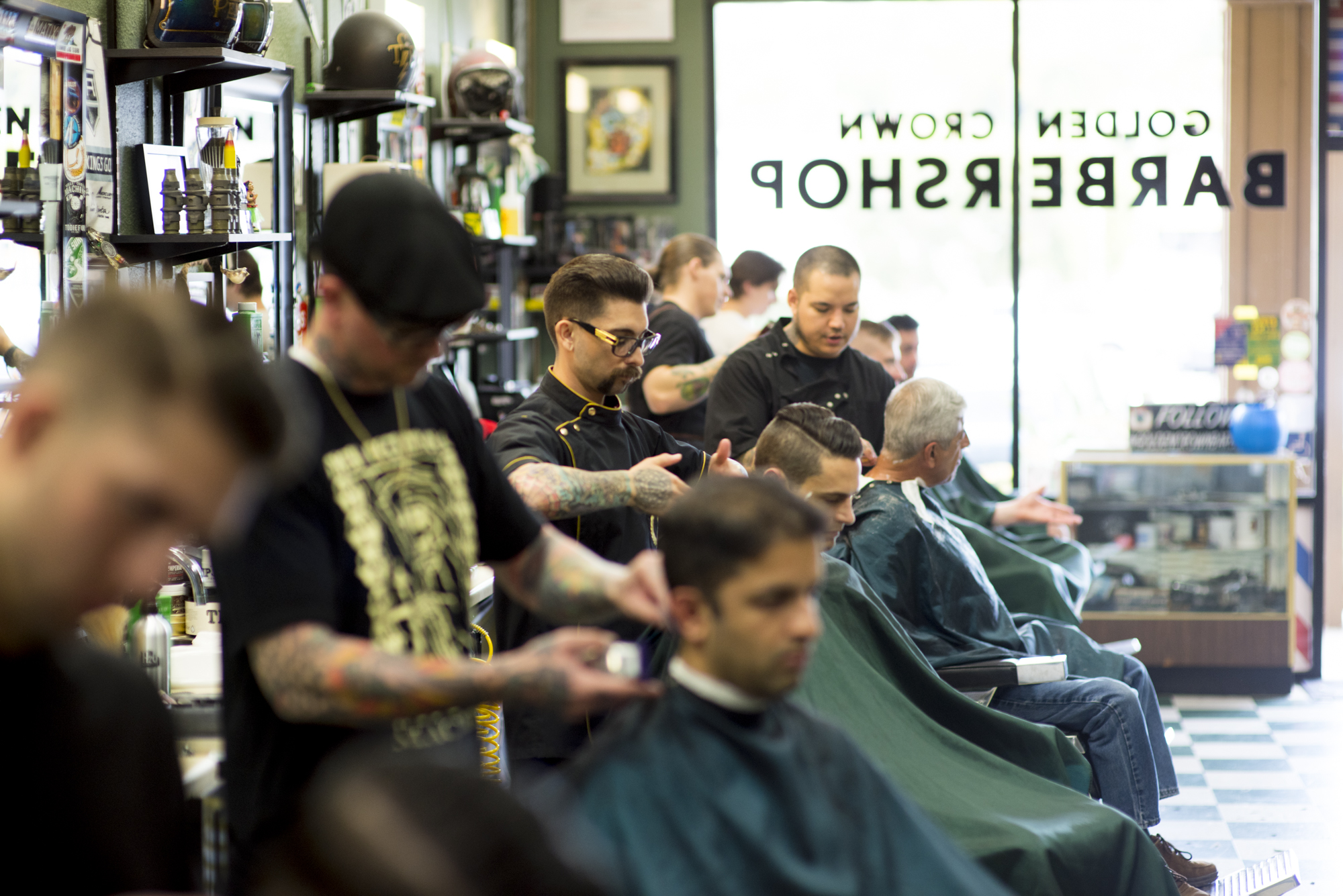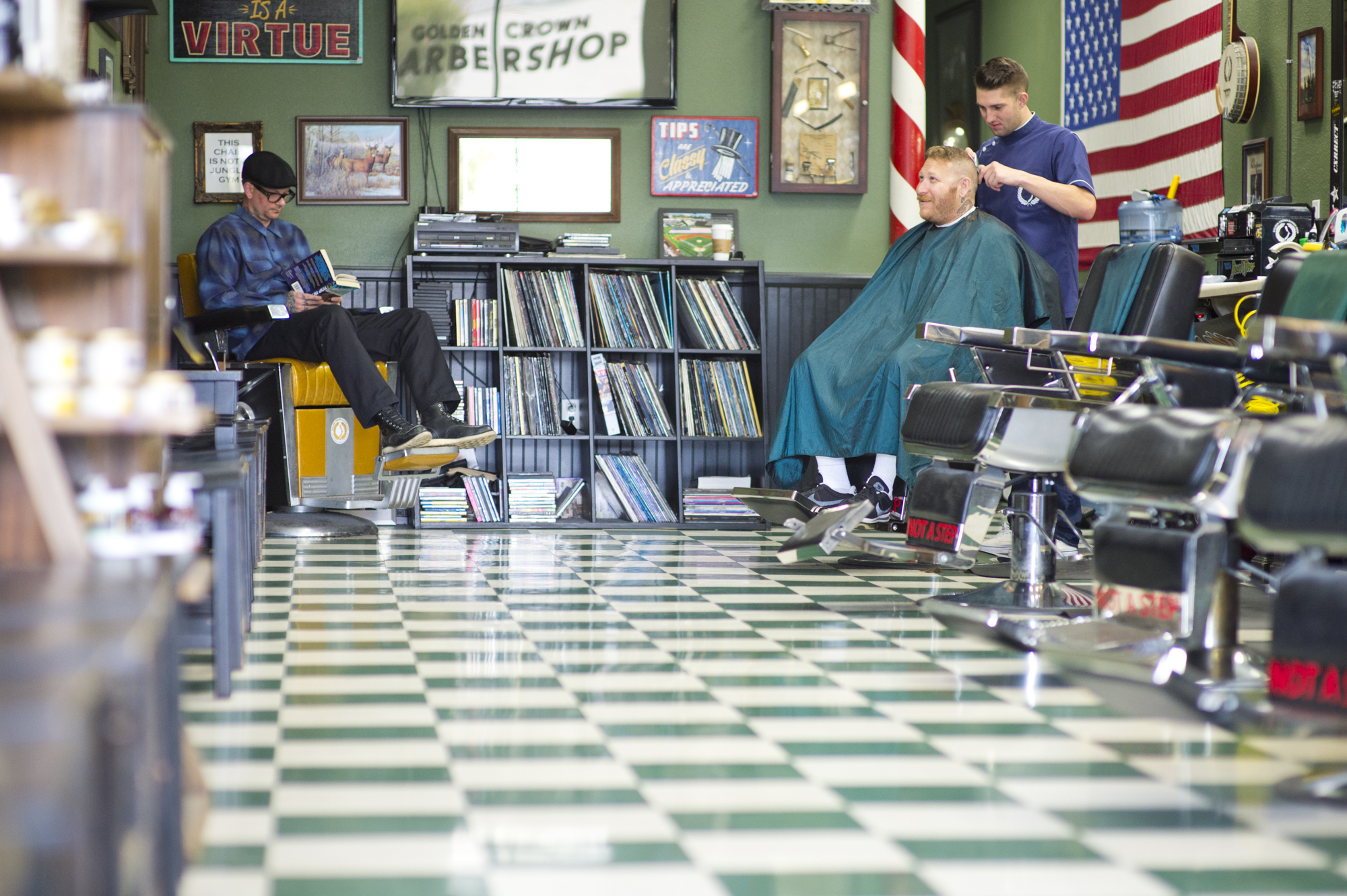
Russell's Barbershop

Russell’s Barbershop and the Role of the Neighborhood Shop in America

There are still a few places left where nothing is rushed.

Russell’s Barbershop in Hurlock, Maryland is one of them.

You can come in for a haircut, sure. That’s the reason most people walk through the door. But it doesn’t take long to realize that the haircut isn’t really the point. The conversations last longer than the appointments. People stay after they’re finished. Some show up with no intention of sitting in the chair at all.

Traditional neighborhood barbershops like Russell’s are becoming harder to find. Not because people don’t need haircuts, but because fewer places still function the way these shops once did—part service, part meeting place, part daily routine woven into the fabric of a community.

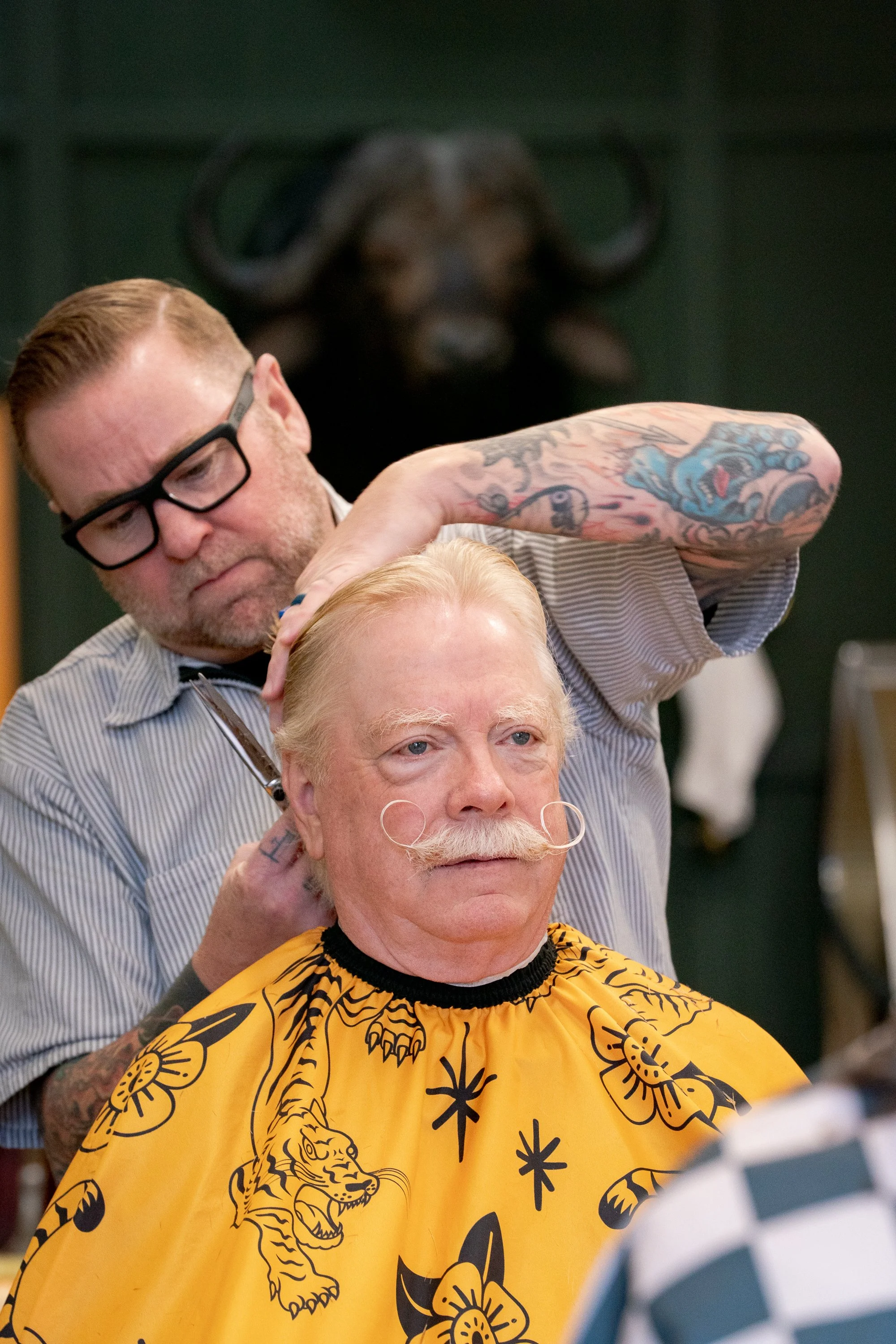
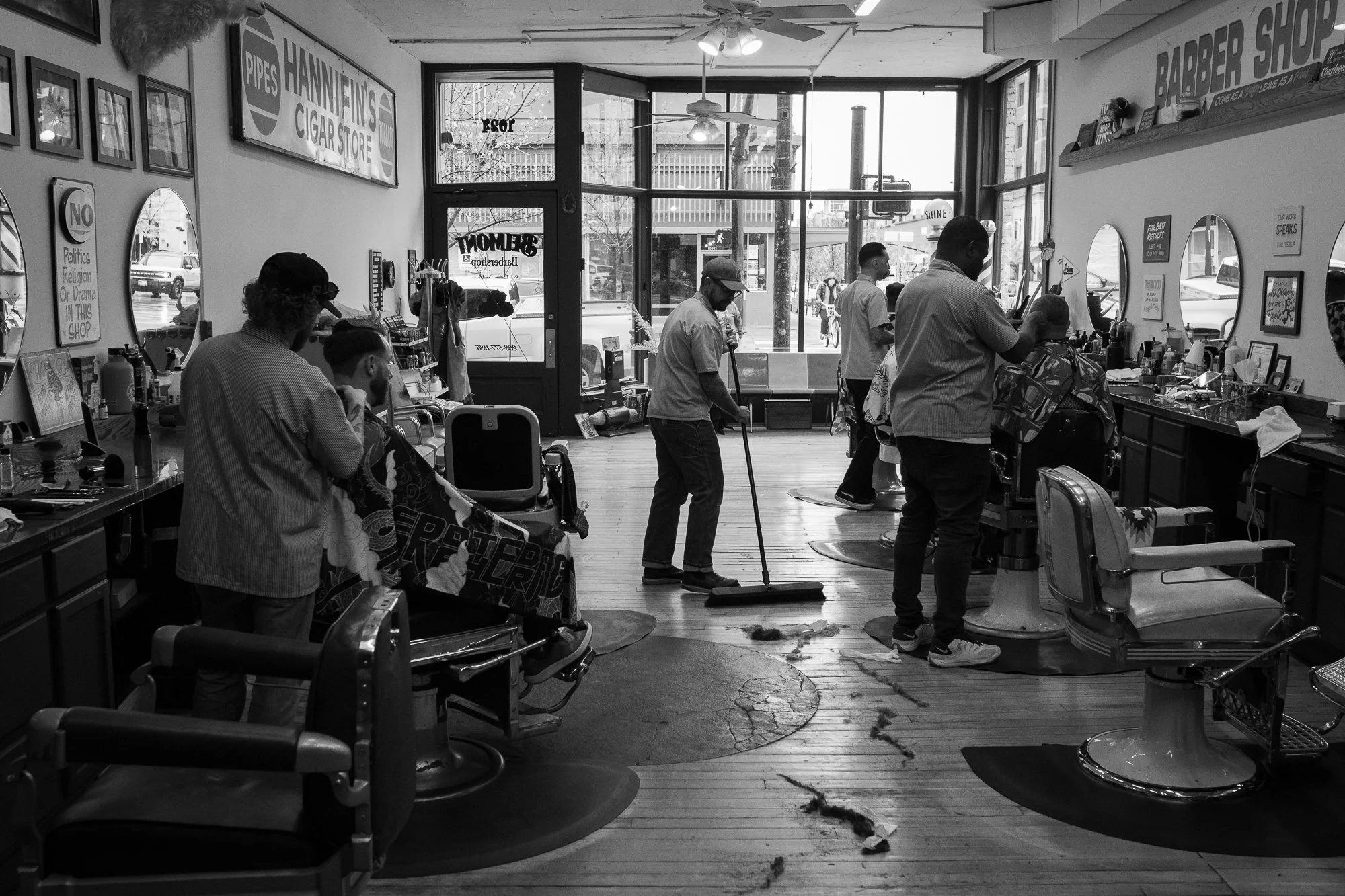
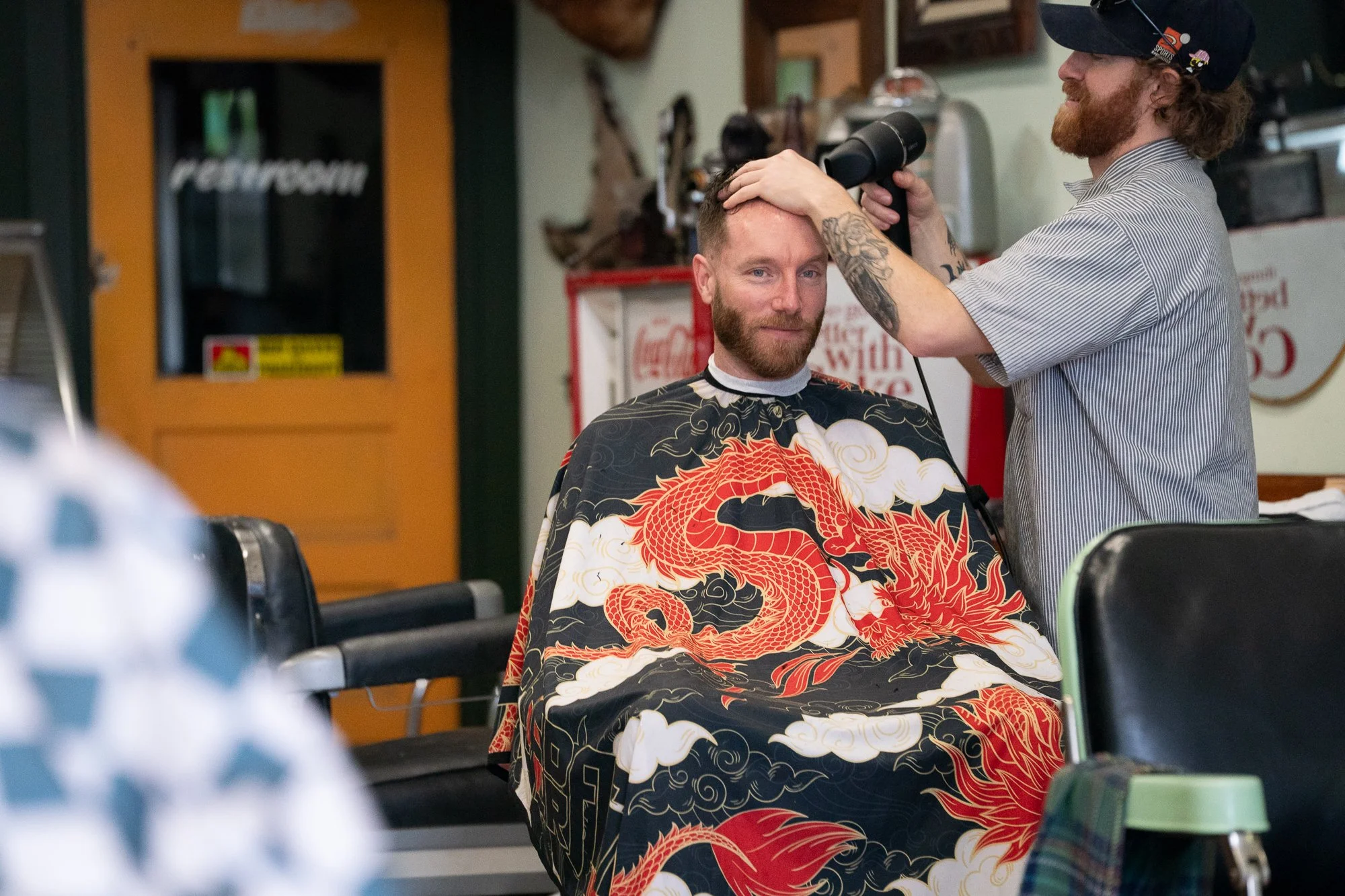
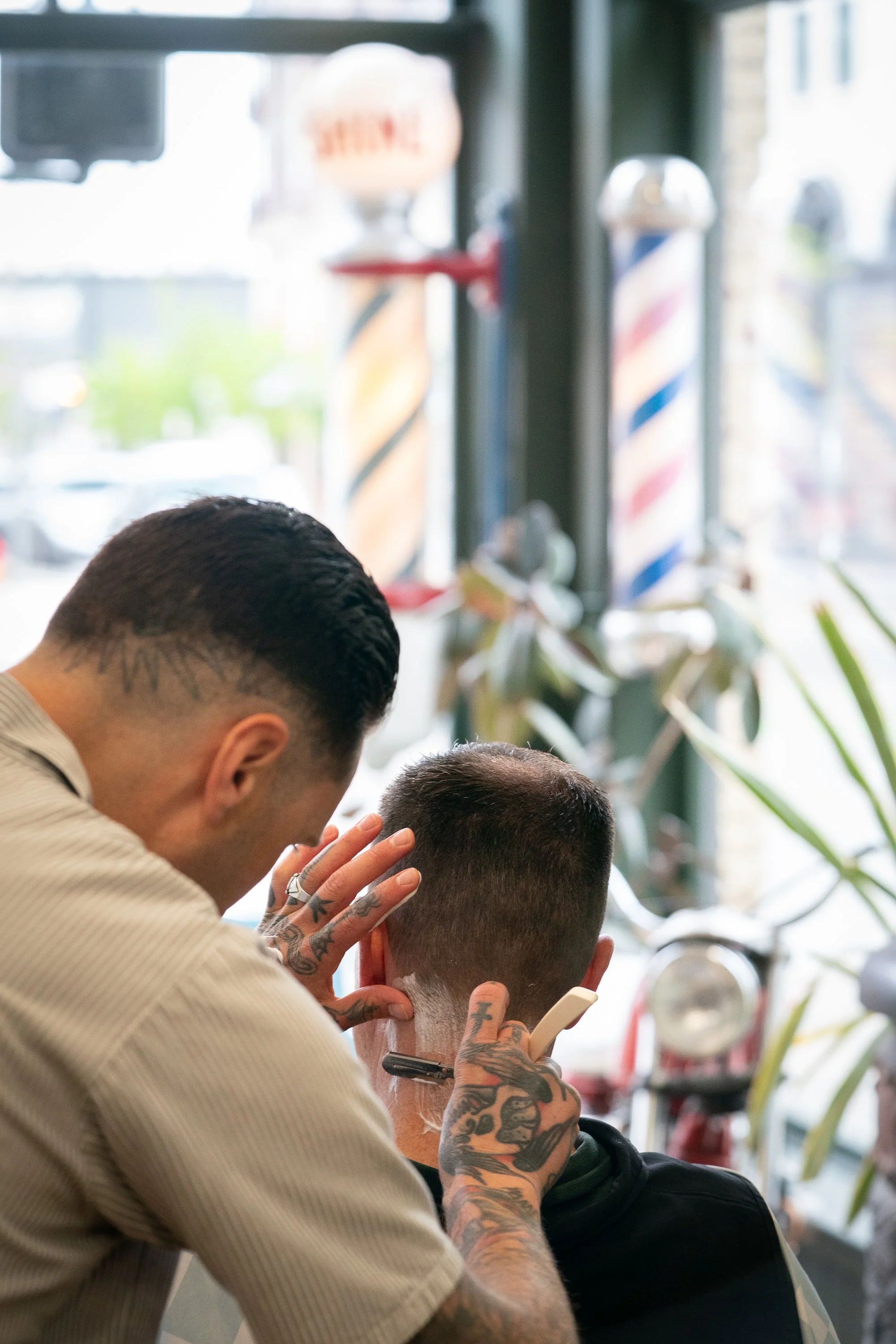
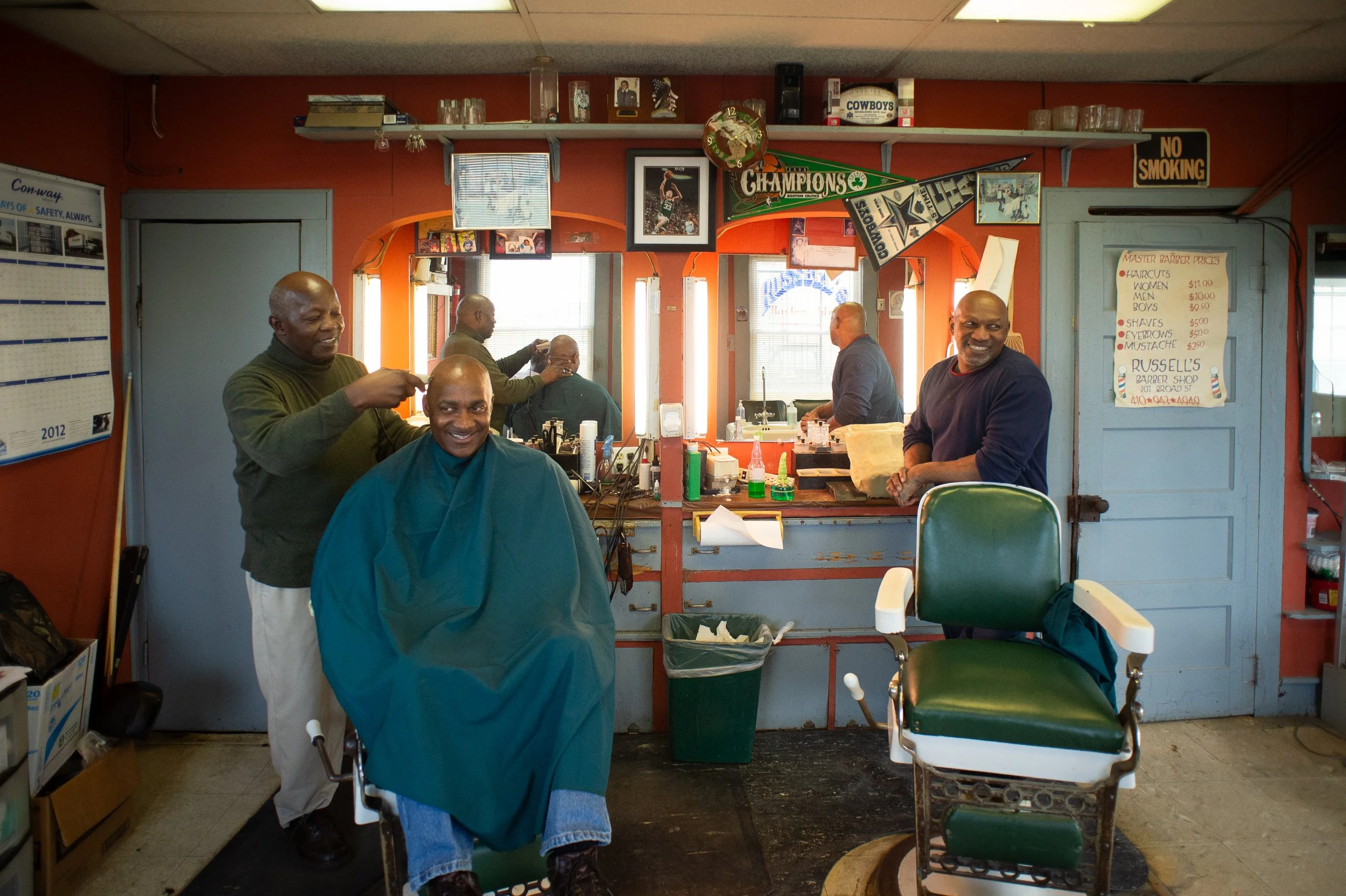
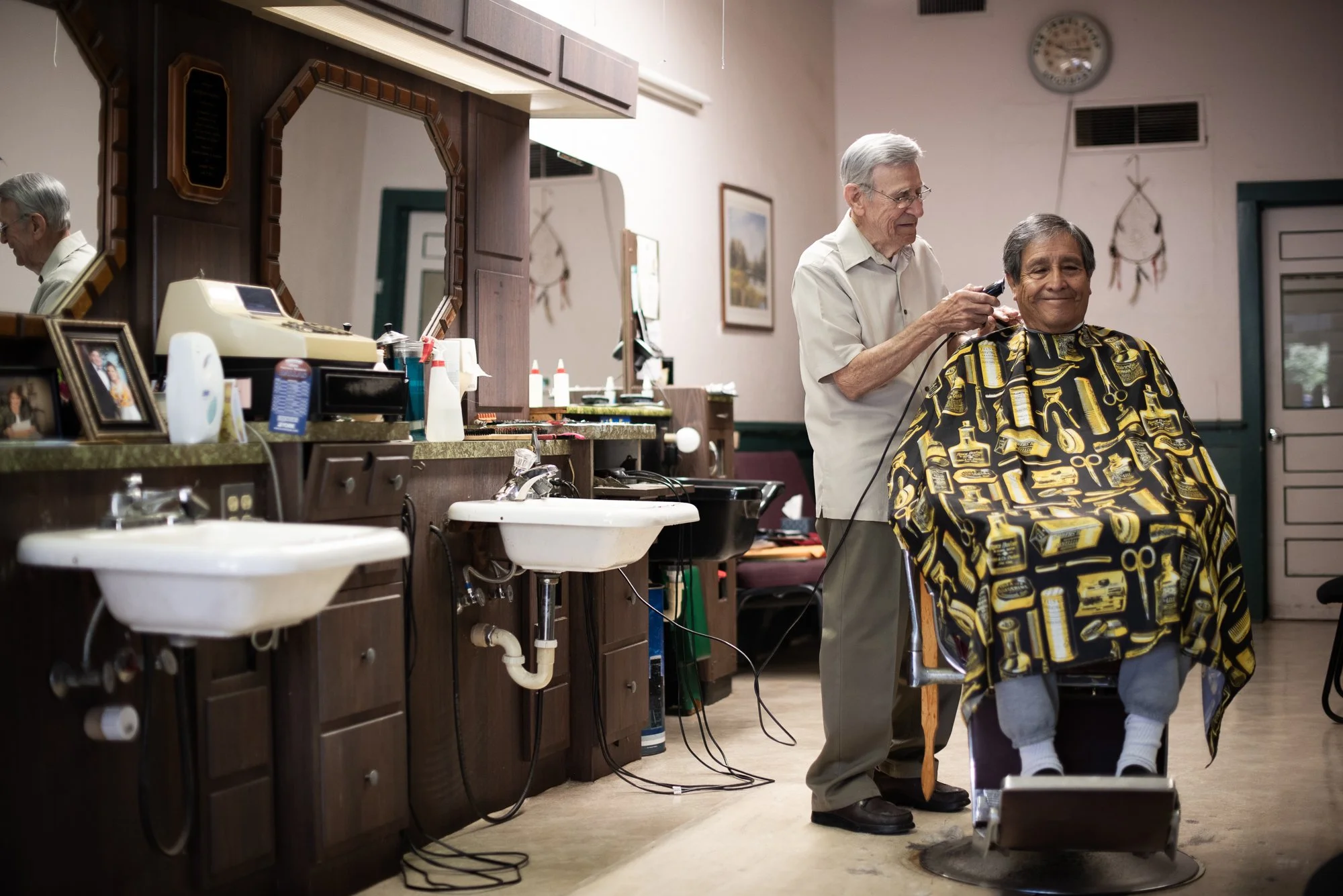
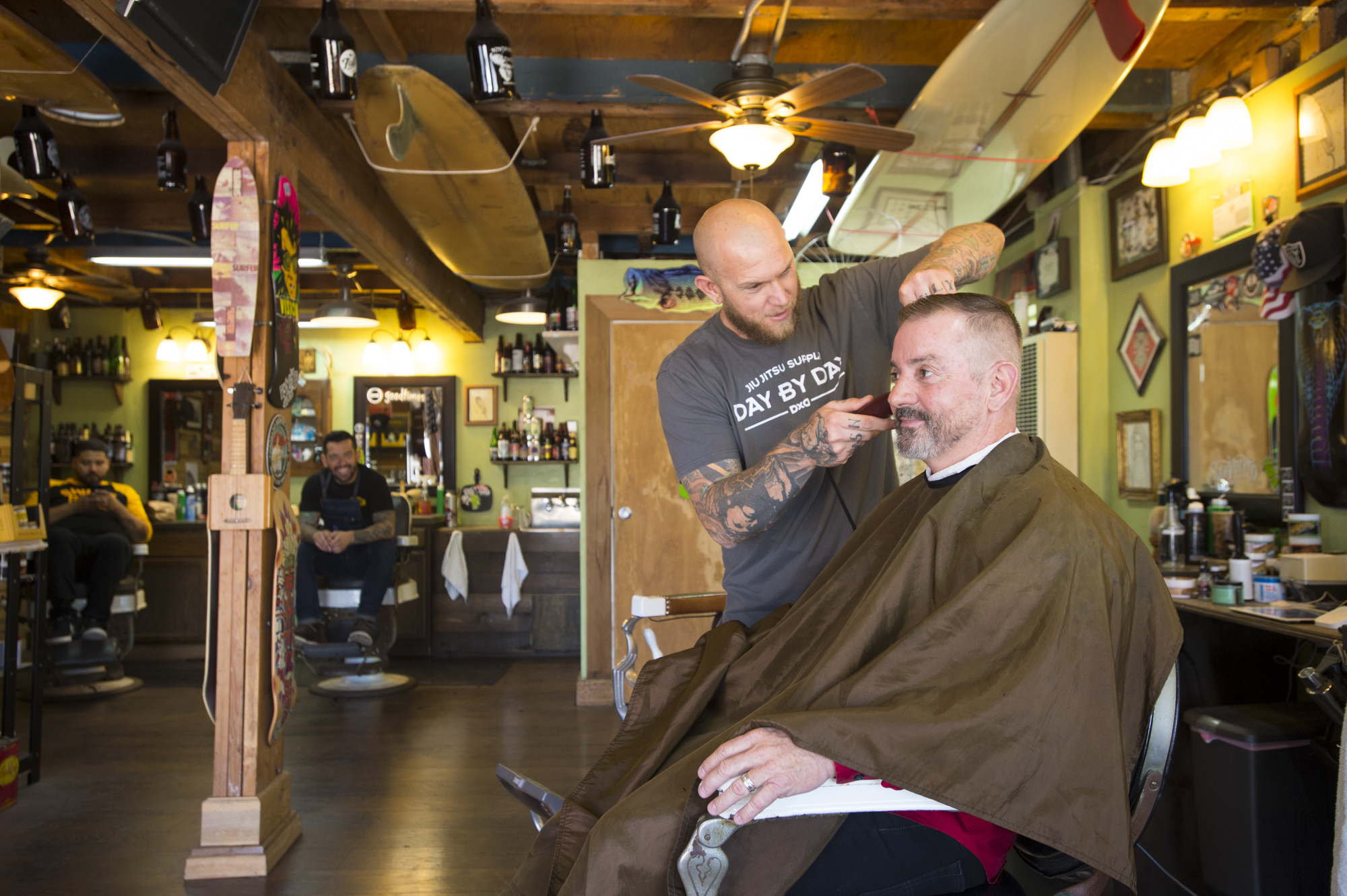
Barber cutting a client’s hair with mirror reflections inside Russell’s Barbershop in Maryland

A cut in progress and laughs carrying from one chair to the next.

A Shop Built Around the Day, Not the Clock

The rhythm inside Russell’s isn’t dictated by appointments or turnover. It’s shaped by the people in the room.

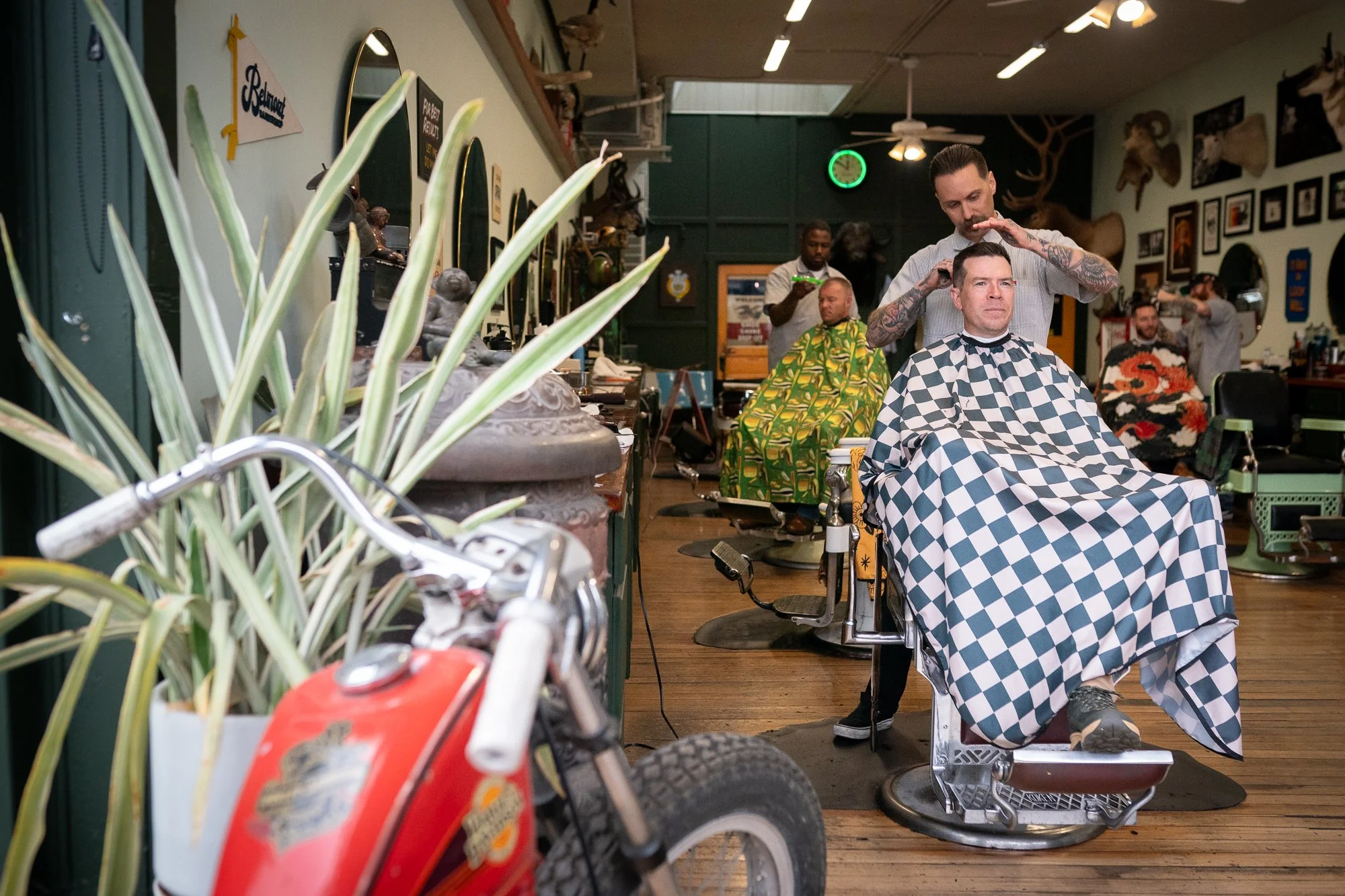
A haircut unfolds alongside conversation. Someone leans against the counter. Another watches from the chair. There’s movement, but no urgency—just a steady pace that hasn’t changed much over the years.

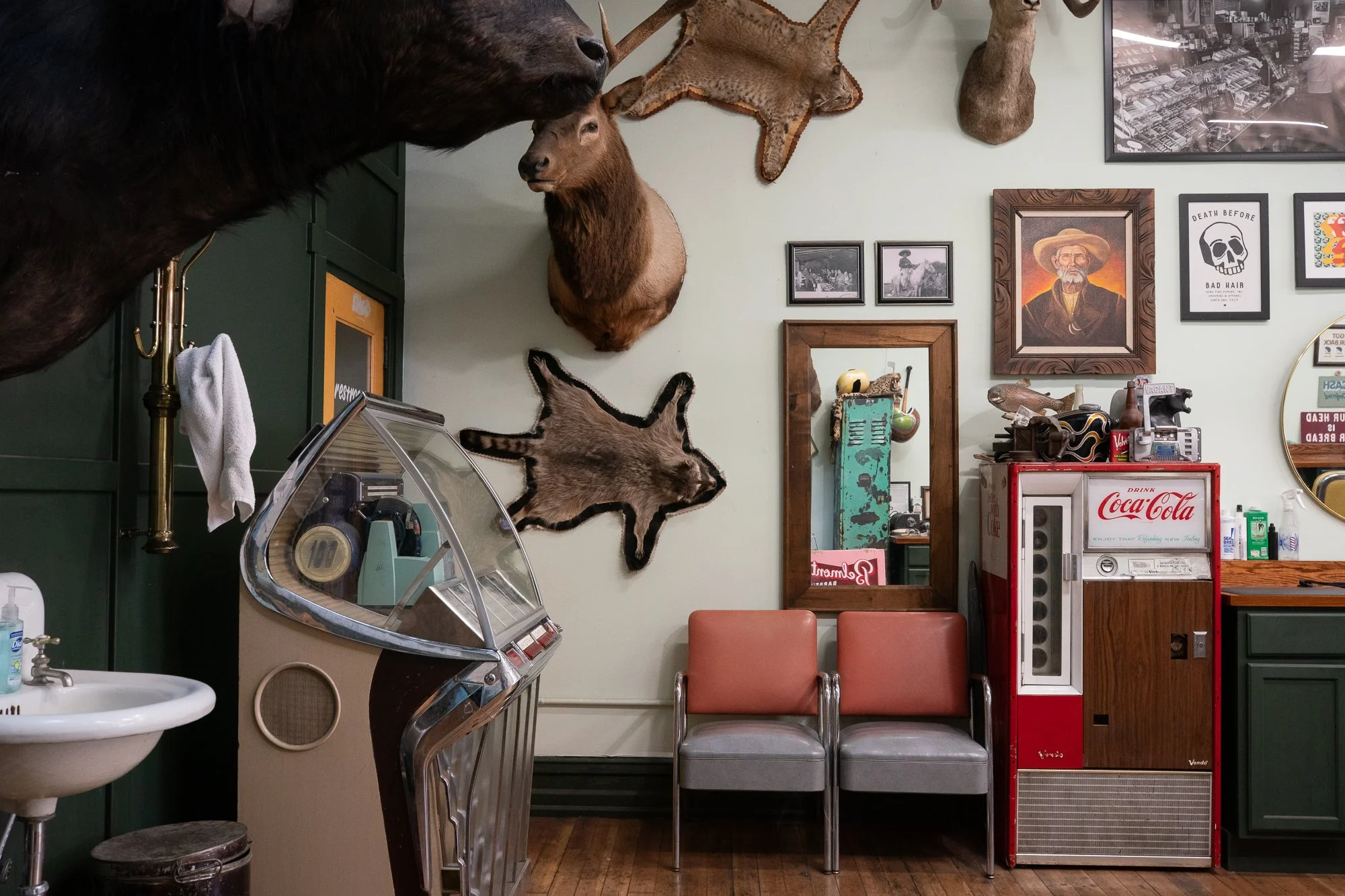
The space itself reflects that. Worn counters, familiar tools, and a layout that hasn’t been redesigned to optimize anything. It works because it always has.

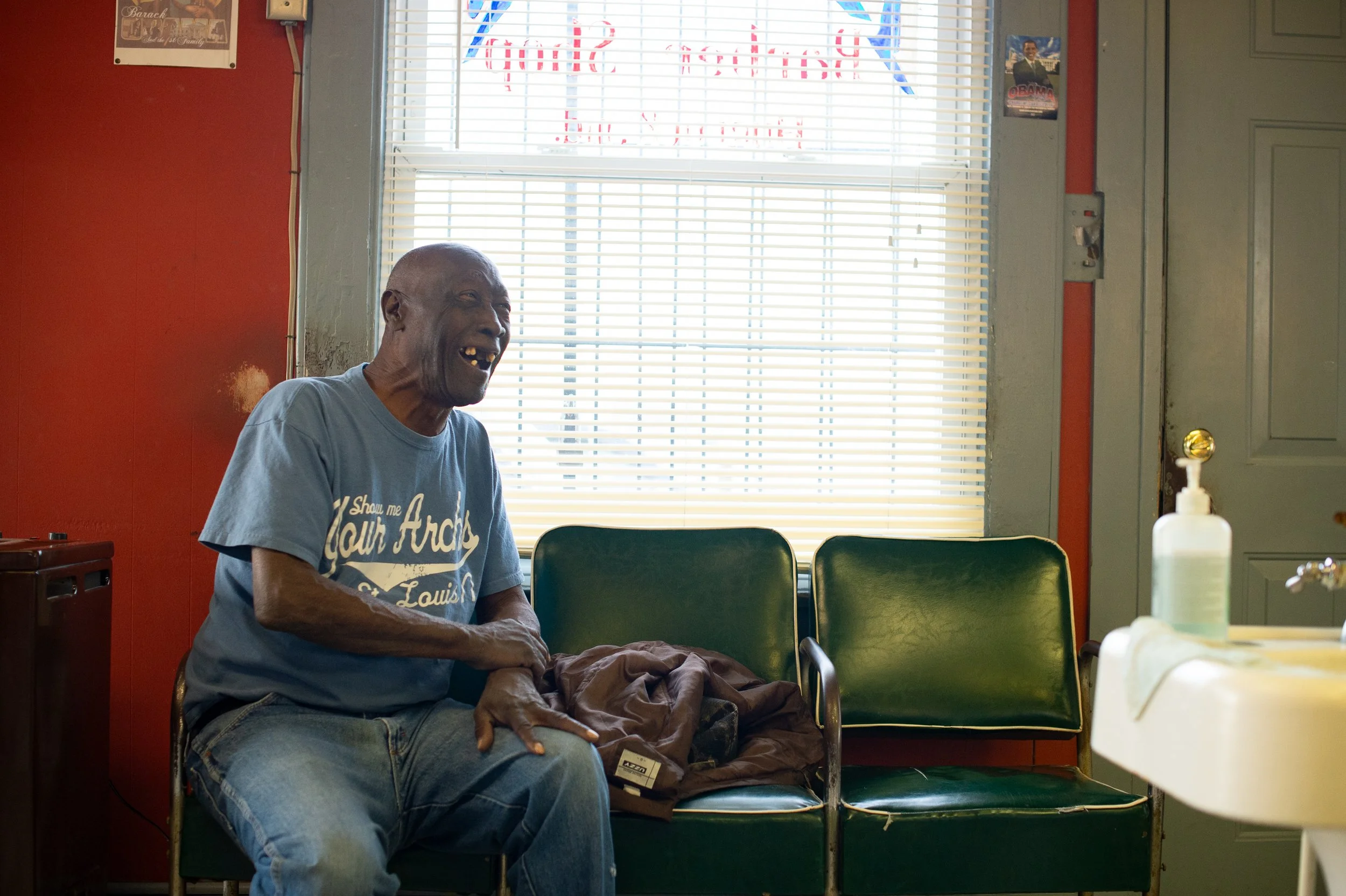
Man sitting and laughing on a chair near a window inside a barbershop in Maryland

The waiting is part of it too—stories, pauses, and time passing easy in the room.

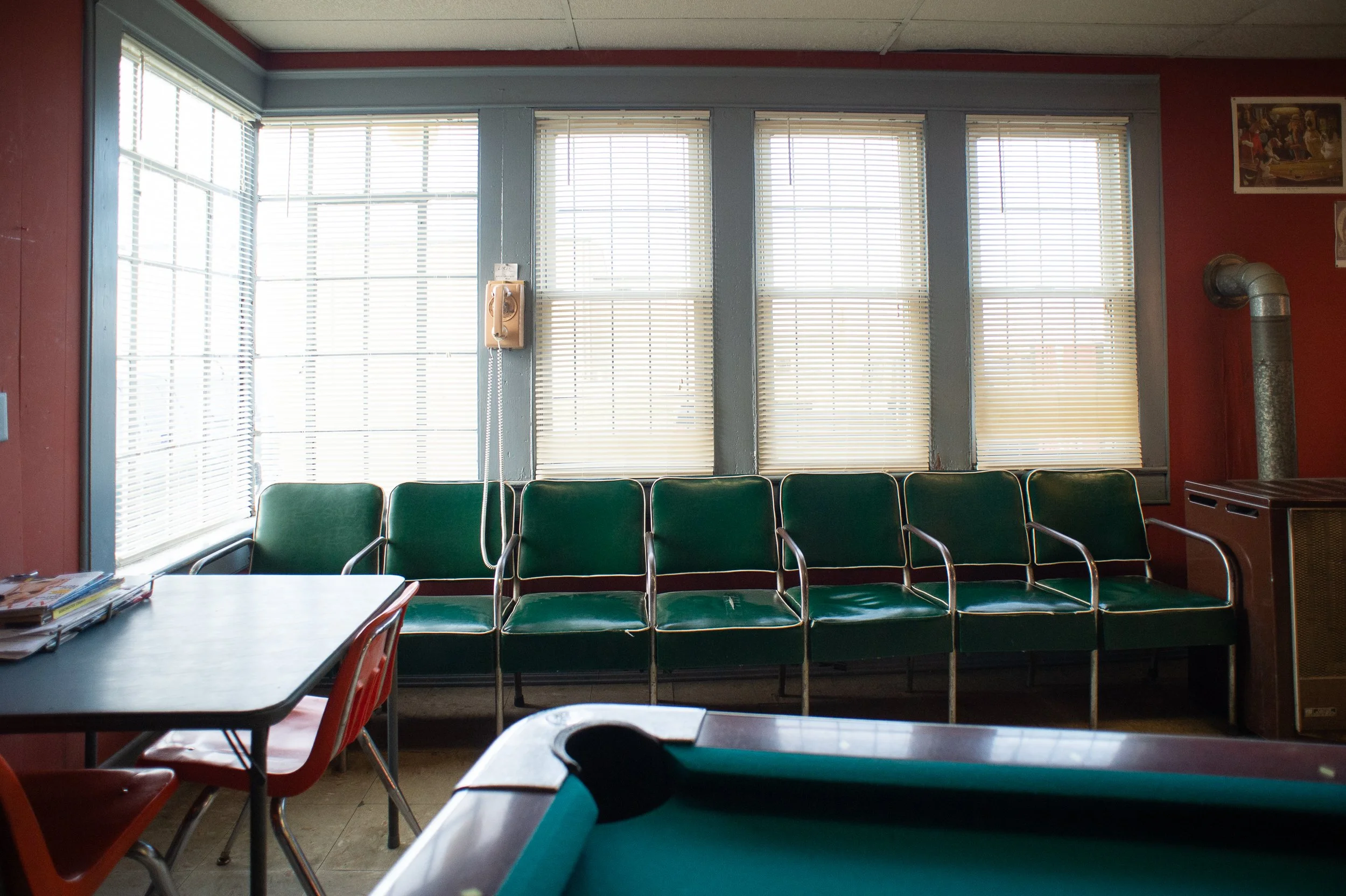
Row of green waiting chairs beneath large windows with blinds inside a barbershop in Maryland

A row of chairs under soft window light, the room holding steady between cuts.

The Waiting Area That Isn’t Really About Waiting

The chairs along the window aren’t just for customers waiting their turn.

They’re for conversations that start before a haircut and continue long after. Stories get told here. News travels through the room. People come in just to sit for a while, knowing someone they know will pass through.

There’s a familiarity to it—an unspoken understanding that this is a place where you can stay as long as you want.

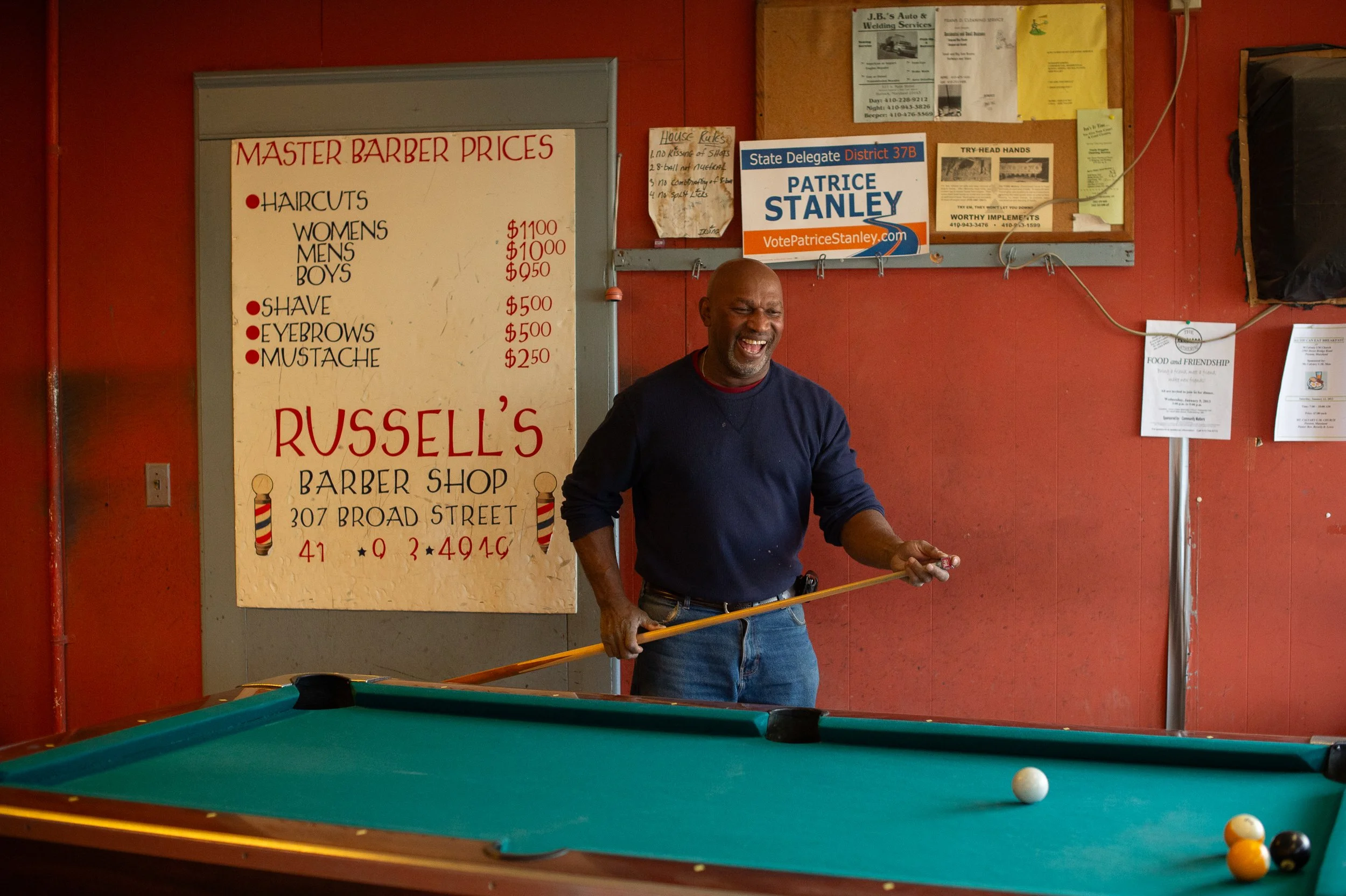
Man playing pool inside Russell’s Barbershop with price list and wall signs in the background

A game between cuts, the table catching what the day brings in.

The Back Room: Where Time Gets Spent in a Neighborhood Barbershop

In the back, a pool table sits just a few steps away from the barber chairs.

It changes the dynamic of the entire shop.

This isn’t just a place you pass through—it’s a place you spend time in. Games start and stop as people come and go. Someone lines up a shot while another watches, cue in hand, mid-conversation.

It’s a reminder that the shop serves a purpose beyond the service. It holds space for the hours in between.

The Details That Haven’t Been Replaced

The details inside Russell’s tell their own story.

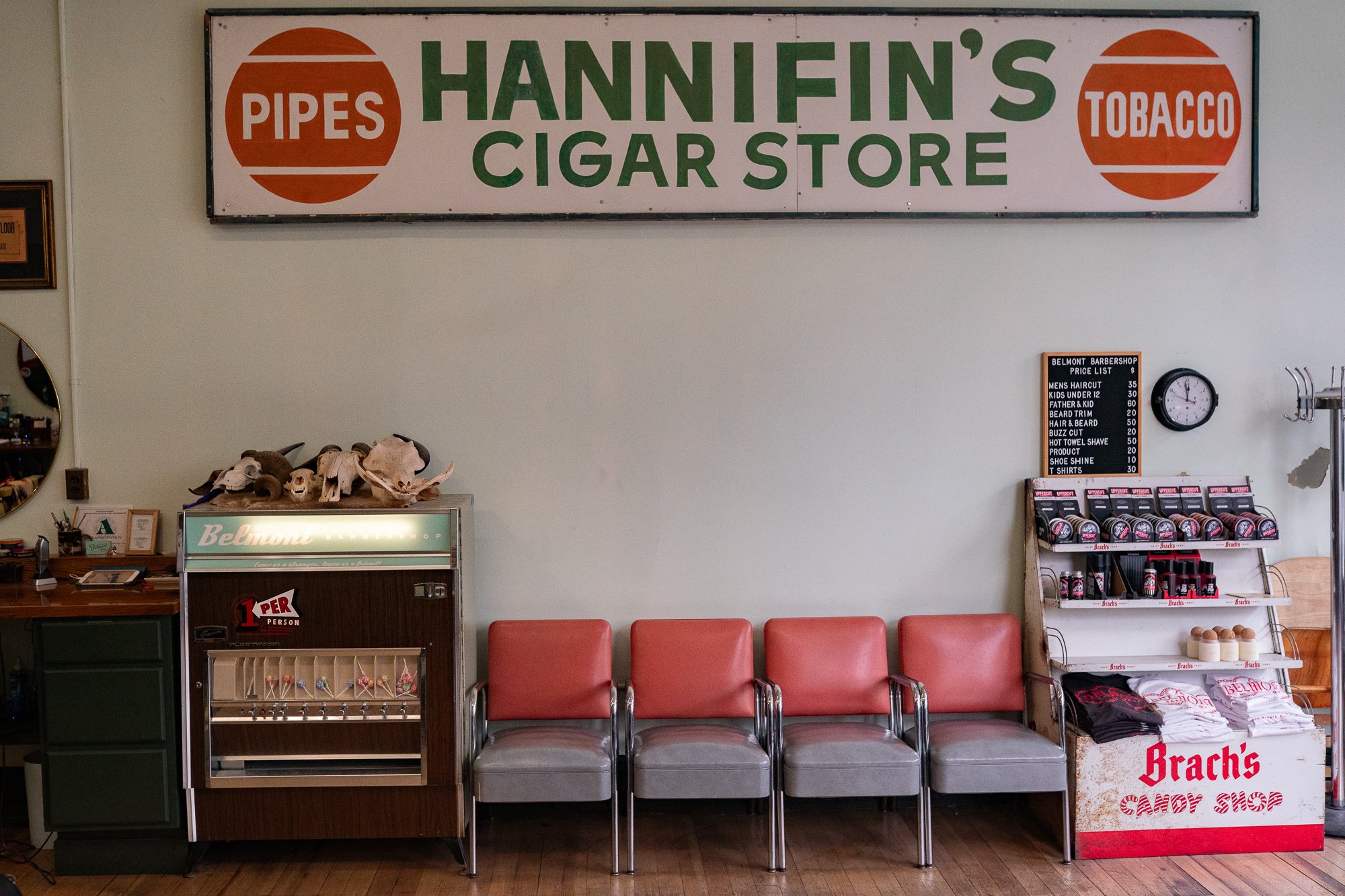
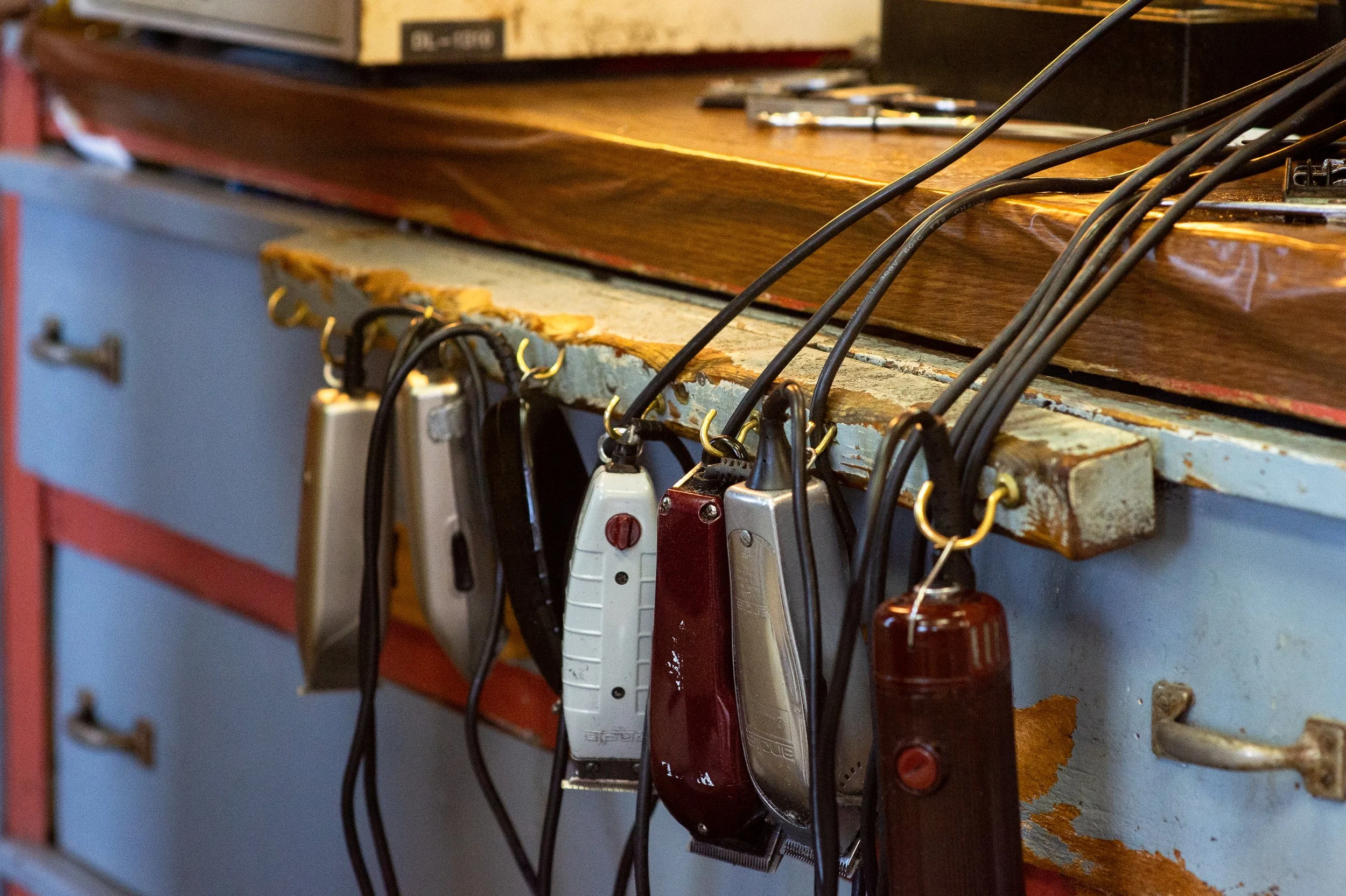
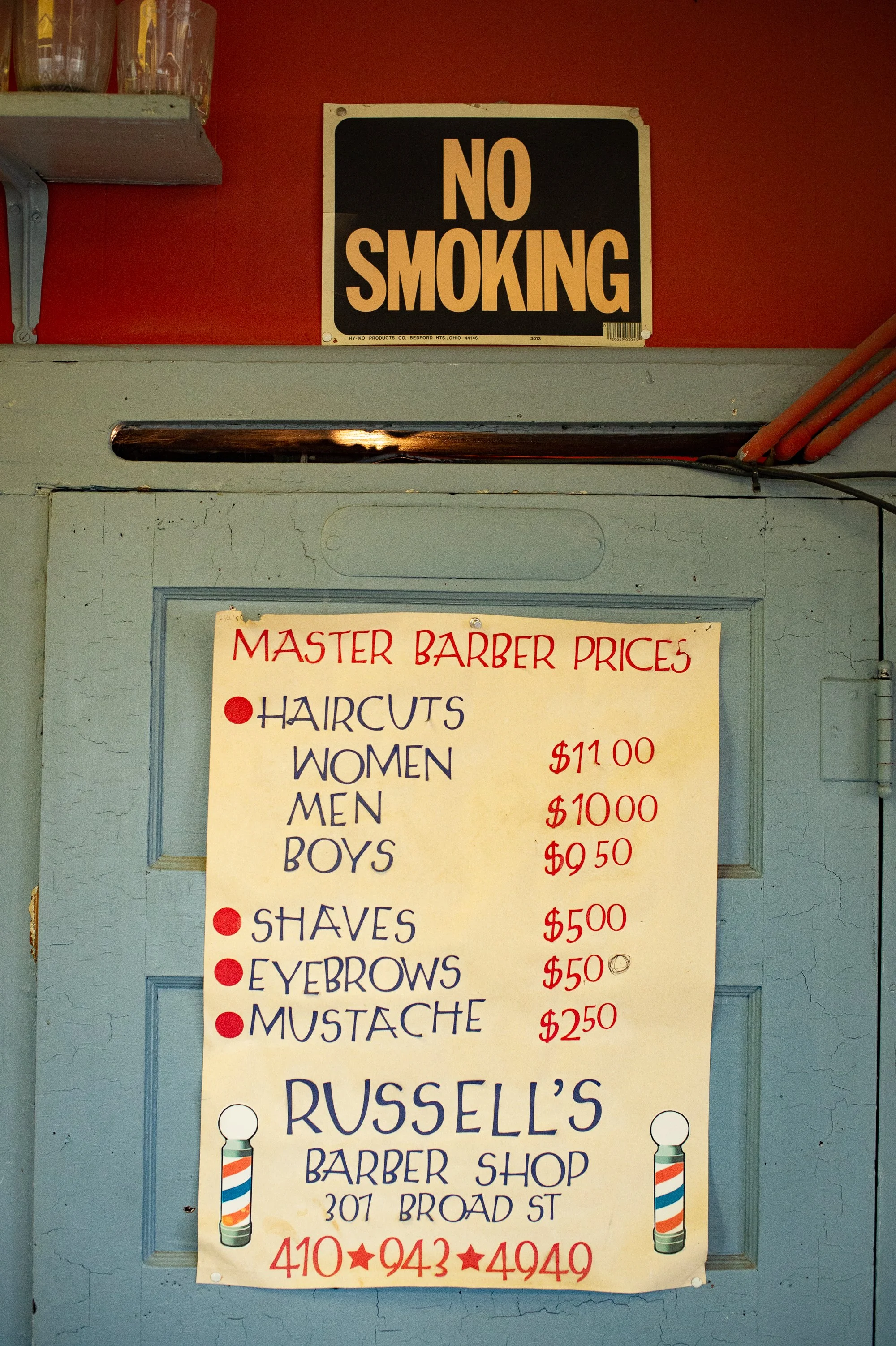
Hand-painted price signs. Clippers hanging from hooks worn smooth over time. A “No Smoking” sign that’s been part of the wall longer than most people can remember.

Even the prices feel like they belong to another era—not as a statement, but simply because there’s never been a reason to change them.

Nothing here has been updated for the sake of appearance. Everything remains because it still serves its purpose.

Close-up of barber clippers hanging from a worn workstation inside a barbershop

Tools worn in just right, each one part of the same steady routine.

Price list and no smoking sign on the wall inside Russell’s Barbershop in Hurlock Maryland

Prices taped to the door, a no smoking sign above, everything laid out the way it’s been for years.

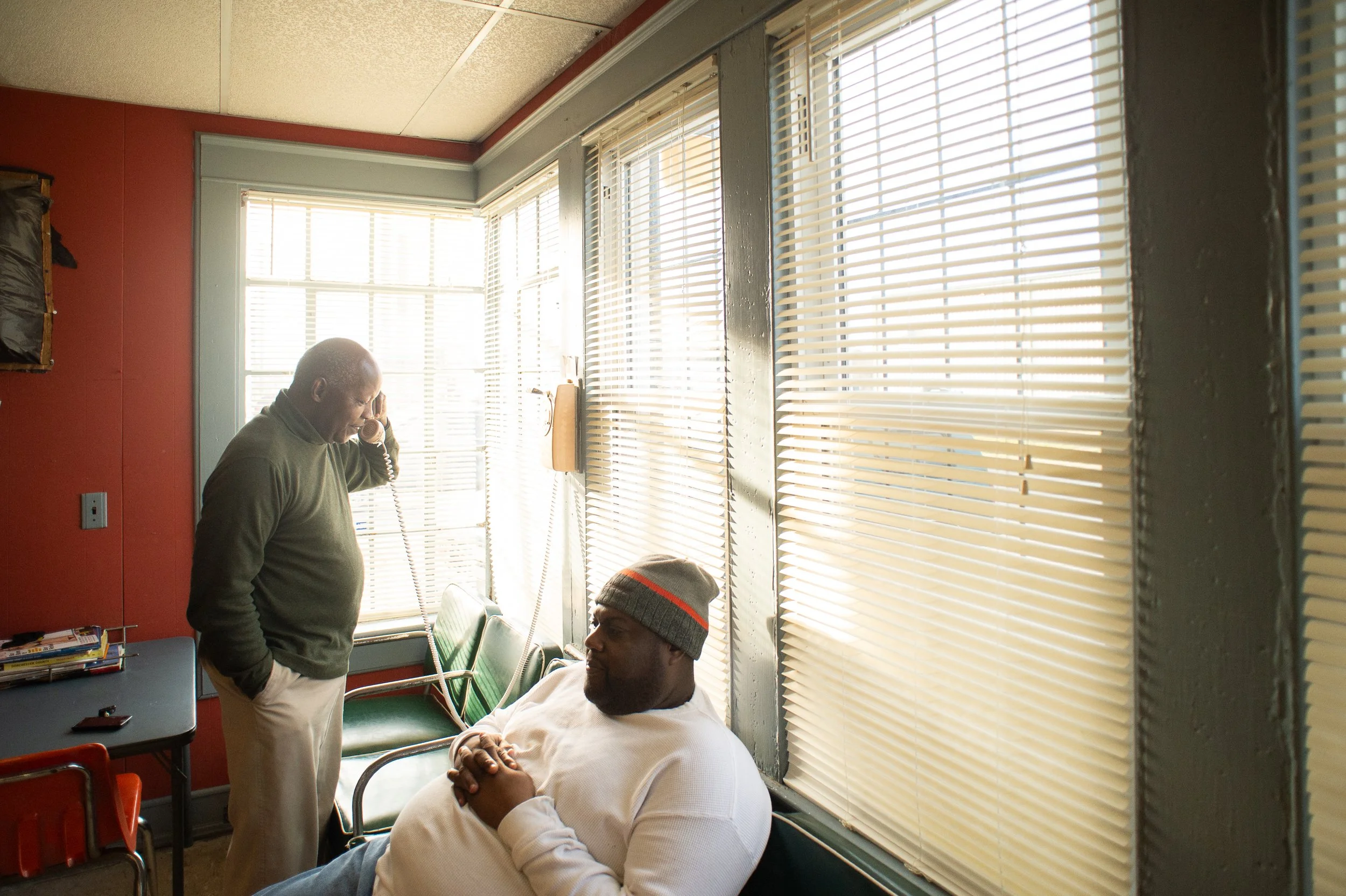
Two men sitting and talking near the window inside a barbershop in Maryland

A call comes through on the wall phone, picked up between cuts as the room carries on.

A Place That Still Holds Its Ground

From the outside, Russell’s doesn’t draw much attention.

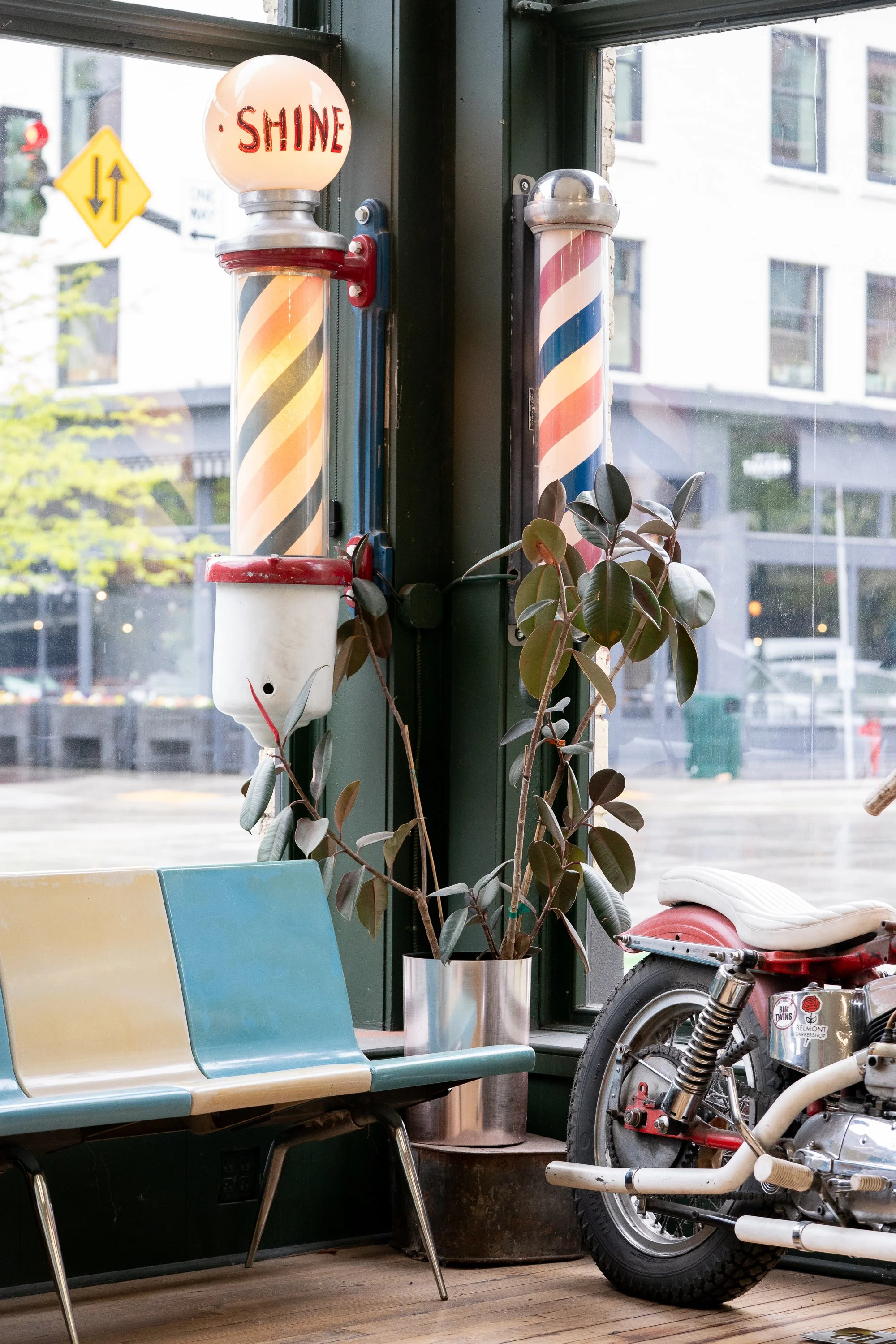
A simple building. A barber pole. A door that opens into something easy to miss if you’re not looking for it.

But inside, it holds onto something that’s becoming harder to find—spaces that exist for the people who use them, not for how they’re perceived.

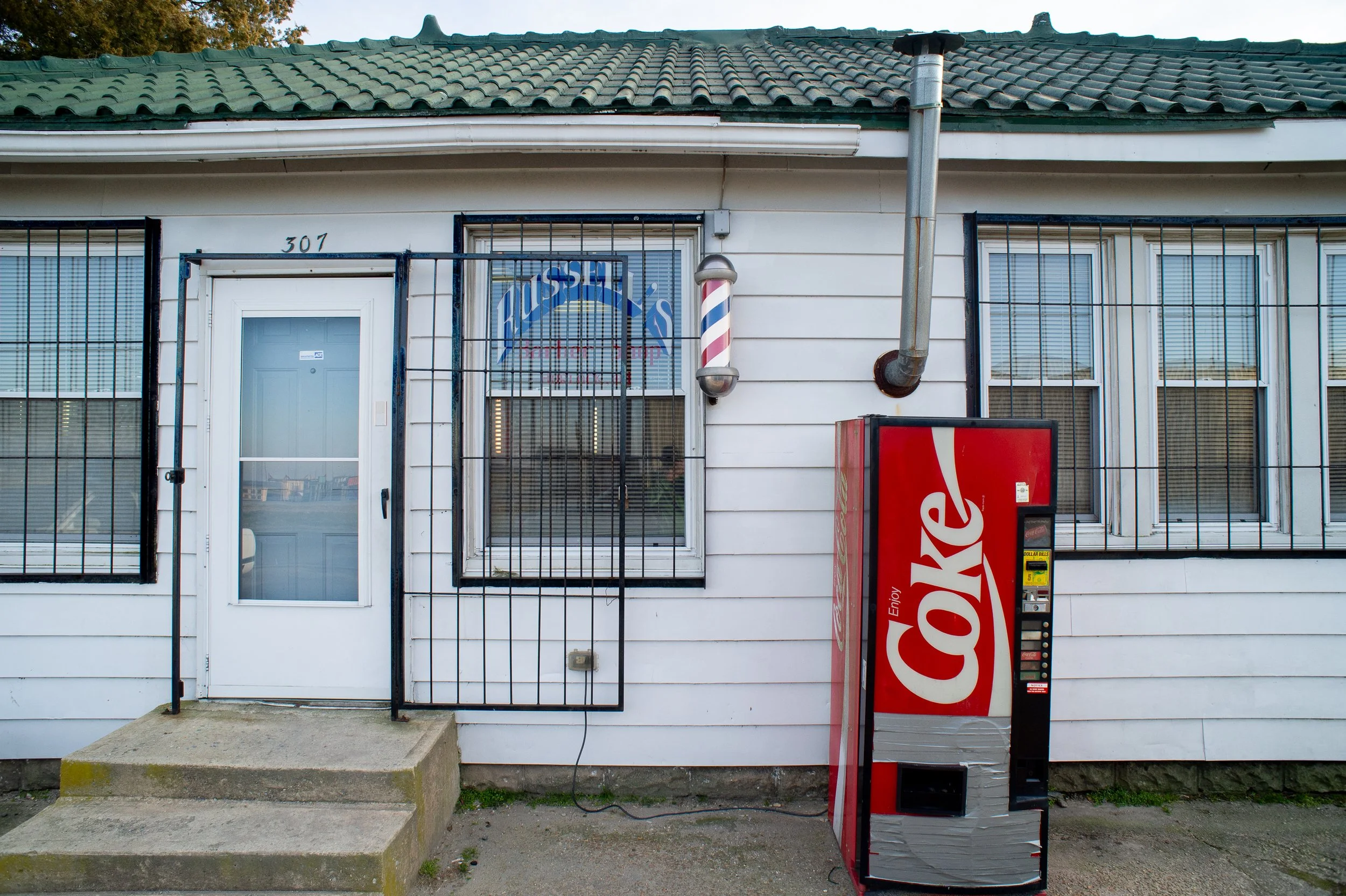
Exterior of Russell’s Barbershop in Hurlock Maryland with a Coca-Cola vending machine outside

Outside Russell’s, a quiet storefront with an old Coca Cola machine humming beside the door.

Part of a Larger American Barbershop Project

Russell’s Barbershop is one of countless shops I’ve photographed over the past 15 years as part of my long-term project documenting barbershops across all 50 states.

Some of those shops are gone now. Others have changed. A few, like this one, continue much as they always have.

Not because they’re trying to preserve anything—but because there’s still a need for places like this.

Places where people come not just for a haircut, but to spend part of their day.

View the full Barbershops of America project

Explore another barbershop story from this project

Shop the barbershop photography book and prints

Sweeney Todd's Barbershop

Sweeney Todd’s Barbershop, Los Angeles

Tucked into the Los Feliz neighborhood of Los Angeles, Sweeney Todd’s barbershop carries a kind of visual weight that comes from it’ impeccable design. Walking in there for the first time you’d have to seriously question whether or not you’d been transported to a different era. All of the shops layered objects, textures, and details reflect something different than our current reality. It’s so well done that the only clue hinting at present day, is the clothing warn by customers.

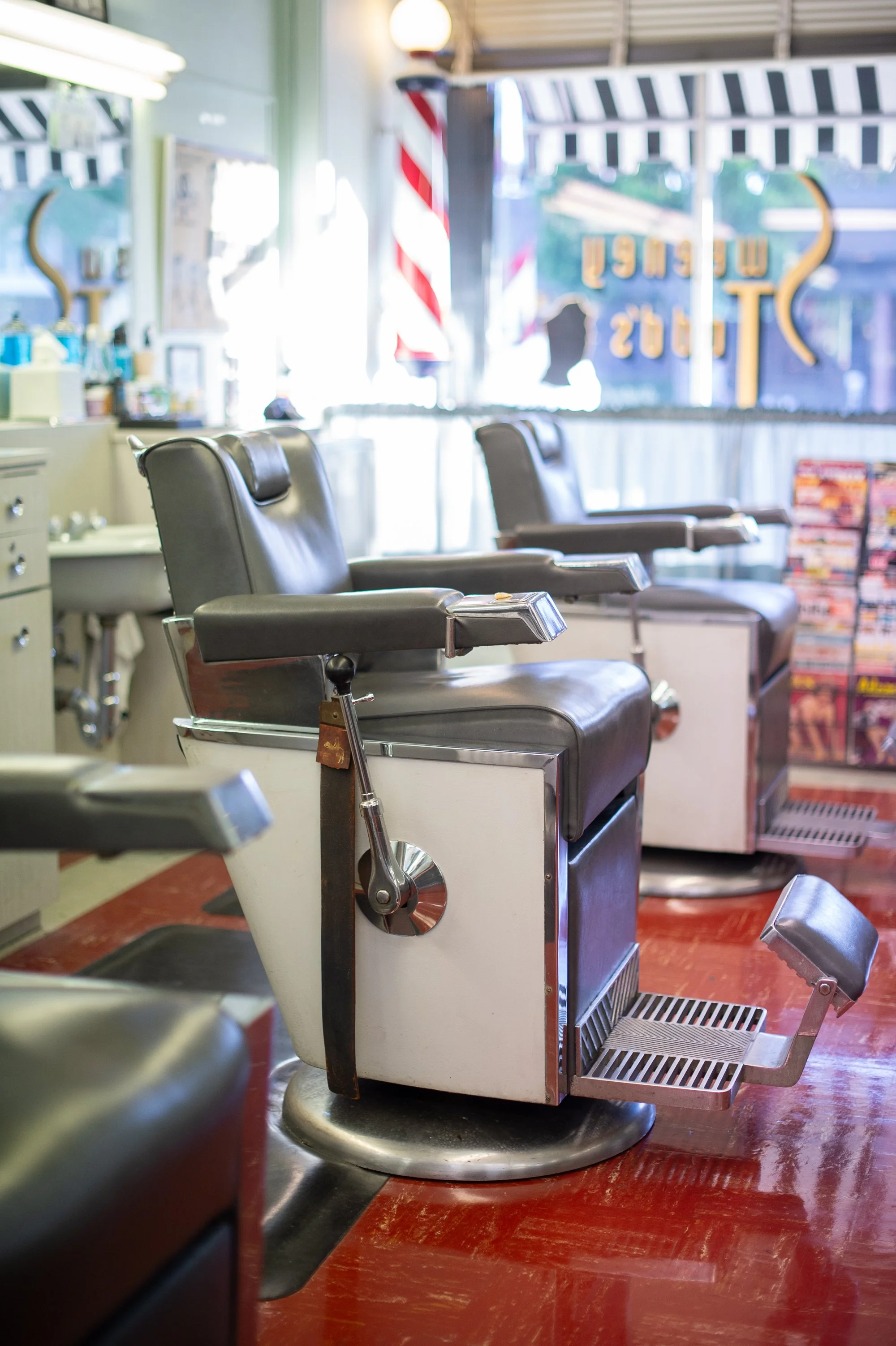
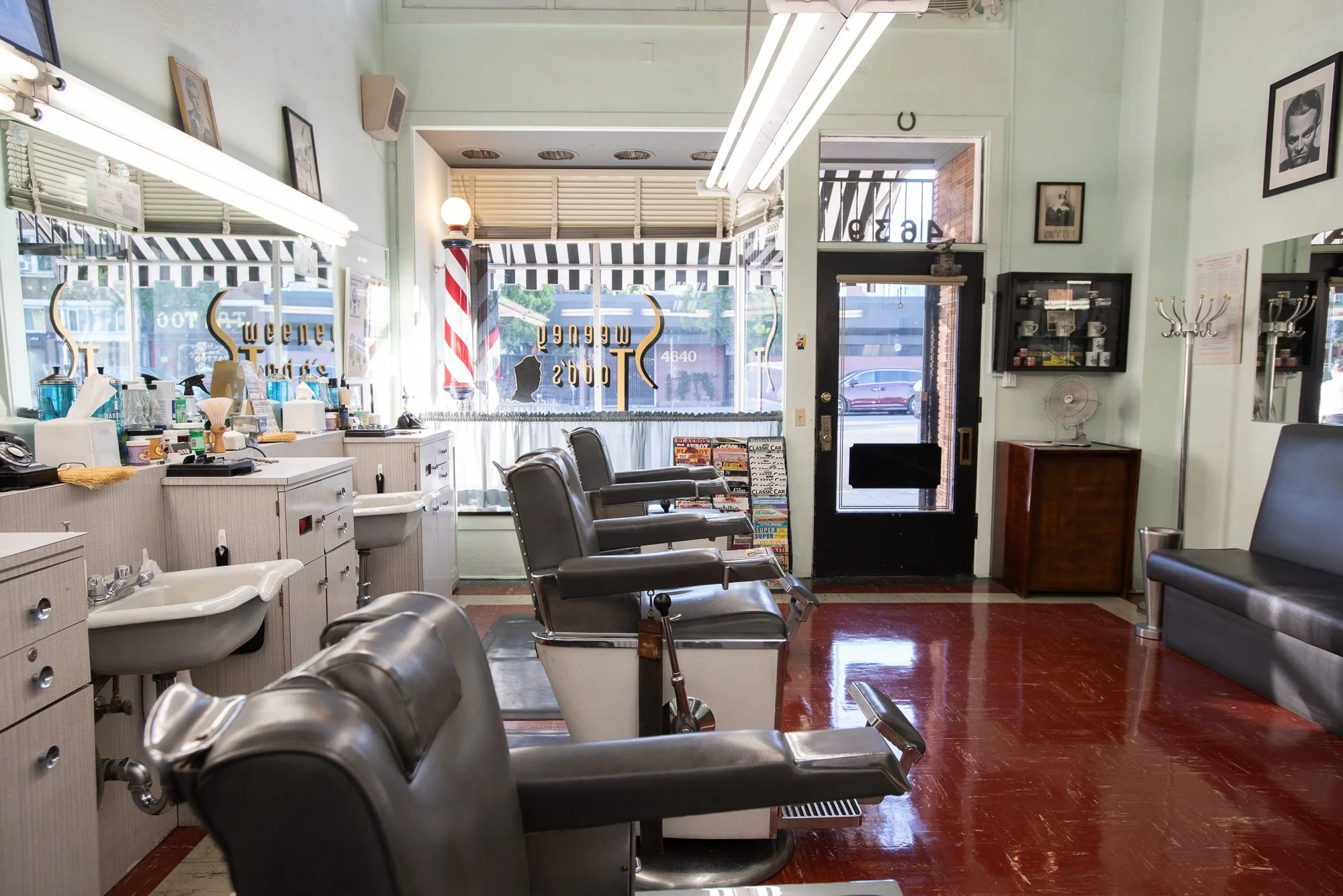
Row of empty vintage chrome and leather barber chairs at Sweeney Todd's Barbershop with barber pole and Sweeney Todd's gold window lettering reflected behind them

The chairs sit empty between cuts, chrome bases and worn leather catching the light. Through the front window, the barber pole turns and the gold lettering reads in reverse. The shop is open.

A Shop Defined by Atmosphere

The first thing that stands out isn’t any one object—it’s the density of the space. The walls are filled, but not cluttered. Vintage signage, photographs, tools, and ephemera stack up in a way that feels intentional without being precious. There’s empty wall space, but none of it begs for decoration. Everything already has a purpose.

The lighting is a mix of classic barbershop interior and a steady flow of California sunshine, creating pockets of contrast across the room. It highlights the patina of worn wood, the shine of old metal fixtures, and the texture of well-used barber chairs. It’s the kind of environment that feels cinematic without trying to be.

Nothing feels new. And that’s exactly the point.

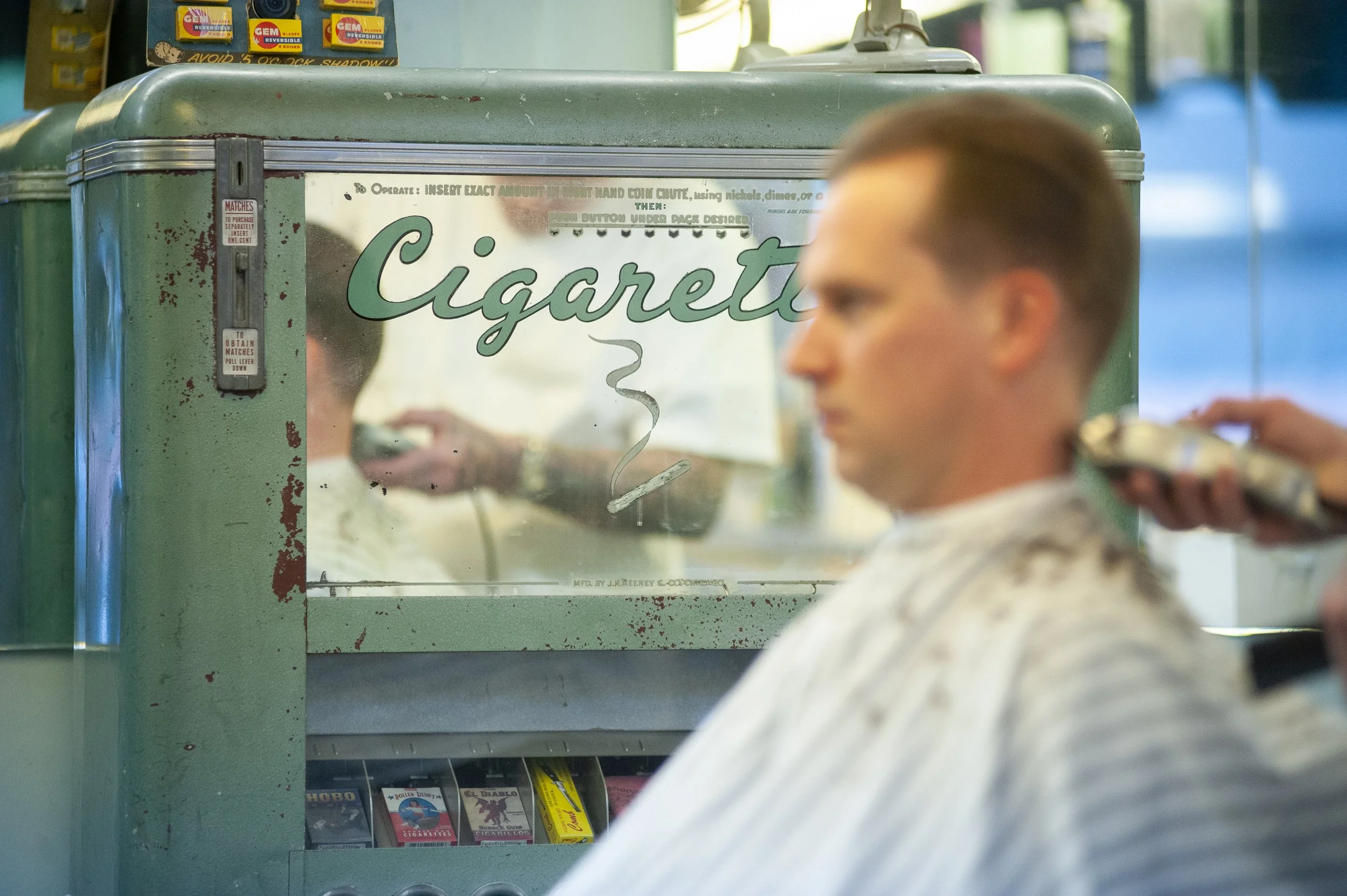
Vintage green cigarette vending machine at Sweeney Todd's Barbershop in Los Angeles, with a caped client being clippered in the foreground

A haircut is happening in the foreground. In the background, a vintage cigarette machine holds its ground, paint worn, decals faded. The shop doesn't explain what it keeps.

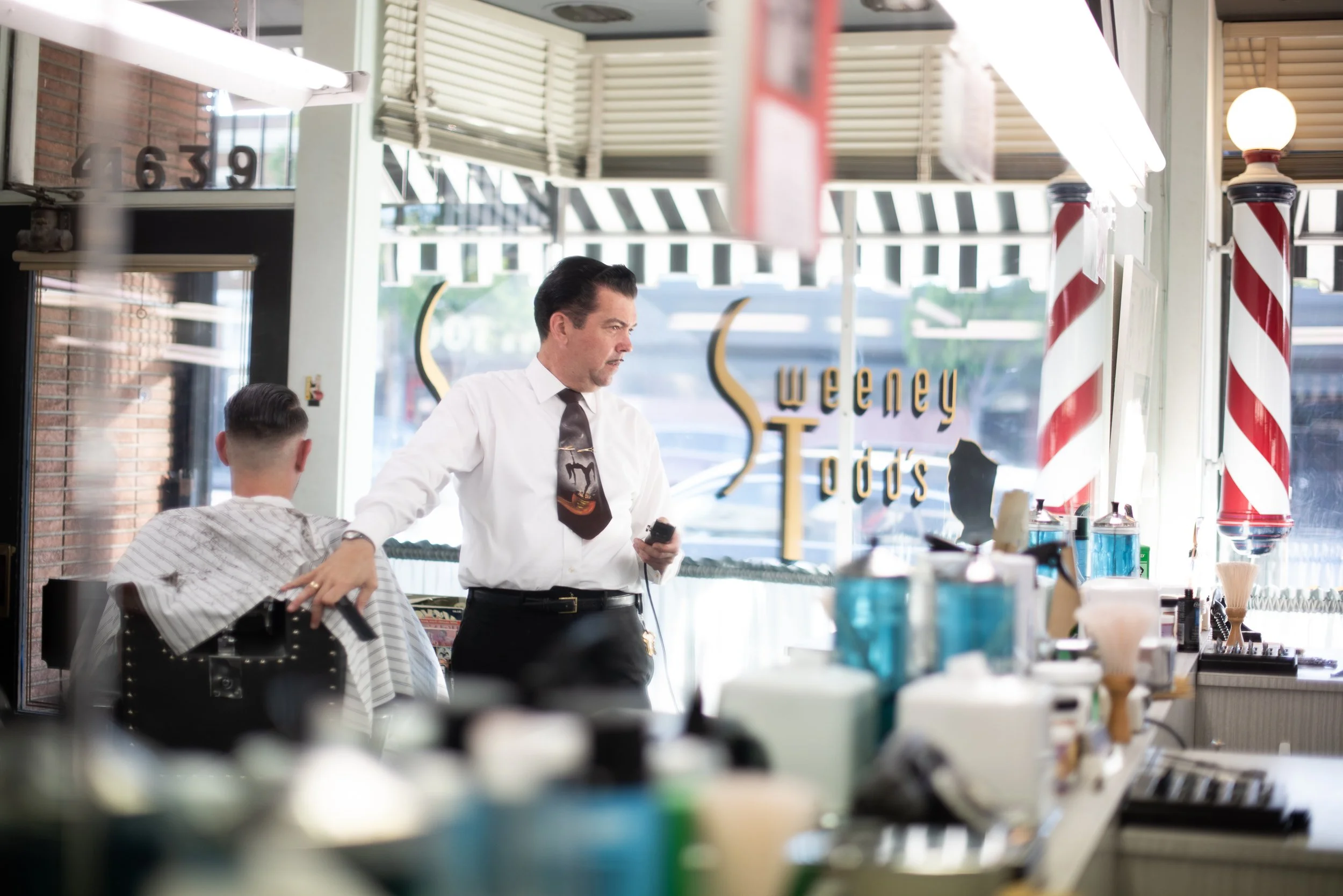
Barber in white shirt and tie pausing with clippers to assess a client's cut at Sweeney Todd's Barbershop, framed by gold storefront lettering and barber pole in the window

He steps back and looks over the cut, clippers still in hand, not finished yet. The Sweeney Todd’s sign sits in the window behind him, the barber pole off to the side, the counter lined with tonics and brushes.

The Details That Matter

Look closer and the shop reveals itself in pieces:

Old barber chairs that have seen decades of use. Each barber wearing classic smocks. Mirrors that reflect not just the customer, but the entire layered environment behind them.
Shelves lined with tools and products that feel chosen over time, not stocked overnight.

Even the small things—Playboy Magazines, perfectly dated photos, worn edges on countertops—contribute to the larger story. These are the details that can’t be manufactured quickly. They accumulate.

And in a city like Los Angeles, where so much is constantly being built, rebuilt, and rebranded, that kind of permanence stands out.

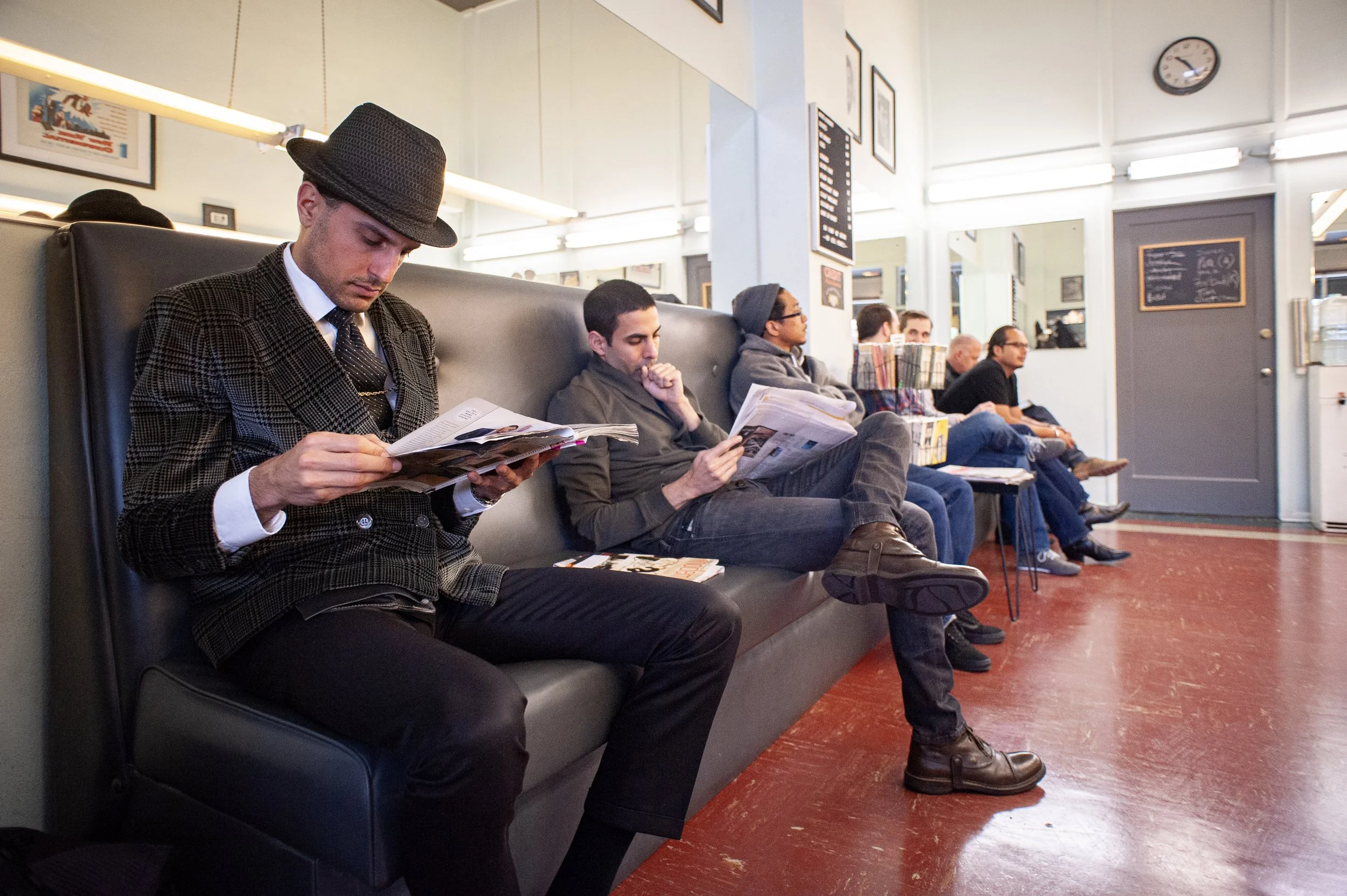
Row of men seated along a bench in Sweeney Todd's waiting area reading magazines and newspapers, with red linoleum floor, wall clock, and framed photographs behind them

The waiting area fills up. Men sit shoulder to shoulder with magazines and newspapers, the red linoleum floor reflecting the fluorescent light above. Nobody's in a hurry.

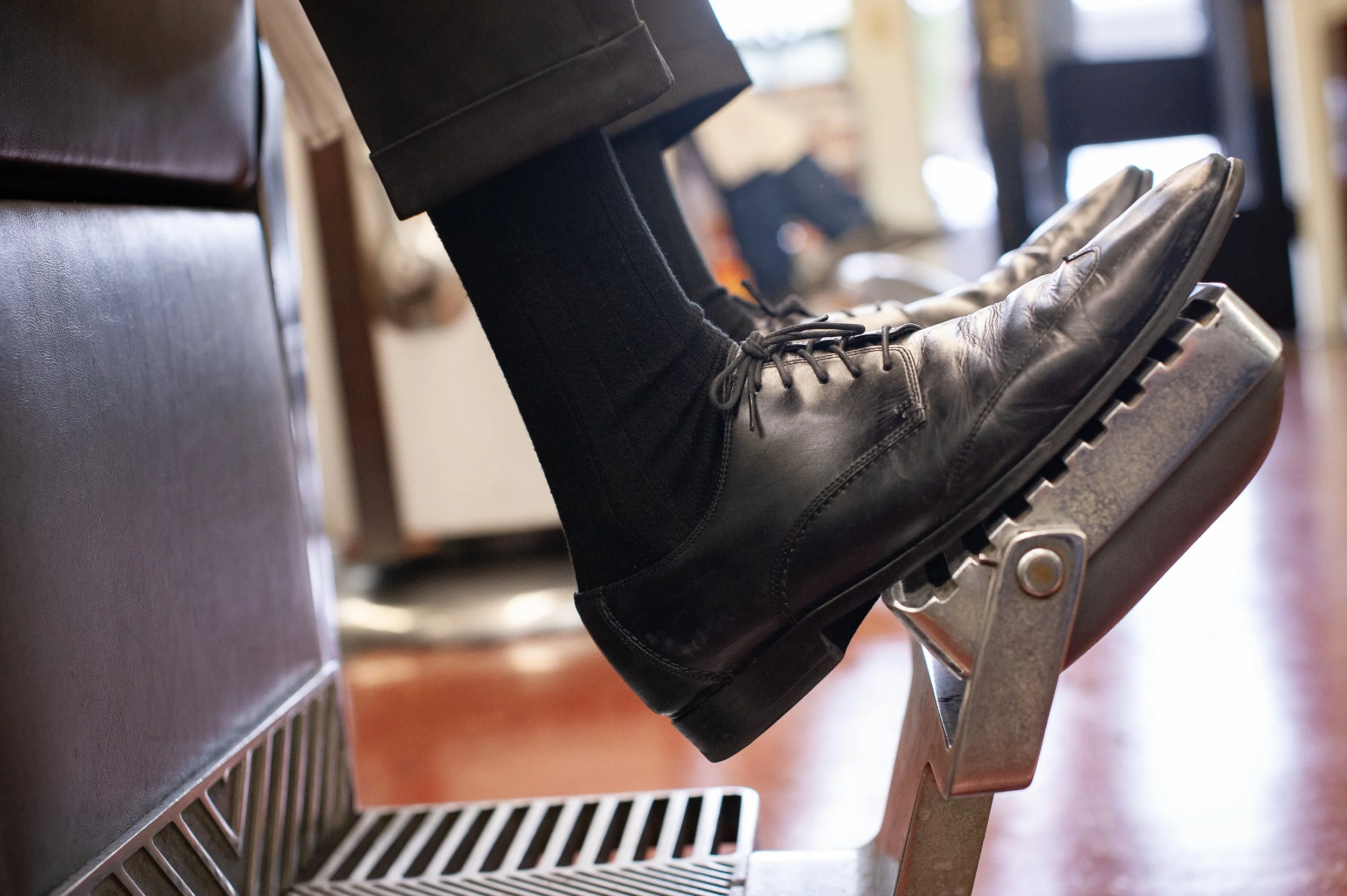
Close-up of a polished black leather oxford resting on the chrome footrest of a vintage barber chair at Sweeney Todd's Barbershop

Black leather on chrome — shoe polished, footrest built to last. The kind of detail you notice when everything else in the shop is exactly where it belongs.

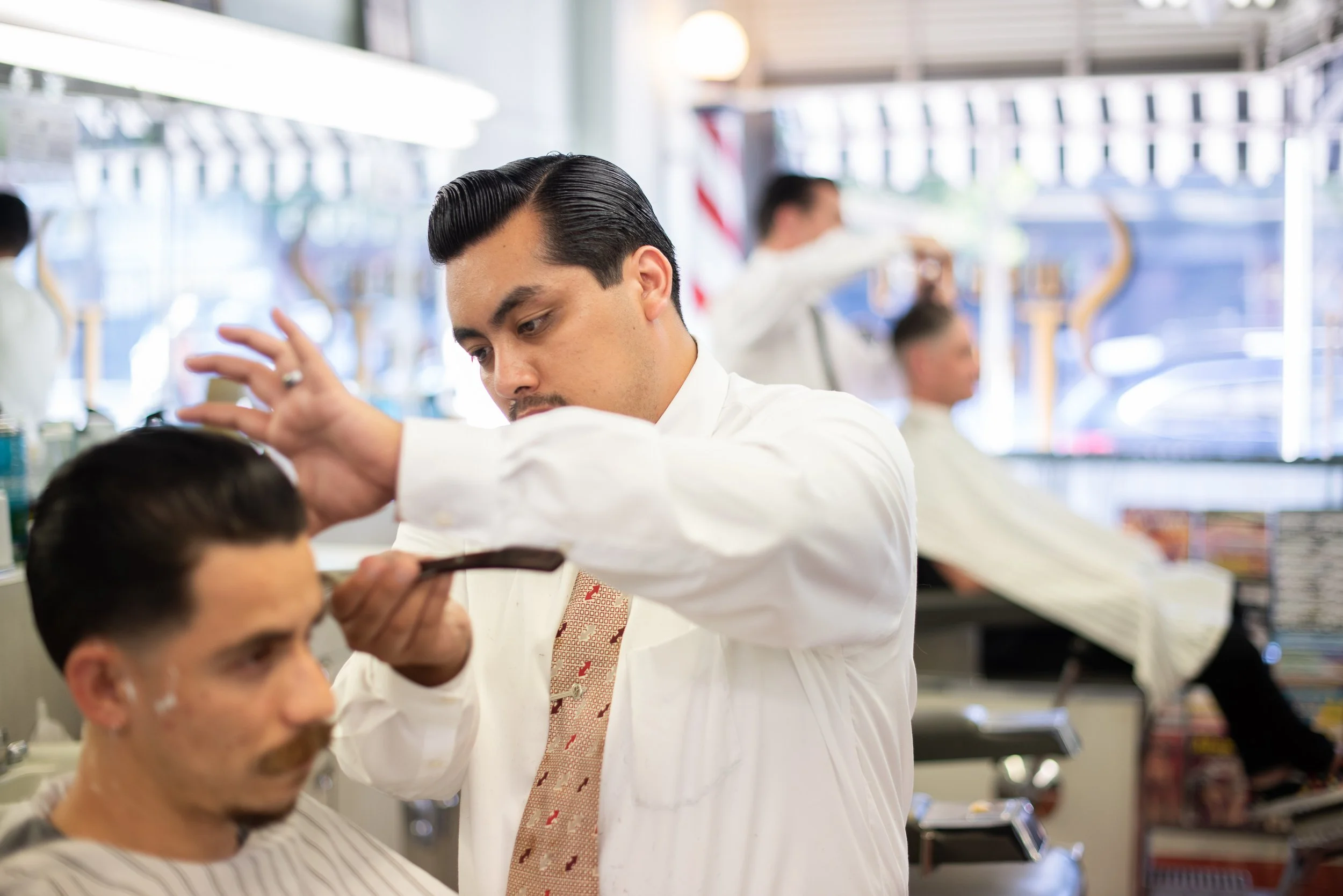
Barber in white shirt and tie working a straight razor along a client's hairline at Sweeney Todd's Barbershop, second barber and client visible in background

The straight razor comes out for the detail work. The barber's eyes stay on the line. In the background, through the fluorescent-lit mirrors, the shop keeps moving.

A Working Shop, Not A Set

Sweeney Todd’s could and should be used for a movie set, but what makes the place compelling isn’t just how it looks—it’s how it functions. This isn’t a space preserved for aesthetics. It’s actively used, day in and day out.

Sween and his barbers move through the space with such familiarity that it almost feels like a choreographed dance. Tools are exactly where they need to be. Clients settle into chairs that have held thousands before them. There’s a rhythm to it that only comes from repetition and trust.

It’s easy to imagine a place like this being imitated elsewhere. It would be much harder to recreate what actually gives it value: time, consistency, and a community that returns again and again.

Wide interior shot of Sweeney Todd's Barbershop with barber adjusting a caped client's cape in a vintage chair, barber pole and gold window sign visible in the background

The full room in one frame, vintage chairs and a red floor, the Sweeney Todd’s sign reading backward in the front window. A barber adjusts the cape while the client sits already smiling.

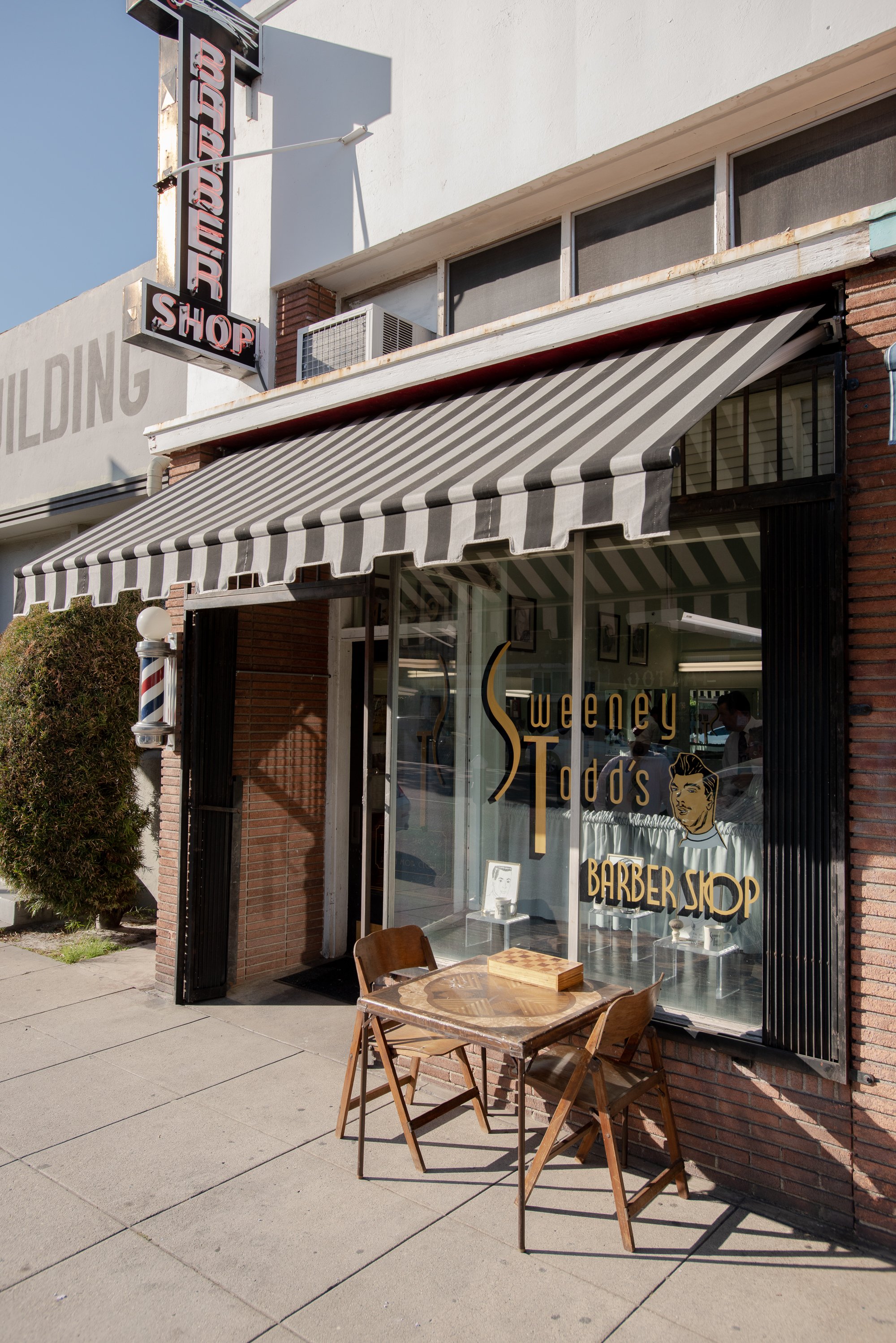
Exterior of Sweeney Todd's Barbershop in Los Angeles showing striped black and white awning, gold script window lettering, barber pole, and sidewalk table with chairs

From the sidewalk it reads clearly as a barbershop, the striped awning, the barber pole, and gold script on the glass. A small table and two chairs sit out front, the door left open.

Part of a Larger Story

Sweeney Todd’s Barbershop is one piece of a much larger body of work documenting barbershops across America. Over the course of 15 years, the project has traced spaces like this in all 50 states—some still operating, others long gone.

What ties them together isn’t just the act of cutting hair. It’s the way each shop reflects its surroundings. The architecture, the objects, the clientele—they all carry subtle clues about the neighborhood, the city, and the era the shop has lived through.

In that context, Sweeney Todd’s becomes more than a single location. It becomes part of a visual record of a trade that continues to evolve while still holding onto its roots.

View the Barbershops of America gallery

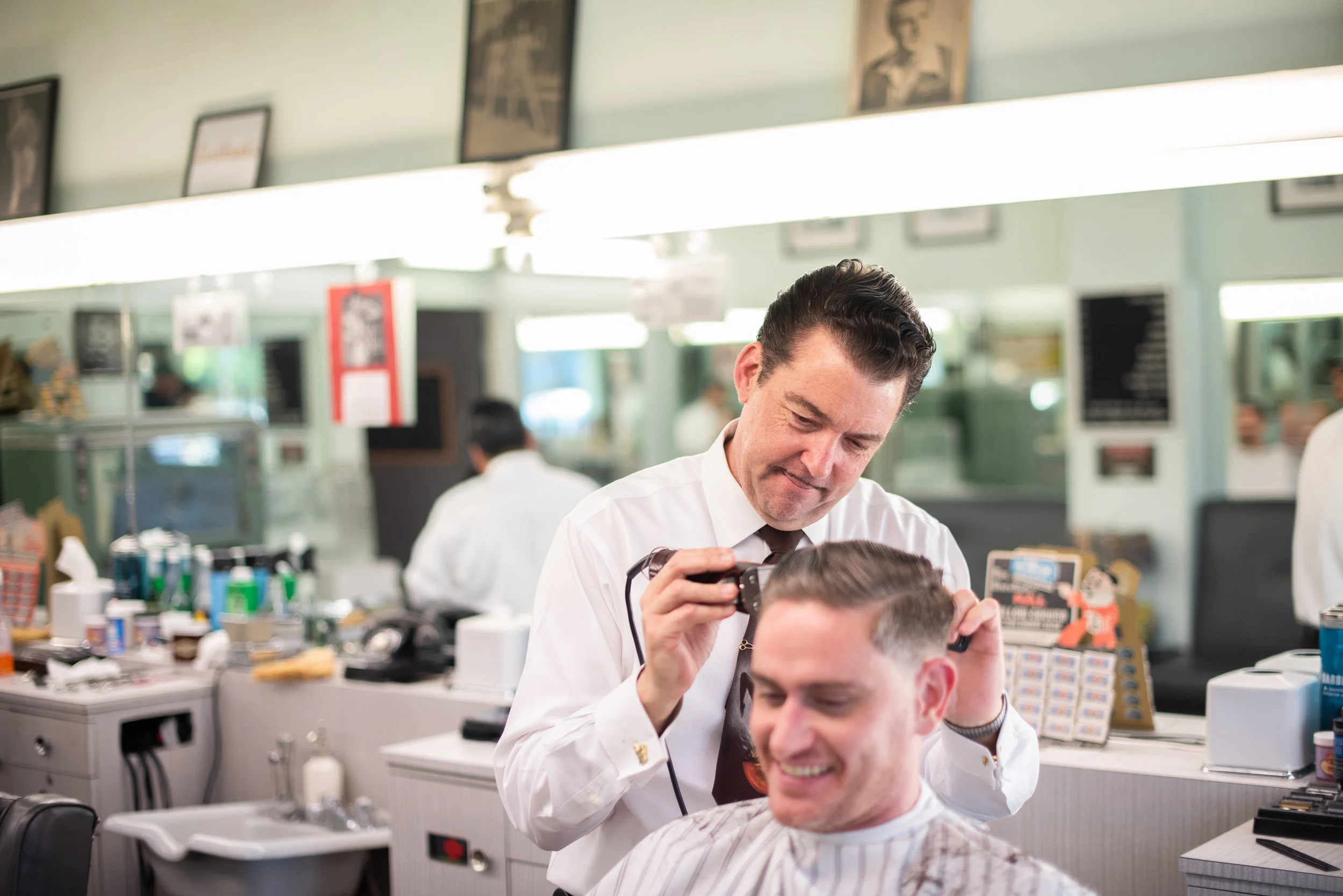
Barber in white shirt and dark tie smiling while using clippers on a laughing client's head at Sweeney Todd's Barbershop, mirrors and vintage wall decor visible behind them

Something lands and they both laugh, the barber mid-clip and the client mid-cut. The exchange stays easy and personal. The room allows for it without calling attention to it.

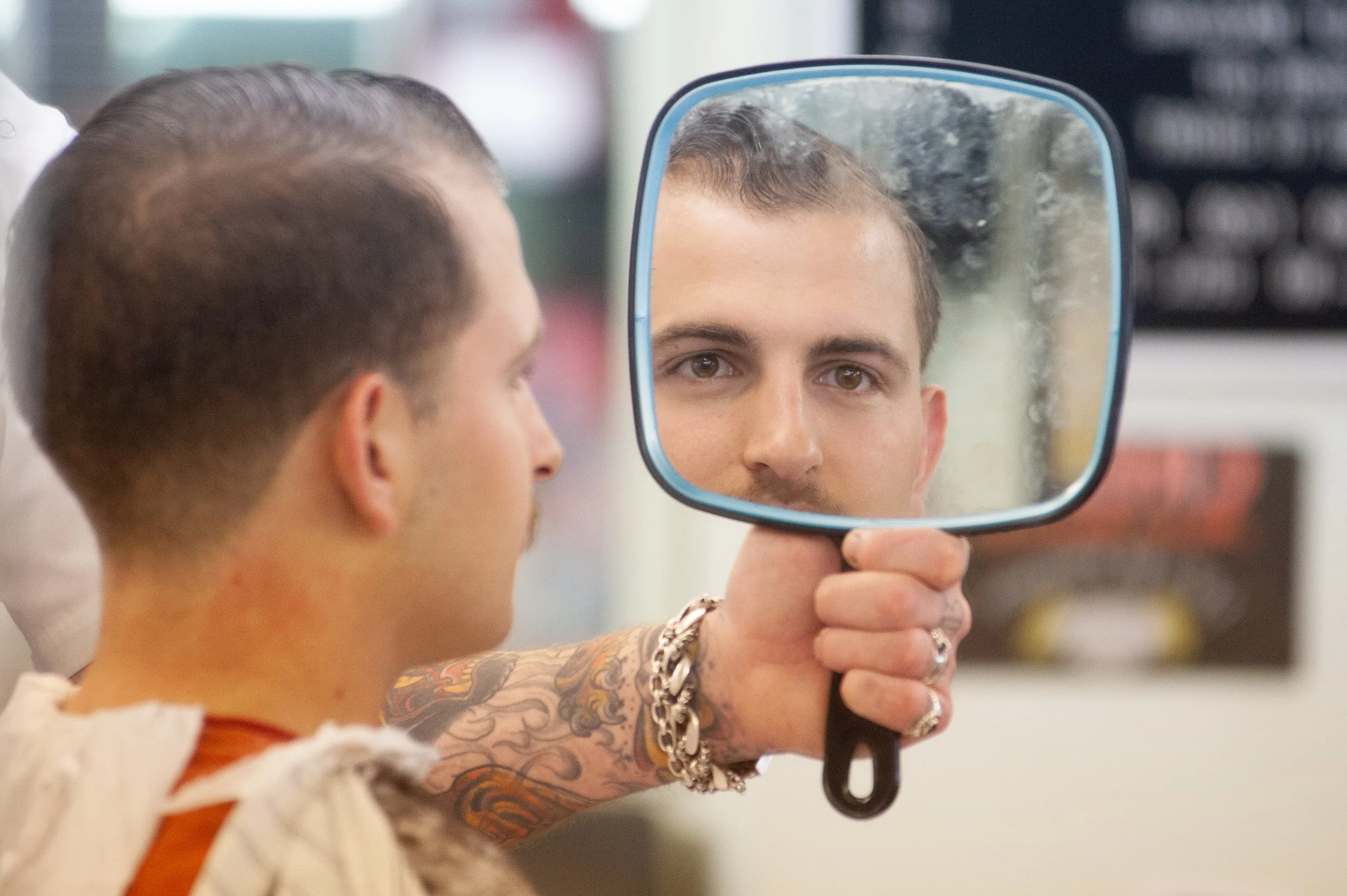
Tattooed barber's hand holding a square hand mirror up to a caped client checking his fresh haircut at Sweeney Todd's Barbershop in Los Angeles

The barber holds the mirror steady with a tattooed hand, a chain bracelet and rings catching the light, as the client checks the back. A moment that’s played out here countless times.

Collect Fine Art Barbershop Prints

Select photographs from this project are available as museum-quality fine art prints. Each piece is produced to highlight the texture, light, and character that define these spaces.

If this shop resonates with you, there are others in the collection that carry a similar sense of place.

Shop Barbershop photography prints

Barber in white shirt standing behind a caped client with a slicked pompadour and waxed mustache at Sweeney Todd's Barbershop, both facing the camera

Barber and client, face to camera. One in the cape, one holding the comb. The cut is clean, the mustache is waxed, the framed photographs line the wall above the mirror.

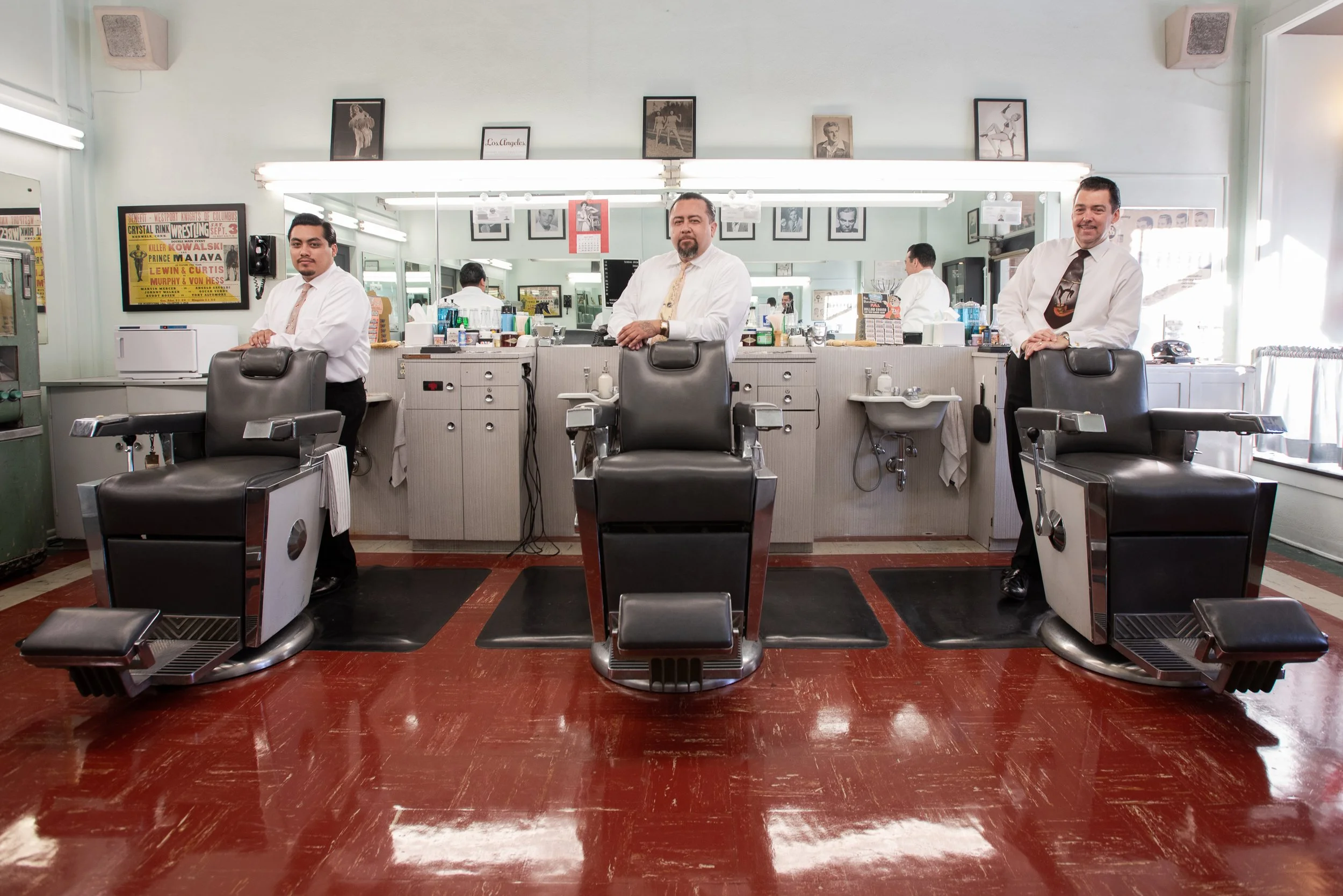
Three barbers in white shirts and ties standing behind three vintage barber chairs at Sweeney Todd's Barbershop, reflected in wall mirrors with vintage framed photographs and wrestling poster above

The crew stands behind their chairs in white shirts and ties, the red floor clean underfoot. The mirror carries the room back again. This is how the place sits when it’s ready.

Why Places Like This Matter

Shops like Sweeney Todd’s don’t just disappear overnight—but when they’re gone, they’re gone for good. The details that define them rarely get preserved in any formal way. They fade with time, replaced by something newer, cleaner, and often less personal.

Photographing these spaces is less about nostalgia and more about recognition. Recognizing that there’s value in places that aren’t trying to be anything other than what they are.

Sweeney Todd’s Barbershop is exactly that—a place shaped by years of work, repetition, and presence. And in a city built on constant change, that kind of consistency is worth paying attention to.

Photograph of a Sweeney Todd's Barbershop early in the morning before any customers fill the chairs

Wide view of Sweeney Todd’s Barbershop in Los Angeles before the rush comes in.

Licensing & Editorial Use

These photographs are available for licensing for editorial features, brand campaigns, and commercial projects looking for authentic barbershop environments.

If you’re working on a project that needs real spaces with real history, this archive was built for exactly that.

Inquire about licensing

Explore More California Barbershops

California has no shortage of character when it comes to barbershops. From long-standing neighborhood staples to newer shops with deep roots in classic barbering, the range is wide—and worth exploring.

Browse more California barbershop features

Black Barbershop Culture in America

Black Barbershop Culture in America: A Documentary Photography Project

For more than a decade, I’ve been photographing barbershops across the United States. Some are well-known, others are easy to miss if you’re not looking for them. Many have been around for decades. Others have quietly disappeared.

What’s consistent isn’t the layout or the signage—it’s what happens inside.

Black barbershops, in particular, carry a different kind of weight. They are places where people return week after week, if not daily. Not just for a haircut, but for conversation, friendship, and a sense of familiarity that doesn’t change much, even as everything around them does.

A Space Defined by Consistency

There’s a rhythm to a barbershop that can’t be explained.

The door opens. Someone takes a seat. Another person is already mid-conversation. Clippers harmonize. A game is on in the back corner. People come and go, but the structure stays the same. The energy rises and falls depending on who’s there and where the conversation goes - sometimes it stays between one customer and his barber. Other times the topic flows throughthe whole shop. It’s a glorious energy to witness.

What makes these spaces distinct isn’t just the haircut—it’s the familiarity, like being at home. The same chairs, the same mirrors, the same people you can count on day after day.

Over time, that consistency builds something more permanent than the physical space itself.

More Than a Haircut

It’s easy to reduce a barbershop to its function, but that misses the point entirely.

These shops operate as meeting places. Conversations move between topics without structure—sports, work, family, local news. Some are loud, some are quiet. Some are built on long-standing relationships, others on quick exchanges between people who may never see each other again.

What matters is that the space allows for it.

There’s no expectations. It’s a place you can feel safe and open.

Details That Hold the History

Much of what defines a barbershop isn’t immediately obvious.

It’s in the details: the tools worn down from years of use. Handwritten signs. Photographs of real people - local people. Chairs older than anyone in the shop.

These elements aren’t curated. They accumulate.

Over time, they become a record of the people who have passed through the space—both barbers and customers.

The Barbershop as Community

In many neighborhoods, the barbershop extends beyond its walls.

People gather outside. Conversations continue on the sidewalk. The shop becomes part of the street itself—connected to everything happening around it.

This is especially true in Black barbershops, where the role of the space has historically gone beyond business. It has functioned as a place of connection, discussion, and continuity within the community.

That presence is still there, even as many of these shops face pressure from rising costs, changing neighborhoods, and shifting culture.

What’s Changing—and What Isn’t

Some of the barbershops in this series are no longer there.

Others are still operating, largely unchanged.

There’s a tendency to focus on what’s disappearing, but that only tells part of the story. What’s just as important is what remains—the memories, the relationships, and the role these spaces continue to play.

The physical details may shift. The structure holds.

Part of something Bigger

This work is part of Barbershops of America, a long-term documentary photography project(and photo book) spanning more than fifteen years and all fifty states.

The goal has never been to define these spaces, but to document them as they are—honestly, without direction, and over time.

Some shops close. Others continue. All of them contribute to a larger record of a place that has remained a constant in American life.

If you’re interested in seeing more from this project, you can view the full Barbershops of America series here and the photography book/prints here.

Explore another barbershop story - Tony’s Barbershop

Contact me directly for editorial and commercial licensing - rob@robhammerphotography.com
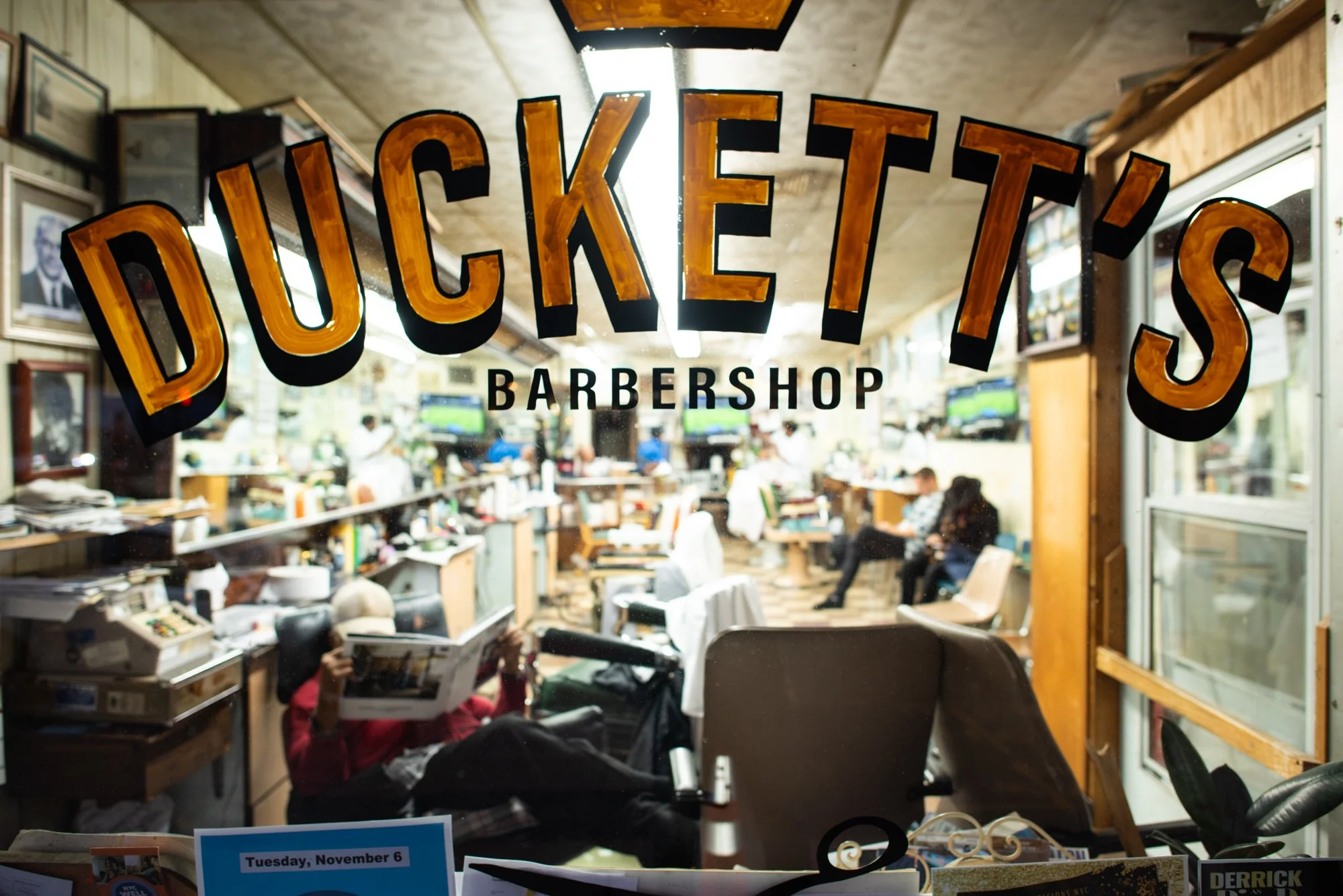
View through a barbershop window with lettering reading Ducketts Barbershop and customers inside

Looking in from the outside—another day unfolding inside a working barbershop.

Man smiling and holding a pool cue inside a barbershop with signage and price board behind him

Beyond haircuts, the barbershop becomes a social space—games, laughter, and time shared between neighbors.

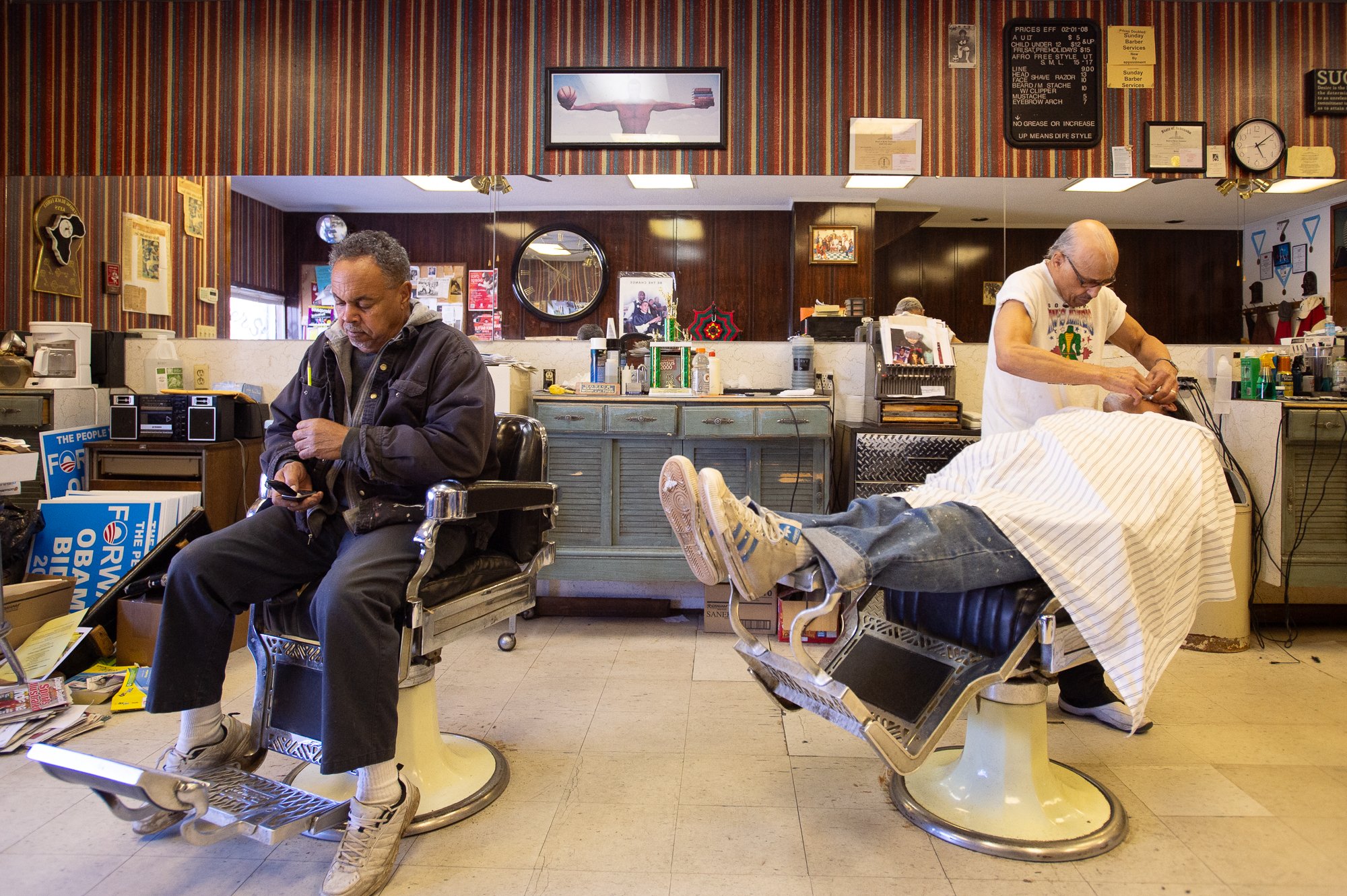
Barber cutting a client’s hair while another man sits nearby in a traditional Black barbershop

An everyday moment inside the shop—conversation, routine, and the quiet rhythm of a haircut unfolding.

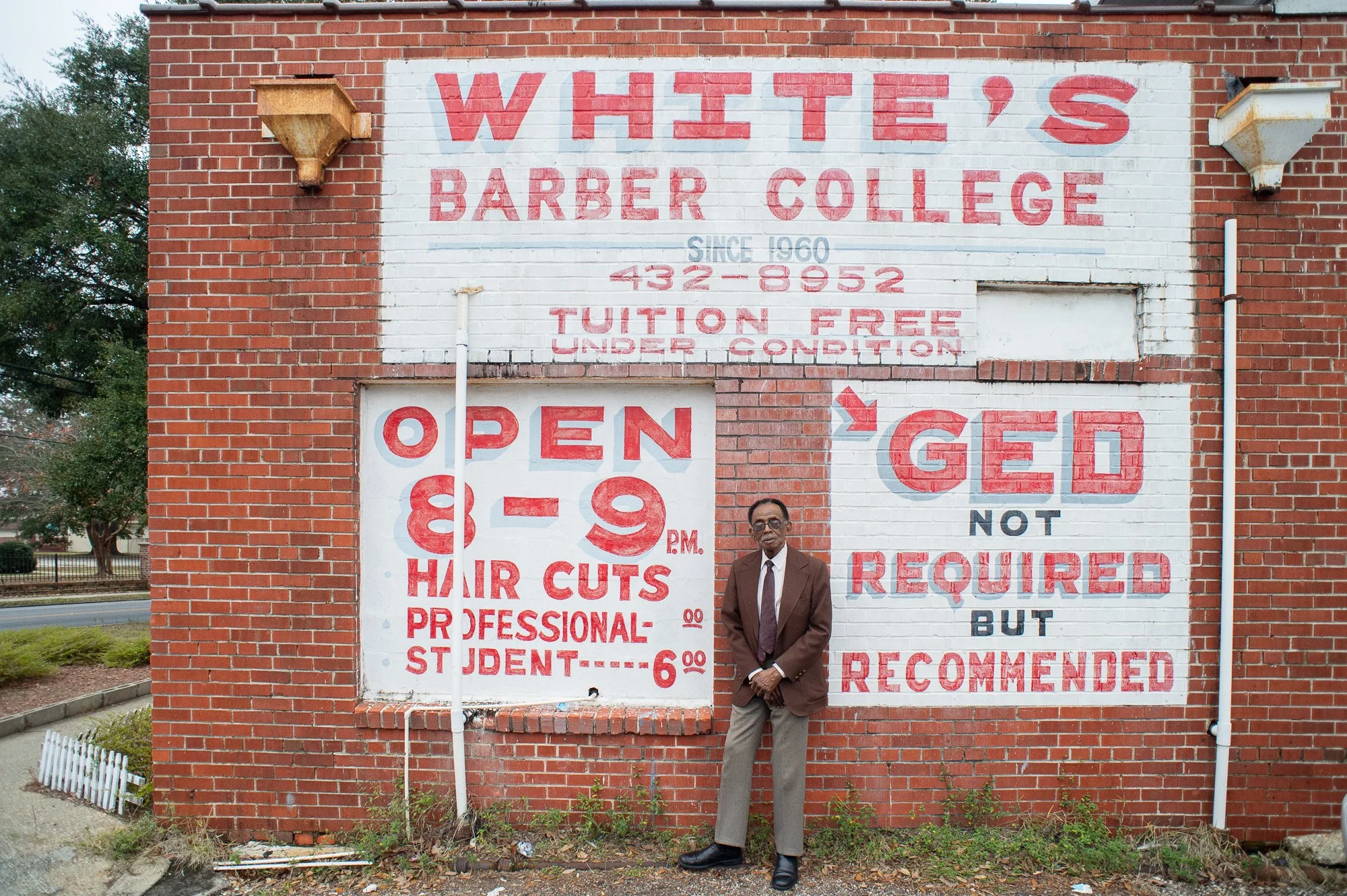
Man standing in front of Whites Barber College exterior with painted signage

A portrait rooted in place—barbering passed down through training, tradition, and time.

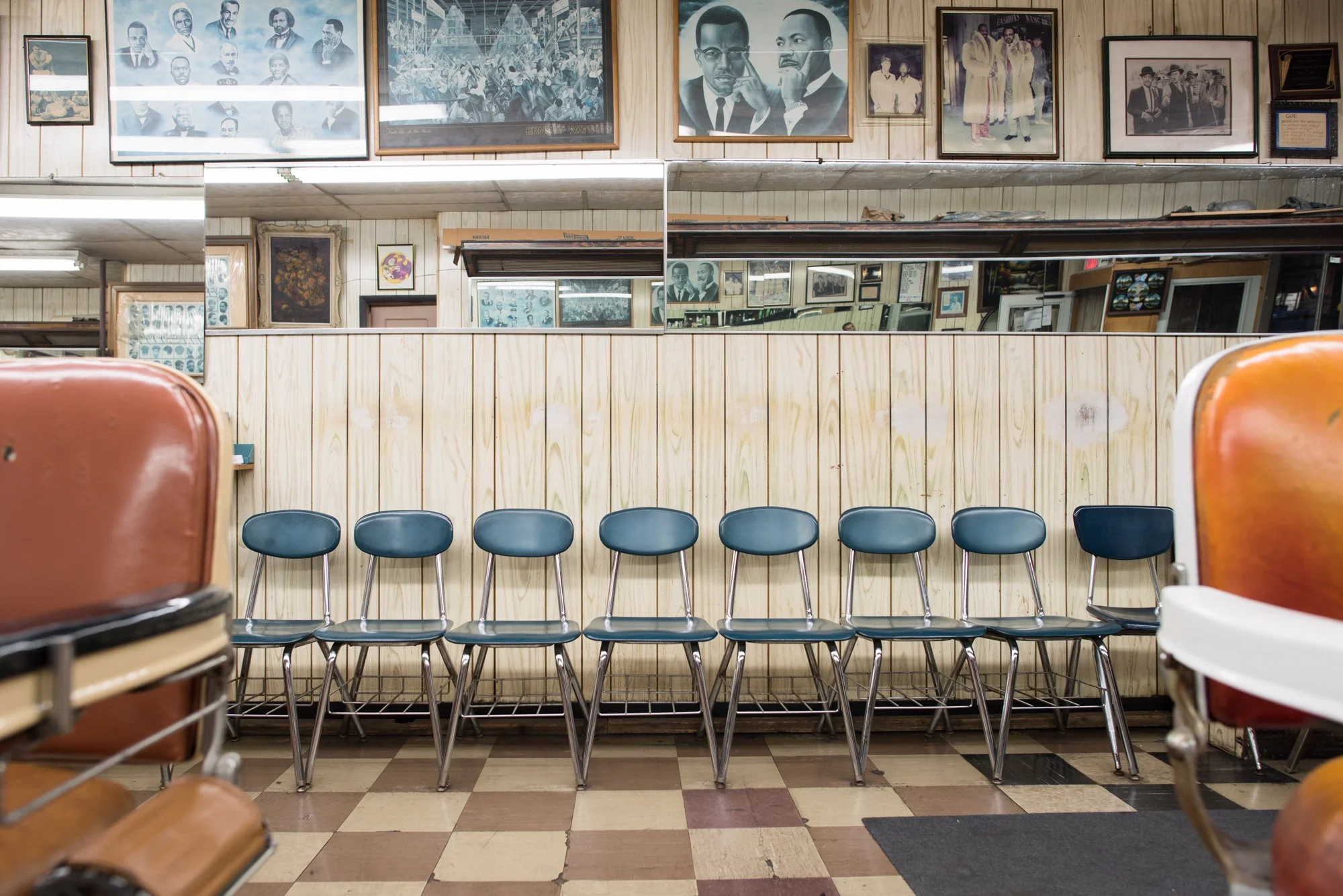
Row of empty chairs inside a historic Black barbershop with framed portraits and mirrors

A row of worn chairs sits beneath decades of history—photographs, mirrors, and memories layered into the walls of a neighborhood barbershop.

Barber cutting hair while other men watch and talk inside a lively Black barbershop

A gathering place as much as a business—where conversation, humor, and community unfold alongside every cut.

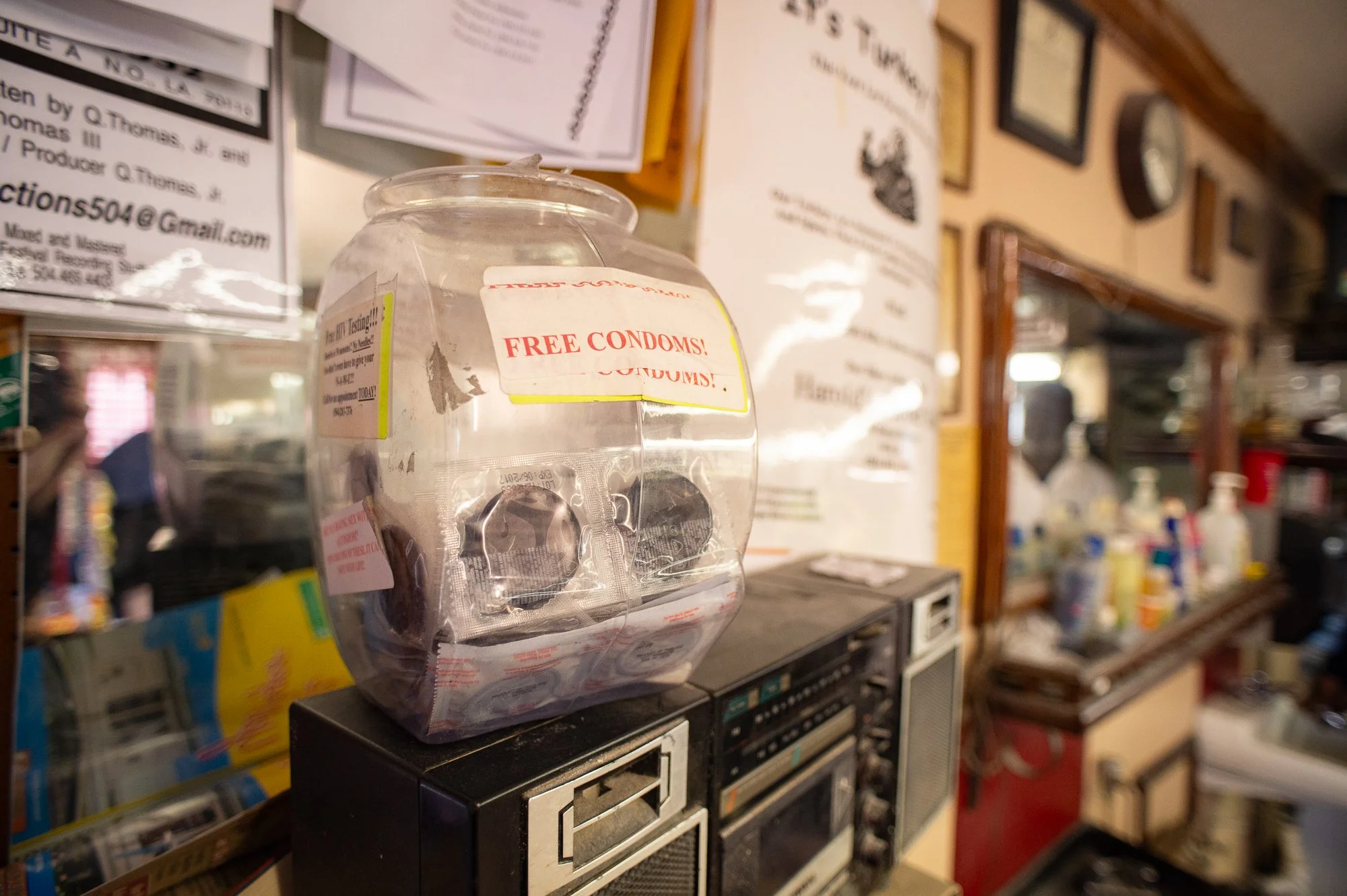
Jar labeled free condoms sitting on a counter inside a Black barbershop with posters behind it

A small but telling detail—barbershops have long served as places of care, conversation, and community beyond the haircut.

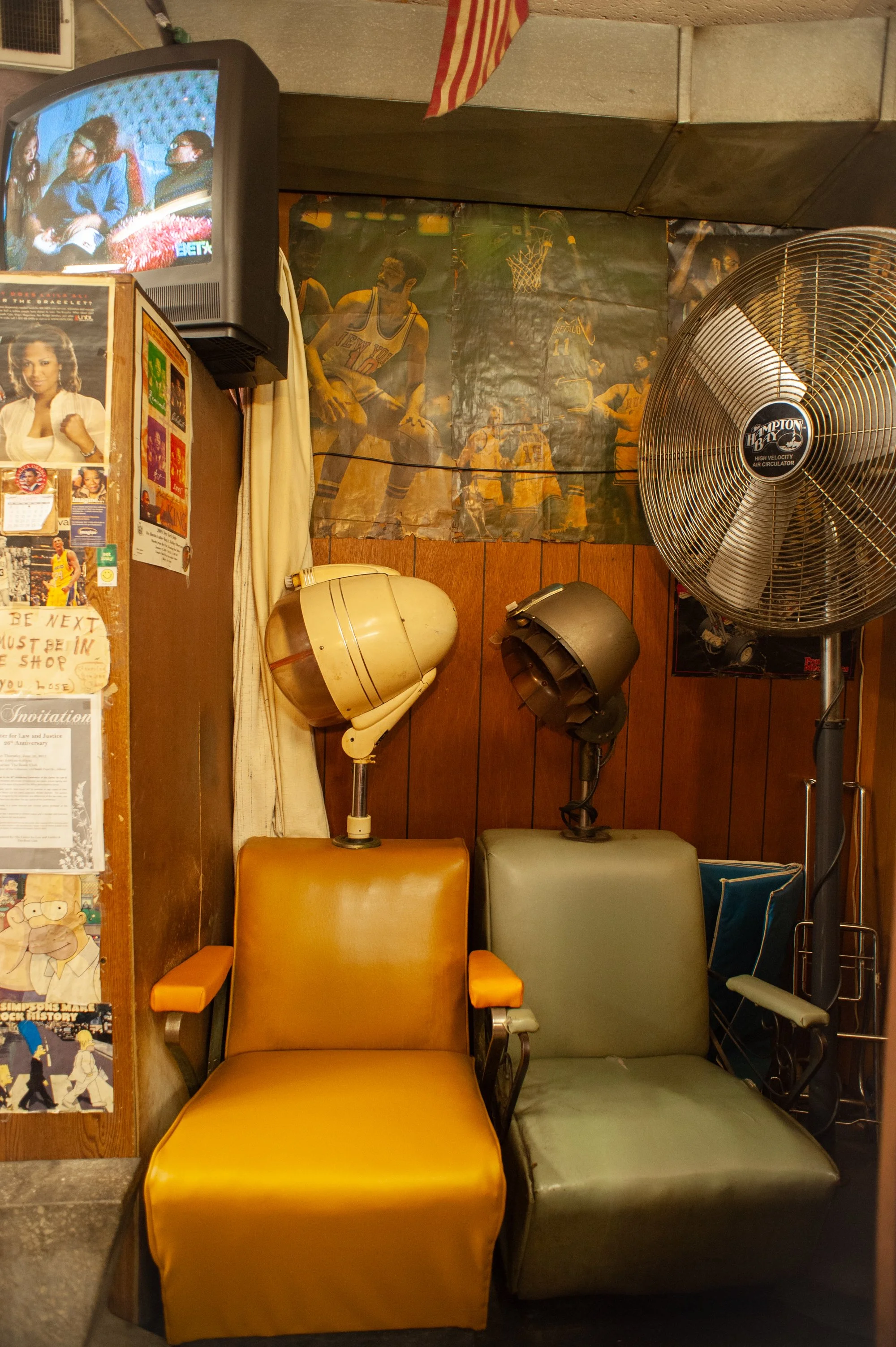
Old hair dryers and posters on the wall inside a classic barbershop interior

Details that mark the era—equipment and imagery that speak to decades of use and change.

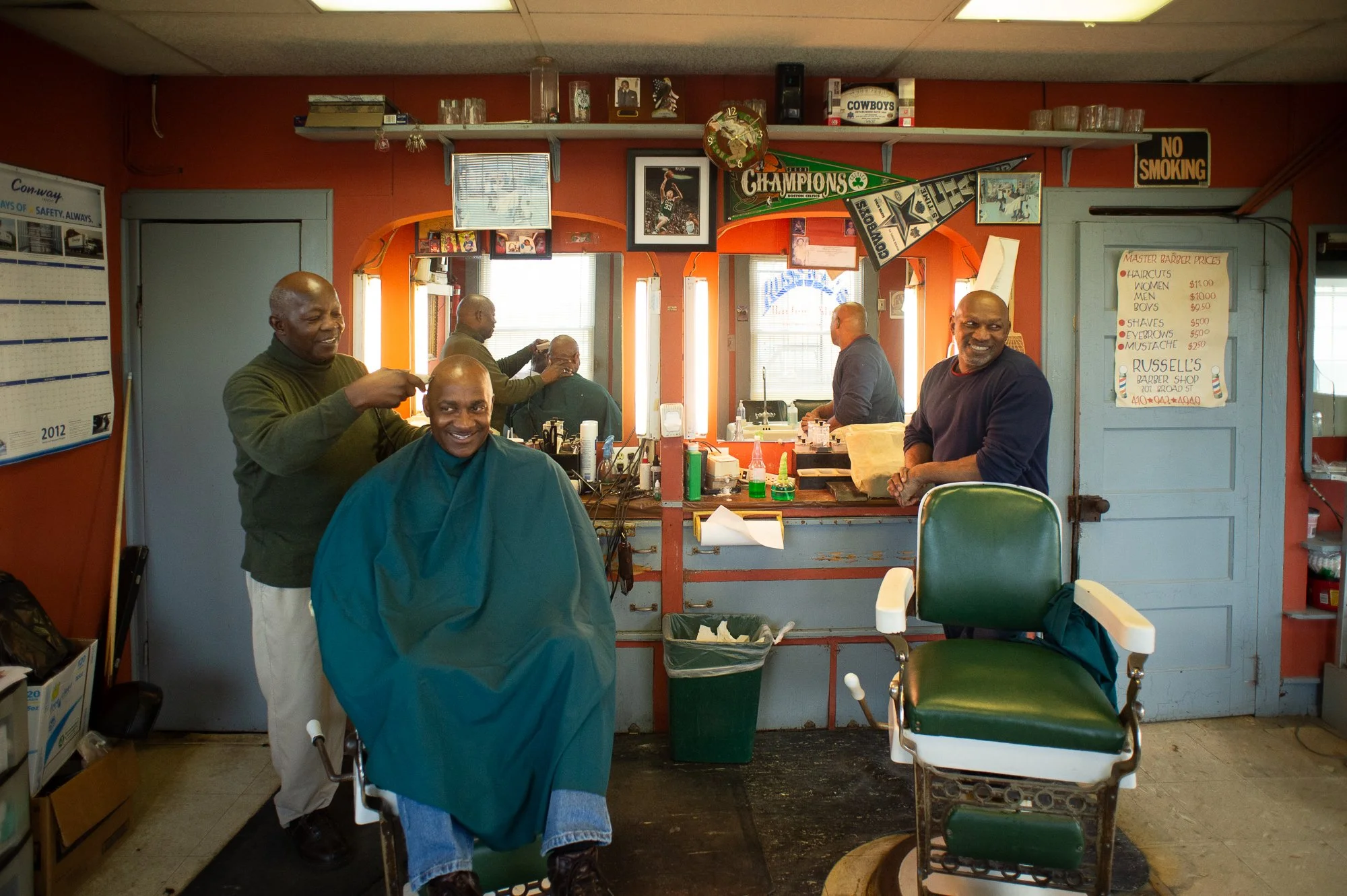
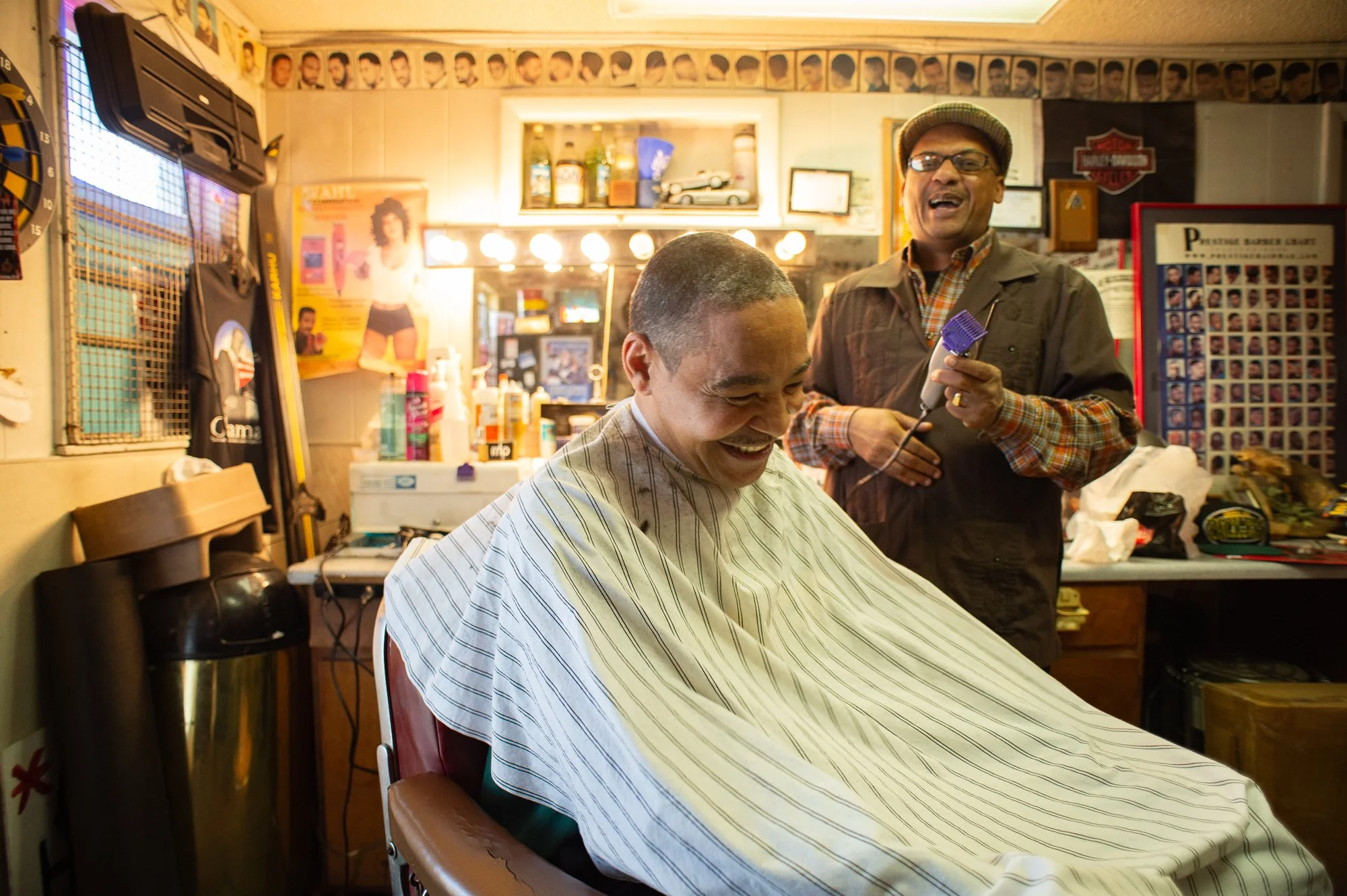
Barber smiling while cutting a client’s hair inside a traditional Black barbershop

A moment of humor during a haircut—relationships built over years, not just appointments.

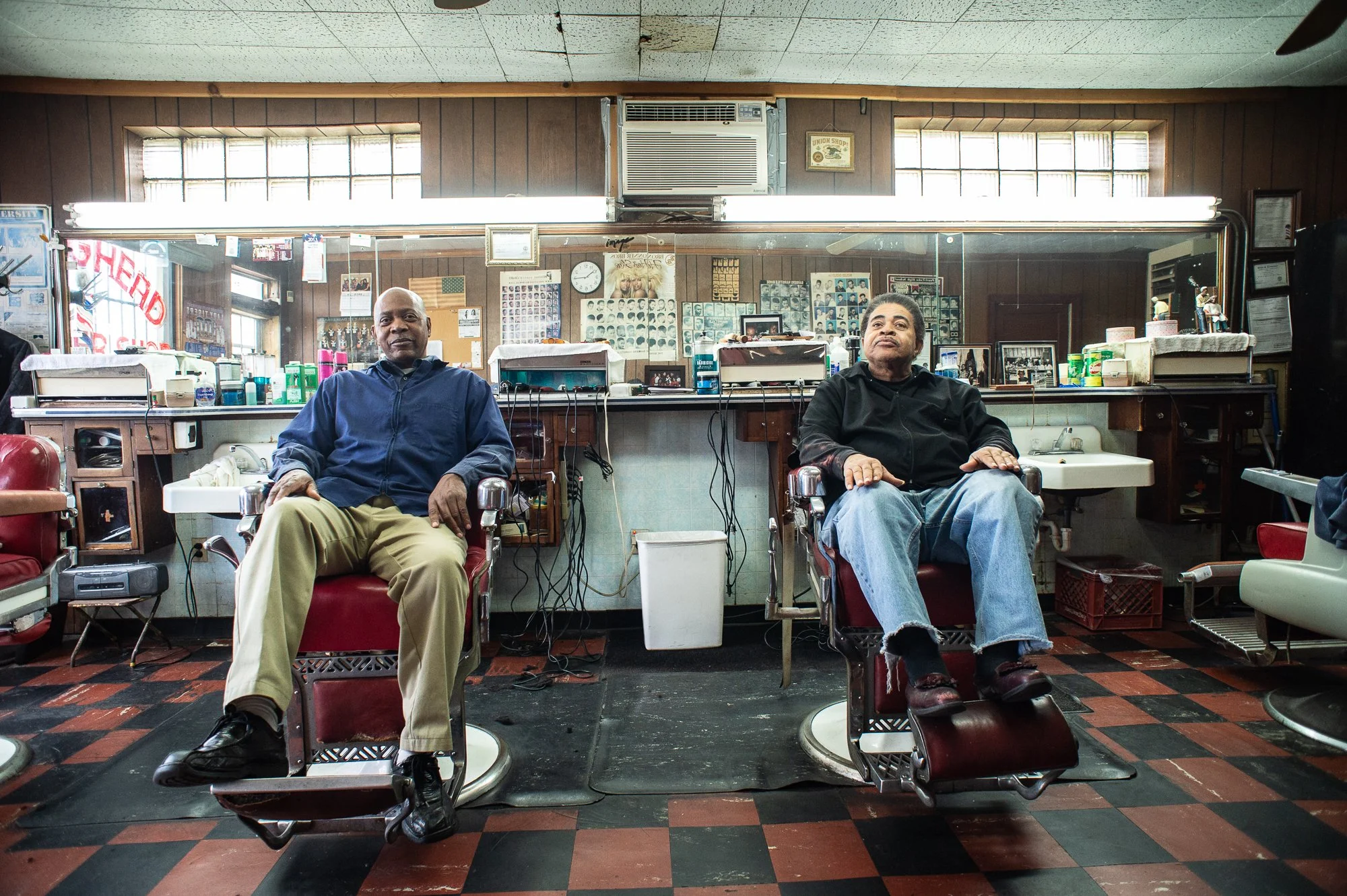
Two men seated in barber chairs inside a historic Black barbershop interior

Waiting, watching, and talking—the chair is as much about presence as it is about the haircut.

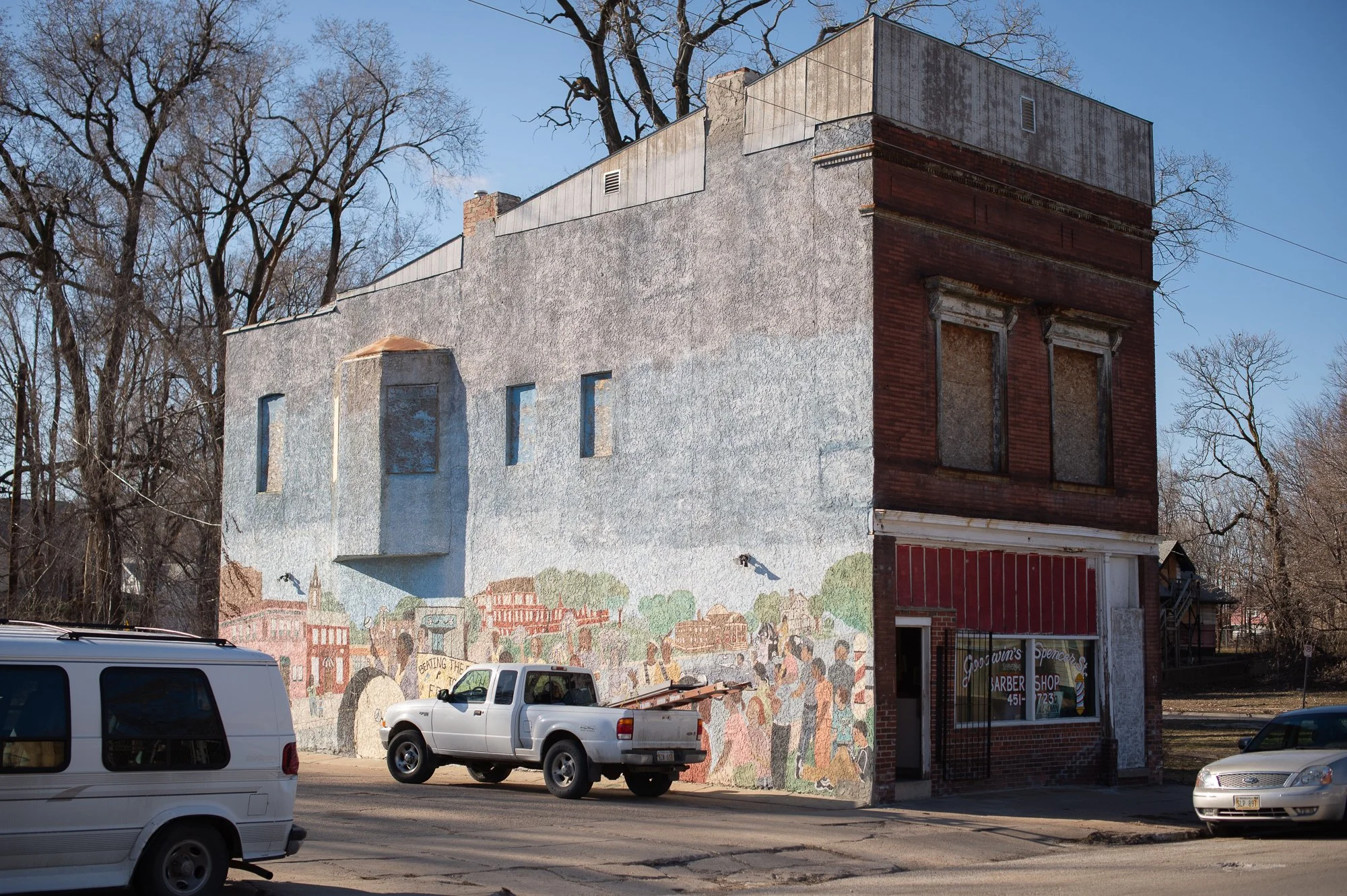
Exterior of an old Black barbershop building with mural and parked cars in a small American town

The outside of the shop carries its own story—weathered walls, murals, and a presence rooted in the neighborhood.

Two vintage green barber chairs facing a cluttered mirror and work station in a traditional shop

Tools, notes, and years of work surround the chair—evidence of a craft practiced daily over decades.

Barber trimming a client’s hair with another man sitting nearby in a classic barbershop interior

Generations gather in these spaces—routine, trust, and tradition carried forward one cut at a time.

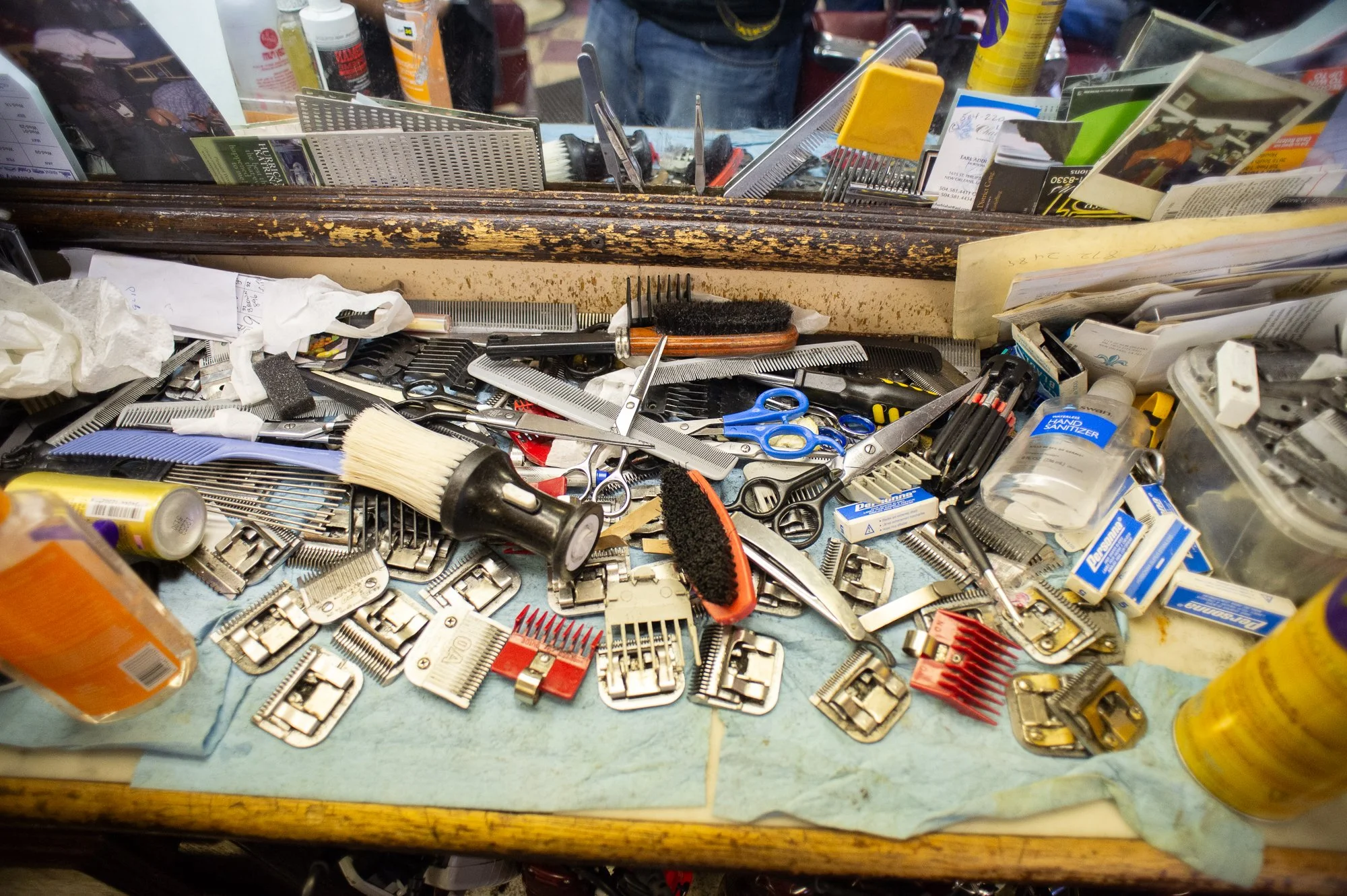
Close up of barber tools including clippers, combs, scissors, and brushes scattered across a worn counter

The tools of the trade—used daily, worn over time, and essential to the craft practiced in every shop.

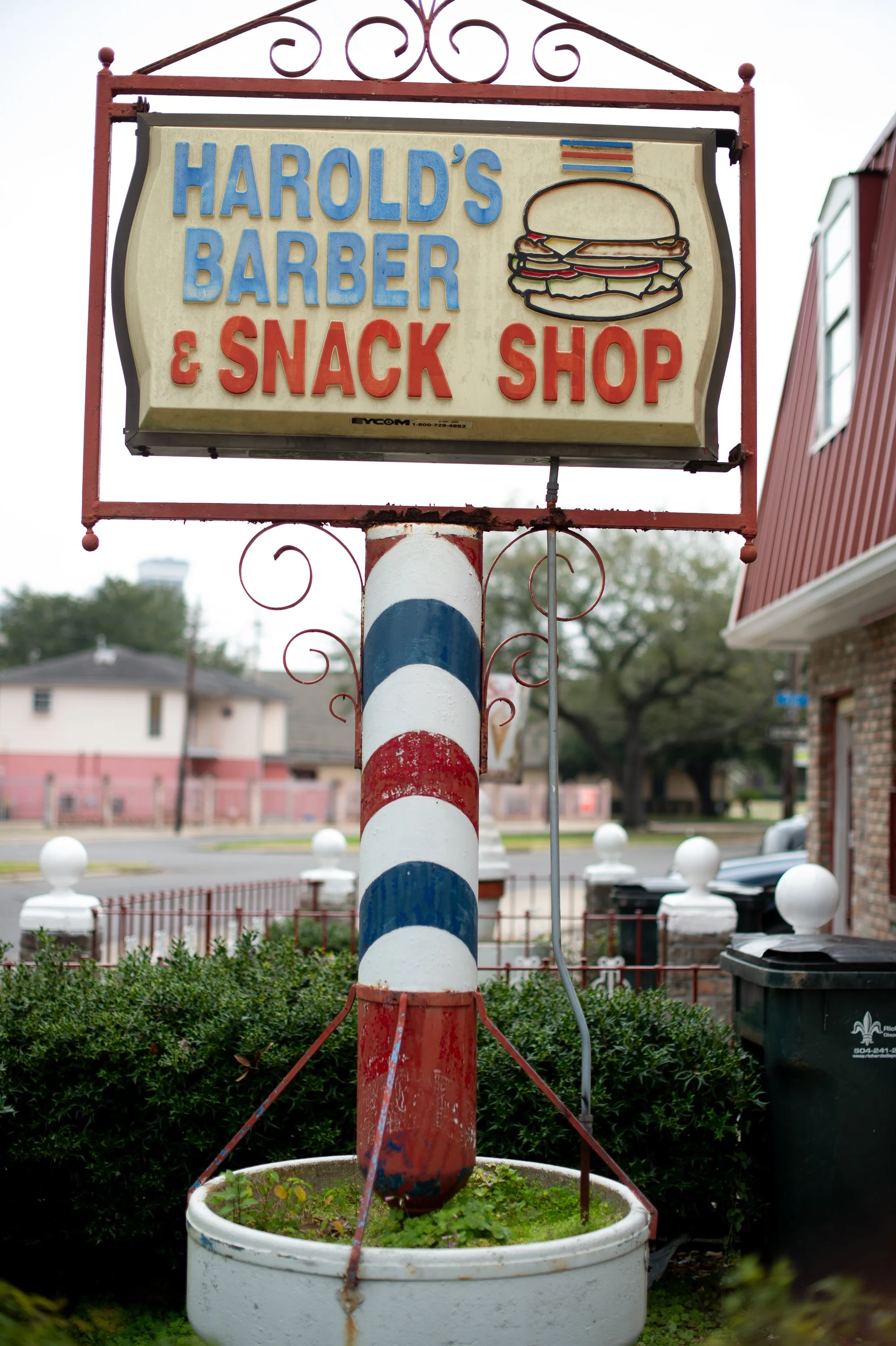
Vintage sign reading Harold’s Barber and Snack Shop above a barber pole outside

A sign that reflects the role of the barbershop as both business and gathering place within the neighborhood.

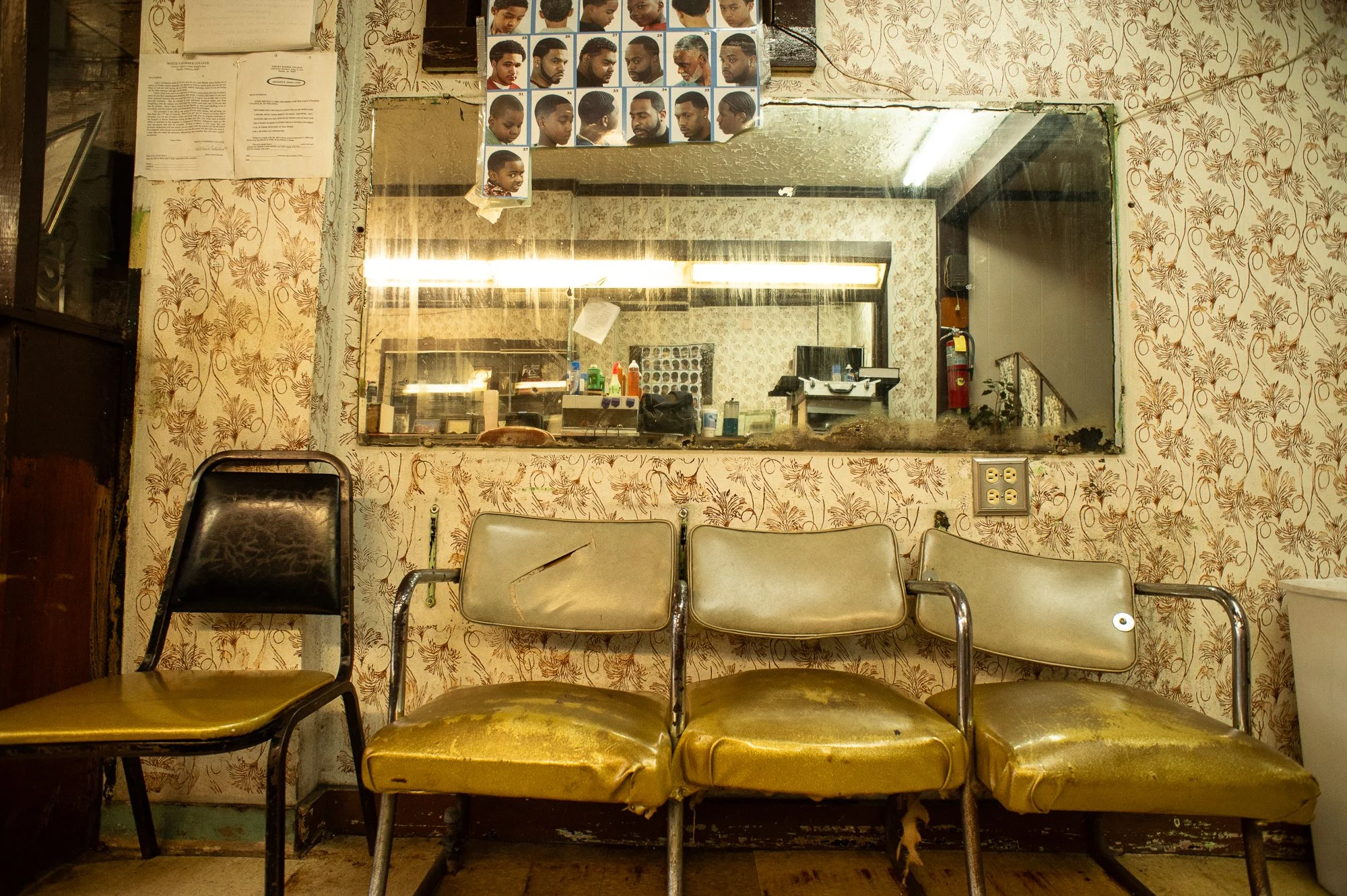
Old worn waiting chairs inside a historic barbershop with patterned wallpaper and mirror

Chairs worn from years of use—each one holding its own history of conversations and waiting.

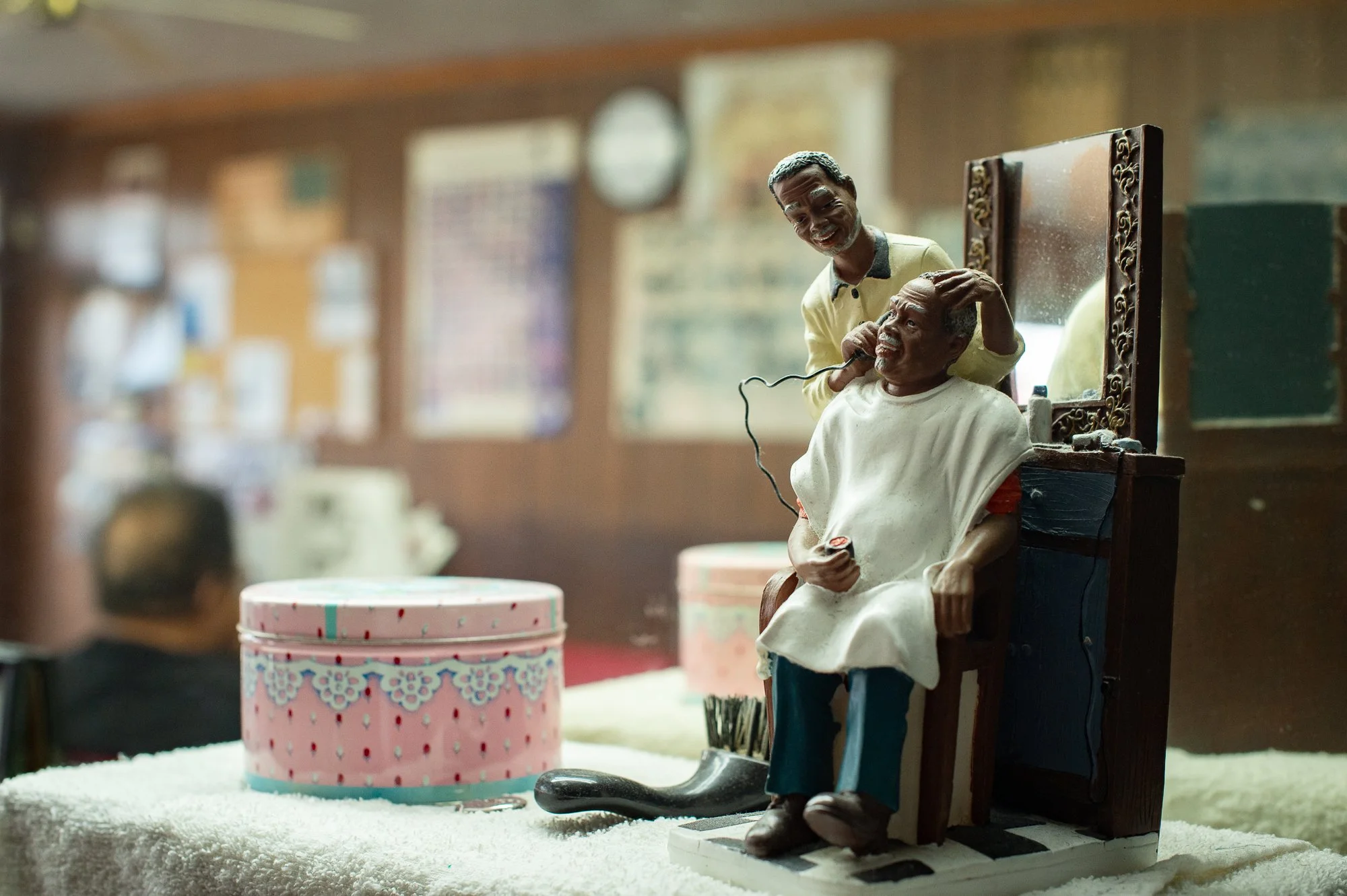
Small figurine of a barber cutting hair placed on a towel inside a barbershop

A small detail on the counter—a reflection of the craft and culture that defines the space.

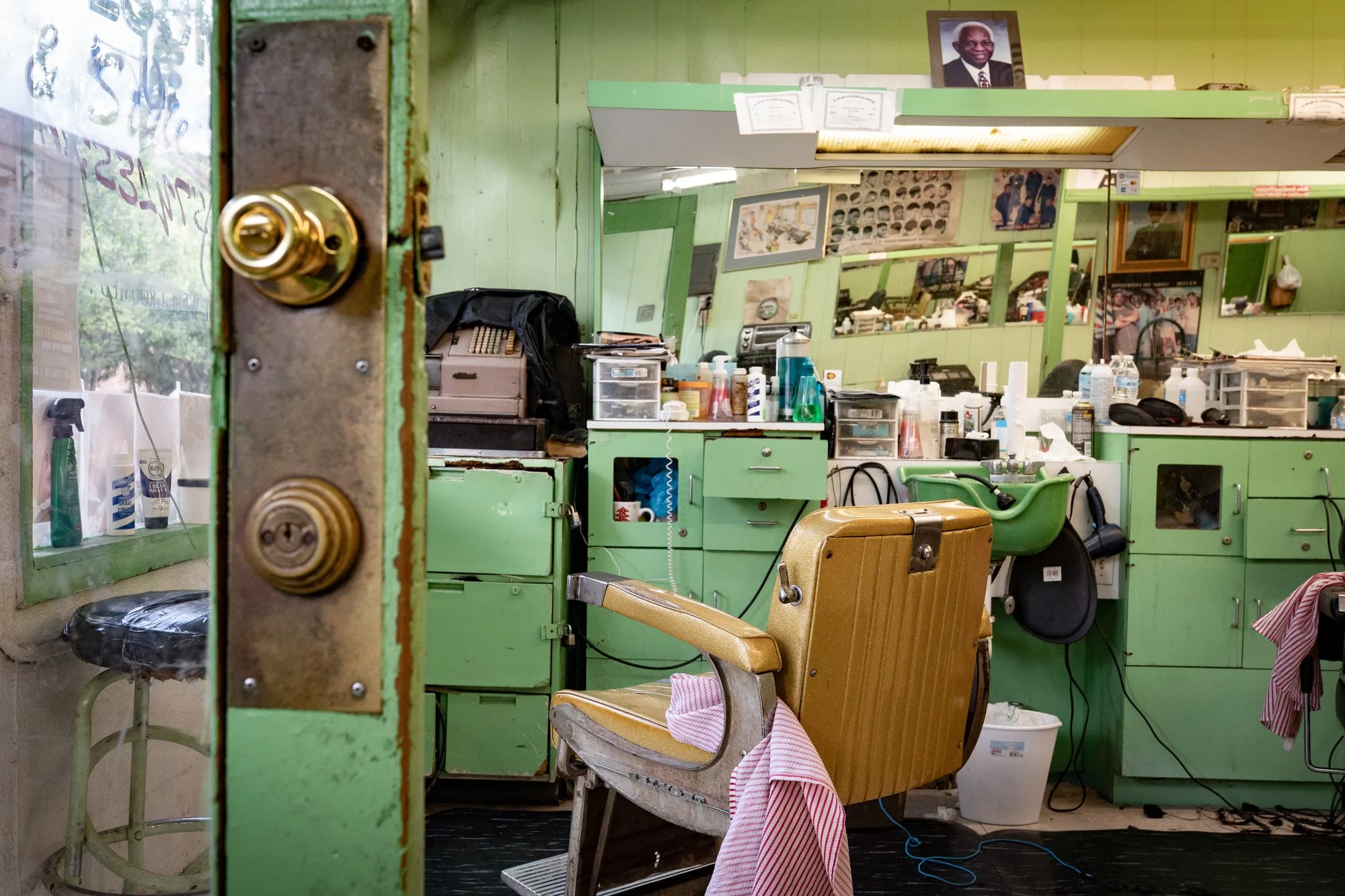
Interior of a barbershop with green cabinets and a vintage barber chair viewed through an open door

A quiet interior between customers—the shop as both workspace and daily routine.

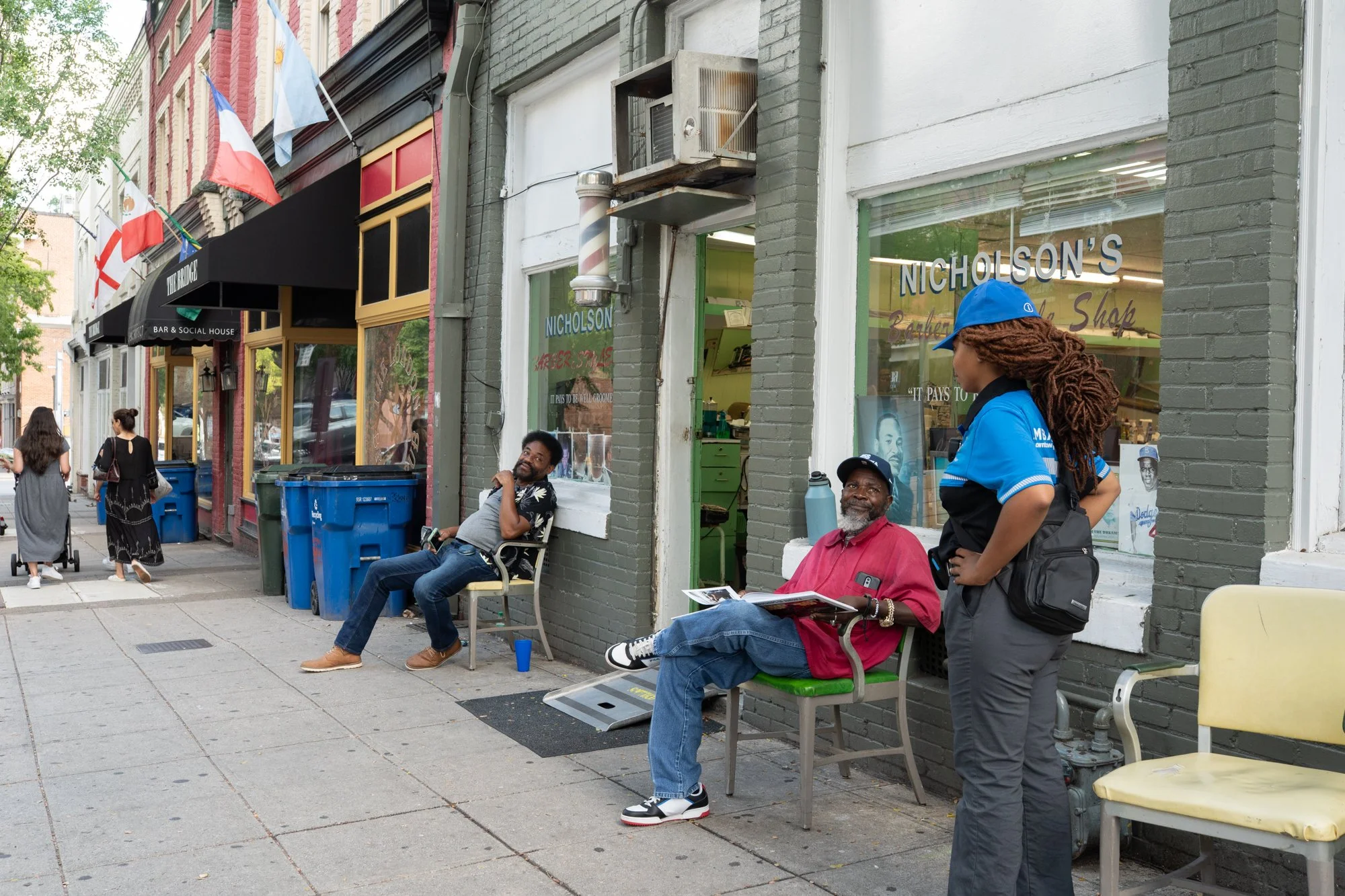
People sitting and talking outside a neighborhood barbershop on a city street

The sidewalk becomes an extension of the shop—conversation and community continuing just outside the door.

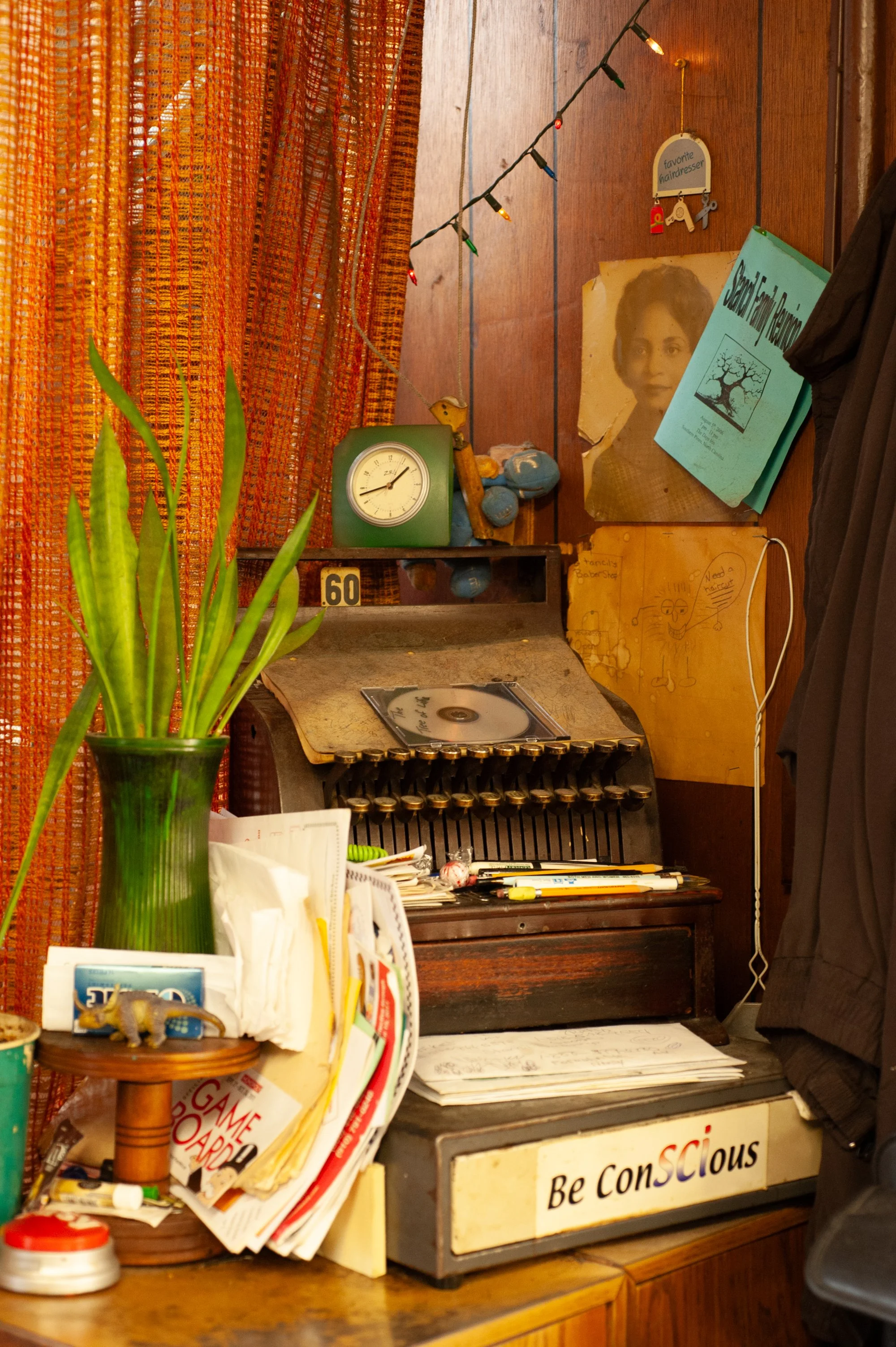
Vintage typewriter and personal items on a cluttered counter inside a Black barbershop

Personal objects layered into the space—notes, tools, and history sitting side by side on the counter.

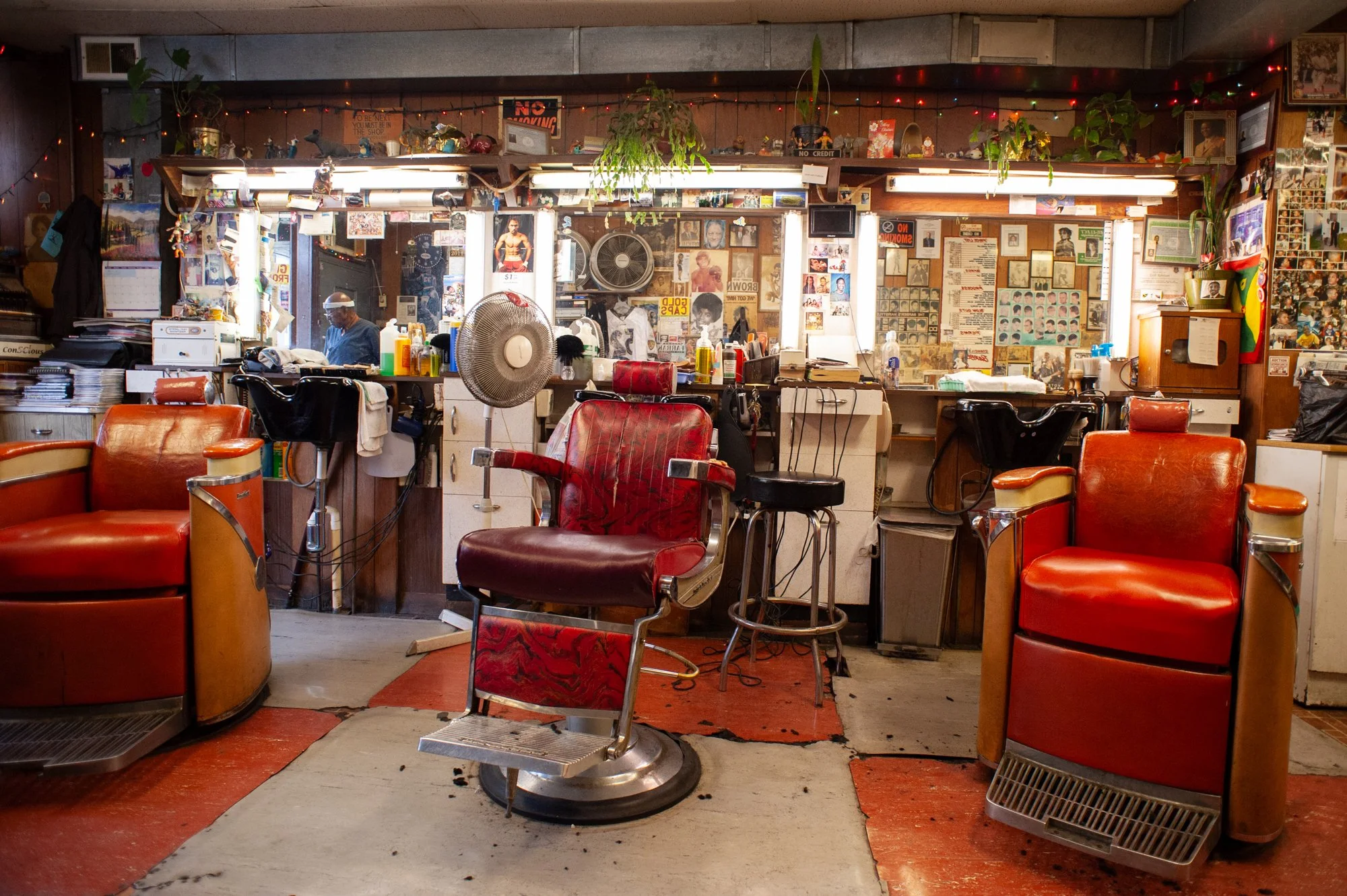
Interior of a traditional barbershop with red vintage barber chairs and mirrors

A full view of the shop—chairs, mirrors, and walls layered with history and everyday life.

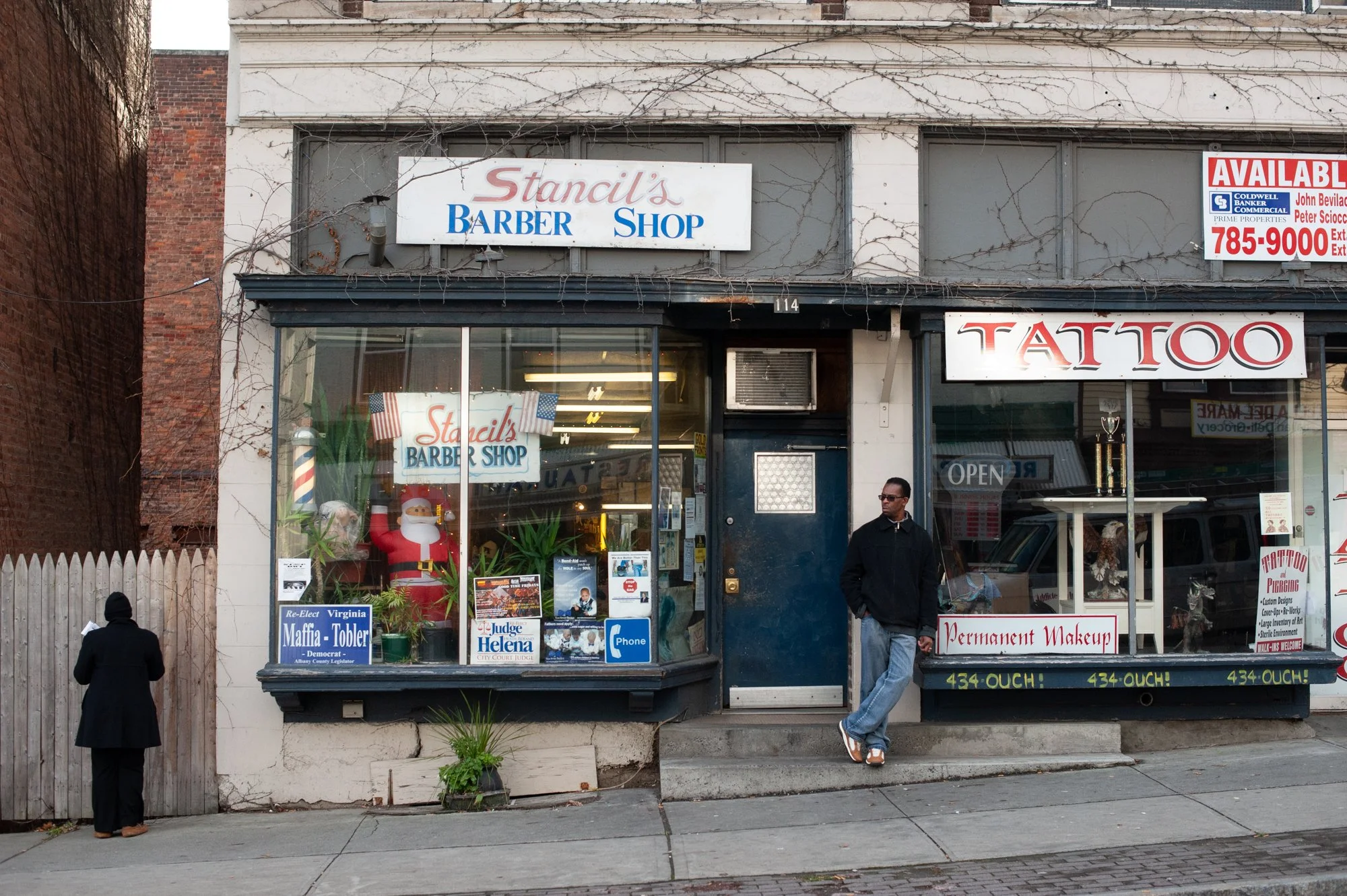
Exterior of Stancil’s Barbershop with people standing outside on a city street in Albany New York

The shop as part of the street—where daily life, community, and routine meet the sidewalk.

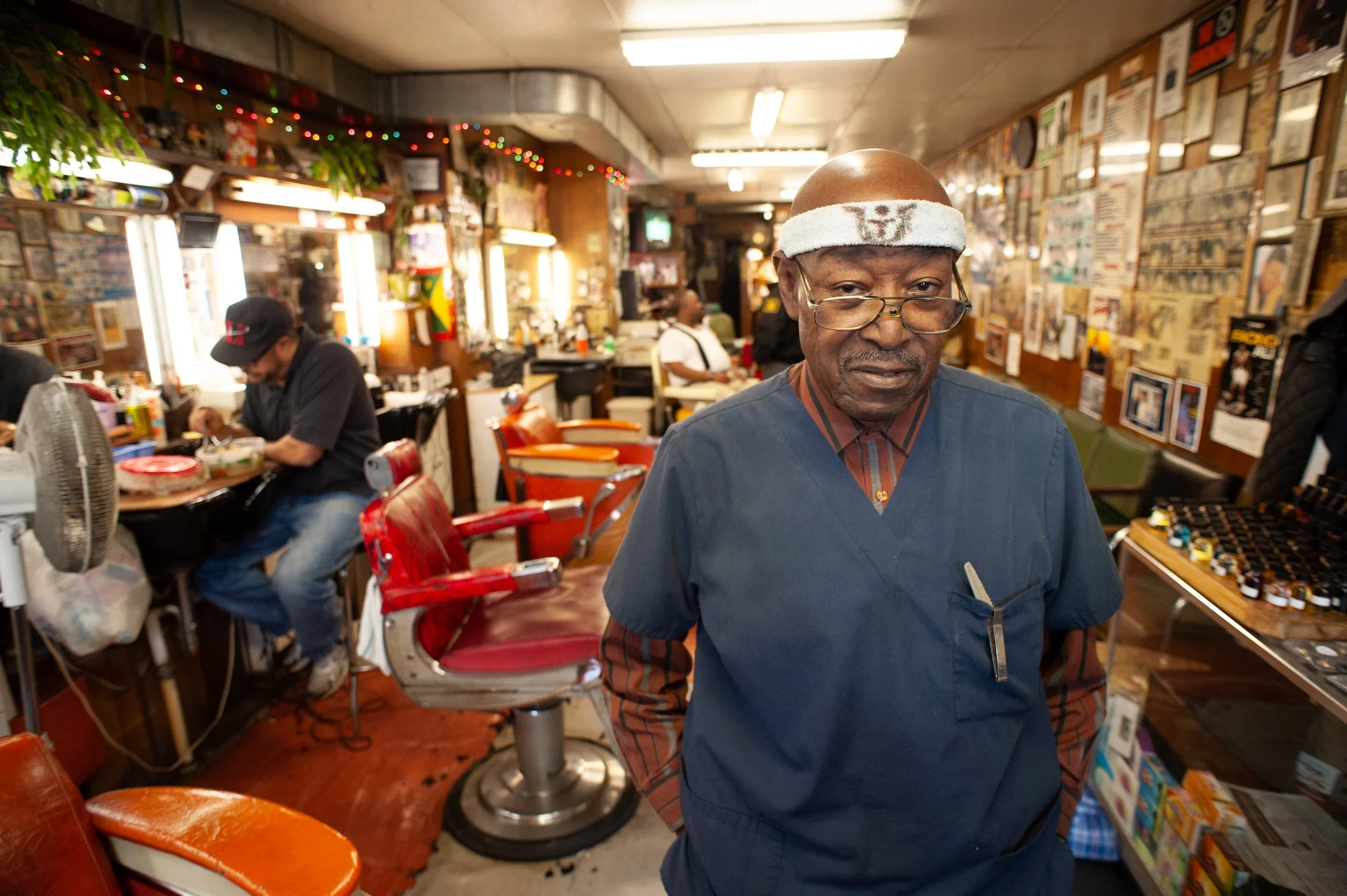
Portrait of a barber standing inside a traditional Black barbershop with chairs and mirrors behind him

A portrait inside the shop—years of experience, routine, and presence behind the chair.

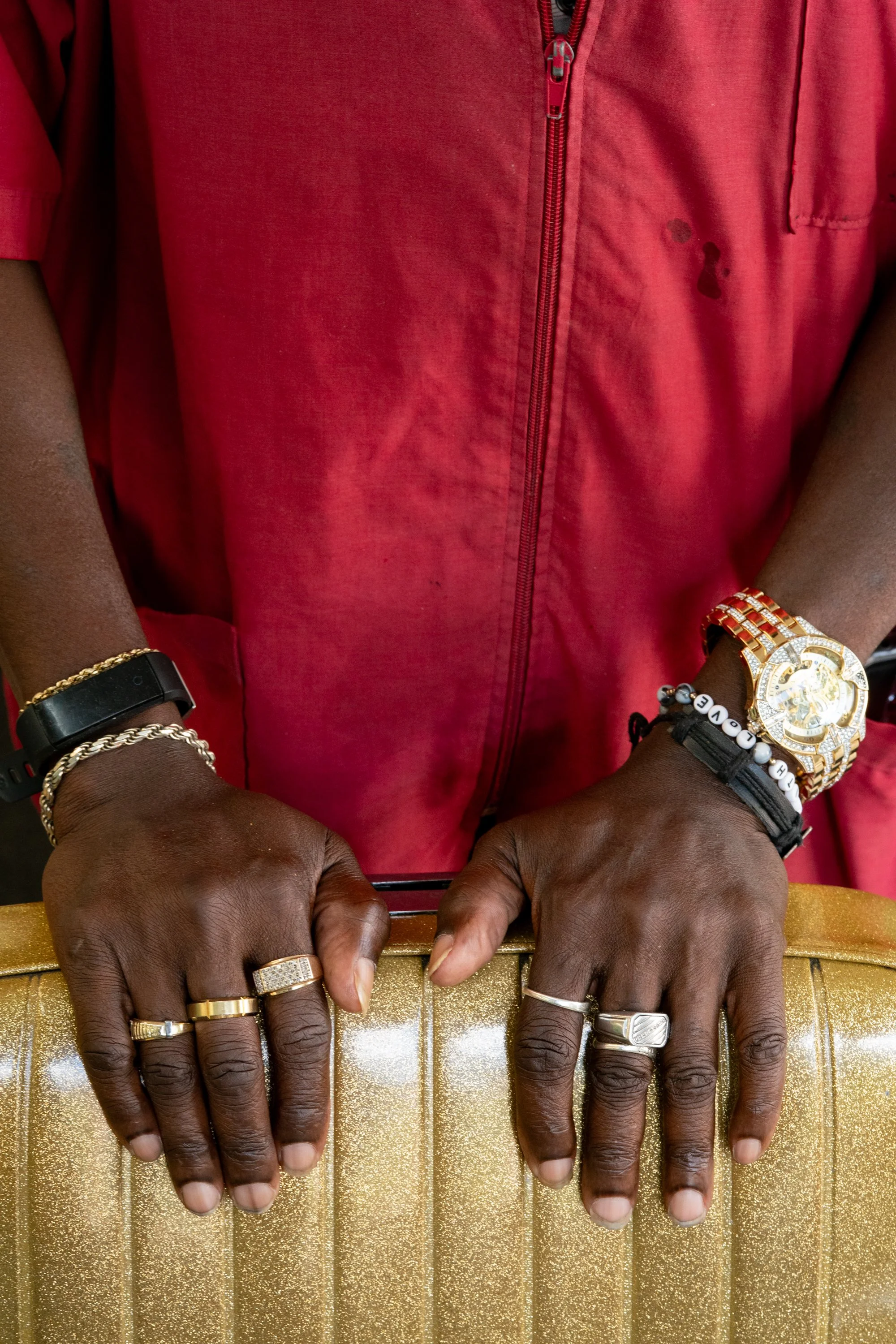
Close up of a barber’s hands with rings and watch resting on a barber chair

Hands that define the craft—tools, precision, and personal style carried into the work.

Leucadia Barbershop in Encinitas, CA

Leucadia Barbershop – A California Chapter of Barbershops of America

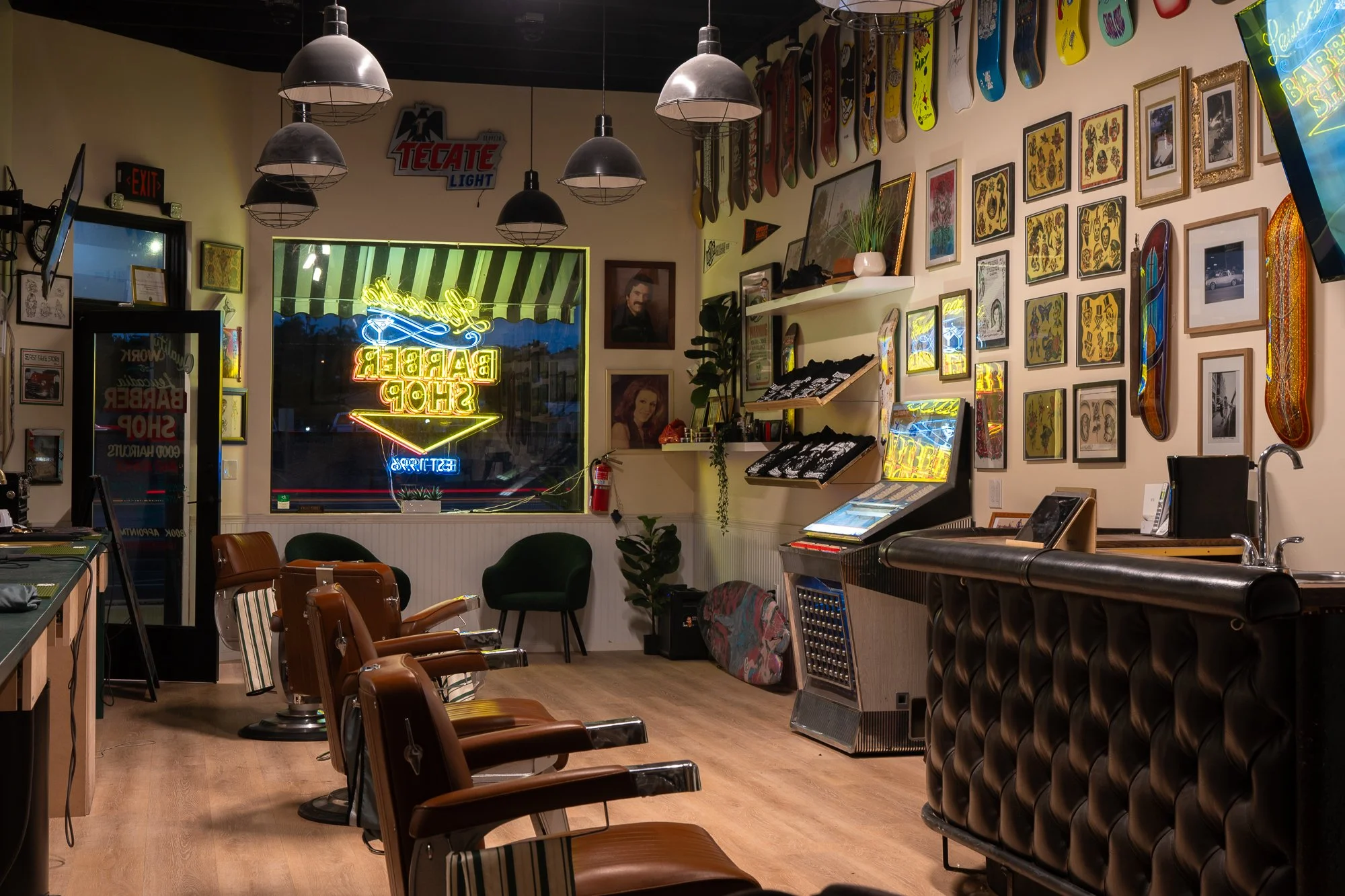
Leucadia Barbershop has been part of Encinitas since 1996, when Emiliano Zermeno’s family first opened the doors at its original location. Like many small barbershops, the business was eventually forced out due to landlord pressures—a familiar story across the country. Instead of closing, Emiliano rebuilt the shop in a new space, carrying forward what his family started while shaping it into something distinctly his own.

A Family Barbershop Rooted in Leucadia Since 1996

Emiliano grew up inside the shop his family created. The rhythm of haircuts, the conversations, the regulars—it wasn’t a concept or aesthetic. It was daily life. When displacement forced the original location to close, the continuity of that space could have ended. Instead, it shifted. The new Leucadia Barbershop carries the same foundation, just reinterpreted through a different generation.

Southern California Skate Culture Inside a Barbershop

The new space reflects Emiliano himself—a Southern California kid who grew up with a love for skateboarding and still carries that passion today. The shop feels less like a preserved relic and more like a lived-in extension of coastal California: relaxed, personal, rooted in community. The design choices, the atmosphere, even the pace of the room mirror the culture that shaped him.

Emiliano didn’t just take over the business to make his family proud, he took it to the next level. Which is obvious when you look at his shop, but more importantly, you see it in his cuts. He’s a member of the Uppercut Deluxe team - a sign of quality, and another layer that further represents the skateboarding culture.
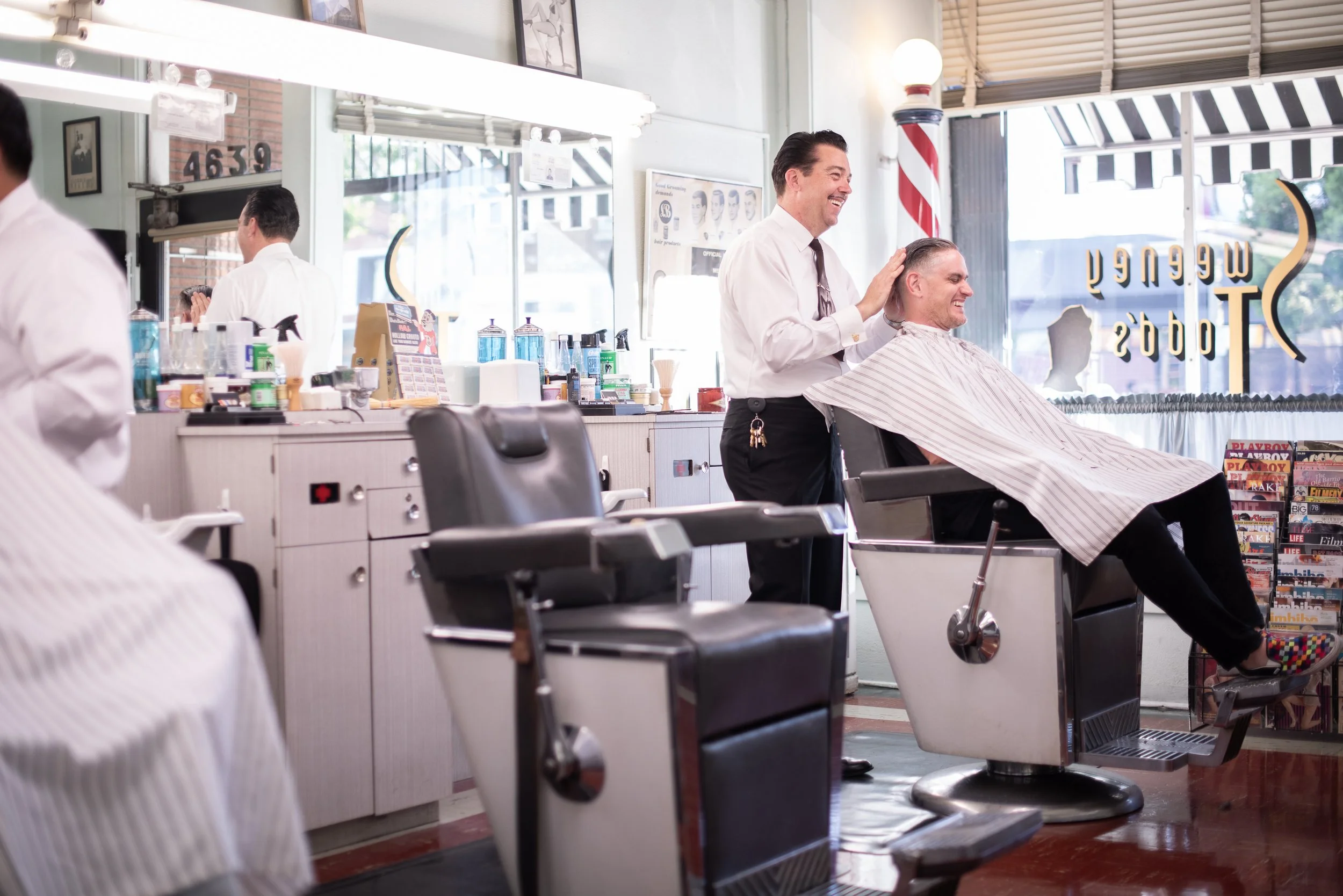
Photographing Leucadia Barbershop

Leucadia Barbershop was photographed as part of a long-term effort to document traditional American barbershops in all 50 states before they disappear or change beyond recognition. Each shop carries its own story. In Encinitas, that story includes family continuity, displacement, and the culture of Southern California itself.

View More Traditional Barbershops

Leucadia Barbershop is one of many shops documented across the country as part of a 15-year archive focused on preserving everyday American spaces.

→ View the full Barbershops of America gallery
You can also view another California barbershop photographed as part of the same series:

→ Read the blog post about a traditional barbershop in San Diego

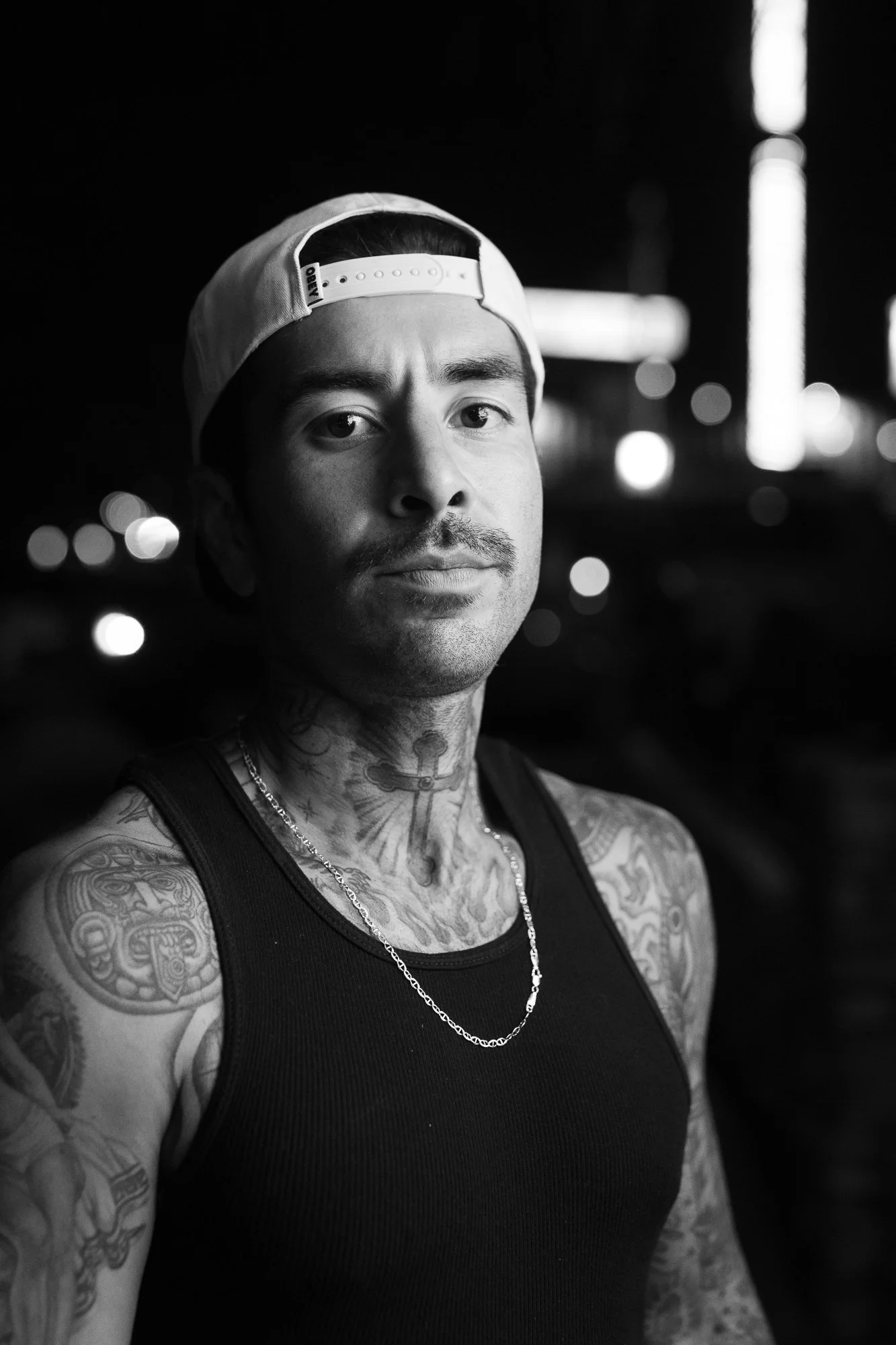
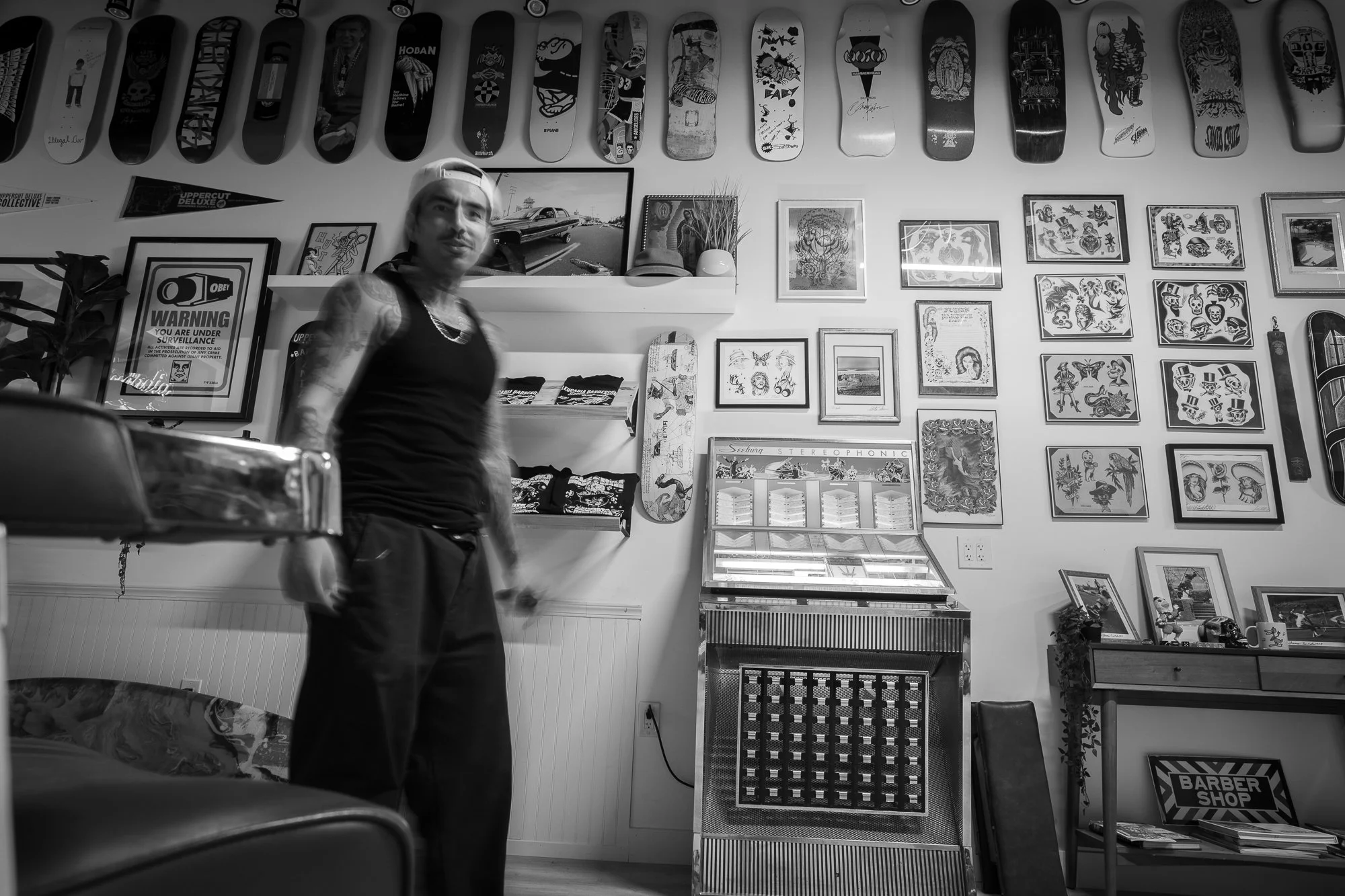
Black and white portrait of Emiliano Zermeno, owner of Leucadia Barbershop in Encinitas, California.

Portrait of Emiliano Zermeno, who continued the family barbershop after the original 1996 location was lost to landlord displacement.

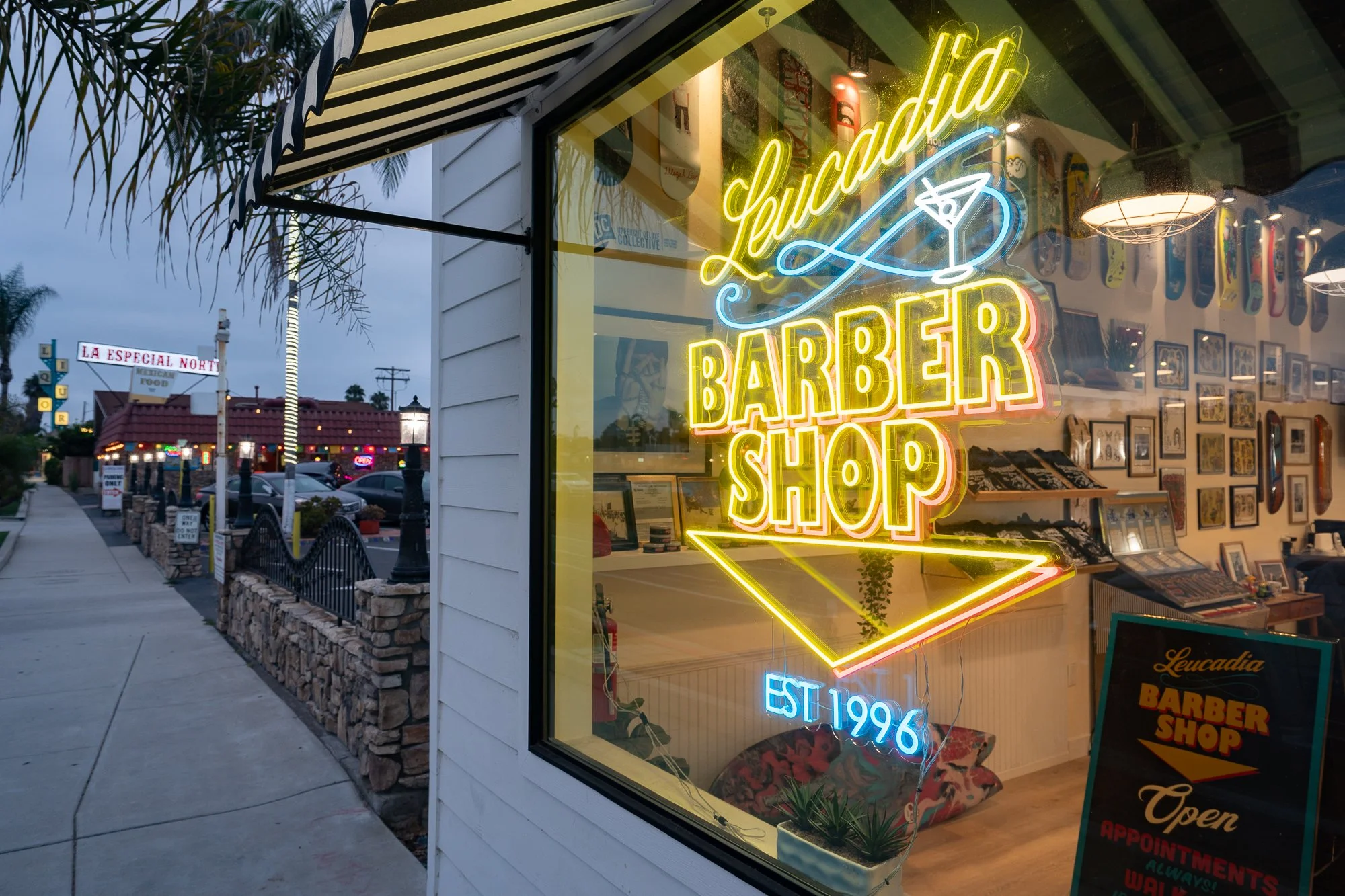
Neon sign at Leucadia Barbershop in Encinitas, California at dusk, established 1996.

The neon sign at Leucadia Barbershop glows over the sidewalk in Encinitas, California. Opened in 1996, the shop has remained part of the coastal community through change and relocation.

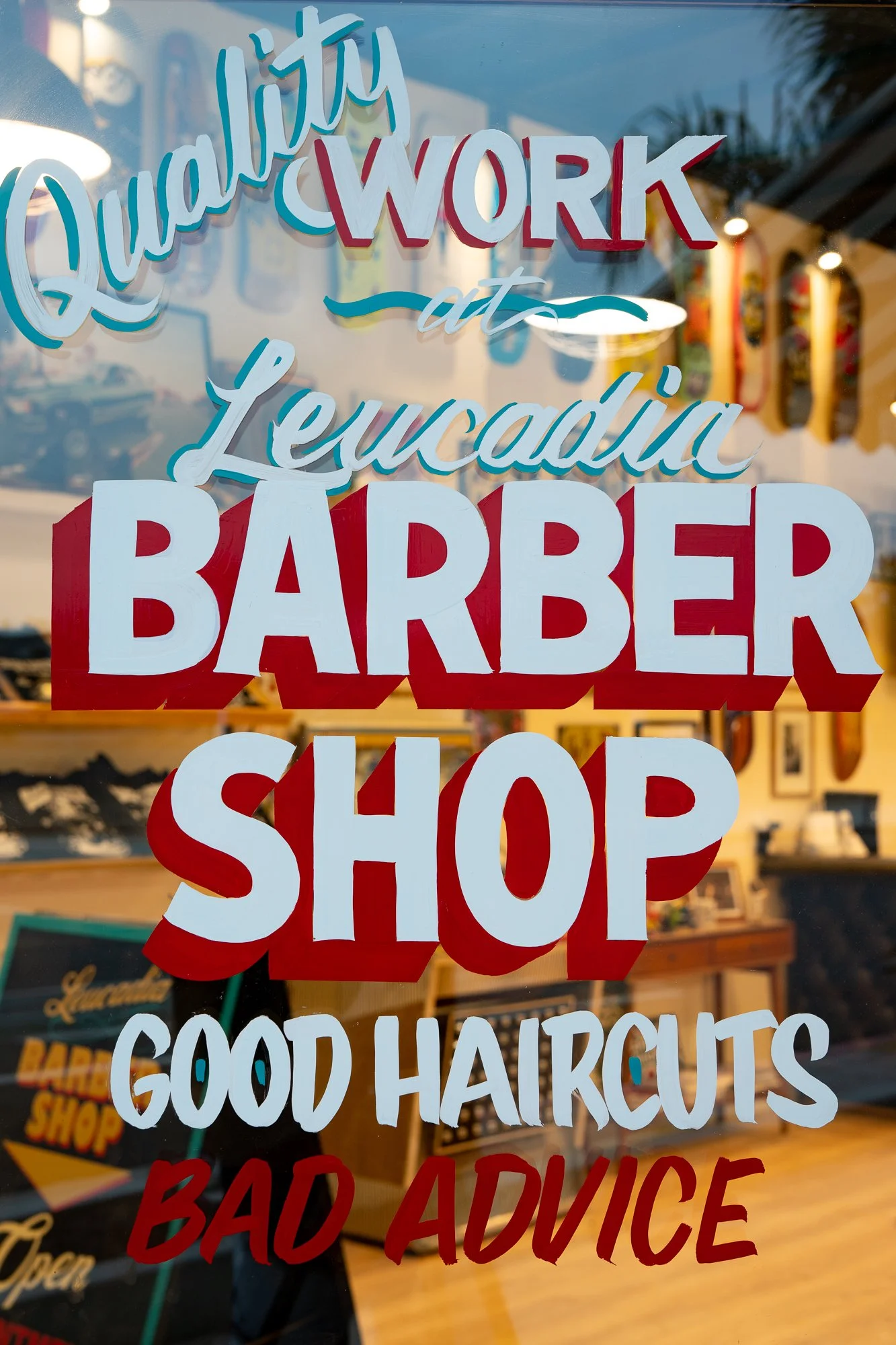
Window lettering reading “Quality Work at Leucadia Barber Shop” on the storefront in Encinitas, California.

Window lettering at Leucadia Barbershop in Encinitas, California. Established in 1996, the shop blends traditional barbering with Southern California character.

Interior of Leucadia Barbershop in Encinitas, California showing barber chairs, framed artwork, and skateboards.

Inside Leucadia Barbershop in Encinitas. The space combines traditional barber chairs with personal artwork and skateboards, creating a shop shaped by the owner’s history.

Emiliano Zermeno inside Leucadia Barbershop in Encinitas, California with skateboards displayed on the wall.

Emiliano Zermeno inside Leucadia Barbershop. The skateboards lining the wall reflect his Southern California upbringing and lifelong connection to skate culture.
Black and white photograph of a neon barbershop sign

Barbershop in Encinitas, CA

The Griffin Museum of Photography

Photography Museum - Winchester, Massachusetts

13+ years now I’ve been photographing traditional barbershops in all 50 states of the USA and the layers continue to peel. In the beginning it was just a thing to do because I love barbershops. Then as time went on I felt responsible for documenting them before they all disappeared. Now, in 2024, I see the collective body of work as a historical document of the barbers and shops that served as a staple in their respective communities for 30, 40, 50, 60+ years. On the surface the theme of this project is about a place to get your haircut. Really though, it’s about community, friendship, and human connection. So I’m honored to announce that a selection of these photographs will be shown at the Griffin Museum of Photography in Winchester, MA for their upcoming group show “Vision(ary) which focuses on communities, cultures, and environments. Please go check out the show as well as the other great exhibitions from June 7th-September 27th.

Click here to purchase a copy of Barbershops of America (photo book) and HERE to purchase prints from this series.

Exhibition at the Griffin Museum of Photography

Barbershops of America at The Griffin Museum of Photography

Photography Books - American Culture

American Photography - Documenting Traditional Barbershops

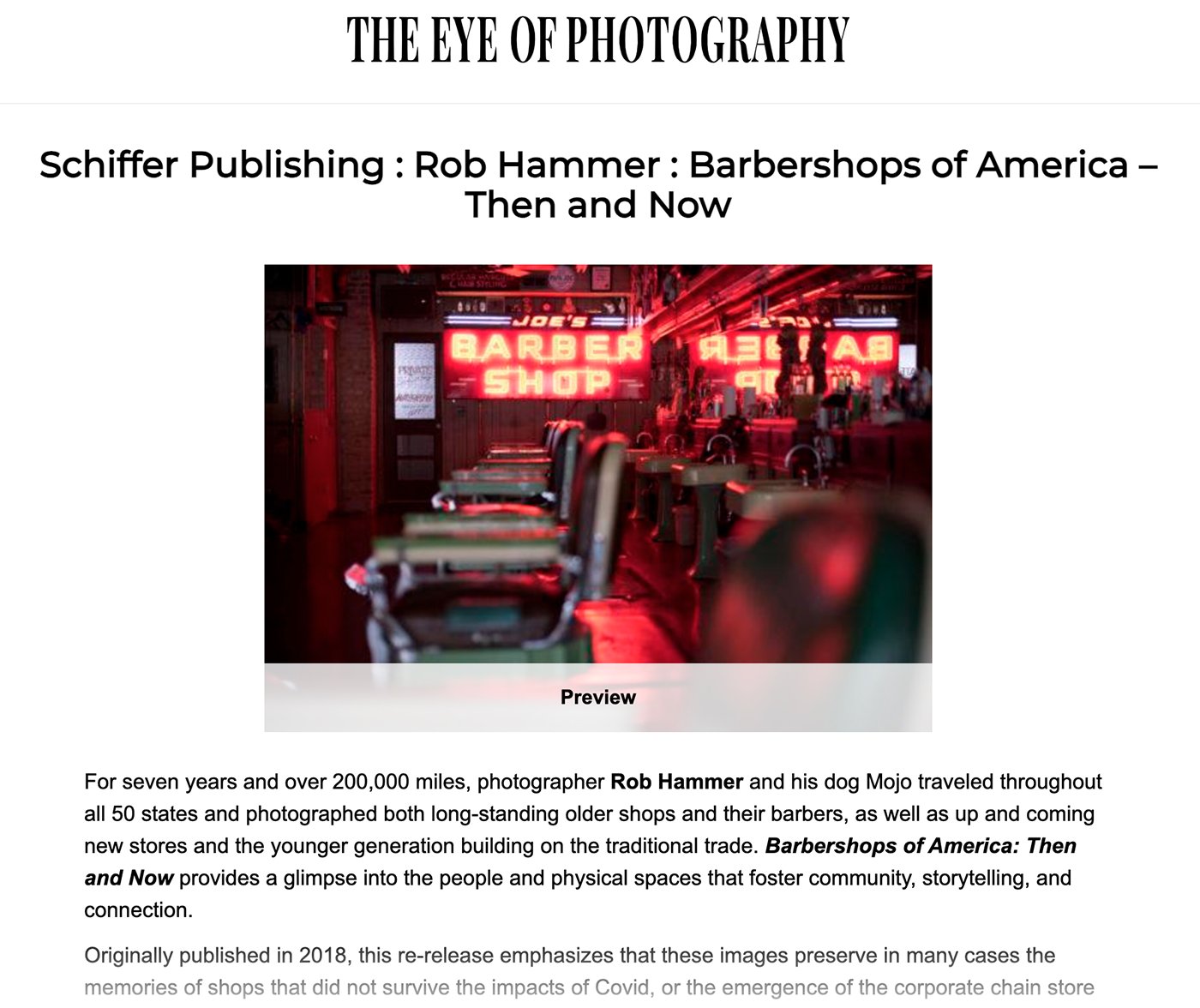
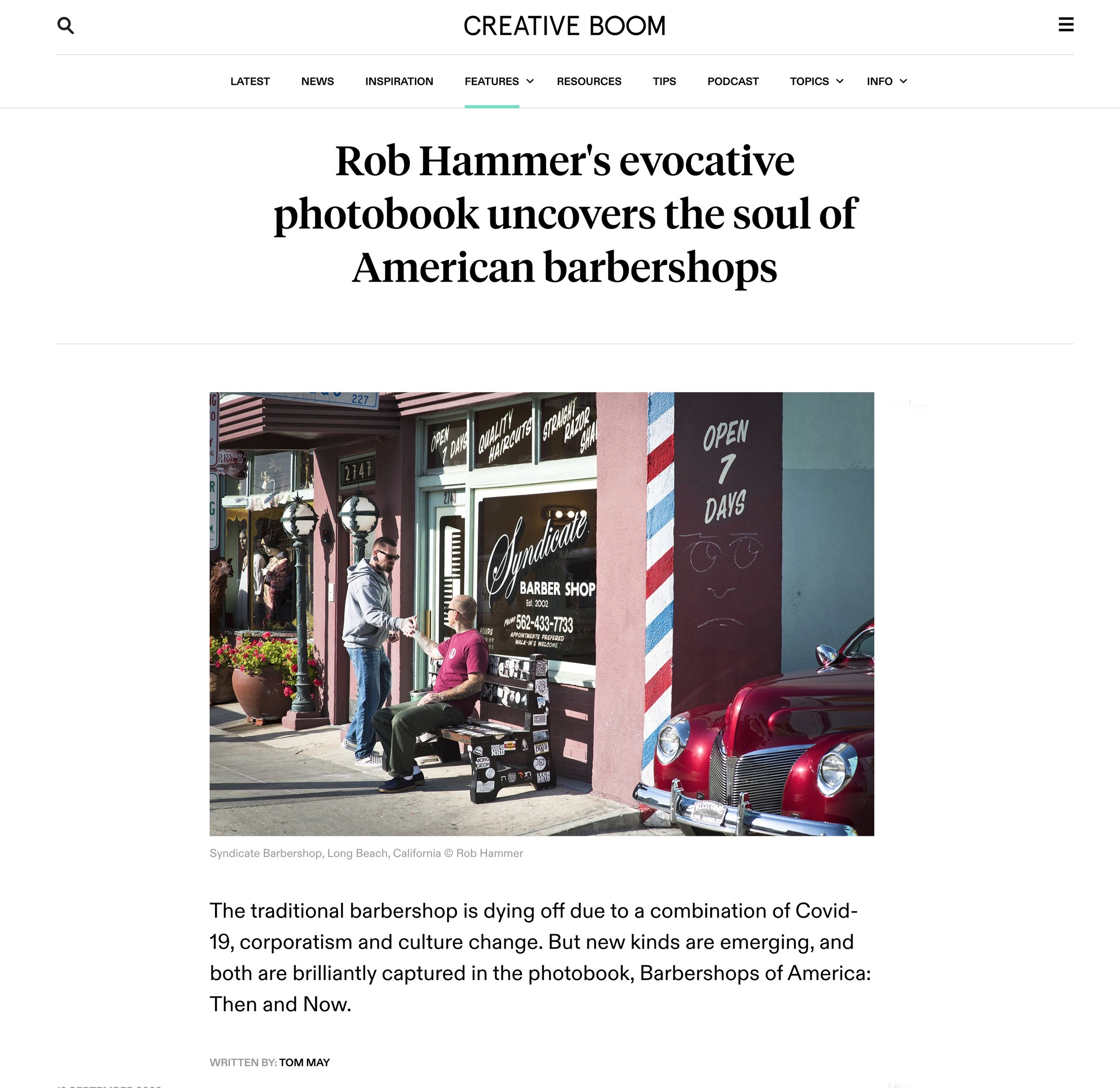
American photography as a genre is hard to define, especially when it comes to art collection and fine art photography. The term is so broad and leaves plenty of room for interpretation. One of my longest running series Barbershops of America fits into that category. Although it’s only been recently that I realized what’s been put together with this series is as much American photography as it is a historical document of a niche piece of American culture. And it occured to me the other day that getting a haircut is just a bonus to the experience you receive from being in a traditional barbershop. Grateful to see this project getting some exposure on Creative Boom and The Eye of Photography.
Click HERE to purchase a copy of Barbershops of American or HERE to purchase fine art prints.

Historic Texas Barbershop Photographs

Raymond’s Barbershop - Lockhart, Texas

Lockhart is best known for its barbecue, but places like Raymond’s Barbershop tell another side of the town’s story. Between visits to longtime institutions like Smitty’s Market, everyday routines continue in quiet spaces that rarely draw attention but shape the rhythm of local life just as much.

A Traditional Barbershop in Lockhart, Texas

Lockhart has no shortage of visitors passing through, but Raymond’s Barbershop remains firmly rooted in local life. The worn chairs, utilitarian layout, and unpolished surfaces reflect decades of daily use rather than intentional preservation. This is not a styled space—it’s one that has simply been allowed to age naturally alongside the town itself. During my time at Raymond’s, he was cutting the hair of an old friend. This wasn’t made known explicitly, rather in the chemistry the two had—genuine smiles exchanged as the customer walked through the door and candid, easy banter which can only be formed by time.

Why Small-Town Barbershops Still Matter

In towns like Lockhart all across America, barbershops have long functioned as informal gathering places—spaces where news travels, laughs are shared, and familiarity carries more weight than novelty. As commercial rents rise and older barbers retire, places like Raymond’s quietly disappear, taking a long and irreplaceable history with them.

Documenting Raymond’s Barbershop as Part of a Larger Archive

Truth be told I only found Raymond’s because of my obsession with BBQ, which brought me to Lockhart, but that’s just the luck of the draw. You never know how important subjects are going to come into your life. Regardless, these photographs of Raymond and his beautiful old shop are part of an ongoing, 15-year effort to document traditional barbershops across the United States. Each shop is approached individually—rooted in its town, its people, and its history—while collectively contributing to a broader visual record of a disappearing American institution.

View More Traditional Barbershops

→ View the full Barbershops of America gallery

For more work made in Texas, you can also view photographs from another long-standing barbershop documented as part of the same project:

→ View a Texas barbershop in Marfa

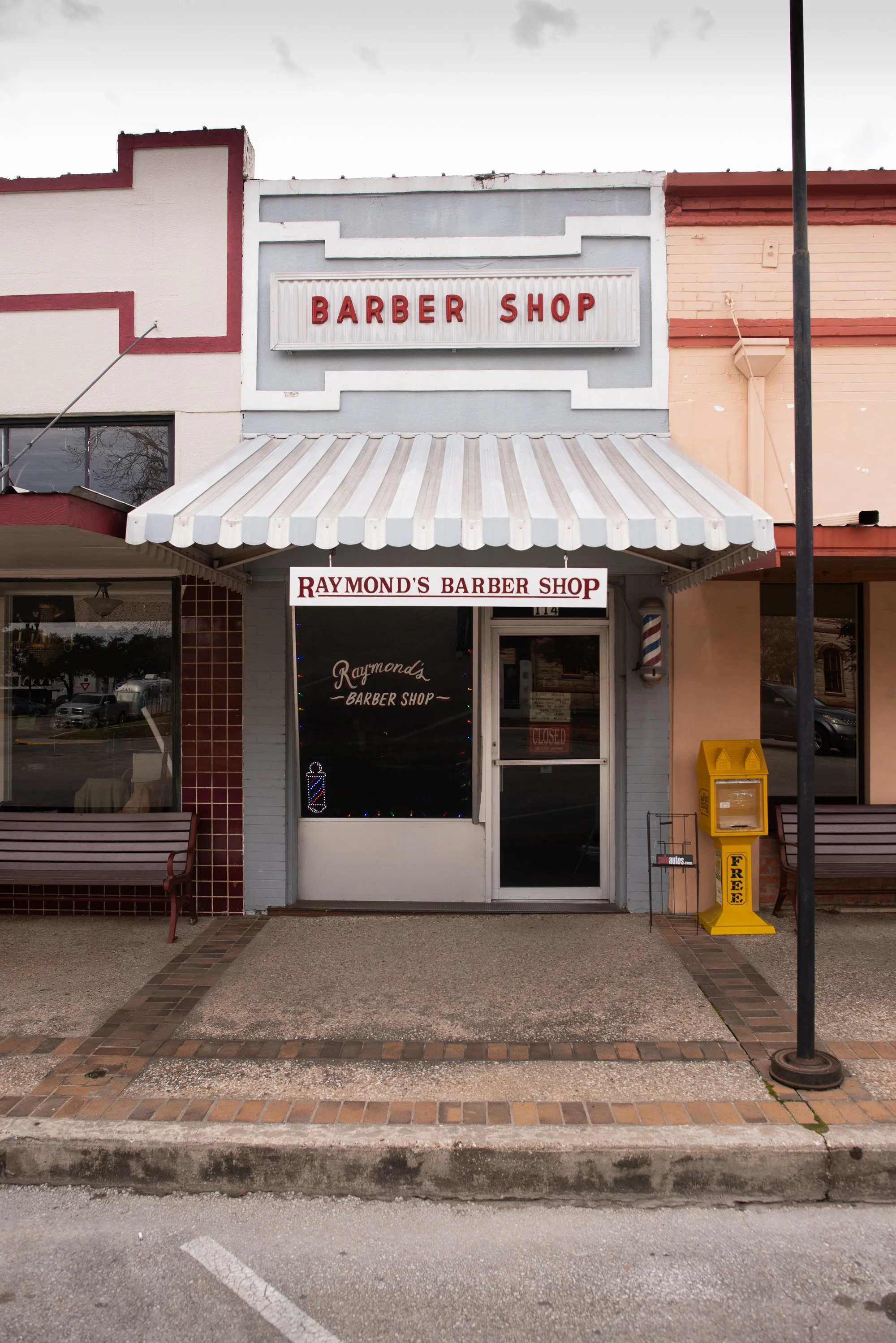
Exterior storefront of Raymond’s Barber Shop in downtown Lockhart, Texas.

The storefront of Raymond’s Barber Shop in Lockhart, Texas—a modest main street presence that has served generations of local residents.

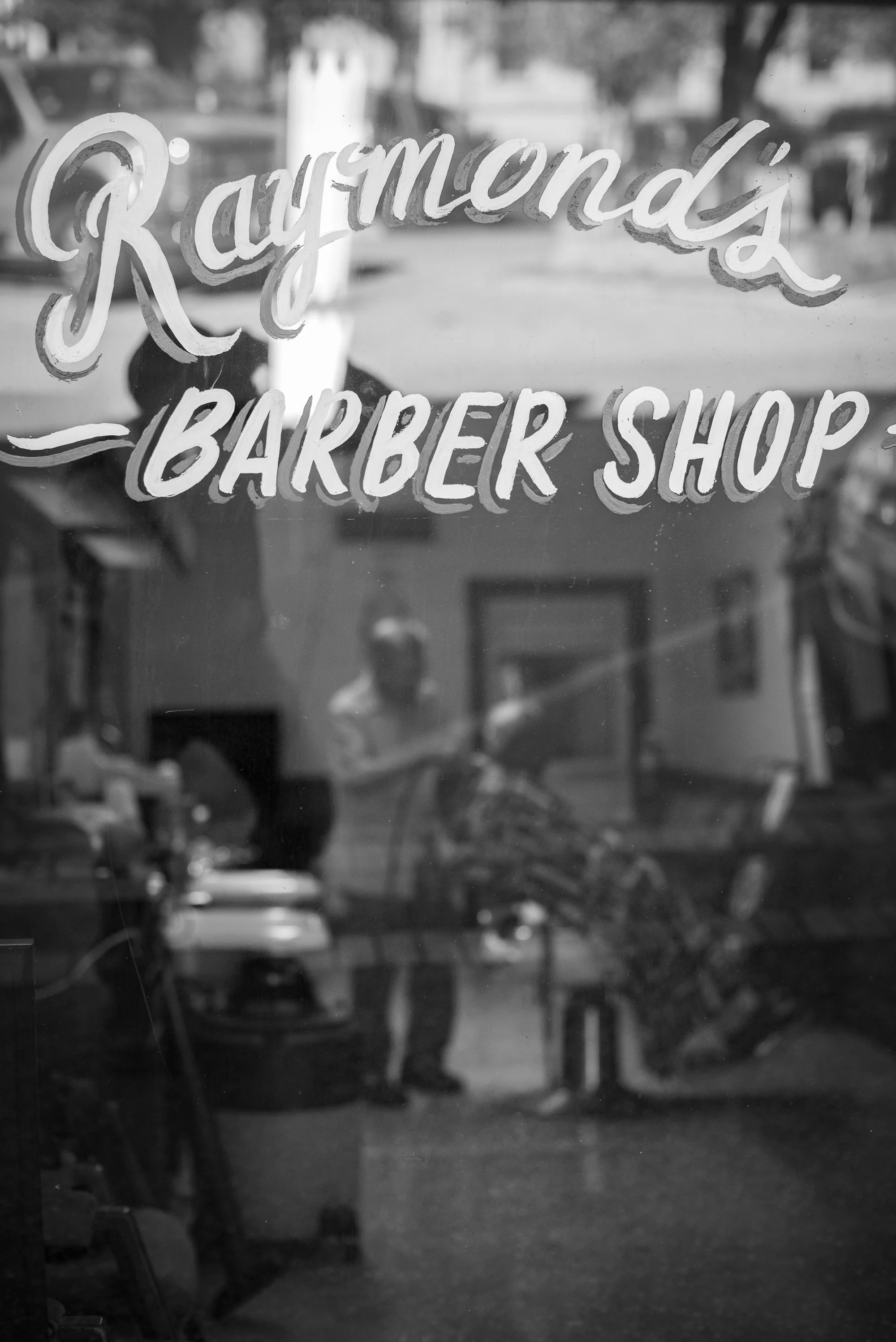
Hand-painted “Raymond’s Barber Shop” lettering on the front window in Lockhart, Texas, with reflections of the barbershop interior.

Hand-painted lettering on the front window of Raymond’s Barber Shop in Lockhart, Texas, separating the street outside from the quiet work happening inside.

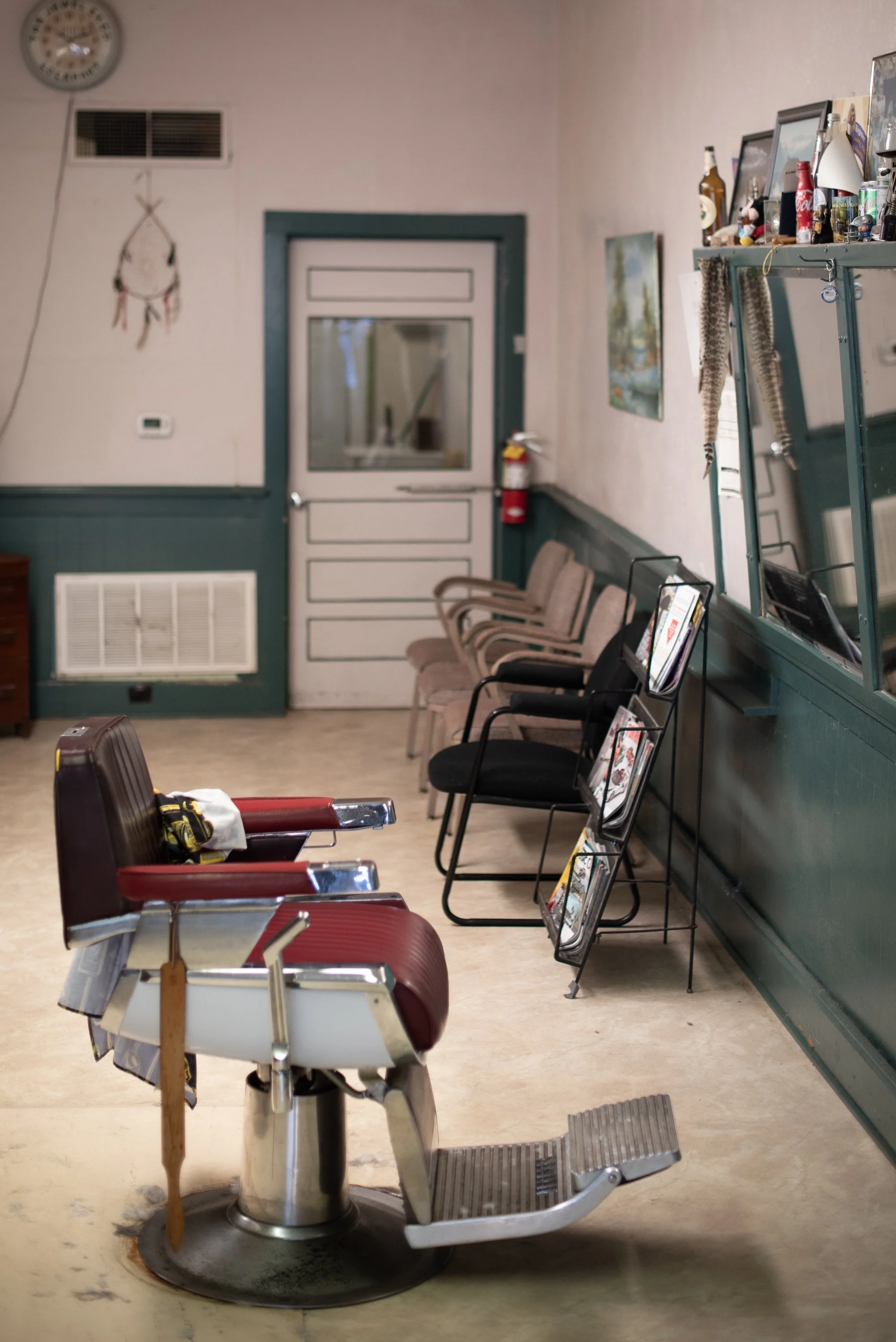
Empty barber chair and waiting area inside Raymond’s Barber Shop in Lockhart, Texas.

An empty chair and quiet waiting area inside Raymond’s Barber Shop in Lockhart, Texas, between customers and conversations.

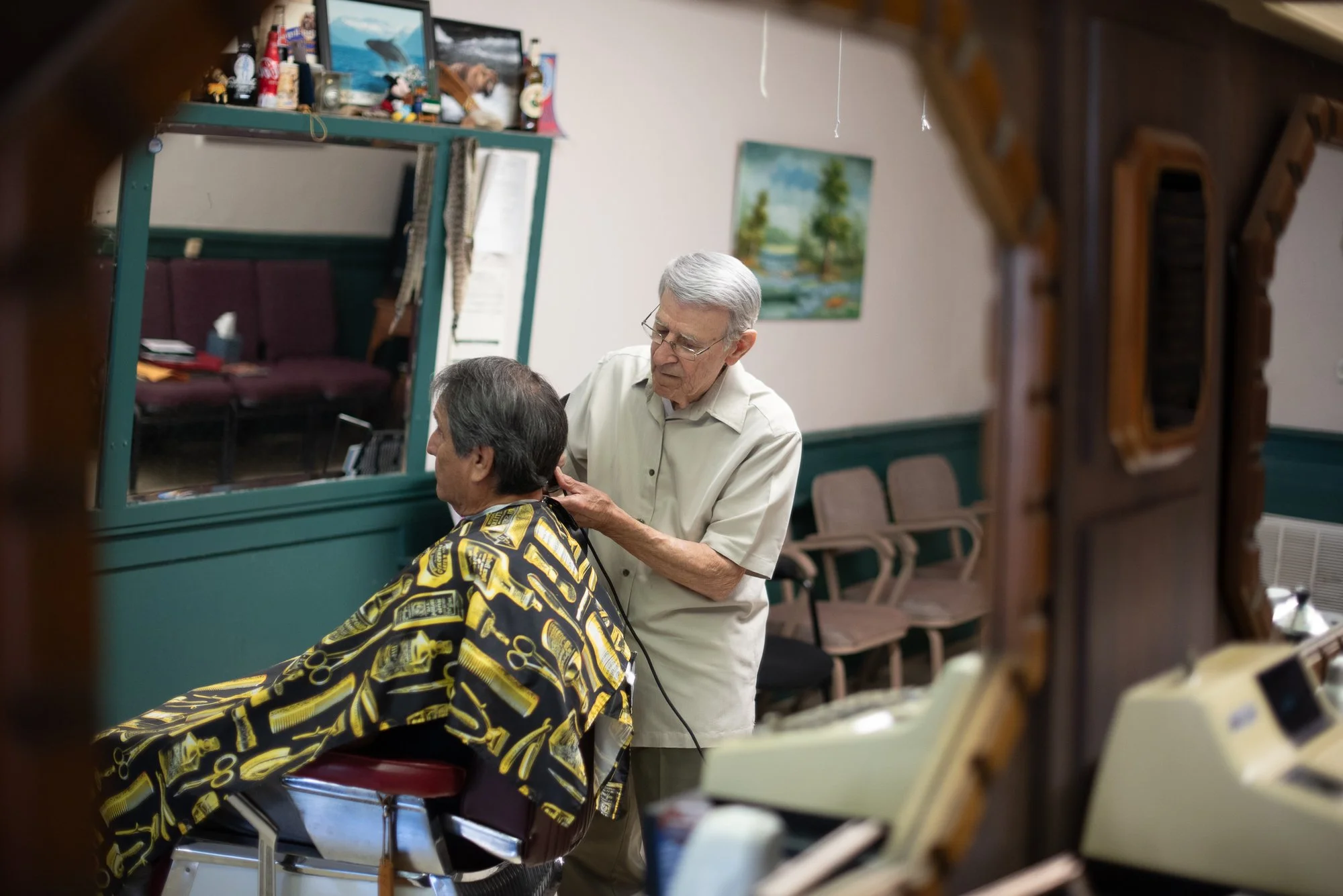
Barber giving a haircut to a customer inside Raymond’s Barber Shop in Lockhart, Texas.

Barber and customer smile together during a routine haircut underway at Raymond’s Barber Shop in Lockhart, Texas, where familiarity and trust guide the work as much as technique.

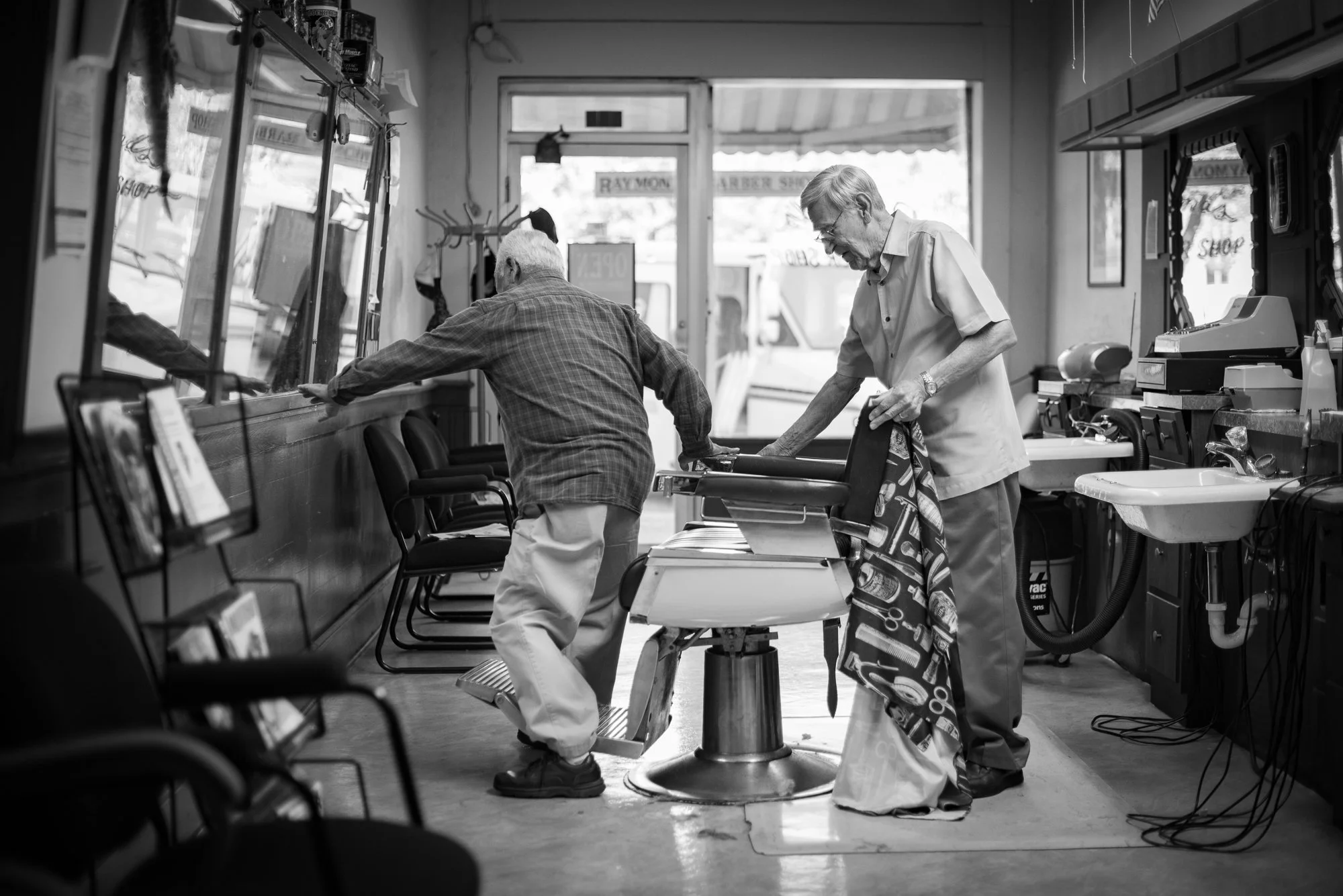
An elderly man sits in a barber chair inside Raymond’s Barber Shop in Lockhart, Texas.

Barber holds the chair as his elderly customer braces himself at Raymond’s Barber Shop in Lockhart, Texas—part of a daily routine that has remained largely unchanged for decades.

Andis Clippers

Andis Clippers

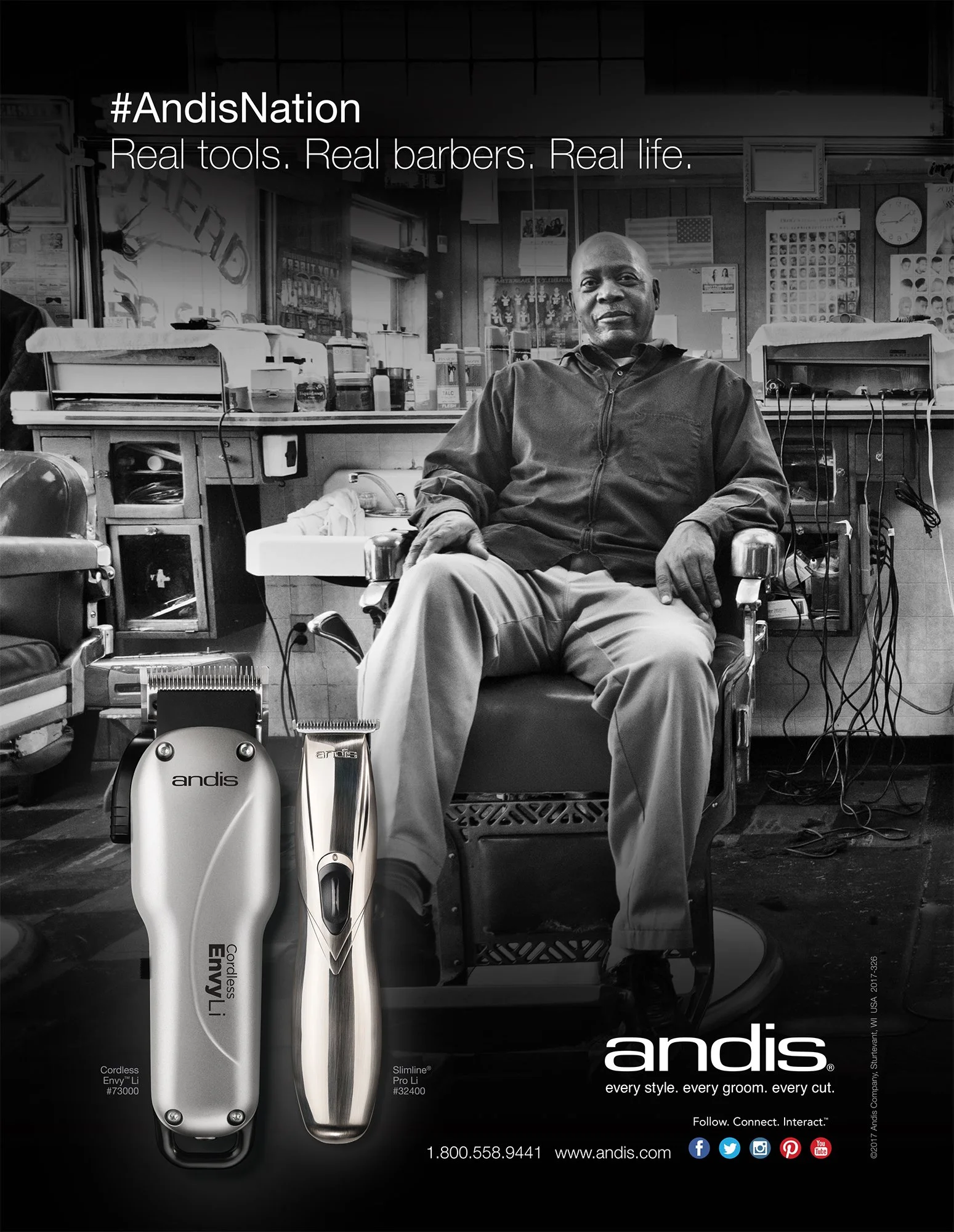
People will probably get sick of my ramblings about personal projects, but I don’t care. It’s an important message to send. As of now it’s been about 10 years since the Barbershops of America series began and I’m still on the lookout for old shops during my travels. One of the most rewarding parts about these projects is their ability to organically connect me with like minded people/brands. Andis Company is one of those brands. They started out in the 1920’s and is now being run by it’s fourth generation of the same family. Hard not to get behind a company like that. A couple years ago I stopped in to their headquarters in Wisconsin and was given a behind the scenes tour. The operation is incredibly impressive, but what stood out the most was the camaraderie and interaction between all the employees. Even during my limited time there it was obvious that they enjoyed each other and enjoyed working for Andis. So I’m proud of our past collaborations as well as this most recent image they licensed for an ad on social justice that ran in USA Today.

Andis Company

Andis Company

Pasquale The Barber

Life has a tendency to take over. I don’t mean that as a bad thing, but it certainly has a natural way of pushing certain things to the side. Maybe it’s just priorities? Who knows. If the downtime caused by COVID has been good for anything though, it’s been a recalculation of what’s important and what isn’t. For me, I’ve been happy to unearth some projects from the archives that haven’t ever seen the light of day. This doc we did on Pasquale The Barber is one of those projects. It was so much fun in a lot of ways, one being that it’s my first time “directing” a video production. I use those terms lightly though because it was a very small personal production between myself and cameraman Jordan Valente. I’ve know Pasquale for years now, ever since photographing him at his shop for the 1st barbershop book way back in 2011(?). This video was shot in 2018, but got buried on a hard drive when life and other commercial projects took over. The only real downside of waiting so long to put this together is that “Pat” has since retired and moved into a senior home. Fortunately we were able to track down his son who was able to play the documentary for him on his computer at the facility. And I’m told he enjoyed it very much. Cheers to Pasquale and all the other old school barbers still carrying on the tradition.

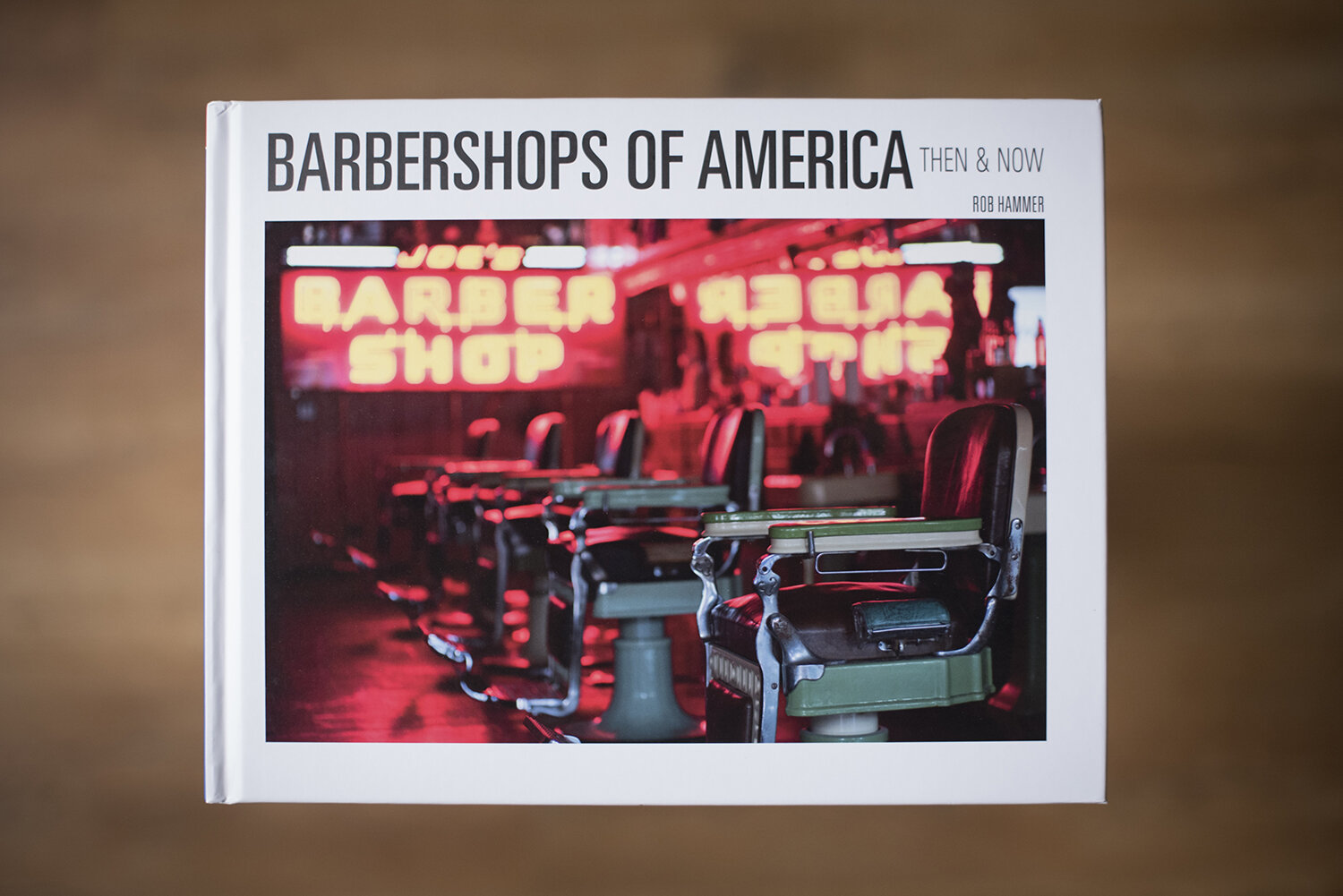
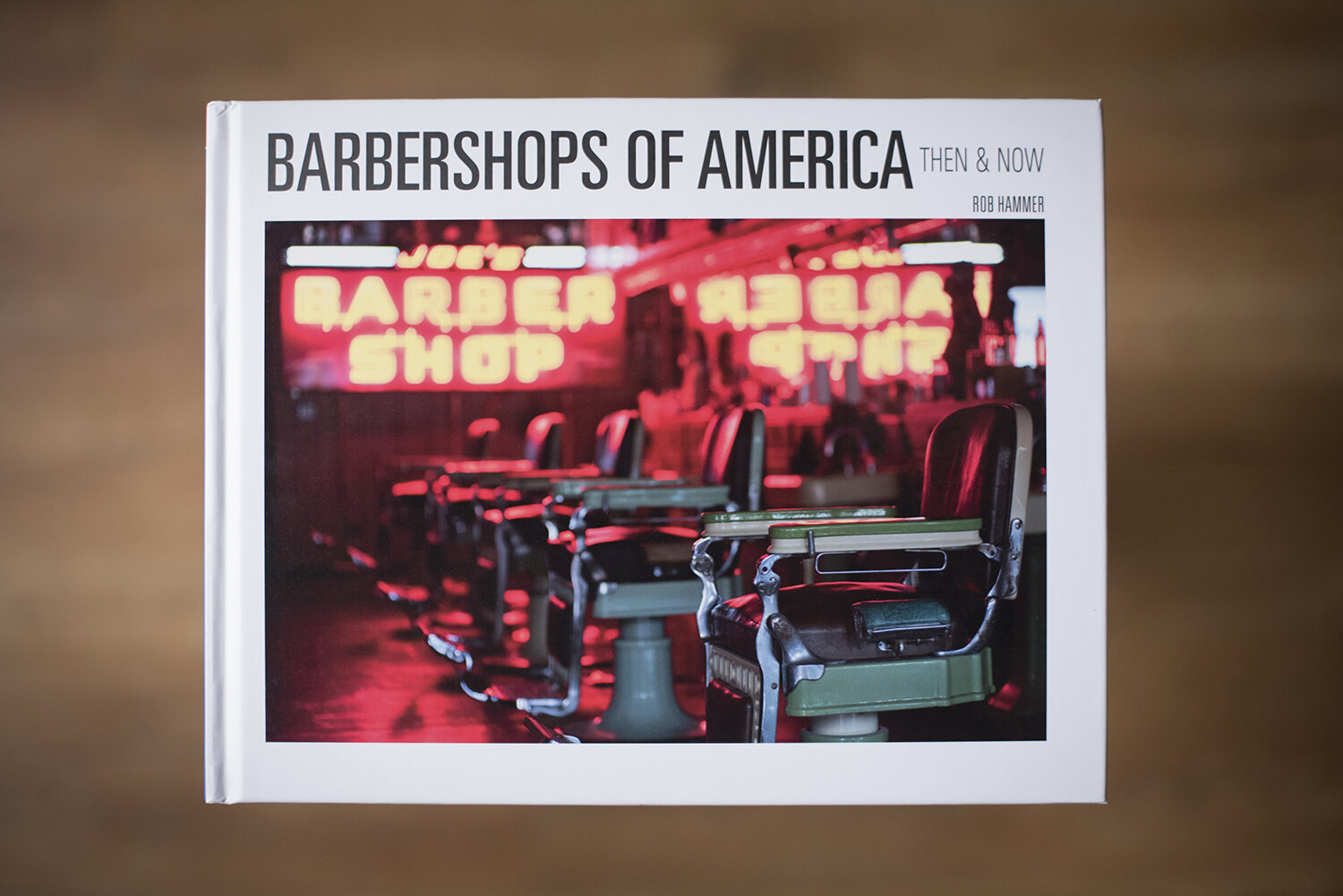
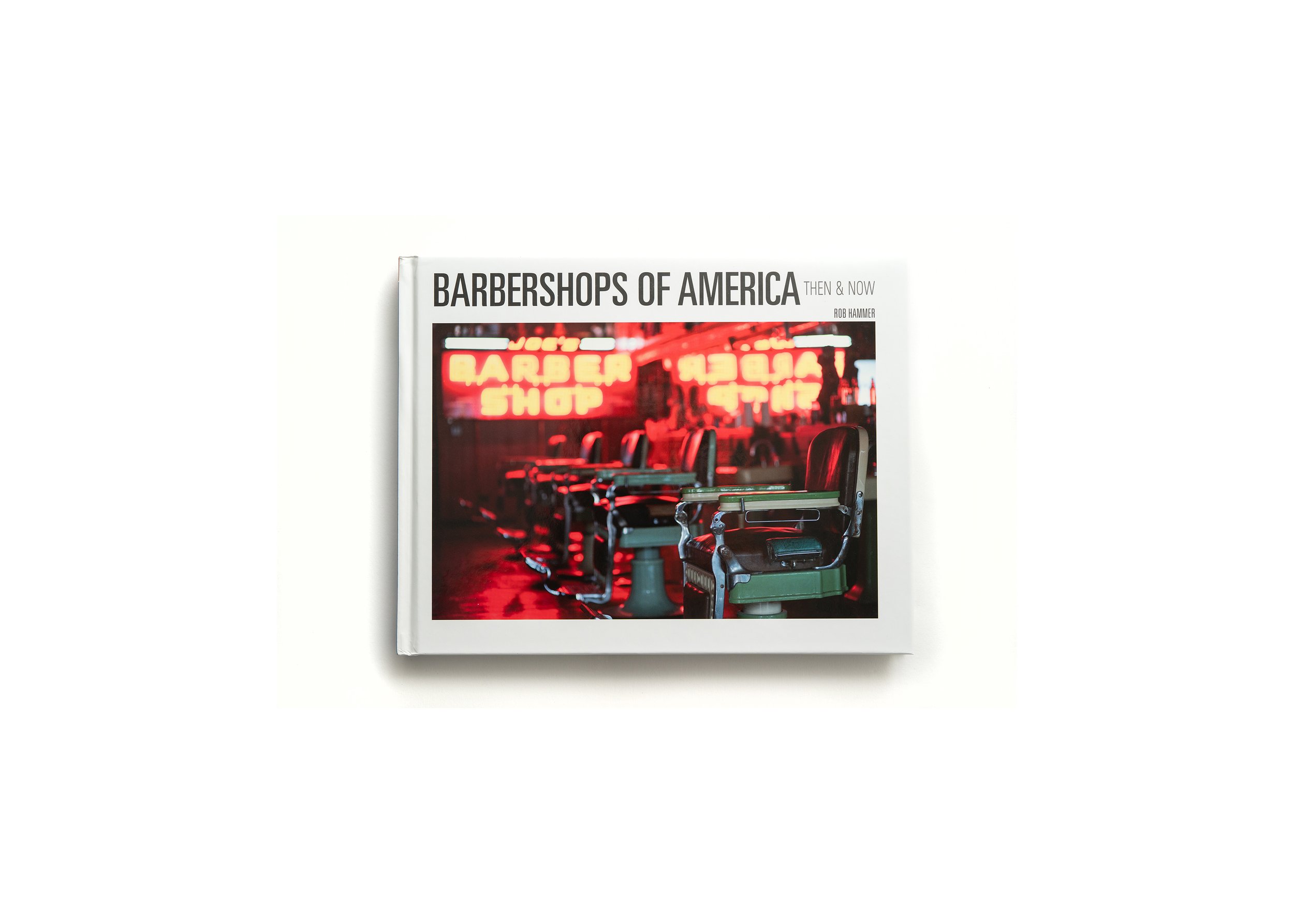
Click here to purchase a copy of “Barbershops of America - Then and Now”

Barbershops of America - Then and Now

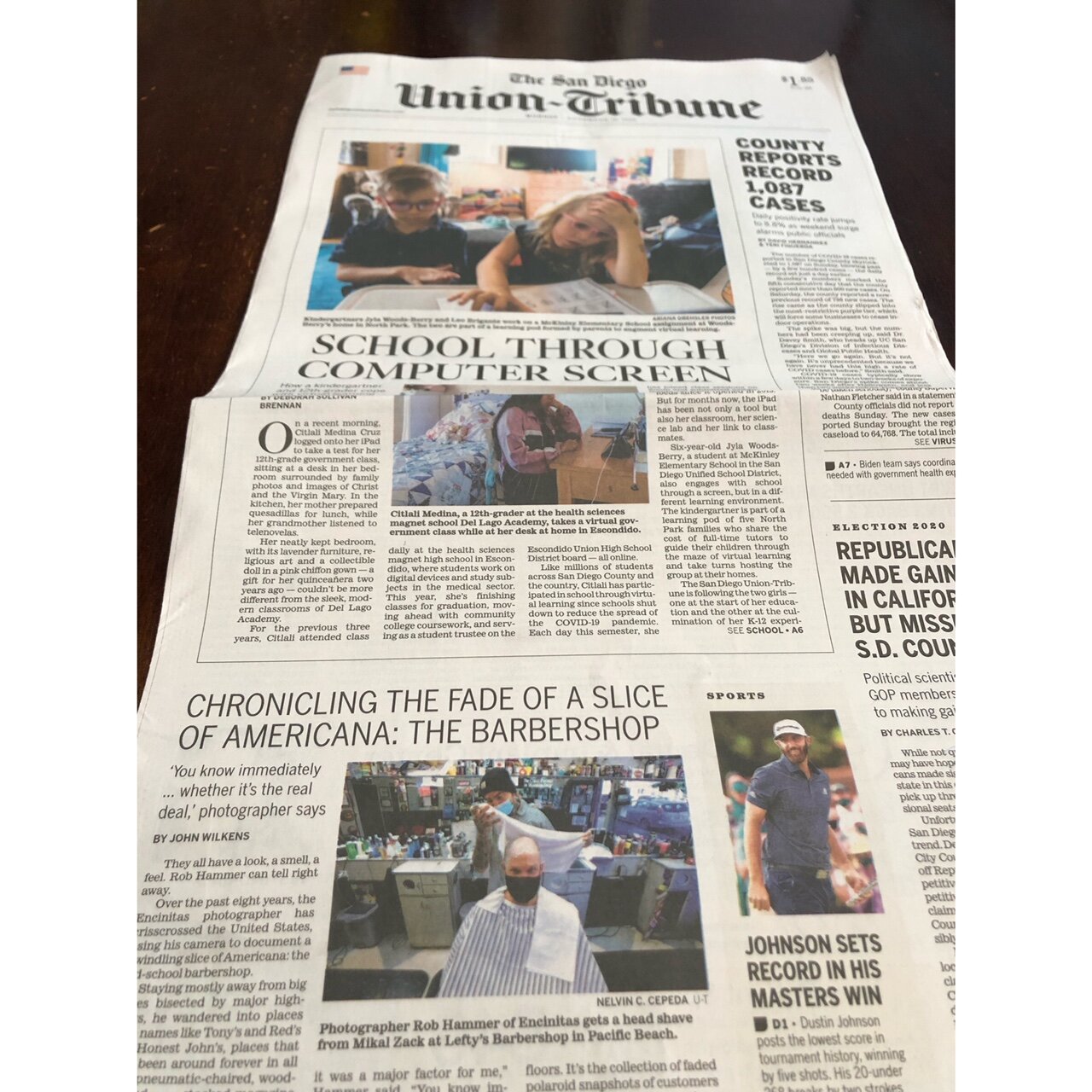
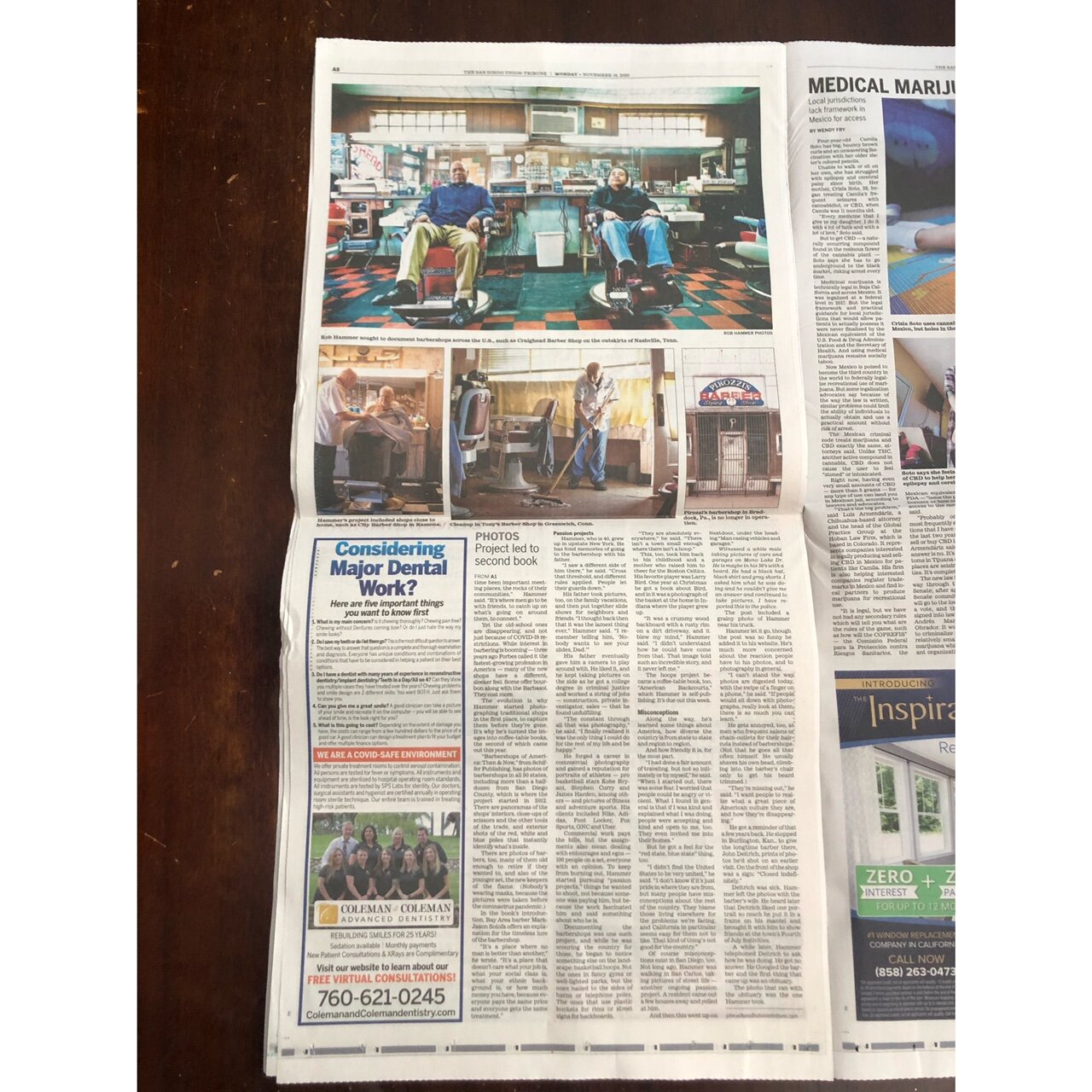
Feeling really grateful for the press Barbershops of America has been getting lately. It feels good when people really connect with your personal work. Barber Evo Magazine ran an article and it was on the front page of today’s San Diego Union Tribune, which caused a number of really kind emails from people who read it. One in particular mentioned that the images reminded him of the shop he grew up in. Exactly the kind of emotional reaction I hope people will have when they look at the book.

CLICK HERE TO GRAB A COPY FOR YOURSELF OR AS A GIFT

What to know before publishing a photo book

Publishing Your First Photography Book

Why and How

Seems redundant to say that quarantine has been a trying time for everyone. My commercial business was shut down for 5 months straight. While stressful, it also became something I embraced because really, there’s nothing any of us could have done to change it. Commercial productions just weren’t possible, which isn’t an excuse to sit around and watch Netflix. For me it became a time to learn and soak up as much knowledge as possible, most notably on book publishing. I read a lot of books and blog posts, watched some videos, and attended a multiple online Zoom workshops. One thing that stood out from all of that was the question asking “why do you want to publish a book?” Everyone really seemed to emphasize that line. If you’ve followed what I do for any length of time, you know I’ve published a few books and have another one on the way. Then, why? After a lot of thinking I recognized how important that question and answer are for anyone wanting to publish a book of any kind. And I felt compelled to share exactly what my Why is as well as other thoughts crucial to the process. I’m a photographer, so my answers will be focused on that genre, but they apply to everyone.  What I offer here are just my thoughts. In no way do I have book publishing or the photography world “figured out”. Nobody does or ever will. Like anything, it’s constantly changing, so all we can do is stay on top of it and help each other out along the way.

1) SO, WHY DO YOU WANT TO PUBLISH A BOOK?

I’ve spent countless hours inadvertently thinking about this one and the answer has become really clear - I believe in photography books. Every which way you can think of, I believe in them. There’s a very distinguishable line in my career that I credit all to photo books. It sounds dramatic, but I don’t mind saying that they changed my life. My collection has grown vigorously over the years, and if memory serves, the first one to alter my way of thinking and seeing is probably Uncommon Places by Stephen Shore. From there I went on to William Eggleston, who I’d say is one of my biggest influences. Then there was (in no particular order) William Albert Allard, Andy Anderson, Joel Sternfeld, Lee Friedlander, Joel Meyorwitz, Walker Evans, Robert Frank, Walter Iooss, Fred Herzog, Saul Leiter, Alex Webb, Dan Winters, and the list goes on, almost forever. Each of their books are, in themselves, a master class on photography.  The point is that I didn’t understand what real photography was until spending countless quiet hours with myself and books by the masters. Just starting out, I was ignorant and hot headed, thinking my images were great and that I didn’t need anyone’s help. What an idiot. Studying photo books has taught me so much about what great photographs are and how to create a cohesive body of work. How to tell a story. What’s involved in pagination. How design factors in. There are so many elements that I can’t begin to think of them all, but it wasn’t until I studied the greats that my own photography actually improved at all.  Even beyond education, photography books just give me an enormous amount of joy. I love looking through them. They have an almost meditative quality that allows you to get lost inside the front and back cover. Every time I close a photo book I feel better than before it was opened.  

2) IS IT ABOUT EGO? 

Without question, I’d have to say that in the beginning it is most definitely about ego. As a younger photographer there seemed to be something hanging over my head saying that you’re not a real photographer unless you publish a book. Sorta like an athlete that never wins a ring?!  Looking back, I see what bullshit that was. Nobody but you cares if you’ve published a book or not. So I’d say the first book was at least partially made because of ego. “Here’s the book I published. I’m a real photographer, right!?” After your first book launches you feel validated and your ego is stroked for a few days, but that quickly fades when you realize what a small percentage of the world gives a shit and how much work is needed to actually sell it. Ego aside, I was still really passionate about my barbershop project that became my first book, but the best thing I’ve done is to work on squashing the ego. Ego gets you nowhere. 

3) WHO IS IT FOR AND WHAT ARE YOU TRYING TO SAY? 

The first part sort of ties into the whole ego thing, just in a different way. Who are you making the book for? Take some time to figure that out and answer yourself honestly. If the answer is Your Ego, then the book is doomed from the beginning. If you actually have something to say though, then it has a fighting chance. I never realized how many books are actually out in the world until I started making my own. 8+ years later it still blows my mind how many books are published on a daily basis. So unless you have something to say that’s unique and has an audience, then it’s most certainly about your ego. “I’m an artist. Look at me and what I created”. Before you put forth a boatload of time, energy, and money be sure the book actually has some substance. Think about how and if it’s going to add or advance the world of photography. Think about what it will do for the subject you’ve focused on and that niche part of the world. Has your particular topic been done before? If so, what are you going to do differently and why are people supposed to care? My first book and project that I continue to work on is about traditional barbershops. Something I view as a beautiful but dying piece of American culture. I’ve always loved barbershops. It made me sad to see them vanishing, so I took it upon myself to document them before they were all gone. Almost 9 years later I’m on the 3rd edition of that book because I’ve continued to photograph shops in all 50 states of the USA. And now, looking back, a lot of the barbers in the book have already passed on. That’s sad, but I’m also grateful to have immortalized them in photographs. Wasn’t until about 5 years into the project that I realized the book is in a sense, a historical document. I’m proud of that. 
4) WHAT IS THE CONNECTION? 

What is the focus of your book and why are you focusing on it? How are you connected to it? Unless you have a strong personal connection, it won’t work. If you’re shooting something just for a book in hopes that it will make you famous or cause a steady stream of publicity, then you’re going to be very disappointed. If that’s your reasoning, then whatever small audience you manage to attract, will immediately know your intentions. It shows up in the work. The desire has to come from somewhere deeper than money. It has to be something you can’t not make. People can see the passion in your photos, or not. So make sure you think this through and produce a book that truly means something to you! 

5) WHAT DOES IT SAY ABOUT YOU AS A PHOTOGRAPHER? 

Every photographer goes through slow times whether they admit it or not. Doesn’t matter who you are. This business will be filled with highs and lows. If fact, you’re more likely to be hit with more lows than highs. So if that’s something you can’t handle, then this isn’t the business for you. There was a period where I was getting boat loads of commercial work. Some of it was really fun. The rest of it sucked and made me miserable, but it paid a LOT of bills. If you continue to take those suck jobs, all it will lead to is more jobs that suck. That was happening to me, which gave me a bad attitude and caused me to withdraw quite a bit without even knowing it. So work started to dry up. I mean really dry. During that time I did a lot of reflecting about what I wanted from my career. And just as important, what I didn’t want. That is a whole discussion in itself, but something I strongly encourage every photographer to do at least a couple times a year.  My answer was to focus on commercial work only where “I was a customer before they were a client”. Meaning that the company/brand sells a product that I already use or their message/goals fit directly with my interests/lifestyle. This goes back to your passion showing up in the work. If you’re shooting for a company, brand, or cause that you believe in, then it will show in the images. Otherwise, I decided the money just isn’t worth the headaches and drama of high maintenance clients. Life is too short. That’s not to say I have my pick of any shoot I want. Definitely not the case at all, but I also just don’t care that much about money. What does this have to do with books? Well, what do you do with your slow/free time? Commercial collaborations can be fun, but what does it all say about you as a photographer? Fast forward 10, 20, 50 years and think about what that commercial work will mean? Do you just want to be a hired gun or actually create something of your own? Ever hear older musicians talk about “owning their masters” or “buying back their masters”? If you’re not familiar, it means they, as opposed to the record company, own the music. It’s theirs forever to make money from. Which is a funny thing to think about. They made the music. Of course they should own it, right? Not if the labels get their way. Same goes for the photography industry. A photographer’s personal projects are far more important (in my opinion) than their commercial work. Enjoy the commercial work and do a great job for your clients, but you have to go farther than that. Create something that is a direct reflection of you and your life and that passion will organically attract other like minded people. Which in turn will organically attract commercial clients. Next thing you know, you’re getting hired to shoot something you love and would do for free. 

6) IS IT ABOUT THE MONEY?

Anyone who has ever been through the process of publishing a book will tell you it can’t be about the money. Unless you’re wildly famous, making tons of money on advances and sales isn’t a thing. I’d like to go on for days about the +/- of publishing vs. self-publishing, but that will need to be a whole other rant on it’s own. Have experience with both and will share those thoughts another time. For now though, forget the money. If that’s your motivation then think now about another way. Make the book because you have to, and trust that it will lead to other things. This is all an add on to what I said in #4. Making a book on barbershops in all 50 states of the USA isn’t something any sane person would do, let alone expect to make money from. Still though, I had to make it. And what came of it? Yes, the books sold and continue to sell, but those margins are insultingly low. It’s what comes from the book that’s truly rewarding, both personally and financially. The book connected me with a massive group of good people all over the globe. That for me is reward in itself, but it also led to other things. As the circle grew, with it came commercial assignments and image licensing. And the best part, there is no selling involved. I don’t have to convince the client that I’m the right person for the job because they can see and feel my passion for the subject. If I was independently wealthy, I’d still be doing the same thing. I’d still work on the Barbershop project, The Hoops project, and all the others that are in the hopper. That’s how you should think about it. Make a book about something you’re totally passionate about and would do even if you knew it would never make you a dime. 

FUN?

Your book should give something to the viewers, but it also needs to boil down to fun. If you’re not having fun, then what’s the point?


Hopefully this will help you answer a few of the questions floating around in your head? Now you just have to figure out how the hell to actually sell your book….

Barbershops of America - Then and Now

It’s safe to say that any plans you previously made in the last 6-ish months have all gone to shit. Such is the case with my new book “Barbershops of America - Then and Now”. The two other versions of this were self published in the past, but I’m proud to say you are looking at my first “published” book, with Schiffer Publishing out of Pennsylvania. I had some grand plans for a release party, but obviously none of that will be happening. Such is the world we now live in. At first this was really upsetting, but after thinking about it for a while, I decided there was no point in fighting the facts and the best course of action was to embrace the times we are in. Maybe it’s not ideal, but so what? You can only plan so much. My man Mike Tyson said it best - “everybody has a plan until they get punched in the face”. Well, the whole world is getting punched in the face right now. So we must adapt. Now I choose to think that the book will be a boost of positivity and happiness to anyone who decided to pick up a copy. The timing doesn’t really matter.

Over the past couple months I’ve been watching a lot of webinars about photo books. And it never fails that the host presents a question to everyone watching - “why do you want to make a photo book?” For some that might be easy to answer and others probably haven’t given it enough serious thought. While I could go on for days about this topic, two things eventually stuck in my mind as answers to that question: 1) I believe in the power of photo books to bring people joy and knowledge 2) I despise what the iPhone and social media have done to photography and feel a need/responsibility to constantly create something that people can own and hold in their hand forever.

Barbershops of America is a series I’m emotionally connected to after working on it for 8+ years and traveling 200,000+ through all 50 states of the USA. For a project like this I don’t see any other place for it to live than a book. One of the main goals is to preserve the history and culture of barbering in our country, and what better place than a book? Otherwise the images just sit on a hard drive or website never to be seen.

Click HERE to purchase a copy of the book.

If you live outside the USA then your cheapest option for delivery is Amazon.

Barber Evo Magazine

Barbershop Photography

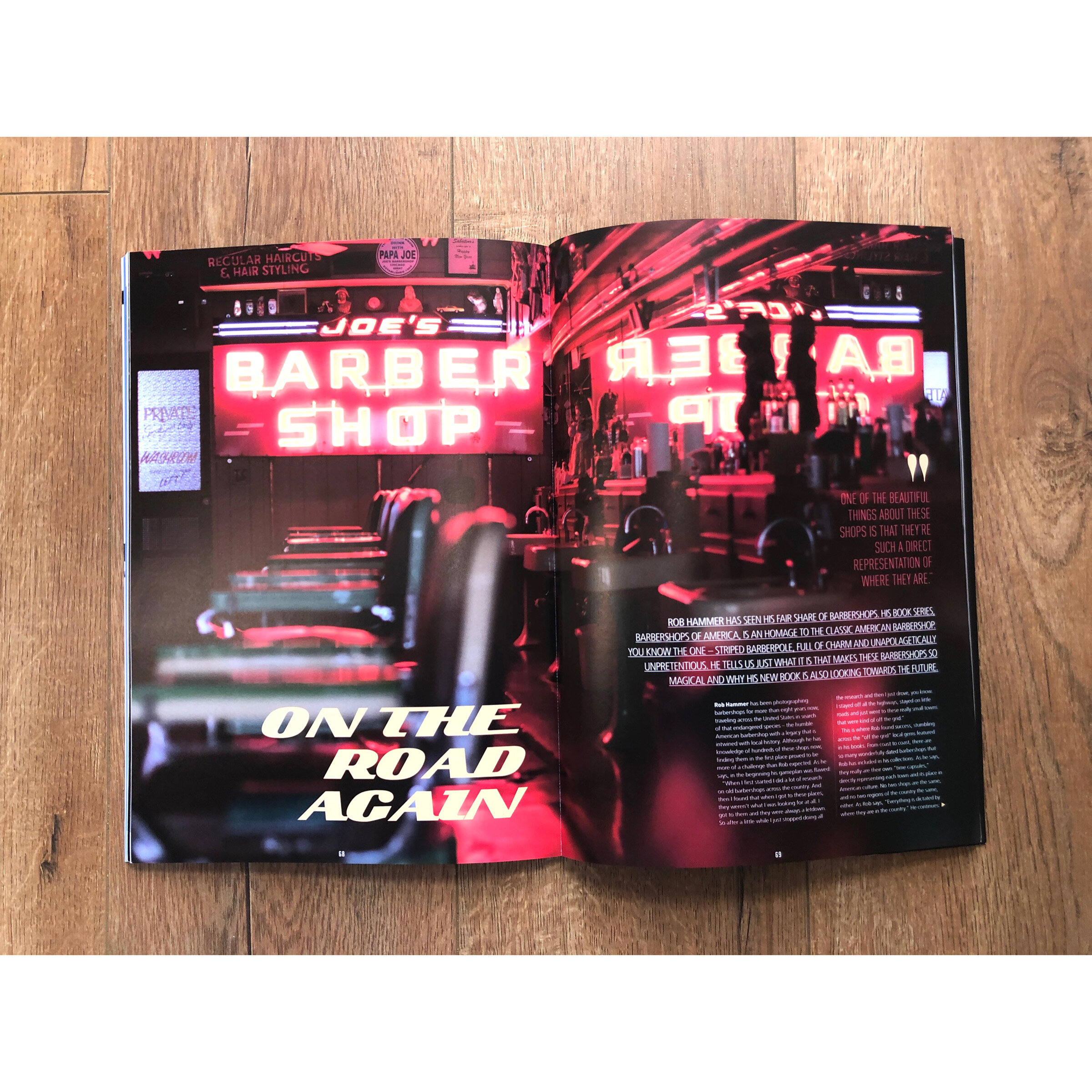
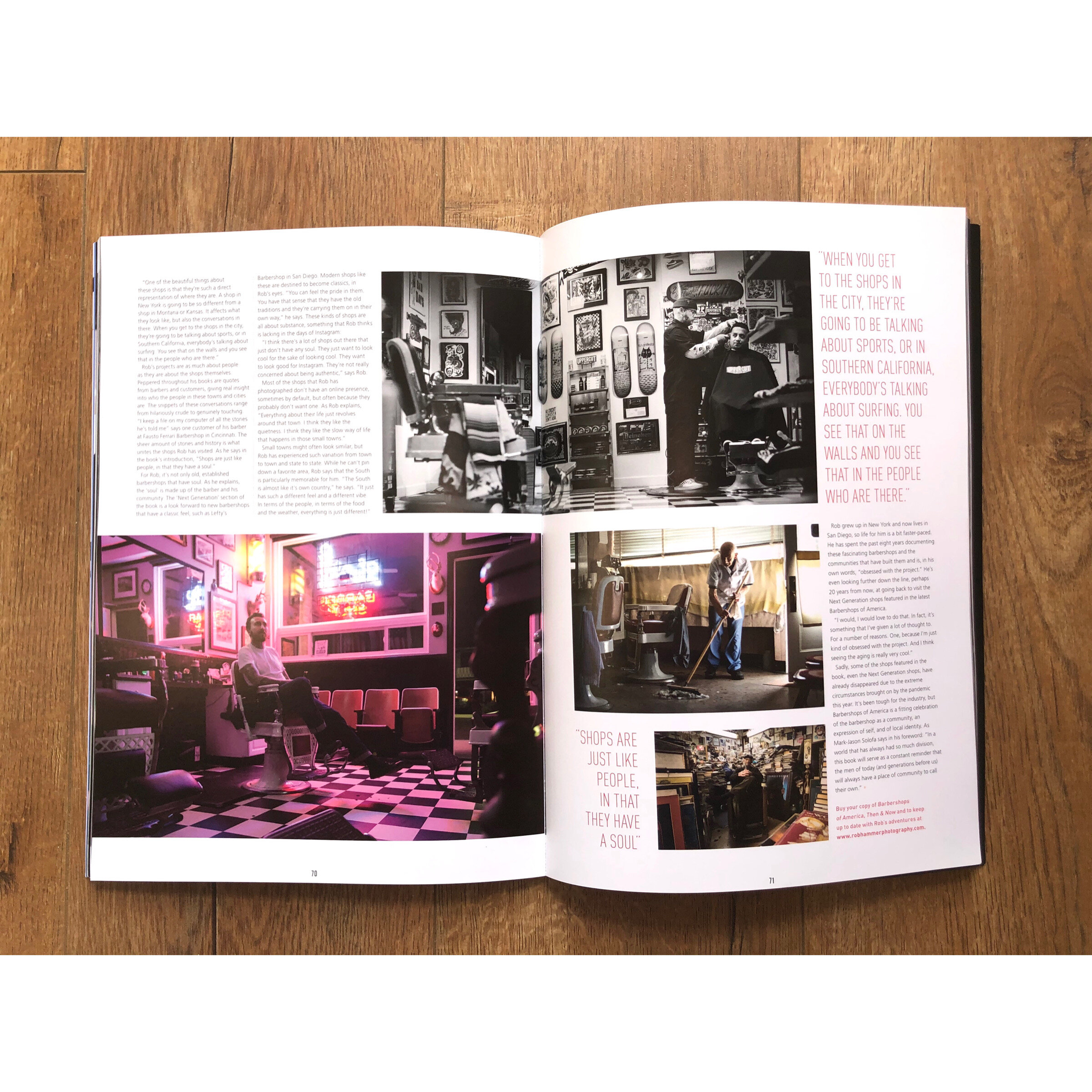
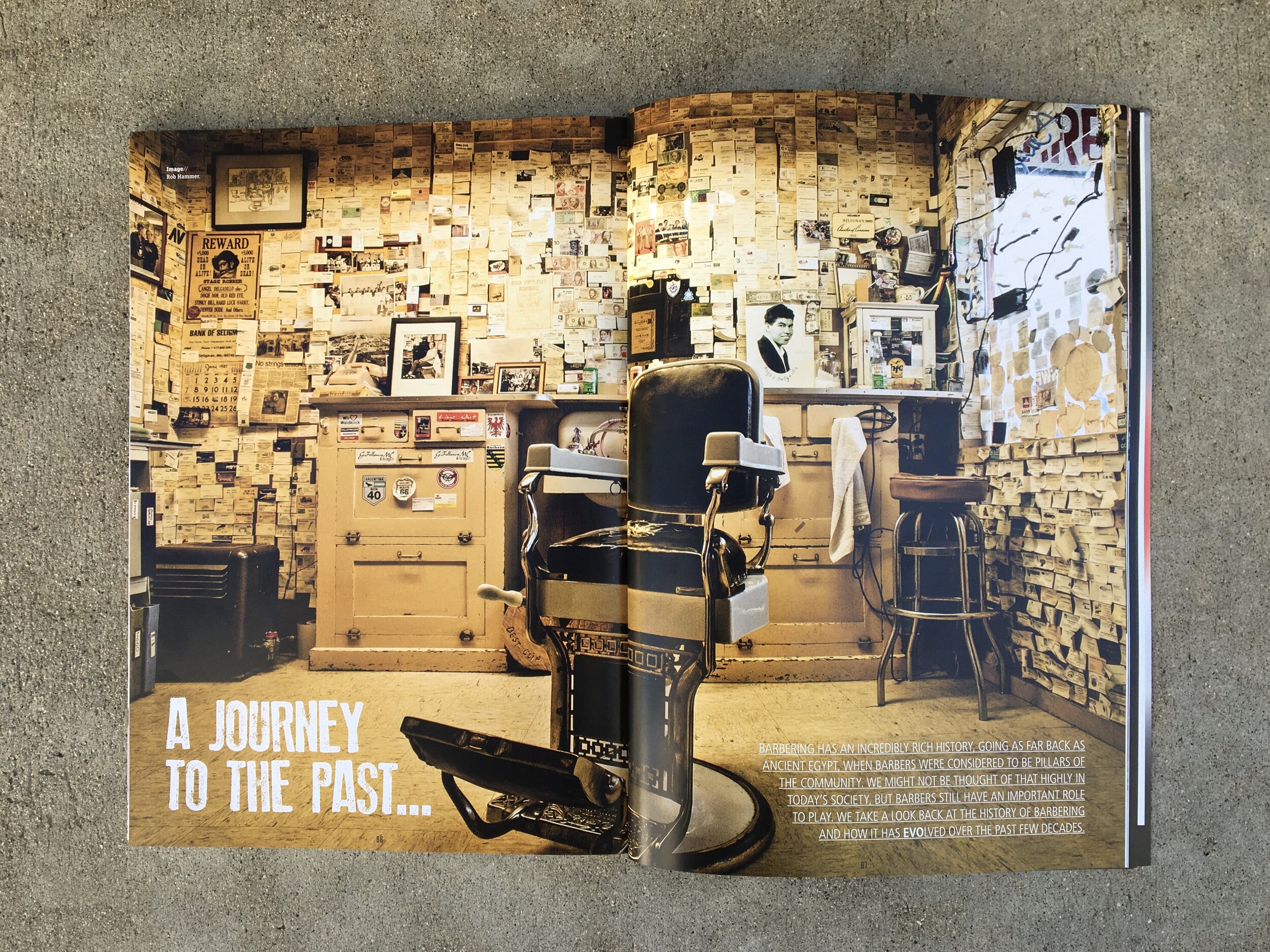
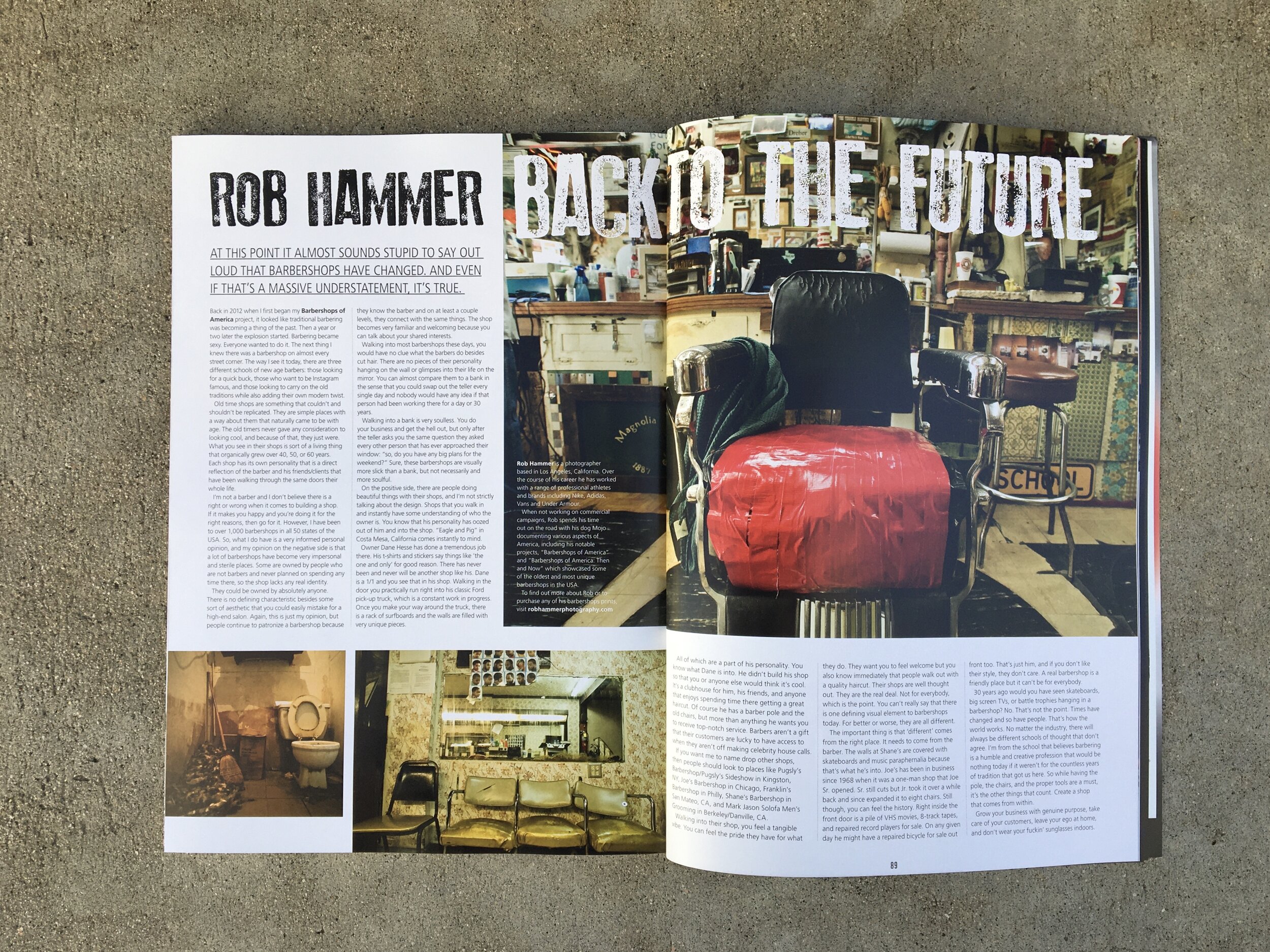
A while ago I was asked to write a piece in Barber Evo Magazine sharing my thoughts on how the barber industry has changed. It was an obvious “yes” as it’s something I’m very passionate about and happy to share. Here is the magazine spread as well as what I had to say. Unfortunately the book is out of print, but you can still buy prints from the series.

Click here to check out the book.


At this point it almost sounds stupid to say out loud that barbershops have changed. And even if that’s a massive understatement, it’s true. Back in 2012 when I first began my “Barbershops of America” project, it looked like traditional barbering was becoming a thing of the past. Then a year or two later the explosion started. Barbering became sexy. Everyone wanted to do it. And the next thing I knew there was a barbershop on almost every street corner. The way I see it today, there are 3 different schools of new age barbers: those looking for a quick buck, those who want to be Instagram famous, and those looking to carry on the old traditions while also adding their own modern twist. Old time shops are something that couldn’t and shouldn’t be replicated. They are simple places with a way about them that naturally came to be with age. The old timers never gave any consideration to looking cool, and because of that, they just were. What you see in their shops is sort of a living thing that organically grew over 40, 50, or 60 years. Each shop has it’s own personality that’s a direct reflection of the barber and his friends/clients that have been walking through the same doors their whole life. 

I’m not a barber and I don’t believe there is a right or wrong when it comes to building a shop. If it makes you happy and you’re doing it for the right reasons, then go for it. However, I have been to over 1,000 barbershops in all 50 states of the USA.  So what I do have is a very informed personal opinion. And my opinion on the negative side is that a lot of barbershops have become very impersonal and sterile places. Some are owned by people who are not barbers and never planned on spending any time there, so the shop lacks any real identity. They could be owned by absolutely anyone. There is no defining characteristic besides some sort of aesthetic that you could easily mistake for a high end salon. Again, this is just my opinion, but people continue to patronize a barbershop because they know the barber and on at least a couple levels, they connect with the same things. The shop becomes very familiar and welcoming because you can talk about your shared interests. Walking into most barbershops these days, you would have no clue what the barbers do besides cut hair. There are no pieces of their personality hanging on the wall or glimpses into their life on the mirror. You can almost compare them to a bank in the sense that you could swap out the teller every single day and nobody would have any idea if that person had been working there for a day or 30 years. Walking into a bank is very soulless. You do your business and get the hell out, but only after the teller asks you the same question they asked every other person that has ever approached their window - “so, do you have any big plans for the weekend?” Sure, these barbershops are visually more slick than a bank, but not necessarily and more soulful.

On the positive side, there are people doing beautiful things with their shops. And I’m not strictly talking about the design. Shops that you walk in and instantly have some understanding of who the owner is.You know that his personality has oozed out of him and into the shop. “Eagle and Pig” in Costa Mesa, California comes instantly to mind. Owner Dane Hesse has done a tremendous job there. His t-shirts and stickers say things like “the one and only” for good reason. There has never been and never will be another shop like his. Dane is a 1/1 and you see that in his shop. Walking in the door you practically run right into his classic Ford pick-up truck, which is a constant work in progress. Once you make your way around the truck there is a rack of surfboards and the walls are filled with very unique pieces. All of which are a part of his personality. You know what Dane is into. He is a really smart guy, but he didn't build his shop so that you or anyone else would think it’s cool. It’s almost a clubhouse for him, his friends, and anyone else that enjoys spending time there while getting a great haircut. Of course he has a barber pole and the old chairs, but more than anything he wants you to receive top notch service. That’s tradition. Great service. Barbers aren’t a gift that their customers are lucky to have access to when they aren’t off making celebrity house calls. 

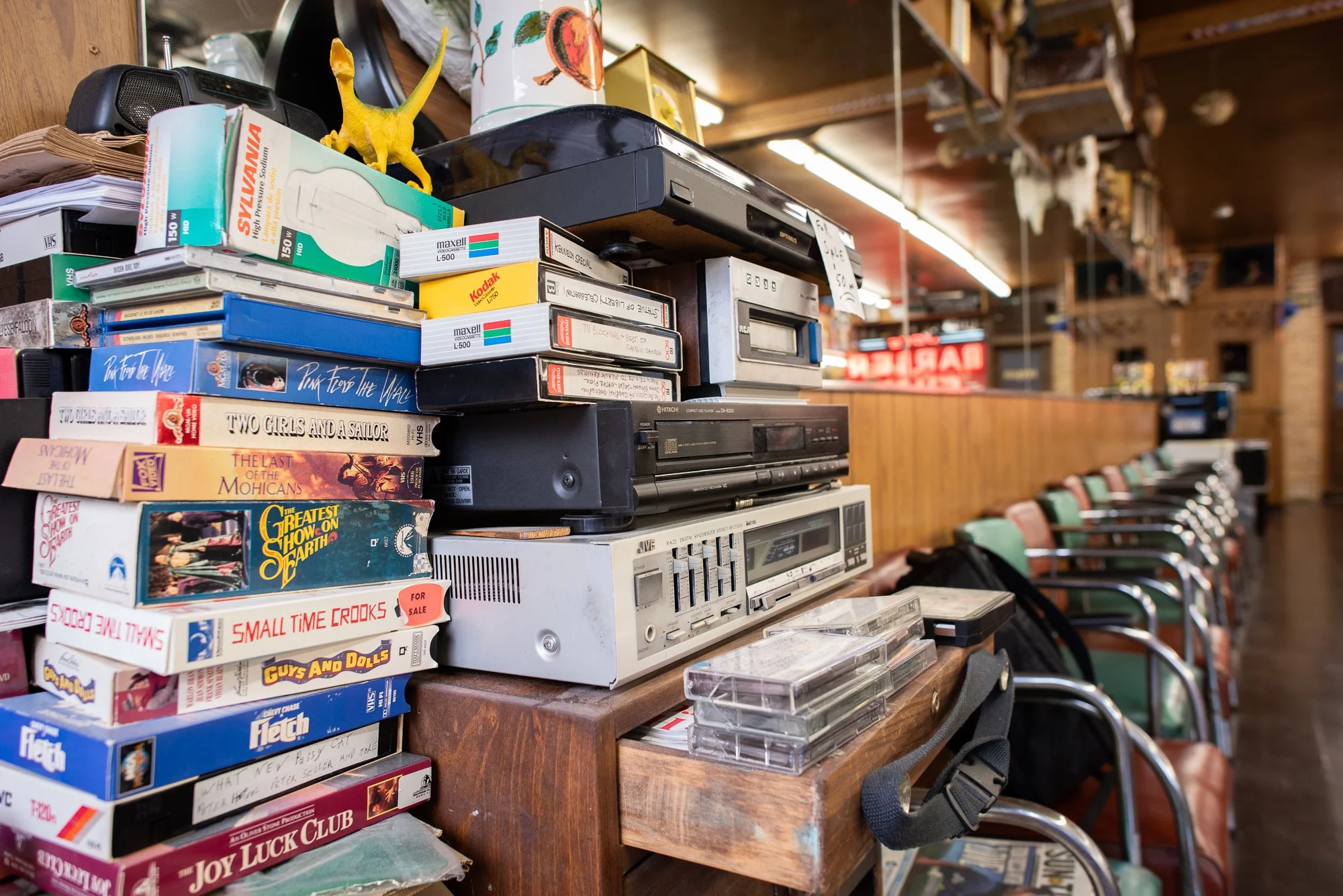
If you want me to name drop other shops, then people should look to places like Pugsly’s Barbershop / Pugsly’s Sideshow in Kingston, NY, Joe’s Barbershop in Chicago, Franklin’s Barbershop in Philly, Shane’s Barbershop in San Mateo, CA, and Mark Jason Solofa Men’s Grooming in Berkeley/Danville, CA. These are guys that get tradition and service. Crossing over from the street into their shop, you feel a tangible vibe. You can also feel the pride they have for what they do. They want you to feel welcome but you also know immediately that people walk out with a quality haircut. Their shops are well thought out. Curated but not overdone. They are the real deal. Not for everybody, which is the point. You can’t really say that there is one defining visual element to barbershops today. Because for better or worse, they are all different. The important thing is that “different” comes from the right place. It needs to come from the barber. The walls at Shane’s are covered with skateboards and music paraphernalia  because that’s where he came from and that’s what he’s into. Joe’s has been in business since 1968 when it was a one man shop that Joe Sr. opened. Sr. still cuts but Jr. took it over a while back and since expanded it to 8 chairs. Still though, you can feel the history. Right inside the front door is a pile of vhs movies, 8-track tapes, and repaired record players that Sr. has for sale. On any given day he might have a repaired bicycle for sale out front too. That’s just him. Not in a mean way, but if you don’t like their style, they don’t care. A real barbershop is a friendly place but it can’t be for everybody like the shitty sports bar that has the pennant of every NFL team hanging in the ceiling.

30 years ago would you have seen skateboards, big screen tv’s, or battle trophies hanging in a barbershop? No. That’s not the point. Times have changed and so have people. That’s how the world works. And no matter the industry, there will always be different schools of thought that don’t agree. I’m from the school that believes barbering is a humble and creative profession that would be nothing today if it weren’t for the countless years of tradition that got us here. So while having the pole, the chairs, and the proper tools are a must, it’s the other things that count. Create a shop that comes from within. Grow your business with a genuine purpose, take care of your customers, leave your ego at home, and don’t wear your fuckin’ sunglasses indoors.

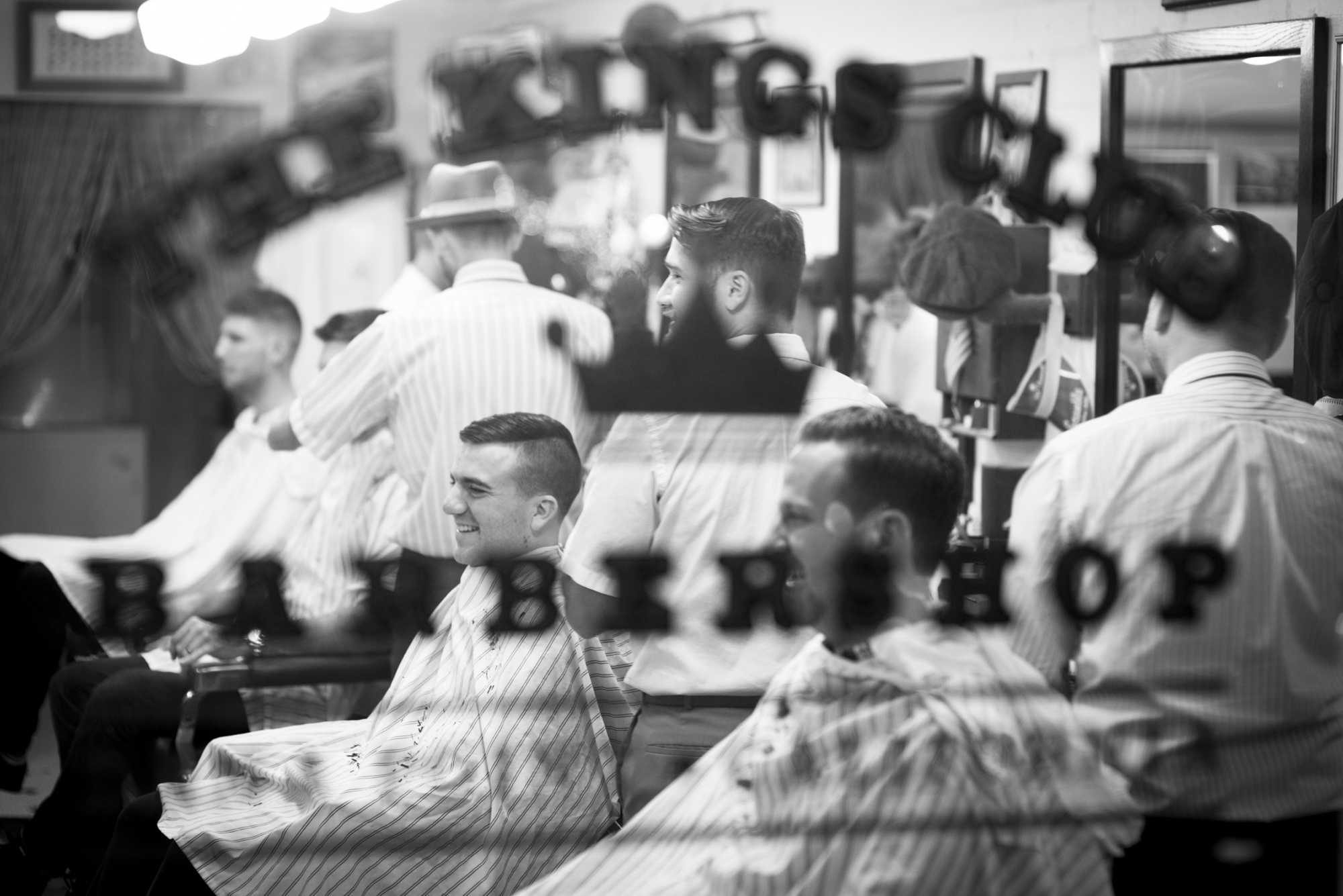
Kings Club Barbershop - Dana Point, California

Best Barbershop in Dana Point, California

Americana - Barbershop Photography

It’s been so long since I sat down with the guys at Kings Club Barbershop to record this thing that I don’t really remember much of what we talked about. I do recall that it was a great time, but it was also completely unfiltered, so you might wanna skip it if you’re offended easily. Either way, they are a great group of guys (and barbers) that you should hit up if you’re in the Dana Point area and need a cut. Beautiful shop too. I’ve known them since way back when I first started shooting for this project in 2012-ish and they’ve been in both books. The shop has been through a lot since then, including a fire that completely destroyed the place, so it was cool to catch up with them to talk about everything that has happened since we first met.

Click here to check out “Barbershops of America”

Click here to check out PRINTS from the book.

Pugsly's SideShow Barbershop

Best barbershop in Upstate New York

Pugsly’s Barbershop - Kingston, NY

Way back in 2012-ish I met the Nefarious Dr. Pugsly at his original shop in Kingston, NY. No remembrance of how we came in contact or how I ended up at his shop, but glad I did. He’s an interesting cat and his place was the first of the “next generation” shops I came across where you could feel an immense amount of pride and a very high bar for service. His cuts are next level and it’s obvious that he wants his shop to reflect that. Since our first meeting, a lot has happened with him, including a second “sideshow” shop (featured below) not far from the original. During the final push for the last book I of course wanted to include his new shop, but the only time I had to photograph it on my trip cross country was Christmas Eve. He graciously took time out of his schedule to open up and even more graciously gave me a beard trim. Thank you, Dr. !

Give him a follow on IG @pugsly_dude or check out his website www.pugslysbarbershop.com

Click here to read the last Q&A with Joe from Joe’s Barbershop in Chicago.

Click here to check out the book


“This is a trade. It’s not a fashion show, it’s not politics”

PugslysSideshowBarbershop-9264.jpg

1) Where are you from and what did you do before barbering?

So, I'm born and raised here in Kingston. I had the opportunity to spend some pretty personal time with most of our country traveling and playing music really early on. As far as formal work, I made most of my living around cars. I worked in a pretty standard repair shop for a while. Learned a lot. Basic car knowledge. Eventually found my way into car audio and custom installs. There, the crew had pretty free run of the shop. We all built a ton of rad stuff there! Lastly i found myself in a local Kustom shop. I'll always be grateful for that opportunity, the friends and lessons I took from that time. I fell in love with metal flake, fancy cast parts, and I received the nickname Pugsly. 

What is the meaning behind Pugsly? 

Pugsly was just a nickname I picked up in a small circle that spread a bit, for a min there. Sounded fun for a shop name... kind of low browy? Either way, that's why Pugsly!

What did you take from building cars that carried on to being a barber? 

Man, I worked in a garage with a group of my best dudes for years where we did audio by day and by night we had full range. We built some crazy stuff in that place! But we had some pretty gnarly work ethic.  You've never seen more organized boxes and work areas. We got really, really involved in our install work. I think I learned a standard there that I took with me.

2) You have 2 beautiful shops that I would say are on a different level from most. Can you talk about your process of putting them together? How does it start and how far are they from the original idea/concept? 

I built my first shop in last few months of 2007. At that time I was watching only a few different shops from the side lines. A couple of which were Lefty's, obviously out of San Diego via MySpace, and Robs Chop Shop out of Dallas who I had met and known personally through the car community. I was just trying to set up a very traditional, walk-in,  gentleman's  style environment. What I felt to be a 1940's style barbershop visually but my main focus was the product. Both the cut and experience riding the same level of importance. I pretty quickly established as diverse of a clientele as I had hoped. As time progressed minor, natural adjustment took place but for the most part Pugslys remains what it set out to be. 

The main problem I found with the original business model was the wait time. I was noticing negative trends concerning client retention. That sparked the idea for shop number two. Pugsly's SideShow was the solution. A small "SideShow" of a location that would except appointments only. With a little bit of a tongue in cheek approach in coordination with the name, the decor took a little bit more of a funky approach. It might be a little bit more representative of me personally.  The only thing I've seen changing and fairly rapidly with business model number 2 is the fact that SideShow started as a "small offshoot" but is quickly growing to the size of the original shop with the popularity of the more modern appointment set up. To be considered moving forward for sure.

PugslysSideshowBarbershop-9253.jpg

You seem like a fairly obsessive person? And I don't mean that in a bad way at all. Quite positive actually. Can you talk about how that translates into your shops and your cuts? 

So thanks? No, I think that's fair and I think that it helps with consistency and some organization within the shops. As far as the cuts and work ethic, I think our crew shares the same thing that the boys from Burts garage did. We feed off of each other. Push each other's standards a little. So it's good. I know we all get pretty nerdy about our haircuts sometimes.

3) Are there any specific factors that you can pinpoint which have lead to your success as a barber? 

I try to be cool to the people that make it possible to pay my bills. I'm hyper focused on giving the best product that I can start to finish. I feel very fortunate to be wired in a manor that I take pride in what I do. I think you have to really believe in what your doing if other people are going to believe what your doing. 

4) You have a great reputation for giving beautiful haircuts, but live in what a lot of people would consider a "small market". Kingston isn't in NYC, but it's also not really upstate. Can you talk about your decision to stay in Kingston as opposed to moving to NYC or LA or any other big market? 

I just wanted to open a barbershop. Every town needs one and my town NEEDED one. The little Hudson valley city that I grew up in was still moving pretty good when I was a kid and until the boom we've experienced in the past decade, I'm not sure how much I noticed the down time we went through. I've benefited from it, established a clientele I couldn't have predicted, but I guess I was just doing what I knew at the time.

 Would you ever consider leaving Kingston? 

Absolutely... We considerate it all the time. Just not sure what really gets better then this at the moment.  We got family, a cool crib, good people, the Hudson valley itself is just a rad place... it's hard to justify a move, right now anyway.

5) What kind of things do you see barbers today doing wrong? 

This is a trade. It's not a fashion show, it's not politics.

PugslysSideshowBarbershop-9593.jpg

6) What do you do outside of the shop? Hobbies? Obsessions? 

I'm a husband and a proud father. I love cars and motorbikes. I really like paint. I play music. Vacation state of mind.

7) Where do you see yourself in 5/10/25 years? 

Cutting hair. I couldn't have imagined almost 11 years ago that I'd have the support or clientele, established the relationships, or the crew that holds this whole project together. No matter where it goes from here I want to be cutting hair. I feel like that means slowing down sometimes. 

PugslysSideshowBarbershop-9262.jpg

8) Thoughts on the IG age of barbering? 

I've made so many friends, pulled so much inspiration, and traveled both domestically and internationally on behalf of my family from Australia, Uppercut Deluxe. All opportunities presented to me through IG. All though, I feel like I've seen some people loose balance a little when it comes to what really makes their world go around. 

9) Can you think of any major screw-up or failures in your life that ended up leading to something great? 

I mean, I guess high school was tough for me. Not that I couldn't do it, I just didn't want to and they didn't keep my interest. But I did invest myself in other things, some real deal collage at one point even, and one of them ended up being barbering. I'm pretty happy about that. 

10) Any barbers/shops out there that you look up to? 

Yeah! A lot of them! I don't even want to rattle off names because I'm afraid to miss someone super important... I have been in so many shops. I've taken so many things, inspirations, ethics, personality, from so many shops... it would be a big list. But my big brother shop is Robs chop Shop in Dallas. That's the guy that popped the bubble, made me think... I should just go to barber school already. 

PugslysSideshowBarbershop-9319.jpg

Joe’s Barbershop - Traditional Barbershop in Chicago

Joe’s Barbershop, Chicago — The Story Behind the Cover of Barbershops of America

When I began photographing barbershops across the United States, I wasn’t looking for perfection — I was looking for places that still felt real. Joe’s Barbershop is one of those places. Tucked into a Chicago neighborhood, Joe’s is the kind of shop where the walls hold decades of conversations and the chair has seen generations pass through it. When it came time to choose the cover photograph for my book Barbershops of America, one from Joe’s felt inevitable. What follows is a conversation with Joe himself — about the shop, the neighborhood, and what it means to keep a traditional barbershop alive in a changing city.

View the book

View the Barbershops of America gallery

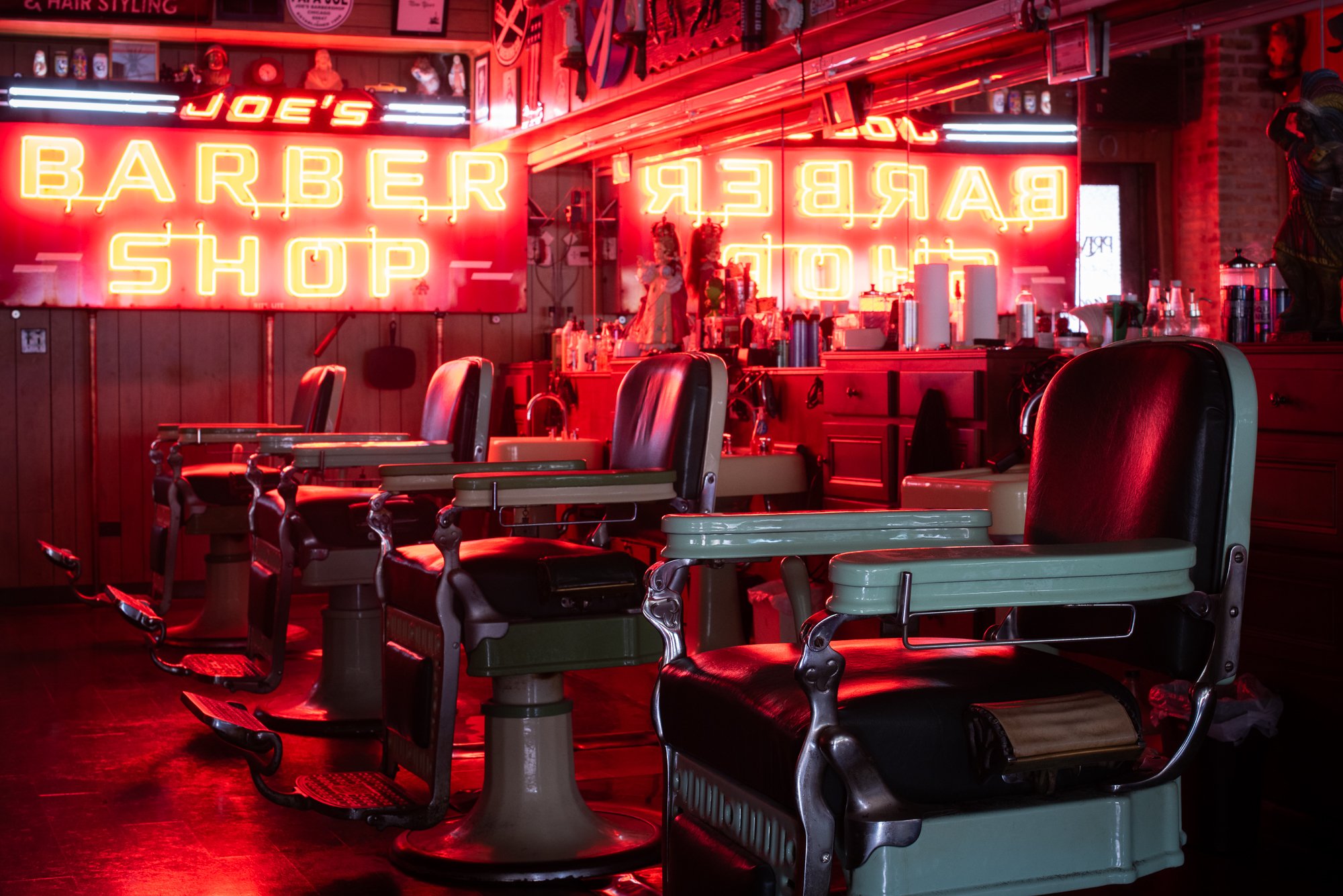
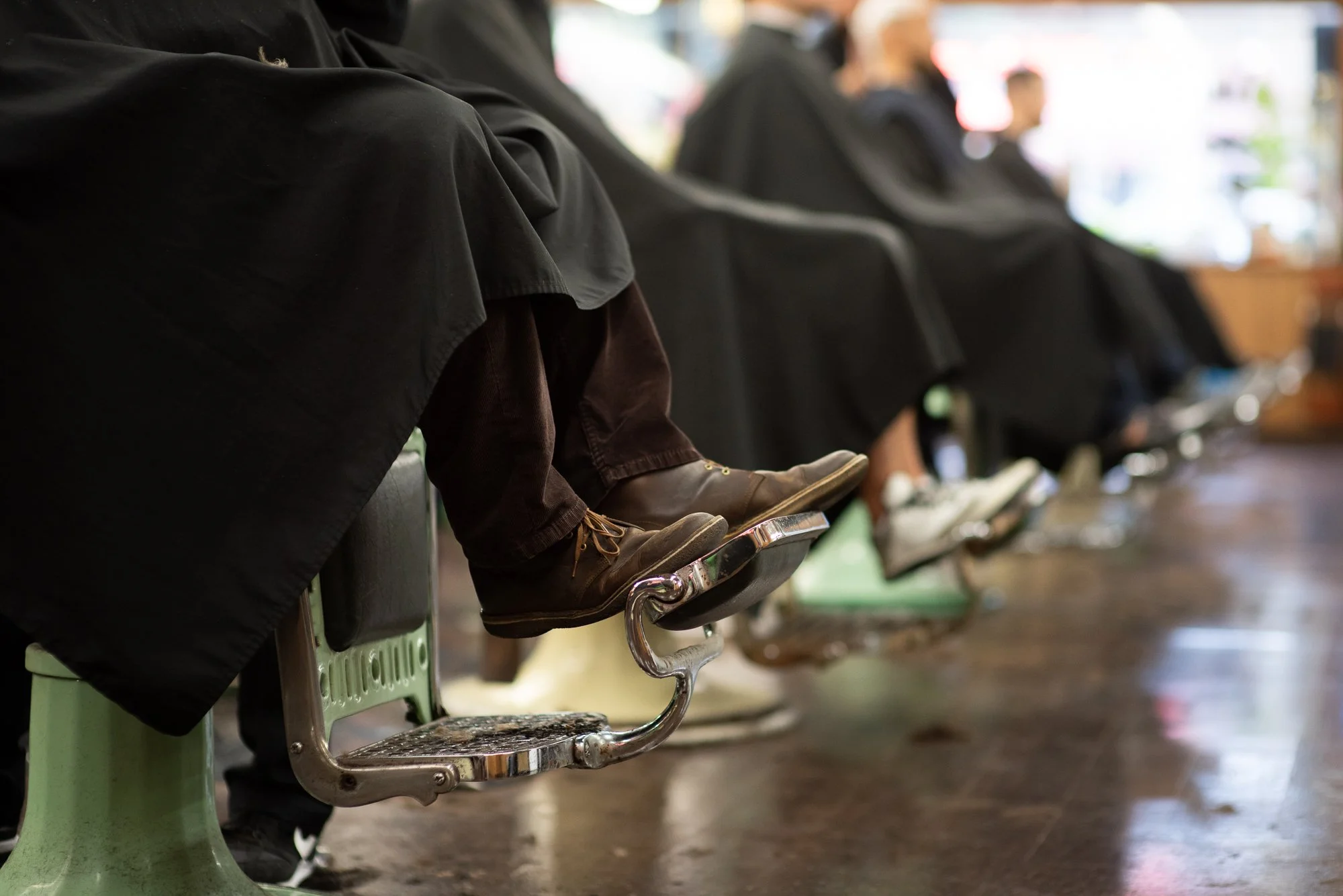
Empty barber chairs lit by the red neon sign inside Joe’s Barbershop in Chicago

Empty barber chairs illuminated by the red neon sign inside Joe’s Barbershop after a long day of haircuts.

A Conversation with Joe of Joe’s Barbershop


1) What did you do before becoming a barber?

I have had my fair share of jobs in my 39 years on this planet. I have done everything from selling 18 Wheelers, to doing contract work for Harley Davidson corporate, to washing cars at a Lexus bodyshop. Most of my "career" could fall into the marketing / advertising world I guess you could say. Not going to college for a piece of paper always got me in the door at the lowest level, and then having to prove to upper management that I wasn't a complete piece of shit I would rapidly move up the ranks. I hate corporate America for the record. 

You sold 18 Wheelers???? How did your random jobs prior to Joe's translate or help what you do now?

Indeed I did. At the ripe age of 23 I handled the largest fleet accounts for a local freightliner dealer pretty much next to O'Hare airport.

It wasn't a bad gig, but it was more a career then a "job" so to speak. You cant just start in a job like that and expect to make any money. The older guys I worked with had been their 10-15-25 years and due to that were making a very nice living. 

My list of random jobs before I started in the barbershop has definitely helped me for sure. I always say I am glad I did have other jobs before starting in the shop with my dad, rather then just going right from high school to the shop. I have had both cool and asshole bosses, had to work holidays, had to miss events and such because I had to work, etc. Plus even today I consider myself a shop barber first, then an owner. I would never expect or want something out of my barbers that I wouldn't want to do myself (if that makes sense). 

2) Your old man started Joe's in 68'. Did he encourage you to follow in his footsteps? 

He didn't. If anything he told me to "stay away" from barbering all together. Just like his father (who was also a barber) told him not to get involved in the trade. All I heard growing up was , "use your head not your body" and " don't deal with the public" but here I am working in the shop. My father started teaching me to cut hair when I was in the 7th or 8th grade. One day an old Paidar barber chair ended up in our small 1 1/2 car garage. I didn't think anything about it because weird shit was always showing up on my pops garage (usually to be sold in the barbershop as back then it was more stolen merchandise trading post then barbershop). But no, that chair was there for a reason ! So for the next year or so every other Sunday before I was allowed to do anything I might have wanted to do I had to give my pops a haircut and a shave. Each time he would change it up on me, as last time I gave him a #3 on the sides with alittle off the top, and now this time he wanted a full cut done with shears left full in the back. Not knowing then what he was doing I thought he was just being difficult (which he still does very well at 72 years old), but now as I'm abit older I realize he was showing me different ways to cut hair. For the next few years I would cut my neighbors hair, friends, relatives over for holidays and such, etc. I bought my first car (a 1985 Toyota Supra) off the money I made doing garage haircuts.

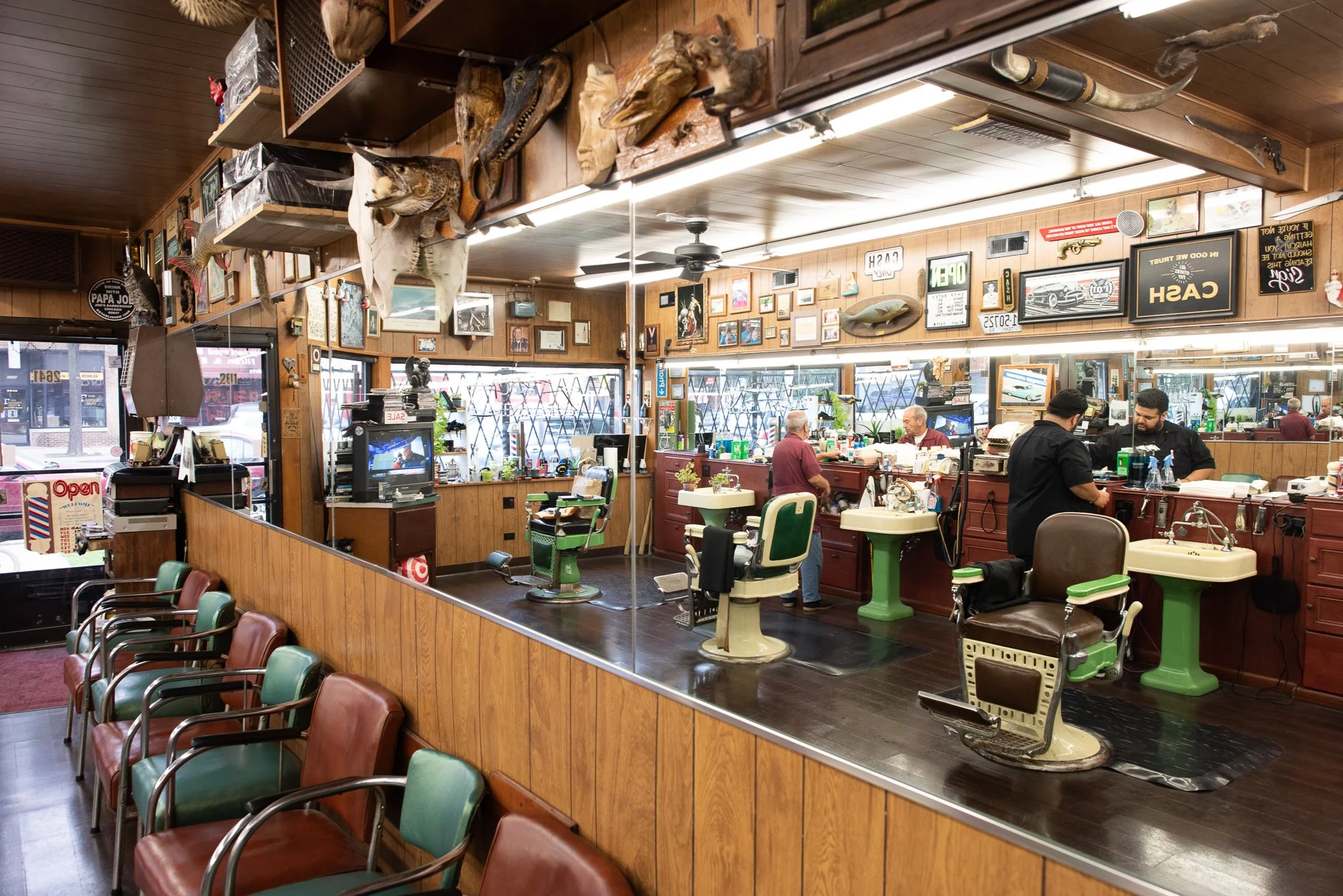
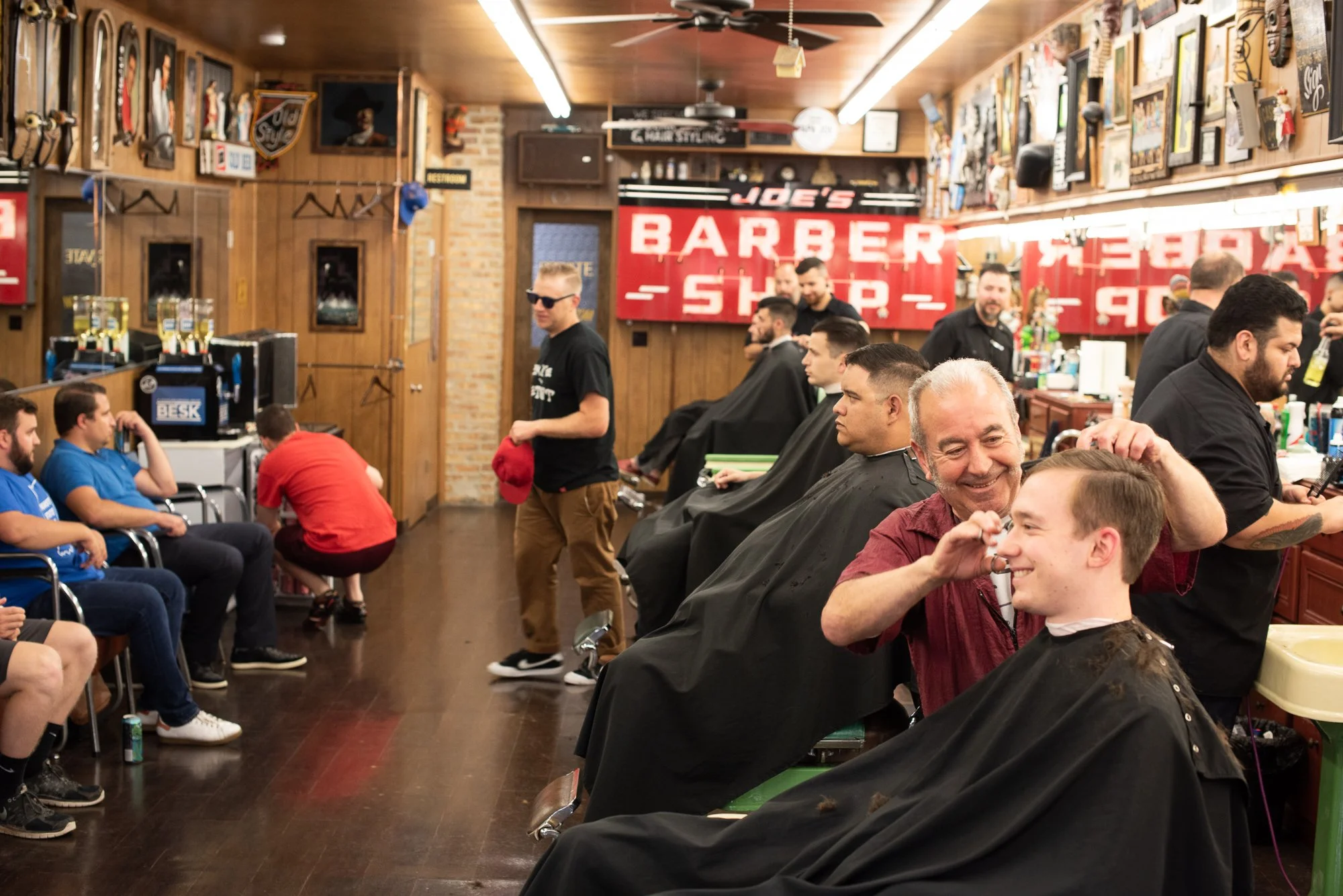
Wide interior view of Joe’s Barbershop in Chicago with barbers working and chairs along the wall

A wide view of Joe’s Barbershop, showing the waiting chairs, workstations, and the layout of the shop as barbers move through the day.

3) What was the transition like when you started there and later convinced him to expand the shop? 

My father didn't want me to get into barbering, let alone work next to him in the then small / 250sq.ft. shop that he had called home / sanctuary away from his family since 1968. So after getting some of his family and my mom to talk to him he agreed. I graduated barber college and started full time @ Joe's in September of 2010 and literally could do nothing right (still cant in his eyes). At that time it was a two chair shop and with abit of effort and using what social media was around then we started to get busier. About 6 months in I started telling him we needed to clean up the shop abit and add a third chair (which we could barely fit). Of course this was answered with a no and a shaking of the little mans head. How could it be a good idea if his son was the one who thought it up? So after a few months of fighting he finally let me add the third chair. After hiring on a third barber it wasn't even a week before that third chair was part of the shop and we could of used a 4th. This was also around the time that our part of Chicago aka Logan Square was going through a change for the better aka "gentrification" if you wanna go down that road, so allot of young dudes were moving into the area around the shop and needing a good haircut. Fast Forward to 2013 and the shop had become a monster. We were winning every sorta social media "award", mentions in national publications, being used for tv and movie shoots, etc. Open 6 days a week with 5 barbers working 3 chairs (in rotation) six days a week averaging a 2 hour wait everyday. We extended our hours and just got busier. We raised our prices and just got busier. Sounds good on paper but was hell working in the shop back in those days. So after another year or so of fighting and bitching with the small man I finally convinced him to let me knock out the back 2 bedroom apartment and expand the barbershop to its current size. The conversation went like this:

“Dad, we need to expand the shop.

No

Dad, we are losing 20-30 customers a day due to them not wanting to wait. We need more barbers and more room. 

No

Dad, Those 20-30 people leaving could be taken care of by the addition of more barbers. We need to expand. 

No

Dad, I worked with some banks and I will pay for the expansion out of my pocket.

OK, Do it..”

So basically when I told him I wasn't needing or asking him to cough up any money to expand the place he was cool with it. Typical old man Italian. So a rough timeline is the shop was opened in 1968. I started in 2010. Added a third chair in 2013. Expanded the shop to its current 1400sq.ft / 7 chair size in 2015. I officially took over ownership of the building and the barbershop in February of 2015. 

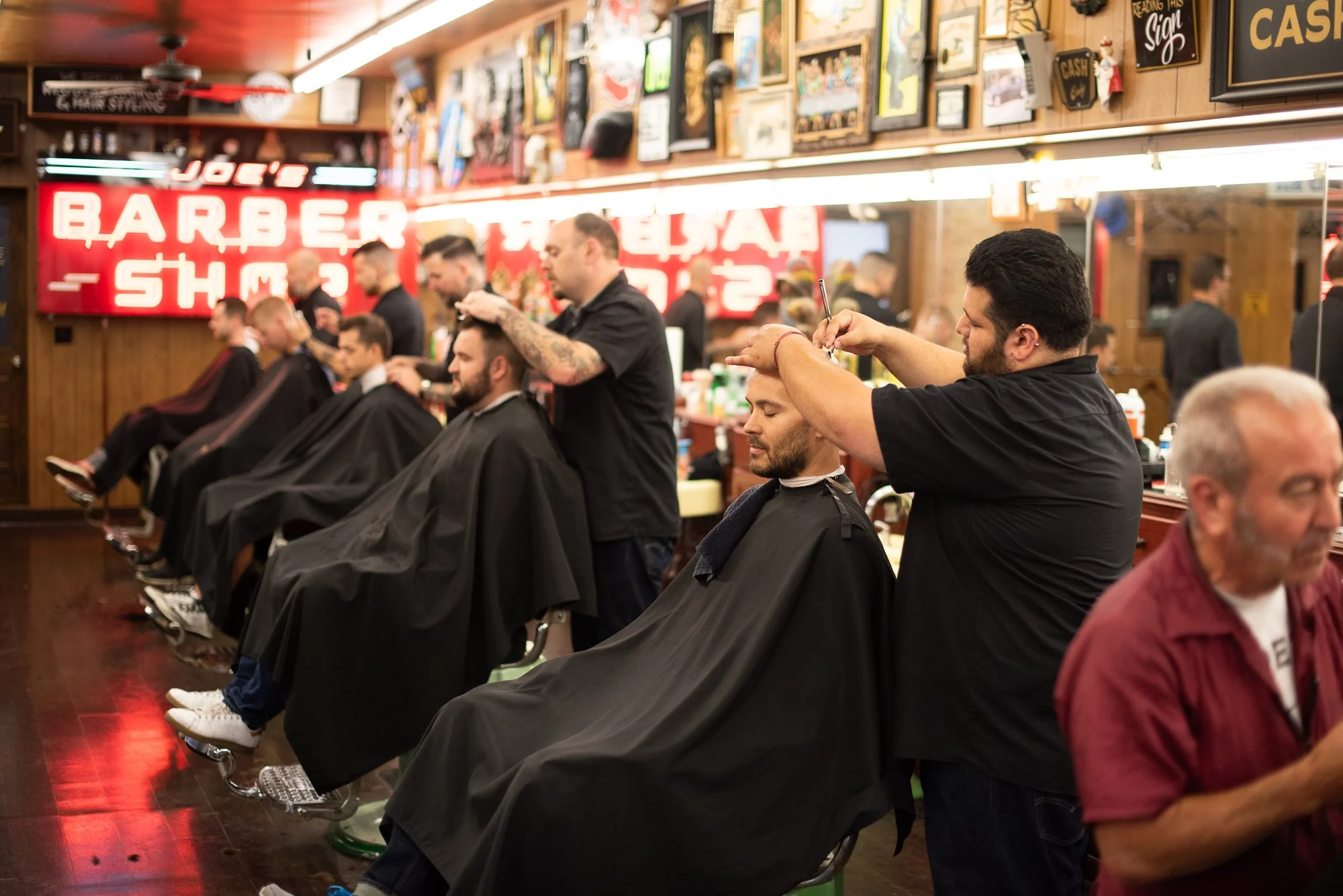
Barbers cutting hair along the mirror wall at Joe’s Barbershop in Chicago

Barbers working along the mirror wall at Joe’s Barbershop, where most days follow a steady rhythm of haircuts and conversation.

4) You're both characters and seem like pretty hard headed guys. Describe your relationship in the shop. How has it changed over the years?

This is a easy one. My father and I have NEVER got along. Not when I was little. Not when I was just starting off in the shop. Not as I write this. Not sure if its because we are too much alike? Are both super hard headed? Who knows. It is literally his way or nothing when it comes to me, and just me. He is not that way with his customers. He is not that way with my older sister. It is literally his attitude towards me and only me. Flash back to 2013 when the shop was insanely busy and I remember him and I got into it on a Friday night after the shop had just closed. I remember sitting him down in his chair and me sitting across from him and saying and I quote, "Dad, I can not work with you anymore. So, you are either going to retire, we are going to expand this shop so I can get alittle bit of distance between you and I, or I am going to drown you in the toilet by your size 6 feet." The expansion started to gain steam about a week after that. Fast forward to present day and my 72 year old father is still working four 10-12 hour days a week and is more feisty and up my ass then ever before. Him still working is really why I have the schedule I have . Working just 4 days a week in the shop and only working 2 days with him. Two too many...

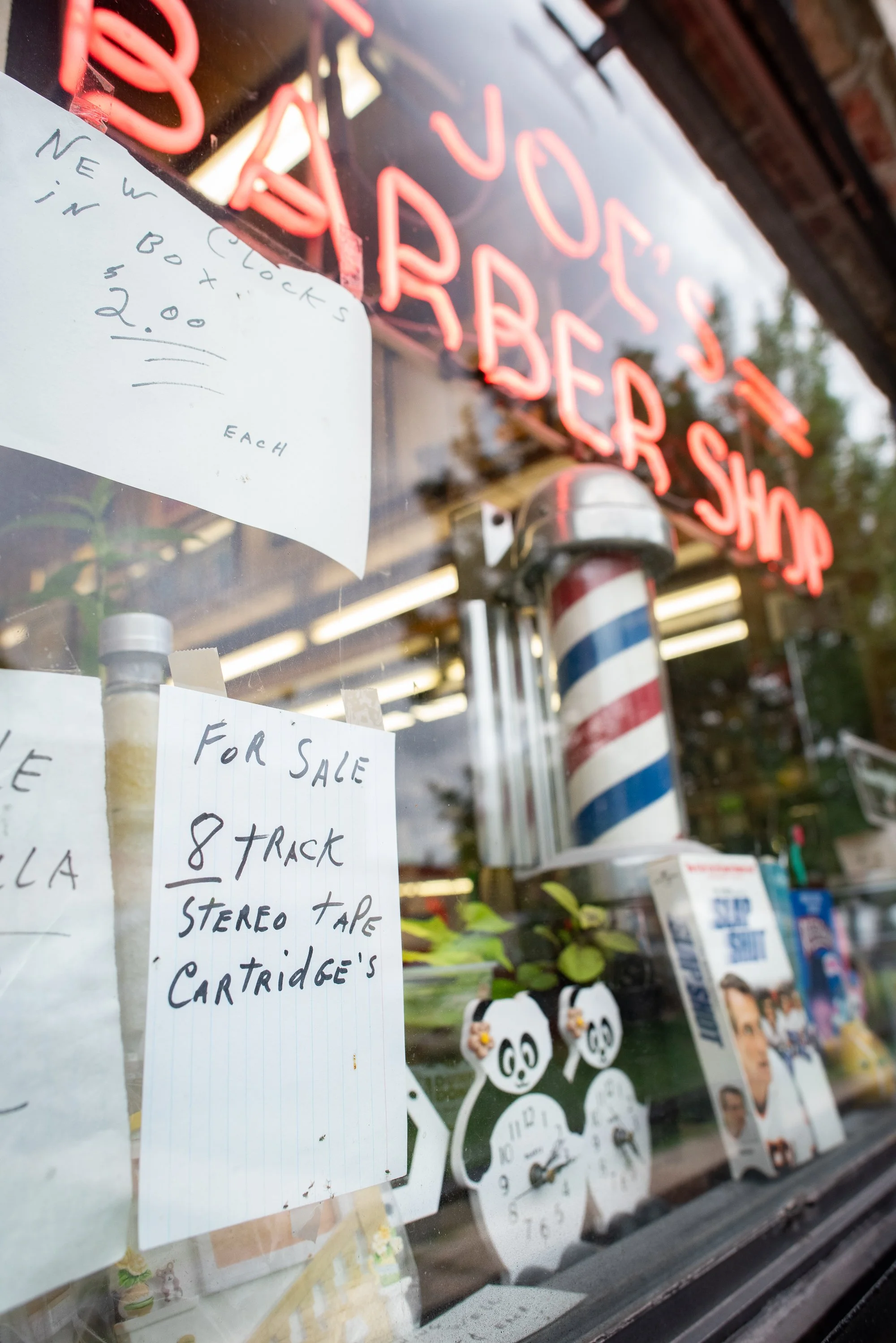
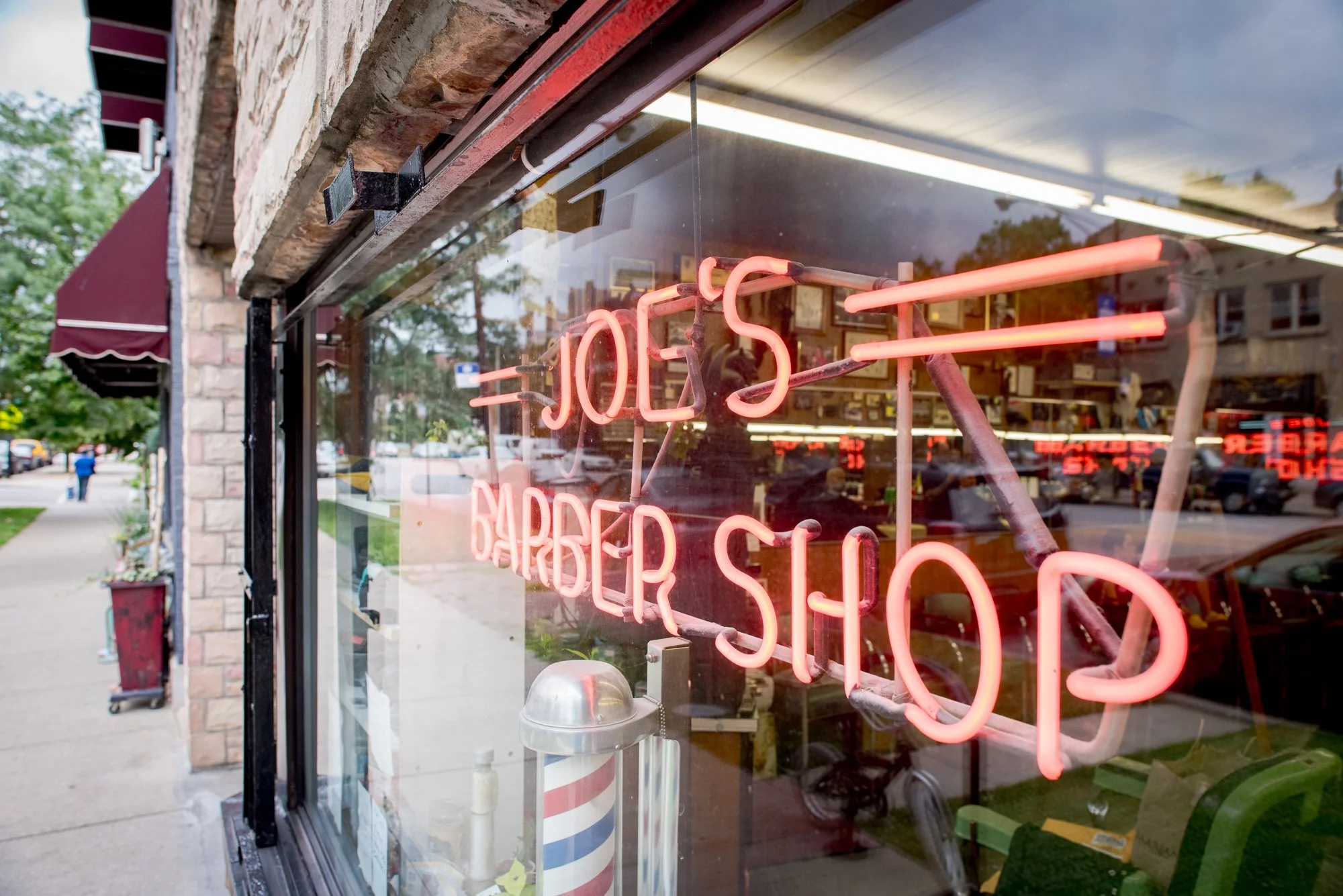
Barber pole and handwritten signs in the window of Joe’s Barbershop in Chicago

Handwritten signs and a classic barber pole in the front window of Joe’s Barbershop.

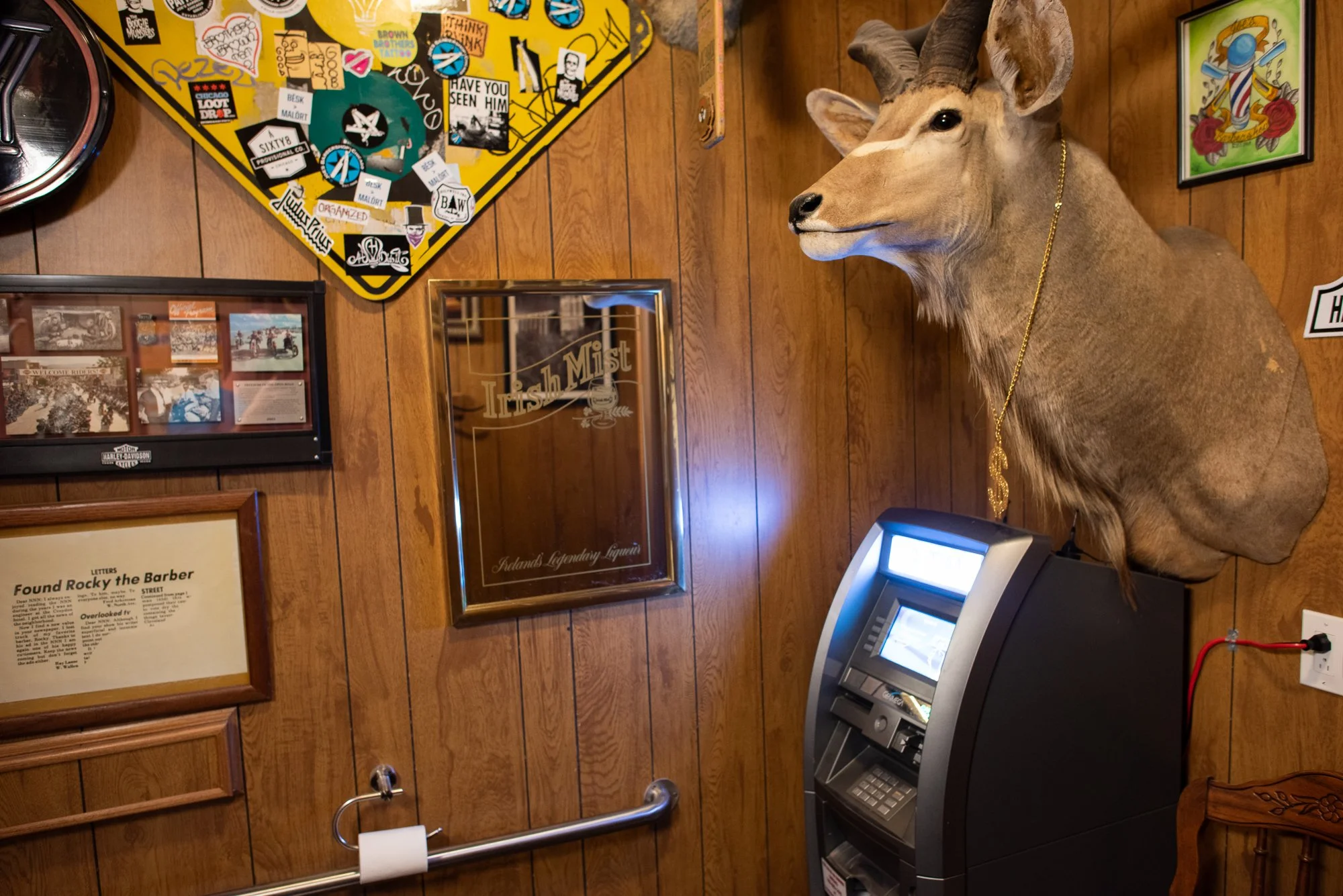
Stack of VHS tapes and old electronics inside Joe’s Barbershop in Chicago

VHS tapes, cassette decks, and old electronics stacked along the counter at Joe’s Barbershop in Chicago.

How does your old man feel about where the shop is today? 

My father is the definition of " old school". He doesn't show emotion, and is definitely not going to give me any sort of praise for what I have done to / for the shop. It's just how he is so it really doesn't bother me. I have seen him be that way since I can remember. The proof is in the business the shop is doing, the amount of haircuts we complete every day, the amount of repeat business we have, and so on. That's how I measure success, not Instagram followers or how many t-shirts the shop sells. Hell, I give more shirts away then I sell. I am not one to hype myself up online, post pictures of haircuts, pictures of famous shop customers, or any of that crap you cant help but see online. The shop itself and what it is/has become is all the "creditation" I myself need. A smooth running shop with good barbers and good customers is all I can ask for, and I bust my ass to maintain that. 

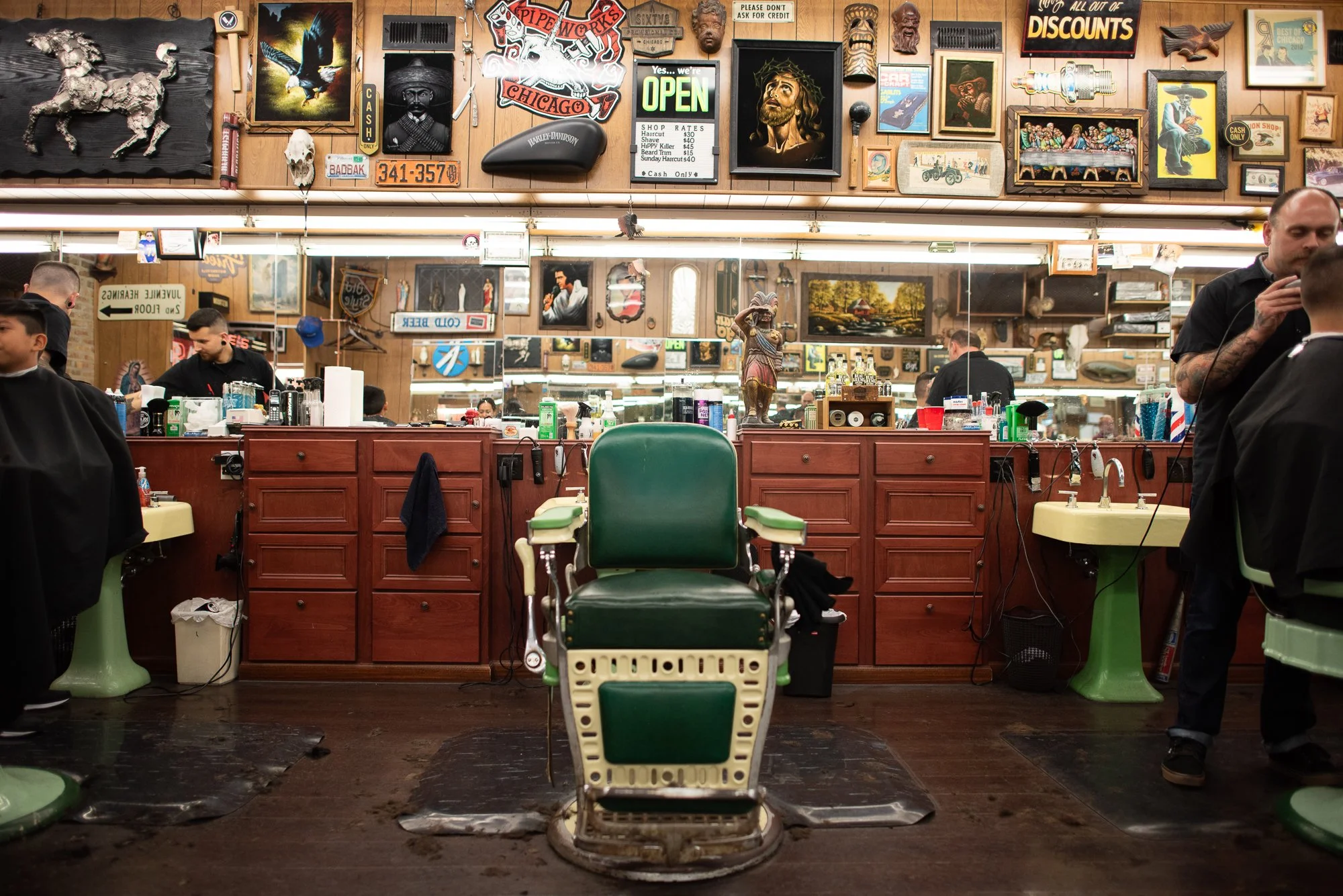
Vintage barber chair centered inside Joe’s Barbershop in Chicago

An empty barber chair centered in the shop before the next customer sits down.

5) Joe's is as I see it, a Chicago institution….

Tough question. I see it kinda in two ways. 1. Yes, 50 years, family business, son taking over from his father and expanding/growing business, etc.

2. No, Its a barbershop that has stuck around because the owner may or may not have been to stubborn to close it down / move it when the neighborhood turned into a ghetto in the late 90's. By just plain luck the neighborhood that the shop is in now is "booming". Barbering is stronger now then ever before. So, I am always torn when thinking of the shop as a "institution", guess it just depends on who I talk to. I can tell you one thing, barbers as of late could care less if the shop they work in has been around for 50 years or 5. As long as their Instagram accounts are popping and they are making $$$. The days of opening up a shop with say 2 dudes and having that crew around for the duration of the shop is long gone. So to answer the question Yes, Joe's is something special. And, no matter who does or doesn't work in the shop the shop itself will continue to carry on through the years.  

Customer getting a haircut at Joe’s Barbershop in Chicago

Joe Jr. giving a customer a haircut under the glow of the shop lights at Joe’s Barbershop in Chicago.

6) How do you manage a shop of 7 barbers? What do you expect out of them? 

Out of all the jobs / tasks I have had in my life up to this point the managing of people / being a boss has been the hardest. I work in my shop alongside my barbers so I try and make the shop / environment a place where I myself would want to work (as I do work there). From the expansion and more room to what's on the walls to the music being played to how well the shop is cleaned (which I do myself). Do I hang out with my barbers outside of work ? Do I not because I don't want to be seen as their "friend" but as their " boss" ? Do I play the roll of " cool boss" and let everything I don't like slide ? Do I play the roll of "stern boss" and sit down with them once a week and tell them what they are doing wrong ? Either way or direction has its good and bad sides to it. I have lost barbers due to things out my control, like how my father acts. I have lost barbers due to the shop down the street offering them 5% more per cut. I have lost barbers due to my "attitude" which is really just how I am. I have lost barbers who wanted to work in an appointment shop because that's what the cool Insta-Babers are doing now a days. So I really cant win. I have paid certain barbers more thinking they would stay working in the shop and they left. I have given certain barbers more leeway in coming in late / leaving early to try and keep them around and they have left. So now my approach is kinda the straight and to the point kinda thing. 1. This is the shop and this is how it's ran. 2. This is what your going to get paid per haircut and that's not going to change. 3. You have a job here for life if you want it. 4. If I happen to have a issue with your performance in the barbershop YOU will be the first to know. I would say that this method has been going well but I lost a barber about 3 months ago and will prob loose another by summer (have a gut feeling which I am usually not wrong about).So, if that does happen we do what we always do, keep chugging on. Everything in the shop has always evened out in the end.  

Row of vintage barber chairs at Joe’s Barbershop in Chicago

A row of well-worn barber chairs inside Joe’s Barbershop, each one with years of daily use behind it.

7) Joe's is everything I love about a barbershop. There is a lot of comedy and you want people to have fun, but you also don't want any bullshit fuckery. Talk about that. 

I do run the barbershop with a heavy hand, and I am well aware that some people don't "get" it and take it the wrong way. As I am an asshole or think I am the shit or whatever. I even made a website called " the dirty" a few years back (its still up there - just do a google search of my name) where an old customer of mine (yes I know who he is) posted a pic and article of me slamming me for being a "tough guy" with a crappy beard. Do I care that he did that ? No, and kinda take it with a smile that I got under his skin that bad for him to take his time and write that. Same as I feel about YELP reviews that say things like the haircut was great and the shop is cool but I was told to hang up my jacket and wont go back, 1 star. Atleast the haircut came out ok is what I think to myself when reading those kinda things. As said before I try and run the shop as I would want it to be as if it was a place I went to get my haircut. I don't want to see a bunch of peoples jackets thrown on the waiting chairs when we have a perfectly good coat rack. It looks sloppy and takes up chairs for waiting customers. I harp on my barbers to tell their customers to hang up their jackets but sometimes they just don't do it. People talking on their phones, people with the legs stretched out so people have to walk over them, guys wearing sunglasses inside the shop, people who waste beers, people who think the floor is a good spot to put their full cup of coffee, Men in flip flops complaining about that hair got on their feet, men in flip flops in general, etc. All things that drive me up a wall and you better bet people are going to hear about in my shop with my name in neon on it !

Straight razor shave in progress at Joe’s Barbershop in Chicago

A straight razor shave in progress at Joe’s Barbershop, a service that has remained unchanged for decades.

My first time in the shop I was wearing flip-flops and took some shit for it. I’ll definitely be leaving a bad Yelp review…

8) What do you get into outside of the shop?

I really never am "off" from the shop. No matter how much I try it is part of me. I mean I live upstairs ! But in reality I do more for the actual running of the shop on my days off then when I am behind the chair. Weather it be updating the website, social media whatever, lunch meetings with people about say a photoshoot in the shop, etc. This is what barbers don't see, the behind the scenes stuff that a good owner does to keep his shop afloat and floating higher then the other shops in the area. Sixty8 Provisional is a small male grooming product company I started back in 2014 which takes some of my time. Everything from product formulation to marketing to sales to fulfillment is all handled by yours truly. We sell it here at the shop, as well as 5-10 other barbershops and retail stores across the US. If it grows cool, if not its something to do which only compliments the barbershop in which it was created in. Sixty8 = the year my dad started Joe's. Also have two other "start-ups" that are in their infant stages that should do pretty well once their up and going. I have smaller roles in those so hopefully alittle effort up front can gain me some added income which would be nice. Besides the above I am into hot rods and classic cars, motorcycles, black haired tattooed women in heels, good food and booze with good company, etc. I have always said I can sleep when im dead.. 

Neon sign outside Joe’s Barbershop in Chicago

The neon sign outside Joe’s Barbershop, a familiar sight on the Chicago street where the shop has operated for years.

9) Random thoughts about what you do....

I am a barber. Barbering is a trade like being an electrician or a plumber. Barbering is the oldest legal profession in the world. Barbering has put food on families plates, sent kids to college, paid for houses, cars, and so on for years. And yes of course I take what I do and my trade seriously and with respect. But, I can’t get a date to save my life on these online dating apps because when a woman see's "barber" as a profession It might as well say "doesn't make any money" to her. I love it when a customer in my chair asks, " so what else do you do to make ends meat ?" Or, " you cant really live of a barbers salary right?" . Believe me their is nothing better then rolling up to Chicago Cut (one of the best steakhouses in Chicago) in my 55 Bel-Air and some snobby older guy asks what I do for a living and tell him I am a barber. Just to watch his face go into some weird questioning look. Then you have these Insta-Barbers wearing gold barber poles around their neck and surgical masks doing backflips into crowds at barber conventions. I don't get it, but to each their own I guess. You don't see plumbers wearing gold plated monkey wrenches around their necks. Or electricians walking around with attitudes because of what they do. All trades, but barbering has something weird about it. I try and let the shop itself do the talking, rather then me myself posting every haircut I do in the shop. You don't see "Joe Jr. " stickers and t-shirts being produced but we make 20,000 Joe's Barbershop stickers a year to slap all over the world and have been since I started back in 2010. The shop is what's special, I am just it's care taker..

Wall decorations and ATM inside Joe’s Barbershop in Chicago

Wall decorations and everyday fixtures that have accumulated over time inside Joe’s Barbershop.

10) Best pie in the city? 

No one in Chicago calls it "pie" so I'm guessing you’re talking about Pizza ? I like all kinds of pizza so I have a few different spots for each style of "pie" as you put it. 

Deep dish = Peaquads  (Lincoln Park, Chicago) for sure. Thin crust Italian style = Gigio's in the burbs (Des Plaines, IL).  Thin crust square cut or "tavern style" = John's Pizzeria (Logan Square, Chicago). Napoli style = Pizza Metro (Wicker Park, Chicago).

Barbers and customers inside Joe’s Barbershop in Chicago during a busy day

A busy afternoon inside Joe’s Barbershop, with multiple barbers working and customers filling the chairs.

About the Barbershops of America project

Barbershops of America is a long-term documentary photography project I’ve been working on for years, traveling state to state to photograph traditional barbershops before they disappear. These shops are more than places to get a haircut — they’re community anchors, personal archives, and working spaces shaped by decades of routine and conversation. Joe’s Barbershop is one of those places, and that’s why a photograph from it became the cover image for my book, Barbershops of America, which brings together stories and photographs from barbershops across all 50 states.

Barbershops of America - Then and Now - Photo Book (Signed)
$32.00

BARBERSHOP PHOTOGRAPHY BOOK


More from the Barbershops of America projectTony’s Barbershop, Brooklyn

Good Times Barbershop - California

San Diego Barbershop - Photography

Imperial Beach, California

Brent Ferris was the owner of Good Times Barbershop in Imperial Beach, CA before he sold it and moved to Missouri to open a Good Times out there. Brent might appear in my books more than anyone else. Prior to writing this blog post I went back to see when the first time I photographed him was, and 2012 is the answer. At that time I was somewhat casually working on this project in the San Diego area. He was working at Lefty’s back when they were still at their Cass St. location, but he is one of the Lefty’s OG’s from the Garnet Ave days. Since all that, he went on to cut at Capitol Barbershop where I shot for the first book. Then when he opened up Good Times in IB, we shot together for the second book. This past year I stopped at his new place in MO, but he wasn’t around and it was closed. No sweat. I’ll be back out there before too long. Can’t seem to find the scans, but I shot him back in 2012 on medium format film using an RZ67. A big bastard of a camera that produces amazing files.

Follow Brent on IG @b_ferris and the shop @goodtimesbarbershopmo

Click here to read the last Q&A with Joe from Al’s Barbershop.

Click here to check out the book.

“We really didn’t learn much in there other than playing craps, smoking weed, and skate boarding all day”

Goodtimesbarbershop-5137.jpg

1) Where are you from and what did you do before becoming a barber? 

I’m from a small beach town on the south side of San Diego called Imperial Beach. 

2) What was it like taking the jump from cutting in someone else's shop to opening your own? Take us through the experience. The good and the bad. 


To be honest, I had no desire to starting a shop, ever. I started off over at Lefty’s Barber Shop with Brian Burt when he first opened the doors of his first shop on Garnet in Pacific Beach and then moved over to Capitol Barber Shop with AJ probably 8 years later. I worked with AJ two years and finally just woke up one day to a sign in a window that I had passed by for about 15 years (in Imperial Beach) that I always thought would be the perfect barber shop location, that eventually became Good Times Barber Shop. I was completely content in paying my booth rent and going home daily. But when I finally got to doing numbers on what booth rent was and what my bills would be, they almost equaled out with the deal I was getting on the spot in IB and I couldn’t pass it up! 

What obstacles did you face with opening that shop? What did you do to increase business?

One of the biggest obstacles I had with opening my first shop was building it out all myself. I decided to go with pallet wood walls and man those were a pain in the ass to take apart! I literally busted my ass working at Capitol Barbershop, get off work, went home, got the kids to bed, and then headed over to the new shop and worked in there until about 1-2am. I completed the shop in just about a month with working on it daily and all days on the weekend. 

Goodtimesbarbershop-9052.jpg

3) After owing your own shop in Ocean Beach, you decided to sell it, move to the middle of Missouri, and then open a shop there. Why? 

I really did it all for my family! San Diego cost of living was just getting outrageous and my family is number one! Plus, every time I visited my family in Missouri I wondered, why the fuck is there no real barbershops here?! So I sold my shop off to one of the guys who worked with me, Adam Foxworth, and packed up and left to MO. 

Goodtimesbarbershop-9131.jpg

4) How was that process different from opening the first? 

It was scary! I had 10+ years of clientele in San Diego to open a shop, so it didn’t seem bad and then moved to a little country town in the middle of Missouri where I didn’t know anybody other than a couple of family members. I was like, “shit, did I do the right thing?!” It has worked out great though. From the get go, it’s been crazy busy and picking up steam every week! 

5) You're known for giving very fast high quality haircuts? How are you able to be so quick yet still keep the quality so high? Why can't other people do that? 

Hahaha, I don’t know who told you that but yeah I cut pretty quick. I guess I’ve just been lucky to be able to cut quick, talk shit, and efficiently. I’m kind of a multi tasker, so that probably helps? 

6) What was barber school like for you? Why did you start? 

Barber school was kinda like being in jail, very segregated by race and always some shit popping off. We really didn’t learn much in there other than playing craps, smoking weed, and skate boarding all day. I got started originally because Brian Burt was my barber and he kept telling me every time I’d come into Milts shop (where he was working before he opened Lefty’s), to go to barber school. I sat there one day and asked him what barbering was all about other than cutting hair and the first thing he said was, “you’ll be your own boss”. That sold me on the spot!

Goodtimesbarbershop-5215.jpg

Can you go into more detail about all the shit that was going on in barber school? Did you ever think about dropping out?  

Haha. Barber school was a trip. People smoked weed in the side alley of the school, craps were played in the back room where we had “class” and we dealt with a lot of homeless coming in the school because of our location. It was definitely a fun time though! Not much was taught in my school. It was kind of up to you how much effort you wanted to put into learning. I would always go and watch Brian Burt cut and he’d teach me stuff that I would take back to school and work on. What better time and place to practice when you’re in school. If you fuck their hair up it didn’t matter as much as when you get into a shop. 

No, I never thought about dropping out. I had my eyes set on the future of what barbering was going to possible bring me and that kept me going. There were definitely times I hated being there, especially once you’re getting close to being out and you feel like “you know it all”.Haha. Then once you’re out it’s a completely different story. Your cuts have to count and be great cause you want that guy to come back and potentially refer people to you. 

7) Where do you find inspiration inside/outside the barber industry? 

I just love checking out barber shops when ever I’m visiting places. If I’m traveling I’m checking out barber shops. Other than that I love watching friends and rad people do cool stuff and making it happen, no matter what the skill is! 

Any one person in particular that you look up to?  

I would have to say Brian Burt for sure! Taking me under his wing when he had just started Lefty’s and trusted me to work there. He definitely taught me a lot on cutting hair and running a successful, clean, and welcoming barbershop! 

8) What do you do outside the shop? Hobbies, obsessions,collections, etc. 

Some times I feel like I do too much! I love building custom hot rods, which is what I did before becoming a barber. I’m a big collector of American vintage stuff such as flags, old barber poles, and many other random things. I grew up surfing so that’s always been a passion of mine along with shaping surf boards. Now that I’m in the mid west I do a lot of fishing, deer hunting, and beer drinking! I love craft beer which is a big part of me and my wife’s life. We visit breweries frequently and travel to find new ones. 

Do you think building hot rods and shaping surf boards has anything to do with your skill as a barber?  

I believe it does! As a hot rod builder and surf board shaper there’s a lot of attention to detail when your building. You need to have that vision of the build/board/haircut before you even put a tool to them and having the skills of all of those translate into each profession. 

Favorite craft brewery? 

Man this is a hard question, I just love beer! If I had to really dissect a brewery though, since I’m into aging and cellaring beer I’d probably have to go with Lost Abbey Brewing Co in San Marcos, CA. They make some of the most complex stouts, sours, and Barrel Aged beers around. Their brewer-Tomme Arthur, is one of the best in the business! 

Goodtimesbarbershop-5255.jpg

9) How do you feel about what barbers are doing with IG? 

I’m not the biggest fan of social media so I don’t participate in IG and Facebook too much. To be honest it’s never gotten me any long term customers or paid me anything so I don’t take the time to always be posting haircuts and stuff. It’s cool for the newer generation but I feel I want to stick with the traditions of the old school way and let my work behind the chair speak for its self rather than posting it out to the world. 

10) Random thoughts on being a barber.....

Goodtimesbarbershop-5348.jpg

It’s the greatest fuckin thing I’ve ever done with my working life!! There’s so much enjoyment knowing you can brighten up somebody’s day with a good haircut. 
If not for barbering I wouldn’t be where I am and be able to support my beautiful wife and kids! 

11) What is your biggest career/life fuck-up that lead you to a realization or to start a better way of life? 

I wouldn’t say it was a fuck up but it was definitely a change in life. I started surfing at a young age and thought I would turn pro so I moved to Maui and surfed my ass off every day and came to the realization that I didn’t want that anymore. I then moved back to California and that is when I started getting into barbering with the help of my roommate at the time Adam Fuqua who is a great tattoo artist. He’s the one who introduced me to Brian after a night of tattooing him. 

Al's Barbershop - Oakland, CA

The Best Barbershop in Oakland, California

Al’s Barbershop - Photography

Q&A number 6 with barbers from the book. There is so much to like about Al’s Barbershop in Alameda, CA, which is just across the bay from San Francisco. Inside and out, it’s a classic any way you spin it. Love this shop. Al’s still looks and feels authentically from the 50’s despite requiring a remodel before they could reopen the place. Such a small and old school joint that it doesn’t even have a bathroom. Just four walls and four chairs. There is almost a monochromatic feel to the decor and the place just makes you feel comfortable. Maybe it’s a combo of the colors, the light, and the crew? I don’t know, but either way, a very enjoyable place to be in. Joe Pollisky is the owner of it now, and there is a lot to him that doesn’t meet the eye, besides his perfect hair. His answers to my somewhat basic questions are great because they contain so much candid advice and knowledge. A couple weeks ago I was on a road trip up to Portland and made it a point to stop in and see Joe. Was even lucky enough to get time in his chair for a quick beard clean up. Thanks Joe!

Follow the shop on Instagram @als.barbershop or on their website www.alsbarbers.com and Joe @joe.the.barber

Check out the last Q&A with Cory from Golden Crown here.

Click here to check out my barbershop photography book.

“After dozens of shitty, meaningless jobs, it’s nice to know that I’m actually contributing to someone’s image, perception, confidence, and hopefully, success.”


1) Tell me about your life before barbering and what got you into it.

Before becoming a barber I did a little bit of everything. I worked office jobs for about 6-7 years before going to barber school. I hated every day of it. Previous to that, I DJ’d at a really low-rent bikini bar in Lancaster, CA called “Snooky’s.” A close friend of mine was DJing there 5 days a week, sometimes 12 hours a day. It was killing his relationship, so he asked me to cover a few of his shifts. The place was owned by alleged Russian mafia connected guys – I speak Russian, so they seemed to take a liking to me, or at the very least trusted me enough to get to work that night. Anyways, that place was a drag. I ended up sleeping with one of the dancers who then got 86’d the next night for being blackout drunk at work. I only did that for about 4-5 months before backsliding into office hell for the next long while. The entire time I was in a few different hardcore punk bands – did a little touring around the US. Unfortunately, not much came of it because I was too concerned with keeping my bullshit cubicle job than actually going out on the road with my closest friends and playing music. That’s probably one of my biggest regrets.

2) Your shop is an Alameda classic that has been around since the 50’s. Talk about how you came to own it, and you’re interest in keeping it (for the most part) the same as it was.

When I moved to Oakland from Los Angeles, I started going to Al’s as a customer. Paul Ehat, a close friend whom eventually became my apprentice (and now fully licensed barber) referred me there. Nick Vlahos was my barber. He and I became friends and after a while he mentioned that he was opening a shop in Oakland sometime soon because Al wasn’t ready to retire or sell the place to him. I started picking his brain about barbering. At the same time, I was also gathering information from Dylan Johnson, a good friend and barber that’s worked all over southern CA. I loved being inside shops, I loved the nostalgia. It just made sense to me – but I had zero skill. It wasn’t until really getting into Nick’s head that I realized the skill can be taught, it’s everything else about barbering that can’t be – the soft skills.  I eventually apprenticed for Nick at Temescal Alley Barbershop. After nearly 4 years of working at Temescal, Al was ready to retire and he approached Nick to take the shop over. Nick brought me in along with his partner at Temescal – Brad Roberts.

The place was a wreck. We decided that we definitely needed to replace the lathe and plaster walls and ceiling, so once that was demo’d, the electrical was so outdated and shot, that by code, we had to replace that. Then we realized that some of the studs were dry rotted, so those had to be replaced. Then the floor had asbestos, so that had to be replaced. It took 9 months to make that place look like it did in 1953. It’s clean and simple. I think people appreciate how minimal it is. Barbering is an uncomplicated thing, so there’s no reason why the space should be complicated.

AlsBarbershop-0138.jpg

3) Each barbershop has a unique feel and different way of operating. Explain why you run your shop the way you do. How much of your personality do you see in your shop?

I think the shop is everything I want my personality to be. I feel like I constantly over complicate things in my personal life. The shop is my respite where I can’t over complicate even if I try. Al’s is staffed by my friends who see it the same way.

What do you mean when you say that you overcomplicate things?

I tend to think way too far into the future with even the most unimportant things. I overanalyze, worry too much, and I'm always trying to put pieces in motion so I can get an outcome rather than just letting things happen as they may. If you're building a house, that's critical. If you're just trying to plan a fucking weekend away, it's annoying and makes things come to a grinding halt. The barber shop is so simple and linear. Once I got over the nervousness of fucking up a haircut it became all about creating relationships with customers and maintaining a place that the barbers I work with love as much as I do. 

4) Barbering has changed so much over the years. What does it mean to you to be a barber?

I think barbering is about building a community. I think what’s changed is that some barbers have put more value on their own image than their customers. In my first year of barbering I can remember specific customers whose hair I really fucked up, but they continued to come back to me. As my skills improved, they didn’t point out how much better they felt their cut was. It was just one long conversation that’s lasted almost 6 years now. Barbering is more about being a friend, a confidante, a counselor, or just a sounding board. After that, sure, a good haircut is a nice thing to give them, too.  

5) There is a certain aspect of repetition to being a barber in that you spend a lot of time in the same place with the same people. Explain how you feel about that and what it does to your decisions about time spent outside of the barbershop.

There’s a level of comfort to seeing and standing with the same people every day. Even if they’re friends going into the working relationship, you learn things about them through their conversations with customers that you otherwise wouldn’t have ever known. We hang out outside of the shop more as family than friends. That being said, time away from the shop is extremely valuable. I’ve only recently come to grips with the fact that quality time apart from the shop is necessary. I try to encourage my work family to do the same.

6) Hardest lesson you've learned as a shop owner? 

 Leading by example isn’t always enough. You want the best for those that work with you and they’ll provide the best to their customers. Occasionally the awkward conversation has to be had so that there’s a shared understanding of how things need to run. I never wanted to be seen as anyone’s “boss.”

7) At the end of a work week, what is it that gives you the most satisfaction? 

 Pulling the hair splinters out of my hands is pretty satisfying. I think knowing that I made a lot of people feel good about themselves translates over to my own well being. After dozens of shitty, meaningless jobs, it’s nice to know that I’m actually contributing to someone’s image, perception, confidence, and hopefully, success.

8) Advice for someone trying to open their own shop?

 Don’t ever put yourself in a place where you think that your customers owe you anything. Remain humble and thankful – provide a great experience and in turn your customers will refer their friends, family, and co-workers. Just be patient and the customers will come.  


9) Anything in particular happen at the shop that stands out as a good memory? 

 I think it was the first day we officially re-opened. It was just me cutting that day, Paul was still an apprentice and hadn’t begun cutting during hours yet. At one point in the day, 4 or 5 customers from my old shop that happened to know one another were all there at the same time, just shooting the shit. It was what I’d imagined that barber shop should be: A place to relax and be amongst friends or at least friendly people.

10) Pet peeves?

Unreal expectations that a customer has for a barber and unreal expectations that a barber has for a customer.

11) If you could only have one tool to do an entire cut, what would it be?

 I’m not the best at any cut, but I try my best every day. One tool? That’s tough! If you don’t include comb, It’d be my shears. I think an all over shear cut is something every barber should be proficient at. If the power goes out… fuck it, a nice clean shear cut is the only thing on the menu that day. The great part about it is that you can create a ton of different styles, shapes, and textures with just shears.

 13) Where do you plan on being/doing in 10 years? 30 years? 

 Whether it’s at Al’s, or on a different venture, I hope that I’m healthy and still behind the chair.

AlsBarbershop-0200.jpg

Golden Crown Barbershop

The Best Barbershop in Orange County

Golden Crown Barbershop - Photography

Golden Crown Barbershop is located in Laguna Nigel, CA and it’s fearless leader; Cory Danger is the subject of today’s Q&A. Over the years I’ve had a few interactions with Mr. Danger (who looks quite royal in the first image below), and if I was forced to use one word to describe him it would have to be jolly. He always seems to have a smile on his face. There is even something happy about the way he walks, which all makes sense after hearing what he had to say. I’m a huge fan of his answers because they really come from him and they are all very positive as well as informative. A lot of people are afraid to be outwardly honest and positive in settings such as a barbershop, so this stuff is cool to hear.

You can follow Mr. Danger on Instagram @goldencrowncory and the shop at @goldencrownbarbershop. Or at their website www.goldencrownbarbershop.com.

Click here to check out my barbershop photography book.

“I try and give my guys a strong sense of self worth and ask them to conduct themselves appropriately. It’s very much a mutual respect.” 

1) Where are you from and what did you do before becoming a barber?

I live in South Orange County California. Been here most my life. Before I was a barber I bounced around jobs. I’ve always worked since I was about 13. My mom started her insurance business in our home and I was her shipping department. I remember when I was 15 I asked for a phone in my room and the next day there was a fax machine and a box of fax paper rolls. I had to deliver her faxes whenever they came in and couldn’t use the phone during business hours. So it was all mine after 5 and weekends! 

How do you think that experience translated into what you do now?

Its created a priceless value on work. It doesn’t matter how small or large the work load is I do something everyday. It’s like a steam powered engine, the fire must always be burning to keep the train moving. 

2) Your shop(s) have a unique feel. Can you talk about the thought process of building them and why/how you run them the way you do?

I worked in a few different shops before opening my own, 5 to be exact. I built the stations with every comfort I ever wanted. I believe today it’s known as ergonomic. The counter is 42” high so I don’t have to bend to get my tools. Each station has a sink, lather machine, paper towels, trash can, register, air hose and plenty of power. We share a hot towel cabi. That was the center of my universe, the rest is just to look cool. More for the customers to have something to look at then me. As far as the way I run my shops I consciously made the decision to take everything I didn’t like about people I worked for and do the opposite. I also put a lot of value on a barber being an independent contractor. I try and give my guys a strong sense of self worth and ask them to conduct themselves appropriately. It’s very much a mutual respect. 

GoldenCrown-6999.jpg

3) As the owner of 2 (soon to be 3) shops, you’re the “boss” of a lot of barbers. Can you talk about what that’s like and how you handle all the different personalities while still keeping the culture the way you want it to be?

I lean heavy on that independent contractor ideal that I mentioned. I have a set of standards I expect and within those parameters you’re free to be whoever you want. My crew has helped me develop a very good system of self regulating. Being a walk in only shop if one barber isn’t in sync with the rest it can damage the whole operation. I’ve got a couple of guys that are managers and do a good job putting out fires before they catch my attention. I hate to be cliché saying we’re a family but we are a very bonded group of guys and our loyalty to the shop is greater then an individual. I’m only the “Boss” when I absolutely have to be. 

4) What is the thing that sticks out to you that separates good barbers from great barbers?

Customer service. We are in the service industry and that should be the first thing every barber learns. Leave your shit at the door, it’s all about the person in the chair, not you.

5) What’s going through your head as you’re about to open the 3rd shop?

Pure excitement. Each time I open a shop I leave the previous one and work full time at the new one. I get to experience being a new shop owner again while simultaneously being a seasoned shop owner. 

What are the biggest roadblocks or hassles with opening a new shop?

At this moment it’s the city and permits. Every city has different rules and regs and if you miss one box that you need to check off the form it could push the whole build out back 2 weeks. Lots of I’s to be crossed and T’s to be dotted.

GoldenCrown-0586.jpg

6) When you stop and think about being a barber, what makes you feel the best?

The immediate connection I have with generations before me. I can meet a 75 year old barber and within minutes share stories, frustrations, proud moments or whatever it is and be connected. A brother in arms if you will. 

One of the most obvious differences between the old timers and your class is first impressions.Most guys now are covered in tattoos, so I’m wondering how the old timers normally react when you introduce yourself as a barber?

When I was younger it was definitely met with a guarded response. It almost seemed to start as an interview of sorts more then a conversation until I answered enough questions correctly. I’ve been a licensed barber for 12 years now, there’s no more vetting process. I can definitely say I’m guilty of carrying on that tradition of an interview introduction as well though.

7) What do you get into outside of the shop? Hobbies, obsessions, collections, etc.

I’m a single dad and I have a two boys that take all my attention when not working. I think now is a good time to say I don’t just cut hair and own barber shops either. I co-produce the MusInk Tattoo Convention & Music Festival here in Orange County as well as have several festivals I provide pop-up barber shops at. I’ve recently started an in house barber program for some action sports companies in the area as well. What I’m saying is my hobby and obsession is barbering and applying it to as many different avenues as possible. As far as collections go I collect old barber equipment and good times. 

I’m sorry, did you say that you collect good times?

Hell yeah man! I’m all about making memories and sharing experiences with friends and family. Forget a bucket list it should be a to do list. 

8) Where do you find inspiration within/outside the barber industry?

Entrepreneurs, rags to riches stories, the struggle! I love to learn about personal growth. I’m a biography fiend. Books, documentaries, podcasts, anything really. Real life happenings you know.

Within my world of barbering I don’t find inspiration, I find more comfort. I like the history of the trade. I used to joke that the last major breakthrough in barbering is when our tools became electric.

Are there a couple you’d really recommend?

Ella Brennan: Commanding the Table is an awesome documentary about a legendary restaurateur and New Orleans Icon. Petty: The Biography is the last book I read about Tom Petty and his life. Mike Rowe has a podcast called The Way I heard it. He does incredible 10 - 15 minute stories about all types of people through out history and reveals who it is at the very end. I think he's up to 100 episodes now, my kids and I like to listen to them while we're driving. 

9) Advice for someone trying to open their owns shop?

Don’t. Unless your city doesn’t have a good barber shop. If it has a couple shops already go to the one you can devote yourself too. That has a crew of guys you can celebrate and commiserate with. I’m guilty of stepping on toes with my shops but I’ve also had my toes stepped on a lot! Thankfully where I am it’s so over populated everyone can eat. 

10) Random thoughts on what you do….

Here’s some advice for anyone that’s been licensed for 5 years or less;

Barbering has never been more popular and profitable then it is right now. Find an old guy and listen to what he has to say. Don’t fuck this up for the rest of us!

11) What is your biggest career/life failure that has in turn caused you to change in a positive way?

I've had failures in life and career but they've never been negative. Positivity is a mind set that takes constant practice and application. For example, I had a barber supply and men's grooming shop for almost 3 years that I closed down. It was a conscience and calculated closure that taught me more then I could have ever imagined. I lost money, owed money, had to shut down a website, liquidate fixtures and product fast and way below what I paid for it. Then I had to explain to customers and friends and family over the next year why I closed it, constantly talking about my "failure." I chose to see the positive through the whole process. I gained new business experiences and lessons that the barber shop could never provide. Now I can take that knowledge and apply it to the barber shop and other business opportunities that come up. Constant practice and application.


Great stuff, Mr. Danger. Thank you.

GoldenCrown-0612.jpg


San Diego Festival of Books

Just got out of a week in the woods, so I'm a bit late on this post to make it effective at all, but still wanted to talk about it. The San Diego Union Tribune asked me to talk about my barbershop book at the San Diego Festival of Books this past weekend at Liberty Station. Truthfully, until they reached out I didn't even know the festival existed, and wasn't sure what to expect. It turned out great though. All of the panels were in private rooms with about 60 chairs, and every one was sold. I was on the panel with another photographer and the discussion was moderated by a woman from the Tribune. She had some great questions, as did the audience. So all in all it was a fun experience and I hope to do something similar again in the future. 
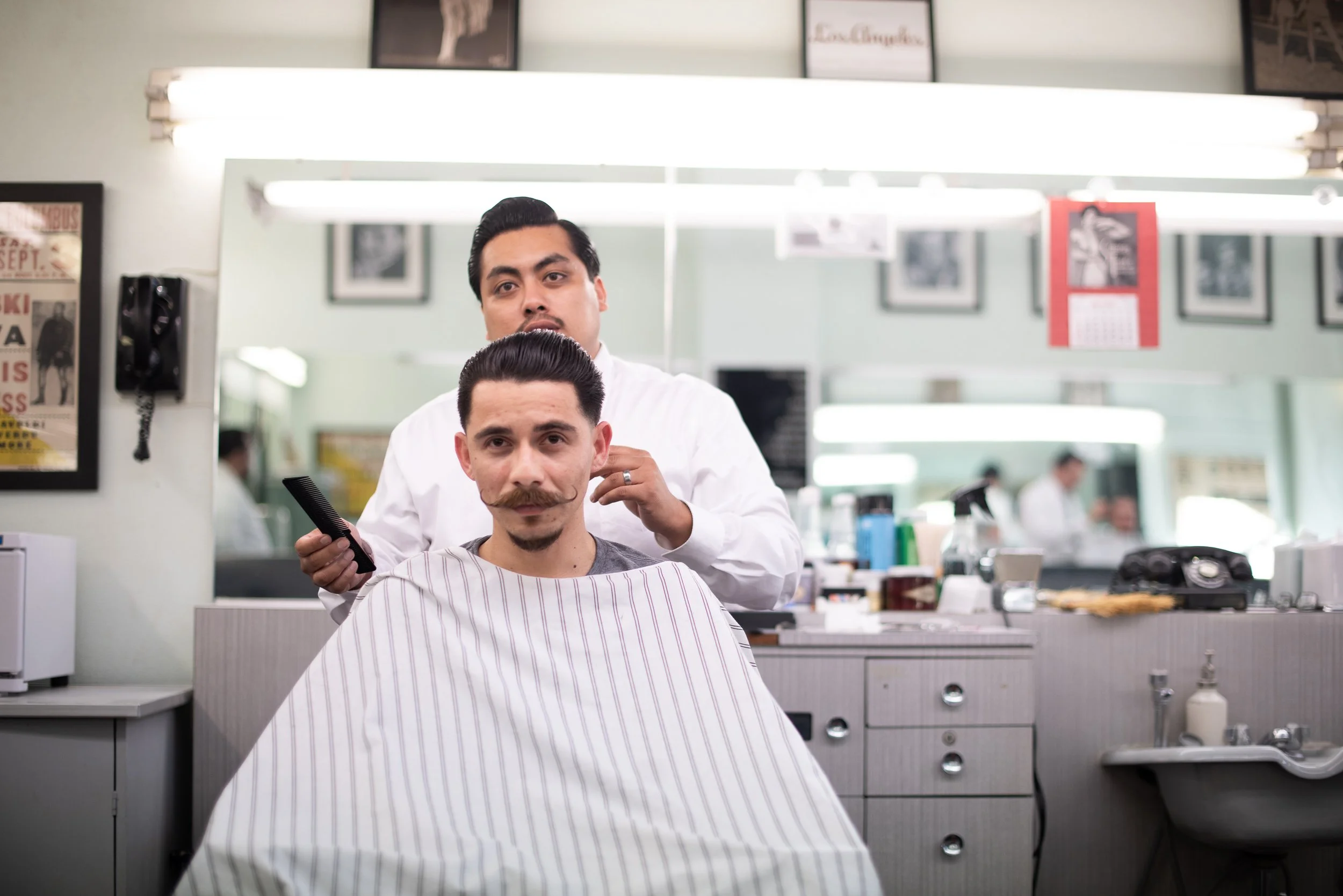
Click here to check out the book.  
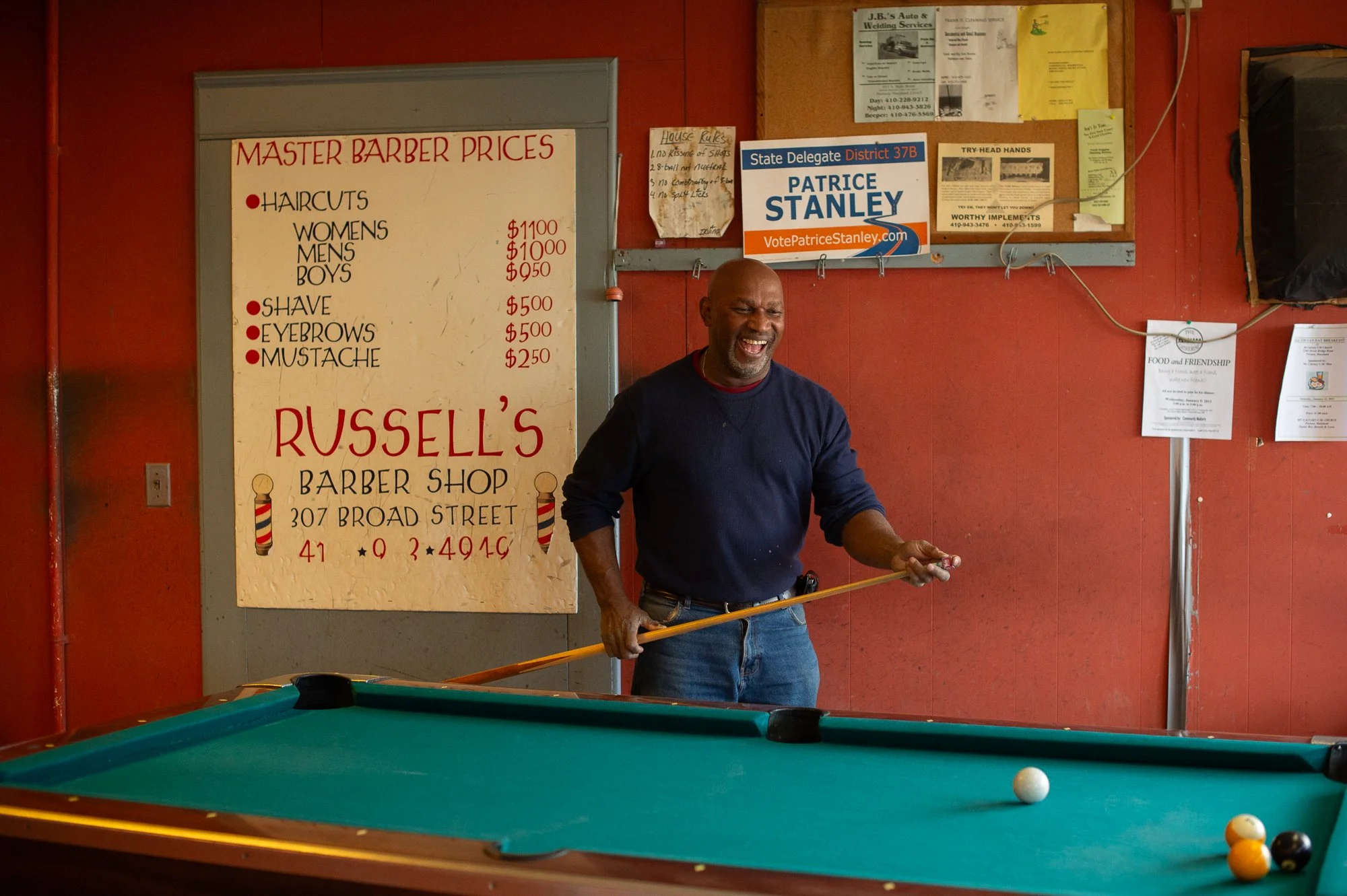
SD_FOB_18_Facebook_1200X628.jpg