Kreuz Market - Lockhart Texas

Texas BBQ - Photography - Food Culture

Kreuz Market - Lockhart - Texas BBQ Trail

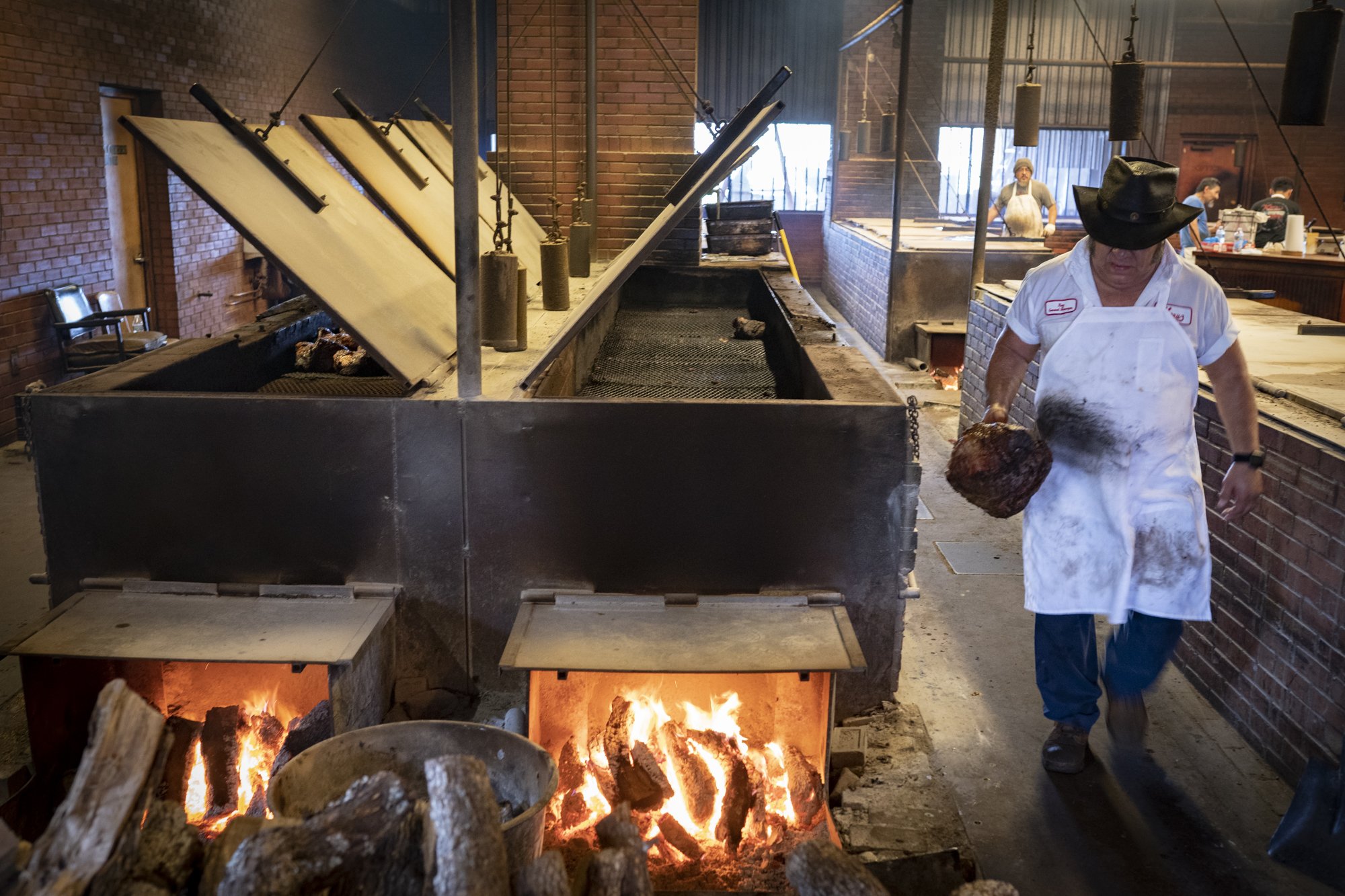
If you know BBQ, then you know Kreuz Market. They’ve been slinging world class BBQ since the early 1900’s in Lockhart, Texas. Which, some say is the BBQ capital of the world. Anyone that would argue otherwise is just a moron. In the span of a square mile (give or take) you can go to 3 top shelf BBQ joints with a handful of others also in the area. Aside from Kreuz, you’ve also got Smitty’s and Black’s. I’d personally vouch for all 3.

The list of photo books in my collection is vast and growing at an alarming rate. All of them are special to me for different reasons, but there are always a handful that any photographer/collector will keep going to back to over and over again. 2 of them for me are Wyatt McSpadden’s books on Texas BBQ. They are a beautiful documentation of the historic BBQ institutions all around the state. I’ve been obsessed with BBQ for quite a while not, but Wyatt’s books taught me a lot about the culture and where to focus my trips in order to get the best smoked meat. Obviously, Kreuz’s Market is on his shortlist.

Click HERE to see more from this ongoing series.

Smitty's Market - Lockhart, Texas

Legendary Texas BBQ at Smitty’s Market

If you love Texas barbecue long enough, you eventually find yourself in Lockhart. The state legislature crowned it the “Barbecue Capital of Texas,” and more recently Smithsonian singled out this little town, and its heavy-hitters like Smitty’s Market, Kreuz, and Black’s, as one of the best small towns in America to visit.

Smitty’s is the one I kept coming back to with my camera. Not because it’s shiny or modern, but because it feels like barbecue preserved in amber — smoke-stained, stubborn, and honest.

A Barbecue Story That Starts in 1948

The story of Smitty’s starts long before there was a sign on the door that said “Smitty’s Market.” In 1948, a butcher named Edgar “Smitty” Schmidt bought Kreuz Market, the old-school meat market and barbecue joint in downtown Lockhart.

For decades, that brick building on South Commerce was the beating heart of Lockhart barbecue. When the family eventually split in 1999, Smitty’s daughter, Nina Schmidt Sells, kept the original downtown building and reopened it as Smitty’s Market, keeping the fires, and the history, right where they’d always been.

That’s what you feel when you walk in: not just a restaurant, but a place that’s been seasoned by generations of smoke, grease, and conversations over butcher paper.

Walking the Long, Smoky Hallway

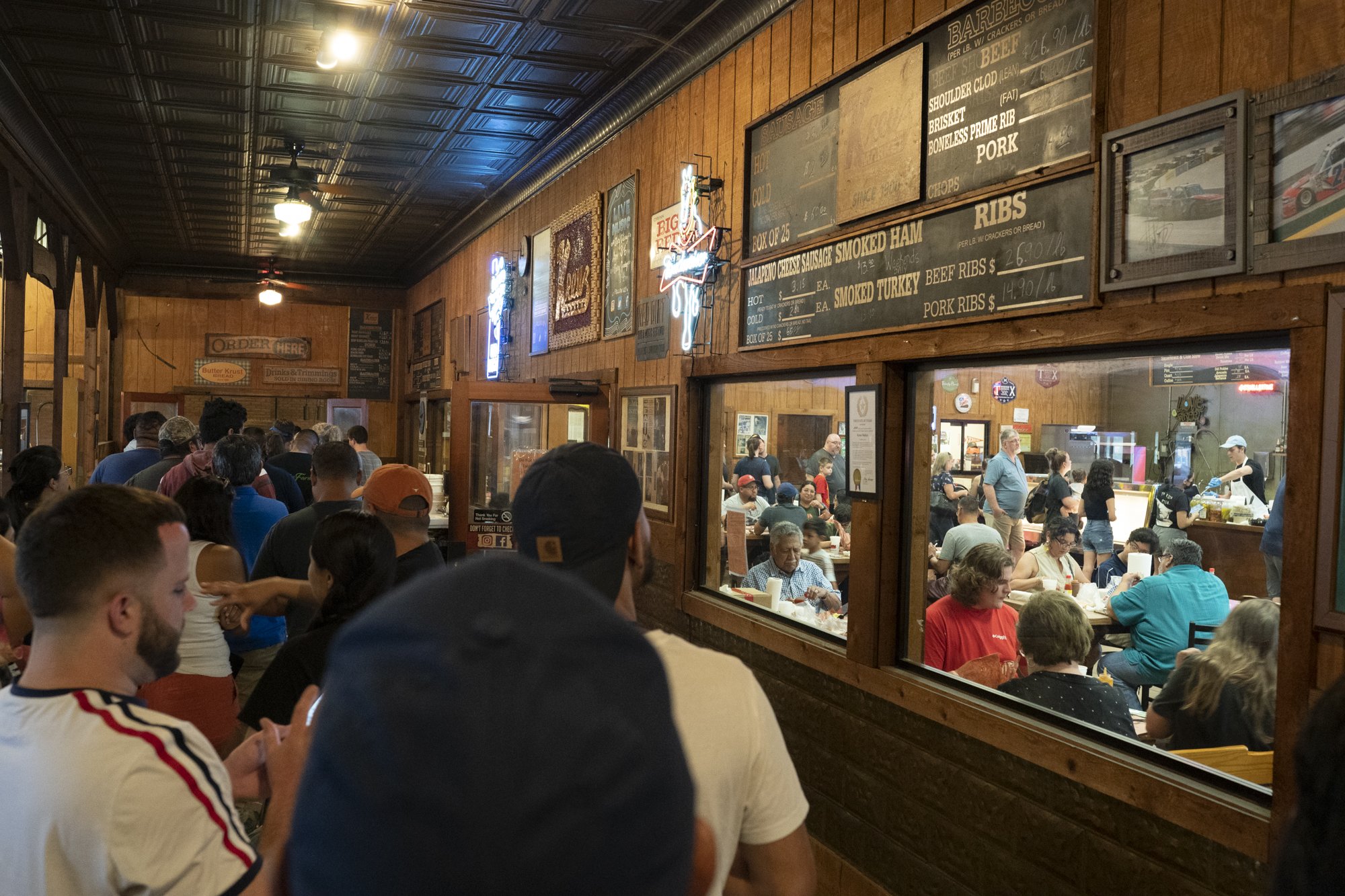
If you’ve been, you know the approach. You step in off the Lockhart square and into that long, dark hallway. The air is thick and warm, the floors worn smooth by decades of boot traffic, and the smoke hangs low like a permanent weather system.

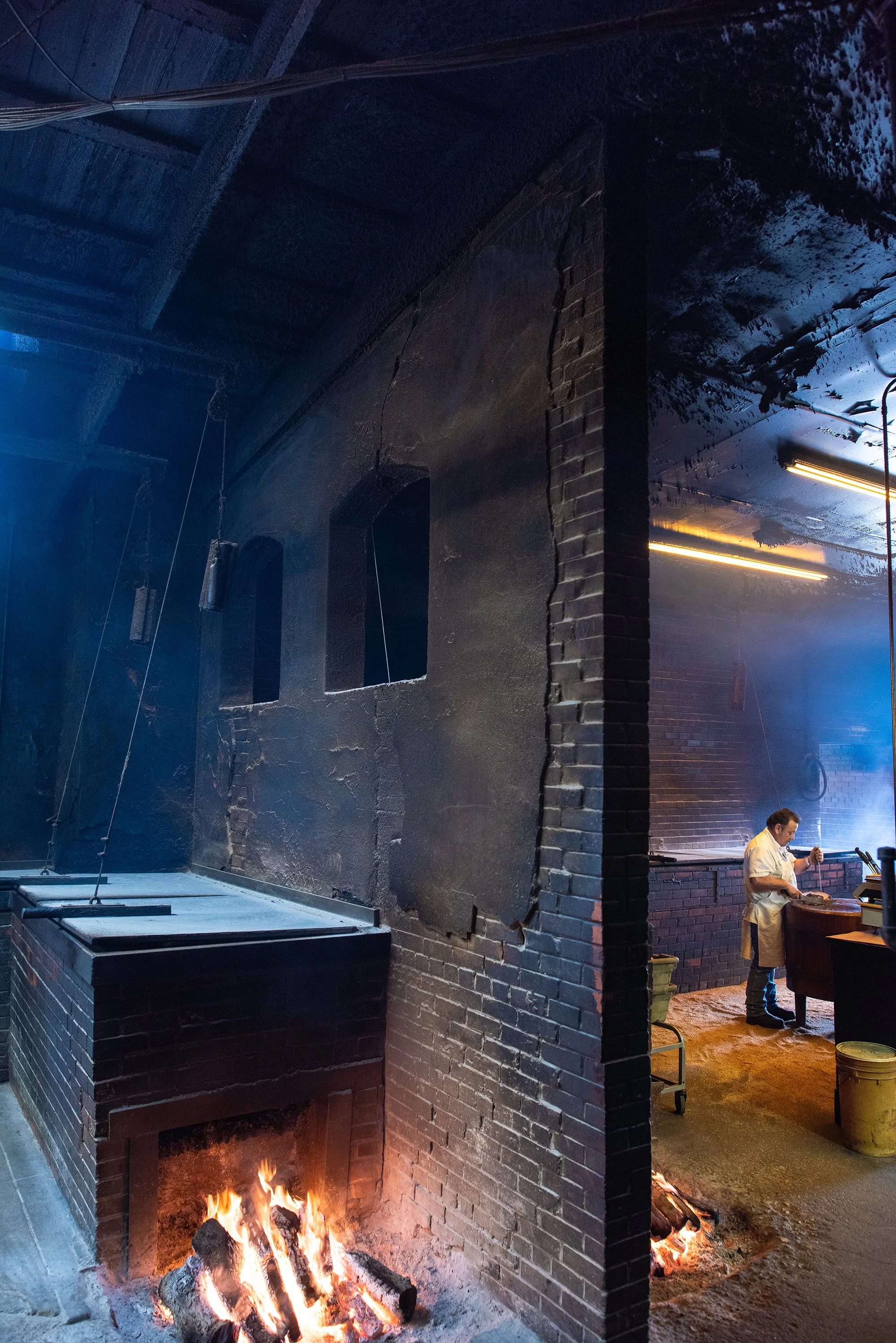
Follow your nose and the temperature climbs. Then the pits reveal themselves — massive brick beasts with open fires glowing on the floor, logs stacked and burning right beside the line. It’s dramatic and a little wild, and it’s part of why Smitty’s leaves such a mark on people.

In a world of spotless stainless-steel kitchens and carefully hidden cook lines, Smitty’s shows you everything: the fire, the coals, the meat, the sweat. You feel like you’re walking through the engine room of Texas barbecue.

What’s on the Butcher Paper

Smitty’s lives firmly in the Central Texas tradition: meat first, everything else second. No plates, no fuss. Your order arrives on butcher paper with maybe a stack of white bread, pickles, and onions if you’re doing it right.

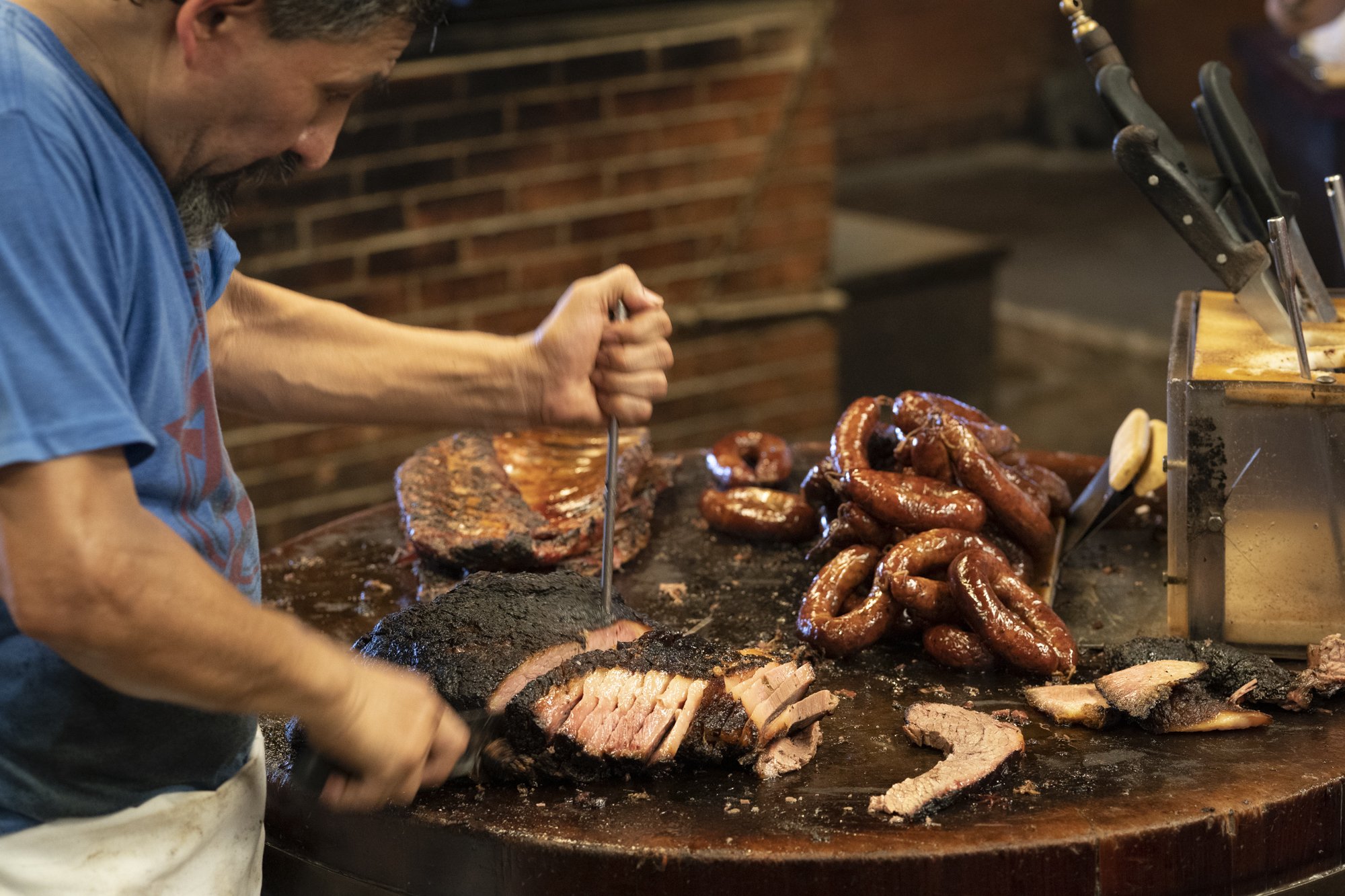
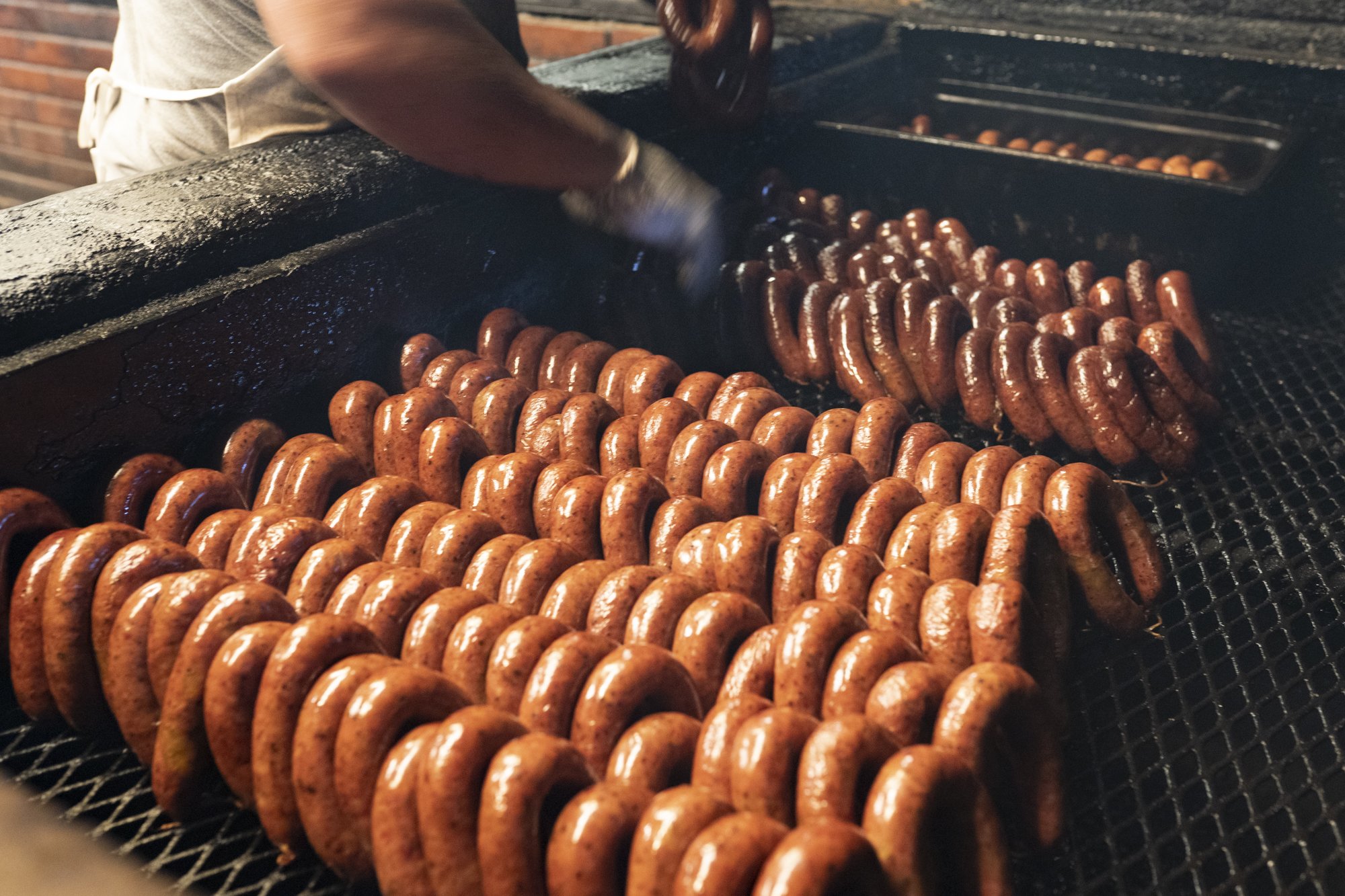
On any given day you’ll see brisket, prime rib, pork chops, ribs, smoked turkey, and, of course, those famous sausage links hitting the paper. The sausage, especially, has built a devoted following — peppery, smoky, with that satisfying snap when you bite into it.

Smitty’s cooking style is so emblematic of “old school” Central Texas barbecue that it’s been featured nationally — including on the Travel Channel’s Food Paradise as a go-to spot for slow-smoked brisket and signature sausage.

Like any legendary joint, opinions about the brisket can spark friendly arguments that last longer than the meal. Some folks swear it’s among the best in the state; others come mainly for the sausage and the atmosphere. But that’s barbecue — subjective, seasonal, and human.

Photographing a Living Time Capsule

Places like Smitty’s are why I haul cameras and lenses across Texas. The moment you step inside, you’re standing in a living time capsule:

  • The orange glow of the open fires against the dark pit room

  • Smoke curling through shafts of window light

  • Long tables packed with families, road-trippers, and locals in feed-store caps

  • Hands passing butcher paper, breaking bread, and building sandwiches in that very Texas way

My photographs from Smitty’s focus less on the close-up food porn and more on the world around it — the way the smoke stains the ceiling, the rhythm of people sliding through that hallway, the quiet concentration of the pitmen tending the fires. It’s the intersection of architecture, ritual, and appetite that makes this place feel like Texas in one room.

For me, Smitty’s isn’t just a stop on a barbecue tour; it’s part of a larger story about American spaces that refuse to modernize just because trends say they should. The pits, the hallway, the dining room — everything still carries the weight of 1948 and all the years since.

For Collectors, Editors, and Brands

If you’re a barbecue fan, I hope these photographs feel like stepping back into that smoky hallway — you can almost smell the oak and feel the heat on your face.

If you’re a collector, these Smitty’s Market images are available as fine art prints. They’re meant to hang in homes, restaurants, and offices as quiet reminders of what “real” Texas barbecue looks like when you strip away the marketing and leave only fire, brick, and tradition.

For editors, publishers, and brands working on stories about Texas, Lockhart, or the culture around barbecue, the images are also available for licensing — from wide environmental scenes that set the mood to tighter, more graphic frames from the pit room and dining area. They work equally well for travel features, restaurant coverage, or campaigns that want an authentic Central Texas feel rather than a staged set.

Why Smitty’s Still Matters

Lockhart’s barbecue landscape has changed over the years, but Smitty’s holds its ground as one of the core stops on what people call the Lockhart BBQ Trail — a lineup that includes Kreuz Market, Black’s BBQ, and other local institutions that keep the town worthy of its “Barbecue Capital” title.

Smitty’s isn’t trying to reinvent anything. The fires still burn in the old building on the square, the pits are still right there in your face, and the meat still hits butcher paper just like it has for generations.

That’s why I keep pointing my camera at it. In a state that’s constantly chasing the next big thing, Smitty’s Market is content to do what it’s always done: smoke meat, feed people, and let the walls slowly absorb another layer of history — one plate at a time.

If you’ve stood in that hallway, I hope the photographs bring you right back. And if you haven’t made it to Lockhart yet, consider this your nudge to go stand in the smoke for yourself.

If these photographs made you smell the smoke, take one home.
Prints and licensing inquiries are welcome — get in touch and I’ll help you find the right piece for your space or project.

Contact Rob
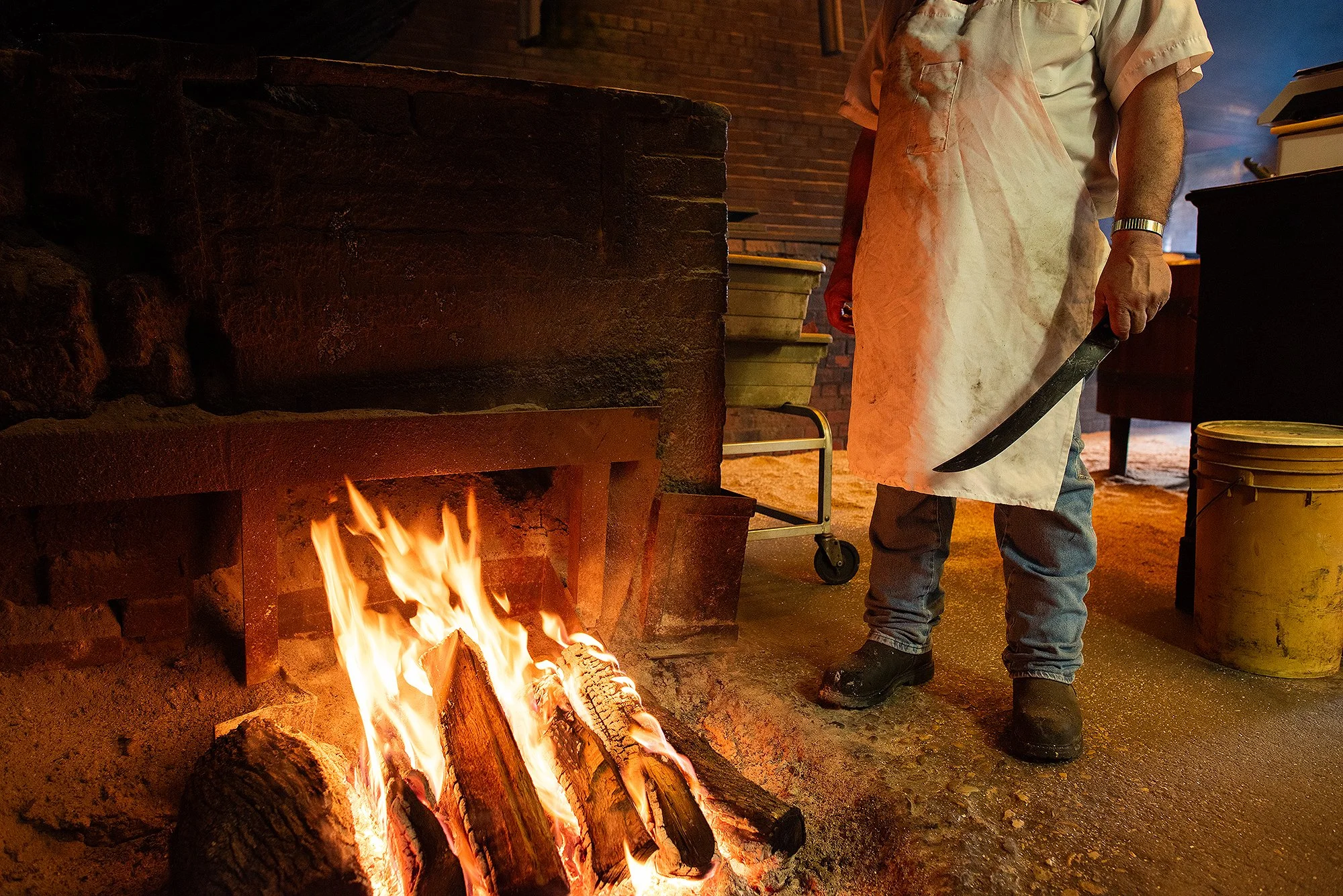
Open fire burning beneath the brick pits at Smitty’s Market in Lockhart, Texas, with a pitmaster working in the smoky room beyond.

Fire in the foreground, work in the distance — the heat, smoke, and rhythm that define a day inside Smitty’s Market.

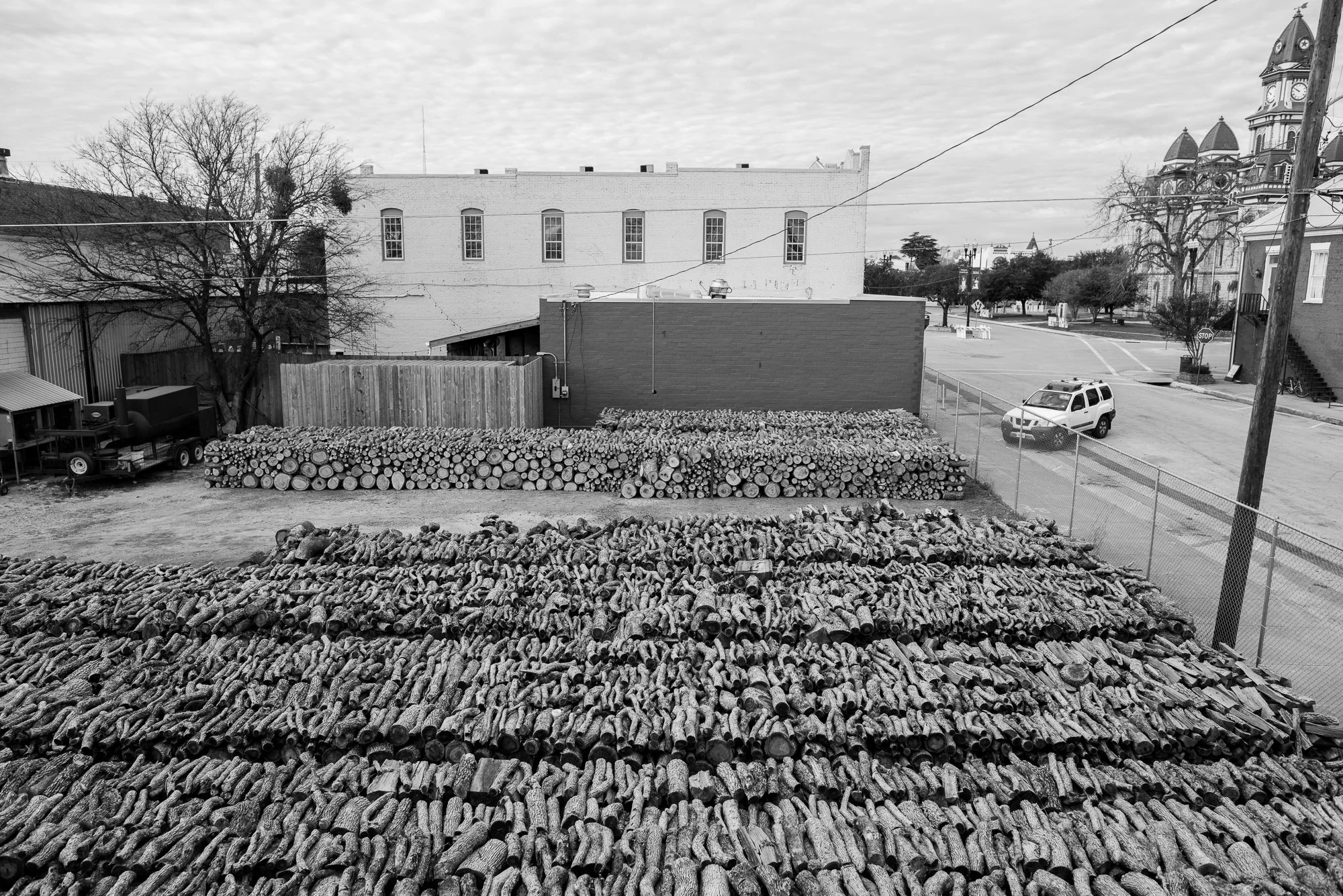
Large stacks of split oak firewood behind Smitty’s Market in Lockhart, Texas, used to fuel the legendary barbecue pits.

Stacks of oak firewood behind Smitty’s Market — the fuel that keeps the old brick pits alive every day.

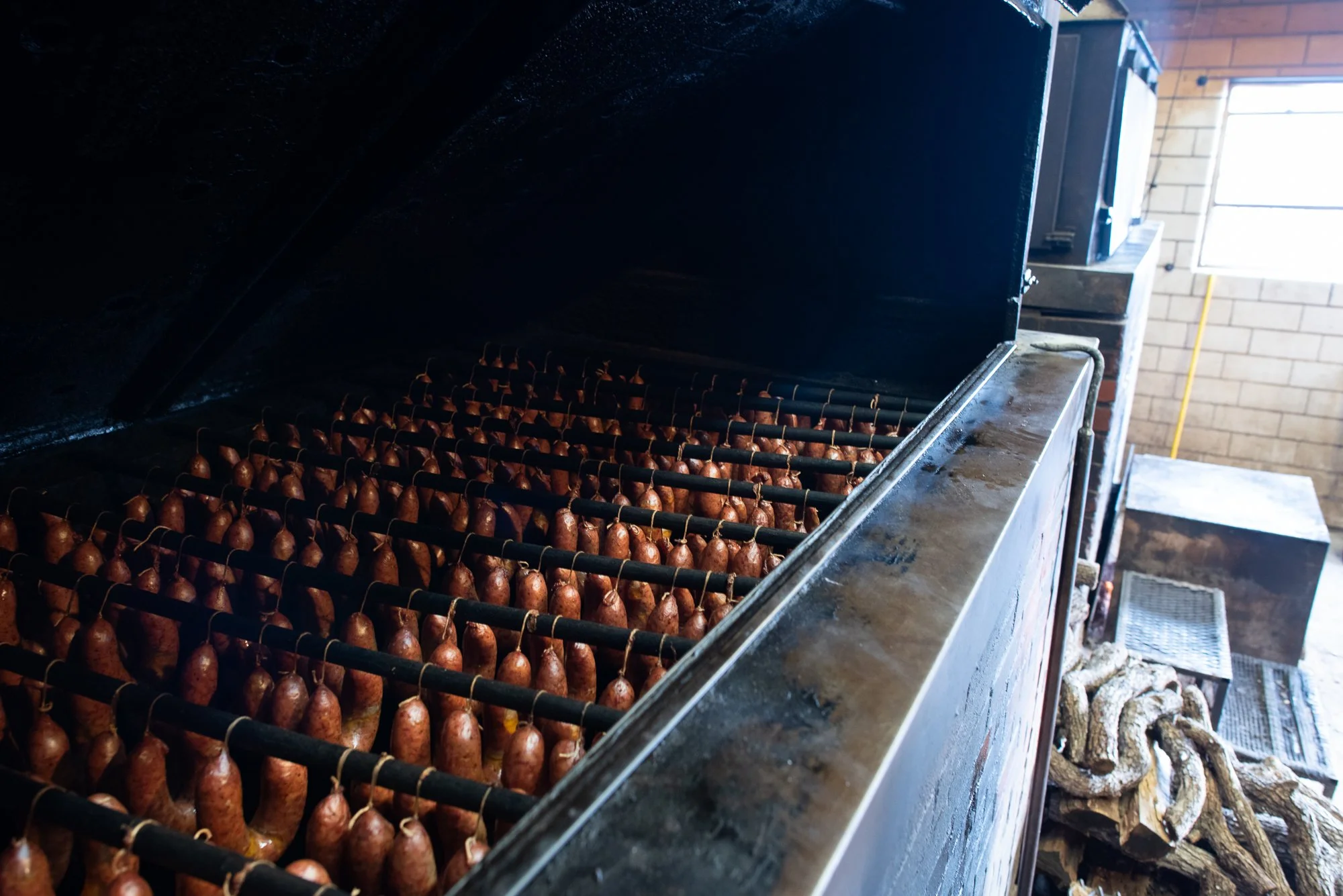
Rows of sausage links smoking inside one of Smitty’s Market’s historic brick pits.

Fresh links smoking low and slow inside one of Smitty’s historic pits.

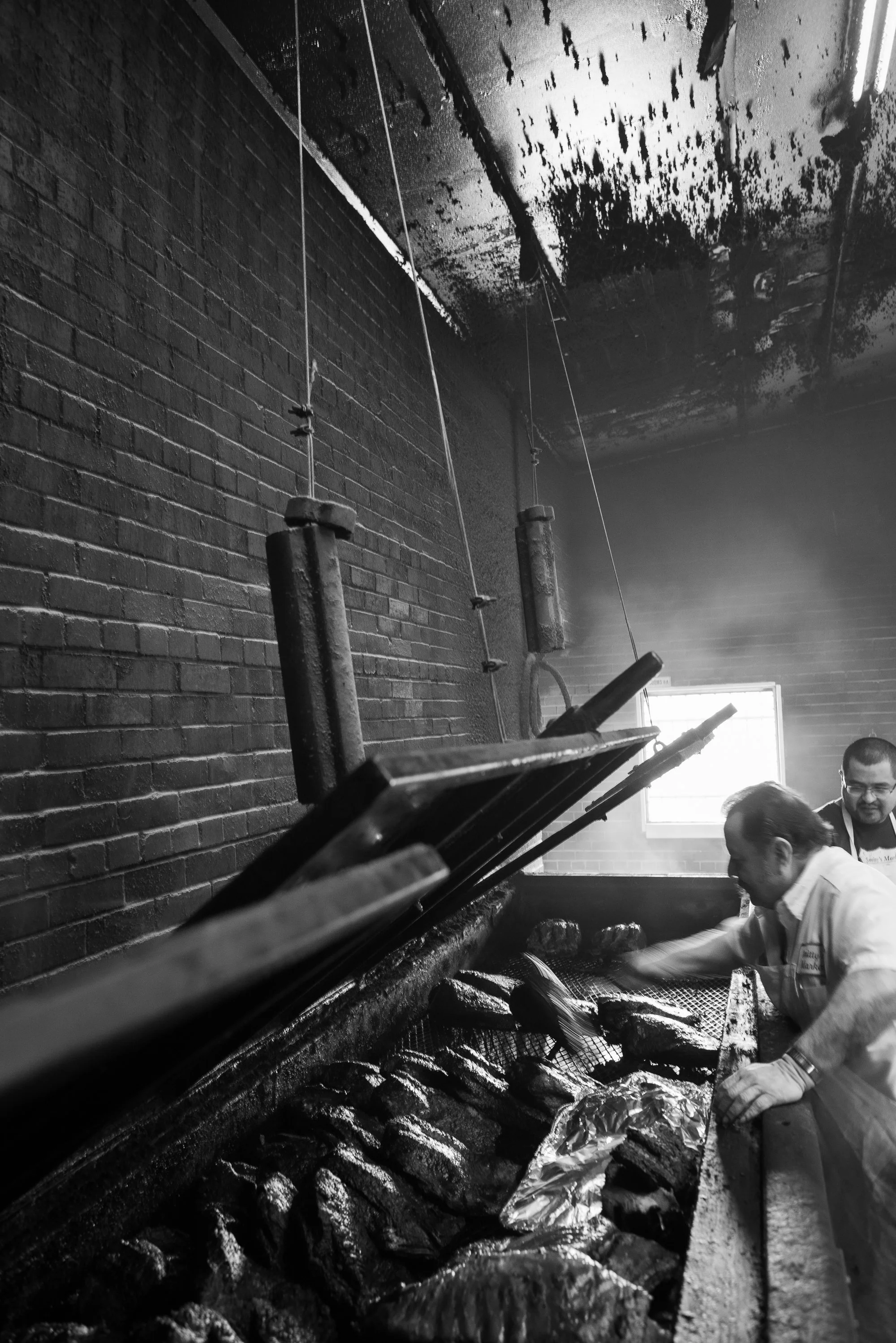
Smoke-blackened ceiling and brick walls above the pits at Smitty’s Market, with pitmasters tending brisket below.

The smokehouse above and below — decades of soot overhead and pitmen working the briskets beneath it.

Pitmaster standing beside an open fire at Smitty’s Market, holding a long carving knife.

The fire that starts it all — a pitman standing ready beside the flames that shape every bite.

Pitmaster tending the sausage pits at Smitty’s Market, surrounded by stacks of oak wood.

A Smitty’s pitman tending the sausage pits, surrounded by the oak that feeds the fires.

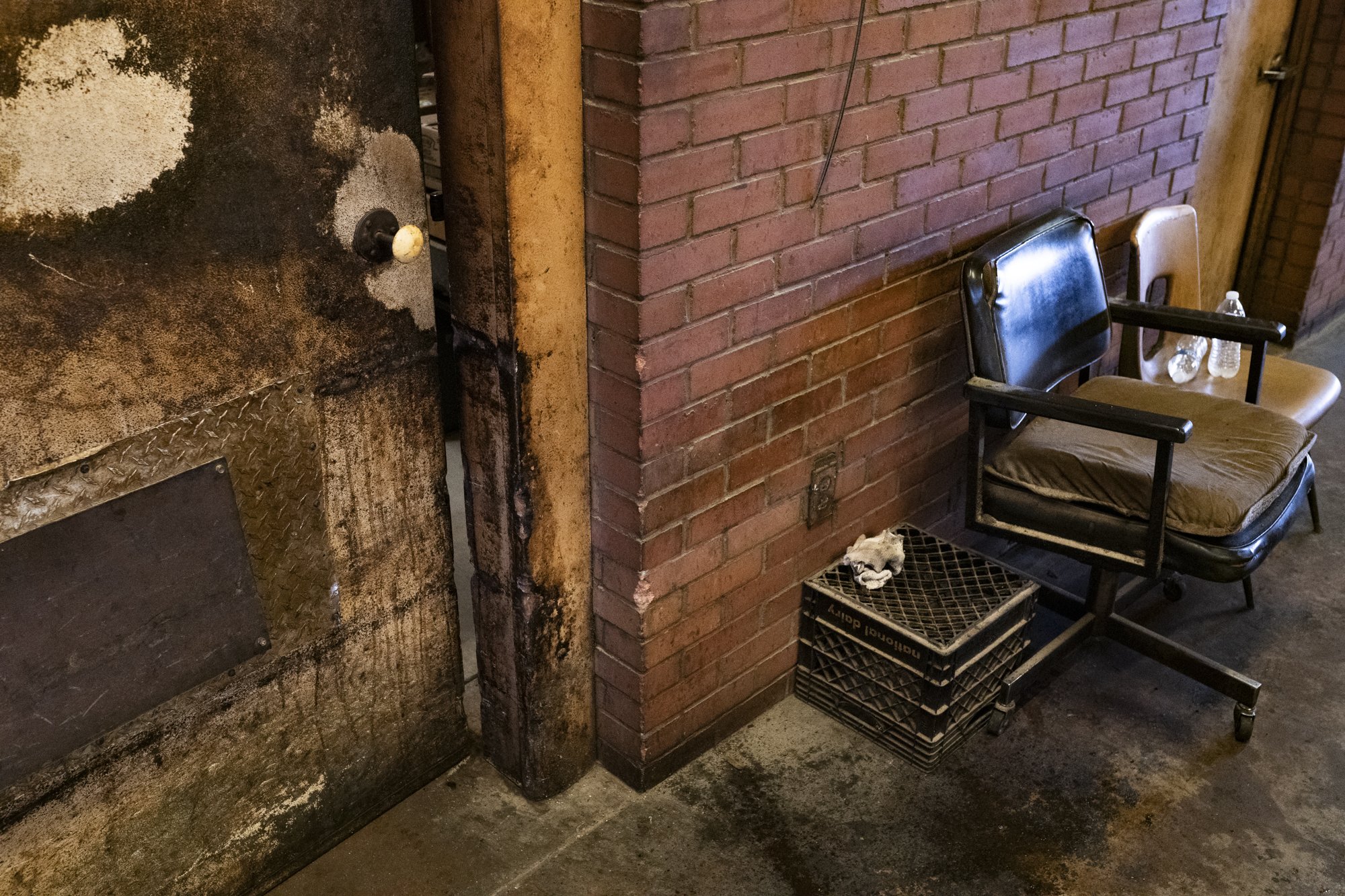
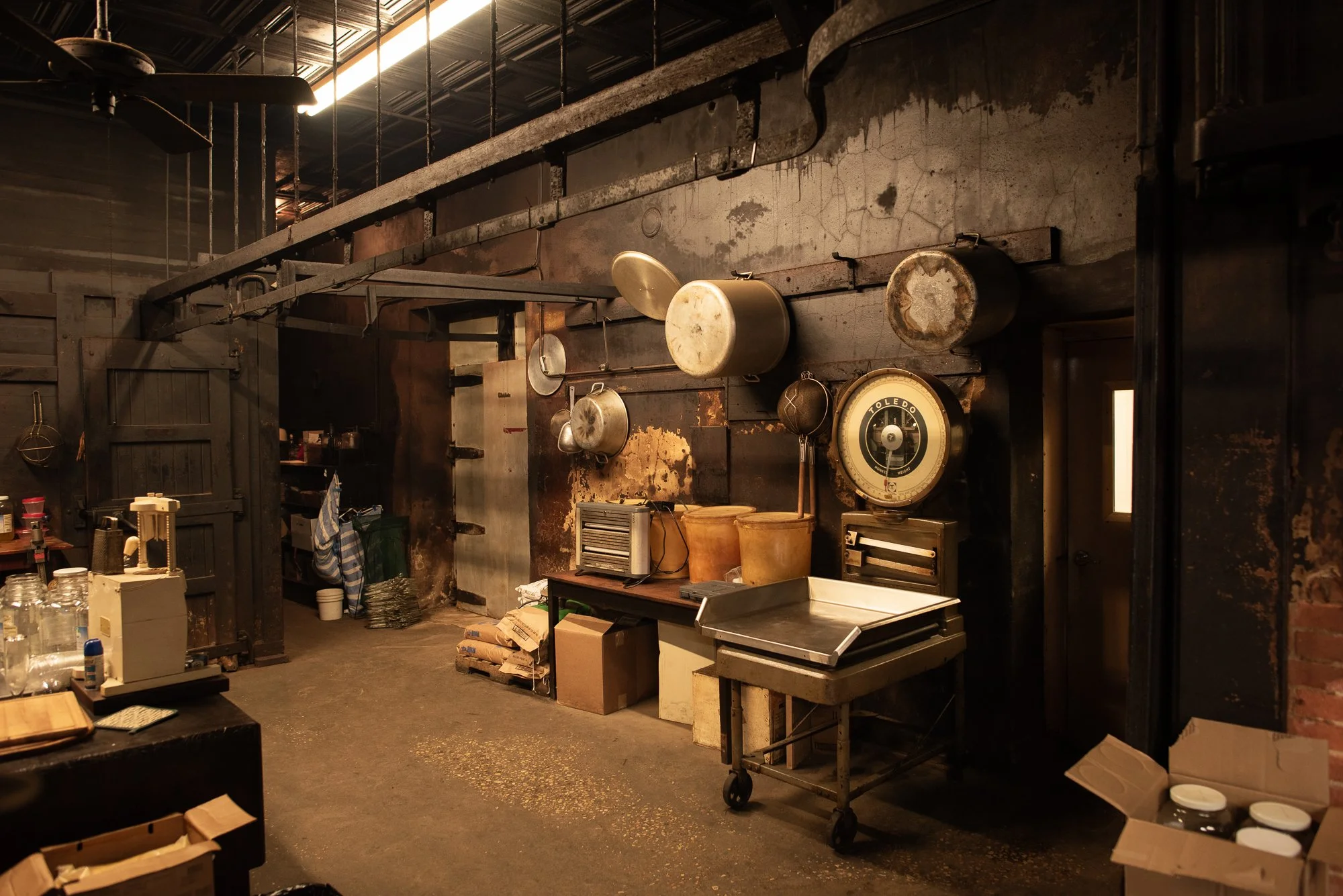
Old preparation room inside Smitty’s Market with pots, scales, and smoke-stained walls.

The back room at Smitty’s — decades of tools, textures, and smoke layered into the walls.

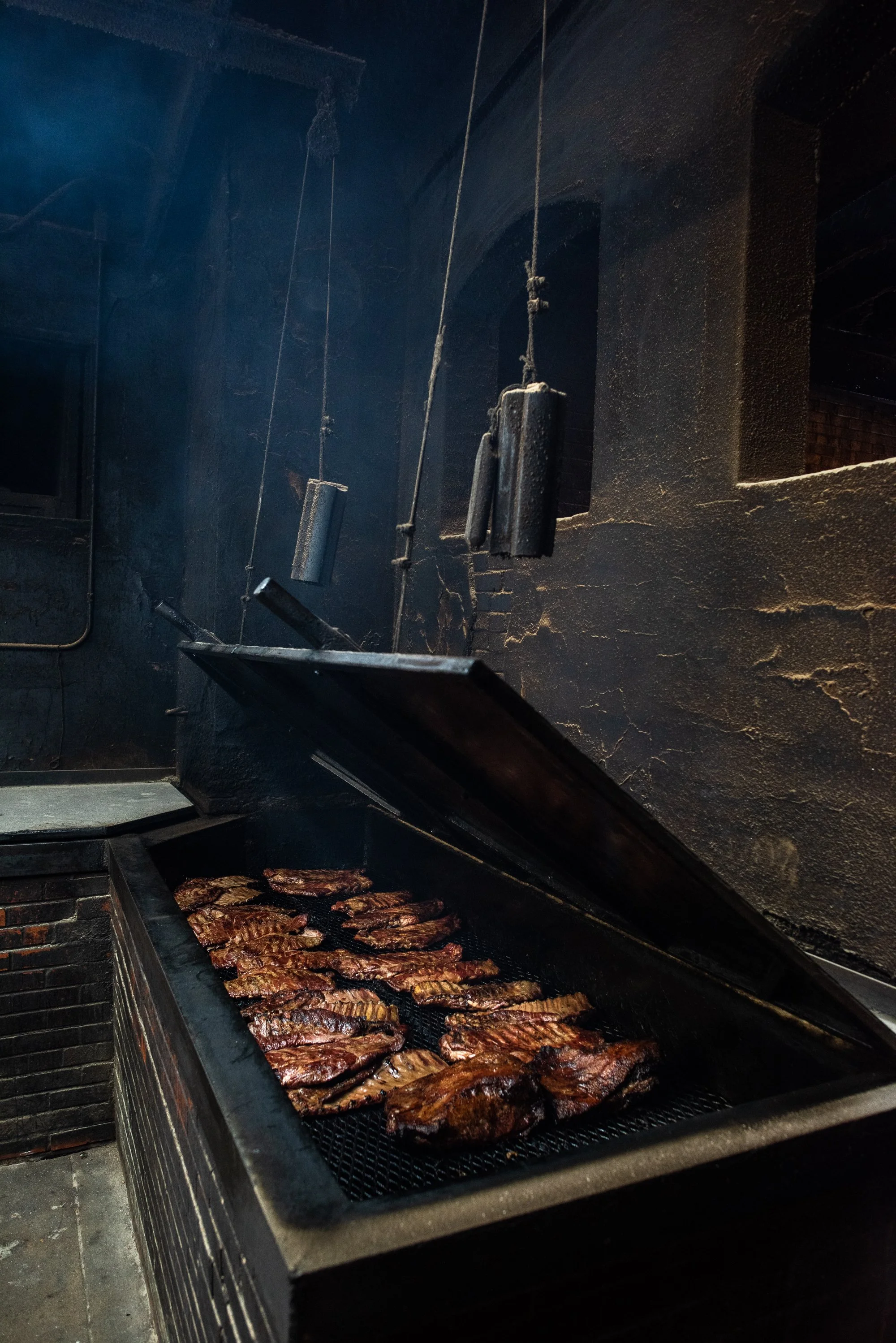
Smoked ribs cooking inside one of Smitty’s Market’s open brick pits, surrounded by rising smoke.

Ribs smoking over the open brick pits — heat, oak, and patience doing their work.

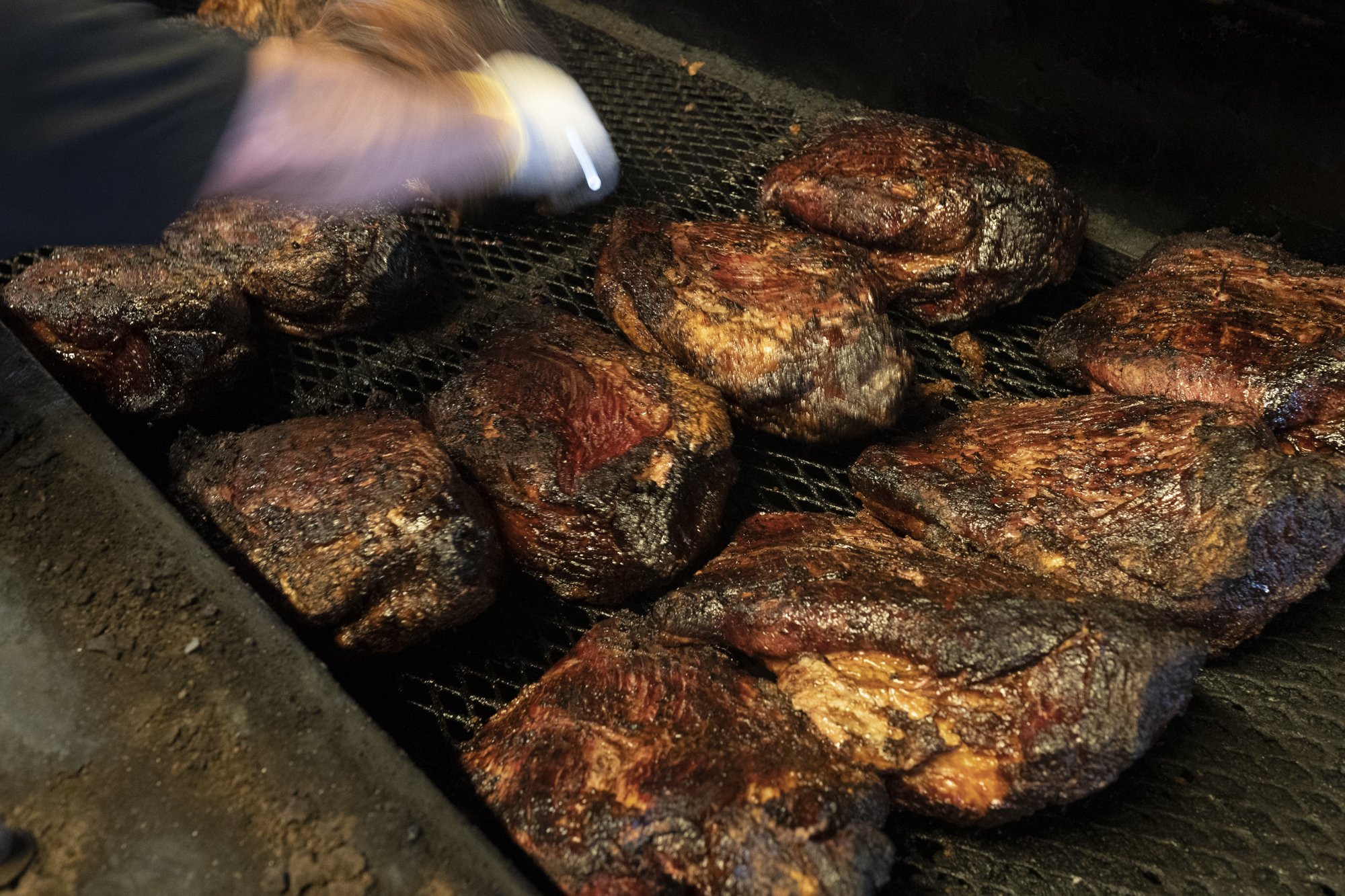
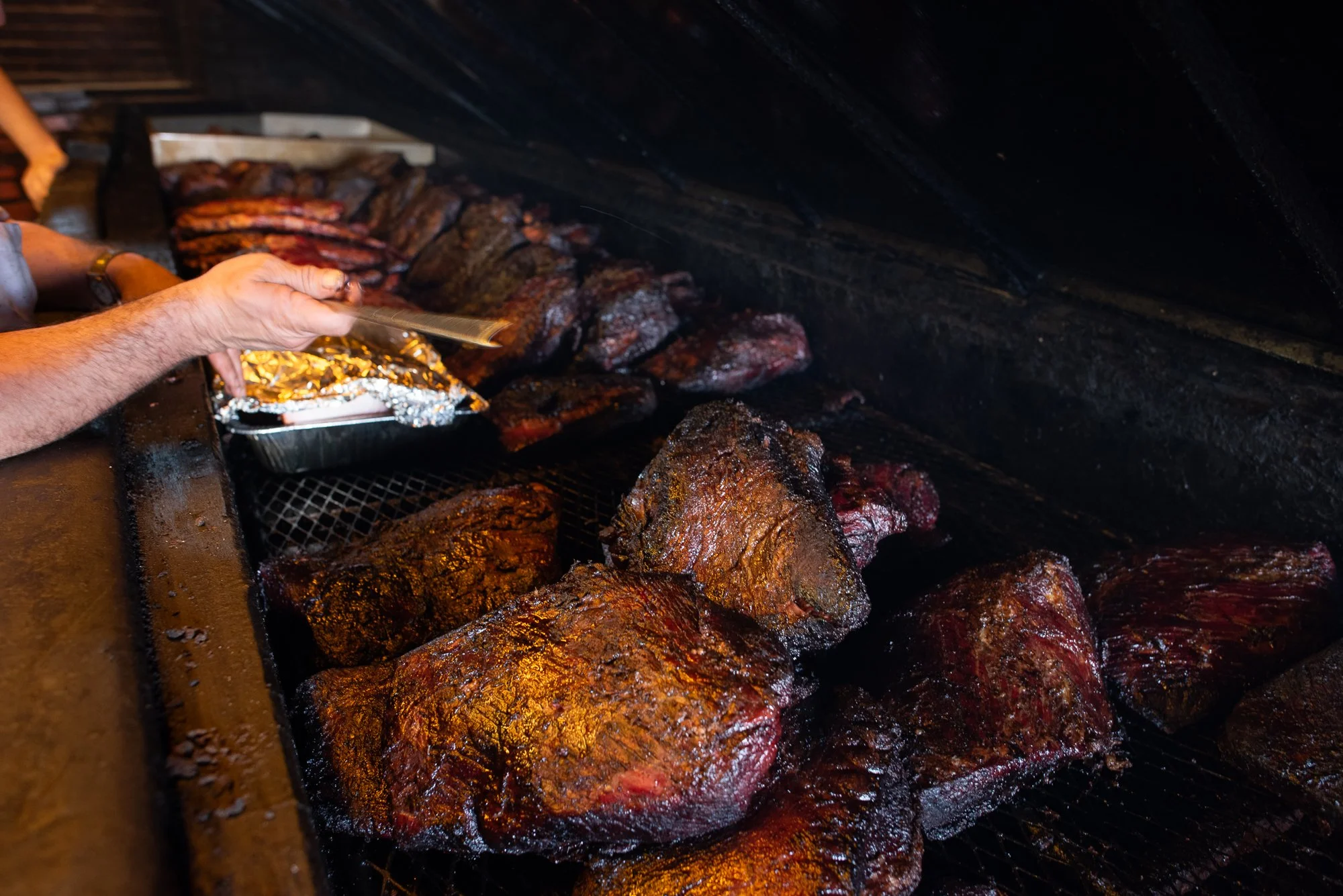
Pitmaster reaching across a pit full of briskets inside Smitty’s Market smokehouse.

A pitman working a full load of briskets inside the dark, smoky heart of Smitty’s.

Close-up of briskets sizzling on the pit at Smitty’s Market, showing bark, color, and smoke.

Briskets deep in the cook — bark forming, fat rendering, smoke wrapping around every surface.

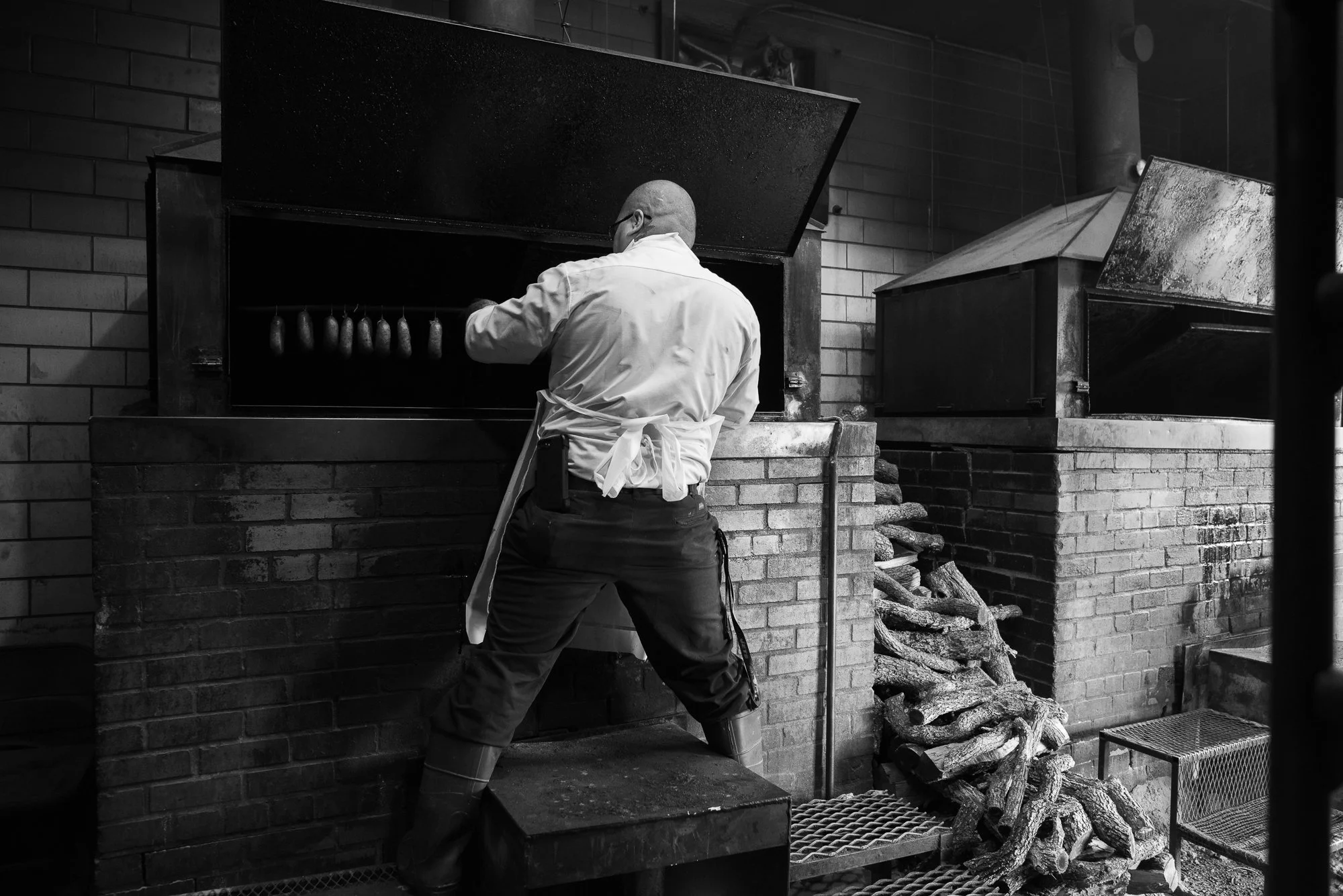
Pitmaster adjusting hanging sausage links inside the smokehouse at Smitty’s Market in Lockhart.

Checking the links inside the smokehouse — one of the daily rituals behind Smitty’s iconic flavor.